Beloved, let us love one another, for love is from God, and whoever loves has been born of God and knows God. Anyone who does not love does not know God, because God is love. In this the love of God was made manifest among us, that God sent his only Son into the world, so that we might live through him. In this is love, not that we have loved God but that he loved us and sent his Son to be the propitiation for our sins. Beloved, if God so loved us, we also ought to love one another. No one has ever seen God; if we love one another, God abides in us and his love is perfected in us.
—1 John 4:7-12
Today marks the 32nd annual National Coming Out Day, a cause for celebration and a time to look back on how far we’ve come. Some look forward to this day to take that big step for the first time and declare who they are to the world. But for many young LGBTQ+ people who are still questioning things, it is a time for quiet reflection and introspective exploration. The day was established to remind society about something positive in the LGBTQ+ community. If more people were aware of out and proud LGBTQ+ individuals living among them, then harmful stereotypes and laws affecting them would hopefully go away. Many hurtful stereotypes have already gone away due to the increased visibility of LGBTQ+ people in society. While LGBTQ+ people and issues are very much at the forefront of American culture today, days like this are still significant.
For every person that is out and proud in their sexual orientation or gender identity, countless others are afraid to share that information. They’re scared to share it because of fear of losing their homes, families, or jobs. Some people don’t come out because they don’t feel like their faith and their sexuality can coexist. Most Christians, myself included, grew up in a church where we were told, at the worst, that gay people are evil and going to hell, and at best (or most hypocritical), were welcome in the church, but not in leadership. Some will even claim they “hate the sin, but love the sinner,” which is a backhanded way of saying that being LGBTQ+ is wrong unless you conform to a heteronormative life. Why would any LGBTQ+ Christian come out in that environment? What does the coming-out process look like for LGBTQ+ Christians, especially when they do not feel safe, affirmed, or supported in their communities? LGBTQ+ Christians can be haunted by feelings of depression, despair, and thoughts of suicide as they try to reconcile their faith with their sexuality. These haunting thoughts are not something that God would want for His children.
Across the United States, LGBTQ+ Christians are coming out of the closet. For many of them, finding acceptance within the church can be a test of faith. Studies show that LGBTQ people of faith are often conflicted. According to a report from the Pew Research Center, many feel unwelcome within most major religions and are much less likely to identify as Christian compared to the general public. For many people who claim to be Christians, “homosexuality” is an issue, when it should not be. It is often considered a matter of “us” versus “them,” or worse, for LGBTQ+, a question of their behavior, not something intrinsic to their identity. A person cannot claim to love someone if they do not accept who that person is. Being LGBTQ+ is not a lifestyle, nor is it a choice. God created us in His image. “Anyone who does not love does not know God, because God is love.” (1 John 4:8) Christians cannot have it both ways, you either love a person or don’t and if you don’t accept a person, you do not love them. And, if you do not love them, then you do not know God. It is a pretty simple and straightforward concept.
I learned pretty early that, as an LGBTQ+ Christian, I am like a unicorn—something people have heard of but never quite seen in person. However, we are here, we are real, and we don’t navigate this journey without our own unique set of problems. I know so many that have lost their relationship with God and/or the church, not because they no longer believed, but because doing the work to free themselves from oppressive things like patriarchy and shame also allowed them to recognize the space that those same concepts occupy within religion. But as a person raised in the Church of Christ, the idea of divorcing myself from my relationship with God and my Christian upbringing seemed unrealistic.
In church, the preachers always say, “don’t just listen to me, study for yourself!” We are consistently taught to read the Bible, so we can truly understand the meaning behind the scripture for ourselves. This concept of studying is indeed the first step toward freeing yourself from religious oppression. To “rightly divide” means to adequately define what the words that you are reading mean. Biblical texts have been used to oppress. We have to deconstruct those texts for their actual meaning and apply those meanings to our lives.
Many lean on the Old Testament’s heavy-handed stories as a reason to take away love, rights, and justice from anyone they do not like. But Christ himself showed that his message was completely different from those negative messages. He loved marginalized people, underprivileged people, and people seen as unworthy by “high class” individuals. He was here for those going through tough times and living their truth even more because those were the ones that, more often, showed true love towards him. The Bible reaffirms that God loves us and created us just as we are.
I took the time to deeply examine what Christ asks of me instead of what church members asked to remember that my choice to have a relationship with Christ is personal. It is not defined by or bound to church or organization. A church is more than just a building or the group of people that gather in that building. Church is perspective and action. My relationship with God makes me feel good. It teaches me about love, charity, hope, faith, joy, strength, and peace. I chose to let those lessons provide me with a path to a more spiritually fulfilled life.
I grew up with people who were often looking down on others, taking notes of all the bad things that they did, and that was especially true of judgmental Christians. The entire church community of Christians where I grew up watched for opportunities to correct, judge, or shame you for living outside of the boundaries they have set. In deciding to study for myself, I had to be willing to take on the burden of releasing fear, shame, and conviction. I would have to believe in myself and not allow myself to be hurt or offended when homophobic Christians rejected me. It’s a tough thing to do because we all hate rejection, but we need to rid our lives of toxic individuals who would reject you for who you are.
Our spirituality is a personal decision and a relationship between God and us. The problems arise when outsiders try to create barriers and rules based on their own biases, prejudices, and ignorance. It takes just a few extra steps to learn that if you allow your heart and mind to step outside of the physical walls of organized religion, you will see that at its root is love and peace. If you have already pulled off the layers of historical oppression, then you have already started the process of defining exactly how to navigate it authentically for yourself.
Brethren, if a man is overtaken in any trespass, you who are spiritual should restore him in a spirit of gentleness. Look to yourself, lest you too be tempted. Bear one another’s burdens, and so fulfil the law of Christ. For if anyone thinks he is something, when he is nothing, he deceives himself. But let each one test his own work, and then his reason to boast will be in himself alone and not in his neighbor. For each man will have to bear his own load.
—Galatians 6:1-4
No Christian should think of themselves as more pious or superior than any other person. We are all children of God, and we are all unique in our way. We are called to love one another with affection; to be kind, compassionate, hospitable, and gracious towards one another—forgiving one another and honoring each other above ourselves. Christians have the uncanny ability to turn on one another at the very time when they are needed most. For many LGBTQ+ individuals, we are most vulnerable when we come out. We never know how someone is going to react. For some of us, we know it’s going to go badly like it did when my mother found out I was gay. For others, we hope they will react with love and kindness. Sometimes, we get the opposite of what we expect, which can be good or bad. For many of us, that means our sexuality is rejected by the person to whom we came out. It is our most vulnerable moment, and all too often, people use the Bible as a reason to reject us. When we need them most, they act the most unchristian.
Legalists and biblical literalists apply the law more harshly toward others than toward themselves. They concentrate on their strengths and others’ weaknesses. Thus the scribes and Pharisees were ready to stone the woman guilty of adultery (John 8:2-11), yet they were insensitive to their breaches of the law by taking advantage of the helpless, the neglect of their responsibilities to their own families, or their persecution of the righteous. In their desire to maintain at least the appearance of severity toward sin, those with a strict interpretation of the Bible during Paul’s time had become calloused and even cruel toward those who had stumbled in their Christian walk. Paul put it this way in Romans 12:3, “For by the grace given to me I bid every one among you not to think of himself more highly than he ought to think, but to think with sober judgment, each according to the measure of faith which God has assigned him.” Excessive adherence to law has no interest in reducing the burdens which we must endure. Instead, it produces limitations and then a refusal to assist those on whom they are imposed. Jesus contrasted Himself with the scribes and Pharisees with respect to burdens.
When correctly carried out, Christian love bears one another’s burdens and can cover a multitude of sins. Christian love seeks to encourage one another towards living true and experiencing spiritual growth, and Paul gives us biblical guidance on what to do when others are in trouble or needs help. First, we are to be sure that we look at ourselves before we judge others. John 8:7 says, “…“Let him who is without sin among you be the first to throw a stone…” I know it is cliché, but we must ask ourselves, “What would Jesus do?” because we should do our best to emulate Jesus which means treating each other in a spirit of gentleness and love.
We should take the time to make an honest analysis of our own lives, instead of merely comparing ourselves to the people around us. Then, we can truly enjoy what we see God accomplishing through us, in real humility. Paul’s use of the word “boast” is not about bragging or a sinful pride in ourselves. It’s about honest measurement of what is right. It is what makes us unique. Frida Kahlo once said, “I used to think I was the strangest person in the world, but then I thought there are so many people in the world, there must be someone just like me who feels bizarre and flawed in the same ways I do. I would imagine her, and imagine that she must be out there thinking of me too. Well, I hope that if you are out there and read this and know that, yes, it’s true I’m here, and I’m just as strange as you.” As LGBTQ+ Christians and our allies, we may seem strange to those who excessively adhere to a literal interpretation of the Bible. When another Christian judges us because we do not fit their image of a perfect Christian, they are not following the teachings of Jesus but are being hypocrites.
And seeing the multitudes, He went up on a mountain, and when He was seated His disciples came to Him. Then He opened His mouth and taught them, saying:
“Blessed are the poor in spirit, For theirs is the kingdom of heaven. Blessed are those who mourn, For they shall be comforted. Blessed are the meek, For they shall inherit the [a]earth. Blessed are those who hunger and thirst for righteousness, For they shall be filled. Blessed are the merciful, For they shall obtain mercy. Blessed are the pure in heart, For they shall see God. Blessed are the peacemakers, For they shall be called sons of God. Blessed are those who are persecuted for righteousness’ sake, For theirs is the kingdom of heaven.
Blessed are you when they revile and persecute you, and say all kinds of evil against you falsely for My sake. Rejoice and be exceedingly glad, for great is your reward in heaven, for so they persecuted the prophets who were before you.
—Matthew 5:1-12 (NKJV)
Kurt Vonnegut, an atheist and a humanist, is not someone I usually look to for religious views. He never showed disdain for those who sought the comfort of religion but instead acknowledged church associations as a type of extended family. Vonnegut proclaimed he was a “Christ-worshipping agnostic” and sometimes called himself a “Christ-loving atheist.” Vonnegut was an admirer of Jesus’ Sermon on the Mount, particularly the Beatitudes, and incorporated it into his principles. In his 2005 essay collection, A Man Without a Country, Vonnegut wrote:
“For some reason, the most vocal Christians among us never mention the Beatitudes (Matthew 5). But, often with tears in their eyes, they demand that the Ten Commandments be posted in public buildings. And of course, that’s Moses, not Jesus. I haven’t heard one of them demand that the Sermon on the Mount, the Beatitudes, be posted anywhere. “Blessed are the merciful” in a courtroom? “Blessed are the peacemakers” in the Pentagon? Give me a break!”
Vonnegut has a very valid point. In 2003, Roy Moore, then Alabama Supreme Court Chief Justice (for the first time), installed a 5,280-pound granite block monument (that broke the floor) of the Ten Commandments in the rotunda of the Alabama Judicial Building in the dead of night (done without the consent or knowledge of the eight associate justices and later caused him to be removed from office for the first of two times). Moore never mentioned the Beatitudes, the basis of Christ’s message, but instead focused on the Ten Commandments. Moore’s actions over the years clearly show that he does not follow the Beatitudes. He prefers media attention to faith. As Governor Kay Ivey’s spokeswoman said last week when asked about Moore filing a lawsuit against Ivey over the mask mandate in Alabama, “It appears this is another attempt to garner some press attention.” Moore is known more for his hate and outrageous statements and actions than for his devout Christianity, which he apparently does not possess.
The United States would be a better place if Christians followed the message of Jesus and did not pick and choose only from the sections of the Bible they want to follow and ignore those they deem inconvenient. Just as Trump supporters pick and choose what they want to believe about him and his policies, the conservative Christian Right picks and chooses what they want to follow of the Bible. Trump is doing the same thing with the Constitution. I have no idea where Trump gets inspiration and comfort, but I don’t believe it is the Bible, or he would be a very different person. He seems to lack all morals, and he is too erratic to have a foundation for his ever-changing belief.
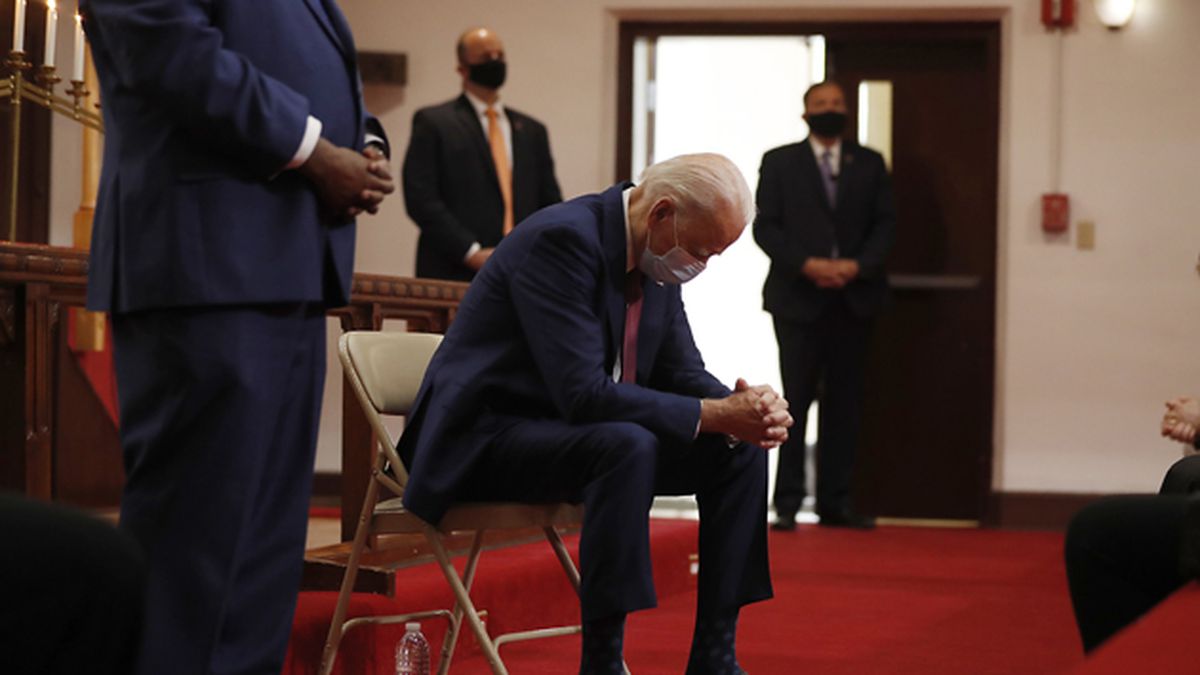
In contrast, when Joe Biden seeks inspiration and comfort, he turns to his faith. His speeches are woven with references to God and biblical language. When Biden spoke to the faith-based anti-poverty group the Poor People’s Campaign, he described the United States under President Trump as a “nation in the wilderness.” Biden told the group, “All of you remind me of how Scripture describes a calling born out of the wilderness. A calling to serve, not to be served. A calling toward justice, healing, hope — not hate. To speak the good news and followed by some good deeds. It’s not just enough to speak the good news, but good deeds.”
This wasn’t a one-off religious reference; this is how Biden routinely speaks. He launched his candidacy by referring to his campaign as a “battle for the soul of the nation.” It was the central theme of his primary run and remains a core belief of his campaign. If elected, Biden would become only the second Catholic president in American history. It’s not a detail he highlights, but people who know him well say his Catholic faith is central to how he sees the world.
Biden carries a rosary in his pocket and attends Mass every Sunday, while Trump plays golf. Trump supporters dismiss Biden’s faith even though he is described by all who know him as a deeply devout person of faith. Ironically, even though we have a president who has shown no sign of being a Christian, especially a deeply devout one, Biden will likely lose the states in the Bible Belt. Biden has framed this election as a clear moral contrast between Trump and himself, but many of Trump’s supporters see Biden as amoral only because he is a Democrat. However, Biden is running perhaps the most overtly devout Democratic presidential campaign since Jimmy Carter in 1976.
During Holy Week this past spring, the campaign released a video in which Biden spoke about faith seeing best in the dark, juxtaposed with images of the coronavirus pandemic. And when he delivered a eulogy for George Floyd and called for racial justice, he spoke of growing up with a Catholic social doctrine that taught him “faith without works is dead.”
Biden’s faith informs his values, and, in turn, his values shape his politics. Biden focuses on faith, rather than religious doctrine; he prays with voters, rather than proselytizes. And yet for some religious conservatives, all of that pales in comparison to the single issue of abortion. Trump has tried to portray Biden as a heathen. Last month the president attacked the Democratic nominee for being a man “against God.” And more broadly, Trump and his supporters have made religion a cultural issue, painting Democrats as the party against religious freedom. The struggle for Trump in defining Biden as a godless man is that Biden’s faith has been in public view for decades.
To heal the United States, we need a president that believes in the tenets of the Beatitudes. We need someone who believes “faith without works is dead.” James 2:14-17 says:
What does it profit, my brethren, if someone says he has faith but does not have works? Can faith save him? If a brother or sister is naked and destitute of daily food, and one of you says to them, “Depart in peace, be warmed and filled,” but you do not give them the things which are needed for the body, what does it profit? Thus also faith by itself, if it does not have works, is dead.
For four years, Trump has relentlessly pursued an economic agenda that rewards wealth over work and favors multinational corporations over small businesses. But middle-class Americans have been largely left out. Trump has not only refused to deliver for struggling working families; he is now pushing for another misguided tax giveaway for America’s wealthiest families. That’s the fundamental difference between Trump and Biden — Trump is focused on further enriching billionaires like himself, while Biden wakes up every day asking how he can help the middle and lower classes in America.
Biden cares about the weakest among us, those who are in the most danger. It is a moral failing and a national shame when children are separated from their parents and locked away in overcrowded detention centers, where the government seeks to keep them there indefinitely. It’s shameful when President Trump uses family separation as a weapon against desperate mothers, fathers, and children seeking safety and a better life. It’s disgraceful when children die while in custody due to a lack of adequate care. Trump has waged an unrelenting assault on our values and our history as a nation of immigrants. Leviticus 19:33-34 says, “And if a stranger dwells with you in your land, you shall not mistreat him. The stranger who dwells among you shall be to you as one born among you, and you shall love him as yourself; for you were strangers in the land of Egypt: I am the Lord your God.” This is a recurring theme for the ancient Hebrews. They were told to remember their treatment/enslavement by the Egyptians and not do the same for foreigners in their territory.
Unless your ancestors were native to these shores, or forcibly enslaved and brought here as part of our original sin as a nation, most Americans can trace their family history back to a choice–a choice to leave behind everything that was familiar in search of new opportunities and a new life. Biden understands that is an irrefutable source of our strength, like the original, though unofficial, motto of the United States says, “E pluribus unum”—out of many, one. Generations of immigrants have come to this country with little more than the clothes on their backs, the hope in their hearts, and a desire to claim their piece of the American Dream. It’s why we have been continuously able to renew ourselves, grow better and stronger as a nation, and meet new challenges. Immigration is essential to who we are as a nation, our core values, and our aspirations for our future. Biden will assure that we never turn our backs on who we are or what makes us uniquely and proudly American. The United States deserves an immigration policy that reflects our highest values as a nation.
The challenges we face will not be solved by a constitutionally dubious “national emergency” to build a wall, separate families, or deny asylum to people fleeing persecution and violence. Addressing the Trump-created humanitarian crisis at our border, bringing our nation together, reasserting our core values, and reforming our immigration system will require real leadership and real solutions. As Deuteronomy 10:18-19 says, “He administers justice for the fatherless and the widow, and loves the stranger, giving him food and clothing. Therefore love the stranger, for you were strangers in the land of Egypt.” As the Hebrews were strangers in Egypt, so were all of us once strangers on this continent. We need someone who will fight for the justice deserved by the foreigners among us today.
Matthew 14:14 says, “And when Jesus went out He saw a great multitude; and He was moved with compassion for them, and healed their sick.” Jesus was the Great Physician. He was a healer and cared for people’s health, both physically and spiritually. In Luke 10:9, Jesus commands his disciples, “And heal the sick there, and say to them, ‘The kingdom of God has come near to you.’” We currently have an administration that is attempting to take away millions of Americans’ healthcare as they attack the Affordable Care Act (ACA). I won’t pretend that the ACA is perfect. It needs reforms, especially in healthcare costs and the control insurance companies have over treatments doctors prescribe to patients. However, we know that there are parts of the ACA that are vitally important. As president, Biden will protect the Affordable Care Act from these continued attacks. He opposes every effort to get rid of this historic law, including Republicans’ efforts and efforts by Democrats. Instead of starting from scratch and getting rid of private insurance, he has a plan to build on the Affordable Care Act by giving Americans more choice, reducing health care costs, and making our health care system less complex to navigate.
For Biden, this is personal. He believes that every American has a right to the peace of mind that comes with knowing they can access affordable, quality health care. He knows that no one in this country should have to lay in bed as I do at night staring at the ceiling wondering, “How am I going to pay for the treatment I so desperately need?” Biden knows there is no peace of mind if you cannot afford the care you need because of a pre-existing condition because you’ve reached a point where your health insurer says “no more,” or because you have to decide between putting food on the table and going to the doctor or filling a prescription.
In Matthew 25:34-36, Jesus says, “Then the King will say to those on His right hand, ‘Come, you blessed of My Father, inherit the kingdom prepared for you from the foundation of the world: for I was hungry and you gave Me food; I was thirsty and you gave Me drink; I was a stranger and you took Me in; I was naked and you clothed Me; I was sick and you visited Me; I was in prison and you came to Me.’” We must help feed the poor among us. Eating well should be a right, not a privilege. We need a government that will help make nutritional and healthy foods affordable to all Americans. Biden believes Americans should have the ability to have secure housing and live in a safe community. Housing should be a right, not a privilege. Tens of millions of Americans spend more than 30 percent of their income on housing – leaving them with nowhere near enough money left over to meet other needs, from groceries to prescription drugs. Americans need someone who cares and who will help make the United States better for all.
Finally, Biden believes that every human being should be treated with respect and dignity and live without fear no matter who they are or who they love. During the Obama-Biden Administration, the United States made historic strides toward LGBTQ+ equality—from the repeal of “Don’t Ask, Don’t Tell” to Biden’s historic declaration in support of marriage equality on Meet the Press in 2012 to the unprecedented advancement of protections for LGBTQ+ Americans at the federal level. But this fight’s not over. Donald Trump and Mike Pence have given hate against LGBTQ+ individuals safe harbor and rolled back critical protections for the LGBTQ+ community. By blocking the ability of transgender individuals to openly serve their country, denying LGBTQ+ people access to critical health care, proposing policies allowing federally funded homeless shelters to turn away transgender people and federally funded adoption agencies to reject same-sex couples, and failing to address the epidemic of violence against transgender people—particularly transgender women of color—the Trump-Pence Administration has led a systematic effort to undo the progress President Obama and Vice President Biden made. With Trump’s latest Supreme Court nominee, the Religious Right is gloating over the possibility of taking away all of the gains made in LGBTQ+ rights. Brian Brown, a co-founder of the hate group National Organization for Marriage (NOM), said in an email that the Supreme Court nomination would “pave the way for the restoration of marriage to our laws and scrapping the illegitimate, anti-constitutional imposition of same-sex ‘marriage’ on the nation.” He went on to say:
It will mean that religious liberty will be restored to its rightful place as a foundational constitutional right, and that the fake “rights” that are constantly demanded by the left – including special rules for homosexuals and the so-called transgendered – will no longer see the light of day.
We need protection of our rights, not someone who will work hard to destroy our freedoms. Trump’s nominee Amy Coney Barrett will be a disaster for our rights. Barrett is also a profoundly conservative thinker. Barrett makes clear that in matters of constitutional interpretation, she would not hesitate to overturn decisions with which she disagrees. On Barrett’s chopping block could be the right of same-sex couples to marry; the existence of affirmative action programs at colleges and universities; the constitutional protections against discrimination based on gender that Ginsburg made the center of her career; the Affordable Care Act, which she has publicly criticized; and environmental protections and other regulatory efforts enacted as part of the congressional power to oversee interstate commerce. Our rights as LGBTQ+ individuals depend on electing Biden as president.
Biden wants to bring about a better United States. Trump has worked for four years to divide this country and tear it down. Trump has ignored the duties of the president and has ignored the fundamental values of democracy and freedom. Biden will answer the call to be the kind of leader the United States needs in a president. He will be guided by his faith to take care of all Americans and bring greater equality to all. He will not use religion to oppress us. He will value democracy and freedom as he has for the past 50 years of service to this nation. We need a man who has faith. We need a man who has morals. We need a man who believes in the tenets of the Beatitudes. We need Joe Biden as president. Remember the Beatitudes in all you do, that includes when you vote in November.
Our Father in heaven, Hallowed be Your name. Your kingdom come. Your will be done On earth as it is in heaven. Give us this day our daily bread. And forgive us our debts, As we forgive our debtors. And do not lead us into temptation, But deliver us from the evil one. For Yours is the kingdom and the power and the glory forever. Amen.
—Matthew 6:9-13
I will admit that I am not one who formally prays a lot. I believe God hears my thoughts, just as he would prayers said in silence. There are definitely things I think about that maybe I wish God didn’t hear, but I think we all have “impure” thoughts. I regularly communicate with God, and I should follow the example of the Lord’s Prayer better. When I was growing up, the men who prayed in my church used pretty standard language for their prayers. I knew when my preacher, who was known for his lengthy prayers, started thanking God for the flowers and the trees in nature, he was nearly finished. We had another man who rambled on and on with no direction. When I had to give a prayer, it was basically the same prayer from memory, just as my father always did when he gave the closing prayer at church.
Jesus gave us clear guidance for praying which did not include the “vain repetitions” I was all too familiar with when growing up in Alabama. In Matthew 9:5-8, Jesus said:
And when you pray, you shall not be like the hypocrites. For they love to pray standing in the synagogues and on the corners of the streets, that they may be seen by men. Assuredly, I say to you, they have their reward. But you, when you pray, go into your room, and when you have shut your door, pray to your Father who is in the secret place; and your Father who sees in secret will reward you openly. And when you pray, do not use vain repetitions as the heathen do. For they think that they will be heard for their many words. Therefore, do not be like them. For your Father knows the things you have need of before you ask Him.
Jesus told us that prayer is a private matter. My sister’s in-laws and many others I know who like displays of piety insist praying before a meal in public. They insist that everyone join hands and bow their heads as someone says the prayer. For most of these people, they are mostly showing a display of their piety like the hypocrites in the synagogues the Jesus tells us about. I have no problem with saying a silent prayer before a meal or praying aloud at a private family gathering, but I have a problem with people who merely want to show how Christian they can be. In the case of my sister’s in-laws, they are very negative people, who consistently denigrate others for not doing as they believe they should. However, they are often doing those same things or overlook things in family members that they condemn in others. In my opinion, if you are going to be pious, follow Christ at all times, not just when people are watching.
In the Sermon on the Mount, Jesus gave us the prayer that became known as the “Lord’s Prayer.” The model prayer, as it is also called, takes only 15-20 seconds to say, yet is filled with deep meaning. This prayer perfectly summarizes our faith and what is expressed in the Gospels. On his reflection on this prayer, St. Cyprian of Carthage, a third-century bishop wrote, “My dear friends, the Lord’s Prayer contains many great mysteries of our faith. In these few words, there is great spiritual meaning, for this summary of divine teaching contains all of our prayers and petitions.” Jesus ends the prayer by adding “For if you forgive men their trespasses, your heavenly Father will also forgive you. But if you do not forgive men their trespasses, neither will your Father forgive your trespasses.” (Matthew 9:14-15) This last part is often incorporated into the Lord’s Prayer by some Christians.
Philip Yancey, a Christian author who writes about questions and topics of faith that matter to both believers and doubters alike said, “Prayer is not a means of removing the unknown and predictable elements in life, but rather a way of including the unknown and unpredictable in the outworking of the grace of God in our lives.” Yancey was born in Atlanta and grew up in a strict, fundamentalist southern church. When Yancey was one year old, his polio-stricken father died after church members suggested he go off life support asserting that faith in God would heal him. This and other negative experiences with a rigid church contributed to Yancey’s losing his faith at one point.
For Yancey, reading offered a window to a different world. He devoured books that opened his mind, challenged his upbringing, and went against what he had been taught. A sense of betrayal engulfed him. “I felt I had been lied to. For instance, what I learned from a book like To Kill a Mockingbird or Black Like Me contradicted the racism I encountered in church. I went through a period of reacting against everything I was taught and even discarding my faith. I began my journey back mainly by encountering a world very different than I had been taught, an expansive world of beauty and goodness. Along the way, I realized that God had been misrepresented to me. Cautiously, warily, I returned, circling around the faith to see if it might be true.”
How does a man who’s been through all Yancey has, draw close to the God he once feared? He spends about an hour each morning reading spiritually nourishing books, meditating, and praying. This morning time, he says, helps him “align” himself with God for the day. “I tend to go back to the Bible as a model because I don’t know a more honest book,” Yancey explains. “I can’t think of any argument against God that isn’t already included in the Bible. To those who struggle with my books, I reply, ‘Then maybe you shouldn’t be reading them.’ Yet some people do need the kinds of books I write. They’ve been burned by the church or they’re upset about certain aspects of Christianity. I understand that feeling of disappointment, even betrayal. I feel called to speak to those living in the borderlands of faith.”
Faith is the essential element in our relationship with God. Jesus says that if you have faith, you can command a mountain to jump into the sea. He also taught us that we must ask in his name, which is why many end prayers with “In Jesus’ name, Amen.” He says that for our prayers to be answered they must be in accordance with God’s will. John 15:7 says, “If you abide in Me, and My words abide in you, you will ask what you desire, and it shall be done for you.” Prayer is a great privilege allowed by God. We can be heard by God through Christ, and God commands us to ask him to intercede on our behalf. God has a plan that involves us that is accomplished through Him answering our prayers. Sometimes that answer is yes, and sometimes it is no. However, we always receive an answer. As the saying from the 1773 hymn by William Cowper goes, “God works in mysterious ways.”
All the teaching of Jesus on prayer taken together points to a life of faith. We must have faith that we are in line with the will of God, and He will answer us if we have faith and accept His answer. Mark 11:24 says, “Therefore I say to you, whatever things you ask when you pray, believe that you receive them, and you will have them.” This verse seems to be saying that God will grant any request we make of Him as long as we believe, but there are limitations on what God is willing to provide and we are bound by the laws of nature and the universe. Prayer is not a means by which God serves us. James 4:3 says, “You ask and do not receive, because you ask amiss, that you may spend it on your pleasures.” Therefore, prayer is a means by which we serve God. Prayer is not a means by which we get our will done in heaven, but a means by which God gets His will done on earth.
We are all in need of prayer and the comfort praying provides. James 5:16 states, “Confess your trespasses to one another, and pray for one another, that you may be healed. The effective, fervent prayer of a righteous man avails much.” James is encouraging us to express our dependence on God, which is done through prayer. In previous verses, James asked his readers to respond to trouble by praying to God, to respond to cheerfulness by singing songs of praise, and to respond to illness or spiritual weakness by asking fellow Christians to pray for them. James believed that Christians should surround themselves with other Christians. We need fellow believers with whom we can trust and be vulnerable. That does not mean we should only surround ourselves with believers. We need diversity in our relationships in order to grow.
In today’s world, few Christians are practicing unconditional love in any specific way. Some Christians have a bad habit of judging others, which is not their place. Many Christians ignore Matthew 7:1-3, which says “Judge not, that you be not judged. For with what judgment you judge, you will be judged; and with the measure you use, it will be measured back to you. And why do you look at the speck in your brother’s eye, but do not consider the plank in your own eye?” Because we fear the judgment of others, we’re too afraid to be vulnerable to others. We need a world in which we can offer support and without judgment to others in need. The world would be a far better place if more of us prayed for each other. After all, James writes, prayer works. God listens and responds. Prayer is powerful and effective because God hears and takes action.
“A man had two sons. And he went to the first and said, ‘Son, go and work in the vineyard today.’ And he answered, ‘I will not,’ but afterward he changed his mind and went. And he went to the other son and said the same. And he answered, ‘I go, sir,’ but did not go. Which of the two did the will of his father?” They said, “The first.” Jesus said to them, “Truly, I say to you, the tax collectors and the prostitutes go into the kingdom of God before you. For John came to you in the way of righteousness, and you did not believe him, but the tax collectors and the prostitutes believed him. And even when you saw it, you did not afterward change your minds and believe him.
– Matthew 21:28-32
The Parable of the Two Sons is a parable told by Jesus in the Gospel of Matthew. It contrasts the tax collectors and prostitutes who accepted the message taught by John the Baptist with the “religious” people who did not.
The first son initially disobeyed his father’s command by refusing to work in the vineyard, but later he repented and obeyed. In the end, he did the will of his father. While his earlier refusal was a sin, the father was willing to accept the son’s repentance and allow him to serve anyway. So, the son was credited with doing the will of the father in the end. The first son was forgiven, just as we will be forgiven by God, Our Heavenly Father, for doing what is right.
However, the second son did not do the will of his father, though he agreed to. His agreement was a lie, and his failure to go was evidence that he never intended to do the father’s will. So not only did the second son fail to obey the word of his father, but he also lied about his intentions, which showed him to be a hypocrite.
The moral of this parable by Jesus is the second son was a picture of the hypocritical Pharisees, who claimed to do the will of the Father in Heaven yet did not obey God’s word. Jesus says that these men will not be in the Kingdom of God, while lessor Jews like prostitutes would be in the Kingdom because they repented and accepted Jesus as the Messiah, which resulted in their forgiveness.
So, the first son exemplifies sinners who will enter into Heaven by repenting and obeying the Gospel. In contrast, the second son represents the hypocrites, the self-righteous religious leaders who talk about serving God but live in disobedience to God’s Word. In this example, the people who look the least religious will enter God’s kingdom ahead of religious leaders, because, in the end, they did God’s will.
The parable reminds us that actions speak louder than words. Many churches and Christian organizations claim their mission is to spread Christianity and God’s love, but many times, they only spread hate, especially when it comes to homophobia. There is a spiritual battle today among Christians. Some of us believe in Jesus and His Great Commandment from Matthew 22:37-39:
Love the Lord your God with all your heart and with all your soul and with all your mind. This is the first and greatest commandment. And the second is like it: ‘Love your neighbor as yourself.’
However, instead of following God’s Word, some follow false teachers Jesus who warned against in Matthew 7:15-20:
“Beware of false prophets, who come to you in sheep’s clothing but inwardly are ravenous wolves. You will recognize them by their fruits. Are grapes gathered from thornbushes, or figs from thistles? So, every healthy tree bears good fruit, but the diseased tree bears bad fruit. A healthy tree cannot bear bad fruit, nor can a diseased tree bear good fruit. Every tree that does not bear good fruit is cut down and thrown into the fire. Thus, you will recognize them by their fruits.
Today’s false teachers (among other fanatics out there) erroneously profess their delusion that our current president is sent from God. They claim he is like King David in the Old Testament. But what does that mean, and how could they possibly conceive of such nonsense? According to the Old Testament, David had a weakness for women. As David conquered surrounding territories through a series of wars and his kingdom grew, he took on more wealth — and more wives and concubines. His descent into sin began one night when David was on his palace’s rooftop and saw a beautiful lady named Bathsheba bathing. She was married to Uriah the Hittite, a soldier fighting in David’s army. This did not discourage David, and he sent messengers to get her. When she was brought to him, he seduced her, and she became pregnant. To cover his sin, David arranged to have Uriah killed while the soldier was fighting a group called the Ammonites. In 2 Samuel 11:14-15, David wrote a letter to one of his commanders telling him to “Set Uriah in the forefront of the hardest fighting, and then draw back from him, that he may be struck down, and die.” After Uriah was killed, David took Bathsheba to be one of his wives.
We are told God was furious with David and sent a prophet named Nathan to deliver David a message: “Now therefore the sword shall never depart from your house, because you have despised me and have taken the wife of Uriah the Hittite to be your wife.'” (2 Samuel 12:10) The remainder of David’s rule was filled with tragedy. David and Bathsheba’s first child died. (But their second child, named Solomon, survived and later became king of Israel.) David also faced multiple rebellions, including one led by his son Absalom. While David succeeded in stopping the rebellion, Absalom was killed in battle, and David mourned his death. In David’s final year of rule, fighting broke out over who would succeed him. To resolve the issue, David had to get up from his deathbed to announce that Solomon would be king.
David was undoubtedly flawed, but we are told that David loved God no matter his later flaws, and God loved David. The problem with the comparison is that David and Trump are nothing alike. While Trump would like to be king, he is not. Trump also gained great wealth through dishonest business conquests; he is not a great warrior or leader, as David is said to have been. Trump is a philanderer just as David was, but Trump does not love God. Trump consistently lies, cheats, steals, and flaunts the laws of our nation. His evangelical followers are completely deceived by a dangerous con man. They cannot conceive that he could do any wrong because he claims to be anti-abortion. Abortion seems to be the only word that makes people who claim to follow Jesus disregard everything Jesus taught over an issue Jesus never discussed. We know that abortion was practiced in biblical times. In his Theaetetus, the ancient Greek philosopher Plato mentions a midwife’s ability to induce abortion in the early stages of pregnancy. So, while it was a known practice, Jesus never discussed it or even alluded to the practice.
When the history of Trump’s presidency is written, it will not look kindly on him or his administration. It will also not look kindly on Trump’s evangelical supporters, just as it does not look kindly on the antebellum Christians who used the Bible to justify slavery or any myriad of other offenses to God advocated by people who profess to be Christian. No matter how pious they claim to be, these evangelical Trump supporters will always be on the wrong side of history. Just as Matthew 7:21-23 says,
“Not everyone who says to me, ‘Lord, Lord,’ will enter the kingdom of Heaven, but the one who does the will of my Father who is in Heaven. On that day many will say to me, ‘Lord, Lord, did we not prophesy in your name, and cast out demons in your name, and do many mighty works in your name?’ And then will I declare to them, ‘I never knew you; depart from me, you workers of lawlessness.’
Those of us who love our neighbor as ourselves and believe in equality and charity are derided continuously by the evangelical Trump cultists for supporting a party which believes in egalitarianism, social equality, protecting the environment, and strengthening the social safety net through liberalism. These are all things that align with the teachings contained in the Sermon on the Mount. As Democrats, we support voting rights and minority rights, especially LGBTQ+ rights, multiculturalism, and religious secularism, while Trump supporters advocate fear, anger, discord, and discrimination. I know there are some Democrats for whom Joe Biden was not their first choice. Still, just as the first son in the parable went to work in the vineyard after telling his father he wouldn’t, we need to rally around Joe Biden to defeat Donald Trump no matter who we initially supported. However, we cannot be like Lindsey Graham and Ted Cruz, who derided Trump before he became president, but now cannot show enough support for him. They are like the second son who said the right thing initially and opposed the egomaniacal bully, but currently support him and have turned against everything they professed they believed.
Let us be like the first son! Let us follow through and support Joe Biden because he is what this country needs right now. Contrary to the beliefs of the evangelical Christian right, we are loved by God, and we will prevail.
Not many of you should become teachers, my brothers, for you know that we who teach will be judged with greater strictness.
– James 3:1
Our brains seem uniquely adapted to making sense of experiences through stories. We tell stories and listen to them not just in our daily conversation, but on the news, in the movies, and in novels. The Bible is filled with stories to help us make sense of the world around us. Most of Christ’s teachings are done using parables. Perhaps even more than the stories we tell in our daily lives, biblical stories and parables invite us to reflect on our most profound experiences whether of God, our families, our community or the terrors and pleasures of life. In other words, these stories aim to make us think about important matters. Rather than telling us how or what to think, they force us to find out what we believe and how to respond. If we’re lucky, we are rewarded with insight and perspective we would otherwise miss engrossed as we usually are in more commonplace matters.
When studied together, biblical stories help join us to others and shape our identity as a community. These sacred stories are less concerned with facts and details than in the “truth” of experience whether of a moral, a spiritual, or a psychological nature. They teach us about the human condition and the many ways in which human beings have encountered God. They teach us how we might best respond to God in our own lives.
The Bible also contains many stories about individuals who face life’s difficulties leaving home and traveling long distances to meet uncertain futures. Some flee to escape the murderous rage of brothers or abuses heaped upon them. Others are abandoned by lovers. They have journeys just as we do. These individuals are recognizably flawed, and we are meant to identify with them. How these characters handle the events of their lives and God’s role in supporting them through such trials are among the stories’ essential lessons for the reader.
As a blogger, I tell stories in each of my posts. Sometimes, the story is about my life; other times, the story is about history. Even the “Picture of the Day” tells a story. It’s the old English adage, “a picture is worth a thousand words.” When it comes to telling our own stories, we must ask ourselves some questions: Why do we tell our story? How do we tell our story? Which story do we tell? And, to whom do we tell? When I write a post about my life, I consider each of these questions. Storytelling can be powerful, but sometimes it’s just entertaining. Other times, I hope, they are thought-provoking. Storytelling can connect us in many ways, and they can teach us about the many truths in life.
The Nigerian author, Chimamanda Ngozi Adichie wrote, “Many stories matter. Stories have been used to dispossess and to malign. But stories can also be used to empower and to humanize. Stories can break the dignity of a person. But stories can also repair that broken dignity.” When we as LGBTQ+ individuals tell our stories truthfully and honestly, we can change people’s attitudes and make the LGBTQ+ community more visible. Through our stories, we show the need not only for the full inclusion of LGBTQ+ people in all aspects of society, but also for the gifts LGBTQ+ people have to offer to ourselves and to others. Sometimes, this includes digging deep to find the courage to come out, and to give ourselves grace and forgiveness for our past mistakes.
American screenwriter, producer, and actress Lena Waithe said, “I’m writing my story so that others might see fragments of themselves.” What she says in her quote is a large part why I try to be as open and honest about my life as possible. Whether I am telling about my own of coming out journey, living as a closeted gay man in the South, my work and teaching career, the journey of my faith, or my struggles with headaches and depression, I tell these stories, so others might realize they are not alone. The most important thing is to be honest in our stories.
So Jesus said to the Jews who had believed him, “If you abide in my word, you are truly my disciples, and you will know the truth, and the truth will set you free.” –John 8:31-32
Telling stories can be a liberating experience for the teller and the hearer. It can provide us with a catharsis which can be valuable in its own right. And yet, if we want to bring about change, catharsis alone is insufficient. They can inspire, empower, and educate us. They can lead us and those around us to action.
How can our stories lead to action? When we begin with the end in mind, our stories are powerful engines for change. When I tell a story, I always wonder: how will my readers respond? When someone hears how I was afraid in the beginning to tell my friends I am gay, will they realize they too should find someone with whom they can truly trust before taking the first step coming out? When writing about how something as simple as going to an LGBTQ+ event by myself can be daunting because of social anxiety, will others empathize and see themselves in that situation? Will they have the courage to go it alone when necessary? When I share how my faith and sexual orientation have informed and enriched my life, does it show other Christians that churches should be inclusive and allow LGBTQ+ people to participate fully? When I tell stories of the incredible support from my straight friends, will others take steps to be vocal and visible allies?
Sadly, the often, overriding, public narrative of LGBTQ+ lives is one of shame, sorrow, hurt, heartache, and injustice. Read most LGBTQ+ novels from before approximately fifteen years ago, and you will see they are all about hardship. The earliest gay fiction always ended badly. The first gay book I ever read was the 1956 novel, Giovanni’s Room, by James Baldwin. While the book is noteworthy for its complex representations of homosexuality and bisexuality, the book ends with David’s mental pictures of Giovanni’s execution and his own guilt. Nowadays, and especially within the male/male romance genre, stories often have a much happier and hopeful ending. With the changes taking place around the world for LGBTQ+ rights, there is hope out there.
A popular counter-narrative to the one of despair is that of normalcy. When people say, “The people in the gay community are just like everyone else; we just happen to be gay,” it’s well-intentioned, but if we’re really honest, it’s incomplete. We are not just like everyone else, and we should value these differences. Equality and unity are not the same as conformity. When we only tell sad stories or stories of normalcy, what stories are we leaving out? How can we relate the real harms we have suffered, and the real injustices which need to be corrected without hosting a pity party? How can we tell stories of our strength and resiliency while noting that our differences are part of what make us beautiful?
Finally, to whom should we tell our stories? We must take our stories to the places where they are not heard. Sharing our stories is inherently a form of activism and must always be a personal decision. No one is required to come out nor share their story. Safety and survival should be the priority. For those of us who can come out and want to, when we take our stories to unpopular places, we bring truth and justice with our mere presence. Where do our stories need to be heard? We can tell our stories at work, in our schools, in organizations we work with, to our friends, our family members, extended family, neighbors, and our blog readers.
“For I know the plans I have for you,” declares the Lord, “plans to prosper you and not to harm you, plans to give you hope and a future.”
—Jeremiah 29:11
As we journey through a tumultuous 2020 and enter into an unknown of what the rest of 2020 will bring us, it is helpful to remember that God has a plan for our lives. Jeremiah 29:11 is just such a reminder.
Many Christians know and cling to this verse by itself. But when we understand its historical and literary context, most will find that it takes on a more profound, more relevant, and even more powerful meaning for their lives. Context is always important in understanding a passage of scripture. Often scripture is taken out of context and given a meaning entirely different from its intended purpose.
For historical context, Jeremiah spoke these words to Jews. They were under the domination of the Egyptian and then Babylonian Empires. Under the Babylonians, the Jews were sent into exile from Jerusalem to Babylon. We can only imagine what it would be like to live under your enemies’ domination and then to be forced by those enemies to leave your homeland and settle in a foreign country.
For the literary context, the previous chapter tells us that Jeremiah has just denounced the false prophet Hananiah. God had commanded Jeremiah to wear a yoke as a sign of the impending captivity, humiliation, and servitude of the Jewish people by the Babylonians. Hananiah told the people that God would break Babylon’s yoke, freeing the people to return home within two years. To make his point, Hananiah took the yoke from Jeremiah’s neck and broke it as a token that the yoke, which had been imposed by Nebuchadnezzar on Israel, would also soon be broken.
Hananiah’s prediction sounded reasonable at the time. This event occurred in about 594 B.C. when Nebuchadnezzar was occupied in a battle against Egypt and could pay little attention to his client-state Judah. Rumors spread that Babylon was weakening. So, Hananiah’s message undoubtedly sounded appealing to the people, but it was a lie. God commanded Jeremiah to tell Hananiah to replace the wooden yoke with an iron one. The yoke to be endured by the Israelites would be stronger than the former one had been. Jeremiah prophesized that Jewish people would live in Babylon for at least 70 years. He is warning them so that they would settle down, build houses, marry, and even pray for the city’s peace and prosperity in which they now found themselves.
When understood in context, we discover that the words of Jeremiah 29:11 were spoken to people in the midst of hardship and suffering; people who were likely desiring a quick rescue like the one Hananiah tried to persuade them to believe. But God’s response is not to provide an immediate escape from the problematic situation. Instead, God promises that He had a plan for the Jewish people to succeed in their current circumstances.
When facing difficult situations today, we can take comfort in Jeremiah 29:11 knowing that it is not a promise to immediately rescue us from hardship or suffering, but rather a guarantee that God has a plan for our lives. Regardless of our current situation, He can work through it to help us thrive and give us hope for the future.
Furthermore, Christians can take comfort in knowing that God promises to be there for us in the most challenging situations. For in the verses immediately following Jeremiah 29:11, God proclaims through Jeremiah that when you “call on me and come and pray to me… I will listen to you. You will seek me and find me when you seek me with all your heart” (Jeremiah 19:12-13).
He restoreth my soul: he leadeth me in the paths of righteousness for his name’s sake.
Psalms 23:3
Have you ever emerged from a long hot shower and felt completely restored? Maybe it’s when you first wake up in the morning and hop in the shower and you feel refreshed and ready for the day ahead. Maybe it’s after a good workout and you are tired and sore, but you take that long hot shower and you step out feeling like a new person. God can do that for us too. Maybe you are sad or frustrated after receiving bad news. Maybe you are going through trying times I think we’ve all experienced trying times to some degree during 2020 and the pandemic. God can act as our long hot shower to refresh you and restore your faith. Always remember that God wants us to appreciate life even when we’re going through tough situations. Next time you’re in one of those situations, whether a family member is sick, you’re out of work, or things just aren’t falling into place, remember that God has a bigger plan for you.
The world is facing inescapable challenges: a rapidly changing climate, the risk of nuclear conflict, trade wars, a rising China, and an aggressive Russia, millions of refugees seeking shelter and security, and attacks on universal human rights and fundamental freedoms. Our next leader must repair our relationships with our allies and stand up to strongmen and thugs on the global stage to rally the world to meet these challenges. We can reclaim our longstanding position as a moral and economic leader of the world.
Today, we are in a battle for the soul of our nation. With the Black Lives Matter Movement, LGBTQ+ discrimination by the current administration, the health and welfare of the citizens of the world during this pandemic, and the last 3+ years of the Trump Administration, we are at a dangerous crossroads. Do we allow a Christian Right that props up a leader without morals and who lacks compassion, or do we try to restore the soul of the United States? Right now, we need to remember who we are. We’re Americans: tough, resilient, but always full of hope. It’s time to treat each other with dignity. Build an economy that works for everybody. Fight back against the incredible abuses of power we’re seeing. It’s time to dig deep and remember that our best days still lie ahead if we elect a true leader who is filled with empathy, compassion, and Christian faith. We must win the battle for the soul of the nation to preserve the dignity of the Republic.
You will be in the right, O Lord, when I lay charges against you; but let me put my case to you. Why does the way of the guilty prosper? Why do all who are treacherous thrive?
Jeremiah 12:1
So much is happening in the world today. We have a president who is incapable of sympathy or remorse. There are too many who follow his cult of personality, even to their own detriment. While we know he was guilty of no less than bribery and many other high crimes and misdemeanors, the Republican Senate acquitted him and allowed him to remain in office. He has put the nation’s security and health at risk for his own personal gain, whether that be for his wealth or his ego. It does seem that the treacherous are thriving as Republican leadership does everything they can to subvert the election process while saying they are doing so to preserve the fairness of the election. It should be apparent to anyone that they are grasping at anything to stay in power.
The massive falsehoods and misinformation that comes from the current administration is staggering. In a White House briefing this past week, the Huffington Post’s Senior White House Correspondent, S.V. Date, bluntly asked the president “Mr. President, after three and a half years, do you regret at all, all the lying you’ve done to the American people?” Confronted with Dáte’s question, the president tried to play dumb and responded with a question of his own. “All the what?” he said. Dáte responded, “All the lying, all the dishonesties.” Again, Trump acted confused asking, “That who has done?” to which Dáte replied, “You have done.” Instead of answering, Trump cut him off and called on another journalist. In July, the Washington Post reported that the president had told more than 20,000 “false or misleading claims” over the course of his presidency. He continues to lie about the coronavirus epidemic, election fraud, and called into question Kamala Harris’ citizenship status.
We are in the midst of the coronavirus epidemic, and too many leaders are doing nothing to help ease the pain and suffering it has caused. They merely continue to spread lies and misinformation. They are rejecting science and causing people to lose their lives because they won’t support medical experts and scientists. They scream about their personal freedoms while trying to take away the freedoms of minorities, those of the LGBTQ+ community, and anyone else they disagree with. They are hypocrites, and they seem to not care that they contradict their own words. We are living in a time when name calling is common, and there is a false belief of privilege by many in society. Why can’t we be a better society? Kindness seems to have left this country and has been replaced by a sense of entitlement at the expense of those who are kind and caring.
Our distress over there being so much evil in the world is often mixed with being downtrodden by the awful events surrounding us. And in these times, and under our current difficulties, let us consider how we should behave during this time of suffering. I pray that the nightmare of the current administration will end. To do so, we must look towards a righteous man like Biden, instead of a man who mocks others for praying. We have to elect Biden as president to lead us to a new era of kindness and empathy. We must do our part. We must vote on November 3rd and make sure that our votes count.
The verse above asks, “Why does the way of the guilty prosper? Why do all who are treacherous thrive?” When we are most in the dark concerning what God’s allows, we must keep our faith in God, believing that he will never wrong us, and that for whatever reason, we are experiencing the current trials and tribulations, it is for a higher good (at least I hope so). When we find it hard to understand God’s dealings with us, or others, we must look to the truth as our first principle and abide by it: The Lord is righteous. We have to keep the faith.
I have never liked mixing politics and religion, but when I came across this verse, I had to write about how it applies to us today. God is in the right, and He will get us through this. So, please forgive my mixture of politics and religion today.