Category Archives: Religion

Mother’s Day

Can a woman forget her nursing child, that she should have no compassion on the son of her womb? Even these may forget, yet I will not forget you. Isaiah 49:15 (ESV)

Mothers are not perfect. Mine sure isn’t. When she found out I was gay, she wanted nothing to do with me. She got very depressed and went to bed and cried. My father went to her and basically told her to get over herself. I was their son, they loved me, and they always would, no matter what. But, she has never accepted that I am gay, and still lives in hope that I will find the right woman someday. I keep telling her it will never happen, but she lives in her own little fantasy world sometimes. Needless to say, my mother and I do not agree when it comes to my sexuality. We also don’t agree when it comes to politics. For some godforsaken reason, she’s a Republican. So, we have a bit of a don’t ask, don’t tell policy. We don’t discuss my sexuality, and we do not discuss politics. We try to keep to that rule, but we both break it too often. She can’t help but making some awful comment about homosexuality, and I can’t help making some comments about how unchristian Republicans are and just how awful they are. (I cannot fathom why she supports Trump when he stands for everything she has always professed to be against. Me being gay, she has a problem with, but him being an unchristian asshole, she can accept???!!!) I firmly believe Jesus would never be a modern-day Republican, no matter what the Christian Right says, but I digress.

Every mother is flawed but just as my father told her that day to love me regardless, God’s love for us is unchanging and unchangeable. His generous grace and great compassion are for all time and throughout eternity. What the Bible is saying in this passage is: while a mother can forget the love she has for her child, God never will. The design of this passage is apparent. It is to show that the love which God has for his people is stronger than that which is produced by the most tender ties created by any natural relation. The love of a mother for her infant child is one of the strongest attachments in nature. The question here implies that it was unusual for a mother to be unmindful of that tie, and to forsake the child that she should nourish and love. With that being said, in the passage above, Isaiah was asking a theoretical question when he said, “Can a woman forget her nursing child?” Children and their mothers have the closest bond, and no one can break it. This passage praises mothers as symbols of amazing compassion, never forgetting their beloved children.

While my mother and I may have our disagreements, we do have a strong bond. It may not be as strong as before I came out, but it is still there. She is my comfort, even when she is not being comforting. That may sound odd, but when I was young, my mother often sang to us. Sometimes it was silly little songs like “Fishy in a Bowl,” “Do Lord,” or “Yes Sir, That’s My Baby,” though she had her own little version of that last one. However, the one I remember most is “You Are My Sunshine.” Even today, when I am sad and lonely, or having anxiety or even a full-on panic attack, I can remember my mother singing ‘You Are My Sunshine,” and I am comforted. Part of it has to do with the rhythm of the song helping to slow my rapidly beating heart, but it’s also because I remember the good times when my mother would sing this to me. For the most part, my mother has always been there when I needed her. As she has gotten older, she tends to focus more on herself, but she was a nurse for most of her life and spent her life taking care of others. Deep down, she is a caring woman; she just shows it a little differently these days.

I want to leave you with a different verse, because while we may see things very differently, my mother does still love me. I firmly believe that she always will. She can’t help but love me.

Love is patient and kind; love does not envy or boast; it is not arrogant or rude. It does not insist on its own way; it is not irritable or resentful; it does not rejoice at wrongdoing but rejoices with the truth. Love bears all things, believes all things, hopes all things, endures all things. 1 Corinthians 13:4-7 (ESV)


For the Good

And we know that all things work together for good to them that love God, to them who are the called according to his purpose. (KJV) ( Romans 8:28

How do you make sense of suffering when you see others walking through it or you are walking through it?  It’s wrong to assume it exclusively happens to punish sins.  But what if we view suffering as something that God can use for good?  No one claims to know everything about God or why He allows bad things to happen.  Ultimately, our thoughts on suffering reflect our belief of God’s character.  Do you view God as good and He can use events to draw us closer to depend on Him? 


To Be Happy

I know that there is no good in them, but for a man to rejoice, and to do good in his life. (KJV) (Ecclesiastes 3:12

Do you acknowledge your happiness?  Often times, we don’t recognize our happiness in the moment but instead look back years later saying it was the happiest time of our lives.  Take joy in your current happiness, even if it is circumstantial.  Let’s do a better job of realizing our happiness and not be a person who walks around happy and not even knowing it.  What makes you happy today? 


Pic of the Day


What to Do with Disappointment

“… casting all your care on Him, because He cares about you” (1 Pet. 5:7).

One of the most difficult obstacles to overcome in this life is disappointment. You put your hope, your faith, and your emotions into something only to see it crumble. Everyone will experience disappointment on some scale; it is what you do with disappointment that has the power to shape your present and your future.

When you experience disappointment, the enemy will try to sow seeds of doubt and unbelief into the very root of how you see God, seeds that can produce a massive rift in your relationship with Him. What you believe about the nature of God has everything to do with how you respond to pain. You can either walk away from God in bitterness or you can turn to Him when you need Him most.

No matter what you face, if you stand on the truth that God is unchanging, you can go through any storm and not be overcome.

It is perfectly normal to experience all the emotions that come with disappointment; you should embrace this part of the process. But the real triumph comes in holding on to the belief that God fully loves you and is wholly good, despite what your circumstances look like.

The ability to walk through an array of difficulties and hold to the truth of God’s goodness and love comes from a place of experiential knowledge, which comes from an intimate relationship with the Creator.

Today, cling to the knowledge that God loves you through and through. Hand over your heavy burdens to Him and find rest.


The Meaning of Easter

The Passion of Christ, from the Latin patior meaning “suffer,” refers to those sufferings our Lord endured for our salvation from the agony in the garden of Gethsemane when he asks God to spare him from the coming misery and then resigns himself to the will of the Father through to His crucifixion on Calvary. The Four Gospels tell us the story of the Passion and provide the details of our Lord’s final days. The Passion is to some extent corroborated by contemporary Roman historians — Tacitus, Suetonius and Pliny the Younger.

After the Last Supper, Jesus went to the Garden of Gethsemane at the Mount of Olives. Our Lord prayed, “Father, if it is your will, take this cup from me; yet not my will but yours be done” (Luke 22:42). Jesus knew the sacrifice He faced. He prayed so intensely that “his sweat became like drops of blood falling to the ground” (Luke 22:44). There is little doubt as to why the Father sent an angel to strengthen Him (Luke 22:43). It was in the garden that Judas Iscariot kissed Jesus to identify him to the arresting officers.

Jesus was then arrested and tried before the Sanhedrin presided over by the High Priest Caiphas. Responding to their questions, He proclaimed, “Soon you will see the Son of Man seated at the right hand of the Power and coming on the clouds of heaven” (Matthew 26:64). For this statement, He was condemned to death for blasphemy, and was then spat upon, slapped, and mocked. While the Sanhedrin could condemn our Lord to death, it lacked the authority to execute; only Pontius Pilate, the Roman governor, could order an execution.

The Jewish leaders, therefore, took Jesus to Pilate. The Jewish leaders told Pilate not that Jesus had committed blasphemy in their eyes, but told Pilate, “We found this man subverting our nation, opposing the payment of taxes to Caesar, and calling Himself the Messiah, a king” (Luke 23:2). Why did they not mention the charge of blasphemy? Pilate did not care if Jesus wanted to be a messiah, a prophet, or a religious leader; however, if Jesus wanted to be a king, He threatened the authority of Caesar. An act of rebellion, treason or subversion against Rome had to be punished quickly and severely. So, Pilate asked, “Are you the king of the Jews?” (Luke 23:3).

Pilate could not find conclusive evidence to condemn Jesus. Pilate challenged the chief priests, the ruling class, and the people, “I have examined Him in your presence and have no charge against Him arising from your allegations” (Luke 23:14). When offering to release a prisoner, Pilate asked the crowd about Jesus: “What wrong is this man guilty of? I have not discovered anything about Him that calls for the death penalty?” (Luke 23:22). Even Pilate’s wife pleaded with him not to interfere in the case of “that holy man” (Matthew 27:19). Pilate then asked the crowd what he should do: Should he spare “Barabbas, or Jesus which is called Christ?” (Matthew 27:17). The crowd indicated that Jesus should be crucified. Pilate then washed his hands and declared himself innocent of the blood of Jesus.

Pilate then had Jesus scourged (John 19:1). The Romans used a short whip with several single or braided leather thongs. Iron balls or hooks made of bones or shells were placed at various intervals along the thongs and at their ends. The person was stripped of his clothing and whipped along the back, buttocks and legs. The scourging ripped the skin and tore into the underlying muscles, leaving the flesh in bloody ribbons. The victim verged on circulatory shock and the blood loss would help determine how long he would survive on the cross. To enhance the scourging of our Lord, the soldiers added other tortures: crowning Him with thorns, dressing Him in a purple cloak, placing a reed in His right hand, spitting upon Him, and mocking Him, “All hail, king of the Jews!” (Matthew 27:27-31).

The Romans had perfected crucifixion, which probably originated in Persia, to produce a slow death with the maximum amount of pain. Crucifixion was reserved for the worst of criminals; those who had committed crimes against the Roman Empire. Ordinary criminals would have been beheaded as Paul was in Rome by orders of Nero. Crucifixion was so awful that Cicero (d. 43 BC) introduced legislation in the Roman Senate exempting Roman citizens from crucifixion; therefore St. Paul was beheaded rather than crucified for being a Christian. Jesus, however, was not a Roman citizen and thus could be crucified.

Jesus carried his own cross to further weaken him. Since the entire cross weighed around 300 pounds, he usually carried only the horizontal beam weighing 75-125 pounds to the place of execution where the vertical beams were already in place. A military guard headed by a centurion led the procession. A soldier carried the titulus which displayed the victim’s name and his crime and was later attached to the cross (Matthew 27:37). For Jesus, the path from the praetorium to Golgotha was about 1/3 of a mile, and He was so weak Simon of Cyrene was forced to assist Him (Matthew 27:32).

Upon arriving at the place of execution, the law mandated the victim be given vinegar mixed with gall (Matthew 27:34). Gall was a poison and would have hastened death and the suffering on the cross. Jesus refused the drink probably because he did not want to die from poisoning or have his senses numbed while on the cross. He knew He had to shed his blood and suffer for Him to become the supreme sacrifice for the sins of all men. His hands were stretched over the horizontal beam and either tied, nailed or both. Archeological evidence reveals the nails were tapered iron spikes approximately seven inches in length with a square shaft about 3/8 of an inch. The nails were driven through the wrist between the radius and the ulna to support the weight of the person. The horizontal beam was affixed to the vertical beams, and the feet were then tied or nailed directly to it or to a small footrest.

As the victim hung on the cross, the crowds commonly tormented him with jeers (Matthew 27:39-44). The Romans oftentimes forced the family to watch to add psychological suffering. The soldiers divided the man’s garments as part of their reward (Matthew 27:35). The victim would hang on the cross anywhere from three hours to three days. The horrors of crucifixion caused it to be one of the most torturous forms of execution. Perhaps,therefore, Jesus spoke only tersely from the cross. He is said to have uttered only a few phrases which differ from gospel to gospel. In Matthew and Mark: “My God, My God, why have you forsaken me?” In Luke: “Father, forgive them, for they know not what they do.” “Truly, I say to you, today you will be with me in paradise.” and “Father, into your hands I commit my spirit.” (This final sentence were His last words as recorded by Luke.) In John: “He said to His mother, “Woman, behold thy son!” He then turned to the disciple and said, “Behold thy mother!” And from that hour that disciple took her into his own home. After this, Jesus, knowing all things were now accomplished, that the scripture might be fulfilled,said, “I thirst” just before a wetted sponge, mentioned by all the Canonical Gospels, is offered. And finally, “It is finished.”

To hasten death, the soldiers would break the legs of the victim though when the soldiers came to break Jesus’ legs, they found him already dead. (John 19:32-33). When he appeared dead, the soldiers insured the fact by piercing the heart with a lance or sword; the soldiers did not pierce Jesus’ heart, but pierced his side instead which may have entered his heart, and from which flowed blood and water (John 19:34). Commonly, the corpse of the crucified was left on the cross until decomposed or eaten by birds or animals; however, Roman law allowed the family to take the body for burial with permission of the Roman governor. In Jesus’ case, Joseph of Arimathea asked Pilate for Christ’s body to which Pilate agreed. Jesus was then taken from the cross, and because it was late on a Friday, there was no time to prepare the body for burial, and He was placed in the tomb.

What we celebrate today is not the Passion, but what happened next, the Resurrection. The Resurrection of Jesus Christ is the cornerstone of our Christian faith. The Resurrection of Christ had been predicted in the Old Testament and by Christ Himself. Early on the Sunday morning after the death of Jesus on the cross, Mary Magdalene and several other women went to the tomb with the spices they had prepared. When they arrived, they found the tomb had been opened already. When they went in, they did not find Jesus’ body, and they wondered what had happened.

Suddenly, two angels in dazzling white clothes appeared. The women were terrified, but the angels said to them, “Why do you look for the living among the dead? He is not here; He has risen! Remember how He told you He would be turned over to sinful men, be crucified, and rise again on the third day?” While the Gospels disagree on what exactly happened next, it seems the women ran back to tell Jesus’ apostles what they had seen. Peter and one other apostle went to the tomb to see for themselves. They looked in and saw the linen cloths that Jesus’ body had been wrapped in but nothing else. Then they went home, amazed and confused.

Luke and John both describe at length Jesus’ post-Resurrection appearances to his followers. (Mark mentions these briefly as well.) Jesus’ appearance before “doubting Thomas” and the other disciples (in John and in Luke) are well known and contain a few details. For instance, Jesus appeared “when the disciples were together, with the doors locked for fear of the Jewish leaders.” A minor sentence, but one that communicates the terror and bewilderment that must have plagued the disciples in the immediate aftermath of Jesus’ crucifixion.

Matthew and Mark both close with the “Great Commission,” Jesus’ instructions to his disciples to go out into the world and spread the good news of salvation:

Then Jesus came to them and said, “All power is given unto me in heaven and in earth. Go ye therefore, and teach all nations, baptizing them in the name of the Father, and of the Son, and of the Holy Ghost: Teaching them to observe all things whatsoever I have commanded you: and, lo, I am with you always, even unto the end of the world.” (Matthew 28:18-20)

This passage has long been the basis of the Christian emphasis on sharing the Gospel with the world through evangelism and missionary work.

The Bible Story of the Ascension of Jesus, found in the first chapter of Acts, describes the ascent of Christ from the Earth to the Heavenly realm. According to Acts, the Ascension of Jesus takes place 40 days after the Resurrection in the presence of his disciples. Christ is risen after advising them to stay in Jerusalem until the arrival of the Holy Spirit. As he rises, a cloud obscures him from their view, and two men in white arrive to tell them that he will return “in the same way you have seen him go into heaven.” In Christian doctrine, the Ascension is correlated with the Deification of Jesus, meaning that through his Ascension, Jesus took his seat at the right hand of God: “He ascended into heaven, and is seated at the right hand of God the Father Almighty.”

The Resurrection of Jesus and His Crucifixion are the central historical events in the Christian faith. Without the Resurrection there would be no Christianity. “If Christ has not been raised,” wrote St. Paul, “then our preaching is in vain and your faith is in vain” (1 Corinthians 15:14). The foundation of all Christian doctrine hinges on the truth of the Resurrection. Jesus said, ” I am the Resurrection, and the Life: he that believe in Me, though he were dead, yet shall he live: And whosoever live and believe in Me shall never die.” (John 11:25-26) Without the Resurrection, Jesus could have been thought of as simply a great teacher and a good man. But after he rose from the dead, his followers knew for certain that he was who he had claimed to be—the Resurrection and the Life, the Savior of the world.

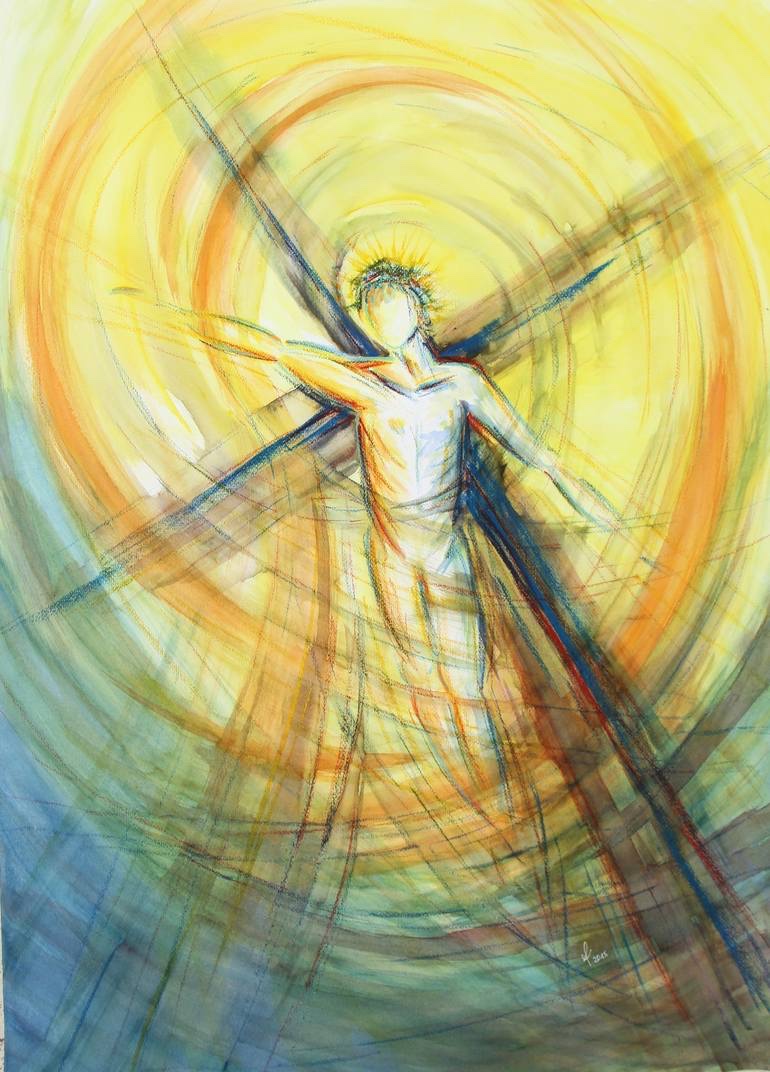
The painting at the top of the post is titled “resurrection” by Oliver Pfaff.


Patience

Strengthened with all might, according to his glorious power, unto all patience and longsuffering with joyfulness; (KJV) ( Colossians 1:11 )

When was the last time your patience was tested? Right now with so many people in isolation, We probably have all had our patience tested in some way or another. Maybe someone wasn’t social distancing like we’re supposed to, or it’s all the extra work we are doing from home these days. We all have different problems right now that try our patience.

How have you dealt with it? It’s such a tough battle when you are running on empty and your patience is wearing thin. This emotion is a great reminder that it’s time to supplement your day with prayer, meditation, and time in the Bible. You will be filled with all the patience you need.

Also, remember to reach out to those you love. They are experiencing a trying time as well. I know for some of us, our families may be a source of our impatience, but we all need each other right now.


The Wayfaring Stranger

I’m just a poor wayfaring stranger
Traveling through this world below
There is no sickness, no toil, nor danger
In that bright land to which I go
I’m going there to see my Father
And all my loved ones who’ve gone on
I’m just going over Jordan
I’m just going over home
I know dark clouds will gather ’round me
I know my way is hard and steep
But beauteous fields arise before me
Where God’s redeemed, their vigils keep
I’m going there to see my Mother
She said she’d meet me when I come
So, I’m just going over Jordan
I’m just going over home
I’m just going over Jordan
I’m just going over home

Yesterday, I watched the movie 1917. It was phenomenal but also very sad. I think it’s almost impossible to have a happy World War I movie. If you did, it would be inaccurate. World War I was such an awful war. The set really bring that to life in this movie. In my opinion, the sets were very accurate. As a historian, I’d be remiss to say that there were no inaccuracies. There are a few, but I’m not here to talk about that. One of the most moving moments of the movie is when Jos Slovik sings “Poor Wayfaring Stranger.”

The song itself is an old American folk hymn about a plaintive soul on the journey through life. “I Am a Poor Wayfaring Stranger” speaks of man’s journeying on this earth. Yet, from what and to what does man go?

From the moment Adam and Eve left the Garden of Eden, man’s journey has him wanting to return. Yet, this return requires passing through the looming, dark portal of death. We journeyed through life into death.

The song’s line “I’m just going over Jordan” evokes this death. In one respect, the line refers to Joshua, that successor of Moses who led the Israelites across the dry bed of the river into the long-desired promised land. Yet, in a deeper sense, the line refers to baptism of Jesus in the River Jordan. Our crossing is a watery plunge, a sign of dying and rising, a baptism.We journey through death into eternal life.

As we walk toward that dark portal of death, the baptized walk with Christ. “We were buried therefore with him by baptism into death, so that as Christ was raised from the dead by the glory of the Father, we too might walk in newness of life” (Romans 6:4). In Baptism, we are changed at the deepest center of our being, we continue to walk in newness and with hope. We are on the way as wayfarers.

The song continues saying, “I’m just going over home.” This is a clear allusion to heaven. As pilgrims, we journey not just to death, but we pass on to more. “Here we have no lasting city, but we seek the city which is to come” (Hebrew 13:14). The deepest and truest sense of our journeying is not about designation of place. Our journeying is about fulfillment, perfection, life, and the all-consuming vision of the beloved, face of God.

Upon rising from the waters of baptism, we follow Christ, who is “the way” (John 14:6). This following requires renewal and sacrifice. St. Paul exhorts us to put off the old man and put on the new man, even calling for our minds to be renewed in Christ (Ephesians 4:22–24). To put off the old man is a command to leave behind the sin and the corruption which came from Adam and Eve. To put on the new man is to “put on the Lord Jesus Christ” (Romans 13:14). To be renewed in the spirit of the mind is to “have the mind of Christ” (1 Corinthians 2:16).

Therefore, we are poor because we need all from Christ. We are wayfarers because we are journeying from death to life in Christ. We are strangers because we have died to this world and seek those things above. “For you have died, and your life is hid with Christ in God” (Colossians 3:3). When our journey—that is, our perfection in the Son—is complete, we will see our Father. “No one comes to the Father, but by me” (John 14:6).


No Favorites

But of these who seemed to be somewhat, (whatsoever they were, it maketh no matter to me: God accepteth no man’s person:) for they who seemed to be somewhat in conference added nothing to me: (KJV) ( Galatians 2:6 ) 

God doesn’t have favorites. He desires to use us ALL and gives us all special gifts that he hopes that you will use to bless others with. Don’t think just because you don’t have a fancy title or that because you aren’t a Bible scholar God doesn’t want to use you! There is only one you in the world. God desires to use in a special only you kind of way.  


Limitless

For which cause we faint not; but though our outward man perish, yet the inward man is renewed day by day. (KJV) ( 2 Corinthians 4:16 ) 

Have you encountered a snag in your life? … a lost relationship, rejection from a school or job, financial hardship or maybe simply a lack of determination. You might be praying for God to give you the strength to get back on your feet. But do you know how powerful God is? Instead of limiting your rescue to a level you understand, have faith and believe that God has a plan beyond returning you to ground zero. Through God, you have the capability to excel way beyond your limits. Jot down a goal that you think is impossible then watch God’s plan unfold.