Category Archives: Religion

Second Chances 

Bless the LORD, O my soul,
and all that is within me,
bless his holy name!
Bless the LORD, O my soul,
and forget not all his benefits,
who forgives all your iniquity,
who heals all your diseases,
who redeems your life from the pit,
who crowns you with steadfast love and mercy,
who satisfies you with good
so that your youth is renewed like the eagle’s.

The LORD works righteousness
and justice for all who are oppressed.
He made known his ways to Moses,
his acts to the people of Israel.
The LORD is merciful and gracious,
slow to anger and abounding in steadfast love.
He will not always chide,
nor will he keep his anger forever.
He does not deal with us according to our sins,
nor repay us according to our iniquities.
For as high as the heavens are above the earth,
so great is his steadfast love toward those who fear him;
as far as the east is from the west,
so far does he remove our transgressions from us.
As a father shows compassion to his children,
so the LORD shows compassion to those who fear him.
For he knows our frame;
he remembers that we are dust.
As for man, his days are like grass;
he flourishes like a flower of the field;
for the wind passes over it, and it is gone,
and its place knows it no more.
But the steadfast love of the LORD is from everlasting to everlasting on those who fear him,
and his righteousness to children’s children,
to those who keep his covenant and remember to do his commandments.
The LORD has established his throne in the heavens,
and his kingdom rules over all.

Bless the LORD, O you his angels,
you mighty ones who do his word,
obeying the voice of his word!
Bless the LORD, all his hosts,
his ministers, who do his will!
Bless the LORD, all his works,
in all places of his dominion.
Bless the LORD, O my soul!

Psalms 103

With the new year, we often think back on the old. We attempt to think of resolutions to help us correct our flaws, and hopefully, give ourselves a second chance in the new year. We are blessed to have a God who grants second chances. In fact, He grants an infinite number of chances. This is good news because most of us mess up the second chance fairly quickly. One of the amazing facets of God’s character is His incredible patience with us. Psalm 86:15 says it well: “But you, O Lord, are a God merciful and gracious, slow to anger and abounding in steadfast love and faithfulness.”

How many times have any of us done something really stupid, and realize it right after, or right in the middle of it? Do you ever feel like you can’t do anything right, wondering why you bother trying as you’re going to fail anyway? I’ve had instances when I really didn’t mean to hurt someone, yet I did, and I didn’t know how to set it right. I must admit, I’ve experienced this on more days than I want to admit. It just seems like no matter how hard I try, things just don’t seem to work out, or not that often anyway. Yet, in each instance I look to God for guidance, and he shows me the way.

Just as God is patient and forgiving, He wants His children to be patient with and forgiving of others. “Put on then, as God’s chosen ones, holy and beloved, compassionate hearts, kindness, humility, meekness, and patience” (Colossians 3:12). He gives us second chances, and we must give the same to others. Jesus gives a stern warning to those who refuse to forgive, saying that if we will not forgive others, God will not forgive us. If someone is truly repentant, then we are obligated to forgive. Matthew 18:21-22 says “Then Peter came up and said to him, “Lord, how often will my brother sin against me, and I forgive him? As many as seven times?” Jesus said to him, “I do not say to you seven times, but seventy-seven times.”

Forgiveness, however, is not the same thing as reconciliation. Many people struggle to find the balance between showing mercy and enabling a harmful person to continue harming. We should forgive everyone who wrongs us, just as Jesus forgives us. Forgiveness is between our heart and God’s, removing any barriers that non-forgiveness brings. When someone continues to unrepentantly violate another person’s boundaries, a wise person learns to set firmer boundaries.

Giving someone a second chance means we give him another chance to earn our trust. But that does not mean we instantly forget what experience has taught us. Trust must be earned over time, and we are foolish if we give trust prematurely. We can have a loving and forgiving heart that also practices wise guardianship over our lives.

When we have wronged someone, we have no right to demand another chance. But we should work to earn another chance by continued demonstration of repentance and change.

God does everything possible to draw us to repentance, offering forgiveness and second chances (2 Peter 3:9). But if we continue to reject Him, the offer is withdrawn and, at death, there are no more chances (Hebrews 9:27). God’s grace is our model. We can offer second chances to others until a healthy relationship is no longer possible.

In this new year, we should try to emulate God more. Just as he gives us second chances, give others a second chance as well. Maybe that someone deserves even more than a single second chance, then offer them more chances as long as they are attempting to do what is right. However, if that person is continuously hurting you, then forgive them and walk away. Just because someone has hurt you, it does not mean that it was intentional. Give them that second chance, just as God would give you a second chance. Yet, when it is intentional hurting, sometimes it is best to just cut ties. It is often difficult to do so, but it is occasionally what is best for both. Sometimes, it’s easy to just cut ties, but evaluate the situation. Could you help that person more by giving them a second chance? If so, then that is what god asks us to do.

Let God give you a second chance in the new year, and resolve to be a better person. Also, try to give someone in your life a second chance, maybe they truly deserve it. I hope each of you has a blessed and happy 2017!


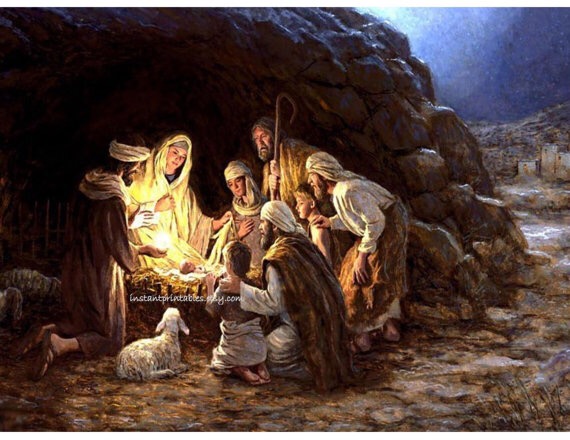
The Christmas Story 

Luke 2 King James Version (KJV)

And it came to pass in those days, that there went out a decree from Caesar Augustus that all the world should be taxed.

(And this taxing was first made when Cyrenius was governor of Syria.)

And all went to be taxed, every one into his own city.

And Joseph also went up from Galilee, out of the city of Nazareth, into Judaea, unto the city of David, which is called Bethlehem; (because he was of the house and lineage of David:)

To be taxed with Mary his espoused wife, being great with child.

And so it was, that, while they were there, the days were accomplished that she should be delivered.

And she brought forth her firstborn son, and wrapped him in swaddling clothes, and laid him in a manger; because there was no room for them in the inn.

And there were in the same country shepherds abiding in the field, keeping watch over their flock by night.

And, lo, the angel of the Lord came upon them, and the glory of the Lord shone round about them: and they were sore afraid.

And the angel said unto them, Fear not: for, behold, I bring you good tidings of great joy, which shall be to all people.

For unto you is born this day in the city of David a Saviour, which is Christ the Lord.

And this shall be a sign unto you; Ye shall find the babe wrapped in swaddling clothes, lying in a manger.

And suddenly there was with the angel a multitude of the heavenly host praising God, and saying,

Glory to God in the highest, and on earth peace, good will toward men.

And it came to pass, as the angels were gone away from them into heaven, the shepherds said one to another, Let us now go even unto Bethlehem, and see this thing which is come to pass, which the Lord hath made known unto us.

And they came with haste, and found Mary, and Joseph, and the babe lying in a manger.

And when they had seen it, they made known abroad the saying which was told them concerning this child.

And all they that heard it wondered at those things which were told them by the shepherds.

But Mary kept all these things, and pondered them in her heart.

And the shepherds returned, glorifying and praising God for all the things that they had heard and seen, as it was told unto them.


Proverbial Giving


Whoever is generous to the poor lends to the Lord, and he will repay him for his deed.
Proverbs 19:17

Whoever oppresses a poor man insults his Maker, but he who is generous to the needy honors him.
Proverbs 14:31

I have to admit that when I was looking up some commentaries on giving and the Bible, too many of the sources I found focused on giving to the church.  I give what I can to church, which is what I think of when the apostle Paul writes in 2 Corinthians 8:12 “For if the readiness is there, it is acceptable according to what a person has, not according to what he does not have.”  Many churches though use this as a means of forcing a true tithe of 10 percent.  However, even though we are in the season of giving, we should be giving and helping year round to those who need assistance.

In the Sermon on the Mount, Jesus commands us to give to the needy:
Beware of practicing your righteousness before other people in order to be seen by them, for then you will have no reward from your Father who is in heaven.
Thus, when you give to the needy, sound no trumpet before you, as the hypocrites do in the synagogues and in the streets, that they may be praised by others. Truly, I say to you, they have received their reward. But when you give to the needy, do not let your left hand know what your right hand is doing, so that your giving may be in secret. And your Father who sees in secret will reward you.
Matthew 6:1-4
Giving is not all about what you give to your local congregation, but what you give to those who are in need.  We are to love our fellow man and not judge them.  If we look down on the poor, then how can we look up to God.  Some people blame God for the misfortunes of the world, I blame those who do not follow the teachings of love and charity.  Do you have to be a Christian to have love for your fellow man or to be charitable to the less fortunate?  Of course you don’t.  But I will say this, too many people who call themselves Christian often follow the proverb “God helps those who help themselves.”  The phrase is often mistaken as scriptural, but it appears nowhere in the Bible. 

Political commentator Bill O’Reilly employed the phrase, in responding to Jim McDermott, the Democratic U.S. Representative for Washington’s 7th congressional district, who argued, “This is Christmas time. We talk about Good Samaritans, the poor, the little baby Jesus in the cradle and all this stuff. And then we say to the unemployed we won’t give you a check to feed your family. That’s simply wrong.” O’Reilly argued for a more selective approach to unemployment benefits, and the importance of individual responsibility, concluding “while Jesus promoted charity at the highest level, he was not self-destructive. The Lord helps those who help themselves. Does he not?” Political comedian Stephen Colbert parodied him in response, concluding in character, “if this is going to be a Christian nation that doesn’t help the poor, either we’ve got to pretend that Jesus was just as selfish as we are, or we’ve got to acknowledge that he commanded us to love the poor and serve the needy without condition; and then admit that we just don’t want to do it.” Colbert may be a comedian who is often irreverent, but he makes a good point.

For the vast majority of us, misfortune finds us at one point or another. Various people have helped me during those unfortunate times, and I do my best to help those in need when I am able to help.  Giving is not just for the red buckets of the Salvation Army during Christmastime but for all year round.  It is also not about gifts and money, because not all of us are able to do so, but it is about giving our love to those around us.  Love is the greatest gift we can give.

Peace, love, and charity!

Agape and Optimism 

Finally, brothers, whatever is true, whatever is honorable, whatever is just, whatever is pure, whatever is lovely, whatever is commendable, if there is any excellence, if there is anything worthy of praise, think about these things.

Philippians 4:8

Let all bitterness and wrath and anger and clamor and slander be put away from you, along with all malice. Be kind to one another, tenderhearted, forgiving one another, as God in Christ forgave you.

Ephesians 4:31-32

There are many people in this world who only look at the negatives of religion. They consider religion to be exclusive, not inclusive. They dwell on what not to do, instead of what should be done. Some of these same people are religious, others are not. However, this view of Christianity is as far from my belief as possible. This is a pessimistic view of religion, and as someone who decided years ago that a positive attitude is far greater than a negative attitude, I look to a far more optimistic view of Christianity.

The two verses above are just two of many examples in the Bible that show the optimistic view of Christianity. More than anything, I believe in the inclusiveness of Christianity. God loves us all, and we are told that we should love all. This type of love is called agape. Agape often translated “unconditional love”, is one of the Koine Greek words translated into English as love, one which became particularly appropriated in Christian theology as the love of God or Christ for humankind. In the New Testament, it refers to the covenant love of God for humans, as well as the human reciprocal love for God; the term necessarily extends to the love of one’s fellow man.

Although the word agape does not have specific religious connotation, the word has been used by a variety of contemporary and ancient sources, including biblical authors and Christian authors. Greek philosophers at the time of Plato and other ancient authors have used forms of the word to denote love of a spouse or family, or affection for a particular activity, in contrast to philia (an affection that could denote friendship, brotherhood or generally non-sexual affection) and eros, an affection of a sexual nature. The term agape is rarely used in ancient manuscripts, but was used by the early Christians to refer to the self-sacrificing love of God for humanity, which they were committed to reciprocating and practicing towards God and among one another (also see kenosis). When 1 John 4:8 says “God is love,” the Greek New Testament uses the word agape to describe God’s love.

Anyone who proclaims that Christianity is a negative religion and focuses only on what not to do, need look only at the Sermon on the Mount (Matthew 5:3-7:27) to be proven wrong. The Beatitudes (Matthew 5:3-12) are enough in themselves to show the positive nature of what Christianity should be:

Blessed are the poor in spirit, for theirs is the kingdom of heaven.
Blessed are those who mourn, for they shall be comforted.
Blessed are the meek, for they shall inherit the earth.
Blessed are those who hunger and thirst for righteousness, for they shall be satisfied.
Blessed are the merciful, for they shall receive mercy.
Blessed are the pure in heart, for they shall see God.
Blessed are the peacemakers, for they shall be called sons of God.
Blessed are those who are persecuted for righteousness’ sake, for theirs is the kingdom of heaven.
Blessed are you when others revile you and persecute you and utter all kinds of evil against you falsely on my account.
Rejoice and be glad, for your reward is great in heaven, for so they persecuted the prophets who were before you.

If more people would follow the teachings of Jesus Christ instead of focusing on the negatives, then I honestly and wholeheartedly believe that the world would be a better place.


Just a Closer Walk with Thee

Just a Closer Walk with Thee

I am weak but Thou art strong;
Jesus, keep me from all wrong;
I’ll be satisfied as long
As I walk, let me walk close to Thee.

Just a closer walk with Thee,
Grant it, Jesus, is my plea,
Daily walking close to Thee,
Let it be, dear Lord, let it be.

Thro’ this world of toil and snares,
If I falter, Lord, who cares?
Who with me my burden shares?
None but Thee, dear Lord, none but Thee.

Just a closer walk with Thee,
Grant it, Jesus, is my plea,
Daily walking close to Thee,
Let it be, dear Lord, let it be.

When my feeble life is o’er,
Time for me will be no more;
Guide me gently, safely o’er
To Thy kingdom shore, to Thy shore.

Just a closer walk with Thee,
Grant it, Jesus, is my plea,
Daily walking close to Thee,
Let it be, dear Lord, let it be.

In this song, we acknowledge our human inability to live righteously, but we also express awareness of the grace and strength that God gives us in our daily walk. Even such an esteemed saint as the apostle Paul acknowledged his need for this grace: “But he [God] said to me, “My grace is sufficient for you, for my power is made perfect in weakness.” … For when I am weak, then I am strong.” (2 Corinthians 12:9a, 10b ESV)

This song is one of my all time favorite hymns. Though I was raised in the church of Christ, my mother was raised a Baptist. She and her sister played the piano and the organ at their church growing up. Mama always loved to sit and play hymns at the piano in our living room. More frequently than any other song, mama would play “Just a Closer Walk with Thee.”


In the Morning of Joy

Listen, I will tell you a mystery! We will not all die, but we will all be changed, in a moment, in the twinkling of an eye, at the last trumpet. For the trumpet will sound, and the dead will be raised imperishable, and we will be changed. For this perishable body must put on imperishability, and this mortal body must put on immortality. When this perishable body puts on imperishability, and this mortal body puts on immortality, then the saying that is written will be fulfilled:‘Death has been swallowed up in victory.’ ‘Where, O death, is your victory? Where, O death, is your sting?’ The sting of death is sin, and the power of sin is the law. But thanks be to God, who gives us the victory through our Lord Jesus Christ.Therefore, my beloved, be steadfast, immovable, always excelling in the work of the Lord, because you know that in the Lord your labour is not in vain.
1 Corinthians 15:51-58


In The Morning of Joy

When the trumpet shall sound,
And the dead shall arise,
And the splendors immortal
Shall envelop the skies;
When the Angel of Death
Shall no longer destroy,
And the dead shall awaken
In the morning of joy:

In the morning of joy,
We’ll be gathered to glory,
In the morning of joy;
In the morning of joy,
We’ll be gathered to glory,
In the morning of joy.

When the King shall appear
In His beauty on high,
And shall summon His children
To the courts of the sky;
Shall the cause of the Lord
Have been all your employ,
That your soul may be spotless
In the morning of joy?

In the morning of joy,
We’ll be gathered to glory,
In the morning of joy;
In the morning of joy,
We’ll be gathered to glory,
In the morning of joy.

O the bliss of that morn,
When our loved ones we meet!
With the songs of the ransomed
We each other shall greet,
Singing praise to the Lamb,
Thro’ eternity’s years,
With the past all forgotten
With its sorrows and tears

In the morning of joy,
We’ll be gathered to glory,
In the morning of joy;
In the morning of joy,
We’ll be gathered to glory,
In the morning of joy.

I’ve had this song in my head lately. As I sang it to myself, tears rolled down my face. This song was sang at my grandmama’s funeral, and I often sang it when I was the song leader of my church. It brings me comfort, since I know that in that morning of joy, I will be reunited with my friends and family.

The above sculpture is called “Angel of Grief” and is an 1894 sculpture by William Wetmore Story which serves as the grave stone of the artist and his wife at the Protestant Cemetery, Rome.


Psalms 103: Bless The Lord, O My Soul

Bless the LORD, O my soul, and all that is within me, bless his holy name!
Bless the LORD, O my soul, and forget not all his benefits,
who forgives all your iniquity, who heals all your diseases,
who redeems your life from the pit, who crowns you with steadfast love and mercy,
who satisfies you with good so that your youth is renewed like the eagle’s.
The LORD works righteousness and justice for all who are oppressed.
He made known his ways to Moses, his acts to the people of Israel.
The LORD is merciful and gracious, slow to anger and abounding in steadfast love.
He will not always chide, nor will he keep his anger forever.
He does not deal with us according to our sins, nor repay us according to our iniquities.
For as high as the heavens are above the earth, so great is his steadfast love toward those who fear him;
as far as the east is from the west, so far does he remove our transgressions from us.
As a father shows compassion to his children, so the LORD shows compassion to those who fear him.
For he knows our frame; he remembers that we are dust.
As for man, his days are like grass; he flourishes like a flower of the field;
for the wind passes over it, and it is gone, and its place knows it no more.
But the steadfast love of the LORD is from everlasting to everlasting on those who fear him, and his righteousness to children’s children,
to those who keep his covenant and remember to do his commandments.
The LORD has established his throne in the heavens, and his kingdom rules over all.
Bless the LORD, O you his angels, you mighty ones who do his word, obeying the voice of his word!
Bless the LORD, all his hosts, his ministers, who do his will!
Bless the LORD, all his works, in all places of his dominion. Bless the LORD, O my soul!
Psalms 103


Love Overcomes

Owe no one anything, except to love each other, for the one who loves another has fulfilled the law. – Romans 13:8

We must continue to love each other. Protests have broken out across the country because of the election. Their slogan is “Love trumps hate.” Of course, it’s a play on words, but it has a deeper meaning as well. In bridge and some other card games, one suit is designated as trump, and cards from that suit carry special powers to take tricks and defeat cards from other suits. This is called “trumping” as a verb. So “love trumps hate” means that love overcomes or defeats hate, with the obvious pun adding an additional layer of meaning. We must remember this in the coming months and years. No matter what happens under this new president, love conquers all. We will survive. We survived the Bush years. We survived, more or less, the Reagan years. We will survive the Trump years.

When it comes time to protest his policies, remember that “for the one who loves another has fulfilled the law.” I’m not calling for a rebellion, but I am saying that love is above the law. The Civil Rights Movement often sand the song, “We Shall Overcome.” And we shall overcome this too.

We shall overcome, we shall overcome,
We shall overcome someday;
Oh, deep in my heart, I do believe,
We shall overcome someday.

The Lord will see us through, The Lord will see us through,
The Lord will see us through someday;
Oh, deep in my heart, I do believe,
We shall overcome someday.

We’re on to victory, We’re on to victory,
We’re on to victory someday;
Oh, deep in my heart, I do believe,
We’re on to victory someday.

We’ll walk hand in hand, we’ll walk hand in hand,
We’ll walk hand in hand someday;
Oh, deep in my heart, I do believe,
We’ll walk hand in hand someday.

We are not afraid, we are not afraid,
We are not afraid today;
Oh, deep in my heart, I do believe,
We are not afraid today.

The truth shall make us free, the truth shall make us free,
The truth shall make us free someday;
Oh, deep in my heart, I do believe,
The truth shall make us free someday.


Health and Healing

Bless the LORD, O my soul, 
and all that is within me, 
bless his holy name! 
Bless the LORD, O my soul, 
and forget not all his benefits, 
who forgives all your iniquity, 
who heals all your diseases, 
who redeems your life from the pit, 
who crowns you with steadfast love and mercy, 
who satisfies you with good 
so that your youth is renewed like the eagle’s. 
Psalms 103:1-5

Good health is something we take for granted—until we start to lose it. When our health takes a downturn, we quickly begin to question our habits and diet. God has designed the human body so that it is a finely tuned instrument that is the most resilient on earth. It can endure fractures and adhesions, constant pain and great stretches of tedium.

However, it is a fragile instrument because it is not built to handle excess, whether in the form of nourishment, fuel or additives. Unlike machines, it chokes on poisons when ingested in unending doses and mistaken for fuel. Though it has moving, feeling and thinking parts, they can be misused. God has provided us with an “owner’s manual” that tells us how to operate the human body. That manual is the Bible, a book that contains instructions for proper maintenance. Although it isn’t a medical text, it is God’s Word, and in its pages He reveals many basic principles for good physical, mental, and spiritual health.

A major part of the Bible’s health instruction dates back to the time of Moses. Yet in our day, many researchers and medical doctors are stunned at the accuracy and effectiveness of its many provisions. The Wycliffe Bible Encyclopedia tells us that the laws given by God to Moses contain remarkable rules pertaining to public health which concerns us even today: water and food contamination, sewage disposal, infectious diseases and health education. These issues were all dealt with in the Mosaic health laws.  Many of these same laws are found in most basic law codes of the ancient world.  Some of them were forgotten by Christians until the late Middle Ages.  Some no longer apply because of modern medicine, technology, and nutritional practices.

The Bible gives us the foundational key to physical and mental health. That key is simply this: “My son, do not forget my teaching, but keep my commands in your heart, for they will prolong your life many years and bring you prosperity . . . This will bring health to your body and nourishment to your bones” (Proverbs 3:1-2, 8). It should not surprise us that obedience to God’s commandments and other laws would promote health. When we obey them, we operate in accordance with His instructions. As our Creator, He knows what’s best for us: “Now all has been heard; here is the conclusion of the matter: Fear God and keep his commandments, for this is the whole duty of man” (Ecclesiastes 12:13).  He commands us to treat our body as a temple and that we should take care of ourselves.  We should not consume things that will harm us, and we should especially not consume things in excess which might cause us harm.

Some biblical statements about health are specific, such as: “If you listen carefully to the voice of the LORD your God and do what is right in his eyes, if you pay attention to his commands and keep all his decrees, I will not bring on you any of the diseases I brought on the Egyptians, for I am the LORD, who heals you” (Exodus 15:26). The ancient Egyptians suffered from the kinds of diseases that have ravaged mankind throughout history. Autopsies on Egyptian mummies have revealed evidence of cancer, arteriosclerosis, arthritis, tuberculosis, gallstones, bladder stones, parasitic diseases and smallpox. They suffered many diseases because they did not understand the health principles God gave to Moses. 

The Good News is that Jesus died for our sins, we should not fear God’s punishment while on earth.  He will not bring forth diseases as a means of punishment, as some have claimed.  In the Middle Ages, people claimed that the Black Death was a punishment from God.  Since the early 1980s, people have claimed that HIV/AIDS is a punishment from God.  These same people claim that earthquake, tornadoes, hurricanes, and other natural disasters are punishments from God.  They are not.  Jesus came to earth to bring us a new covenant, and to absolve us of our sins.  If we believe, are baptized in the newness of life, allow our sins to be washed away, and follow God’s teachings of love and acceptance, then we shall walk with God and provide a healthy and honorable view of ourselves as Christians.  We can live a life in God’s example.

The biblical instructions regarding health, maintenance, and recovery from illness involve application of cause-and-effect principles—based on true science—that were given thousands of years before scientists developed the technology that enabled them to discover germs, bacteria, viruses, genes and the like. Modern medical science has discovered many principles of good health, but they originated with God who designed and created the miracle that is the human body.

What the Bible says about health is that those who follow God will generally be healthy. That does not necessarily mean that those who don’t follow God will always be sick. Nor does it mean that God’s people will be absolutely free of disease. The Bible says, “I pray that you may enjoy good health and that all may go well with you, even as your soul is getting along well” (3 John 1:2). Obviously, God is more interested in our spiritual health than our physical well-being, but He does want us to be physically healthy as well. On the other hand, disease is a result of Adam’s sin, and even the most righteous may suffer. After all, Job was righteous, but God allowed him to suffer disease and hardship as a test of his faith.

It was not until the modern era that men obtained detailed knowledge of human physiology and medicine. Yet the Creator God, who is sometimes called the Great Physician, knows everything about us, and He’s provided the necessary keys to good health. The choice to obey the Lord and reap the resulting benefits is ours to make.

God’s Help

Too many times we can feel helpless and out of control. But we can turn to the One who is fully in control and perfectly able to help in our times of need.

Psalm 46:1

“God is our refuge and strength, a very present help in trouble.” 

Psalm 68:6 

“God sets the solitary in families; He brings out those who are bound into prosperity; but the rebellious dwell in a dry land.”

Proverbs 3:5-6 

“Trust in the LORD with all your heart, and lean not on your own understanding; in all your ways acknowledge Him, and He shall direct your paths.”

Matthew 7:7

“Ask, and it will be given to you; seek, and you will find; knock, and it will be opened to you.”