Category Archives: Religion

Jesus Loves Us

20140222-232502.jpg

Jesus Loves Me. This I Know . . . Even If I’m Gay, Lesbian, Bisexual or Transgendered

by Mary Pearson

“Jesus loves me. This I know, for the Bible tells me so . . . ” unless you are Gay, Lesbian, Bisexual, Transgendered, Intersex or Queer, in which case you are told that Jesus loves everyone EXCEPT me. Well it’s time to set the record straight – if you’ll pardon the expression. Jesus loves ESPECIALLY His GLBTIQ children – for the Bible tells me so!

The Protestant Bible is like a library consisting of 66 books, written by about 40 authors over a period from about 2000 BC to about 70 AD. It is divided into the Old Testament (before Christ) and the New Testament (after Christ). In these 66 books, there are 1,189 chapters containing about 31,273 verses. The final divisions into chapters and verses occurred only about 500 years ago for ease of referencing. They are not part of the original texts.

I believe that the Original Scriptures were God-inspired and contain the truths that God would have us to know. I believe also that subsequent translations must deal with text, where perhaps there is no comparable word for the original, and meanings of words are sometimes lost or changed.

Translations have been written with the best of intentions by God-fearing, uninspired human beings who have done their very best to convey God’s message, as they understand it, with their current knowledge of the original languages, customs, traditions and culture of Bible times, AND with their own biases, based on their understanding of what they THINK the Original Scriptures said. None of us have been brought up in a vacuum, and it is impossible not to let our preconceived beliefs influence our understanding. If these translators believed that homosexuality was wrong, then that’s how they viewed the scriptures that they were attempting to translate. New research would indicate that their beliefs were indeed wrong.

Since the concept of homosexuality as an orientation was unknown until about a hundred years ago, on that basis alone, we know that the “clobber verses” used against gays could NOT refer to homosexuality as an orientation. They refer to same-sex acts, which were understood to be perpetrated by heterosexuals, and therefore were “lustful” and “unnatural”.

There is no word in biblical Greek or Hebrew (the original languages of the Bible) that is the equivalent to the English word “homosexual”. The 1946 Revised Standard Version (RSV) of the Bible was the first translation to use the word “homosexual”.

There is no word in biblical Greek or Hebrew for “sodomy”. A Sodomite was simply an inhabitant of Sodom, just as a Torontonian is an inhabitant of Toronto. It was not until after the rise of the hierarchy in the institutional Church that the story of Sodom and Gomorrah was inaccurately equated with homosexuality and the word “sodomite” came into use. (Read my article The Sin of Sodom Was NOT Homosexuality!.) Any translation using the words “homosexual”, “sodomy” or “sodomite” are interpretations and are not faithful representations of the Original Scriptures.

Wherever same-sex acts are mentioned, it is either with regard to ritualistic traditions which were intended to increase the small population of the Hebrews, or it is among the Purity Codes for the Priests, or it is with regard to temple prostitution (idol worship) which was very common among the pagan people who surrounded the Hebrews, or it had to do with rape, power and violence as in the story of Sodom and Gomorrah.

None of the “clobber verses” used against gays refer to a loving relationship between two people, however you will find examples of same-sex love in the beautiful and romantic stories of Ruth and Naomi, a passage which very often is used in marriage ceremonies and yet it is between two women.

“And Ruth said, Intreat me not to leave thee (Naomi), [or] to return from following after thee: for whither thou goest, I will go; and where thou lodgest, I will lodge: thy people [shall be] my people, and thy God my God: Where thou diest, will I die, and there will I be buried: the LORD do so to me, and more also, [if ought] but death part thee and me.” Ruth 1:16,17

– and of David and Jonathan

“The soul of Jonathan was knit with the soul of David, and Jonathan loved him as his own soul.” I Samuel 18:1(b)

“Thy love to me was wonderful, passing the love of women.” II Samuel 1:26(b)

Jesus never mentioned homosexuality. Society and the church perceive it to be a sin, worthy of ostracizing family and friends, but Jesus never mentioned it! He talked about money, adultery, divorce, greed and lots of other things, but He never mentioned homosexuality. Rather neglectful of Him – IF being gay were such an abomination – another word usually linked to homosexuals, which has also been mistranslated. The correct interpretation of the word “abomination” refers to impurity and is usually linked with idolatry, not sexuality.

The Bible has been perverted to uphold slavery, apartheid and segregation, to malign Jews and other non-Christian people of faith, to support Hitler’s Third Reich, to resist medical science and to rebuke inter-racial marriage. It has been used to execute women as witches, to defend the racism of the Ku Klux Klan and to perpetrate intolerance and discrimination of women and sexual minorities. It took the Catholic Church 359 years to admit that they were wrong when they accused Galileo of heresy and condemned him to death unless he recanted that the earth rotates around the sun. Oh yes! The Bible has been misused and misinterpreted often over the years, and it has been misinterpreted regarding the issue of homosexuality.

Jesus’ love was INCLUSIVE! His friends were not the Pharisees and Sadducees of the faith who were always trying to catch Him breaking the letter of the law – which He often did. Jesus made it clear that the only law is LOVE.

On one occasion Jesus was asked: “Master, which is the great commandment of the law?” He answered: “Thou shalt love the Lord thy God with all thy heart, and with all thy soul, and with all thy mind. This is the first and great commandment. And the second is like unto it, Thou shalt love thy neighbour as thyself. On these two commandments hang all the law and the prophets” Matt. 22:36-40

If what you have been told does not agree with Jesus’ Great Commandments, then what you have been told is wrong. God’s love is for ALL, especially gay, lesbian, bisexual, transgender, intersex and queer people! Jesus was the First to reach out to the rejected of society. Jesus reaches out to us now.

“It is never legitimate to use the words of Scripture to promote a loveless agenda.” – Right Rev. Dr. Peter Short, Moderator of the United Church of Canada

“God loved the world so much, that Jesus Christ, God’s only begotten Son, was freely given, that WHOSOEVER believes in Him shall not perish but have everlasting life.” John 3:16

Jesus’ friends were the marginalized of society – the despised tax collectors, the uneducated, the prostitutes and the lepers. Doesn’t it just make sense that He would choose we gays for His close friends if He were here today! So smile because God has a plan for your life and “Jesus loves YOU. This I know, for the Bible tells me so!”



How to Love Your Enemies

20140215-232908.jpg

“You have heard that it was said, ‘An eye for an eye and a tooth for a tooth.’ But I say to you, Do not resist the one who is evil. But if anyone slaps you on the right cheek, turn to him the other also. And if anyone would sue you and take your tunic, let him have your cloak as well. And if anyone forces you to go one mile, go with him two miles. Give to the one who begs from you, and do not refuse the one who would borrow from you.”
“You have heard that it was said, ‘You shall love your neighbor and hate your enemy.’ But I say to you, Love your enemies and pray for those who persecute you, so that you may be sons of your Father who is in heaven. For he makes his sun rise on the evil and on the good, and sends rain on the just and on the unjust. For if you love those who love you, what reward do you have? Do not even the tax collectors do the same? And if you greet only your brothers, what more are you doing than others? Do not even the Gentiles do the same? You therefore must be perfect, as your heavenly Father is perfect.”

Matthew 5:38-48

Here’s a joke: A priest is giving a homily based on Jesus’s command to love your enemies.

“Now,” he says, “I’ll bet that many of us feel as if we have enemies in our lives,” he says the congregation. “So raise your hands,” he says, “if you have many enemies.” And quite a few people raise their hands. “Now raise your hands if you have only a few enemies.” And about half as many people raise their hands. “Now raise your hands if you have only one or two enemies.” And even fewer people raised their hands. “See,” says the priest, “most of us feel like we have enemies.”

“Now raise your hands if you have no enemies at all.” And the priest looks around, and looks around, and finally, way in the back, a very, very old man raises his hand. He stands up and says, “I have no enemies whatsoever!” Delighted, the priest invites the man to the front of the church. “What a blessing!” the priest says. “How old are you?

“I’m 98 years old, and I have no enemies.” The priest says, “What a wonderful Christian life you lead! And tell us all how it is that you have no enemies.”

“All the bastards have died!”

Most of us, sadly, go through life with, for better or worse, and no matter how hard we try, a few people we may feel are our “enemies.” Or, more broadly, people seem to hate us. There are people whom we’ve offended and to whom we’ve apologized, but who refuse to accept our apologies. There are people at work who we’ve angered, who are jealous of us or who have set themselves against us. There are people in our families who hold a grudge against us for some mysterious reason that we can never comprehend. And there are people who seem to dislike us or wish us ill for no good reason. It’s a sad part of human life.

And it’s a hard part of life. And sometimes, when we hear Jesus telling us to love our enemies, it seems to make things even harder.

In the Gospel of Matthew (5:38-48), Jesus contrasts what his disciples had heard in the past with what they must practice as his followers. “You have heard that it was said, ‘An eye for an eye.’ But I say to you offer no resistance to one who is evil,” he says. “You have heard that it was said that you must love your neighbors and hate your enemies. But I say to you love your enemies.” Jesus is trying to move the disciples beyond what they knew into a realm of practice that will help them follow Jesus, to live according to a new law, the law of love.

But there’s a problem: it seems impossible! How are we supposed to love our enemies sincerely? Are we really supposed to pray for … whom? For people who hate us because we are gay? For people who work against us because they think we are sinners? For people who want us to fail because they don’t want us to have equality? It seems almost masochistic — a surefire recipe for psychological disaster.

A few things might help us understand what Jesus means. Now, I’m not going to water down these passages, but as in all the Gospel narratives, it’s important to understand the context of Jesus’s comments, and how they may have been understood in his time.

For example, when Jesus talks about someone turning the other cheek, many Scripture scholars feel that he’s talking about a particular act. The Gospel of Matthew specifies that the “right cheek.” This means the blow comes from the back of the assailant’s left hand, and therefore constitutes an insult not a violent assault. So some scholars say that when Jesus says the “other cheek,” the idea is that when you’re insulted by a slap on the cheek you should turn away and not retaliate. It’s not so much an invitation for someone to keep hitting you as it is for you not to retaliate. So that may help us understand things.

Likewise, the word Jesus used when he talks about loving your enemies is not the same word that is used in other discussions of love. In ancient Greek, the language of the Gospels, there are three words for love: first, philios, which was a kind of fraternal or friendly love (and where we get the word Philadelphia) and second, eros, a romantic love.

But the word Jesus uses here is the third kind of love, agape, a sort of unconquerable benevolence or invincible goodwill. We’re supposed to agape our enemies. Jesus is asking us to agape people no matter what they do to us, no matter how they treat us, no matter how they insult us. No matter what their actions we never allow bitterness against them to invade our hearts, but will treat them with goodwill.

So it doesn’t mean that we have to love our enemies the same way that we speak about “falling in love” with someone or the way we love our family members. It simply means we must open our hearts to them.

And pray for them, too. In my experience, it’s easier to agape someone you dislike (or who dislikes you) when you pray for them. Because when you pray for them, God often opens your heart to seeing people the way that God sees them, rather than the way you see them. And you can often have pity for people who may be filled with anger toward you.

But even when you understand all these things, and even if you read Scripture commentaries, these remain difficult things to hear. Even harder to follow. Loving your enemies and pray for those who persecute you is hard. I remember several years ago when Westboro Baptist Church came to my grad school to protest with all of their hateful signs. I wanted to be there protesting against them, yet what I ended up doing was going and praying for them. I prayed that God would show them the error of their ways. I prayed that God would teach them about love and help them realize that God hates no one. God truly does love us all, even those who spew hate.

Over the course of many years, in light of that experience, and in light of meditating on the Gospels, I realized three things about loving your enemies.

First of all, some people may simply dislike you. So it’s useless to try to “get” them to like you, much less to love you. It’s useless to try to change them. You can be open to reconciliation, but you have no control over whether someone will reconcile with you. Part of this process is embracing your own powerlessness. Letting go is paramount.

Second, turning away from insults, hatred and contempt and “offering the other cheek” is emotionally healthy. Now, some schools of psychology say that you should always give vent to anger (rather than let it fester) but always responding with bitter and abusive language or vengefulness is rather a childish thing to do. Only a baby gives vent to his or her anger all the time. You can acknowledge your anger, perhaps express frustration you have in a calm way, but you don’t have to respond in kind.

Basically, and to put it less elegantly than Jesus, if your enemy behaves like a jerk toward you, there’s no reason you have to act like a jerk toward him.

Third, loving your enemies and praying for those who persecute you is liberating. Too often we can find ourselves in pitched battles with the people who hate us, always seeking the upper hand, always noting who’s up and who’s down, always analyzing every slight. You see this in families and even in office environments, where people are trapped into cycles of vengefulness. It wears both parties down and dehumanizes everyone involved. I’ve seen my own mother, for example, whose hatred toward those who she feels has wronged her utterly destroyed by the inability to forgive and suffers from severe depression; since she has discovered that I am gay, her hatred toward the LGBT has intensified far beyond what it ever was before. Jesus is offering us a way out of all that, a way to forgive those who we feel wronged by and to turn to love instead.

So what Jesus is telling us is hard, but it’s not impossible. And it’s necessary, too, because ultimately he is inviting us not only to forgiveness and charity but to something else: freedom and happiness. So you have heard that it was said, and you have heard that it was said to you by Jesus, who wants you to be happy.


Farther Along

20140208-221838.jpg

Jesus answered him, “What I am doing you do not understand now, but afterward you will understand.”
John 13:7

Farther Along
By W. A. Fletcher

Tempted and tried, we’re oft made to wonder
Why it should be thus all the day long;
While there are others living about us,
Never molested, though in the wrong.

Farther along we’ll know more about it,
Farther along we’ll understand why;
Cheer up, my brother, live in the sunshine,
We’ll understand it all by and by.

Sometimes I wonder why I must suffer,
Go in the rain, the cold, and the snow,
When there are many living in comfort,
Giving no heed to all I can do.

Farther along we’ll know more about it,
Farther along we’ll understand why;
Cheer up, my brother, live in the sunshine,
We’ll understand it all by and by.

Tempted and tried, how often we question
Why we must suffer year after year,
Being accused by those of our loved ones,
E’en though we’ve walked in God’s holy fear.

Farther along we’ll know more about it,
Farther along we’ll understand why;
Cheer up, my brother, live in the sunshine,
We’ll understand it all by and by.

Often when death has taken our loved ones,
Leaving our home so lone and so drear,
Then do we wonder why others prosper,
Living so wicked year after year.

Farther along we’ll know more about it,
Farther along we’ll understand why;
Cheer up, my brother, live in the sunshine,
We’ll understand it all by and by.

“Faithful till death,” saith our loving Master;
Short is our time to labor and wait;
Then will our toiling seem to be nothing,
When we shall pass the heavenly gate.

Farther along we’ll know more about it,
Farther along we’ll understand why;
Cheer up, my brother, live in the sunshine,
We’ll understand it all by and by.

Soon we will see our dear, loving Savior,
Hear the last trumpet sound through the sky;
Then we will meet those gone on before us,
Then we shall know and understand why.

Farther along we’ll know more about it,
Farther along we’ll understand why;
Cheer up, my brother, live in the sunshine,
We’ll understand it all by and by.

The lyrics to the song were written in 1911 by Rev. W. A. Fletcher, an itinerant preacher, while he was traveling to the Indian Territories by train. Fletcher was feeling depressed because his wife, Catherine Louise Emmett Fletcher of Cleburne, Texas, was expecting their first-born child in a few weeks and he wouldn’t be present for the occasion. He felt that his priorities were with his ministry in the Indian Territories and wrote the lyrics to reflect his frame of mind at the time. Sitting next to him on the train was J. R. Baxter, a gospel music promoter who was quite taken with the lyrics that Fletcher was writing and offered him $2.00 for them. Mr. Baxter subsequently had them put to music and the song has been quite popular in the gospel music arena ever since.

The song deals with a Christian’s dismay at the apparent prosperity of the wicked, when contrasted with the suffering of the righteous. The repeated theme is that, “farther along” (in Heaven, perhaps), the truth will be revealed. Some songs are truly comforting, and for me this is one of them. No matter how bad things may be in life, if we keep our faith and we don’t change the goodness of our character, then heaven will be ours someday.


When We All Get to Heaven

20140201-224525.jpg

After that, we who are still alive and are left will be caught up together with them in the clouds to meet the Lord in the air. And so we will be with the Lord forever. Therefore encourage each other with these words. 1 Thessalonians 4:17-18

Yesterday, I went with my mother to visit Pop’s grave. Pop was Mama’s daddy and thus my grandfather. Pop died three years ago, and Mama faithfully puts new flowers on his grave. She took his death particularly hard, and she’s having just as hard of a time with her sister’s death (my aunt who died a few weeks ago). A few words about Pop before I go into the main part of today’s post. Pop was a giving and godly man. He was a faithful churchgoer and deacon until he was no longer able to attend church because of his failing eyesight, growing deafness, and his inability to walk very far. I have never heard anyone say a bad word against Pop, and I doubt I ever will. I also never heard Pop speak ill of anyone. There was truly nothing anyone could say against him. There are very few genuinely good men in this world, but Pop was one of them.

While we were at his gravesite, Mama remarked, “I won’t tell him that [my sister] died. I’m sure he already knows.” To which I remarked that they were together in heaven. Mama said, “No, they are not. They won’t be together in heaven until the Judgement Day.” And she is right, as the song below says:

When we all get to Heaven,
What a day of rejoicing that will be!
When we all see Jesus,
We’ll sing and shout the victory!

When we die we don’t automatically got to heaven or hell (Yes, I know Catholics believe there is a Purgatory in between). The Bible tells us that we will all go to heaven on the Day of Judgement, but many people believe that this occurs at the moment of death. Since I was raised in the churches of Christ, I go strictly by what the Bible says and have always been taught that it is on the Day of Judgement when we will all be together again. In my belief, and I really have nothing to back this up, but I believe that we do not know from the time of our death until we reach the Day of Judgement that any time has passed. I believe that the next thing we will know after death is that as we are judged on that day that our Lord will either say “I never knew you; depart from me, you workers of lawlessness.” (Matthew 7:23) Or, as I hope and believe He will say to me, “Well done, good and faithful servant. You have been faithful over a little; I will set you over much. Enter into the joy of your master.” (Matthew 25:21)

So as I was thinking on this brief conversation I had with my mother, I thought of beloved friends and family members who have gone on before us, and i was suddenly singing the song below in my head. It has long been one of my favorites, because I love the message it gives.

When We All Get to Heaven

Sing the wondrous love of Jesus,
Sing His mercy and His grace.
In the mansions bright and blessèd
He’ll prepare for us a place.

When we all get to Heaven,
What a day of rejoicing that will be!
When we all see Jesus,
We’ll sing and shout the victory!

While we walk the pilgrim pathway,
Clouds will overspread the sky;
But when traveling days are over,
Not a shadow, not a sigh.

When we all get to Heaven,
What a day of rejoicing that will be!
When we all see Jesus,
We’ll sing and shout the victory!

Let us then be true and faithful,
Trusting, serving every day;
Just one glimpse of Him in glory
Will the toils of life repay.

When we all get to Heaven,
What a day of rejoicing that will be!
When we all see Jesus,
We’ll sing and shout the victory!

Onward to the prize before us!
Soon His beauty we’ll behold;
Soon the pearly gates will open;
We shall tread the streets of gold.

When we all get to Heaven,
What a day of rejoicing that will be!
When we all see Jesus,
We’ll sing and shout the victory!

The author of this song, Eliza Edmunds Hewitt, was a school teacher in Philadelphia and a Christian lay worker who was deeply devoted to the Sunday school movement. Like many of the other gospel song writers during the latter half of the nineteenth century, Eliza’s goal in writing her songs was to reach children and teach them the basic truths of the gospel. She dedicated this particular song to her own Sunday school class in Philadelphia. Though an invalid for much of her life, Eliza did not become bitter but devoted her life to God. I think we can all read the words of this beautiful song and rejoice that one day we will see Jesus, and on that day, we will shout the victory when we are told “Well done, good and faithful servant,” and we enter through the pearly gates to the place He has prepared for us.

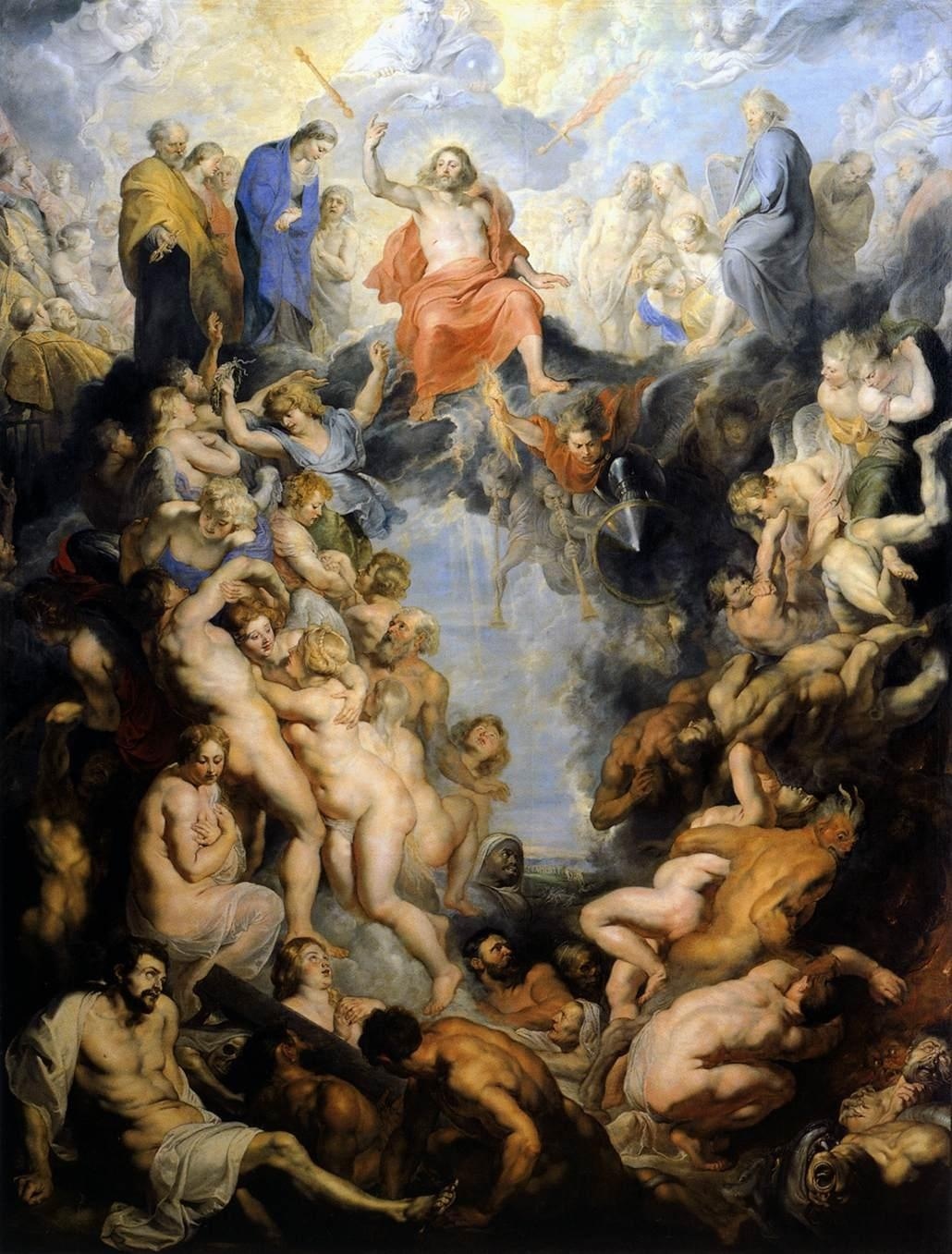
The picture above is called “Judgement Day” and was created specifically for the 2009 GLAAD Art Auction by Troy Dunham of troyboydesign and the photographer Jeff Eason of Wilsonmodels and features many of New York’s finest assets in a modern day re-interpretation of the classic Paul Rubens painting “The Last Judgement” (seen below).

20140201-224553.jpg


God Is Love

20140125-221940.jpg

Beloved, let us love one another, for love is from God, and whoever loves has been born of God and knows God. Anyone who does not love does not know God, because God is love. In this the love of God was made manifest among us, that God sent his only Son into the world, so that we might live through him. In this is love, not that we have loved God but that he loved us and sent his Son to be the propitiation for our sins. Beloved, if God so loved us, we also ought to love one another. No one has ever seen God; if we love one another, God abides in us and his love is perfected in us.

By this we know that we abide in him and he in us, because he has given us of his Spirit. And we have seen and testify that the Father has sent his Son to be the Savior of the world. Whoever confesses that Jesus is the Son of God, God abides in him, and he in God. So we have come to know and to believe the love that God has for us. God is love, and whoever abides in love abides in God, and God abides in him. By this is love perfected with us, so that we may have confidence for the day of judgment, because as he is so also are we in this world. There is no fear in love, but perfect love casts out fear. For fear has to do with punishment, and whoever fears has not been perfected in love. We love because he first loved us. If anyone says, “I love God,” and hates his brother, he is a liar; for he who does not love his brother whom he has seen cannot love God whom he has not seen. And this commandment we have from him: whoever loves God must also love his brother.

1 John 4:7-21

One of our greatest needs as human beings is to be loved. We all need love. We need to know that we are important to somebody, that somebody truly cares about us, wants us, and accepts us unconditionally. When we doubt that we are loved, we may develop unacceptable behavior patterns to compensate for it. We all need to know that somebody loves us.

The good news from God’s Word is that somebody does. To know Him is to find release from the crippling effects of feeling unloved. Twice the Apostle John categorically stated that God is love (1 John 4:8,16). Love is one of the warmest words in the English language, and that God is love is one of the most sublime, uplifting, and reassuring truths known to mankind. Love is His nature. It is not merely a friendly attitude He projects. It is the essence of His being. He is always going to act toward us in love because He cannot do otherwise. Love is the way He is.

Knowing the God of love can help to make us more loving and giving persons. Not only will getting to know Him more intimately cause us to become more like Him, but resting secure in the assurance that He loves us will keep us from making demands of others and free us to reach out unselfishly and minister to them for their benefit alone. It is vitally important that we understand how much God loves us.

Not only does God’s love motivate Him to give, but it motivates Him to give when it costs Him dearly. That too is different from our love. We hesitate to do anything for others that will cost us too much or inconvenience us too greatly. But God’s love cost Him the very best that He had—His only Son. That is the message of the greatest love text in the Bible: “For God so loved the world, that He gave His only begotten Son, that whoever believes in Him should not perish, but have eternal life” (John 3:16). God’s giving His Son involved more than merely allowing Him to leave Heaven’s glory and enter earth’s history. It meant allowing Him to die in our place and pay the awful debt of our sins. God proved His love conclusively and irrefutably by sending His Son to the cross as an atoning sacrifice for our sins (Romans 5:8; 1 John 4:9-10). That is sacrificial love.

Whenever we are tempted to think that nobody loves us, we need to think of the cross. Jesus bore that shame and suffering because He loves us. He values us so highly that He was willing to make the ultimate sacrifice to secure for us eternal joy. That is the epitome of love. Knowing Him intimately will motivate us to make some sacrifices for the good of others—for our spouses, our children, and other members of the body of Christ. It will help us give up what we want in order to minister to their needs.

When some people hear that God’s love is self-giving, sacrificial, unconditional, eternal, and infinite, they get the idea that it is merely soft, sloppy sentimentality, that God is an indulgent Father who gives us everything we want and conveniently turns His head the other way when we sin. But that is not the case. Everything God does is done in the totality of His being, so His love must always be consistent with His other attributes. Since God is holy, then His love must be a holy love that encourages holiness in those loved.

Look for evidences of God’s love for you all throughout the day, and remind yourself often that you are the object of His endless love.


Looking to the Future

20140118-231913.jpg

For I know the plans I have for you, declares the LORD, plans for welfare and not for evil, to give you a future and a hope. Then you will call upon me and come and pray to me, and I will hear you. You will seek me and find me, when you seek me with all your heart.
Jeremiah 29:11-13

I will admit this last week did not go as I had planned. Last Sunday, instead of boarding a cruise ship for seven days, I returned home to my family after I received the news of my aunt’s passing. To say that this week has been difficult would be an understatement. But I am reminded that God has a plan for each of us. James 4:13-17 states:

Come now, you who say, “Today or tomorrow we will go into such and such a town and spend a year there and trade and make a profit”-yet you do not know what tomorrow will bring. What is your life? For you are a mist that appears for a little time and then vanishes. Instead you ought to say, “If the Lord wills, we will live and do this or that.” As it is, you boast in your arrogance. All such boasting is evil. So whoever knows the right thing to do and fails to do it, for him it is sin.

For reasons that may (or may not) one day be revealed to me, it was not in the Lord’s will for me to take that cruise. God has a purpose for everything he does, and we are not to always understand his purpose, but we must remain faithful that is that His purpose is “to give [us] a future and a hope.” And as much as I wanted to go on that cruise, I knew that if I had forsaken my family in a time of need then I would have failed to do the right thing. My mother needed me, so I sacrificed my trip to be with her and comfort her in her time of need.

None of us knows what the future holds. Just as we cannot tell what the future holds; we cannot dwell on the past either. We have to look toward the future and see the great hope it holds for us. Maybe we have had great glories in our past or we have had great misfortunes, but they are things in the past and if we dwell on them, then we become lost in the past. We must look to the future, even though we do not know what it holds. The future has great hope contained within it, especially if we look to God and seek Him with all our heart. If we do this, then the glory of God will shine down on us, and our future cannot help but be bright.


Lift Your Eyes To the Hills

20140111-091651.jpg

A Song of Ascents. I lift up my eyes to the hills. From where does my help come? My help comes from the Lord, who made heaven and earth. He will not let your foot be moved; he who keeps you will not slumber. Behold, he who keeps Israel will neither slumber nor sleep. The Lord is your keeper; the Lord is your shade on your right hand. The sun will not harm you by day, nor the moon by night. The Lord will keep you from all harm he will watch over your life; the Lord will watch over your coming and going both now and forevermore.
Psalm 121

We all travel at some points in our lives, and a prayer for when we travel is important to be sure God knows we want His hand in our vacation, trip or in any journey in which we travel. We all may be good enough in our driving, much aware that there are important travel safety tips we can follow to protect ourselves away from home, but one of the most important is to pray for God to be with us.

Life itself is often a challenging, dangerous journey, with no clear idea what is over the hill in front of you. You “lift your eyes unto the hills” and ask from where will help come. We will all need help and courage in getting over those hills and this can only be fulfilled with the grace of God.

Only The Lord can direct the steps and can provide peace throughout the trip. I know whenever am away from home there are some people back home praying the whole time for my return. For all of my family members, relatives and friends I would express my humble thanks, and request to pray for my journey of life as well. One thing I have gotten to know is the point that no matter where you go and whatever you might experience, God is always their watching over you. May god watch over me this week! and may he watch over all of us in our travels through life.


How Great Thou Art

20140105-041502.jpg

How Great Thou Art

Verse 1:
O Lord my God, When I in awesome wonder,
Consider all the worlds Thy Hands have made;
I see the stars, I hear the rolling thunder,
Thy power throughout the universe displayed.

Chorus:
Then sings my soul, My Saviour God, to Thee,
How great Thou art, How great Thou art.

Then sings my soul, My Saviour God, to Thee,
How great Thou art, How great Thou art!

Verse 2:
When through the woods, and forest glades I wander,
And hear the birds sing sweetly in the trees.
When I look down, from lofty mountain grandeur
And see the brook, and feel the gentle breeze.

Chorus

Verse 3:
And when I think, that God, His Son not sparing;
Sent Him to die, I scarce can take it in;
That on the Cross, my burden gladly bearing,
He bled and died to take away my sin.

Chorus

Verse 4:
When Christ shall come, with shout of acclamation,
And take me home, what joy shall fill my heart.
Then I shall bow, in humble adoration,
And then proclaim: “My God, how great Thou art!”

Chorus

“How Great Thou Art” is a Christian hymnbased on a Swedish poem written by Carl Gustav Boberg (1859–1940) in Sweden in 1885. The melody is a Swedish folk song. It was translated into English by British missionary Stuart K. Hine, who also added two original verses of his own composition.

The inspiration for the poem came when Boberg was walking home from church near Kronobäck, Sweden, and listening to church bells. A sudden awe-inspiring storm gripped Boberg’s attention, and then just as suddenly as it had made its violent entrance, it subsided to a peaceful calm which Boberg observed over Mönsterås Bay. According to J. Irving Erickson:

Carl Boberg and some friends were returning home to Mönsterås from Kronobäck, where they had participated in an afternoon service. Nature was at its peak that radiant afternoon. Presently a thundercloud appeared on the horizon, and soon sharp lightning flashed across the sky. Strong winds swept over the meadows and billowing fields of grain. The thunder pealed in loud claps. Then rain came in cool fresh showers. In a little while the storm was over, and a rainbow appeared.

When Boberg arrived home, he opened the window and saw the bay of Mönsterås like a mirror before him… From the woods on the other side of the bay, he heard the song of a thrush…the church bells were tolling in the quiet evening. It was this series of sights, sounds, and experiences that inspired the writing of the song.

According to Boberg’s great-nephew, Bud Boberg, “My dad’s story of its origin was that it was a paraphrase of Psalm 8 and was used in the ‘underground church’ in Sweden in the late 1800s when the Baptists and Mission Friends were persecuted.” The author, Carl Boberg himself gave the following information about the inspiration behind his poem:

“It was that time of year when everything seemed to be in its richest colouring; the birds were singing in trees and everywhere. It was very warm; a thunderstorm appeared on the horizon and soon thunder and lightning. We had to hurry to shelter. But the storm was soon over and the clear sky appeared.

“When I came home I opened my window toward the sea. There evidently had been a funeral and the bells were playing the tune of ‘When eternity’s clock calling my saved soul to its Sabbath rest.’ That evening, I wrote the song, ‘O Store Gud.'”


Second Chances

20131228-212511.jpg

Bless the LORD, O my soul,
and all that is within me,
bless his holy name!
Bless the LORD, O my soul,
and forget not all his benefits,
who forgives all your iniquity,
who heals all your diseases,
who redeems your life from the pit,
who crowns you with steadfast love and mercy,
who satisfies you with good
so that your youth is renewed like the eagle’s.

The LORD works righteousness
and justice for all who are oppressed.
He made known his ways to Moses,
his acts to the people of Israel.
The LORD is merciful and gracious,
slow to anger and abounding in steadfast love.
He will not always chide,
nor will he keep his anger forever.
He does not deal with us according to our sins,
nor repay us according to our iniquities.
For as high as the heavens are above the earth,
so great is his steadfast love toward those who fear him;
as far as the east is from the west,
so far does he remove our transgressions from us.
As a father shows compassion to his children,
so the LORD shows compassion to those who fear him.
For he knows our frame;
he remembers that we are dust.
As for man, his days are like grass;
he flourishes like a flower of the field;
for the wind passes over it, and it is gone,
and its place knows it no more.
But the steadfast love of the LORD is from everlasting to everlasting on those who fear him,
and his righteousness to children’s children,
to those who keep his covenant and remember to do his commandments.
The LORD has established his throne in the heavens,
and his kingdom rules over all.

Bless the LORD, O you his angels,
you mighty ones who do his word,
obeying the voice of his word!
Bless the LORD, all his hosts,
his ministers, who do his will!
Bless the LORD, all his works,
in all places of his dominion.
Bless the LORD, O my soul!
Psalms 103

As the new year approaches we often think back on the old. We attempt to think of resolutions to help us correct our flaws, and hopefully, give ourselves a second chance in the new year. We are blessed to have a God who grant second chances. In fact, He grants an infinite number of chances. This is good news because most of us mess up the second chance fairly quickly. One of the amazing facets of God’s character is His incredible patience with us. Psalm 86:15 says it well: “But you, O Lord, are a God merciful and gracious, slow to anger and abounding in steadfast love and faithfulness.”

How many times have any of us done something really stupid, and realize it right after, or right in the middle of it? Do you ever get to feeling like you can’t do anything right, wondering why you bother trying as your going to fail anyway? I’ve had instances when I really didn’t mean to hurt someone, yet I did, and I didn’t know how to set it right. I must admit, I’ve experienced this on more days than I want to admit. It just seems like no matter how hard I try, things just don’t seem to work out, or not that often anyway. Yet, in each instance I look to God for guidance, and he shows me the way.

Just as God is patient and forgiving, He wants His children to be patient with and forgiving of others. “Put on then, as God’s chosen ones, holy and beloved, compassionate hearts, kindness, humility, meekness, and patience” (Colossians 3:12). He gives us second chances, and we must give the same to others. Jesus gives a stern warning to those who refuse to forgive, saying that if we will not forgive others, God will not forgive us. If someone is truly repentant, then we are obligated to forgive. Matthew 18:21-22 says “Then Peter came up and said to him, “Lord, how often will my brother sin against me, and I forgive him? As many as seven times?” Jesus said to him, “I do not say to you seven times, but seventy-seven times.”

Forgiveness, however, is not the same thing as reconciliation. Many people struggle to find the balance between showing mercy and enabling a harmful person to continue harming. We should forgive everyone who wrongs us, just as Jesus forgives us. Forgiveness is between our heart and God’s, removing any barriers that non-forgiveness brings. When someone continues to unrepentantly violate another person’s boundaries, a wise person learns to set firmer boundaries.

Giving someone a second chance means we give him another chance to earn our trust. But that does not mean we instantly forget what experience has taught us. Trust must be earned over time, and we are foolish if we give trust prematurely. We can have a loving and forgiving heart that also practices wise guardianship over our lives.

When we have wronged someone, we have no right to demand another chance. But we should work to earn another chance by continued demonstration of repentance and change.

God does everything possible to draw us to repentance, offering forgiveness and second chances (2 Peter 3:9). But if we continue to reject Him, the offer is withdrawn and, at death, there are no more chances (Hebrews 9:27). God’s grace is our model. We can offer second chances to others until a healthy relationship is no longer possible.

In this new year, we should try to emulate God more. Just as he gives us second chances, give others a second chance as well. Maybe that someone deserves even more than a single second chance, then offer them more chances as long as they are attempting to do what is right. However, if that person is continuously hurting you, then forgive them and walk away. Just because someone has hurt you, it does not mean that it was intentional. Give them that second chance, just as God would give you a second chance. Yet, when it is intentional hurting, sometimes it is best to just cut ties. It is often difficult to do so, but it is occasionally what is best for both. Sometimes, it’s easy to just cut ties, but evaluate the situation. Could you help that person more by giving them a second chance? If so, then that is what god asks us to do.

Let God give you a second chance in the new year, and resolve to be a better person. Also, try to give someone in your life a second chance, maybe they truly deserve it. I hope each of you has a blessed and happy 2014!


In the Spirit of Christmas

20131221-234327.jpg

As for the one who is weak in faith, welcome him, but not to quarrel over opinions. One person believes he may eat anything, while the weak person eats only vegetables. Let not the one who eats despise the one who abstains, and let not the one who abstains pass judgment on the one who eats, for God has welcomed him. Who are you to pass judgment on the servant of another? It is before his own master that he stands or falls. And he will be upheld, for the Lord is able to make him stand.

One person esteems one day as better than another, while another esteems all days alike. Each one should be fully convinced in his own mind. The one who observes the day, observes it in honor of the Lord. The one who eats, eats in honor of the Lord, since he gives thanks to God, while the one who abstains, abstains in honor of the Lord and gives thanks to God. For none of us lives to himself, and none of us dies to himself. For if we live, we live to the Lord, and if we die, we die to the Lord. So then, whether we live or whether we die, we are the Lord’s. For to this end Christ died and lived again, that he might be Lord both of the dead and of the living.

Why do you pass judgment on your brother? Or you, why do you despise your brother? For we will all stand before the judgment seat of God; for it is written,

“As I live, says the Lord, every knee shall bow to me, and every tongue shall confess to God.”

So then each of us will give an account of himself to God.
Romans 14: 1-12

This may sound odd, mainly because I love Christmas, but most members of the church of Christ do not celebrate Christmas as a truly religious holiday. Since the bible does not give us a specific time to celebrate the birth of Christ, we celebrate it everyday of the year. My family has always celebrated Christmas though, and it’s always been a special time of year for us.

We’ve always seen it as a good thing to observe Christmas day. The mere marking of times and seasons, when men and women agree to stop work, spend time together, and celebrate the joys of giving, is a wise and wholesome custom. It helps one to feel the supremacy of the common life over the individual life. It reminds us of the joy that surrounds us.

But there is a better thing than the observance of Christmas day, and that is, keeping the spirit of Christmas.

Are you willing to forget what you have done for other people, and to remember what other people have done for you? Are you willing to ignore what the world owes you, and to think what you owe the world? Are you willing to put your rights in the background, and your duties in the middle distance, and your chances to do a little more than your duty in the foreground? Are you willing to see that your fellow-men are just as real as you are, and try to look behind their faces to their hearts, hungry for joy? Are you willing to realize that probably the reason for your existence is not what you are going to get out of life, but what you are going to give to life? Are you willing to close your book of complaints against the management of the universe, and look around you for a place where you can sow a few seeds of happiness? Are you willing to put aside your judgement of your fellow man, and realize that God does not wish us to judge one another? Are you willing to do these things even for a day? Then you can keep the spirit of Christmas.

Are you willing to consider the needs and the desires of of humankind young and old? Are you willing to stop asking how much your friends love you, and ask yourself whether you love them enough? Are you willing to bear in mind the things that other people have to bear on their hearts? Are you willing to do these things even for a day? Then you can keep the spirit of Christmas.

Are you willing to believe that love is the strongest thing in the world–stronger than hate, stronger than evil, stronger than death–and that the blessed life which began in Bethlehem over two thousand years ago is the image and brightness of the Eternal Love? Then you can keep the spirit of Christmas.

And if you keep the spirit of Christmas for a day, why not always? We should open our hearts and minds to all of humankind and be blessed that we are on this earth another day. We should celebrate the love that Jesus Christ brought us each and every day of our lives, not just on December 25. I had planned to expand my post from Friday and discuss more about those who pass judgement on the LGBT community, but I chose to focus on the good that we can do as people. There will always be those who pass judgement on us, but as the passage above states, they will be held accountable for their actions.

At Christmastime we should rejoice and love our fellow man, whether he or she loves us or not. We need to be the better people, for as the angels declared to the shepherds who were watching their flock outside of Bethlehem:

Glory to God in the highest, and on earth peace, good will toward men.
Luke 2:14