Category Archives: Religion

Atypical Sunday

Today was not the typical Sunday.  I got up a little late to go to church this morning, so I hurried to get there.  I was about 2 minutes too late.  Church had already started, and our preacher was leading the singing.  I had noticed that our regular song leader had not left his house yet when I went by, so I had hoped that I would make it before they started.  Apparently, our regular song leader has bronchitis, and so our preacher had stepped in to lead the singing.  It’s a small congregation, so we don’t have enough kids to have Sunday School, but we do start every service with “Jesus Loves Me” for the kids.  As soon as the song was over, our preacher stopped and asked if I wanted to lead the singing today.  I was the song leader before I moved away for graduate school.  I was never very good at it.  I’m just not a loud enough and confident enough of a singer to lead a congregation, let alone a small congregation where every singer counts and there is no musical accompaniment since it is a Church of Christ. Luckily, there was already a song service planned out that I had used the last time I had to be the substitute song leader.  I just wasn’t exactly prepared.  I usually need to get mentally read to sing and make sure that the right tune comes out.  I admit, I faltered a few times today.  I even had to restart “The Old Rugged Cross” because I started it wrong.  Overall, I guess the song service went well.  I did my best. The Bible does say:

Speaking to yourselves in psalms and hymns and spiritual songs, singing and making melody in your heart to the Lord.

Ephesians 5:19 (KJV)

Today, we made a joyful noise only because we did it for the glory of God.  Others may not have agreed that it was a joyful noise, but to me, there is nothing more beautiful than a group of people in a small country church where everyone is singing and making melody in our hearts to the Lord.


GOD LOVES YOU! No matter what others may say

Can a gay person really be saved? What does the Bible really say? According to the Bible, I found that the answer is yes! Furthermore, you don’t have to “stop being gay” in order to be considered righteous by God!
This article is based on two assumptions:

First, God sent his Son into the world for all of us. According to John 3:16, 17 there are no conditions on God’s love. The only condition set on obtaining everlasting life, or salvation, is to believe in Jesus.
John 3:16-17

For God so loved the world, that he gave his only begotten Son, that whosoever believeth in him should not perish, but have everlasting life. For God sent not his Son into the world to condemn the world; but that the world through him might be saved. (KJV)

Second, what we are to believe about Jesus is that he died and was raised from the dead on the third day. If we believe this with our hearts and confess with our mouth that “Jesus is Lord” then we will be saved according to the Bible:
Romans 10:9-10

That if thou shalt confess with thy mouth the Lord Jesus, and shalt believe in thine heart that God hath raised him from the dead, thou shalt be saved. For with the heart man believeth unto righteousness; and with the mouth confession is made unto salvation. (KJV)

TRADITIONAL TEACHING: Gays are an abomination…

According to the general Church community gays are an abomination. Gays are told that they have a no hope in God; they will end up like the people of Sodom and Gomorrah; and they are treated as though they embody all evil. A Christian co-worker once told me that the antichrist is going to be a homosexual man. She believed that he was going to be in the closet at first to make everybody like him. She said that when the time comes for him to show his evil he will come out of the closet. I want to proclaim to you that the concept that gays have no hope in God, as gay people, is not a Biblical teaching but a traditional teaching.
Colossians 2:8

Beware lest any man spoil you through philosophy and vain deceit, after the tradition of men, after the rudiments of the world, and not after Christ. (KJV)

There are many examples of traditional teachings that served no other purpose but to separate people from God.

  1. Galileo discovered that the earth revolved around the sun. The Church considered this heresy according to their misinterpretation of Genesis 1. They sentenced him to life imprisonment under house arrest.
  2. The Church used Genesis 9:21-27 to “prove” that Blacks were cursed by God into a life of slavery in order to justify what was done to them during the plantation days and to justify racism. The fact is that the curse fell upon Canaan, one of Noah’s grandson’s. Canaan was one of four brothers. His three brothers settled in Africa but Canaan settled in the Middle East.
  3. Another example of a traditional teaching with no basis in Scripture is the hatred of Jews. Some think that God condemned the Jews because they killed Jesus. If it were not for the death and resurrection of Jesus Christ there would be no salvation. Jesus himself was a Jew!

Finally, the Church community is wrong when it uses God’s Word to condemn you for being gay. The fact that you care what God thinks about you, proves them wrong! The fact that you have suffered hurt, humiliation, guilt, rejection and shame at the hands of these people proves that they are misrepresenting God!

The God of the Bible is full of justice, mercy and love. Yes, He has gotten and will get angry with people, but this anger is always precipitated by three things: abandoning Him in exchange for another god, abusing others morally, financially, sexually or otherwise, and abusing ourselves in the same manner. You will see this consistent theme from Genesis to Revelation.

SOURCEInspiritus


A Model of Christian Charity

This semester, I am teaching the first part of the US History Survey for the first time.  It has been a wonderful experience so far, and I have enjoyed going back and reading some of the early American documents to refresh myself on them for my lectures.  One of my favorites is John Winthrop’s “A Model of Christian Charity.”  This is Winthrop’s most famous thesis, written on board the Arbella in 1630. We love to imagine the occasion when he personally spoke this oration to some large portion of the Winthrop fleet passengers during or just before their passage.

In an age not long past, when the Puritan founders were still respected by the educational establishment, this was required reading in many courses of American history and literature. However, it was often abridged to just the first and last few paragraphs. This left the overture of the piece sounding unkind and fatalistic, and the finale rather sternly zealous. A common misrepresentation of the Puritan character.

Winthrop’s genius was logical reasoning combined with a sympathetic nature. To remove this work’s central arguments about love and relationships is to completely lose the sense of the whole.  You may read the full text by clicking on the link above.  However, below, I have done what so many in American history and literature have done and just given you the last few paragraphs.

Now the only way to avoid this shipwreck, and to provide for our posterity, is to follow the counsel of Micah, to do justly, to love mercy, to walk humbly with our God. For this end, we must be knit together, in this work, as one man. We must entertain each other in brotherly affection. We must be willing to abridge ourselves of our superfluities, for the supply of others’ necessities. We must uphold a familiar commerce together in all meekness, gentleness, patience and liberality. We must delight in each other; make others’ conditions our own; rejoice together, mourn together, labor and suffer together, always having before our eyes our commission and community in the work, as members of the same body. So shall we keep the unity of the spirit in the bond of peace. The Lord will be our God, and delight to dwell among us, as His own people, and will command a blessing upon us in all our ways, so that we shall see much more of His wisdom, power, goodness and truth, than formerly we have been acquainted with. We shall find that the God of Israel is among us, when ten of us shall be able to resist a thousand of our enemies; when He shall make us a praise and glory that men shall say of succeeding plantations, “may the Lord make it like that of New England.” For we must consider that we shall be as a city upon a hill. The eyes of all people are upon us. So that if we shall deal falsely with our God in this work we have undertaken, and so cause Him to withdraw His present help from us, we shall be made a story and a by-word through the world. We shall open the mouths of enemies to speak evil of the ways of God, and all professors for God’s sake. We shall shame the faces of many of God’s worthy servants, and cause their prayers to be turned into curses upon us till we be consumed out of the good land whither we are going.

And to shut this discourse with that exhortation of Moses, that faithful servant of the Lord, in his last farewell to Israel, Deut. 30. “Beloved, there is now set before us life and death, good and evil,” in that we are commanded this day to love the Lord our God, and to love one another, to walk in his ways and to keep his Commandments and his ordinance and his laws, and the articles of our Covenant with Him, that we may live and be multiplied, and that the Lord our God may bless us in the land whither we go to possess it. But if our hearts shall turn away, so that we will not obey, but shall be seduced, and worship other Gods, our pleasure and profits, and serve them; it is propounded unto us this day, we shall surely perish out of the good land whither we pass over this vast sea to possess it.

Therefore let us choose life,
that we and our seed may live,
by obeying His voice and cleaving to Him,
for He is our life and our prosperity.

A City upon a Hill is a phrase from the parable of Salt and Light in Jesus’ Sermon on the Mount. In Matthew 5:14, he tells his listeners, “You are the light of the world. A city that is set on a hill cannot be hidden.” The phrase entered the American lexicon early in its history, in the Puritan John Winthrop’s 1630 sermon “A Model of Christian Charity”. Still aboard the ship Arbella, Winthrop admonished the future Massachusetts Bay colonists that their new community would be a “city upon a hill”, watched by the world—which became the ideal the New England colonists placed upon their hilly capital city, Boston. Winthrop’s sermon gave rise to the widespread belief in American folklore that the United States of America is God’s country because metaphorically it is a Shining City upon a Hill, an early example of American exceptionalism.

American exceptionalism refers to the theory that the United States is qualitatively different from other countries. In this view, America’s exceptionalism stems from its emergence from a revolution, becoming “the first new nation,” and developing a uniquely American ideology, based on liberty, egalitarianism, individualism, populism and laissez-faire. This observation can be traced to Alexis de Tocqueville, the first writer to describe the United States as “exceptional” in 1831 and 1840. Historian Gordon Wood has argued, “Our beliefs in liberty, equality, constitutionalism, and the well-being of ordinary people came out of the Revolutionary era. So too did our idea that we Americans are a special people with a special destiny to lead the world toward liberty and democracy.”

I think that we still have that call of duty to be the “city upon a hill,” though I see it a little differently.  American exceptionalism is alive and well, but in truth what are we exceptional at? Do we continue to uphold a uniquely American ideology, based on liberty, egalitarianism, individualism, populism and laissez-faire.  I don’t think that most of us do.  Too many are out for what is best for us, not best for our country or the world.  I think that we should believe in what Jefferson wrote in the Declaration of Independence “We hold these truths to be self-evident, that all men [and women] are created equal, that they are endowed by their Creator with certain unalienable Rights, that among these are Life, Liberty and the pursuit of Happiness.”  Why then do politicians and Americans fight against equal rights for the GLBT community?  Why are we so often excluded from these ideals?  God, and, yes, our Founding Fathers advocated love and equality.  Why then are we held back from having equality?  Why do some of us have to hide who we are behind a closet door?  Why can’t we be accepted for who we are without fear of rejection?

I know there are no easy answer to these questions, but when I look at these early documents and the ideology that the United States was founded on, then it makes me question what kind of government Americans expect us to have and what kind of God they are claiming to follow.  In my humble opinion, it is not the government of our Founding Fathers (though most, if not all of the Founding Fathers, would not have wanted equality for what they would have termed sodomites) nor is it the religion of the one true God.


Christian Love

As Christians, God’s greatest commandment is a simple one, but sometimes it is the most difficult to follow.

Thou shalt love the Lord thy God with ALL thy heart, and with ALL thy soul, and with ALL thy mind. This is the first and great commandment. And the second is like unto it, Thou shalt love thy neighbor as thyself. On these two commandments hang ALL the law and the prophets.

Matthew 22:35 

When things do not go well in our life, we sometimes questions God, and if we are questioning God, then we are not loving him with all of our heart, soul, and mind.  Love and trust go together, and even when times get bad, we must trust in the Lord that he will be there by our side, helping us through the troubled times.

The second greatest commandment can be really difficult to follow.  How many times have you thought, “I really hate this/that person”?  How many times have you felt anger toward someone for something that they did wrong?  I constantly feel anger at people who call themselves Christians but then do not follow God’s greatest commandments and love one another.  This probably makes me a hypocrite, but in the end, I try to love all of my fellow men.  For all of those who give speeches about America being a Christian nation, how can they condemn others and yet still follow God’s word?  It is something that has always perplexed me.

I teach my high school students the Golden Rule on a regular basis.  It is on the wall in my classroom.  They see it each and every day, and I hope that it will sink into them and give our next generation a better hope.  With Valentine’s Day drawing near, and with some of us who are single, we should all remember that God’s Greatest Commandment is LOVE.


I’d Like to Hear Your Opinion on This

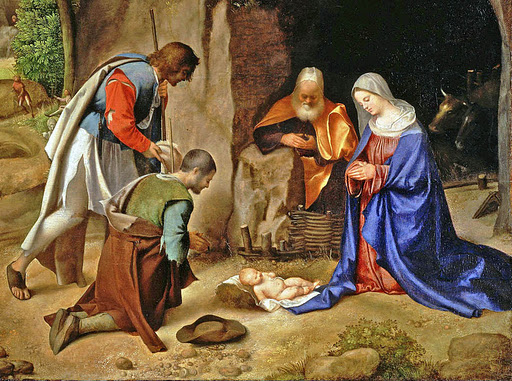
Anbetung der Hirten (Adoration of the Shepherds) (c. 1500–10), by Italian painter Giorgio da Castelfranco

I read this article, and thought that the whole thing was a bit ridiculous. I know that not all of my readers will agree with me about this, but I do hope that you will read it.

‘Silent Night’ in school Christmas play could lead to lawsuit
TUSCUMBIA, AL (WAFF) – A Tuscumbia elementary school plans on keeping “Silent Night” a part of their holiday program.
A Washington DC group has threatened legal action if students sing the song.
The non-profit said the song violates federal law and the separation of church and state.
Florence City Schools have had a front row seat to two of these separation of church and state issues.
Earlier this year, Brooks High School came under fire for public prayer at football games.
Now there’s the controversial decision to sing “Silent Night” at G.W. Trenholm Primary School in Tuscumbia.
Florence City Schools Superintendent Dr. Janet Womack said every program her district does is checked by the district’s attorney.
She said the district is always keeping up to date with court decisions.
She also said watching what’s going on in these other districts is a reminder of how important communication needs to be between school employees, administration, and the central office.
“It’s always being willing to ask for guidance instead of stepping into a gray area asking for guidance first so that we don’t create a landmine for ourselves that would take and deter away the attention from what our main focus is,” she said.
WAFF 48 News spoke to the group in Washington DC, and they told us what they plan to do next.
They said this is the only public school they know of where a religious message is being relayed in an elementary school play. And they said that’s why they’ve targeted this school.
They’ve already sent a letter to the Tuscumbia City School Board.
That letter says the school needs to edit the play and get rid of the song “Silent Night.”
The district told us Wednesday they don’t plan on making any edits to the program.
Americans United for the Separation of Church and State said that means they’ll take legal action.
“I hope that cooler heads prevail and people understand that this is a significant constitutional issue and they don’t go along with the idea of continuing the plans to sing this hymn as part of what should be a secular public school event,” said Barry Lynn, executive director of the nonprofit group.

There are several things that I see wrong with what  the group Americans United for the Separation of Church and State are doing.  First of all, let me state that I am a firm believer in the separation of church and state.  I don’t believe that anyone should tell me how to worship.  That being said, Christmas is first and foremost a religious holiday.  It is for the Mass of Christ’s birth, regardless of whether or not it had it origins in pagan rituals or that it become more and more commercial each year.  Also, “Silent Night” is one of the most popular Christmas songs.  It has always been one of my favorites.  Furthermore, Tuscumbia, Alabama, is a small north Alabama town of less than 9,000 people, which is most famous for being the birthplace of Helen Keller.  Why would the Americans United for the Separation of Church and State be worried about a small north Alabama elementary school.  I guess my point is that if they are going to have a Christmas program, which school all over the country have, then why should they not be allowed to sing about the origins of the holiday?  Anyway, I would love to hear your opinion on this, whether you agree with me or not.

I hope that you are all having a wonderful holiday season.


Adelphopoiia Rite

A Same Gender Union from the Eastern Orthodox Church
Translation by Nicholas Zymaris
Published in 1647
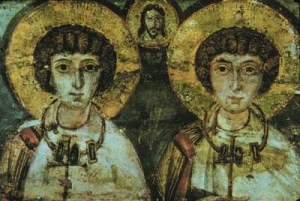
Sergius and Bacchus

This service is a rite of the Eastern Orthodox Church dating from very early times and assuming its present form between the fourth and ninth centuries AD. This service is translated from the Euchologion of Jacobus Goar, which was printed in 1647 and revised in 1730. A facsimile of the 1730 edition, published in Graz, Austria, in 1960, is the edition available in many theological libraries. With the rising influence of western ideas in recent centuries, this rite ceased to be practiced widely and was largely forgotten or ignored except in isolated areas, most notably Albania and other areas in the Balkans, where it flourished throughout the nineteenth century and up to at least 1935. Both men and women were united with this rite or similar ones.

This rite is called “spiritual” because the relationship between spiritual brothers is not one of blood-relation but of the Holy Spirit, and also to distinguish the rite from blood-brotherhood, which the Church opposed. In the service, the saint-martyrs Sergius and Bacchus are invoked, who were united in spiritual brotherhood “not bound by the law of nature but by the example of faith in the Holy Spirit”. These saints were tortured and martyred late in the third century AD. when they refused to worship the emperor’s idols. In their biography by Simeon Metaphrastes (available in J.P. Migne, Patrologia Graeca, vol. 115, pp. 1005-1032) they are described as sweet companions and lovers to each other.”

“This rite is incorporated into the Divine Liturgy. It begins with the usual blessing and prayers of a Liturgy. During the Great Synapte, petitions for the couple to be united in spiritual brotherhood are added to the usual petitions. After the First Antiphon, two special prayers are said for the couple, after which they kiss the Gospel Book and each other. After the priest sings a hymn, the Liturgy continues at “Have mercy on us, O God .. “. Accounts of the use of this rite (such as Nacke, _Jahrbuch fuer sexuelle Zwischenstufen_ 9 (1908),. 328) confirm that the spiritual brothers receive Holy Communion together, thereby forming the sacramental bond in this union. However, Goar mentions in a footnote that in some manuscripts, the couple is only blessed with holy water.”

PRIEST: Blessed is the kingdom of the Father and the Son and the Holy Spirit, now and ever and unto ages of ages. Holy God, Holy Mighty, Holy Immortal, have mercy on us. (3 times).
Glory to the Father and the Son and the Holy Spirit, now and ever and unto ages of ages. Amen.
All-Holy Trinity, have mercy on us.
Lord forgive our sins.
Master, pardon our transgressions.
Holy One, visit and heal our infirmities for your name’s sake.
Lord, have mercy. Lord, have mercy. Lord, have mercy.
Glory to the Father and the Son and the Holy Spirit, now and ever and unto ages of ages. Amen.
Our Father, who is in heaven, hallowed be your name. Your kingdom come. Your will be done, on earth as it is in heaven.
Give us this day our daily bread; and forgive us our trespasses, as we forgive those who trespass against us; and lead us not into temptation, but deliver us from evil. For yours is the kingdom and the power and the glory, of the Father and the Son and the Holy Spirit, now and ever and unto ages of ages. Amen.
(After this, the priest says the Troparion.)
Save, O Lord, your servants, and bless your inheritance.
(And the two who are about to be joined together in brotherly unity place their hands on the holy Gospel book, which has been prepared and placed on the table. And they hold in their hands lighted candles.)
(And the priest says the following, so that it is heard from above:
Save, O Lord, your servants. Followed by the Troparion of the day
Glory to the Father and the Son and the Holy Spirit.
Holy Apostles, intercede with the merciful God to grant our souls forgiveness of sins.
Now and ever and unto ages of ages. Amen.
Through the intercessions, O Lord, of all the saints and of the
Theotokos, grant us your peace and have mercy upon us, only merciful One.

THE GREAT SYNAPTE

(The responses of “Lord, have mercy” are understood.)
In peace let us pray to the Lord.
For the peace that is from above, and for the salvation of our souls, let us pray to the Lord.
For the peace of the entire world, the welfare of the holy churches of God, and the union of all of them, let us pray to the Lord.
For this holy house, and for those who enter it with faith, reverence, and fear of God, let us pray to the Lord.
For our Archbishop, the honorable priesthood, the deacons in Christ, and all of the clergy and laity, let us pray to the Lord.
For the servants of God who have approached to be blessed by Him, and for their love (agapesis) in God, let us pray to the Lord.
That they may be given full knowledge of the apostolic unity, let us pray to the Lord.
That they may be granted a faith unashamed, a love unfeigned, let us pray to the Lord.
That they may be deemed worthy to glory in the honorable Cross, let us pray to the Lord.
That both they and we may be delivered from all affliction, wrath, and distress, let us pray to the Lord.
Help us, save us, have mercy on us and keep us, O God, by your grace.
PEOPLE: Amen.
PRIEST: Having called to remembrance our all-holy, immaculate, most blessed, glorious Lady Theotokos and ever-virgin Mary, with all the Saints, let us commend ourselves and one another, and all our life unto Christ our God.
PEOPLE: To You, O Lord.
PRIEST (quietly): O Lord our God, whose might is beyond compare, whose glory is incomprehensible, whose mercy is infinite, and whose love toward mankind is ineffable; in Your tender compassion look down upon us Yourself, O Master, and upon this holy house, and grant us and those who pray with us Your rich mercies and compassion.
PRIEST (aloud): For to You are due all glory, honor, and worship; to the Father and the Son and the Holy Spirit, now and ever and unto ages of ages.
PEOPLE: Amen.
PRIEST: Let us pray to the Lord.
Lord our God, who has granted us all things for salvation, and who has commanded us to love one another and to forgive each others’ transgressions; now You Yourself, Master and Lover of mankind, to these Your servants who have loved each other with spiritual love, and who approach Your holy temple to be blessed by You, grant to them a faith unashamed, a love unfeigned. And as You gave Your holy disciples Your own peace, also grant these all the petitions for salvation, and eternal life. For You are a merciful and loving God, and to You we ascribe glory, to the Father and the Son and the Holy Spirit. Let us pray to the Lord.
Lord our God, the omnipotent, who made the heaven and the earth and the sea, who made man according to Your image and likeness, who was well-disposed to Your holy martyrs Sergius and Bacchus becoming brothers, not bound by the law of nature but by the example of faith of the Holy Spirit; Master, do send down Your Holy Spirit upon Your servants who have approached this temple to be blessed. Grant them a faith unashamed, a love unfeigned, and that they may be without hatred and scandal all the days of their lives. Through the prayers of Your immaculate Mother and of all the Saints. For Yours is the kingdom and the power and the glory, of the Father and the Son and the Holy Spirit, now and ever, and to the ages.
(And with the table made ready in the middle of the church, they place the holy Gospel upon it. And they kiss the Holy Gospel, and each other.)
THEN THE PRIEST SINGS: By the union of love the apostles join in the praying to the Master of all; themselves committed to Christ, they extended their beautiful feet, announcing the good news of peace to everyone.
PRIEST: Have mercy on us, O God.

(And continues the Liturgy.)

Source:  Adelphopoiia Rite (version one)


St. Sebastian: The Patron Saint of Homosexuals

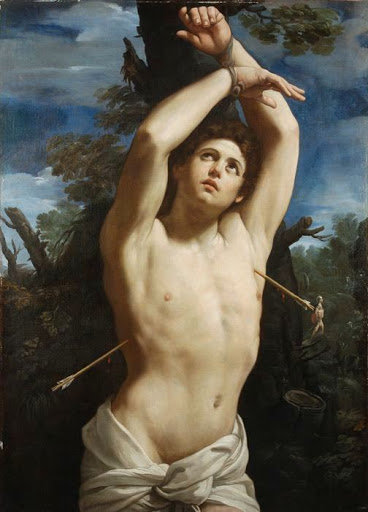
Saint Sebastian by Guido Reni (c. 1616)

There is hardly anything unusual or particularly compelling about a gay icon who is young, beautiful, white, shirtless, and baby-faced. But what if this same boyish icon had emerged from a key historical antagonist of same-sex desire: the teachings of Christianity?

The case of Saint Sebastian, who was martyred in 287, animates several complex questions about the evolution of a gay idol, not the least of which is his so-called appropriation from the hallowed pages of Church history and martyrology to the visual, literary, and filmic works of numerous gay artists.

Although he has had various embodiments throughout history–plague saint in the Middle Ages, shimmering youth of Apollonian beauty throughout the Renaissance, “decadent” androgyne in the late nineteenth century–Sebastian has long been known as the homosexual’s saint.

Precisely when and how this role evolved may be related to details of St. Sebastian’s life, the earliest reference to which can be found in the Martyrology of 354 A.D., which refers to him as a young nobleman from either Milan or Narbonne, whose official capacity was commander of a company of archers of the imperial bodyguard.

According to the Church’s official Acta Sanctorum, Sebastian, serving under the emperors Diocletian and Maximian, came to the rescue of Christian soldiers, Marcellinus and Mark, and thereby confessed his own Christianity. Diocletian insisted that Sebastian be shot to death by his fellow archers; these orders were followed, and Sebastian was left for dead.

What is often neglected in later accounts is that Sebastian survived this initial attack after having been nursed by a “pious woman,” St Irene of Rome. Diocletian was required to order a second execution, and this time Sebastian was beaten to death by soldiers in the Hippodrome.

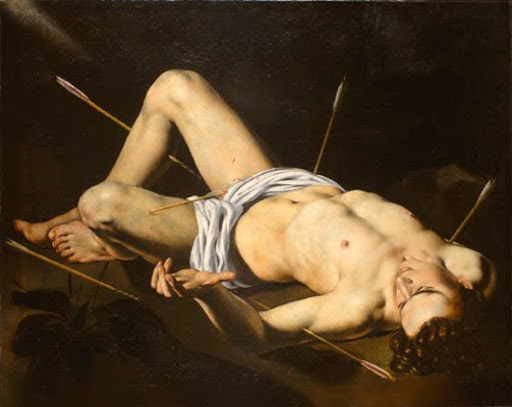
School of Nicolas Regnier, Saint Sebastian, 17th century

These details–based on accounts written centuries after Sebastian’s death and therefore largely apocryphal–may have helped form Sebastian’s subsequent reputation as a homosexual martyr since his story constitutes a kind of “coming out” tale followed by his survival of an execution that may be read symbolically as a penetration.

Renaissance representations of Saint Sebastian–mostly paintings of a tender, loin-clothed youth writhing in the ecstasy of the arrows that pierce him–are perhaps ground zero for his appointment as the patron saint of gay sensuality.

And for seemingly obvious reasons. Sebastian’s supple, near-naked body; the wink-wink symbolism of the penetrating arrows; his thrown-back head expressing a mixture of pleasure and pain; and his inviting gaze all readily contribute to his homoerotic appeal. But Sebastian’s entry into gay cultures in the first place most certainly involves his origins as an emblem of Christian godliness and martyrdom.

Same-sex desire is often, on many levels, about the crossing of lines, the overturning of sacred norms, the pleasure of the forbidden. Both the story of Sebastian and his subsequent role in modern gay cultures epitomize this subversive impulse: Sebastian revels in the pleasure of his own martyrdom as gay men revel in gazing upon an off-limits emblem of Christian holiness. By all accounts, Sebastian is a very good “bad object choice.”

Possibly his role as a plague saint may have generated associations between Sebastian and what, in a nineteenth-century medical context, was represented as a disease, homosexuality.

The question of whether Sebastian himself was gay is largely moot. While some historical records suggest a notable affection between the saint and his male superiors, after almost two thousand years Sebastian’s sexuality is not only greatly speculative, but also rather inconsequential.

However, while it is doubtful that a buried homosexual existence could justify his current camp popularity, it seems equally doubtful that his homoerotic associations can be explained away as the superficial afterthoughts, revisions, or cross-readings of a willful contemporary gay purview.

Saint Sebastian is not just represented in the visual arts during the Renaissance, but also in the written arts as well. In Shakespeare’s Twelfth Night (1600), for example, the character of Sebastian, saved from a shipwreck by Antonio, is the intense focus of Antonio’s love: “And to his image, which methought did promise / Most venerable worth, did I devotion.”

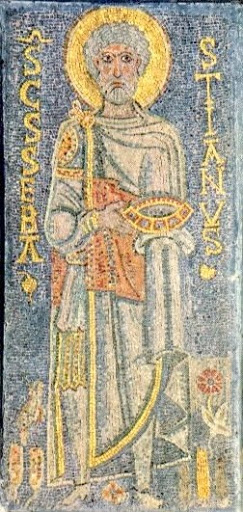
Mosaic of St. Sebastian, ca. 682 in San Pietro in Vincoli

Sebastian has been reinvented numerous times in history, from the middle-aged man in the mosaic at the Church of San Pietro in Vincoli, not far from San Sebastiano Fuori le Mura, where the martyr’s punctured remains have lain since the year 287 AD. Here, in a niche to the left, is the seventh-century mosaic of a middle-aged man, bearded and in Byzantine court dress. Perhaps Sebastian’s oddest reinvention came in Thomas Mann’s Nobel Prize acceptance speech. “Grace in suffering – that is the heroism symbolised by St Sebastian,” said Mann; then, warming to his theme, he added: “The image may be bold, but I am tempted to claim this heroism for the German mind and German art.” The date was 1929. A decade later, German gays such as Mann were being rounded up and tortured in the Nazi concentration camps.

All of which is to say that the secret of Sebastian’s success may lie in his ability to be all things to all men. Along with the famous arrows, the symbol of his martyrdom is the rope that binds his hands; yet the shape-shifting Sebastian just won’t be tied down. The novelist and political activist Susan Sontag pointed out that his face never registers the agonies of his body, that his beauty and his pain are eternally divorced from each other. This made him proof against plague in 1348, and, in these ungodly times, it still does.

Sources:


Who Decides What’s Right or Wrong?

We all know the Bible appraises self-worth according to strict sets of laws and hierarchies: Go to Hell if you covet the neighbor’s house, kill the neighbor, or take off with the neighbor’s wife.  It runs moral meanings smooth over broken fine lines that fall somewhere between fact and fiction and good and evil. God still hates figs and shrimp, right? It also often hides contradiction and its very own accommodating history under stories that once upon a time were not its own: Remember, Christmas and Easter grew from Pagan roots.


Unfortunately for us, the Bible and people’s interpretations of it can brew misguided thoughts about homosexuality. But it does deserve our attention. Its words read just like modern humans behave: We wake hand-in-hand with dissension; we evolve, yet still keep patterns of judgment close. And we all at some point in time ask, “Where did we come from? What’s the point?”
So where do the gays go from here?
Well, former United Methodist minister and Duke University seminary scholar, Jimmy Creech, suggests that maybe it’s time we re-evaluate what the Bible really says about homosexuality.
In Adam’s Gift: A Memoir of a Pastor’s Calling to Defy the Church’s Persecution of Lesbians and Gays, straight-identifying Creech defends same-sex love against the Church’s dangerous distortion of homosexuality as sin. He digs deep into Biblical texts, mines credible sense from scripture and history, and writes passionately about his decision to reconcile his stance on gay rights and same-sex marriage even though these things ultimately led the Church to revoke his ordination credentials.
What would Jesus do? Jimmy Creech might know.


Does the Bible condemn homosexuality?

No, it’s actually not possible for the Bible to say this in any way. First of all, the writers of the Bible had no understanding of the innate human trait of sexual orientation. Consequently, there were no words for homosexuality, bisexuality and heterosexuality. These words were coined in the late 1800s when the young science of psychology studied human sexuality and discovered that sexual orientation is an innate aspect of human personality. We’ve come to understand these three sexual orientations as equally normal, natural and healthy. There are a few references in the Bible to same-gender sexual acts, though all of them are condemned because of the context in which they are found: violent rape, idolatry, and promiscuity. There is, by the way, no condemnation in the Bible of same-gender loving relationships. However, because of the fear and prejudice against same-gender loving relationships, church leaders have used these condemnations of violence, idolatry and promiscuity to condemn same-gender loving relationships. If the logic used against homosexual sex acts was used in the context of condemned heterosexual sex acts, one could claim the Bible says “heterosexuality is a sin.” But, of course, no one does. 
Another issue at play is patriarchal culture. Men are considered the masters (the Hebrew for husband actually means “lord”) and women are inferior and subservient. Consequently, for a man to have sex with another man as men have sex with women violates the rigid gender roles and threatens the patriarchal culture. Such an act puts the submissive man in the woman’s role which from the biblical perspective is “abominable.” Interestingly, there’s only one biblical reference to women having sex with women (chapter one of Romans), most likely because the writers of the Bible (men) weren’t concerned about that – it didn’t threaten their patriarchal culture. 
The few references to same-gender sexual acts have thus been interpreted and used in ways to justify the persecution of LGBT people. In similar ways, passages in the Bible were interpreted in ways to justify slavery, white supremacy and racial segregation. The Bible denies equal rights to women because of its patriarchy and allowed the persecution and mass murder of Jews. Modern society has rejected the misuse of the Bible to justify these injustices even though each case is a form of abuse. Using the Bible to justify the persecution of LGBT people is no less an abuse and can no longer be tolerated. It’s intellectually dishonest, pure bigotry.

Can you explain how the word “homosexual” is misused in Biblical texts?

In First Corinthians and First Timothy, the Apostle Paul used Greek words that no one else had ever used – either before him or after him.  These words came to be associated with homosexuality in the late 13th Century after Thomas Aquinas condemned same-sex sexual acts in his writings. From then on, the Greek words in these two passages were understood to mean, a “man who has sex with a man.”  Because there was no Hebrew, Aramaic or Greek words (the three languages in which the Bible was written) for a “man who has sex with a man,” the term Sodomite was invented.  It is often found in translations, but has no basis in the languages of the Bible – it’s purely an example of bigotry written into those translations after the fact.
Aquinas was the first church teacher to associate the destruction of Sodom and Gomorrah with same-sex acts.  Before then, the destruction was attributed to the violent inhospitality and greed of the people of Sodom and Gomorrah.  A similar thing happened when the Revised Standard Version of the Bible was published in 1952.  Instead of using “a man who has sex with a man,” or the King James version, “them that defile themselves with mankind,” or Sodomites, the translators chose to use the modern term homosexual – even though there was no basis for it in biblical languages. Consequently, people who do not know this history innocently claim that the Bible says “homosexuals can’t inherit the kingdom of heaven” because First Corinthians says so; and, that “homosexuals” are contrary to sound doctrine. 
While careful study of these passages reveals no condemnation of same-sex loving relationships, the mass of people who read these passages without the benefit of careful study feel justified in condemning homosexuals. The harm that has been done to LGBT people by this scandalous scholarship cannot be exaggerated. 

Do you think Christianity will eventually embrace LGBT people in the future, however near or far?

Yes, mainline Christian communities will fully embrace the LGBT community with equal standing and participation in the nearfuture. Christian communities actually have come a long way toward this goal in a relatively short time. The Unitarian Universalist Association was the first in this country, soon after Stonewall. And now the United Church of Christ, the Presbyterian Church, USA, the Episcopal Church, USA, and the Evangelical Lutheran Church of America have all embraced the ordination of clergy in same-sex committed relationships and marriage for same-sex couples.
Even though the ecclesiastical leadership of the Roman Catholic Church remains adamantly against sexually active LGBT people, more than 74% of Catholic laity support same-sex marriage or civil unions with support for their full civil rights and equal protections. There will be some who will never accept same-sex relationships, but they belong to the past of fear and hatred, not the future of acceptance and equality.
What do you say to non-believers, atheists and agnostics? Do you see religion as something essential and necessary to humanity’s place in the universe?

No, I don’t believe religion is essential and necessary. Religion is an organized or structured expression of the innate wonder and awe human beings have about life, nature and time. This wonder and awe and the beliefs people have about it are not dependent on religious language and concepts. I find common ground with anyone who explores those big questions about life.
Being religious doesn’t guarantee a person will be good, nor does being a non-believer make a person bad. These are just two ways humans approach the mysteries of life. But, I do believe everyone who is aware and sensitive to what’s happening in the world, in their lives and the lives of others, has a keen sense of wonder and awe about it all. What really matters is how we treat each other.

Your memoir, Adam’s Gift, is about the United Methodist Church’s decision to revoke your ordination credentials after you performed same-sex commitment ceremonies. But what do you think the real gift was for you? 

Adam’s gift was the truth about himself – a truth he’d concealed for nearly 50 years of his life. It was a gift because it opened my eyes to a reality I’d not seen before – a persecution of LGBT people in which I unknowingly was complicit. It was his humanity, his dignity and integrity, his gentleness and humility that would not allow me to rely on my conventional stereotypes and prejudice about the gay community. While there was much study and understanding I had to pursue afterward, Adam transformed me in the moment he revealed to me his true personhood and personal history. He gave me his most precious gift: His personal truth. 
How do you feel about Christianity’s position in US politics? It’s sad, but a holier than thou attitude still marginalizes the LGBT community.

It’s not possible to speak of “Christianity” as if it is one set of beliefs and values. Today, Christianity is not a term that has meaning because of the diversity within and among Christian groups. The Christians with whom I’m aligned are progressives. There are large numbers of moderate Christians too. And, there are Christian reactionaries who have found a political home in the Republican Party. The attack on LGBT people by many Christian reactionaries is sincere – meaning, it is an expression of their real fear and prejudice. However, right-wing politicians cynically exploit this bigotry for political ends (Karl Rove and George W. Bush). I believe that the political strategy of exploiting anti-gay bigotry is coming to an end. With marriage equality in a growing number of states, with the repeal of DADT, and the current discussion of the Respect for Marriage bill, the momentum is toward inclusion and acceptance, not exclusion.  Even some right-wing Republicans are saying their party should no longer talk about gay issues. 

How do you think we can change the way other people less understanding think about LGBT people?

People I know who’ve changed their hearts and minds about gay people have done so because they got to know someone who is gay. They didn’t change because of a good argument or debate about the Bible. They changed because they couldn’t reconcile their fear and hatred with the dignity and character of someone they discovered to be gay. Sometimes, this is a new acquaintance whose respect is earned over time.  Sometimes, it’s someone loved for a lifetime. So, the gift Adam gave to me is a gift all lesbian, gay, bisexual and transgender people can give to someone – a parent, sibling, child, neighbor, pastor, friend or colleague. LGBT people should not undervalue the power of their own dignity and integrity. There are, of course, some people whose minds and hearts will never change.
In addition, those of us who are straight must challenge anti-gay bigotry and malice whenever we encounter it and challenge elected officials who perpetuate persecution. An unjust world belongs to all of us, and all of us have an obligation to end the injustice.

What Is Really to Blame?

My post on Bigotry has faced a number of criticisms in the comments section.  One of those criticisms, which I want to address first, is that my post made it sound as if there was an organized selective breeding program of slaves going on during the Antebellum South.  As Russ Manley of the blog “Blue Truck, Red State” wrote, “It’s important, though, not to give people the impression there was any organized program going on – all depended on the individual whims of slave owners, and antebellum accounts are full of complaints about the “lazy darkies” who had to be watched and prodded every minute to get their work done.”  I certainly didn’t mean it to sound that way, and one of the reasons that I love to have you guys comment is so that I can clear up misunderstandings in my posts.  I do that with my students as a way to get discussion going in the classroom.  As long as civility reigns, I very much appreciate comments and criticisms.


Furthermore, there was also much debate about religion being the main cause of homophobia and bigotry.  I admit, that it is part of the equation, but not the only reason.  When we choose one reason for homophobia then we are missing the larger picture.  Homophobia, or the hatred of same-sex intercourse, has been around much longer than Christianity of Judaism.  More than likely, it has been part of societies since the beginning of man.  Therefore, there are many parts to this equation.


In another criticism, Lonnie left the the following comment on my post about “Bigotry“:

I think John D’Emilio and Sherry Wolf give a much better account of the origins of gay oppression:
http://platypus1917.home.comcast.net/~platypus1917/demilio_captialismgayid.pdf

http://www.isreview.org/issues/37/gay_oppression.shtml
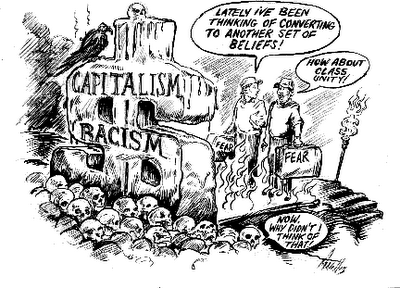
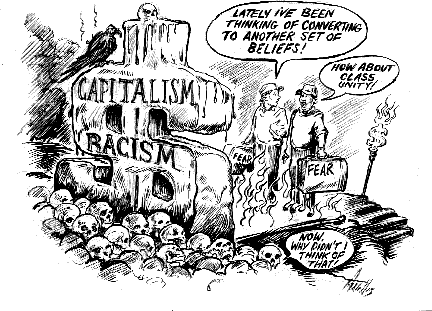
Since it was suggested, I read the two articles.  I found Wolf’s article to be particularly hard to stomach, but I read it anyway.  Both of these authors present a Marxist historiographical approach to the question of the origins of gay oppression.  In its most basic form, the Marxist historical tradition blames all of the problems of the world on capitalism and class struggles.  However, I have always found it deeply flawed.  For one, if you look at the sources used by Marxist historians, you will quickly find that more of those sources are from other Marxist historians.  They so narrow down their sources, until they ignore the larger historical picture, even though they claim to be looking at the larger historical picture.  In my opinion, this effectively removes their objectivity which is at the heart of true history.  They ignore those sources that contradict their point of view.  You cannot be an effective historian and dismiss the sources you do not agree with, you must take them into account.  History has many schools of historiography (the study of the history and methodology of the discipline of history), and Marxist interpretation is only one of them.


Before I continue, I want to say this, John D’Emilio is one of the greatest LGBT historians.  His books Sexual Politics, Sexual Communities: The Making of a Homosexual Minority in the United States, 1940-1970 and Intimate Matters:A History of Sexuality in America are two of the seminal books on LGBT American History.  The article suggested above by D’Emilio, and I do hope that each of you will go check these links out for yourself and not just take my opinion, was written while he was still a graduate student, which does not diminish his writing in the least, but his tone has changed since those early days in the 1980s when it was written.  Still, the two books above are well worth reading if you want a greater understanding of LGBT history in America.

Now that I have stated why I disagree strongly with Marxist interpretations, I want to address some of the semi-valid points in their arguments.  First of all, homosexual identity as it is seen today was nearly non-existent before the twentieth century; however, that does not mean that just because we did not have the word for it, that it did not exist.  I think it most certainly did, though it was quite rare and was not always practiced in the same way, it still existed.  The love between persons of the same sex existed before the advent of capitalism, which did not emerge until the end of mercantilism in the late 19th century.  D’Emilio and Wolf try to state the difference between homosexual behavior and homosexual identity.  Do you really think that no one before 1900 realized that they had an attraction to someone of the same sex and that they were not attracted to someone of the opposite sex?  Do you think that we become homosexual because family structure has broken down?  The answer to these questions is no.  The history of Florence, Italy during the Renaissance shows that homosexuality/sodomy was not illegal during that time period.  Some men married because they felt the need to procreate, but other did not.  They had homosexual relationships.  Also, the Inquisition records of the Catholic Church in Brazil during the 17th-19th centuries has numerous documented cases of homosexual persecution.  This was not a phenomenon of capitalism. Brazil only had a brief history of capitalism in the early twentieth century that was quashed by Getúlio Vargas and his corporatism from 1930-1954 and then largely under the control of the military until 1985. Likewise, Spain who continually persecuted homosexuals under Francisco Franco from c. 1936 to 1975, was not a capitalist country but was a hybrid of corporatism, fascism, and dictatorship.  Even in the late 19th century in America, there was talk of so-called “Boston Marriages,” a term is said to have been in use in New England in the decades spanning the late 19th and early 20th centuries to describe two women living together, independent of financial support from a man.  The term was believed to be first coined by Henry James in The Bostonians.  Since 2000, many mentions of “Boston marriage” cite as examples the same few literary figures, in particular the Maine local color novelist Sarah Orne Jewett and Annie Adams Fields her late life companion, the widow of the editor of The Atlantic Monthly. There is often an assumption that in the era when the term was in use, it denoted a lesbian relationship. However, there is no documentary proof that any particular “Boston marriage” included sexual relations, but there has been a great deal of speculation, some of which comes from what we know or the private life of Willa Cather.


Furthermore, these authors argue that same-sex segregation during World War II brought about modern day homosexuality.  First of all, World War II is not the first time that large numbers of men and women have been separated from their families. This has happened in all major modern wars.  In Europe, this had happened in the First World War, and to a lesser extent in America.  So I don’t think that you can pinpoint WWII as the starting point.  It had all happened before.  Wolf does not address that millions of men in Europe served in World War I, and that millions of women left their homes and family to either work in the military or in factories during World War I.  Because it is convenient for her argument, she dismisses the history of Europe when it is inconvenient, and then turns around and uses it when it is convenient and the same history in America in turn is inconvenient.  In addition, both authors cite WWII as the beginning of homosexual persecution in the military and that it has continued largely uninterrupted until the modern day.  The problem is that it was largely ignored during Vietnam, when men identified as homosexual to not be drafted, most of those men truly were homosexual, however, they were forced to serve in the military anyway.  The ban on homosexuals was largely ignored by the draft board and military during the Vietnam War.  Likewise, today, when America is fighting two wars, and there is an increasing need for soldiers in the war against Terrorism, they have repealed Don’t Ask, Don’t Tell.  It is not a coincidence in my opinion.


I have three more points that I want to make.  Both authors claim that sexual liberation, that is sex for enjoyment not for procreation, is capitalist invention/byproduct.  I cannot buy that explanation.  First of all, communism and socialism pushed for the ideas of free love, long before the flower children of the 1960s.  The sexual revolution was made much more visible because of birth control, but people have been having sex for reasons other than procreation since man first had an erection.  We are the only species who we know for sure have sex for enjoyment.  It is not a modern phenomenon.


I also want to point out that Wolf argues that the family has not always existed in human history.  If she would look at the anthropological studies, archeological studies, and historical studies of mankind, she would realize that it has always existed.  From the earliest humans, the family structure has been the governing structure.  The idea of the family or clan is the first political structure in any society.  As the family grows larger, the head of the family becomes the head of the clan.  From there, stronger clans take over weaker clans and form chiefdoms, which eventually grow into kingdoms and empires.  The family structure has always been the basis of human society.  Even as gay men and women today, we are not abandoning the family, we want families of our own.  We want marriage, and we want children (at least I do, and so do many others.)


The last point that I want to make is that urbanization has led to gay communities more so than capitalism. Urbanization has more to do with the industrial revolution than it does the rise of capitalism.  As fewer people were needed to work a farm, due in large part of the end of slavery and the mechanization of the farm, that excess labor moved to the cities to find work.  Most did not abandon the families, and a large family often lived together in a household trying to make a living wage.  However, the urbanization of America began before capitalism, and thus I feel that it is not the cause of the breakdown of the family, nor is it the cause of class warfare.  Class warfare has existed long before capitalism, and therefore, capitalism cannot be the blame for all the evil of the world.


Wolf is not totally wrong in all that she writes. In fact she (surprising to me) got this part of history correct:

In Paris and Berlin, medical and legal experts in the 1870s examined a new kind of “degenerate” to determine whether or not these people should be held responsible for their actions. The word “homosexuality”was first coined by a Hungarian physician named Karl Maria Benkert in 1869.  Homosexuality evolved in scientific circles from a “sin against nature” to a mental illness. The first popular study of homosexuality, Sexual Inversion by Havelock Ellis in 1897, put forward the idea that homosexuality was a congenital illness not to be punished, but treated. Nineteenth-century sexologists developed ideas about homosexuality as a form of mental insanity. One famous theory held that gayness was the result of “urning”–the female mind was trapped in a male body (or vice versa). Another theory widely disseminated referred to homosexuals as a third sex.

I do want to make one final point before I end this post.  Both D’Emilio and Wolf argue that there is not basis for being “born gay.”  This is a recent argument that I have actually come across several times in the last few weeks from LGBT activists and scholars.  Most of the recent attention to arguments against a biological component to homosexuality is because of the Lady Gaga song, “Born This Way,” to which some in the LGBT community are now starting to argue against.  This is a topic for a future post, so I won’t go into much detail right now. I merely wanted to mention this as part of the discussion.

I may have rambled a bit in this post, but I wanted to talk a bit about historical interpretation.  I hope that you will read those two articles cited above and give me your take on them. I do not believe that either author presented a convincing argument for the beginnings of gay oppression.  In fact, from my reading of the articles, it seems to me that both vaguely lay the blame on capitalism, but do a poor job of giving evidence to this claim. Do you think that I am completely off base or are they completely off base or are all of us a somewhat right and somewhat wrong?  I want to know what you think.  I personally think that the origins of gay oppression is a many faceted problem and cannot be explained in a simple historical method.  We have to look at all parts of the picture and not ignore those parts that we find inconvenient.


Via, Veritas, Vita

The Way, The Truth, and The Life—John 14:6

Final Thoughts

I hope that I have given us all something to consider whether you are a fellow gay member of the Churches of Christ or of any other denomination or sect of Christianity.  I have not written anything in these posts that I do not firmly believe myself.  I do believe that Jesus is “the way, the truth, and the life.”  My journey to self acceptance was a long and torturous journey.  When I was sixteen, I took a handful of pills hoping that the agony that I felt would finally be over.  I did not know why I was different.  I did not yet at that time understand homosexuality.  I also did not understand the never-ending love that God has for me and all of humankind.  I thank God each and every day for me being unsuccessful on that day nearly twenty years ago.

Once I understood that the feelings I was having probably meant that I was homosexual, I had to come to terms with that.  It was not easy.  I had never once in my life been told that it was okay to be gay.  One of the early books I read while trying to figure all of this out was one called Finding the Boyfriend Within: A Practical Guide for Tapping into Your Own Source of Love, Happiness, and Respect by Brad Gooch.  Who is the Boyfriend Within? Simply put, he embodies “qualities we find attractive in ourselves but often imagine others to possess more fully, as well as … dormant qualities we wish to nurture and grow.”  The main lesson I learned from this was the technique where you basically schedule a date with yourself.  You dress nicely, cook a wonderful meal, and have a romantic evening with just you.  At first, I thought this would be my answer.  I could love myself and be content with a celibate life.

That was not the answer.  I still wanted the love of another man, and I still do want to find that man.  I wanted to feel another man in my arms, to be held by another man, to kiss another man, to make love to another man, etc.  These were all things I longed for, and things I could not give myself.  However, the struggle that I ultimately faced was: What would my family say?  How would God judge me?  So I began to pray and mediate on the subject.  I did what research I could back then, though I am a much better researcher now (thank you, graduate school).  What I came to realize back then was that God will always love me and never forsake me.  Though I won’t claim that God spoke to me like a burning bush in the desert, I do believe that the Holy Spirit allowed my heart to understand.  My faith could/would/will remain strong and never waiver.  It never did and never has.  The question was whether or not I could act on my homosexuality.  And at certain points I have been very promiscuous, which I do not think God smiled upon, but he did forgive me, and that is the most important thing.  God forgives.  God loves. God will not forsake us.

I love what Justin O’Shea had to say in a recent post in his blog Justin Dunes:

Let me tell you, briefly, I hope, what is at the bottom or foundation of me.  I’ve worked on this and as we joke about here “I am a work of art in progress. . . .always becoming.  .”  I hold fast to this.  We are created in the image and likeness of God. Love does such things. . .Love engenders and creates love.  Being a gay man is part of God’s gift to me. . .how I live this out is my gift to God. . . .and to others.. . .because to be real  ‘religion is relationships – God… Justin . . .and everyone else.’
How I love is how I live and vice versa.  I believe too that God has given me all I need to become. . .grow into the man He created me to be.  All I have to do is use what I have been given. . .and. . .as I use and share this I receive more to keep on going. .
 

One of the most important reasons that I was able to come to these same conclusions is through the loving relationships I had with my friends who welcomed my sexuality and never, not once, made me feel bad about it.  My family has been another struggle, one that I hope I will be able to resolve some day.  If you are struggling with sexuality and religion, then know that I am here to help.  I started these posts to reach out to other GLBT Christians and to GLBT members of the Churches of Christ.  I know there are other GLBT members of the Churches of Christ out there, and I do hope that they eventually come across these posts.  We need the strength that friends can supply, we need the strength that God can supply, and we need the strength that our GLBT community can supply.

Thank you for reading, and God Bless You.
I feel like there should be an AMEN in there somewhere, LOL.