
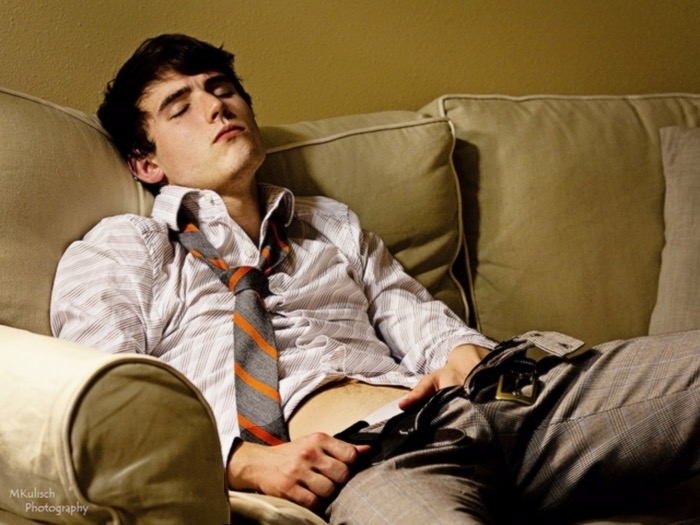
I was very tired as I wrote this last night. It had been a whirlwind day. I had been put up the night before at a hotel near the airport and brought down to the museum/campus in the morning. I was given a tour of the museum and the campus and then lunch. After the lunch was the formal interview, though I wouldn’t call it too formal. The people at the museum are very informal, and it makes for a relaxing atmosphere. After the interview, I was given a tour of the surrounding area. I really love this area. It’s very funky cool (that’s the only way I can describe it). After touring a few places, we met for dinner, which was excellent. The president of the museum board had dinner with us and I can’t say this enough, everyone was so nice and relaxed. There was a lot of laughing and friendliness. Then I came back to the bed and breakfast that I’m staying in so I could relax. I will go to the museum this morning after breakfast, but I’m not sure what today’s agenda will be. I was only told that we’d work out some of the details. I’m really hoping that they can tell me today whether or not I’m hired, though they may wait until I am home for that. I think though that today will probably be an easy day.
Category Archives: Travel
Exhausted but Good
Flying Out

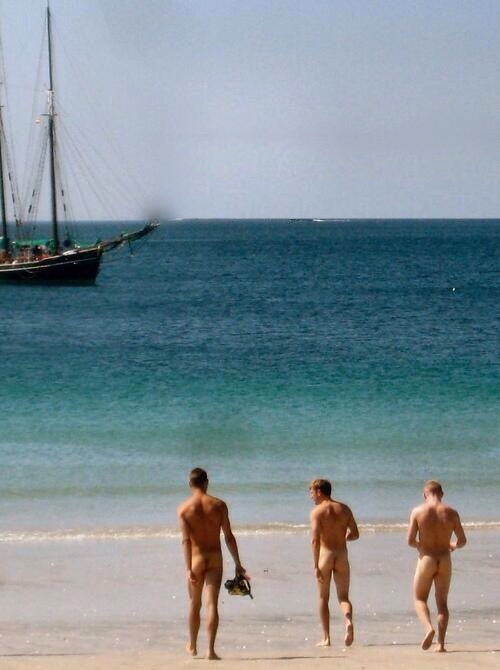
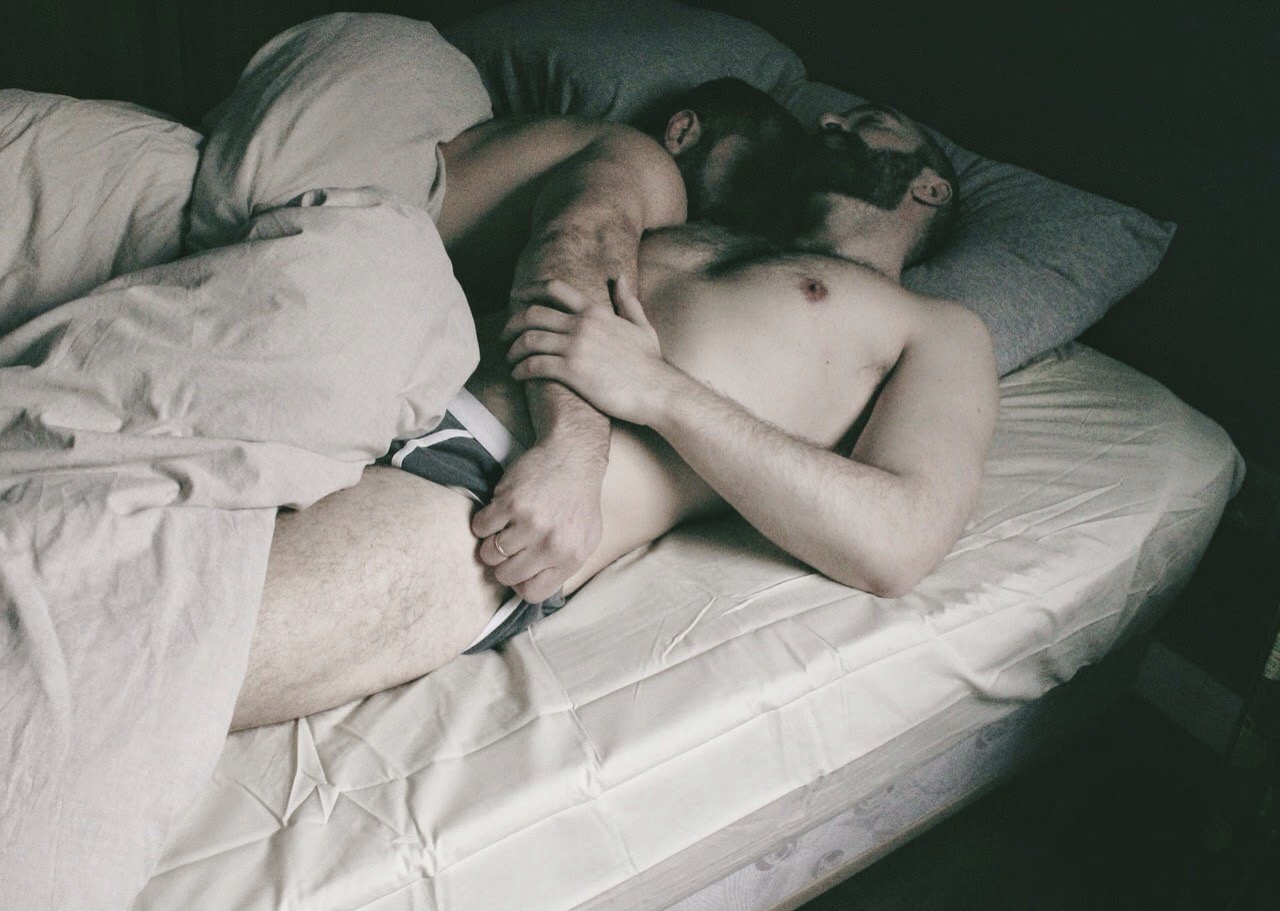
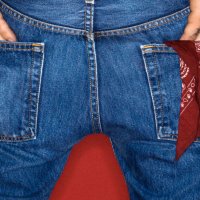
Time got away from me yesterday because I was packing and making sure I had everything I would need for the next few days. I pray that I have packed everything. While the guys above look very sexy, I made sure that I packed pants socks and shoes as well. Well, actually I packed two suits and then two casual outfits, just not as casual as the ones above.
I’m nervous, but that’s to be expected. I’m hoping that all goes well and that I didn’t forget anything. I’ll fly out this afternoon and arrive sometime tomorrow night, then be driven down to the hotel near the college. I’m not exactly sure what to expect Tuesday and Wednesday, except that I will be spending that time with the museum staff.
I’m scheduling today’s post and I will schedule tomorrow’s. I will try to post on Wednesday and Thursday if time permits, though I suspect they will be short posts. Wish me luck and please continue to pray. Thank you all for your love, support, and advice. I have the best group of readers out there.
Six Flags
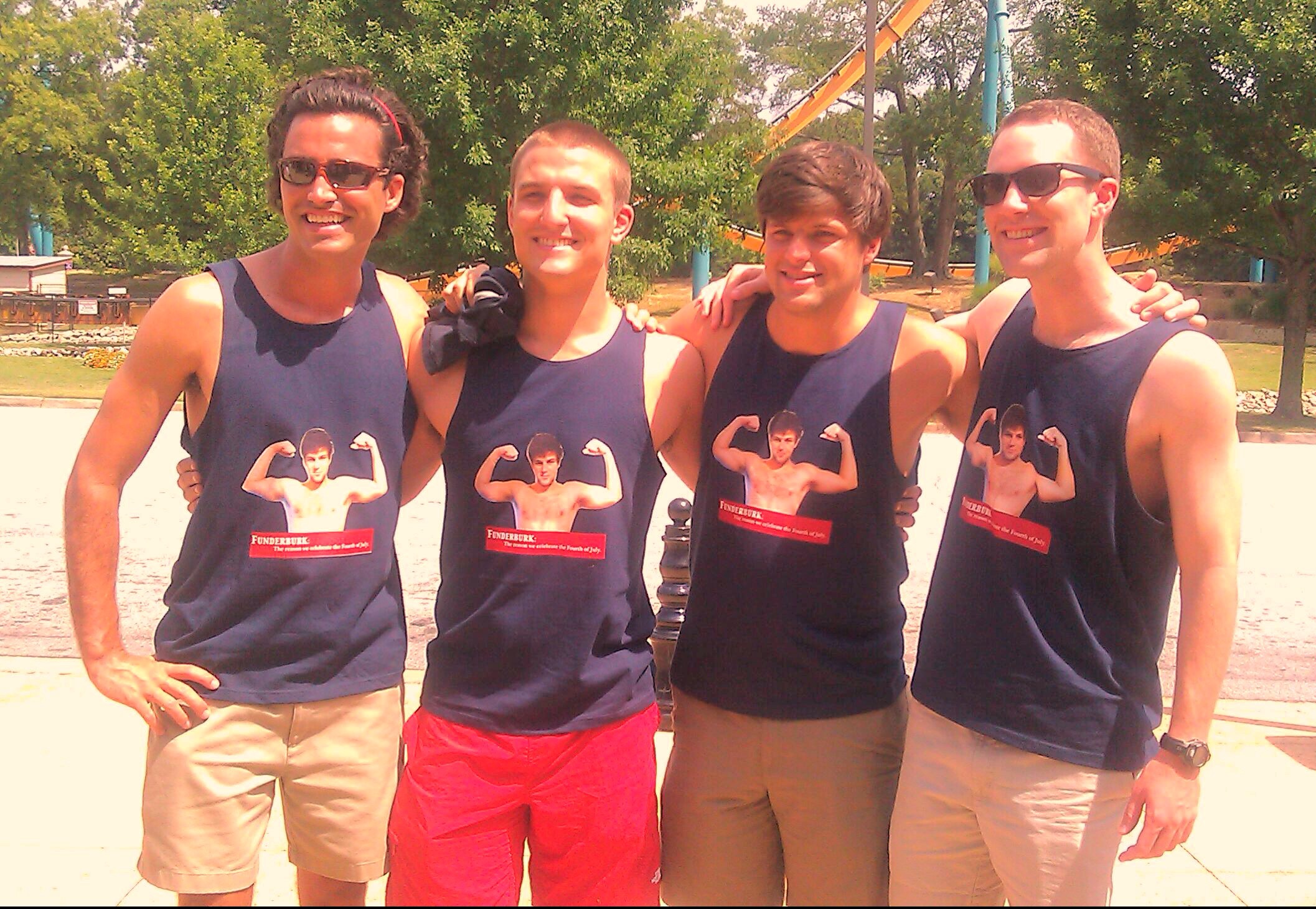
My niece really wanted to ride roller coasters yesterday, so I took her on the Georgia Cyclone first. The Georgia Cyclone is a wooden roller coaster that is a mirror image of the original Coney Island Cyclone, but ten feet higher. If you’ve ever been on a wooden roller coaster you know they will nearly shake or beat you to death. There isn’t a damn thing fun about them, which is why I took her on that one first. It cured her of wanting to ride another one, most of which she was too short for anyway. That may be a bit mean and sneaky of me, but they give me vertigo, make me sick and usually I end up with a headache, so better to go on one then have to ride them all.
Silvereagle, yes, it was hell. The heat index I’m sure was over 100 degrees, and by the end of the day, it was thundering and lightning and most of the park closed down, so we went back to the hotel.
Susan, my mother and I have had this discussion of not volunteering me for things without my knowledge. I made it absolutely clear that this was the last time I’m going to Six Flags.
Michael, yes, I do cherish these memories with my niece, and more importantly she cherishes them too.
JiEL, it is particularly nice that my niece loves it so. Her aunt on her father’s side insists on taking her to Disney World (which I cannot afford), but the nice thing is, she has said on numerous occasions that it much more fun to go to Six Flags with me.
Jay, it’s getting harder for me to fit in some of these rides too. Have you ever seen Gabriel Iglesias talk about getting on rides and seeing how many clicks they can get on the safety bar? It is too funny. His amusement park stories are some of his funniest.
Amanda, people watching truly is the most fun. So many hot guys!
Sacrificial Lamb
I feel like I’m being led away as the sacrificial lamb. I am taking my niece to Six Flags today. I hate amusement parks. I hate the crowds. I hate the rides. However, I love my seven year old niece, and she did make straight A’s all year long. My mother promised her a trip to Six Flags as a reward, and I get the supreme pleasure of doing something I hate with a passion. I know it’s probably wrong of me, but I hope that she’s too short for the only two roller coasters that I’m “almost” willing to ride (The Great American Scream Machine and the Georgia Cyclone). Pray for me to survive. Especially, since it’s going to be 97 degrees today and God only knows how high the heat index will be.
Louisiana: A Fun Place to Be

We are having a great time here in Louisiana. We spent two nights in New Orleans, and now we are spending two nights in Cajun country. Tomorrow morning (the pic above is obviously not of a swamp tour, but isn’t he cute?), we are going on a swamp tour and possibly to see a plantation tomorrow afternoon.

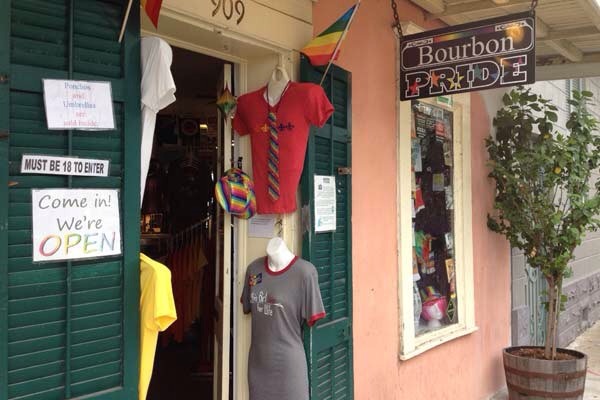
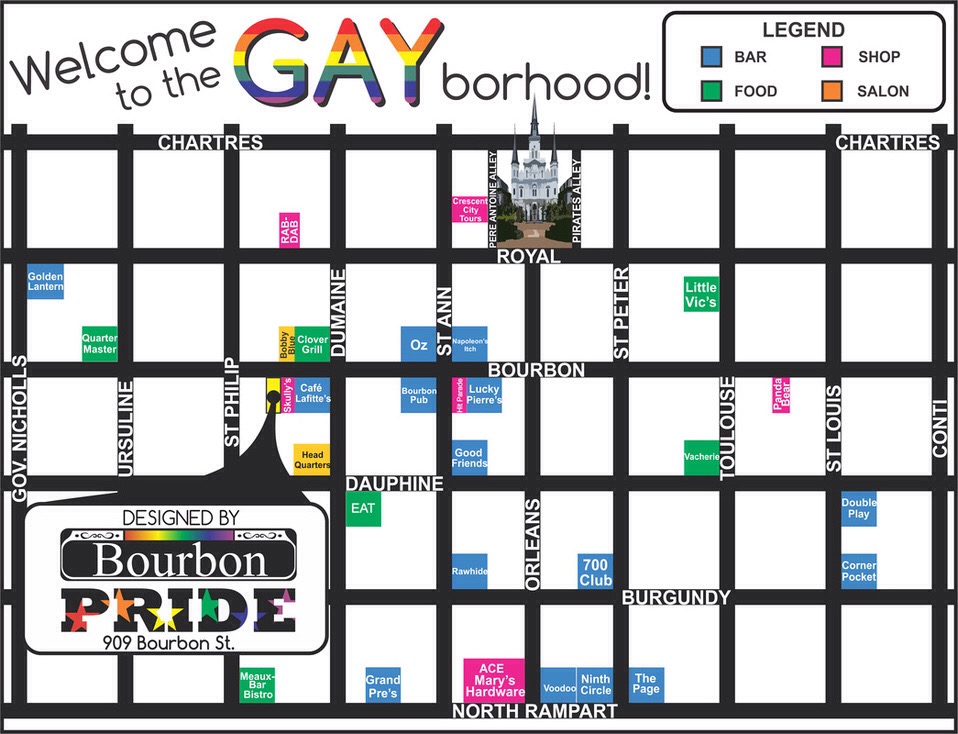
There isn’t a lot to say in this post, but here are two suggestions for when you go to New Orleans: eat at the Court of Two Sisters (entrance on Royal or Bourbon) for their fabulous jazz brunch and visit the five Louisiana State Museums. Also, I highly suggest that you head down Bourbon past St Ann, where Oz and Bourbon Pub is and venture just over a block to a small store called Bourbon Pride. Josh Duffy owns it and I’m a big fan of his music. Bourbon Prode has all the things a gay boy needs, and the staff was super nice and very helpful. I’ll definitely be returning to Bourbon Pride next time I’m in New Orleans.
NOLA: A Rich Gay Heritage

During the New Orleans’ early history, gay people were largely invisible, although same-gender communities existed throughout the culture. Although not self-identified, some prominent figures such as multi-millionaire John McDonogh – a life-long bachelor – might be recognized today as a gay man.
As the nineteenth century ended and a wild new music was being birthed in the saloons and bordellos of Storyville, Tony Jackson was crowned the “unrivaled king” of the early jazz pianists. Described as “an epileptic, alcoholic, homosexual Negro genius,” he composed countless songs, including “Pretty Baby,” inspired by a lover.
By the time writer Lyle Saxon arrived in 1919, the French Quarter was little more than a run-down slum. Saxon championed its preservation and promoted the Quarter as a welcoming home for artists. Among them was Truman Capote, who was born here and returned as a nineteen-year-old to write his first novel in a slave quarter apartment on Royal Street.
Tennessee Williams arrived in 1938 and knew immediately he had found his spiritual home. “A Streetcar Named Desire” would become the most famous New Orleans work of literature. Pioneering photographer Frances Benjamin Johnston retired to New Orleans in 1940, living in her Bourbon Street townhouse until her death in 1952.
A lively gay social world had long existed, but after Prohibition ended in 1933, it became more public. In 1936, a bar opened at the Lafitte Blacksmith Shop on Bourbon Street. Although its clientele was a varied group, gay men and women knew they were welcome. But in 1953, the owners lost their lease. They moved to the next corner and reopened as Café Lafitte in Exile – now one of the oldest gay bars in the country.
Private gay socializing flourished in mid-century New Orleans. The oldest continuing gay event, the Fat Monday Luncheon, began in 1949, and the oldest gay social organization, the Steamboat Club, was launched in 1953. The Krewe of Yuga was the first gay Carnival club in 1958, followed by the Krewe of Petronius in 1961.
 The Gay Liberation movement was slower to develop in New Orleans than in many other cities. This was due in part to local politics. In 1967, District Attorney Jim Garrison arrested Clay Shaw, a prominent gay business and civic leader, and charged him with conspiring to assassinate President John F. Kennedy. Although Shaw was eventually acquitted, the affair had a chilling effect on political organizing.
Nevertheless, a small group of activists founded the Gay Liberation Front of New Orleans in late 1970. Although the group dissolved within a year, participants subsequently organized a Metropolitan Community Church congregation and a chapter of the national lesbian organization, Daughters of Bilitis.
The emerging community suffered a great tragedy in June 1973, when a deliberately set fire in the Upstairs Lounge killed 32 people.
But the indomitable New Orleans spirit prevailed. Southern Decadence started as a small party in 1972, the same year as the Tulane University Gay Students Union. The 1970s also saw the arrival of IMPACT newspaper, the Faubourg Marigny Bookstore and the first gay pride events.
The Gertrude Stein Society, which began in 1975, brought together a group of men and women who were instrumental in developing an active community infrastructure in the 1980s: the Louisiana Gay Political Action Caucus (1980), the State Gay Conference (1981), the New Orleans Gay Men’s Chorus and a local chapter of P-FLAG (both in 1982), and the NO/AIDS Task Force (1983).
The 1990s were a decade of political accomplishment. In 1991, the New Orleans City Council passed a gay non-discrimination ordinance. Shortly afterwards, Gov. Edwin W. Edwards issued a far-reaching executive order, prohibiting discrimination in state employment and services. In 1997, Louisiana earned the distinction of being the first state in the Deep South to pass a hate crimes law that covered sexual orientation, and New Orleans Mayor Marc H. Morial extended domestic partner benefits to city employees. And, in 1998, New Orleans became one of the earliest cities to add gender identity to its list of groups protected from discrimination.
As the century closed and the new millennium dawned, GLBT people in New Orleans could look with pride at a community that had achieved much in its political movement, while continuing to develop its vibrant social life.

I also want to add one more thing about New Orleans. Of the many times I’ve been here, I’ve stayed at the Holiday Inn-French Quarter, the Fairmont (now The Roosevelt Waldorf Astoria), and the Hilton. Each are very nice hotels (The Fairmont is probably the finest hotel I’ve ever stayed in, with the Peachtree Westin in Atlanta a close second), but on this trip, I stayed at the Prince Conti Hotel which is less than a block from Bourbon Street. It is by far my favorite hotel in New Orleans, and I highly recommend it to anyone coming to New Orleans. It has an exceptional price, has the best wi-if I’ve ever experienced in the city (or any hotel from that matter), and the staff could not be any friendlier. The front desk staff was so wonderful and friendly, remembering us each time we walked into the hotel and asking us how our day was and wishing us a good nights sleep and sweet dreams. It’s been a special experience. The hotel room was luxurious with high ceilings and an old southern feel. I will admit that the view from our room was not spectacular and the hallways smell a bit musty, but let’s face it, if you want a spectacular view, you will pay for it and everything else made up for the view. As for the musty smell, it is only noticeable when leaving your room, when coming back to your room from the odiferous city streets of New Orleans, the smell is quite refreshing (that is not even noticeable). So if you are heading to New Orleans, I suggest a stay at the Prince Conti Hotel. When I read reviews, the main thing was how expensive parking is at the hotel, but even when combined with the the hotel rate, it’s still less expensive than most hotels in the city, especially hotels in the heart of the French Quarter.
Theories of Time and Space
Theories of Time and Space
By Natasha Trethewey
You can get there from here, though
there’s no going home.
Everywhere you go will be somewhere
you’ve never been. Try this:
head south on Mississippi 49, one—
by—one mile markers ticking off
another minute of your life. Follow this
to its natural conclusion—dead end
at the coast, the pier at Gulfport where
riggings of shrimp boats are loose stitches
in a sky threatening rain. Cross over
the man-made beach, 26 miles of sand
dumped on a mangrove swamp—buried
terrain of the past. Bring only
what you must carry—tome of memory
its random blank pages. On the dock
where you board the boat for Ship Island,
someone will take your picture:
the photograph—who you were—
will be waiting when you return
I’ve never been further north on U.S. Highway 49 than Jackson, Mississippi, but I have driven the stretch from Jackson to its beginning in Gulfport, Mississippi, too many times to count. North of Jackson at the junction of US 49 and U.S. Route 61, was where blues singer Robert Johnson is said to have sold his soul to the Devil. But it is Gulfport that I am more familiar with because it used to be a short drive down to the beach when I wanted to get away from the stresses of graduate school. I’ve walked those man-made beaches and taken the boat out to Ship Island to see Fort Massachusetts. If you are ever in Gulfport, or on the Mississippi Gulf Coast for that matter, you’ll probably be there for the casinos, but you really should go out to Ship Island and take a picnic lunch, explore the fort, and lounge on the beach on the south side of the island.
The first time I went to Ship Island, I remember standing on top of Fort Massachusetts and feeling history come alive. Having the only deep-water harbor between Mobile Bay and the Mississippi River, the island served as a vital anchorage for ships bearing explorers, colonists, sailors, soldiers, defenders and invaders. The French, Spanish, British, Confederate and Union flags have all flown over Ship Island. French explorer Pierre Le Moyne d’Iberville charted Ship Island on 10 February 1699, which he used as a base of operations in discovering the mouth of the Mississippi River. The island served as a point of immigration to French colonies in the New World.
In the War of 1812, Admiral Sir Alexander Cochrane anchored between Ship Island and Cat Island with a fleet of fifty British warships and 7,500 soldiers in preparations for the Battle of New Orleans and the island was used as a launching point for British forces. I remember standing on top of Fort Massachusetts and it was almost like I could see the fifty British warships as they prepared to attack New Orleans nearly 200 years before. It was one of those magical moments historians sometimes have. We are standing in a historical place and suddenly we are transported back to a significant moment. The present world disappears and the world of the past emerges before your eyes.
“Everywhere you go will be somewhere you’ve never been.” So if you ever find yourself in Jackson, Mississippi, try heading down U.S Highway 49 through Hattiesburg and past the beautiful campus of the University of Southern Mississippi down to the Mississippi Gulf Coast, hop on the boat out to Ship Island and let another world take you over.
Come Out to the National Parks
The National Park Service is encouraging LGBT Americans to come out and visit the more than 400 parks overseen by the federal agency. The latest move by the park service to engage the LGBT community is part of the new Find Your Park initiative, launched recently in conjunction with the National Park Foundation.
Gay and lesbian park service employees and lesbian singer Mary Lambert, one of several celebrity centennial ambassadors for the initiative, are helping to spread the inclusive invite as part of the new public awareness and education campaign celebrating the milestone centennial anniversary of the National Park Service in 2016.
I’ve always loved the National Parks, and once considered joining. The National Parks Service as a historian. When I was a kid, my family would go camping at least once a year at the Gulf Islands National Seashore at Ft. Pickens near Pensacola. We would also often go in the summers to the Great Smokey Mountain National Park and stay in either Pigeon Forge, Tennessee, or Cherokee, North Carolina. I learned so much at these National Parks and Ft. Pickens was one of the major reasons for my love of history. The beauty of the National Parks is unmatched anywhere, and they deserve to be celebrated.
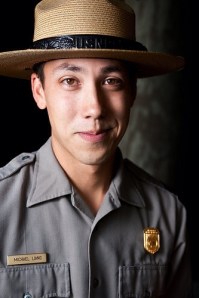 A video featuring gay park ranger Michael Liang, a visual information specialist at Santa Monica Mountains National Recreation Area in Southern California shows him jogging through Cheeseboro Canyon off the 101 where he runs prior to heading to work. Liang noted that parks allow visitors to “slow down” their minds and “notice” the beauty of the outdoors. “All you have to do is get up, get out there, and find your park,” said Liang.
Liang, 29, explained that the park service is looking to create the next generation of park supporters and advocates with the campaign. “If you look at who we traditionally attracted, it was upper middle-class families,” noted Liang, who grew up in Michigan and started with the park service as an intern in 2004. “The parks are funded by the taxpayers, so it is really important we represent the diversity of the country and the population.”
Through the Find Your Park’s website, http://www.findyourpark.com/, any visitor can upload their own video talking about their love for America’s protected spaces or an individual park site that is of particular interest to them. “It is a digital platform to share your stories. We invite the public to share their favorite national park stories or how they want to envision what the park service looks like,” said Liang. “It is a great way for LGBT people to share why it is important to them or what we can do to make them more relevant to our community.”
Responsible for the marketing materials of the park where he works, Liang said he is mindful of using photos that show a diverse array of visitors. He is working on a series of posters aimed at inspiring Los Angeles residents to visit the Santa Monica Mountains west of the city. “I take personal responsibility to ensure the people depicted in those photos reflect the diversity of L.A., for example, having two men holding hands watching the sunset in the Santa Monica Mountains,” said Liang, who came to the park last June from Philadelphia where he worked in the park service’s regional office for the Northeast. “I am still discovering our park. By June my challenge is to identify LGBT historical figures with our park. It will be perfect timing to start digging into those stories.”
One way the parks can attract LGBT visitors, said Liang, is through the programming sites offer guests. He pointed to the Bay Area’s Rosie the Riveter/WWII Home Front National Historical Park on the waterfront in Richmond, which has sought to capture the stories of LGBT people who either worked in the East Bay shipyards during the war or were service members who embarked from Bay Area military bases for combat in the Pacific Rim.
“How we can attract LGBT visitors is through creating national park sites that tell the story of our community,” said Liang, who is hopeful that one day there will be an LGBT-specific national park site. “While there currently isn’t one yet in the system, there is the theme study looking at LGBT sites.”
In January 2014 the B.A.R. broke the news that the park service had teamed with Megan E. Springate, who identifies as queer and is seeking a Ph.D. in archaeology at the University of Maryland, to oversee a National Historic Landmark LGBTQ Theme Study and proposed framework. As part of the project, the park service is seeking nominations of places important to the country’s LGBT community for inclusion on the National Register of Historic Places or to be designated as a National Historic Landmark. Both are considered important first steps that could lead to the properties one day becoming national park sites.
According to park service officials, only five properties in the country have been granted some form of federal historic preservation recognition specifically due to their relationship to LGBT history. There are four sites presently included in the National Register of Historic Places and one – New York City gay bar the Stonewall Inn – listed as a National Historic Landmark. The second landmark, the Chicago home of gay rights pioneer Henry Gerber, should be finalized later this year.
Last month the National Park Service released a seven-page document listing various ways members of the public can assist with its LGBTQ Heritage Initiative. Steps people can take run the gamut from proposing landmark-worthy sites to creating LGBT-themed tours of historic districts.
“The National Park Service has just released a document that brings together the many ways that people across America, regardless of identity, location, or how much time they have, can participate and engage with the initiative,” Springate wrote in an email to members of the Rainbow Heritage Network, a group for LGBT history advocates. “These include sharing information about places important to your community, spreading the word, visiting historic places, and writing nominations or nomination amendments for the National Register of Historic Places or National Historic Landmarks programs.”
The document can be downloaded online at http://www.nps.gov/history/heritageinitiatives/LGBThistory/GetInvolved.pdf
Moment of Zen: True Bliss
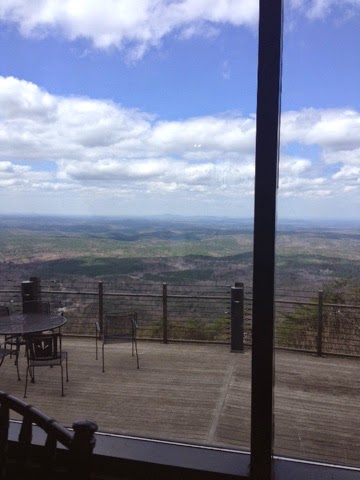

The Beauty of Nature
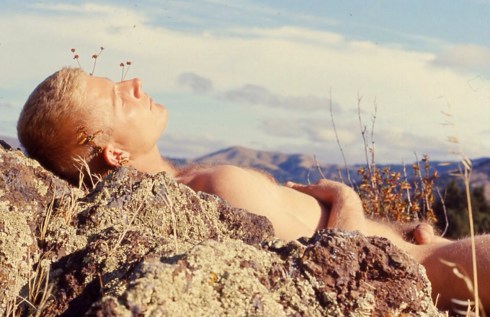
Yesterday, we did some hiking and had a wonderful time checking out small streams and waterfalls and enjoying the scenery. Mostly, we have just enjoyed being with one another and being kind of lazy. It’s spring break and teachers need the rest and relaxation much more than the kids. We have to have the strength to forge ahead through the last few months at school and make sure that the students don’t give up too quickly or easily.


Authors
Recent Comments
noisilycool3bc985058… on Pic of the Day Joe on When Time Stands Still? vandycolt on When Time Stands Still? vandycolt on Pic of the Day vandycolt on Pic of the Day Top Posts & Pages


Amazon Associate

As an Amazon Associate I earn from qualifying purchases. So, if you click on a link that takes you to Amazon.com, I may earn a commission.
Trust me, it isn’t much, but every little bit helps.

 Joe
Joe


 The Closet Professor