wish Isabella understood what the end Daylight Saving Time means. Sadly (frustratingly), Isabella only tells time with her internal clock. She doesn’t understand that it’s an hour earlier than she thinks it is. When it’s 4 AM for me, she (and her stomach) believes that it’s 5 AM. She only knows it’s time to eat. I wish we could understand each other. I’d love to ask her what food she wants because some days she’ll eat what I feed her, and a few days later when I feed her the same thing, she won’t eat it. If she could just say, “I want salmon, not chicken today” or “tuna, not salmon.” Sadly, I’m not Dr. Doolittle. Sigh!
While I can’t do anything about reading her mind about what she wants for her breakfast, she may get used to the time change while I’m away for work this week. My neighbor is feeding her, and he doesn’t come down first thing in the morning. Honestly, it doesn’t matter what time he comes down, she won’t eat her wet food if I don’t feed it to her. I mainly have my neighbor come down so she’s not completely lonely while I’m gone. He tries to get her to eat, but mostly he just plays with her. She’s very chatty with him while he’s here. She’s always happy to see him, but it doesn’t take the place of me being here. I wish I could just take her with me. She’d be much happier, but sadly, I can’t do that.
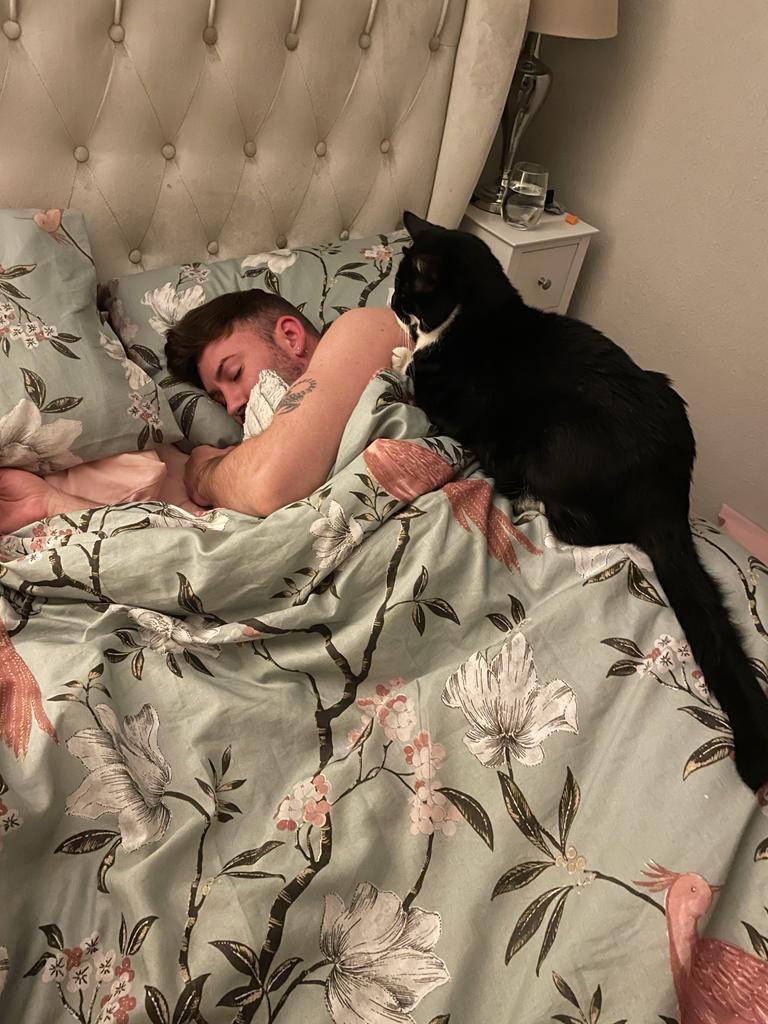
P.S. The picture above is not of me or Isabella. First, Isabella is solid black, and second, I would never have that comforter on my bed. I prefer more muted colors, and the one in the picture is too busy and too flowery for my tastes.
Likewise you younger people, submit yourselves to your elders. Yes, all of you be submissive to one another, and be clothed with humility, for
“God resists the proud, But gives grace to the humble.”
Therefore humble yourselves under the mighty hand of God, that He may exalt you in due time, casting all your care upon Him, for He cares for you.
Be sober, be vigilant; because your adversary the devil walks about like a roaring lion, seeking whom he may devour. Resist him, steadfast in the faith, knowing that the same sufferings are experienced by your brotherhood in the world. But may the God of all grace, who called us to His eternal glory by Christ Jesus, after you have suffered a while, perfect, establish, strengthen, and settle you. To Him be the glory and the dominion forever and ever. Amen.
— 1 Peter 5:5-11
Often times, those who hate the LGBTQ+ community are the loudest and most vocal in their hatred. Sadly, because of the centuries of Christian persecution of LGBTQ+ people, it is acceptable to far too many people. Yet, other forms of discrimination, such as racism, are almost universally condemned. There is nothing humble about homophobia. Those who hate LGBTQ+ are hateful and loud about their hatred. As 1 Peter 5:8 says, our “adversary the devil walks about like a roaring lion,” and tells us to “be sober, be vigilant” because he is “seeking whom he may devour.”
Quite frankly, most of the homophobes of the world want us dead and are often not ashamed to say so. They want to ruin the lives of LGBTQ+ people. This week, the small-town mayor of Smith Station, Alabama, who was also a Baptist minister in Phenix City, committed suicide after a Christofascist hate group calling itself “1819 News” (1819 refers to the year Alabama became a state), published pictures of him wearing women’s clothes and makeup. The Phenix City School Superintendent Dr. Larry DiChiara wrote in a Facebook post, “I am so angry right now and heartbroken. I witnessed a good man be publicly ridiculed and crucified over the last few days to the point that he just took his own life today. I just want to ask you people who thought it humorous to publicly ridicule him, ‘Are you happy now?’ What crime did he commit?” Sadly, I have no doubt that those who publicly ridiculed him are happy.
The Alabama Baptist State Convention put out a statement that said, “We have become aware of the alleged unbiblical behavior related to the pastor of the First Baptist Church of Phenix City. We are praying for the leaders of the church family as they seek to determine the truth concerning these accusations.” The Baptist Convention referred to this man “wearing women’s clothes and makeup” as “alleged unbiblical behavior.” Yet, they were careful not to condemn 1819 News, the ones who made the pictures public, as committing what should be obvious to all Christians as “unbiblical behavior.”
Some might think this man, who was a Baptist minister, is not worthy of our pity because he lived a secret life, but that secret life made him happy. I know how conflicting and confusing it can be for someone to believe they are being forced to live a secret life. He probably felt he had no other choice. If someone had outed me while I worked at a small private school in Alabama, I’d have been devastated and humiliated. I’m not sure what I would have done. The internal pressures this man felt were there because of centuries of hatred for who he really was. I’m sure he had enough self-hatred without the help of 1819 News. I don’t know what kind of preacher this man was, but I hope that he was the kind who preached about love and kindness and that “sufferings are experienced by [our] brotherhood in the world.”
On the Wednesday night (southern churches often have Wednesday night services), the minister took to the pulpit at First Baptist Church to denounce the post about him, claiming he was a “victim of an internet attack.” He then read from the 23rd Psalm as he delivered a short sermon. “God will always protect you, take care of you,” he said. “He will see you through anything, absolutely anything.”
Our adversaries who walk about like a roaring lion, seeking whom they may devour are not humble people. Christ taught over and over that we should be humble. Jesus was clear in the Beatitudes:
“Blessed are the poor in spirit, For theirs is the kingdom of heaven. Blessed are those who mourn, For they shall be comforted. Blessed are the meek, For they shall inherit the earth. Blessed are those who hunger and thirst for righteousness, For they shall be filled. Blessed are the merciful, For they shall obtain mercy. Blessed are the pure in heart, For they shall see God. Blessed are the peacemakers, For they shall be called sons of God. Blessed are those who are persecuted for righteousness’ sake, For theirs is the kingdom of heaven. Blessed are you when they revile and persecute you, and say all kinds of evil against you falsely for My sake.” (Matthew 5:3-11)
Homophobic Christofascists hate us to the point that they want us dead and are more than happy to drive us to kill ourselves. They ruined this man’s life through their hatred, and while they should be prosecuted for what they did and charged with no less than accessory to murder, I know nothing will come of it. Yet, this man died because he was doing something that made him happy and did not harm anyone else. Sadly, the Speaker of the House of Representatives is a homophobic Christofascists. Like so many Republicans, especially those who are ardent supporters of the orange traitor, they walk about like roaring lions, seeking whom they may devour.
I don’t get to sleep in very often because of a little black furball wanting to be fed, but I do occasionally enjoy sleeping in, even if it’s for only a few more minutes.
I’m so glad it’s Friday, and I get to work from home today. It’s a nice respite from the drive in and the tension at the office lately. Nobody is making me uncomfortable or tense, but two of my coworkers are very tense around each other. These same two were giving me problems a few months ago, so now they are seeing what I went through. Karma’s a bitch!
Anyway, I do have some work I need to get done today. Even though I don’t have class next week because I’ll be out of town for a conference, I still need to do some prep work for the week after. I’m sure I have some emails I’ll have to deal with, but I doubt it will be too difficult. I’m just glad to be home today.
I got an early start this morning, waking up to go over some lecture notes for today (and to watch the season finale of Star Trek: Lower Decks) only to find that I did not have internet at home. So I got ready and came into work about an hour early. Some days, there is just too much to do and things don’t always go smoothly.



















 Joe
Joe