











Not Thankful It’s Friday

Usually I look forward to Fridays, but not this week. I’m not even looking forward to Saturday. This weekend brings with it our big annual set of events at the museum, which means lots of tours, lots of visitors, and lots of chaos. Today I have multiple tours lined up, and tomorrow I’ll be back again for one or two more—yes, working on a Saturday. Yesterday I put in a twelve-hour day, came home, and went straight to bed. This morning I’m running on sheer habit and coffee.
If there’s a silver lining, it’s that today will “only” be an eight-hour day and tomorrow about six. That may not sound like much of a break, but after the marathon that was yesterday, it’s something to be thankful for. Really, I’ll only feel relief when Sunday finally rolls around and I can rest, free from the craziness and hoopla.
And here is your Isabella Pic of the Week. This is the look I get when I’m not petting her as much as she thinks I should. Normally she likes to curl up on my hip, but with my back problems she hasn’t been able to. Instead, she’s taken to lying on my chest. It’s her version of cuddling, and honestly, I’ll take it.


Bronze and Geometry: Art Deco’s Ideal Man
When most people picture Art Deco, the mind goes to sleek skyscrapers, angular ornament, and those famous female dancer figurines with ivory faces and bronze limbs. But the 1920s and 1930s also produced a remarkable body of male imagery, especially in sculpture, where the male nude was celebrated as much for its athletic power as for its aesthetic beauty.
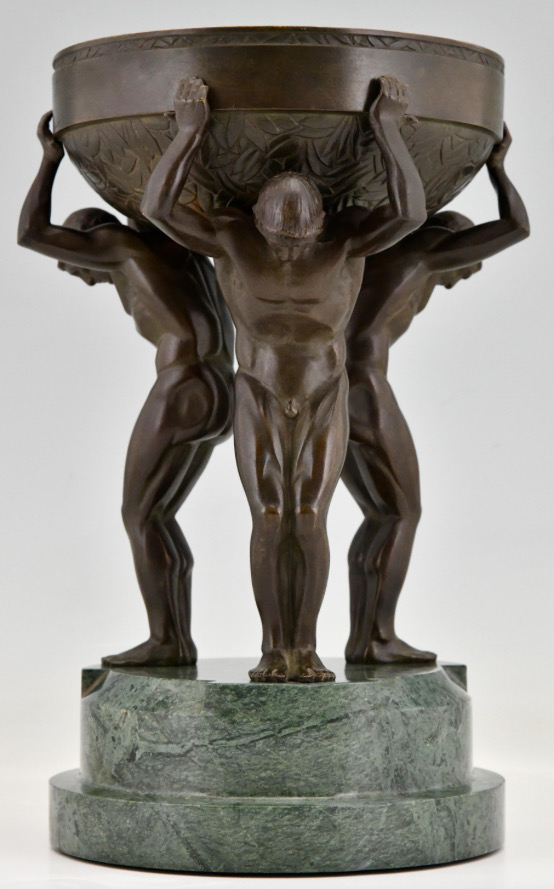
Sculptural Heroes
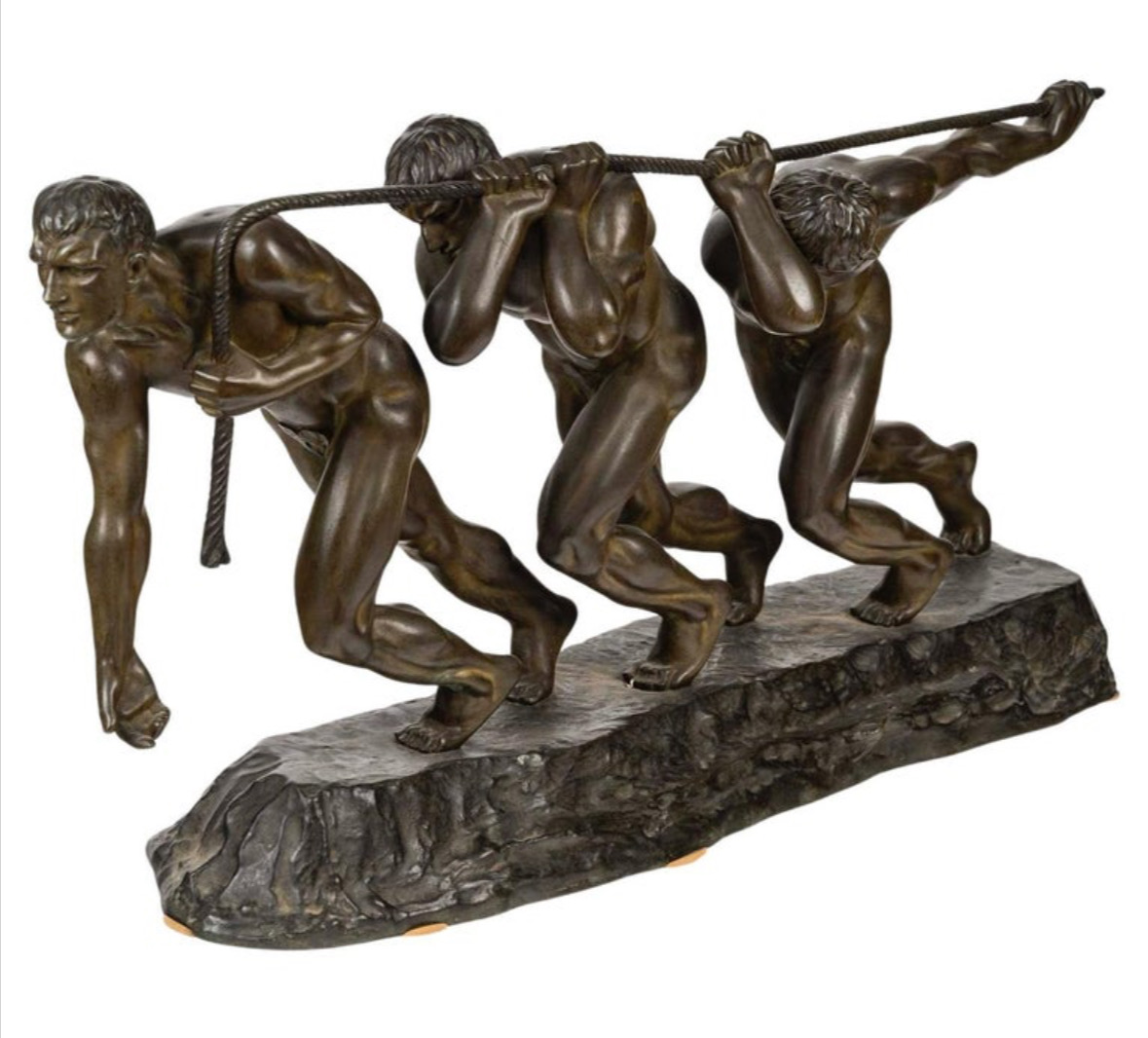
Auguste Durin crafted muscular athletes whose streamlined bodies recalled both ancient Greek statues and modern gymnasiums. His bronzes often highlight the flex of a thigh or the arc of a torso, creating men who feel both timeless and distinctly of their era. Maurice Guiraud-Rivière gave us dynamic bronzes of runners, discus throwers, and hunters; their bodies drawn into taut, geometric rhythms as if caught in perpetual motion.
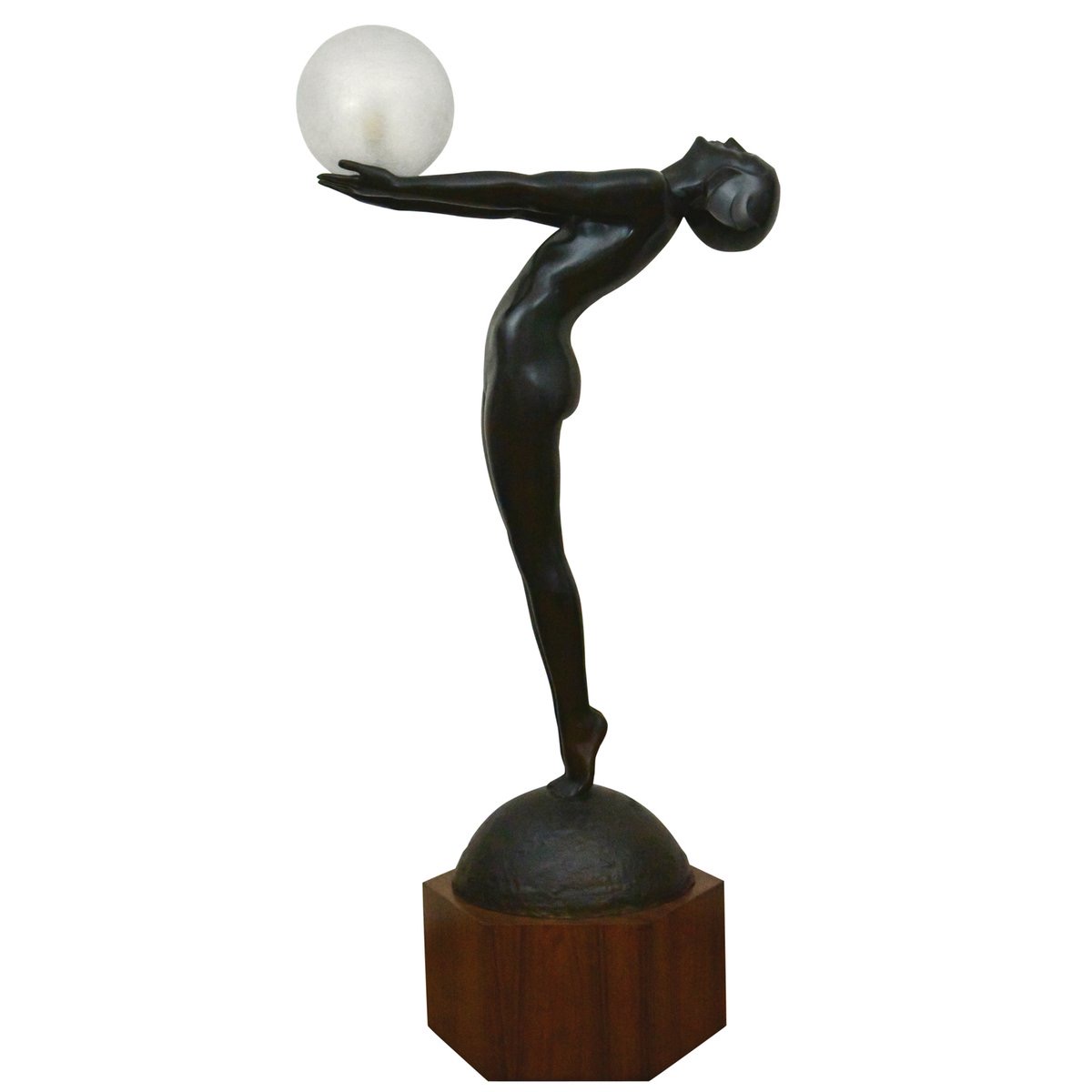
Demétre H. Chiparus, though famous for exotic female dancers, did not neglect men altogether—his Le Premier Pas shows a young nude stepping forward with deliberate grace, his body a harmony of energy and elegance. Max Le Verrier, perhaps the most recognizable name in Art Deco sculpture, created striking athletic youths such as Clarté, a lamp-bearing nude male who holds a glowing globe aloft like a modern Prometheus.
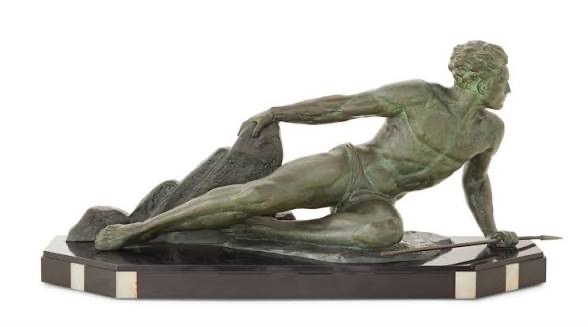
Jean de Roncourt’s works exude virility: his bronzes of hunters, wrestlers, and archers reveal every muscle in sharp definition, nude or scantily draped. Pierre Le Faguays, often working under pseudonyms like Fayral or Guerbe, produced vigorous male and female dancers alike; his Danseur Nu captures the twisting grace of a naked youth in motion. Even lesser-known sculptors like L. Valderi French contributed to this canon of heroic men, cast in bronze and spelter, embodying an age obsessed with strength and beauty.
Nudity and the Male Form
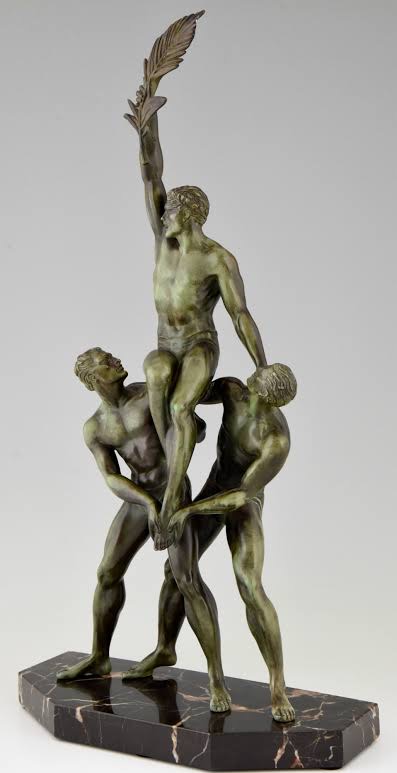
The nude male in Art Deco sculpture is strikingly different from the female nude of the same period. Where women are often allegorical or eroticized, men are athletic, disciplined, and powerful. Nudity was not scandal but symbol: the unclothed male body embodied health, modernity, and idealized masculinity. These weren’t portraits of individuals, but archetypes—youths who seemed to stride straight out of both the classical past and the Jazz Age future.
Two-Dimensional Visions
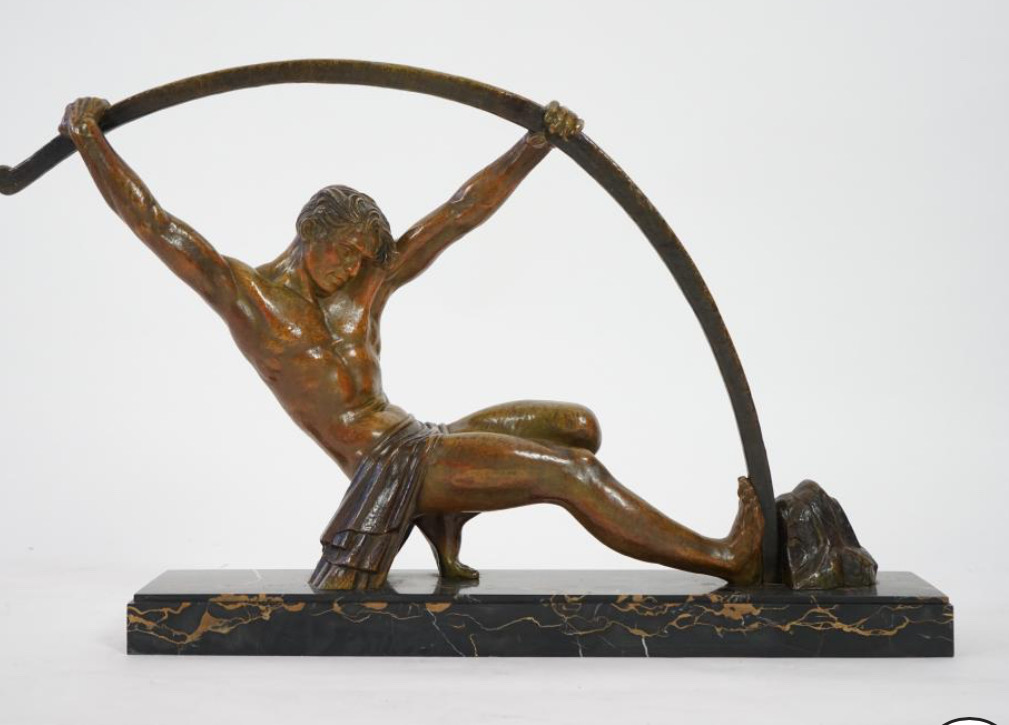
Art Deco depictions of men weren’t limited to bronze and stone. Painters, graphic artists, and muralists also took up the subject, often balancing sensuality with stylization. Tamara de Lempicka, best known for her cool, chic portraits of women, also painted striking male nudes, such as Nu Masculin (1929). In these canvases, bodies are sculptural and polished, more marble than flesh.
Jean Dupas, whose monumental panels adorned interiors of luxury liners, often depicted sailors, mythological heroes, and allegorical figures—sometimes draped, sometimes nude—his men elongated and stylized, their musculature arranged like architecture. In graphic art and advertising, artists such as Paul Colin infused male figures—whether jazz musicians, dancers, or athletes—with the same geometric vitality seen in sculpture.
Even in decorative arts, male forms appear: wall panels, book illustrations, and magazine covers showed sleek swimmers, runners, and workers, clothed or unclothed, embodying vigor and speed. The nude was celebrated not only in galleries but in the very fabric of modern life.
The Question of What’s Missing
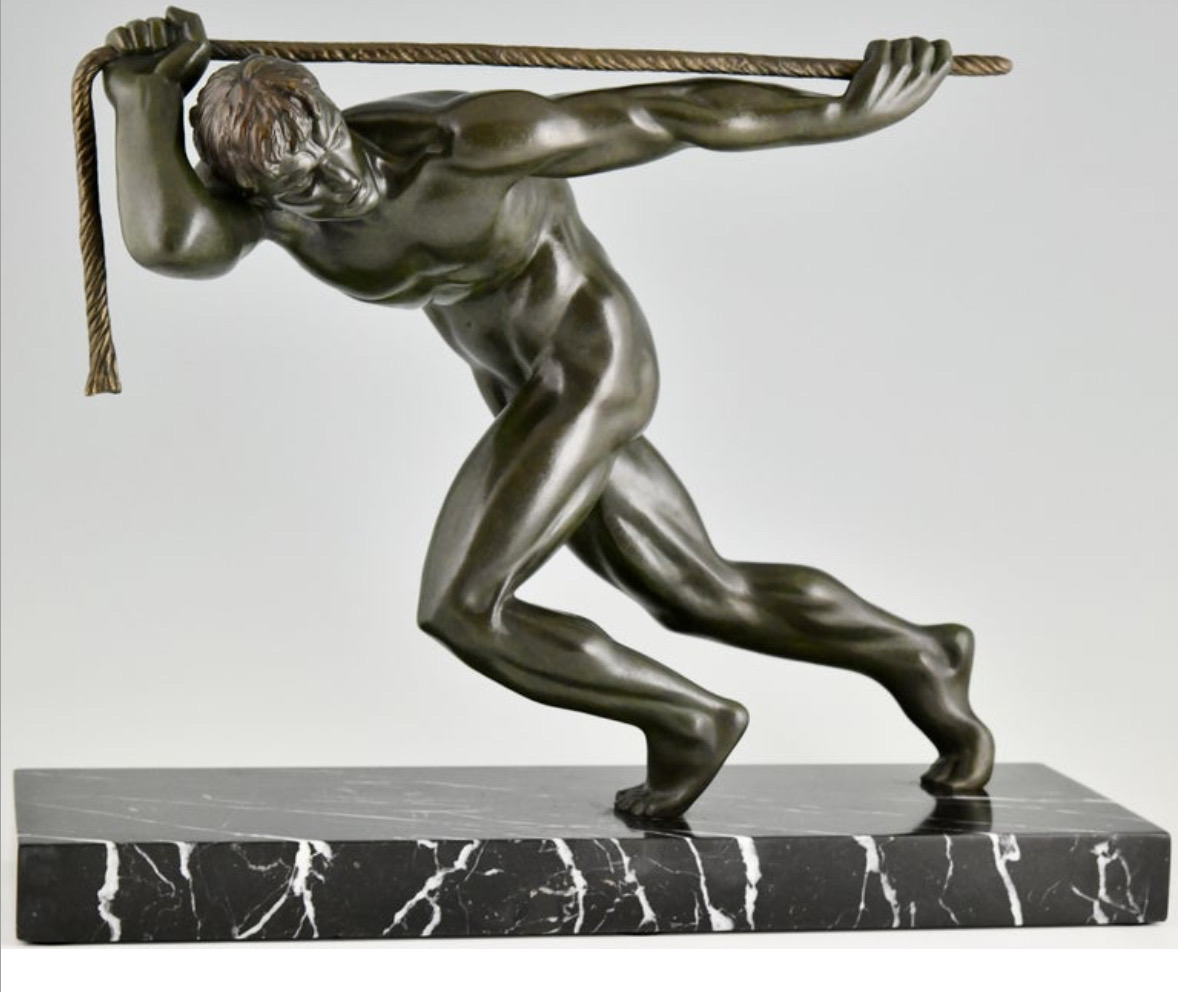
One detail that often strikes modern viewers is what is not shown. Many Art Deco male nudes either cover or minimize the penis. This wasn’t an accident—it was a deliberate choice shaped by several factors. The style drew heavily on classical precedents, where small, modest genitalia signaled refinement rather than vulgarity. Social propriety and marketability also mattered: a statuette with prominent genitals would not have graced many bourgeois mantelpieces. Moreover, the Art Deco aesthetic favored clean lines, streamlined geometry, and polished surfaces—the penis simply disrupted the ideal silhouette. And finally, there was the delicate matter of gender politics: a nude woman could be eroticized without scandal; a nude man, if too explicit, risked reading as homoerotic in a society uncomfortable with such implications.
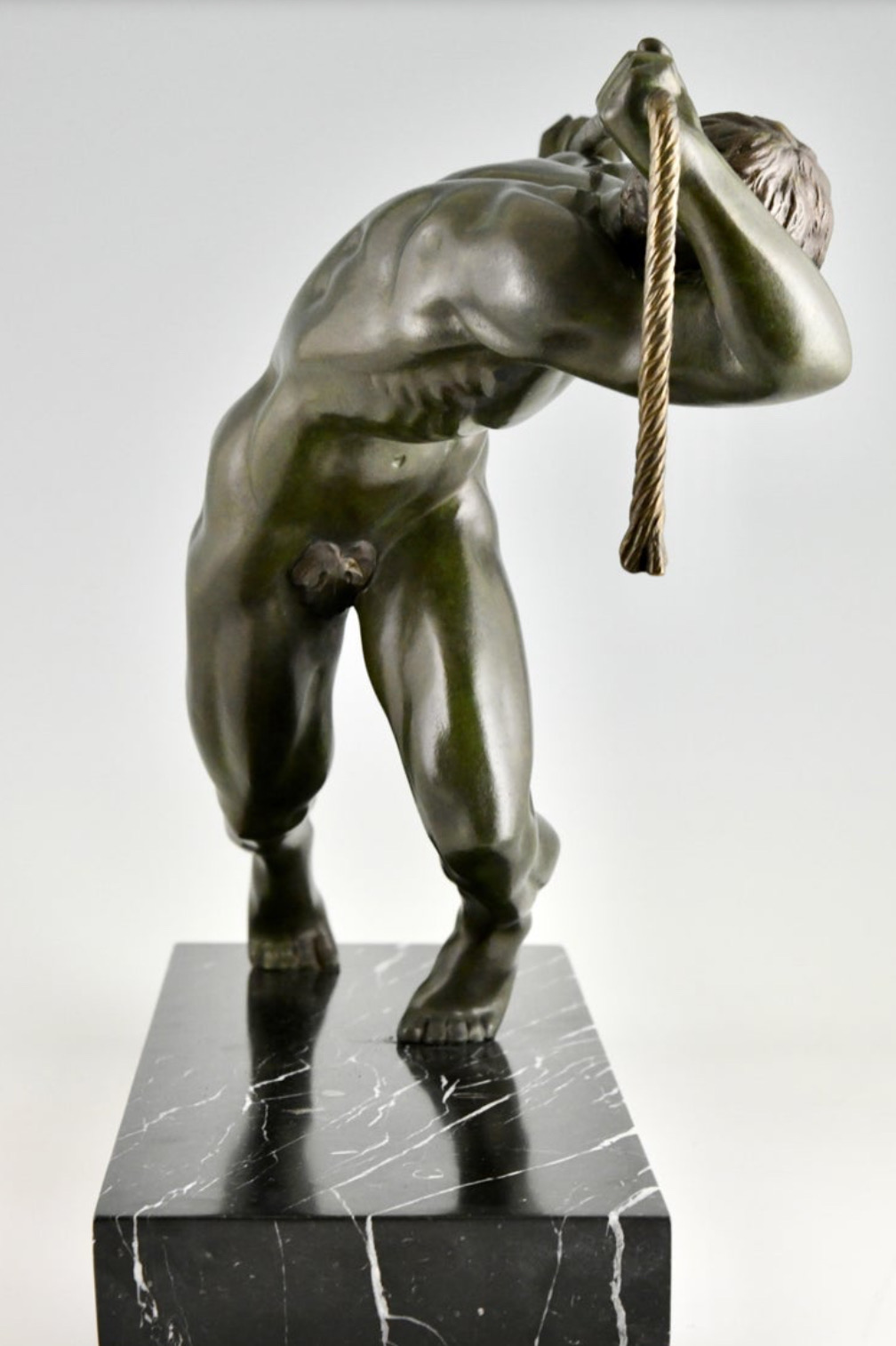
So while Art Deco exalted the male body, it often did so with strategic omissions. Muscles, movement, and idealized form took precedence over sexual detail. In this sense, the missing penis tells us as much about the cultural anxieties of the 1920s and 1930s as the stylized bodies tell us about its ideals of beauty and strength.

MRI

Today is finally MRI day, and I’m both relieved and a little anxious. I had to be up earlier than usual this morning since my appointment at the hospital was at 6 a.m. Isabella didn’t seem to mind me stirring around at that hour—she was just happy to have breakfast a bit earlier. For weeks now my back has been bothering me, and while I’ve tried to push through the pain, it’s clear something isn’t right. Hopefully, the MRI will give me some answers and a clearer path forward. It’s one of those things where just knowing what’s going on will be a huge relief in itself.
Since I have the whole day off, I decided to make the most of it and head up to Burlington afterward. There are a few shoe stores there that carry some really nice options, and I’ve been needing a good pair of shoes for a while. It feels like a bit of a treat to mix something necessary with something enjoyable. After all, if I’m going to be dealing with back issues, I might as well do it in style with a comfortable (and hopefully sharp-looking) new pair of shoes.

Freedom and Truth

Freedom and Truth
by Margaret Fuller
To a Friend.
The shrine is vowed to freedom, but, my friend,
Freedom is but a means to gain an end.
Freedom should build the temple, but the shrine
Be consecrate to thought still more divine.
The human bliss which angel hopes foresaw
Is liberty to comprehend the law.
Give, then, thy book a larger scope and frame,
Comprising means and end in Truth’s great name.
About the Poem
Margaret Fuller’s poem Freedom and Truth offers a meditation on what freedom really means. She insists that freedom is not an end in itself, but a means to something higher — to truth, to comprehension of moral law, to the divine. Freedom without truth, she suggests, is an empty shrine: a structure without a god inside. For her, true human happiness comes from using liberty not merely for self-indulgence, but to understand and live within universal truths.
Reading Fuller’s lines, I couldn’t help but think of the chorus of Kris Kristofferson’s “Me and Bobby McGee” (made immortal by Janis Joplin):
“Freedom is just another word for nothin’ left to lose…
And feelin’ good was easy, Lord, when he sang the blues.”
Though written more than a century later, these lyrics capture a strikingly similar tension. For Kristofferson and Joplin, freedom stripped of attachments is both exhilarating and hollow. It means release, but also loss. Like Fuller, the song suggests that freedom alone is not enough; its meaning is found when it leads to something more — in this case, authentic connection, soulful music, and the raw honesty of experience.
This resonates deeply with the American Transcendentalist movement, of which Fuller was a central voice. Ralph Waldo Emerson once wrote, “For what avail the plough or sail, or land or life, if freedom fail?” — reminding us that liberty matters only in so far as it sustains deeper purposes. Henry David Thoreau sharpened the point in Walden: “Disobedience is the true foundation of liberty. The obedient must be slaves.” Both Emerson and Thoreau, like Fuller, argued that freedom was valuable only when it brought us closer to truth, authenticity, and the divine.
And yet, we see in our own age how this lesson is often forgotten. Freedom of speech, one of the most cherished liberties, is frequently used as a cover for spreading hatred, division, and outright lies. But freedom of speech divorced from truth is no freedom at all — it becomes the empty shrine Fuller warned against, a hollow liberty that erodes rather than sustains the human spirit.
Fuller’s 19th-century vision, Kristofferson’s 20th-century lyric, and our 21st-century struggles meet on common ground. All remind us that freedom cannot be idolized on its own. Whether in the pursuit of higher laws, in the fleeting transcendence of music and love, or in defending speech that is rooted in truth and justice, freedom gains its true meaning only when it opens into truth.
May we never forget that freedom without truth is a shell. Truth gives freedom its soul.
About the Poet
Margaret Fuller (1810–1850) was one of the great voices of the American Transcendentalist movement, though her life and legacy often stand in the shadow of Emerson and Thoreau. I’ve always been inspired by the Transcendentalists, but I find myself especially drawn to Fuller — not only her writings but also the way she lived her life, ahead of her time and unwilling to conform to society’s expectations.
Fuller was the first editor of The Dial, the Transcendentalist journal, and the author of Woman in the Nineteenth Century (1845), one of the earliest works of American feminism. In that book she declared, “Let every woman, who has once begun to think, examine herself.” That call to self-examination and truth resonates as much today as it did in her century. She also wrote, “Very early, I knew that the only object in life was to grow.” For Fuller, freedom was always tied to growth, to becoming more fully human, more fully alive.
Her life took her far beyond Concord. I’ve long had a fascination with American expatriates of the 19th century, and Fuller became one herself. In 1846, she traveled to Europe as a foreign correspondent for the New York Tribune. It was there that she found herself drawn into the currents of Italian nationalism — what would later grow into the Risorgimento, the movement for Italian unification.
Fuller fell in love with Giovanni Ossoli, a young Italian revolutionary, and bore his child. Their relationship had to be kept secret, both because of politics and because of society’s judgment. At one point she even entrusted her baby to the care of another family, only to find he was treated poorly — a decision that haunted her. Eventually, Fuller, Ossoli, and their child decided to leave Italy for America, carrying with them her manuscript history of the Roman Republic.
Tragically, they never reached American shores. In July 1850, their ship struck a storm and sank off Fire Island, just short of New York Harbor. Fuller, her husband, and her child all drowned.


Authors
Recent Comments
Joe on Coffee, Toast, and Starfleet… noisilycool3bc985058… on Coffee, Toast, and Starfleet… noisilycool3bc985058… on Pic of the Day iameverywhere1 on Pic of the Day vandycolt on Finding Peace in the Midst of… Top Posts & Pages




Amazon Associate

As an Amazon Associate I earn from qualifying purchases. So, if you click on a link that takes you to Amazon.com, I may earn a commission.
Trust me, it isn’t much, but every little bit helps.

 Joe
Joe


 The Closet Professor