She knew what it probably was, even though it was early enough in the epidemic for the disease to be called GRID — gay-related immune deficiency — instead of AIDS. She had a gay cousin in Hawaii and had asked him about the stories of a gay plague after seeing a report on the news. He’d told her, “That’s just the leather guys in San Francisco. It’s not us. Don’t worry.” Still, in her concern for him, she’d read everything she could find about the disease over the previous months, hoping he was right.
Whether because of curiosity or — as she believes today — some higher power moving her, Burks eventually disregarded the warnings on the red door and snuck into the room. In the bed was a skeletal young man, wasted away to less than 100 pounds. He told her he wanted to see his mother before he died.
“I said, ‘Well, yeah. He wants his mother.’ They laughed. They said, ‘Honey, his mother’s not coming. He’s been here six weeks. Nobody’s coming.’”
Unwilling to take no for an answer, Burks wrangled a number for the young man’s mother out of one of the nurses, then called. She was able to speak for only a moment before the woman on the line hung up on her.
“I called her back,” Burks said. “I said, ‘If you hang up on me again, I will put your son’s obituary in your hometown newspaper and I will list his cause of death.’ Then I had her attention.”
Her son was a sinner, the woman told Burks. She didn’t know what was wrong with him and didn’t care. She wouldn’t come, as he was already dead to her as far as she was concerned. She said she wouldn’t even claim his body when he died. It was a curse Burks would hear again and again over the next decade: sure judgment and yawning hellfire, abandonment on a platter of scripture. Burks estimates she worked with more than 1,000 people dying of AIDS over the years. Of those, she said, only a handful of families didn’t turn their backs on their loved ones.
Burks hung up the phone, trying to decide what she should tell the dying man. “I went back in his room,” she said, “and when I walked in, he said, ‘Oh, momma. I knew you’d come,’ and then he lifted his hand. And what was I going to do? So I took his hand. I said, ‘I’m here, honey. I’m here.’”
Burks pulled a chair to his bedside, talked to him, and held his hand.
She bathed his face with a cloth and told him she was there. “I stayed with him for 13 hours while he took his last breaths on Earth,” she said.
Since at least the late 1880s, Burks’s kin have been buried in Files Cemetery, a half-acre of red dirt on top of a hill in Hot Springs, Ark. When Burks was a girl, she said, her mother got in a final, epic row with Burks’s uncle. To make sure he and his branch of the family tree would never lie in the same dirt as the rest of them, Burks said, her mother quietly bought every available grave space in the cemetery: 262 plots. They visited the cemetery most Sundays after church when she was young, Burks said, and her mother would often sarcastically remark on her holdings, looking out over the cemetery and telling her daughter, “Someday, all of this is going to be yours.”
“Who knew there’d come a time when people didn’t want to bury their children?”
Files Cemetery is where Burks buried the ashes of the man she’d seen die, after a second call to his mother confirmed she wanted nothing to do with him, even in death. “No one wanted him,” she said, “and I told him in those long 13 hours that I would take him to my beautiful little cemetery, where my daddy and grandparents were buried, and they would watch out over him.”
Burks had to contract with a funeral home in Pine Bluff, some 70 miles away, for the cremation. It was the closest funeral home she could find that would even touch the body. She paid for the cremation out of her savings.
The ashes were returned to her in a cardboard box. She went to a friend at Dryden Pottery in Hot Springs, who gave her a chipped cookie jar for an urn. Then she went to Files Cemetery and used a pair of posthole diggers to excavate a hole in the middle of her father’s grave.
“I knew that Daddy would love that about me,” she said, “and I knew that I would be able to find him if I ever needed to find him.” She put the urn in the hole and covered it over. She prayed over the grave, and it was done.
Over the next few years, as she became one of the go-to people in the state when it came to caring for those dying with AIDS, Burks would bury more than 40 people in chipped cookie jars in Files Cemetery. Most of them were gay men whose families would not even claim their ashes.
“She had a little spade, and I had posthole diggers. I’d dig the hole, and she would help me. I’d bury them, and we’d have a do-it-yourself funeral. I couldn’t get a priest or a preacher. No one would even say anything over their graves.”
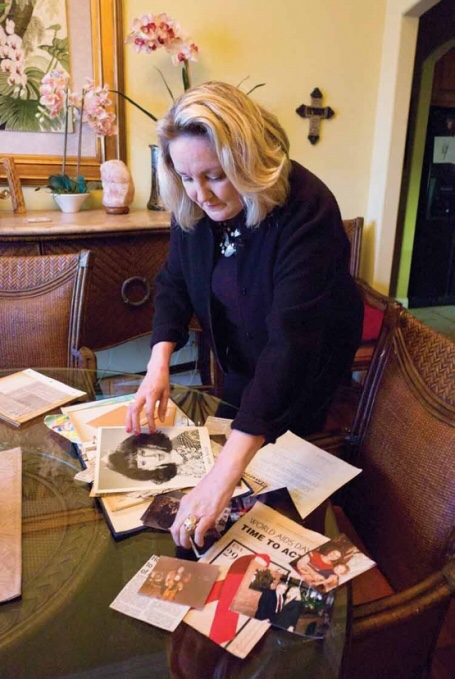
She believes the number is 43, but she isn’t sure. Somewhere in her attic, in a box, among the dozens of yellowed day planners she calls her Books of the Dead filled with the appointments, setbacks, and medications of people 30 years gone, there is a list of names.
Burks always made a last effort to reach out to families before she put the urns in the ground. “I tried every time,” she said. “They hung up on me. They cussed me out. They prayed like I was a demon on the phone and they had to get me off — prayed while they were on the phone. Just crazy. Just ridiculous.”
After she cared for the dying man at University Hospital, people started calling Burks, asking for her help. “They just started coming,” she said. “Word got out that there was this kind of wacko woman in Hot Springs who wasn’t afraid. They would tell them, ‘Just go to her. Don’t come to me. Here’s the name and number. Go.’…I was their hospice. Their gay friends were their hospice. Their companions were their hospice.”
Before long, she was getting referrals from rural hospitals all over the state. Financing her work through donations and sometimes out of her own pocket, she’d take patients to their appointments, help them get assistance when they could no longer work, help them get their medicines, and try to cheer them up when the depression was dark as a pit. She said many pharmacies wouldn’t handle prescriptions for AIDS drugs like AZT, and there was fear among even those who would.
She soon stockpiled what she called an “underground pharmacy” in her house. “I didn’t have any narcotics, but I had AZT, I had antibiotics,” she said. “People would die and leave me all of their medicines. I kept it because somebody else might not have any.”
Burks said the financial help given to patients — from burial expenses to medications to rent for those unable to work — couldn’t have happened without the support of the gay clubs around the state, particularly Little Rock’s Discovery. “They would twirl up a drag show on Saturday night and here’d come the money,” she said. “That’s how we’d buy medicine, that’s how we’d pay rent. If it hadn’t been for the drag queens, I don’t know what we would have done.”
There was the man whose family insisted he be baptized in a creek in October, three days before he died, to wash away the sin of being gay; whose mother pressed a spoonful of oatmeal to his lips, pleading, “Roger, eat. Please eat, Roger. Please, please, please,” until Burks gently took the spoon and bowl from her; who died at 6 foot 6 and 75 pounds; whose aunts came to his parents’ house after the funeral in plastic suits and yellow gloves to double-bag his clothes and scrub everything, even the ceiling fan, with bleach.
She recalled the odd sensation of sitting with dying people while they filled out their own death certificates, because Burks knew she wouldn’t be able to call on their families for the required information. “We’d sit and fill it out together,” she said. “Can you imagine filling out your death certificate before you die? But I didn’t have that information. I wouldn’t have their mother’s maiden name or this, that, or the other. So I’d get a pizza and we’d have pizza and fill out the death certificate.”
Billy is the one who hit her hardest and the one she remembers most clearly of all. He was one of the youngest she ever cared for, a female impersonator in his early 20s. He was beautiful, she said, perfect and fine-boned. She still has one of Billy’s dresses in her closet up in the city of Rogers: a tiny, flame-red designer number, intricate as an orchid.
As Billy’s health declined, Burks accompanied him to the mall in Little Rock as he quit his job at a store there. Afterward, she said, he wept, Burks holding the frail young man as shoppers streamed around them. “He broke down just sobbing in the middle of the mall,” she said. “I just stood there and held him until he quit sobbing. People were looking and pointing and all that, but I couldn’t care less.”
Once, a few weeks before Billy died — he weighed only 55 pounds, the lightest she ever saw, light as a feather, so light that she was able to lift his body from the bed with just her forearms — Burks had taken Billy to an appointment in Little Rock. Afterward, they were driving around aimlessly, trying to get his spirits up. She often felt like crying in those days, she said, but she couldn’t let herself. She had to be strong for them.
“He was so depressed. It was horrible,” she said. “We were driving by the zoo, and somebody was riding an elephant. He goes, ‘You know, I’ve never ridden an elephant.’ I said, ‘Well, we’ll fix that.’” And she turned the car around. Somewhere, in the boxes that hold all her terrible memories, there’s a picture of the two of them up on the back of the elephant, Ruth Coker Burks in her heels and dress, Billy with a rare smile.
And it wasn’t all terrible. While Burks got to see the worst of people, she said, she was also privileged to see people at their best, caring for their partners and friends with selflessness, dignity, and grace. She said that’s why she’s been so happy to see gay marriage legalized all over the country.
“I watched these men take care of their companions and watch them die,” she said. “I’ve seen them go in and hold them up in the shower. They would hold them while I washed them. They would carry them back to the bed. We would dry them off and put lotion on them. They did that until the very end, knowing that they were going to be that person before long. Now, you tell me that’s not love and devotion? I don’t know a lot of straight people who would do that.”
Ruth Coker Burks had a stroke five years ago, early enough in her life that she can’t help but believe that the stress of the bad old days had something to do with it. After the stroke, she had to relearn everything: to talk, to feed herself, to read and write. It’s probably a miracle she’s not buried in Files Cemetery herself.
After better drugs, education, understanding, and treatment made her work obsolete, she moved to Florida for several years, where she worked as a funeral director and a fishing guide. When Bill Clinton was elected president, she served as a White House consultant on AIDS education.
In 2013, she went to bat for three foster children who were removed from the elementary school at nearby Pea Ridge after administrators heard that one of them might be HIV-positive. Burks said she couldn’t believe she was still dealing with the same knee-jerk fears in the 21st century.
Before she’s gone, she said, she’d like to see a memorial erected in Files Cemetery. Something to tell people the story. A plaque. A stone. A listing of the names of the unremembered dead who lie there.
“Someday,” she said, “I’d love to get a monument that says: This is what happened. In 1984, it started. They just kept coming and coming. And they knew they would be remembered, loved, and taken care of, and that someone would say a kind word over them when they died.”
*This story originally appeared in the Arkansas Times.
Click here to donate to Ruth’s campaign to restore the Historic Files Cemetery.








 Joe
Joe




 The Closet Professor