

I seem to have come down with a cold. It’s not a bad one. One minute I am able to almost forget about it then I will start coughing or swallow or feel the aching in my body or all of the above. Anyway, it seems to hit in waves and I was so tired when I went home, I basically went to bed. There was no need for that nighttime, sniffling, sneezing, coughing, aching, fever, best sleep you ever got with a cold… medicine. I was in the middle of texting a friend while simultaneously writing this post when I fell asleep.
Cold
My Doubt

My Doubt
By Jane Hirshfield
I wake, doubt, beside you,
like a curtain half-open.
I dress doubting,
like a cup
undecided if it has been dropped.
I eat doubting,
work doubting,
go out to a dubious cafe with skeptical friends.
I go to sleep doubting myself,
as a herd of goats
sleep in a suddenly gone-quiet truck.
I dream you, doubt,
nightly—
for what is the meaning of dreaming
if not that all we are while inside it
is transient, amorphous, in question?
Left hand and right hand,
doubt, you are in me,
throwing a basketball, guiding my knife and my fork.
Left knee and right knee,
we run for a bus,
for a meeting that surely will end before we arrive.
I would like
to grow content in you, doubt,
as a double-hung window
settles obedient into its hidden pulleys and ropes.
I doubt I can do so:
your own counterweight governs my nights and my days.
As the knob of hung lead holds steady
the open mouth of a window,
you hold me,
my kneeling before you resistant, stubborn,
offering these furious praises
I can’t help but doubt you will ever be able to hear.
About This Poem
Jane Hirshfield is the author of The Beauty (Knopf, 2015), which was longlisted for the 2015 National Book Award. She is a Chancellor of the Academy of American Poets and the 2016 Mohr Visiting Poet at Stanford University. When I read this poem, it immediately struck me as describing the way I have been feeling for the last month. When I read what Jane Hirshfield said about the poem, it hit even closer to home. Hirshfield described the poem by saying, “There are times almost impossible to navigate and silencing, when everything has come into question. The doubt behind this poem was, in the living of it, something close to despair—at my own life; at the life of the world held in any day’s news. Yet to find within the times of ash anything that might be made word-malleable, anything susceptible to imaginative leap and some sense, even, of the comic—that in itself is antidote and through-passage. By the time the poem was half-written, the window had been cracked open an inch; once that happens, some breathable air can’t help but rush in.” I’m hoping for some of that breathable air to reach me.
Cool News

While I was in Alabama for the holidays, winter finally hit Vermont. I’m going to admit something dumb. I can be a real flake at times. When I was landing in Manchester Saturday night, I looked out the window and thought, I didn’t know Manchester was near the beach, but that’s the prettiest white sand I’ve seen besides the gulf coasts if Alabama and Florida. Then it downed on me, that’s not sand that’s snow. Everything was blanketed in, not really snow but ice. As I drove home yesterday, the ice turned more to snow as I drove northwest back toward home. When I left Vermont, the temperature had been in the upper 30s, low 40s. Today, the high is expected to be 9 and the low is expected to be -5. (All temps are in Fahrenheit, of course. I never could convert to Celsius.) I will finally get to use my real winter gear today and tomorrow. Then the temperature will rise back into the 30s.
In other cool news (pun intended), “Teen Wolf”/”Arrow” star and one of my favorite crushes Colton Haynes appeared to open up about his sexuality in a coy social media post some media outlets have deemed his public coming out.
On Tumblr, a user wrote of the 27-year-old actor, “When I found out Colton Haynes had a secret gay past, I got so excited even though i know it makes absolutely no difference in my life.”
On his personal Tumblr, Haynes quickly responded to the remark:
Was it a secret? Let’s all just enjoy life & have no regrets 🙂
Although the “Arrow” actor has thus far remained tight-lipped about the meaning behind his remark, a number of publications have interpreted the post as him publicly acknowledging that he’s gay. For anyone who has followed Haynes career, this is no big surprise.
The actor’s sexuality has been the subject of heavy media speculation for some time. The “secret gay past” that the Tumblr user was referencing could refer to a March 2006 photo series that ran in the now-defunct publication XY which purportedly showed Haynes kissing another man. I first noticed Haynes when he appeared in that magazine, though I dint know who he was at the time. Once I found out who he was, I have followed his career.
In an interview discussing the turning point in his career as an actor, Haynes describes it as “The day I decided to trust my own instincts and not mask my sometimes big personality. I’ve had a bunch of agents and managers over the years who controlled my every move and didn’t necessarily care about me as a person.” When I read this, the actions of his agents and managers in the past make more sense. They’d sued or threatened lawsuits to have the pictures from XY Magazine removed from websites. Of course it didn’t work and they didn’t get all of them removed. For years one of the major search terms that brought people to my blog was “Colton Haynes gay,” that is because of a post I did several years ago about gay college,life, in which I’d used some of those XY pictures.
Haynes, however, has been much less secretive than he was in his time with “Teen Wolf.” For the past two halloweens, he has dressed in Disney drag: Princess Fiona and Ursula. He’s also made no secret in the last few years that he has a gay brother, Joshua, or that he has a close friendship with out actor John Barrowman. In 2013, Haynes was spotted in an airport holding hands with his “Arrow” co-star, Barrowman. Barrowman, who married husband Scott Gill that same year, laughed off the incident in a Greg In Hollywood interview. “He’s a great kid and we have a great time and he’s becoming a really good friend, which I think is really nice,” Barrowman said of Haynes.
I’ve been hoping for years that Haynes would come out. His sexuality has been one of the worst kept secrets in Hollywood. Congrats, Colton! Now, if you’d just marry me.
God’s Eye View
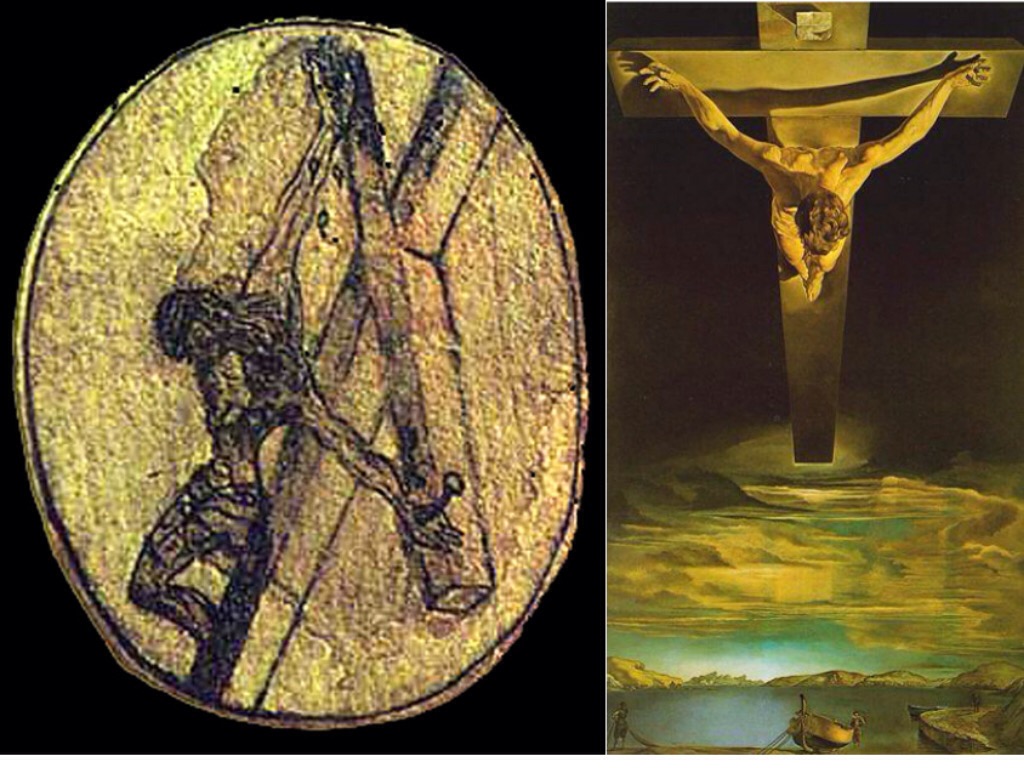 Michael Dodd was kind enough to provide the following devotional today. I was so glad that Michael agreed to send a devotional which comes from a book of devotionals that he wrote. Michael always provides the perfect words for encouragement, and I always value his advice tremendously. When Michael sent this devotional, he wrote “Attached is an excerpt from my book for your consideration. This passage refers to a drawing of Christ crucified done by St. John of the Cross [left], later made much more famous by the Salvador Dali painting it inspired [right].” When he sent this, he also said that he “realize[d] that this passage may hit very close to the bone for you at the moment and might not be one you want to use.” Here is what Michael sent me:
In his profound teaching on the experience that has come to be called the dark night of the soul, John of the Cross helps the person experiencing spiritual dryness see the experience from a different perspective. He helps me see that God has not abandoned me, despite my feelings or my confusion, but that God is perhaps being present to me in a new way. This may be unfamiliar to me and seem to be regression, whereas, properly understood, it is in fact a sign of spiritual progress. It is a matter of changing my perspective so that I begin to see things from God’s point of view.
A wonderful example of this can be seen in a famous painting of Salvador Dali, based on a drawing of the crucified Christ by John of the Cross. The original drawing, preserved in the museum at the Monastery of the Incarnation in Avila, intrigues the viewer because of the angle from which it is drawn. Most familiar views of the crucifixion are head-on or perhaps looking up at the figure of Jesus on the cross. John’s drawing looks at the body from the side and a bit from above. It is such an unusual angle that the viewer’s first impulse is to shift position or even to reach out and turn the drawing, trying to make it fit into the expected perspective. Dali’s beautiful painting emphasizes this view from above, so that one is looking down, as it were, from heaven on the scene of Christ’s death. At first, it may look like a bird’s-eye view, but then the thought come: It is perhaps a God’s-eye view.
If you read the accounts of the Passion in the four gospels, you cannot help being struck by the way the perspective in John differs from the perspective in the first three gospels. The story is the same, and we tend to merge details from each version into one continuous storyline in our imagination. Yet the Jesus in John seems to be moving in a different atmosphere than the same Jesus in Matthew, Mark and Luke. I would contend that it is not the story that is different, but the perspective. Matthew, Mark and Luke tell the story very much from the human point of view; John gives us a mystical glimpse into the same events with the eyes of God.
In the Dali painting, the bloody brutality that marks our ordinary perception of Calvary is missing, and instead there is an air of timelessness and even serenity. Instead of the walls of Jerusalem in the background, we see a boat beside a body of water, and nearby stands a figure in the uniform of the papal Swiss Guard. The mind is directed not to the past but to the future, to the action of God that will flow from this supreme act of love on the part of Jesus: the establishment of the church as the sacrament of his body and the instrument of the invitation to universal salvation.
When you and I stand on different sides of an image and look at it, we see the same object, but what we see is not the same. My view – and yours – is always partial. That is why we move around from side to side, walk around behind a statue or peer at a painting from different angles. Our view remains partial, but we seek to see more so that we may see more fully. We sometimes mistakenly think we have seen all there is to see. Dali’s painting, like the original drawing of John of the Cross, is a reminder that there is more.
Dryness, therefore, can call us to change our way of seeing things, our way of seeing the world and ourselves so as to open out hearts and minds up to what Jesus calls “God’s work.” Dryness, tragedy and sorrow can be seen as an opportunity for grace more than as a sign of divine anger.
I’m not sure Michael expected my response. I had been talking earlier with my friend John, who will most likely also be providing some devotionals until I can get back on a firmer spiritual footing. After reading the above devotional, a few things kind of clicked and I wrote Michael back saying: “It did hit close to home, but not in a bad way. John and I had a long discussion this afternoon about our relationship with God. He said that God is always with us, but sometimes he is silent and allows us to work through things on our own, especially when it is a time of great pain. We also discussed heaven. I was always taught that you did not enter heaven until the Day of Judgement, but he said that he’s always believed we go straight to heaven. He allowed me to realize…that for God, time is meaningless. So even if we do go to heaven on the Day of Judgement, time is meaningless once we are there, so those who have gone on before are able to enjoy the greatness of heaven and look down upon us even now before the Judgement because for them it has already happened. Maybe I’m making a stretch here, but when we look at things from God’s perspective as it is done in the two paintings and in the Gospel of John, then we can take greater comfort in the passing of loved ones. They are already in a better place.”
Michael Dodd
Michael Dodd has written and lectured about Carmelite spirituality and history for over twenty years. His work has appeared in publications in the United States, Europe and Africa. He is the author of The Dark Night Murders: A Fray John of the Cross Mystery and Jerome Gratian: Treatise on Melancholy. The above devotional is from his book Elijah and the Ravens of Carith: A Twenty-First Century Reflection in a Medieval Carmelite Mode, which can be purchased on Amazon.com in paperback for $9.95.
By the way, Michael did not ask that I mention his books, but I think anyone who reads this blog and also reads the comments know that Michael is a very special person, wise beyond words, and we all love him.
Moment of Zen: Being Held

When I was in college and coming to terms with my sexuality, one of the things that made me realize I was gay was that I wanted to be held by a man. Of course I’d had fantasies about sex with a guy and kissing a man and all the other things that gay men do, but the number one thing I always wanted was to be held in the strong arms of a man and to feel his hard chest up against me. I wanted a man to put their arms around me and make me feel safe. Honestly, if I had to choose just one type of contact with a man, I’d be happy the rest of my life, if I could just get held and comforted on occasion. Maybe that sounds silly or even pathetic, but I’d held my girlfriends and comforted them and all I wanted was to be held in the same way. Knowing that I wanted to be held, helped me to realize that I was attracted to men and not women. Also the fact that when I had erotic dreams they were always of men and not women was the other major clue.
Usually my moments of zen are things that made me smile during the week, but this one is something that I long for. I want someone to hold me when I cry. I want someone to hold me because they love me. I want someone to hold me so their smell can make all things right with the world. I want someone to hold me so we can feel our heartbeats in unison. I want someone to hold me and make me safe. Ther are many things in life that I want that I know I will never have, but to have someone to hold me could and I hope will happen.
Thought of being held always bring to mind the song “The Best Is Yet To Come” because of the lyrics in the second half of the song:
Wait till your charms are right for these arms to surround
You think you’ve flown before, but baby, you ain’t left the ground
Wait till you’re locked in my embrace
Wait till I draw you near
Wait till you see that sunshine place
Ain’t nothin’ like it here
The best is yet to come and babe, won’t it be fine?
The best is yet to come, come the day you’re mine
Come the day you’re mine
Happy New Year

As the year comes to an end we look forward to a new one filled with good fortune. Those hopes and expectation about the future are precisely how traditions get started and according to the country you are living in you are ruled by them. But this is a fun tradition. In the South, we have our traditional meals of greens, black-eyed peas, and pork, but around the world, superstitions abound and one of those is the color underwear that you wear on New Year’s Day.
Did you know that men in several countries follow an strict color-coded custom to celebrate the New Year? Most of the countries listed here seemed to agree that wearing black is not good (I’m a bit superstitious myself, so I will not be wearing black and follow the advice just in case) and if worn on New Year’s Eve will bring bad luck and misfortune in the new year. In Spain with their fondness for eating twelve grapes at midnight, Spaniards wearing tight red underwear to keep you warm and is a symbol of life during the cold months. In Puerto Rico, their tradition is to wear tighty whities to aid fertility and a year of good health. I love how every country think that they have unlocked some kind of secret connected to their crotches and bulges to improve their luck in the next planetary solar trip around the sun. Brazilians go for bright orange to provide a year of professional success. In Peru, they wear green underwear inside out to bring positive energy in the new year. They change them back at midnight. Chinese of course have chosen red as it is always a lucky color for the new year. Men from the Philippines are the most eccentric and they prefer polka dots for their underwear as the round shape symbolizes prosperity. Argentinians don pink undies for a better chance in their love life. Bolivians also wear pink to keep friendships strong and if worn backwards, they double your luck in the new year. The men of Columbia no Ecuador wear yellow underwear to inspire a year of happiness and good fortune. In order to have a year of tranquility, Portuguese men sport blue. Like the Spanish and Chinese, Italians wear red but for them, it’s for a year of good cheer. If you received the red underwear as a gift the day before, then they provide even more cheer.
Since Spain, Italy, and China all agree that red is the correct color, that’s the color I am donning for the day (I even bought a pair as a gift to myself yesterday), though I started the year in a pair of orange underwear in hopes that it will provide a year filled with professional success.
What New Year’s superstitions do you follow? Whatever they may or may not be, I hope that 2016 is a good year that will be filled with good memories for all of us. Happy New Year, everyone!
2015: A Year in Review

In the year of our Lord two thousand fifteen, there has been many ups and downs. I think though that in many ways, it will be remembered as a year of crossroads. In January of last year, I was in a miserable job that was getting more miserable each day. I was teaching high school. I had students who didn’t care nor did they want to try. I was more of a babysitter who felt like he was herding cats than a teacher. From January to April, I suffered from one long chronic headache which had actually begun the previous November. At times, the pain was unbearable, but I was finally correctly diagnosed with cluster headaches instead of migraines. I was given the correct treatment, which seemed to work. I was pain free for the first time in six months. I still experienced minor cluster headaches, but nothing like what I’d previously experienced. I was feeling more hopeful.
Then on the last teacher workday of the school year, I was called into my headmaster’s office and told that my contract would not be renewed. So instead of enjoying my summer off, like all teachers are entitled to because of the horrors and stress of the school year, I had to hunt for a job. The job hunt became a full time job in itself. I worked on applications from the time I woke until I went to bed. I made the decision though to get out of teaching. I still applied to some college teaching jobs but after looking for seven years already, I didn’t see much hope in that direction. However, I made the decision to move into the museum field. I began to volunteer at a local museum to gain some experience. My volunteer work was the highlight of my summer.
With the love, support, and advice of my readers and some dear friends, I made it through the summer. In July, I set up a GoFundMe site to help pay for new training in museum studies, and to get a new laptop to help with writing a novel I began to write. More on that later. Without those donations, I’m not sure I would have been able to make it through the summer or had the money to ove and begin a new life in the fall. I receive so much help from many of you that I can’t thank you enough. I had days and weeks when rejection letters poured in, and I became despondent and sunk into a deep depression. I kept faith though that God would guide me to the right job. My faith took me through that ordeal.
In August, I was checking out a new job posting site when I came across a job that seemed ideal. They were looking for someone who had my qualifications, and I even met the preferred qualifications. If you’ve ever been on a job hunt, you know how hard it can be to fill all of the requirements for a job. Jobs often post a wish list as opposed to what they really need. I turned out to be this museum’s wish list. It took a month, but I finally got called for a phone interview, which went well. Then I got called for an on campus interview. The last call was to hire me for the job. I accepted immediately and began packing to move to Vermont.
The drive up to Vermont wasn’t what I expected. As I was driving through Knoxville, Tennessee, I hit something on the interstate that ruptured my gas tank, and I was stranded there for a few days while a new gas tank was found and installed. I finally made it though safe and sound and moved into my new apartment. I fell in love with Vermont immediately. I’m still in the honeymoon phase. As I settled into my job, I found out just how perfect a job it was for me. Yes, there have been challenges. The two people who had the job before me couldn’t have been more different, so I’ve been working to standardized the job and get things in order the best I can. I couldn’t ask for a more wonderful group of people to work with though. They have been so accepting, supportive, and kind.
Just as I was settling into my job, my world came crashing down again. My best friend and closest confidante who I loved like the brother I never had was suddenly killed in a car accident. I’d been devastated when I lost my job, but the loss of my best friend was world shattering. With the loss of my job, I had faith that God would guide me on the right path, but the loss of my friends tore holes in my faith. I couldn’t understand (still can’t) how God could allow this to happen. Why God didn’t save him. My days have been lost without him. I’ve had friends who have offered tremendous support, and I’ve received some wonderful words of wisdom from my blog readers. I’m finally able to discuss my friend without bursting into tears, but my depression has grown and the frequency of my panic attacks have increased. Also, my cluster headaches are back, and while the medicine that I take to prevent them somewhat lessens the intensity, they are back to waking me in the middle of the night. They’d begun again before my friend’s death, but had only come on weekends, but for the past month since his death, they have been constant. Pain relievers help for a few hours, but there is only so much pain medication you can take without it becoming a problem.
I’m hoping that on a whole, 2016 will be better. While I’ve made a new home for myself in Vermont and it’s been a tremendously positive change, so much of the rest of 2015 was unexpectedly horrific. I went to my doctor’s office here in Alabama yesterday, and I was given medicine to help with the headaches as well as a new antidepressant that will help with the one I am already on. Hopefully, the combination of the new medicine and the therapist I’ve been seeing will help alleviate the depression, which in turn I am hoping will help end this new cycle of cluster headaches.
I have a lot of hopes for the new year. The novel is still in the works, and I expect to finish it sometime in the coming year. It will be dedicated to the friend that I lost not only because he was the greatest friend I’ve ever known but he was the one who encouraged me to write a novel and he read and helped edit the parts of the novel that has already been written. I see great thing on the horizon for my new job and my new life in Vermont. I’m also working to lose weight and get in better shape. I got a Fitbit for Christmas. Since I’ve been in Alabama, people have already told me that I look like I’ve lost weight. I don’t know that I have but maybe there’s been some fat replaced by muscle. I have two years until I turn 40 and I plan to be in good shape when I hit that milestone year.
This past year will probably always live in my memory for two reasons: a beginning of a new life and the loss of the life of my friend. If I could, I’d trade my new life for that of my friend’s lost life in a heartbeat. I’d do anything to have him back, but unless time travel is invented, I cannot change what happened. I can’t bring him back, no matter how much I wish I could. The year has also been a dichotomy of faith. My faith brought me through losing my job and finding a new and better one; however, the loss of my friend has cracked my faith. It hasn’t shattered it, but it has caused me to question some of my long held beliefs about my faith and God’s role in our lives. I’m working through those questions. I don’t expect answers, but with the help of some very good friends, I hope to work though my current crisis of faith.
May you all have a wonderful 2016!
Once You Snap, You Can’t Go Back

Monday, I wrote about how Millennials are doing their best to hide their nudity in the locker rooms, but on the flip side, they are all too willing to trade naked selfies with one another, be it through texts, snapchat, or various other ways. A growing numbers of youngsters are swapping naked selfies. When I was teaching one of the first things that the computer teacher taught was that once an image is uploaded online, it is there forever. Kids may think they can delete it or that a SnapChat is only there for a few seconds, but once there, someone can always find it if they know where to look.
As a teacher, I heard a lot of students talking when they didn’t know I was listening, or didn’t care that I was listening. One of the things I heard a lot was that so and so sent a naked selfie on SnapChat or they would talk about other students sending often naked or revealing pictures of themselves in text. It was happening earlier and earlier. I’d heard of this with kids as young as fifth grade.
When these Millennials get to college, they are even freer about sending nude selfies. Take a look on Twitter any day and at all the “Anon” accounts and there are constantly headless pictures of nude or nearly nude guys. I have no doubt that it is the same with women, but I don’t particularly want to see that. Anon Twitter accounts will often show their face with these pics for a limited time and then delete them, but the picture is already out there.
The same is true with webcams. With sites like Chaturbate and Chatroulettle, people do all sorts of things for others to see, often showing their bodies but not their face. I guess this is the big difference, they don’t mind showing off to others as long as they don’t show their face. Others though don’t have a problem showing their face, and even when they don’t show their face, most everyone knows their friends SnapChat name, so whether it shows their face or not, their peers know who it is and they are showing off what they are hiding in the locker rooms.
Celebrities and non-celebrities alike often have no problem showing their nude butts, especially men (women it often comes down to their breasts), but butts have become so commonly shared that they are almost not considered nudity anymore. Let’s face it, mooning has been a thing for high school and college students for many, many years. It is the penis that is most hidden, and celebrities with particularly large ones will often allow themselves to have very brief frontal nude scenes or they “allow” their own nude selfies to be leaked online. It is always claimed to be an invasion of privacy, but once you take those pictures or videos of yourself, you have to realize that the possibility of it being leaked online is quite high.
The point that I am trying to make is that live and in person Millennials don’t want to show off their bodies and they hide behind their towels in the locker room, but these same guys who do the towel dance will send out naked selfies to all their friends later that day. While certainly not everyone, or probably even a majority, send naked selfies, a large number of Millennials do. While SnapChats, tweets, texts, and the like might be contained with just a few people, often those they hide from in the locker room, all you need to do is check out a dating app to see more dick pics than you might ever want to. Granted, dating sites are a different beast than all the others, but it shows that they don’t mind showing off the “goods” as long as a face isn’t attached or if it will get them laid.
I think that nudity is probably less an issue for gay men than straight men, but it is more of a body conscious issue with gay men. However, the SnapChat and texting phenomenon that I heard so much about as a teacher was with guys and girls (mostly guys) sending out pictures of themselves to both genders. It was a joke, at least that’s the way they saw it. Of course, like the celebrities who have their pictures leaked, there are always people who are proud of their goods and have no problem sending out dick pics. I had one incident when I was a teacher of a kid whipping out his penis to a girl in class. From what I was told, for a small guy he was quite large and quite proud of his size. In another such incident, the guy claimed that he’d been scratching his balls when it just flopped out when he removed his hand. Both instances were ridiculous, but the point is they had something they wanted to show.
Not all guys are that brazen. Many, if they can get away with it, will post dick pics online anonymously to get a response and see how they measure up. Without the more free nudity in locker rooms, guys don’t necessarily know the vast array of penis sizes. Even when there was more nudity, I don’t think many understood the difference between growers and showers, because that is a secret you only find out with an erect penis. It is one of the advantages to being a gay man, we get to see the penis at all stages from flaccid to erect.
I have a feeling that the selfie is here to stay. With all things people will get more and more extreme with the selfie and the headless nude shot will become ever more common, while the towel dance will continue in the locker rooms. Privacy it seems is something that is only desired in live interaction, but behind a camera, privacy means very little as long as you can hide your face.
The Feast of Stephen by Anthony Hecht

I
The coltish horseplay of the locker room,
Moist with the steam of the tiled shower stalls,
With shameless blends of civet, musk and sweat,
Loud with the cap-gun snapping of wet towels
Under the steel-ribbed cages of bare bulbs,
In some such setting of thick basement pipes
And janitorial realities
Boys for the first time frankly eye each other,
Inspect each others’ bodies at close range,
And what they see is not so much another
As a strange, possible version of themselves,
And all the sparring dance, adrenal life,
Tense, jubilant nimbleness, is but a vague,
Busy, unfocused ballet of self-love.
II
If the heart has its reasons, perhaps the body
Has its own lumbering sort of carnal spirit,
Felt in the tingling bruises of collision,
And known to captains as esprit de corps.
What is this brisk fraternity of timing,
Pivot and lobbing arc, or indirection,
Mens sana in men’s sauna, in the flush
Of health and toilets, private and corporal glee,
These fleet caroms, plies and genuflections
Before the salmon-leap, the leaping fountain
All sheathed in glistening light, flexed and alert?
From the vast echo-chamber of the gym,
Among the stumbled shouts and shrill of whistles,
The bounced basketball sound of a leather whip.
III
Think of those barren places where men gather
To act in the terrible name of rectitude,
Of acned shame, punk’s pride, muscle or turf,
The bully’s thin superiority.
Think of the Sturm-Abteilungs Kommandant
Who loves Beethoven and collects Degas,
Or the blond boys in jeans whose narrowed eyes
Are focussed by some hard and smothered lust,
Who lounge in a studied mimicry of ease,
Flick their live butts into the standing weeds,
And comb their hair in the mirror of cracked windows
Of an abandoned warehouse where they keep
In darkened readiness for their occasion
The rope, the chains, handcuffs and gasoline.
IV
Out in the rippled heat of a neighbor’s field,
In the kilowatts of noon, they’ve got one cornered.
The bugs are jumping, and the burly youths
Strip to the waist for the hot work ahead.
They go to arm themselves at the dry-stone wall,
Having flung down their wet and salty garments
At the feet of a young man whose name is Saul.
He watches sharply these superbly tanned
Figures with a swimmer’s chest and shoulders,
A miler’s thighs, with their self-conscious grace,
And in between their sleek, converging bodies,
Brilliantly oiled and burnished by the sun,
He catches a brief glimpse of bloodied hair
And hears an unintelligible prayer.
The Feast of Stephen
If you are interested in seeing the complete short film by James Franco based on this poem, it can be found at the following link: http://m.sinemalar.com/mobileweb/movieInfo/169207. It’s only 4 min. long and is quite interesting.
You may know of this poem if you are a huge James Franco fan. He used this poem as the basis for a student film he made in college. When he was at NYU, he made three short films based on the following poems: “The Feast of Stephen” (Anthony Hecht), “Herbert White” (Frank Bidart), and “The Clerk’s Tale” (Spencer Reece). Of the three poems, he said that this was the one that had the least character development. It has characters in it, and there is a progression, but until the last stanza, the characters are described as a group, rather than as distinct individuals. The first two stanzas, set in a locker room and a basketball gymnasium, describe boys coming into their new bodies. The boys are not differentiated. Sometimes there is subtle distancing from these boys, like the last two lines of the second stanza that seems to be describing the gym from a distance. Even when the boys are described as inspecting each other, it doesn’t sound as if the voice of the poem is their voice. It is too sophisticated, the metaphors are too advanced, the diction too high. There is another kind of consciousness present, even if it isn’t described within the actual substance of the poem.
In the third stanza, there is a sharp change in the development of the poem’s subject. The pubescent and exploring boys are now described as violent. They are compared to an SS officer and are at an ominous hangout where there are cracked mirrors and weapons like gasoline and knives. The members of the group are not distinguished from one another, but the group’s identification has changed. The boys have become evil and potentially destructive.
The last stanza finally differentiates some of the characters. The description recalls the martyrdom of St. Stephen, described by Luke in Acts 6–8. The character of Saul functions on two levels. In the context of the poem, he is the witness who observes and does nothing to stop the violence. Without Saul, the attack would unfold at a distance, with no possibility of outside intervention. To have him there but doing nothing places the reader there as well, asking us to consider occasions when we have stood by in the face of injustice. The boy who is being beaten is another new character freshly differentiated from the group. He is compared to a martyr. It is not clear why he is being beaten, although the first two stanzas lean heavily on homoerotic descriptions, suggesting that violence is homophobic in nature. If the first stanzas show the boys in a state of discovery and uncertainty, the later stanzas could be read as moments after the boys have decided that the innocent observations that took place in the early stanzas were wrong, that that kind of behavior should be punished.
Anthony Hecht
One of the leading voices of his generation, Anthony Hecht’s poetry is known for its masterful use of traditional forms and linguistic control. Extraordinarily erudite, Hecht’s verse often features allusions to French literature, Greek myth and tragedy, and English poets and poetry stretching from Wallace Stevens to John Donne. Hecht, who died in 2004, was often described as a “traditionalist.” George P. Elliott contended in the Times Literary Supplement that “Hecht’s voice is his own, but his language, more amply than that of any living poet writing in English, derives from, adds to, is part of the great tradition.” Though his early work was often slighted as ornate or Baroque, his collection The Hard Hours (1967) is generally seen as his break-through volume. In that book, Hecht begins to use his experiences as a soldier in Europe during World War II. The often unsettling and horrific insights into the darkness of human nature told in limpid, flowing verse that characterize the poems in the collection would become Hecht’s trademark. According to Dana Gioia: “Hecht exemplifies the paradox of great art…He found a way to take his tragic sense of life and make it so beautiful that we have to pay attention to its painful truth.”
Anthony Hecht was born in New York City in 1923. Though a self-described mediocre student, he nonetheless counted his first three years at Bard College some of the happiest of his life. His college career was interrupted, however, when he was drafted into the army to serve in World War II. As an infantryman, he fought in Germany, France and Czechoslovakia. His division also helped liberate Flossenburg concentration camp. Ordered to collect evidence from the French prisoners, the experience marked him for the rest of his life. Hecht returned to the United States and finished his degree at Kenyon College where he studied under John Crowe Ransom. At Kenyon he also formed friendships with poets like Robert Lowell, Elizabeth Bishop, Allen Tate and Randall Jarrell. Hecht’s first book, A Summoning of Stones (1954) displays great technical skill, but for some critics, the style seems mannered and dated.
A longtime professor of poetry at the University of Rochester, Hecht also taught at institutions such as Georgetown, Yale, Harvard and Smith College. He was the Poet Laureate Consultant to the Library of Congress from 1982-1984, and won many of America’s most prestigious poetry awards, including the Bollingen Prize, the Ruth Lily Poetry Prize, the Wallace Stevens Award and the Frost Medal. His collected poems were published in two volumes, Early Collected Poems (1993) and Later Collected Poems (2005). His death in 2004 was marked by a great outpouring of tributes and eulogies. In the New York Times, David Yezzi offered this praise: “It was Hecht’s gift to see into the darker recesses of our complex lives and conjure to his command the exact words to describe what he found there. Hecht remained skeptical about whether pain and contemplation can ultimately redeem us, yet his ravishing poems extend hope to his readers that they can.”
Locker Rooms

Early in my blog, I did a post called “Naked Male Camaraderie,” which has been the most popular post on this blog. A friend recently shared a New York Times titled “Men’s Locker Room Designers Take Pity on Naked Millennials.” One of the things I talked about in my previously mentioned blog post was that guys these days don’t like being naked in front of each other, which was part of this NYT article. In the article, it states:
But gyms are still unable to provide the one thing younger men in particular seem to really want: a way for them to shower and change without actually being nude.
Each day, thousands upon thousands of men in locker rooms nationwide struggle to put on their underwear while still covered chastely in shower towels, like horrible breathless arthropods molting into something tender-skinned. They writhe, still moist, into fresh clothes.
If you’ve been in a locker room recently, you know how sad and true this is. When I was in grad school, I used to frequent the gym there. In the locker room they had the gang showers (which was supposedly a major gay hook up area), three private showers, and a sauna. I never saw anyone use the group showers unless they kept a swimsuit on and most guys kept a towel on in the sauna, the only exception being Asian guys. Except for the swimmers who’d shower in their swim trunks the guys who wore speedos tended not to have a problem with being fully nude. So with the exception of swimmers wearing speedos and Asian guys in the sauna, most other guys did the towel dance.

According to the NYT article, this is because:
Showering after gym class in high school became virtually extinct in the ’90s. And if Manhattan’s high-end gyms weren’t riddled with ab-laden models or Europeans (or both), there would be few heterosexuals under 40 who have spent any naked time with other men.
A generation ago, when most schools mandated showers, a teacher would typically monitor students and hand out towels, making sure that proper hygiene was observed. In schools with pools, students were sometimes required to swim naked, and teachers would conduct inspections for cleanliness that schools today would not dare allow, whether because of greater respect for children or greater fear of lawsuits.
In a striking measure of changed sensibilities in school and society, showering after physical education class, once an almost military ritual, has become virtually extinct. This is beginning to change, especially with athletes in schools, as health officials are increasingly warning that not showering after gym class leads to MRSA infections, the potentially deadly staphylococcus infection that is resistant to most antibiotics. The Center for Disease Control (CDC) has practical advice on preventing staph infections. Showering right after exercise is at the top of the list.
If showering can help prevent a deadly disease from spreading to school children, why aren’t more schools making showers mandatory? There are several reasons, which seem as varied as insecurities about body image, heightened sexual awareness, and a lack of time in a busy school schedule. The lack of showers in schools leads to a shyness about bodies that is virtually nonexistent in older generations. Old men seem to have no problem walking around locker rooms naked but young men do.

In March 2015, Men’s Health had an article about locker room etiquette called “Are You the Gym Locker Room A**hole?” in which they outline their do’s and don’t’s of locker room etiquette. Here’s the problem with this article, they asked a woman about male locker room etiquette. What does a woman know about men’s locker rooms? (No offense to the women who read this blog.) Two of the things she warns against are nudity and conversations in the locker rooms. Really? According to her, men should not be nude in the locker room nor should men talk to one another. I find that utterly ridiculous.
Nudity in America is so puritanical that it’s nearly nonexistent. The NYT article makes some interesting observations about what gyms are doing to attract more members. The main thing is providing more privacy. Men are afraid to see each other naked. They are afraid they won’t measure up, whether that is with whether they are a shower or a grower or whether they are just insecure about the way their body looks as a whole. Men need not fear being naked in front of one another.



Recent Comments
Top Posts & Pages


