Wrestling Demons by Xavier Mayne

20140423-224357.jpg

Last week, I reviewed Frat House Troopers by Xavier Mayne and I couldn’t wait to read Wrestling Demons, the second book in the Brandt and Donnelly Capers by Xavier Mayne. Last night, I finished Wrestling Demons, and though I expected a great and thought provoking read as I had with Frat House Troopers, I was surprised at how Wrestling Demons was even better. The wrestlers, Jonah and Casey, are more the stars of this book than Brandt and Donnelly, but it isn’t long before you are as smitten with the 18 year old high school wrestlers as you are for Brandt and Donnelly

In Wrestling Demons, Jonah Fischer’s high school wrestling career has been stellar, but now he’s the unwilling star of a series of videos that have hit the web. The whole world may have seen the evidence that his best friend turns him on. Jonah’s conservative family wants him cured, and his conventional town and school want him normal. The only person who still wants him just the way he is is Casey Melville, the same best friend who turned him on for all the world to see. Meanwhile, Casey begins to wonder if there’s more to his feelings for Jonah than he thought.

Officers Brandt and Donnelly—lovers as well as partners on the job—have been assigned to find the culprit who posted the video. While investigating the case, they also help Jonah and Casey find their way through their feelings, and steer them toward refuge when Jonah’s family turns against him. But the mystery remains: who wants to hurt Jonah badly enough to post those videos, and why? Thank goodness Jonah and Casey have found friends—they’re going to need all the help and support they can get.

Xavier Mayne is well-versed in academic theories of sexual identity, and is passionate about writing stories in which men experience a love that pushes them beyond the boundaries they thought defined their sexuality. He believes that romance can be hot, funny, and sweet in equal measure. Once again, he proves this in Wrestling Demons. Mayne writes sex scenes they way they should be written in a book: organic so the sex play easily into the story and plays an integral part in the plot but not so overly done that the book becomes erotic fiction. To me, the sex scenes written by Mayne are more erotic and sexually charged than any book I’ve ever read, and they don’t come across as silly hyperboles.

As my readers know, I am a religious person, and so in many ways this book hit home on so many levels because of the religious questions that are brought up. I don’t want to give away too much of what happens in the book, but one of the characters attends a church that is very welcoming to everyone and is vastly different from the ultra-conservative church of his youth. Instead of the character turning his back on religion, he sees what religion can truly be, a welcoming and accepting journey. The struggles the character faces between the damning church of his youth and the welcoming church he finds, is a dichotomy that truly warmed my heart. Instead of a maybe doing as many gay authors do and wrote how the character rejected religion, it instead showed not only how wrong these hate filled churches are but also shows what is right when Christians show compassion and acceptance.

One of the reason I have so enjoyed reading Xavier Mayne’s books is that not only is ere a great story, but also but their are deeper meaning and lessons contained within. Thank you Xavier Mayne for such a delightful read. I look forward to more capers from Brandt and Donnelly’s case files.


Fell Asleep

20140423-000206.jpg

I fell asleep last night as I was getting ready to write my post for today, and I could barely keep my eyes open to type this. Have a wonderful day.


From “I Sing the Body Electric” by Walt Whitman

20140421-221700.jpg

I knew a man, a common farmer, the father of five sons,
And in them the fathers of sons, and in them the fathers of sons.

This man was a wonderful vigor, calmness, beauty of person,
The shape of his head, the pale yellow and white of his hair and
beard, the immeasurable meaning of his black eyes, the richness
and breadth of his manners,
These I used to go and visit him to see, he was wise also,
He was six feet tall, he was over eighty years old, his sons were
massive, clean, bearded, tan-faced, handsome,
They and his daughters loved him, all who saw him loved him,
They did not love him by allowance, they loved him with personal
love,
He drank water only, the blood show’d like scarlet through the
clear-brown skin of his face,
He was a frequent gunner and fisher, he sail’d his boat himself, he
had a fine one presented to him by a ship-joiner, he had
fowling-pieces presented to him by men that loved him,
When he went with his five sons and many grand-sons to hunt or fish,
you would pick him out as the most beautiful and vigorous of
the gang,
You would wish long and long to be with him, you would wish to sit
by him in the boat that you and he might touch each other.


Country Boys

20140420-231725.jpg

There is just something about the rough and rugged country boy. Someone who’s worked hard and is dirty and sweaty with the musculature only hard manual labor can provide and the gym can’t. These men are the men of fantasies and can make a man like me weak in the knees. Some might be classified as a cowboy, others as a farmer, and some might even be called a good ol’ boy or redneck, but those are loaded terms.

20140420-231745.jpg

The term redneck has expanded in meaning beyond the poor Southerner to refer to “a bigoted and conventional person, a loutish ultra-conservative.” It is often used to attack white Southern conservative. And while as a general rule this may be true, I’ve known many a Southern man who had a rough and rugged exterior, but a heart of gold. Not all of them are quite so conservative either. As the world changes, so do the rednecks. The younger generation is more accepting of gays men and especially gay women (not for the lesbian fantasy but because they are often very hard workers and can out man a lot of men). Religion sometimes gets in the way of this progress, but I think we will see that change as well. Religion used to be one of the factors behind racism, but that is disappearing as well, and is in fact, almost non existent. I think the same will happen with homophobia.

The term redneck and good ol’ boy is also used broadly to degrade working class and rural whites that are perceived by urban progressives to be insufficiently liberal. Living in a rural area myself, I can attest to some of the small changes. It’s slow progress, but the South has always been slow with progress. Even the Progressive Movement in America itself came to the South twenty to thirty years after the rest of the country. And though they are still catching up, they will. Progress comes slow, but I have the hope and faith that it will continue to come to the South.

20140420-231824.jpg

At the same time, some white Southerners have reclaimed these words, using it with pride and defiance as a self-identifier. If you come to the South from a more liberal area, you won’t see it. You have to see the more subtle changes, but it will happen, if you get to know the people and don’t judge them. If you want to see the real change, look at the profiles on Manhunt, Grindr, or any other gay hook-up site in the South and you will see more of redneck gay culture than you’d expect. These gay men are men you’d never suspect to be gay, but they love the country life. They love their rural surroundings, and they love a sexy man in a pair of Wrangler jeans.

20140420-231857.jpg

Don’t dismiss the South or other rural areas. They will come around. It may just take a while. Those sweaty, dirty, calloused handed, country boys are the stuff of legend. Save a horse, ride a cowboy.


Happy Easter!

20140419-215033.jpg

Now on the first day of the week Mary Magdalene came to the tomb early, while it was still dark, and saw that the stone had been taken away from the tomb. So she ran and went to Simon Peter and the other disciple, the one whom Jesus loved, and said to them, “They have taken the Lord out of the tomb, and we do not know where they have laid him.” So Peter went out with the other disciple, and they were going toward the tomb. Both of them were running together, but the other disciple outran Peter and reached the tomb first. And stooping to look in, he saw the linen cloths lying there, but he did not go in. Then Simon Peter came, following him, and went into the tomb. He saw the linen cloths lying there, and the face cloth, which had been on Jesus’ head, not lying with the linen cloths but folded up in a place by itself. Then the other disciple, who had reached the tomb first, also went in, and he saw and believed; for as yet they did not understand the Scripture, that he must rise from the dead. Then the disciples went back to their homes.

But Mary stood weeping outside the tomb, and as she wept she stooped to look into the tomb. And she saw two angels in white, sitting where the body of Jesus had lain, one at the head and one at the feet. They said to her, “Woman, why are you weeping?” She said to them, “They have taken away my Lord, and I do not know where they have laid him.” Having said this, she turned around and saw Jesus standing, but she did not know that it was Jesus. Jesus said to her, “Woman, why are you weeping? Whom are you seeking?” Supposing him to be the gardener, she said to him, “Sir, if you have carried him away, tell me where you have laid him, and I will take him away.” Jesus said to her, “Mary.” She turned and said to him in Aramaic, “Rabboni!” (which means Teacher). Jesus said to her, “Do not cling to me, for I have not yet ascended to the Father; but go to my brothers and say to them, ‘I am ascending to my Father and your Father, to my God and your God.'” Mary Magdalene went and announced to the disciples, “I have seen the Lord”-and that he had said these things to her.

John 20:1-18

Easter, which celebrates Jesus Christ’s resurrection from the dead, is Christianity’s most important holiday. It has been called a moveable feast because it doesn’t fall on a set date every year, as most holidays do. Instead, Christian churches in the West celebrate Easter on the first Sunday following the full moon after the vernal equinox on March 21. Therefore, Easter is observed anywhere between March 22 and April 25 every year. Orthodox Christians use the Julian calendar to calculate when Easter will occur and typically celebrate the holiday a week or two after the Western churches, which follow the Gregorian calendar.

For Jesus’ mother, his disciples and his followers, Jesus’ death was a tragedy. You can imagine that all hope was naturally gone. We today can face the same feeling. Many times in life, with homophobic politicians, the increasing rise of anti-gay homophobic groups, and everything that is going on in the world — war, famine, disease, natural disasters, discrimination, and hate — there can be a loss of hope and faith. Yet the resurrection gives us hope that no matter what has happened in our lives, no matter how much faith and hope we have lost, we can experience hope, we can overcome and regain whatever we have lost in our lives.

Our hope includes the knowledge that evil does not win. – Sometimes today, it seems that the bad guy often wins. Sometimes it seems that the one who cheats, the one who lies, the one who steps on others to get ahead, is the one who prospers. Far too often, I read of this person cheating or that one (or catching a student cheating) or another kid, gay or otherwise, who has been bullied, lost hope, and committed suicide. How often do we read of politicians cheating, or working to make sure their businesses get the good contract? It seems that there is no hope for the little guy, the one who lives right, to ever get ahead.

With a positive attitude that through God we can accomplish anything, we truly can make the world a better place. With hope that springs eternal, just as the flowers in spring show the rebirth of the earth, we can be assured that God’s promises will deliver a better day, a rebirth our faith. The promise that Jesus would rise from the grave on the third day is remembered every Easter Sunday, it is the greatest sacrifice God could give for our sins. When we are baptized, it is done in symbolic reverence as our old body dies in its watery grave to be reborn and rise from the dead as Christ did for our sins.

I realize that some Churches of Christ may not celebrate Easter, but it has always been the major religious holiday at my church. It is a day which has a date for us to celebrate, and it has the most meaning for Christians. It is the day when the Old Testament prophesies of the Messiah were ultimately fulfilled. It is he day that Christ rose from the dead. The resurrection is the most important of the miracles. When I was a child, our church had dinner on the grounds, and everyone brought a dish and the kids had an Easter egg hunt. It was always a wonderful day of fellowship. We no longer have dinner on the grounds because we once had a preacher (he didn’t last long with us) who was extremely hardcore and did not believe in having dinner on the grounds. I think he believed the only meal that should be taken at church was communion. Though he is long gone, we never revived the tradition of dinner on the grounds. I find it quite sad, since early Christian services were often centered around the dinner table where fellowship, worship, and food were part of the gathering. Our church did have a gathering and Easter egg hunt last Sunday at the home of one of our members.

My family and I will have a big Easter dinner (or lunch as the Yankees say) today. It will be a big meal with a ham, a roast chicken, dumplings (with no chicken, just the flavor because my niece requested them that way), green beans, butter beans, macaroni and cheese, deviled eggs, potato salad, congealed salad, a cake and a pie. All of that should be enough food. I’m sure it will be more than enough, but some of the people from church may come too, so we want to have plenty, and I love to cook.

I hope that all of you have a wonderful Easter. Does your family have any traditions for Easter? I, also, hope that each of you feels the hope of the rebirth that Easter brings to us today. May God’s love eternally bless you.


Moment of Zen: Spring

20140419-084126.jpg


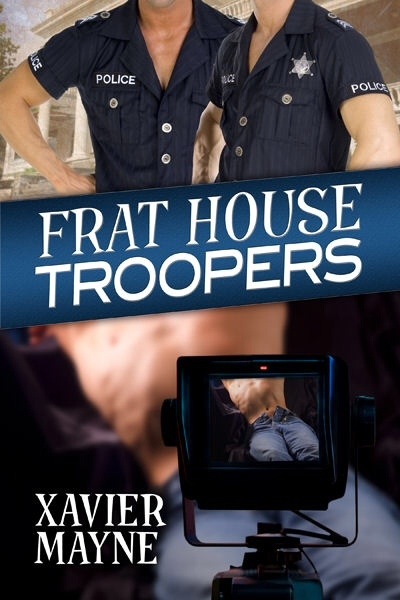
Frat House Troopers by Xavier Mayne

20140417-224230.jpg

I just finished Frat House Troopers by Xavier Mayne, which might sound like a silly name for a book, but considering that State trooper Ethan Brandt’s new assignment is to infiltrate a sex-cam operation that puts him in a very uncomfortable position, especially since he’ll have to perform naked on camera for his audition. Fortunately his partner and best friend, Donnelly, has his back—whether that means helping Brandt shop gay boutiques for sexy underwear or offering Jäger and encouragement while he researches porn.

Despite his mortification, Brandt gives the audition his best “shot”—and becomes an overnight sensation. But to meet the man behind the operation, he’ll have to give a repeat performance, this time live on webcam opposite the highest bidder. Donnelly makes sure to win that auction for his partner’s sake, but their plan has a flaw: faking it is not an option.

In the aftermath, Brandt is a humiliated mess trying desperately to come to terms with what he’s had to do for the job and his own mixed feelings. But Donnelly has been on a journey of discovery of his own. Suddenly everything the two men thought they knew about themselves and each other gets turned inside out. Meanwhile, they still have a case to solve… but it may not be the case they thought it was.

The “frat house” mentioned in the books title, seems to be based on fratmen.com’s web-cam house Fratpad. As Fratpad describes itself on its website, “There’s nothing quite like the FRATPAD. It’s the liveliest, sexiest, frattiest cam house in Cyberspace. No fake frat rituals here. Just a house full of college age guys walking around, working out and chatting on webcams, mostly naked, all day long. They create 24 hours of new content every day and there are 36 stationary cams all around the house so you can spy on them when they think you’re not looking.” This seems to be a pretty good description of the “frat house” in the book, as well.

But that’s not all the book is about. Officers Brandt and Donnelly are on a journey of discovery about themselves. Are they the firmly heterosexual men they’ve always believed themselves to be, or is there more to it? Can a man be straight one day and gay the next? Or do some gay men grow up like I did believing that there was no other choice until that day when our sexual awakening begins? In today’s day and age, young men have seen homosexuality more and more in the mainstream. The Internet is a great way to research things and feeling you don’t understand. I think for many young gay men, the option of following your desires are more acceptable. I think this book has a fresh perspective to show on this subject of sexuality. Though you might not be able to tell it from the title, there is something deeper than the superficiality of a very sexy story.

Furthermore, the descriptions of sex are quite fantastic. Mayne certainly has a way with words and knows how to describe sexual tension in a masterful and thoughtful way. Mayne is also able to write sex scenes in a way that doesn’t come across as pornographic, but the scenes are not chaste either. There is some incredibly hot sex scenes in this book, but this book by no means would be one that I would classify as gay erotica. They story and the emotional tensions contained within, far outweighs the amount of eroticism. It’s an almost perfect balance for a book that is just plain fun to read.

Xavier Mayne is the pen name of a professor of English who works at a university in the Midwest United States. Versed in academic theories of sexual identity, he is passionate about writing stories in which men experience a love that pushes them beyond the boundaries they thought defined their sexuality. He believes that romance can be hot, funny, and sweet in equal measure. The name Xavier Mayne is a tribute to the pioneering gay author Edward Prime-Stevenson, who also used it as a pen name. He wrote the first openly gay novel by an American, 1906’s Imre: A Memorandum, which depicts two masculine men falling in love despite social pressures that attempt to keep them apart.

I hope that you will read Frat House Troopers and hopefully you will become so hooked that you will do as I am currently doing, and read the sequel Wrestling Demons.


I Was Torn

20140416-230746.jpg

I was torn on what to write about today, but not as bad as these guy’s pants. Honestly, I had no idea what to write about today, so I decided on a pun instead. I love puns. By the way, the picture below is of actor Matt Lanter, who it appears does not wear underwear. I find that pretty sexy.

20140416-230815.jpg


Lament on Shaving

20140415-232341.jpg

First of all, I love a man who keeps his body hair natural, or at least trimmed. A hairless man can be very sexy, but I prefer a little fur. I can handle, and actually quite prefer, a shaved scrotum, but please leave the bush alone, except maybe for a minor trim if it looks like a jungle down there. The only men who look remotely okay like that are muscular men without any body fat at all. The truth is though I find pubic hair very sexy. I find chest hair very sexy. I even find a furry butt to be sexy. My thought is that manscaping can be okay in moderation, but too much can just end up looking silly.

With that being said, I despise shaving my face every morning. I don’t look good with scruff and it feels so weird to me. Now I will admit there are a lot of men that look very good with a beard or scruff. I know one friend of mine who looks pretty damn sexy with some scruff. Since I don’t, I shave everyday, unless I am not planning to go anywhere or do anything. Very rarely do I leave the house without shaving. I’ve also never liked using an electric razor, so I shave the old fashioned way like in the picture above. And as much as I hate shaving, I shave every day. Sometimes I’m in the shower and think, “Do I have to?” The answer is always yes. I could never go to school without shaving. It would be unthinkable to me. So as much as I hate it, I still shave every day.


Hope Springs Eternal

20140414-211525.jpg

III.
Heav’n from all creatures hides the book of fate,
All but the page prescrib’d, their present state:
From brutes what men, from men what spirits know:
Or who could suffer being here below?
The lamb thy riot dooms to bleed today,
Had he thy reason, would he skip and play?
Pleas’d to the last, he crops the flow’ry food,
And licks the hand just rais’d to shed his blood.
Oh blindness to the future! kindly giv’n,
That each may fill the circle mark’d by Heav’n:
Who sees with equal eye, as God of all,
A hero perish, or a sparrow fall,
Atoms or systems into ruin hurl’d,
And now a bubble burst, and now a world.

Hope humbly then; with trembling pinions soar;
Wait the great teacher Death; and God adore!
What future bliss, he gives not thee to know,
But gives that hope to be thy blessing now.
Hope springs eternal in the human breast:
Man never is, but always to be blest:
The soul, uneasy and confin’d from home,
Rests and expatiates in a life to come.

Lo! the poor Indian, whose untutor’d mind
Sees God in clouds, or hears him in the wind;
His soul, proud science never taught to stray
Far as the solar walk, or milky way;
Yet simple nature to his hope has giv’n,
Behind the cloud-topt hill, an humbler heav’n;
Some safer world in depth of woods embrac’d,
Some happier island in the wat’ry waste,
Where slaves once more their native land behold,
No fiends torment, no Christians thirst for gold.
To be, contents his natural desire,
He asks no angel’s wing, no seraph’s fire;
But thinks, admitted to that equal sky,
His faithful dog shall bear him company.

The above poem is merely a section of a much longer poem, “An Essay on Man” by Alexander Pope. Line 19 is probably the most famous and oft quoted piece of Pope’s writing, “Hope springs eternal in the human breast.”

The phrase “Hope springs eternal” is what drew me to this poem. I think it is a great illustration of the sheer tenacity of the human spirit. It tells us that it is human nature to always find fresh cause for optimism. Yes, there are those who are always pessimistic, or often pessimistic, but for those who choose optimism there are many more opportunities. As long as you have faith that you will persevere and and hope for a better tomorrow, hope will spring eternal. Pope’s “Hope springs eternal in the human breast” does not just encompass one single individual but instead is a concise treatise on the human condition.

The essence of hope itself is that wonderful blessing/curse that truly makes human beings the most intelligent and emotional creature that we are. Its existence provides us with the very basis of living. What does our existence amount to without the hope for a better tomorrow or expectation of things to come?

Hope is a wonderful thing. Each morning we are filled with hope for the day. But then also at the end of the day, hope can be a devastating thing. For example, you spent all day hoping that your beloved would phone as he promised you but as you lay your head on your pillow, you are left with the emptiness of an unrealized hope. However, we merely need to renew our hope for the next day and the day after. We should never lose hope.

I was speaking to a friend last night of the hope of finding a man in my life. I refuse to give up on that hope. I believe that someday it will happen. It is that hope/expectations that truly differentiates humans from the animal world around us. For what is a life without hope?

About the Poem
The Essay on Man is a philosophical poem, written, characteristically, in heroic couplets, and published between 1732 and 1734. Pope intended it as the centerpiece of a proposed system of ethics to be put forth in poetic form: it is in fact a fragment of a larger work which Pope planned but did not live to complete. It is an attempt to justify, as Milton had attempted to vindicate, the ways of God to Man, and a warning that man himself is not, as, in his pride, he seems to believe, the center of all things. Though not explicitly Christian, the Essay makes the implicit assumption that man is fallen and unregenerate, and that he must seek his own salvation.

The “Essay” consists of four epistles, addressed to Lord Bolingbroke, and derived, to some extent, from some of Bolingbroke’s own fragmentary philosophical writings, as well as from ideas expressed by the deistic third Earl of Shaftsbury. Pope sets out to demonstrate that no matter how imperfect, complex, inscrutable, and disturbingly full of evil the Universe may appear to be, it does function in a rational fashion, according to natural laws; and is, in fact, considered as a whole, a perfect work of God. It appears imperfect to us only because our perceptions are limited by our feeble moral and intellectual capacity.

Epistle I, which the above poem is from, concerns itself with the nature of man and with his place in the universe; Epistle II, with man as an individual; Epistle III, with man in relation to human society, to the political and social hierarchies; and Epistle IV, with man’s pursuit of happiness in this world. Considered as a whole, the Essay on Man is an affirmative poem of faith: life seems chaotic and patternless to man when he is in the midst of it, but is in fact a coherent portion of a divinely ordered plan. In Pope’s world God exists, and he is beneficent: his universe is an ordered place. The limited intellect of man can perceive only a tiny portion of this order, and can experience only partial truths, and hence must rely on hope, which leads to faith. Man must be cognizant of his rather insignificant position in the grand scheme of things: those things which he covets most — riches, power, fame — prove to be worthless in the greater context of which he is only dimly aware. In his place, it is man’s duty to strive to be good, even if he is doomed, because of his inherent frailty, to fail in his attempt.