

Answering God’s Call
“Carry each other’s burdens, and in this way you will fulfill the law of Christ.”
—Galatians 6:2
After hearing how Trump and Vance treated Zelinsky on Friday, I have been horrified, embarrassed, mortified, and depressed. No president ever in the history of the United States has decided to turn against democracy to buddy up with our greatest enemy. Seeing what went on was like witnessing a bully who wants your lunch money in exchange for making the other bullies leave you alone, except this was on an international scale. I could use a prison analogy too, but this is a Sunday post, and I don’t want to be crude. I knew they were hateful people, but what they did Friday was disgraceful. I do not see how anyone who supports this president can call themselves a Christian. It goes against every Christian principle in the Bible.
Living in a country that often prioritizes self-interest, God calls us to live differently. He commands us to love, serve, and give generously, rejecting greed and selfishness. One of the clearest ways we can live out our faith is by helping those in need—especially those suffering from war, displacement, and hardship. The people of Ukraine, enduring the devastation of conflict, offer us a powerful opportunity to put our faith into action. Scripture repeatedly teaches that our lives should not be driven by greed but by a heart of generosity. In Matthew 6:19-21, Jesus said, “Do not store up for yourselves treasures on earth, where moth and rust destroy, and where thieves break in and steal. But store up for yourselves treasures in heaven, where neither moth nor rust destroys, and where thieves do not break in or steal. For where your treasure is, there your heart will be also.” If we focus only on accumulating wealth and possessions, we risk missing out on God’s eternal purposes. Instead, He calls us to invest in things that last—acts of love, justice, and mercy. One of the greatest ways to do this is by helping those who are suffering.
Jesus also made it very clear that loving others is central to our faith. In Mark 12:31, Jesus commanded us to “Love your neighbor as yourself.” The people of Ukraine have faced unimaginable hardship—families torn apart, homes destroyed, and lives upended by war. Many have fled to other countries as refugees, while others remain in dangerous conditions. As followers of Christ, we are called to respond with love. One of the most well-known parables in the Bible, the “Parable of the Good Samaritan” (Luke 10:25-37), illustrates this perfectly. A man was left beaten and helpless on the side of the road. Two religious leaders passed by without helping, but a Samaritan—a person from a group often despised by Jews—stopped, cared for the wounded man, and provided for his needs. Jesus tells us to “go and do likewise” (Luke 10:37). Are we willing to be like the Good Samaritan? Will we stop, see the pain of the Ukrainian people, and respond with action? I know that I am likely preaching to the choir, but if there are those who are Trump supporters that read this blog, I hope you will take this to heart. We may not be able to do much until the midterm elections, but we can resist as much as possible.
One of the biggest barriers to helping others is greed—clinging to what we have out of fear or selfishness. This is seen all to clearly in the executive branch of the United States federal government. But the Bible warns against this mindset in Proverbs 21:13, “Whoever shuts their ears to the cry of the poor will also cry out and not be answered.” Instead of hoarding wealth, God calls us to be generous. In 1 Timothy 6:17-18, Paul reminds us, “Command those who are rich in this present world not to be arrogant nor to put their hope in wealth, which is so uncertain, but to put their hope in God, who richly provides us with everything for our enjoyment. Command them to do good, to be rich in good deeds, and to be generous and willing to share.” We may not all consider ourselves rich, but compared to those who have lost everything, we have much to give. Whether through financial support, prayer, advocacy, or welcoming refugees, we can use what God has given us to bless others. James 5:6 tells us that we should, “Therefore confess your sins to each other and pray for each other so that you may be healed. The prayer of a righteous person is powerful and effective.” We should pray for peace, for those affected by war, and for leaders to seek justice and wisdom. Proverbs 19-17 tells us, “Whoever is kind to the poor lends to the Lord, and he will reward them for what they have done.” We can support humanitarian organizations providing food, medical aid, and shelter. Hebrews 13:2 says, “Do not forget to show hospitality to strangers, for by so doing some people have shown hospitality to angels without knowing it. If you live in a community with Ukrainian refugees, offer friendship, support, or resources. Finally, Isaiah 1:17 tells us to “Learn to do good; seek justice, rebuke the oppressor; defend the fatherless, plead for the widow.” We must speak out against injustice and support policies that help those affected by war
In James 2:15-17, James reminds us that faith without works is dead, “Suppose a brother or a sister is without clothes and daily food. If one of you says to them, ‘Go in peace; keep warm and well fed,’ but does nothing about their physical needs, what good is it? In the same way, faith by itself, if it is not accompanied by action, is dead.” Let us not be passive in the face of suffering. Instead, let’s be the hands and feet of Jesus, showing love to those in desperate need. By helping the Ukrainian people—or anyone in crisis—we reflect God’s love and live out the Gospel. May we answer God’s call with open hearts, rejecting greed and embracing a life of generosity.
How is God calling you to help today?
*The Photograph Above
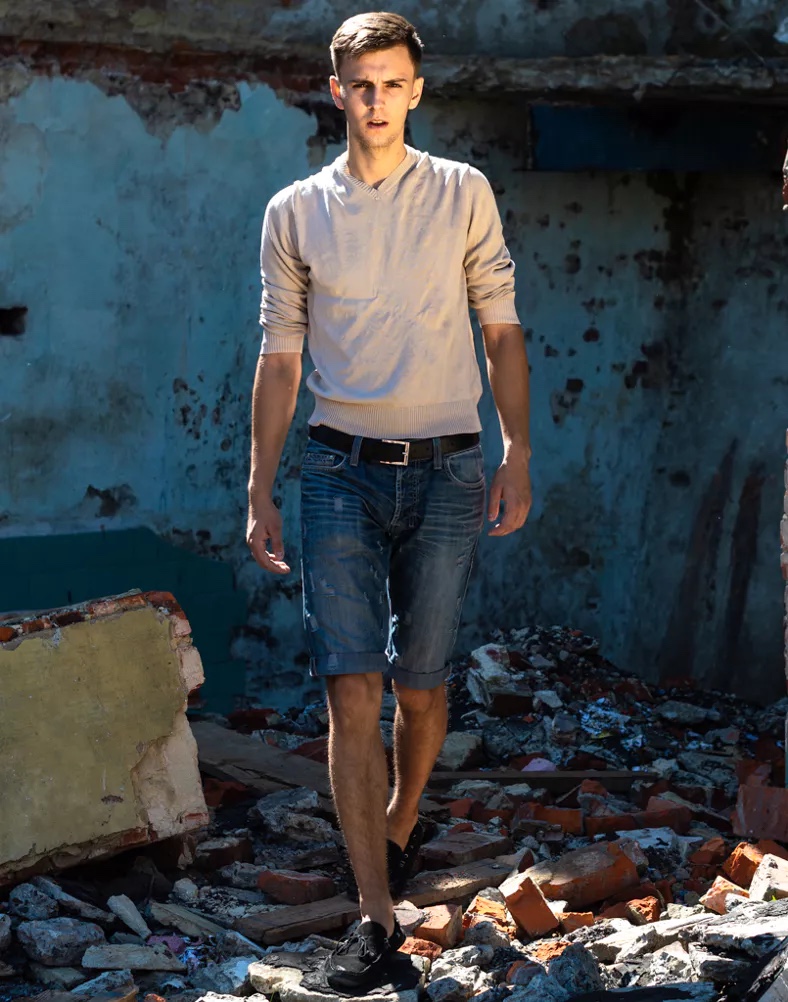
The photographer Liam Campbell is the editor of Elska Magazine, a project centered on traveling around the world, meeting a selection of everyday local guys, and introducing their city and their lives to readers through honest photography and personal stories. The ‘Elska Lviv’ issue of Elska Magazine was dedicated to the men of Ukraine. The model above was named Marko, and Campbell had this to say about him:
Marko was one of the men we photographed toward the beginning of the war. While editing, I became a bit uneasy about the impression we would leave. Would people see Marko standing amongst the detritus of destroyed buildings and feel like we were somehow glamorizing the war? Perhaps some would, but the reality is that we shot these scenes on the site of a former Soviet industrial complex.
In this context, there was a clear message that the Soviet Union was well and truly over. There Marko was walking proudly over the rubble, asserting a new Ukrainian future. This is a message I absolutely had to share, but at the same time, I can’t help but feel immense sadness when I imagine how much of Ukraine now lies in ruins, at the hands of a campaign to bring back Soviet-style ‘glory’ and [Russian] supremacy.

Moment of Zen: Dean Tsiranides (AKA Tyler Otto)










A few things; 1) Yes, he is young but he’s also legal, 2) He is absolutely gorgeous, 3) His hair gets a little wild in some of these pictures, 4) There are some more pictures I think you will like if you click “Continue reading” below, and 5) Enjoy!
Continue reading
TGIWFHF

Thank goodness, it’s a work from home Friday. I can relax and not be bothered. I have to do some online training today, and I’ll probably grade some midterms. Other than that, it should be an easy day. This week has either been incredibly busy or incredibly boring. There hasn’t been much in between. I have a four day weekend at home since we are off Monday for Spring Break.
If you are in the USA, you might have heard about the organization People’s Union USA calling for a nationwide boycott. They want today to be an economic blackout. This movement follows the rollback of diversity, equity and inclusion initiatives at several major companies, including Target, PepsiCo and others. (Coca-Cola and Apple have both refused to rollback DEI initiatives.) The boycott coincides with protests against President Dumbass’s plans to reduce the government workforce and mass firings at federal agencies. The boycott began at midnight last night and will last for 24 hours. During this time, the organization encourages Americans not to buy anything — this includes gas, fast food, or shopping in-store or online at major retailers. If participants need to buy anything, they are encouraged to shop at local and small businesses. Essential items such as medicine, food and emergency supplies can still be bought.
I hope you’ll join in. The thing about boycotts is that if enough people don’t participate, then it won’t be successful. There had to enough of an economic impact to make a difference and to make the point your trying to make. So, please consider following this boycott and only buy locally today.

Inspirational Quote
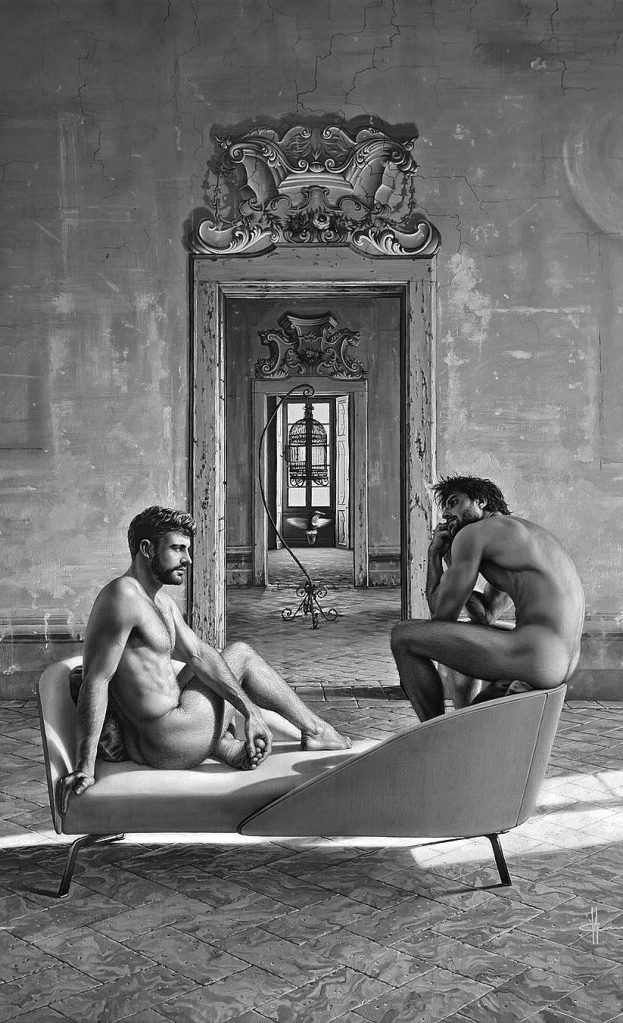
“We deserve to experience love fully, equally, without shame and without compromise.” — Elliot Page
Love is one of the most fundamental human experiences, yet for too long, LGBTQ+ individuals have been told that their love is something to be hidden, altered, or diminished. Elliot Page’s words remind us that love should be free from fear and compromise. No one should have to justify their identity or fight for the right to love openly and authentically.
This quote speaks to the importance of equality—not just in legal rights, but in the way love is valued and respected in society. It’s a call to reject shame and embrace pride, to push back against narratives that suggest LGBTQ+ love is anything less than beautiful and valid. Whether in relationships, friendships, or self-love, everyone deserves to experience love without barriers. Today, let this quote serve as a reminder to support, uplift, and celebrate each other in our journeys toward full acceptance and joy.
Since it’s Thursday, here’s your Isabella Pic of the Week:

This is about as close as I get to her cuddling. She’s not a cuddly cat, and she also seems to not like her picture being taken.

The Aesthetics of the Male Nude in Ancient Art

The male nude was a central subject in the art of many ancient civilizations, particularly in Greece and Rome, but also in Egypt and Mesopotamia. These representations were not just artistic choices but carried deep cultural, religious, and philosophical meanings. The aesthetic of the male nude in the ancient world often emphasized idealized forms, physical perfection, and heroic attributes, reflecting societal values and beliefs about masculinity, virtue, and even divine favor.
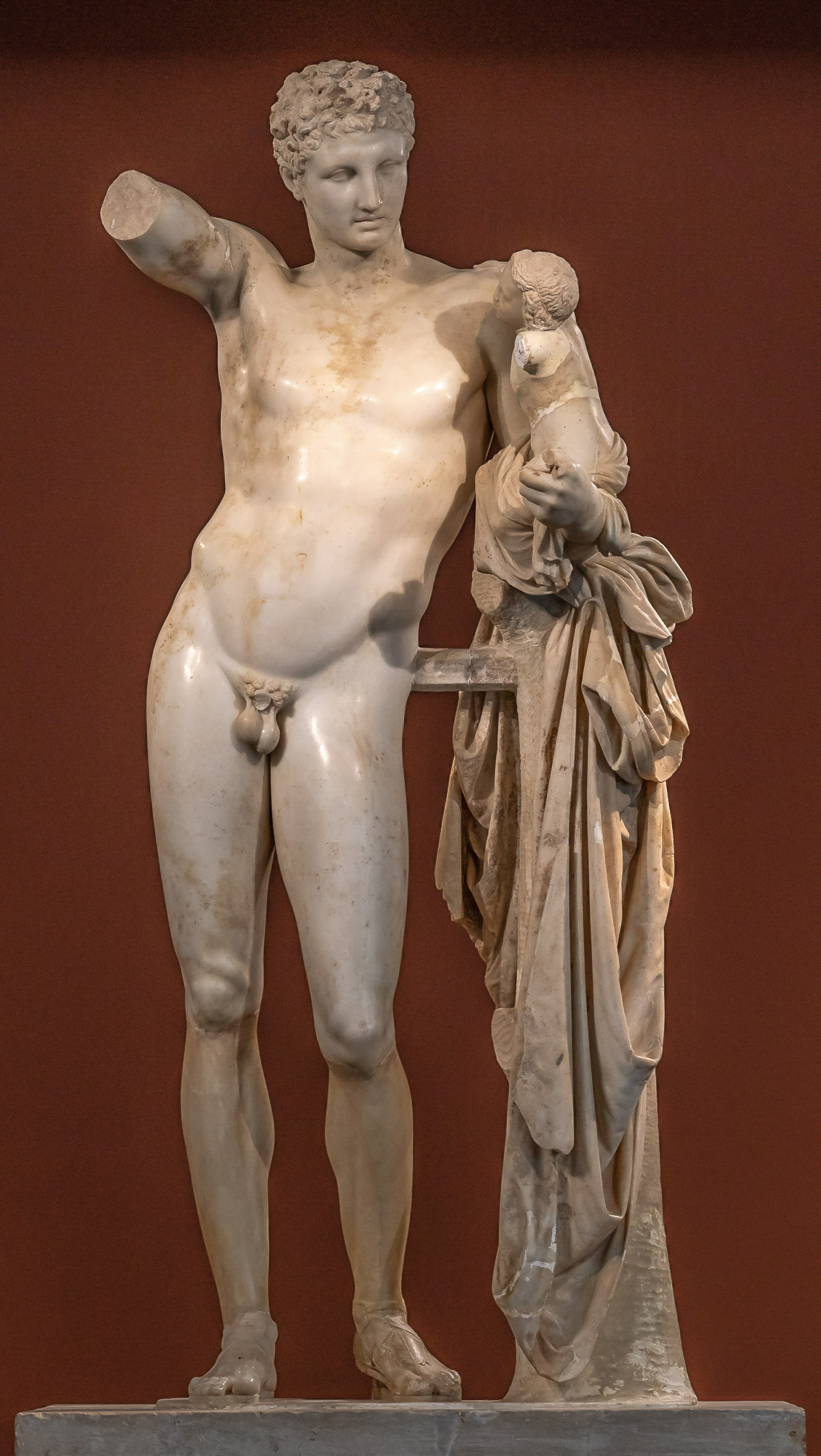
In ancient Greek art, the male nude was idealized in sculpture, particularly in works such as Polykleitos’ Doryphoros and Praxiteles’ Hermes and the Infant Dionysus. The Greek kouros statues (early archaic depictions of young men) emphasized youthful beauty, symmetry, and a balance between realism and idealization. Nudity in Greek art was associated with athleticism, heroism, and even moral virtue, reflecting the Greek belief that the male form was the pinnacle of divine beauty. Greek vase paintings often depicted nude male athletes, warriors, and gods, reinforcing the connection between physical excellence and noble character. The gymnasium (a place where young men trained nude) was both an athletic and intellectual center, reinforcing the idea that physical and intellectual excellence were intertwined.
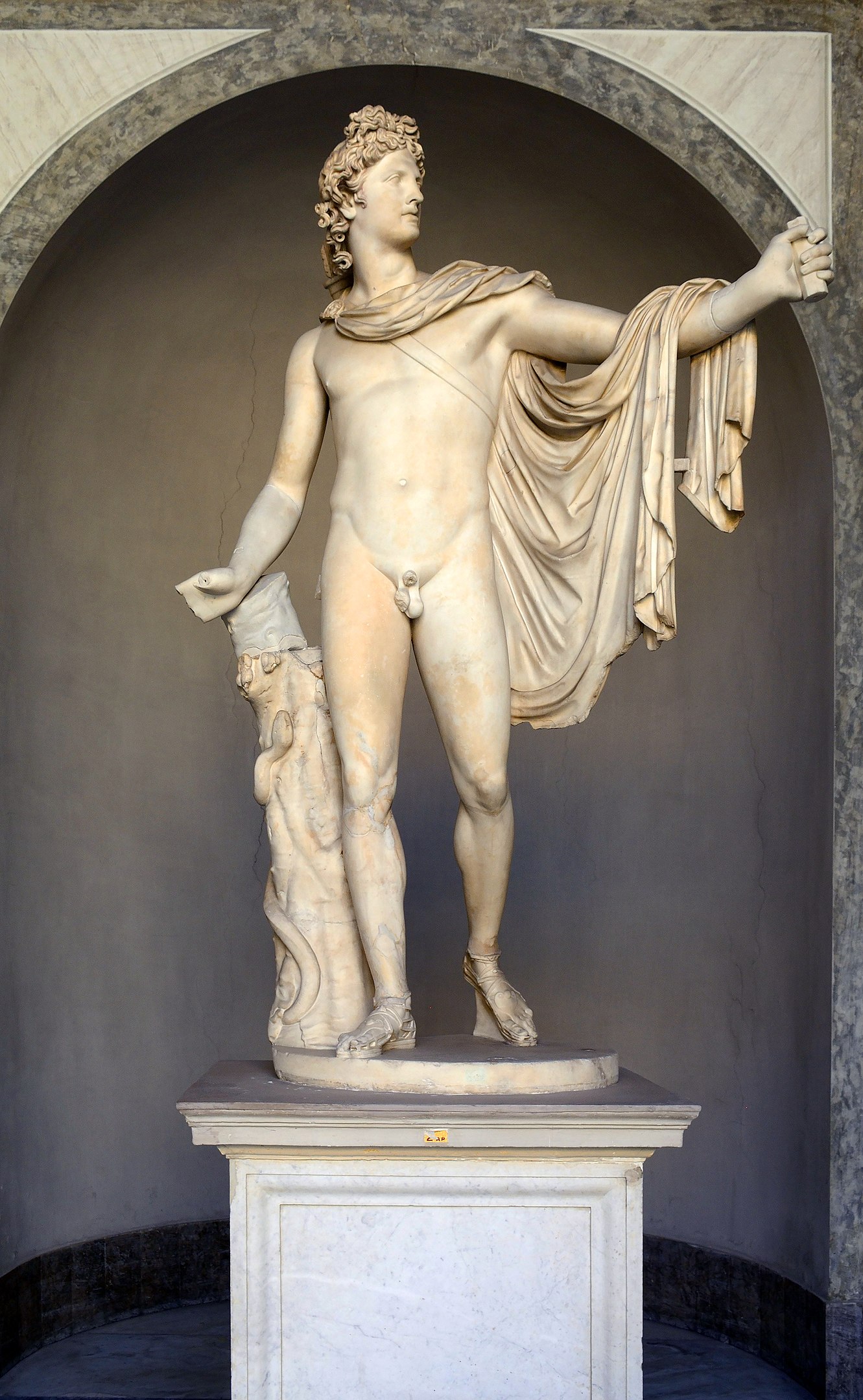
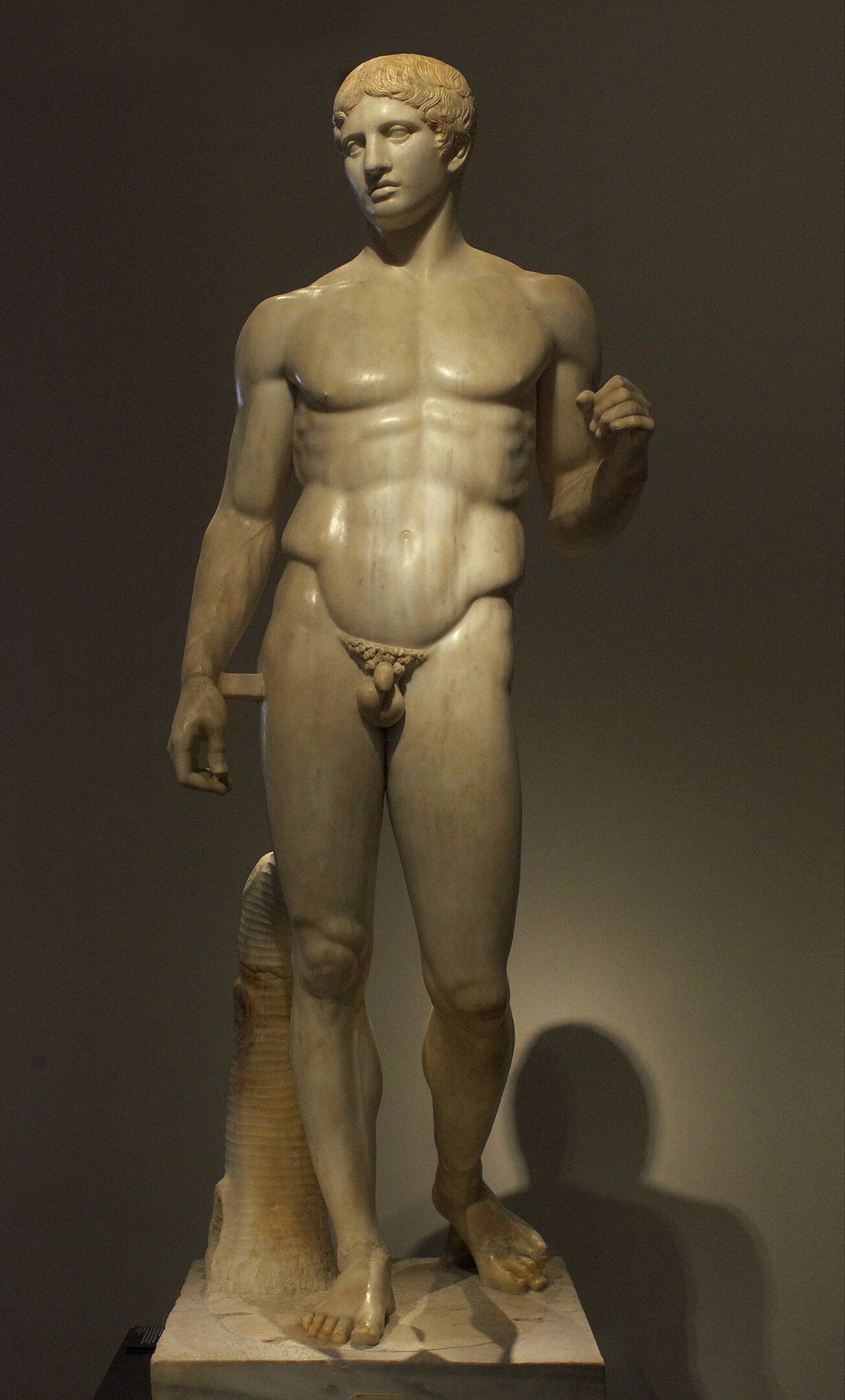
The second century Roman copy of the Apollo Belvedere is one of, if not the, most celebrated marble sculpture of a nude male from classical antiquity. From the mid-18th century, it was considered the greatest ancient sculpture by ardent neoclassicists, and for centuries it epitomized the ideals of aesthetic perfection for Europeans and westernized parts of the world. The Apollo became one of the world’s most celebrated art works when in 1755 it was championed by the German art historian and archaeologist Johann Joachim Winckelmann as the best example of the perfection of the Greek aesthetic ideal. Its “noble simplicity and quiet grandeur,” as he described it, became one of the leading lights of neoclassicism and an icon of the Enlightenment. Goethe, Schiller, and Byron, all endorsed it. The Apollo was one of the artworks brought to Paris by Napoleon after his 1796 Italian Campaign. From 1798 it formed part of the collection of the Louvre during the First Empire, but after 1815 was returned to the Vatican where it has remained ever since.
The frequent depiction of the male nude in ancient art reveal how cultures conceptualized beauty, masculinity, and relationships between men. In ancient Greece, for example, the admiration of the male form was closely tied to pederasty, a socially accepted relationship between an older man (erastes) and a younger man (eromenos). This relationship was often educational and mentorship-based but could also have an erotic component. Greek vase paintings sometimes depicted these relationships explicitly, showing affection between men, including courtship rituals like gift-giving or intimate gestures. In Rome, male-male relationships existed, but Roman masculinity was defined differently than in Greece. A freeborn Roman man (citizen) could engage in relationships with other men, but societal norms dictated that he should take the dominant role; being the passive partner was seen as unmanly. Roman frescoes and sculptures sometimes depicted homoerotic themes, especially in private or mythological contexts, such as scenes involving the god Ganymede, who was abducted by Zeus.
While not often, Greek and Roman art would feature homoerotic relationships. One of the most compelling pieces of ancient Roman art that directly addresses same-sex desire is the Warren Cup, a silver drinking vessel from the 1st century CE. The Warren Cup, named after its modern owner Edward Perry Warren, is a luxurious Roman silver cup featuring explicit homoerotic scenes. The two sides of the cup depict male-male sexual encounters between older and younger men, rendered in a detailed and naturalistic style. The craftsmanship suggests that it was an elite object, likely used in private banquets (symposia) where discussions of philosophy, poetry, and sexuality took place. The scenes on the cup align with what we know of Roman and Greek attitudes toward male-male relationships. The figures are shown engaging in acts that emphasize the older man as the active partner and the younger as the passive partner, reflecting Roman norms around masculinity and dominance in sexual relationships. The setting, with draped beds and carefully arranged compositions, suggests that such relationships were not only known but also accepted in elite social circles. The cup’s artistic style is distinctly Greco-Roman, with a focus on idealized musculature and classical composition. The use of silver, a valuable material, indicates that it belonged to a wealthy individual who may have collected art reflecting personal tastes or cultural ideals around eroticism.
Continue reading

Authors
Recent Comments
vandycolt on Pic of the Day Steve Davis on A Queen Was Born noisilycool3bc985058… on A Queen Was Born noisilycool3bc985058… on Pic of the Day noisilycool3bc985058… on Pic of the Day Top Posts & Pages




Amazon Associate

As an Amazon Associate I earn from qualifying purchases. So, if you click on a link that takes you to Amazon.com, I may earn a commission.
Trust me, it isn’t much, but every little bit helps.

 Joe
Joe


 The Closet Professor