

Intense Migraine

Thank God today is my work-from-home day. I woke up with one of the worst migraines I’ve had in a while—the kind where the pain is so bad it brings on intense nausea. Honestly, it was almost bad enough that I forgot to write a post this morning. Hopefully, my meds will kick in soon so I can actually get something done today.
In the meantime, I hope everyone has a wonderful weekend!

Stress on Top of Stress

Anxiety and depression are bad enough on their own, but stress makes everything feel so much worse. I truly love my job, but lately I dread going to work. My boss has created a hostile workplace. One moment she can seem nice, the next she reveals a total lack of emotional intelligence—no empathy, no compassion, no sympathy. Her passive-aggressive behavior is some of the worst I’ve ever seen. People have warned me before about writing this here, worrying that she might stumble across my blog. Honestly? At this point, I don’t fucking care. If she does, she’ll either delight in knowing she’s making my life miserable or maybe, just maybe, she’ll take a hard look at how she treats her employees.
I won’t go into details about the latest mess, but she’s currently refusing to make even the smallest accommodation for my back and leg pain until she has a note from my doctor—even though I’ve told her over and over that it has to go through HR. I have zero control over how quickly they do their jobs.
And if the back pain and migraines weren’t enough, I’ve now got a sore throat on top of it all. I have to drag myself in today because I’m working from home tomorrow (thank God!) and need to prepare for a class on Monday.
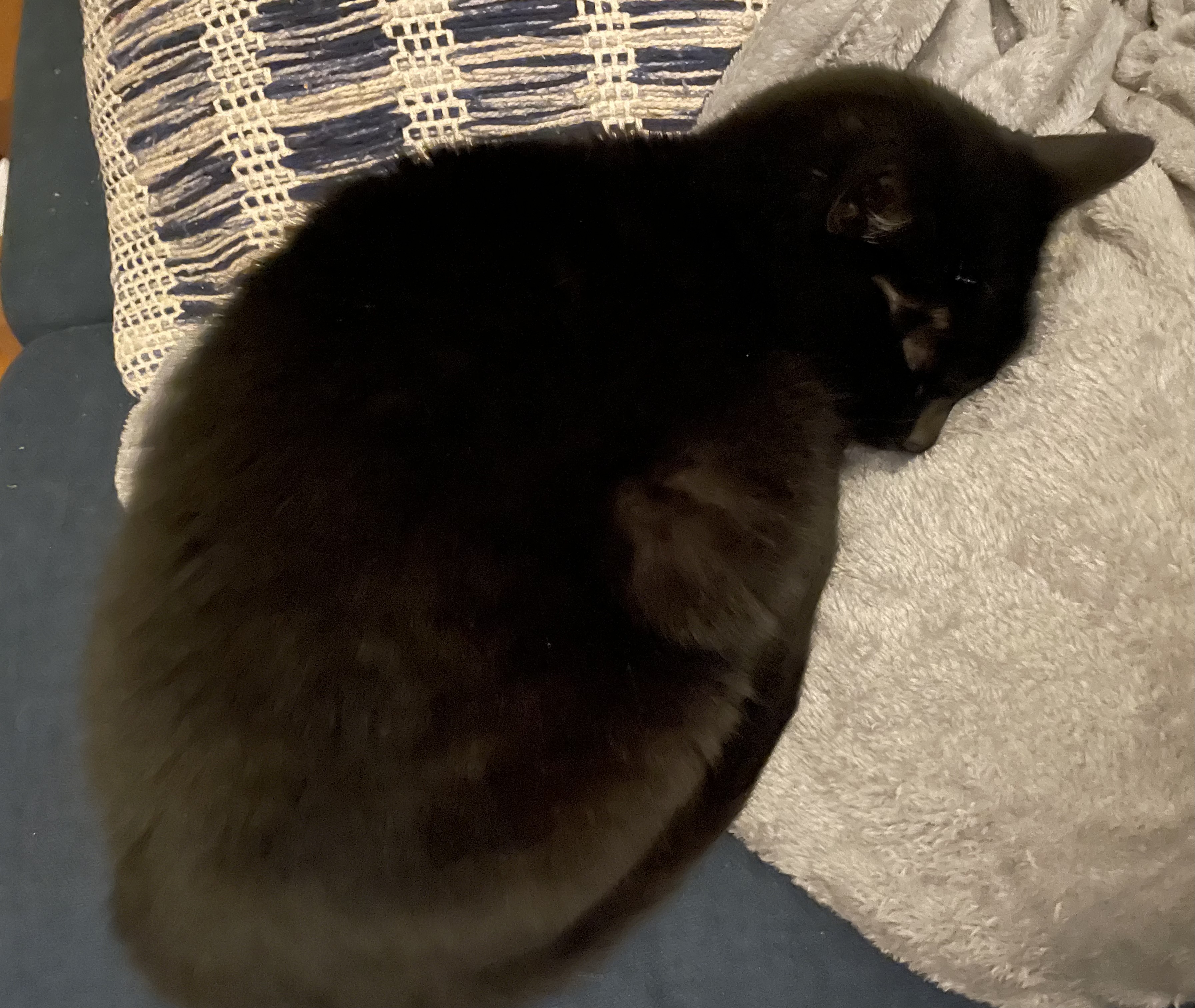
In the meantime, here’s Isabella—curled up, cozy, and oblivious to the world. Sometimes I wish I was a cat, able to just cuddle up with my human and sleep all day. Honestly, I’d even settle for just cuddling with another human right now.

Dragging a Bit

Subscribe to continue reading
Subscribe to get access to the rest of this post and other subscriber-only content.
Palm Springs

Palm Springs
By Christian Gullette
We drink Fernet by ironic sculptures
under misters that make our bangs damp.
It’s our anniversary,
though that time feels faint.
We are searching for a place
to escape his diagnosis,
laws against gay marriage,
our leaky, flat roof.
Every Memorial Day
and Labor Day, we go to the desert.
Sometimes also the Fourth
of July.
Palm Springs rewinds things.
We almost buy that mid-century chair
proud of our rule that love for it
needs to be immediate.
At the Parker, a guy with a calf tattoo
brings drinks.
You can ask for anything here.
We toast to another year without cancer.
After dinner, we wander the hotel hedge maze,
nowhere to go that late but home.
About the Poem
Christian Gullette’s Palm Springs is a poem of sleek surfaces and simmering tensions. The desert resort town—so often painted in mid-century glamour—becomes here a backdrop for longing, performance, and queer recognition. Palm Springs is both mirage and mirror: a place where artifice and authenticity blur, where the hot light reveals as much as it conceals.
The poem doesn’t settle for nostalgia or kitsch. Instead, it examines what it means to inhabit a space so layered with history, expectation, and desire. Gullette’s Palm Springs isn’t just a sunny escape; it’s a charged landscape where intimacy pulses against the façade of cocktails, poolsides, and desert views.
Queer poets have long re-imagined spaces marked by leisure or luxury as sites of deeper reflection, and Gullette does just that. Palm Springs is lush but not naïve, glamorous but not shallow. It suggests that behind every stylish lounge chair or glimmering pool, there’s a body hoping to be seen, a self negotiating the terms of love and exposure.
As readers, we are left with a sense of recognition—of what it means to find ourselves in a place where beauty and fragility intertwine, where queer desire is both illuminated and complicated by the desert sun.
About the Poet
Christian Gullette is an acclaimed poet and translator based in San Francisco. His debut collection, Coachella Elegy (Trio House Press, 2024), earned critical praise and became a finalist for the 2025 Northern California Book Award in Poetry. The volume has also been featured on several “must‑read” lists from LitHub, Electric Lit, Alta Journal, and Debutiful. Ron Charles of The Washington Post Book Club lauded its “cool, elegantly controlled poems,” while Publishers Weekly described it as “tender and deliciously sly.”
Gullette holds a Ph.D. in Scandinavian Languages and Literatures from the University of California, Berkeley, where he explored themes of sexuality, race, and neoliberalism in Swedish literature and film. He also earned an MFA from the Warren Wilson MFA Program for Writers and an M.Ed. from George Washington University, following a B.A. in English from Bates College. As a translator, he works professionally with Swedish texts—including poetry by Kristofer Folkhammar and Jonas Modig, as well as cookbooks by Roy Fares, Lisa Lemke, and others.
He currently serves as editor-in-chief of The Cortland Review and has taught workshops for the Kenyon Review Online Writers Workshops and the Poetry Society of New York. He was awarded a Bread Loaf Writers’ Conference scholarship in 2022.
A longtime resident of San Francisco, Gullette lives with his husband, Michael. His work intricately interweaves personal grief—including living through his husband’s ocular cancer diagnosis and the loss of his brother—with the luminous terrain of California’s desert landscapes, exploring themes of desire, mortality, visibility, and renewal.

Labor Day and the Work of Equality

Labor Day is meant to honor the dignity of work and those who labor to build better lives for themselves and their families. For the LGBTQ+ community, this day also reminds us of the struggles—and victories—hard won in workplaces across the country. From the first people who risked everything by being openly queer at work, to those who organized for equal protections, to today’s advocates fighting for trans rights in the workplace, our labor has always included not just our jobs, but the fight to be recognized fully as ourselves.
It can be easy to forget that for so long, queer people could be fired simply for who they were—or still can in too many places. Labor Day, then, isn’t just about wages and hours, but about fairness, dignity, and opportunity. It’s about remembering that “the work of equality” is ongoing, and each generation takes up its part of the task.
So today, as we enjoy the holiday, let’s also honor the countless LGBTQ+ workers—teachers, nurses, artists, soldiers, and so many others—who make our world brighter and stronger. And let’s commit ourselves to a future where every person’s work, and every person’s identity, is respected.
Happy Labor Day, friends. 🌈✊🏽


Recent Comments
winnerimpossible1f89… on Moment of Zen: A Room with a… noisilycool3bc985058… on Pic of the Day paul on Pic of the Day paul on Pic of the Day paul on Pic of the Day Top Posts & Pages


