Category Archives: Book Review

Behind the Curtain

IMG_9103.JPG

Right now, my favorite author is Amy Lane. I’m finishing up the Promises Series, and will review them as soon as I finish the last one. It is not out in audiobook, so I actually have to find time to read it, instead of listening to it on my way to and from work. I love to read, but I rarely have time to stop and do so (at least not something fun). I’ve also started on the Johnnies Series. I just finished the first one and can’t wait to read the next. However, in between the Promises and Johnnies books, I read a sweet little Amy Lane book called Behind the Curtain. The last time I’d written about Amy Lane, I’d mentioned that the ending to Locker Room drove me crazy because it kind of left you hanging, and someone sent me a note that Behind the Curtain contained some closure. I fully admit, this was the main reason it made it to my next listen list. I’d had it in my wish list for a while, but it had been on the back burner as I planned to read other things. I need that closure though. So I read it. Here is the blurb for the book:

Dawson Barnes recognizes his world is very small and very charmed. Running his community college theater like a petty god, he and his best friend, Benji know they’ll succeed as stage techs after graduation. His father adores him, Benji would die for him, and Dawson never doubted the safety net of his family, even when life hit him below the belt.

But nothing prepared him for falling on Jared Emory’s head.

Aloof dance superstar Jared is a sweet, vulnerable man and Dawson’s life suits him like a fitted ballet slipper. They forge a long-distance romance from their love of the theater and the magic of Denny’s. At first it’s perfect: Dawson gets periodic visits and nookie from a gorgeous man who “gets” him—and Jared gets respite from the ultra-competitive world of dancing that almost consumed him.

That is until Jared shows up sick and desperate and Dawson finally sees the distance between them concealed painful things Jared kept inside. If he doesn’t grow up—and fast—his “superstar” might not survive his own weaknesses. That would be a shame, because the real, fragile Jared that Dawson sees behind the curtain is the person he can see spending his life with.

Amy Lane is known for her angst ridden books, and I have to admit, this one is low on the angst. I don’t believe I cried even once. This is not a bad thing. It was just a beautiful story. Furthermore, as the advisor for my schools drama club (I knew nothing about theater before being given the task), I found the technical aspects of being behind the curtain and the emotional aspects of being in front of the curtains very intriguing. I couldn’t identify with either aspect because I’ve never acted, and my little hundred year old stage doesn’t even have electricity (we use makeshift lights and extension cords, covering the lack of lights with onstage lamps and hiding the utility lights that we end up using). We are low tech in the extreme. But I think my little club does a fantastic job with what they have, and I do the best I can. I’ve even written a play for them next semester. But I’ve gotten off topic….

The book was heartwarming in many ways, and it had a little angst in there, just not much. Take a virgin gay boy who is cute but awkward and goofy and put him together with an absolutely beautiful superstar ballet dancer, plus their friends, and you have a wonderful cast of characters. Some characters you might not like at first until you get to know them, but by the end, you’ll love them all and root for each one.

There was one other reason why I fell in love with this book. I have a dear friend, who lives quite a ways away from me, who just graduated college in May and has been trying to find a job. He has a boyfriend and finding a job may take him away from his boyfriend if he has to move for the job. As much as it hurts, he and his boyfriend realize that for each of their careers, they may be separated for a little while. It breaks my heart because they wonder if their relationship is strong enough to survive a long-distance relationship. I firmly believe their love for each other is strong enough to pull them through. Honestly, they were made for each other, and I don’t want anything to pull them apart. I told my friend that he had to read this book. I don’t want to give it away, but it does show that while there are ups and downs in long-distance relationships, love and faith can keep them together. I hope when he does read this book, he will see that it can work.

You may think, “It’s just a book, Joe. It’s not real life.” However, as my friend, who also loves to read Amy Lane, pointed out to me recently, Amy Lane is a master of understanding the human psyche and emotions. Her understanding of human nature reminds me a lot of Shakespeare’s understanding of human nature. When I teach Shakespeare, I mention that one of the things that make him great is his mastery of the range of human emotions, the understanding of the human mind, and the nature of humanity. However, I sometimes find Shakespeare’s characters to be unreal, but I find Amy Lane’s characters to be very real in many way. Her characters are flawed, not as in a bad writer flawed kind of way, but in the way humans are flawed.

Amy Lane is a master when it comes to writing and character development. I just absolutely love her. I would love nothing more then to be able to just sit and talk with her for hours. Maybe she could even teach me to knit. Knitting is often a therapeutic exercise for some of her characters, and reading about knitting just makes me want to learn how. I see how much it helps her characters be calm and sometimes, I wish I could have that tranquility.


Amy Lane: Master of M/M Romance

IMG_7843.JPG

One of my favorite authors at the moment is Amy Lane. Lane has four children, two cats, a love starved Chi-who-what, a crumbling mortgage and an indulgent spouse. She also has too damned much yarn, a penchant for action adventure movies, and a need to know that somewhere in all the pain is a story of Wuv, Twu Wuv, which she continues to believe in to this day! She writes fantasy, urban fantasy, and m/m romance–and if you give her enough diet coke and chocolate, she’ll bore you to tears with why those three genres go together, which I’d love the chance of hearing. She’ll also tell you that sacrifices, large and small, are worth the urge to write.

Currently, I have read five of her books and working on a sixth. The first book I read, recommended by a dear friend, was Country Mouse followed quickly by its sequel, City Mouse. In these books, and all American boy is traveling in London when he meets a self absorbed British man and sparks fly. My friend and I can’t decide if we like the clever banter between the characters or the exceptionally hot sex more. When you read Amy Lane you become hooked, so on the recommendation of the same friend, I read Clear Water. Clear Water is about a thirty-six year old college professor/biologist and his romance with a twenty-two year old guy with ADHD. I happen to be thirty-six and the friend who recommended it is a twenty-two year old guy with ADHD. Other than the sex (and that my friend has a wonderful boyfriend), the relationship was similar in many ways, and really resonated with me. Next I read Locker Room, a novel about two basketball players who fall in love with each other. I loved the book but I don’t know if I will ever be ok with the ending. The most recent book I finished was Keeping Promise Rock (which is the inspiration for the picture above since the main characters meet on a horse ranch). Currently, I’m reading Keeping Promises, the second book in the Promises series.

I had planned to write a review of Keeping Promise Rock, but I will just say that you really should read it. Instead, I decided I wanted to talk about Amy Lane as an author. When Amy Lane first started writing her author bio said she was an English teacher. As a fellow teacher, this just endears me to her more, she seems to no longer be teaching and is instead focussing on her writing (and knitting). I think that one of the most wonderful things about Lane is that her characters really touch your heart.

My friend calls her Amy “Rip Your Heart Out” Lane, because of the emotional roller coaster that is her books. She makes her characters so real. I always see parts of myself in many of her characters or see my friends in others. You cannot help but care about the characters, and the thing is, their situations are so plausible. Sometimes you read a book and the characters are just too perfect or there situations are too perfect.

Some writers write their ideal, but Lane seems to write real people. I’m not sure I have ever read a reaction a character had to a situation and said, “No one would ever do that.” The reason is that you can see that the character would react just that way. Yes, there is a lot of pain and anguish at times. Lane’s characters go through many difficult situations but you get to see real human struggles.

Lane also seems to write from the heart. The bio for Clear Water states that her own son has ADHD. She describes so well in that book Patrick’s ADHD. It’s apparent that by some of the reactions that other characters have ADHD as well. I will always believe that Carrick from the Promises series has ADHD. It’s never explicitly said, but I would suspect that Lane’s son had not yet been diagnosed with ADHD when she wrote the Promises series, which is why I believe it was not specifically mentioned. This is just one more example of the realness of Lane’s characters.

I also love that Lane seems to have a hard time letting go of the characters. Some books, you’d think would end at a certain point, and many others authors would, but not Lane. She takes the characters to a conclusion. She ties up the loose ends and though she leaves you wanting more, you seem to be able to tell that Lane wants more too. I definitely want more of Amy Lane.


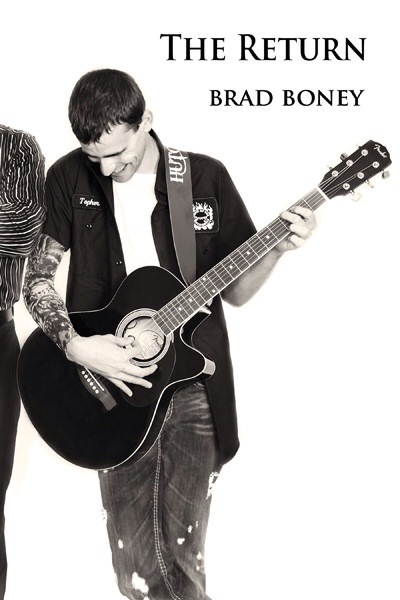
A Symphony of Words: A Review of Brad Boney’s The Return

20140814-231516-83716531.jpg

The Return by Brad Boney

A friend of mine recently suggested that I read Brad Boney’s two books: The Nothingness of Ben and The Return. I will admit that I listened to them on audiobook. I drive back and forth to work each day forty minutes both ways, so audiobooks are an easy way for me to consume new books, without me staying up all night long reading as I often do with books. While The Nothingness of Ben is a wonderful book and a true joy to read (and by the way must be read before The Return), The Return is an absolute masterpiece of gay fiction. It is a symphony of words and one of the most masterful pieces of literature that I have read in years.

Here’s a quick description of The Return:

Music. Topher Manning rarely thinks about anything else, but his day job as a mechanic doesn’t exactly mesh with his rock star ambitions. Unless he can find a way to unlock all the songs in his head, his band will soon be on the fast track to obscurity.

Then the South by Southwest music festival and a broken-down car drop New York critic Stanton Porter into his life. Stanton offers Topher a ticket to the Bruce Springsteen concert, where a hesitant kiss and phantom vibrations from Topher’s cell phone kick off a love story that promises to transcend ordinary possibility.

There is a lot of music associated with The Return and it only seems fitting that I review it using symphonic allegory, at least that’s what I’m calling it. A classic symphony is in four parts: 1) an opening sonata or allegro, 2) a slow movement, such as adagio, 3) a minuet or scherzo with trio and 4) an allegro, rondo, or sonata. The book loosely follows this pattern. It begins with the opening sonata or allegro which is fast, quickly, and bright. There is a whirlwind of things happening in the beginning, but once you start you are hooked and can’t stop. Then there is a slow movement, adagio, which is slow and stately. I will admit it slows down and you think this book will be quite predictable. I thought I knew where it was going and what would happen, yet I couldn’t have been more wrong. The scherzo can frequently be referred to a fast-moving humorous composition which may or may not be part of a larger work. In the case of The Return, this come approximately in the middle of the book and holds the novel together. It’s fast. It grabs your attention and the tears begin to flow. It’s all about a tying together of events, and Brad Boney is a master of this. The third quarter of the book has a rising crescendo that grasps you emotionally. Every emotion is tugged at and your heart swells and sinks as the book progresses. Once the book reaches it’s climax and you know how things will end, or at least you think you know, you must continue even though you know the emotional roller coaster is no where near its end. The last couple of chapter, the last quarter of the book, is the second climax that brings things together that you would have never guessed. When you think the book becomes predictable, hold on to your seat. Many classical rondos feature music of a popular or folk character. In the fourth movement of The Return, the central character of most serious gay fiction since the 1980s is also a major character. If you don’t understand, I’m speaking of the AIDS epidemic. As I said though, this is an emotional roller coaster and one that you will not want to get off of.

In the literary history of gay fiction, you have books such as E.M. Forster’s Maurice in which the main character find tragedy and sadness as a punishment for his homosexuality. The same is the case with the heart wrenching Giovanni’s Room by James Baldwin. Gay authors were not allowed to publish books with a happy ending. Then came the liberation of gay fiction in the 1970s and happiness could be seen in gay fiction for the first time. But once the AIDS epidemic begins, gay literature takes on a mourning period. There are no more happy endings, only lessons of loss. By the 2000s, there was a return of more cheerful books of gay fiction, romance and mystery. These books were whimsical and fun, but publishers have since largely closed their gay imprints and ebooks and independent publishers have replaced the gay imprints. And finally, those who love gay fiction can find a large supply of books to read. Some of the authors, such as Brad Boney, Amy Lane, Xavier Mayne, LB Greg, JB Sanders, and KC Burn are creating beautiful and emotional love stories, some are even still whimsical such as JB Sanders. Not all of this proliferation of gay literature is readable or even mildly entertaining, but just as with the authors I just mentioned, there are numerous gems to be found.

I mentioned at the beginning that I listened to this book. It was read by the actor Charlie David, who,read both The Nothingness of Ben and The Return. I will admit, that Charlie David is a good reader, but some of this southern pronunciations of names and especially places is off in The Nothingness of Ben. But with The Return, David had found his ability to capture the voices and settings. He adds the emotions and conveys them like no other narrator I have ever heard. There is one scene when Topher is on the plane coming back from NYC and he calls his band mate Peter and cries. Charlie David’s voice breaks, and I cried with Topher. I can’t imagine anyone reading a book with the emotions and savvy of Charlie David. He was perfection in his reading of The Return.

The Return does transcend ordinary possibility and borders on fantasy or science fiction, but it’s a beautiful story and the end will blow you away. You just read this book, and along the way, listen to some of the songs mentioned. It will truly bring the book alive, especially if you aren’t listening to Charlie David read it.


Summer Reading

20140612-012909-5349711.jpg

Even with my busy schedule so far this summer, as a teacher, summer brings one of my greatest joys: reading. Even as a student and now as a teacher, I have gotten the summers off, which means for the other nine months out of the year, I collect books that I want to read when I have the time, which is usually during the summer. There is so much to do and so many other thigs to read during the school year, that if don’t get to read much for pleasure. The other day, I was talking to a woman who was studying for the bar exam. She said the same thing. For three years, she has read what she was told to read and what she had to read, now she just wanted to read for enjoyment.

20140612-012932-5372219.jpg

I do get some pleasure reading done during the school year now that I’m a teacher, but not as much as I’d like. As a grad student, it was worse. By the end of the academic year, I’d have a stack of books three or four feet tall waiting for me to read when summer arrived. Summers tend or be lean times, especially as a grad student, so I really didn’t have much money to go an do, so I stayed home and read. And what better light for reading is available than the summer sun. Whether your sitting on your porch or patio, in a window, laying on the beach, or lounging in the park, a book is the perfect accompaniment.

20140612-013044-5444088.jpg

So even with the business of my summer, I have read a few books. Amy Lane has written two wonderful books called Country Mouse and it’s continuation City Mouse. If you want an easy fun read for summer with a bit of naughty sex thrown in, then these are the books for you. Then there are The Men of Smithfield series by L.B. Gregg: Mark and Tony (Book 1), Max and Finn (Book 2), Seth and David (Book 3), and Adam and Holden (Book 4). Gregg also has the much anticipated and soon to be released on Sam and Aaron (Book 5) which will be available as an e-book on June 16. Each book is about a different budding relationship in the town of Smithfield, where everyone knows each other. The great thing about The Men of Smithfield is that each story contains a mystery within that goes along with the love affair. The sex scenes are well written, and some are rough and some are gentle. No matter which you read, you’ll find characters that you fall in love with.

20140612-013128-5488558.jpg

Currently, I’m reading the third in the “Glen and Tyler” series by J.B. Sanders, Glen and Tyler’s Paris Double-Cross. If I’ve never mentioned the Glen and Tyler Adventures, then I have done all of my readers a disservice. The Glen & Tyler series of adventure books are about a happy married couple getting out there and solving crimes. Or playing hockey. It depends on the day. Glen and Tyler’s Honeymoon Adventure is the first book and details how Glen and Tyler got married and what it means for their future, especially the honeymoon. The second in the series was Glen and Tyler’s Scottish Troubles which continues their adventures in their newly inherited Scottish manor. There is a fourth book in the works called Glen and Tyler’s High Seas Hijinks which sounds very fun and I can’t wait for it to be released. In addition, to the three books already released there are also two erotic novellas dealing with Glen and Tyler: Glen and Tyler Just Married and Glen and Tyler vs. The Gay Kama Sutra. The three major books have implied sex, but nothing explicit. They are just really fun to read, especially if you want to imagine what it’s like to have more money than you know what to do with; it makes a nice fantasy and is just plain fun.

20140612-013330-5610174.jpg

So now that I’ve told about my summer reading list so far, do you have any suggestions? Are there any books that you are dying to read or are there any that you have read that you’d like to recommend? If so, put them in the comment section. Happy reading!


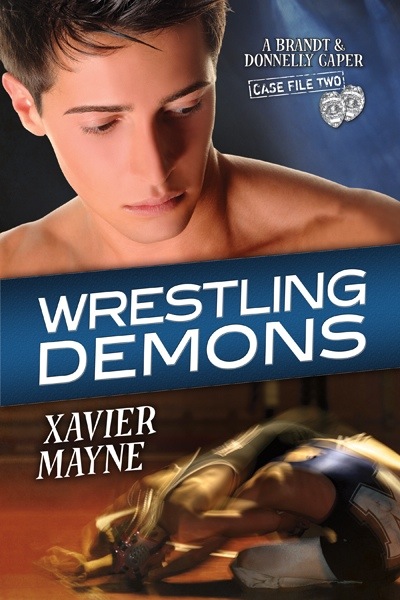
Wrestling Demons by Xavier Mayne

20140423-224357.jpg

Last week, I reviewed Frat House Troopers by Xavier Mayne and I couldn’t wait to read Wrestling Demons, the second book in the Brandt and Donnelly Capers by Xavier Mayne. Last night, I finished Wrestling Demons, and though I expected a great and thought provoking read as I had with Frat House Troopers, I was surprised at how Wrestling Demons was even better. The wrestlers, Jonah and Casey, are more the stars of this book than Brandt and Donnelly, but it isn’t long before you are as smitten with the 18 year old high school wrestlers as you are for Brandt and Donnelly

In Wrestling Demons, Jonah Fischer’s high school wrestling career has been stellar, but now he’s the unwilling star of a series of videos that have hit the web. The whole world may have seen the evidence that his best friend turns him on. Jonah’s conservative family wants him cured, and his conventional town and school want him normal. The only person who still wants him just the way he is is Casey Melville, the same best friend who turned him on for all the world to see. Meanwhile, Casey begins to wonder if there’s more to his feelings for Jonah than he thought.

Officers Brandt and Donnelly—lovers as well as partners on the job—have been assigned to find the culprit who posted the video. While investigating the case, they also help Jonah and Casey find their way through their feelings, and steer them toward refuge when Jonah’s family turns against him. But the mystery remains: who wants to hurt Jonah badly enough to post those videos, and why? Thank goodness Jonah and Casey have found friends—they’re going to need all the help and support they can get.

Xavier Mayne is well-versed in academic theories of sexual identity, and is passionate about writing stories in which men experience a love that pushes them beyond the boundaries they thought defined their sexuality. He believes that romance can be hot, funny, and sweet in equal measure. Once again, he proves this in Wrestling Demons. Mayne writes sex scenes they way they should be written in a book: organic so the sex play easily into the story and plays an integral part in the plot but not so overly done that the book becomes erotic fiction. To me, the sex scenes written by Mayne are more erotic and sexually charged than any book I’ve ever read, and they don’t come across as silly hyperboles.

As my readers know, I am a religious person, and so in many ways this book hit home on so many levels because of the religious questions that are brought up. I don’t want to give away too much of what happens in the book, but one of the characters attends a church that is very welcoming to everyone and is vastly different from the ultra-conservative church of his youth. Instead of the character turning his back on religion, he sees what religion can truly be, a welcoming and accepting journey. The struggles the character faces between the damning church of his youth and the welcoming church he finds, is a dichotomy that truly warmed my heart. Instead of a maybe doing as many gay authors do and wrote how the character rejected religion, it instead showed not only how wrong these hate filled churches are but also shows what is right when Christians show compassion and acceptance.

One of the reason I have so enjoyed reading Xavier Mayne’s books is that not only is ere a great story, but also but their are deeper meaning and lessons contained within. Thank you Xavier Mayne for such a delightful read. I look forward to more capers from Brandt and Donnelly’s case files.


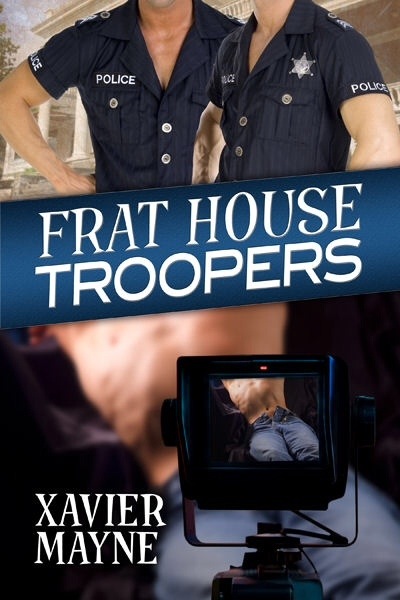
Frat House Troopers by Xavier Mayne

20140417-224230.jpg

I just finished Frat House Troopers by Xavier Mayne, which might sound like a silly name for a book, but considering that State trooper Ethan Brandt’s new assignment is to infiltrate a sex-cam operation that puts him in a very uncomfortable position, especially since he’ll have to perform naked on camera for his audition. Fortunately his partner and best friend, Donnelly, has his back—whether that means helping Brandt shop gay boutiques for sexy underwear or offering Jäger and encouragement while he researches porn.

Despite his mortification, Brandt gives the audition his best “shot”—and becomes an overnight sensation. But to meet the man behind the operation, he’ll have to give a repeat performance, this time live on webcam opposite the highest bidder. Donnelly makes sure to win that auction for his partner’s sake, but their plan has a flaw: faking it is not an option.

In the aftermath, Brandt is a humiliated mess trying desperately to come to terms with what he’s had to do for the job and his own mixed feelings. But Donnelly has been on a journey of discovery of his own. Suddenly everything the two men thought they knew about themselves and each other gets turned inside out. Meanwhile, they still have a case to solve… but it may not be the case they thought it was.

The “frat house” mentioned in the books title, seems to be based on fratmen.com’s web-cam house Fratpad. As Fratpad describes itself on its website, “There’s nothing quite like the FRATPAD. It’s the liveliest, sexiest, frattiest cam house in Cyberspace. No fake frat rituals here. Just a house full of college age guys walking around, working out and chatting on webcams, mostly naked, all day long. They create 24 hours of new content every day and there are 36 stationary cams all around the house so you can spy on them when they think you’re not looking.” This seems to be a pretty good description of the “frat house” in the book, as well.

But that’s not all the book is about. Officers Brandt and Donnelly are on a journey of discovery about themselves. Are they the firmly heterosexual men they’ve always believed themselves to be, or is there more to it? Can a man be straight one day and gay the next? Or do some gay men grow up like I did believing that there was no other choice until that day when our sexual awakening begins? In today’s day and age, young men have seen homosexuality more and more in the mainstream. The Internet is a great way to research things and feeling you don’t understand. I think for many young gay men, the option of following your desires are more acceptable. I think this book has a fresh perspective to show on this subject of sexuality. Though you might not be able to tell it from the title, there is something deeper than the superficiality of a very sexy story.

Furthermore, the descriptions of sex are quite fantastic. Mayne certainly has a way with words and knows how to describe sexual tension in a masterful and thoughtful way. Mayne is also able to write sex scenes in a way that doesn’t come across as pornographic, but the scenes are not chaste either. There is some incredibly hot sex scenes in this book, but this book by no means would be one that I would classify as gay erotica. They story and the emotional tensions contained within, far outweighs the amount of eroticism. It’s an almost perfect balance for a book that is just plain fun to read.

Xavier Mayne is the pen name of a professor of English who works at a university in the Midwest United States. Versed in academic theories of sexual identity, he is passionate about writing stories in which men experience a love that pushes them beyond the boundaries they thought defined their sexuality. He believes that romance can be hot, funny, and sweet in equal measure. The name Xavier Mayne is a tribute to the pioneering gay author Edward Prime-Stevenson, who also used it as a pen name. He wrote the first openly gay novel by an American, 1906’s Imre: A Memorandum, which depicts two masculine men falling in love despite social pressures that attempt to keep them apart.

I hope that you will read Frat House Troopers and hopefully you will become so hooked that you will do as I am currently doing, and read the sequel Wrestling Demons.


Was Norman Rockwell Gay?

20140309-230617.jpg

Without thinking too much about it in specific terms, I was showing the America I knew and observed to others who might not have noticed.
Norman Rockwell

Born in New York City in 1894, Norman Rockwell always wanted to be an artist. Rockwell found success early. He painted his first commission of four Christmas cards before his sixteenth birthday. While still in his teens, he was hired as art director of Boys’ Life, the official publication of the Boy Scouts of America, and began a successful freelance career illustrating a variety of young people’s publications.

At age 21, Rockwell’s family moved to New Rochelle, New York, where Rockwell set up a studio with the cartoonist Clyde Forsythe and produced work for such magazines as Life, Literary Digest, and Country Gentleman. In 1916, the 22-year-old Rockwell painted his first cover for The Saturday Evening Post, the magazine considered by Rockwell to be the “greatest show window in America.” Over the next 47 years, another 321 Rockwell covers would appear on the cover of the Post. Also in 1916, Rockwell married Irene O’Connor; they divorced in 1930.

The 1930s and 1940s are generally considered to be the most fruitful decades of Rockwell’s career. In 1930 he married Mary Barstow, a schoolteacher, and the couple had three sons, Jarvis, Thomas, and Peter. The family moved to Arlington, Vermont, in 1939, and Rockwell’s work began to reflect small-town American life.

In 1943, inspired by President Franklin Roosevelt’s address to Congress, Rockwell painted the Four Freedoms paintings. They were reproduced in four consecutive issues of The Saturday Evening Post with essays by contemporary writers. Rockwell’s interpretations of Freedom of Speech, Freedom to Worship, Freedom from Want, and Freedom from Fear proved to be enormously popular. The works toured the United States in an exhibition that was jointly sponsored by the Post and the U.S. Treasury Department and, through the sale of war bonds, raised more than $130 million for the war effort.

Although the Four Freedoms series was a great success, 1943 also brought Rockwell an enormous loss. A fire destroyed his Arlington studio as well as numerous paintings and his collection of historical costumes and props.

In 1953, the Rockwell family moved from Arlington, Vermont, to Stockbridge, Massachusetts. Six years later, Mary Barstow Rockwell died unexpectedly. In collaboration with his son Thomas, Rockwell published his autobiography, My Adventures as an Illustrator, in 1960. The Saturday Evening Post carried excerpts from the best-selling book in eight consecutive issues, with Rockwell’s Triple Self-Portrait on the cover of the first.

In 1961, Rockwell married Molly Punderson, a retired teacher. Two years later, he ended his 47-year association with The Saturday Evening Post and began to work for Look magazine. During his 10-year association with Look, Rockwell painted pictures illustrating some of his deepest concerns and interests, including civil rights, America’s war on poverty, and the exploration of space.

So much has been written about Rockwell, including his own autobiography, that his life would seem to be a closed case. But he receives a fascinating rethinking in Deborah Solomon’s American Mirror: The Life and Art of Norman Rockwell, in which she makes a case for his homoerotic desires.

Although she can’t conclusively prove that Rockwell had sex with men, she makes an argument that he “demonstrated an intense need for emotional and physical closeness with men” and that his unhappy marriages were attempts at “passing” and “controlling his homoerotic desires.” Rockwell also had a close bond with the openly gay artist J.C. Leyendecker and his gay brother, Frank, also an artist, and counted himself as the “one true friend” the brothers had. As Solomon states, “it was both an artistic apprenticeship and an unclassifiable romantic crush.” According to Solomon, Rockwell went on to have close relationships with his studio assistants (even sleeping in the same bed with one on an extended camping trip) and created his own version of idealized boyhood beauty.

While digging into his back story, Solomon offers sensitive close readings of some of his well-known works that smack of homoeroticism but have been cherished (and sanitized) for their depiction of all-American values. For example, when she points out that in the beloved portrait of a young boy seated next to a police officer at a diner counter, “The Runaway,” the cop can be seen as a “figure of tantalizing masculinity, a muscle man in a skin-tight uniform and boots,” it’s almost as if we’re seeing a proto-Tom of Finland emerge before our eyes. In this analysis, it’s not only a painting that represents a desire for both independence and security, it shows the tenderness between men (of any age) and encapsulates the complicated life and desires of an artist many have written off as a proselytizer of an American dream that didn’t include them. According to Solomon, Rockwell was constantly yearning for another ideal, of youthful male beauty, that always seemed to lie beyond reach.

I’m all for taking a close look into history and uncovering evidence that a historical figure may have been gay; however, this is one instance where I tend to think that Solomon is making a bit of a stretch. I personally have never viewed Norman Rockwell’s work as homoerotic, but as idealistic Americana. I certainly see no traces of a Tom of Finland police officer in the doughy 1950s officer of “The Runaway.” I will admit that I have not read Deborah Solomon’s book nor have I had the chance to evaluate the evidence, but it seems like pure speculation to me. American Mirror has produced a fair amount of controversy, so I do not think I am alone in finding fault with Solomon’s assumptions.

Patrick Toner, a professor at Wake Forest University, wrote:

In her new biography, however, Deborah Solomon presents a Rockwell we might not be inclined to love so much. Her most shocking claim is that he was sexually attracted to young boys. Almost equally shocking, but more subtle, is her suggestion that Rockwell’s self-absorption had a body count—his behavior led directly or indirectly to at least three ugly deaths.

There is no reason to go along with Solomon about these things. As I’ll show, her arguments—such as they are—are deeply flawed, and she has a pronounced tendency to either distort or ignore evidence to the contrary of her claims. As her interpretation of Rockwell himself is irremediably flawed, so is her interpretation of his art. Hers is a book without merit.

Toner continues by stating:

Her evidence for Rockwell’s pedophilia consists of three intertwined claims: First, he paints a lot of boys. Second, he forms strong relationships with some of the boys who serve as models for these paintings. Third, some of these paintings are sexually suggestive. Solomon thinks that pedophilia serves as the best unifying explanation for these claims. I doubt even that, but even if it were the case, there are problems with all three.

Toner’s review of American Mirror is quite long but interesting. From what I have read, it seems as if Solomon had a particular agenda, probably for publicity, in writing her Rockwell biography. It seems that sensationalism is what sells biographies these days, and Solomon has certainly written what seems to be a sensational book. The fact is, if Norman Rockwell was homosexual, there seems no way of proving it except through speculation. I doubt it would surprise many people if one of America’s greatest artists was gay, because let’s face it, most of history’s great artists were. However, I think Rockwell would have probably painted a new version of the picture below to answer the questions of his sexuality:

20140309-230655.jpg

In “The Gossips,” a Saturday Evening Post cover from March 6, 1948, it seems Rockwell had a neighbor who started a disagreeable rumor about him. What can one do about a nasty gossip? Well, if you are a famous illustrator, you can paint a cover about it. It started with just a couple of people, then it just grew, leaving Rockwell in need of more models. The result, said the editors, is that we see “almost the entire adult population of Arlington, Vermont.” As he worked on the project, the artist worried that his friends and neighbors might be offended, so he included his wife and himself. Mary Rockwell is second and third in the third row, spreading the rumor via rotary phone. In the gray felt hat in the bottom row is, of course, the artist himself (you can click on the image for a close-up). You’ll notice the lady at the end is the one at the beginning who started the rumor, and our friend Rockwell appears to be giving her a piece of his mind. Apparently, the neighbor who started the rumor in real life never spoke to Rockwell again. I have a feeling it was no great loss.


The Eleven Nations of America

20131117-220820.jpg

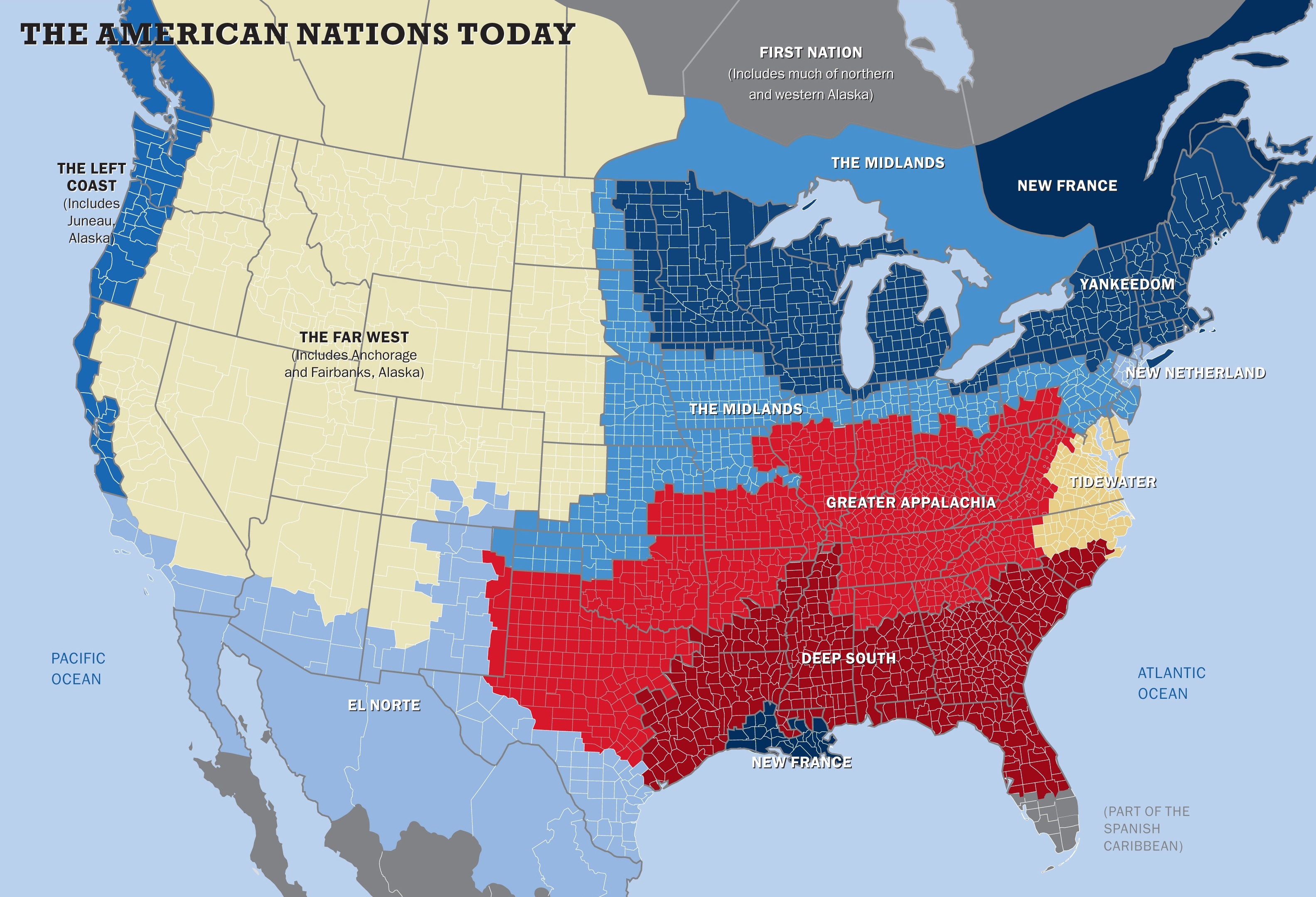
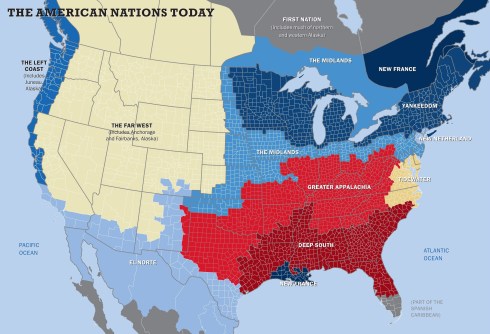
For hundreds of years, this nation has been known as the United States of America. But according to author and journalist Colin Woodard, the country is neither united, nor made up of 50 states. Woodward has studied American voting patterns, demographics and public opinion polls going back to the days of the first settlers, and says that his research shows America is really made up of 11 different nations.

Woodard says that while individual residents will have their own opinions, each region has become more segregated by ideology in recent years. In fact, he says the mobility of American citizens has increased this partisan isolation as people tend to self-segregate into like-minded communities. Woodard lays out his map in the new book “American Nations: A History of the Eleven Rival Regional Cultures of North America.” Here’s how he breaks down the continent:

YANKEEDOM. Founded on the shores of Massachusetts Bay by radical Calvinists as a new Zion, Yankeedom has, since the outset, put great emphasis on perfecting earthly civilization through social engineering, denial of self for the common good, and assimilation of outsiders. It has prized education, intellectual achievement, communal empowerment, and broad citizen participation in politics and government, the latter seen as the public’s shield against the machinations of grasping aristocrats and other would-be tyrants. Since the early Puritans, it has been more comfortable with government regulation and public-sector social projects than many of the other nations, who regard the Yankee utopian streak with trepidation.

NEW NETHERLAND. Established by the Dutch at a time when the Netherlands was the most sophisticated society in the Western world, New Netherland has always been a global commercial culture—materialistic, with a profound tolerance for ethnic and religious diversity and an unflinching commitment to the freedom of inquiry and conscience. Like seventeenth-century Amsterdam, it emerged as a center of publishing, trade, and finance, a magnet for immigrants, and a refuge for those persecuted by other regional cultures, from Sephardim (Jews of Spanish and Portuguese descent; I had to look it up, so I thought I’d share the definition) in the seventeenth century to gays, feminists, and bohemians in the early twentieth. Unconcerned with great moral questions, it nonetheless has found itself in alliance with Yankeedom to defend public institutions and reject evangelical prescriptions for individual behavior.

THE MIDLANDS. America’s great swing region was founded by English Quakers, who believed in humans’ inherent goodness and welcomed people of many nations and creeds to their utopian colonies like Pennsylvania on the shores of Delaware Bay. Pluralistic and organized around the middle class, the Midlands spawned the culture of Middle America and the Heartland, where ethnic and ideological purity have never been a priority, government has been seen as an unwelcome intrusion, and political opinion has been moderate. An ethnic mosaic from the start—it had a German, rather than British, majority at the time of the Revolution—it shares the Yankee belief that society should be organized to benefit ordinary people, though it rejects top-down government intervention.

TIDEWATER. Built by the younger sons of southern English gentry in the Chesapeake country and neighboring sections of Delaware and North Carolina, Tidewater was meant to reproduce the semifeudal society of the countryside they’d left behind. Standing in for the peasantry were indentured servants and, later, slaves. Tidewater places a high value on respect for authority and tradition, and very little on equality or public participation in politics. It was the most powerful of the American nations in the eighteenth century, but today it is in decline, partly because it was cut off from westward expansion by its boisterous Appalachian neighbors and, more recently, because it has been eaten away by the expanding federal halos around D.C. and Norfolk.

GREATER APPALACHIA. Founded in the early eighteenth century by wave upon wave of settlers from the war-ravaged borderlands of Northern Ireland, northern England, and the Scottish lowlands, Appalachia has been lampooned by writers and screenwriters as the home of hillbillies and rednecks. It transplanted a culture formed in a state of near constant danger and upheaval, characterized by a warrior ethic and a commitment to personal sovereignty and individual liberty. Intensely suspicious of lowland aristocrats and Yankee social engineers alike, Greater Appalachia has shifted alliances depending on who appeared to be the greatest threat to their freedom. It was with the Union in the Civil War. Since Reconstruction, and especially since the upheavals of the 1960s, it has joined with Deep South to counter federal overrides of local preference.

DEEP SOUTH. Established by English slave lords from Barbados, Deep South was meant as a West Indies–style slave society. This nation offered a version of classical Republicanism modeled on the slave states of the ancient world, where democracy was the privilege of the few and enslavement the natural lot of the many. Its caste systems smashed by outside intervention, it continues to fight against expanded federal powers, taxes on capital and the wealthy, and environmental, labor, and consumer regulations.

EL NORTE. The oldest of the American nations, El Norte consists of the borderlands of the Spanish American empire, which were so far from the seats of power in Mexico City and Madrid that they evolved their own characteristics. Most Americans are aware of El Norte as a place apart, where Hispanic language, culture, and societal norms dominate. But few realize that among Mexicans, norteños have a reputation for being exceptionally independent, self-sufficient, adaptable, and focused on work. Long a hotbed of democratic reform and revolutionary settlement, the region encompasses parts of Mexico that have tried to secede in order to form independent buffer states between their mother country and the United States.

THE LEFT COAST. A Chile-shaped nation wedged between the Pacific Ocean and the Cascade and Coast mountains, the Left Coast was originally colonized by two groups: New Englanders (merchants, missionaries, and woodsmen who arrived by sea and dominated the towns) and Appalachian midwesterners (farmers, prospectors, and fur traders who generally arrived by wagon and controlled the countryside). Yankee missionaries tried to make it a “New England on the Pacific,” but were only partially successful. Left Coast culture is a hybrid of Yankee utopianism and Appalachian self-expression and exploration—traits recognizable in its cultural production, from the Summer of Love to the iPad. The staunchest ally of Yankeedom, it clashes with Far Western sections in the interior of its home states.

THE FAR WEST. The other “second-generation” nation, the Far West occupies the one part of the continent shaped more by environmental factors than ethnographic ones. High, dry, and remote, the Far West stopped migrating easterners in their tracks, and most of it could be made habitable only with the deployment of vast industrial resources: railroads, heavy mining equipment, ore smelters, dams, and irrigation systems. As a result, settlement was largely directed by corporations headquartered in distant New York, Boston, Chicago, or San Francisco, or by the federal government, which controlled much of the land. The Far West’s people are often resentful of their dependent status, feeling that they have been exploited as an internal colony for the benefit of the seaboard nations. Their senators led the fight against trusts in the mid-twentieth century. Of late, Far Westerners have focused their anger on the federal government, rather than their corporate masters.

NEW FRANCE. Occupying the New Orleans area and southeastern Canada, New France blends the folkways of ancien régime northern French peasantry with the traditions and values of the aboriginal people they encountered in northeastern North America. After a long history of imperial oppression, its people have emerged as down-to-earth, egalitarian, and consensus driven, among the most liberal on the continent, with unusually tolerant attitudes toward gays and people of all races and a ready acceptance of government involvement in the economy. The New French influence is manifest in Canada, where multiculturalism and negotiated consensus are treasured.

FIRST NATION. First Nation is populated by native American groups that generally never gave up their land by treaty and have largely retained cultural practices and knowledge that allow them to survive in this hostile region on their own terms. The nation is now reclaiming its sovereignty, having won considerable autonomy in Alaska and Nunavut and a self-governing nation state in Greenland that stands on the threshold of full independence. Its territory is huge—far larger than the continental United States—but its population is less than 300,000, most of whom live in Canada.

“The borders of my eleven American nations are reflected in many different types of maps — including maps showing the distribution of linguistic dialects, the spread of cultural artifacts, the prevalence of different religious denominations, and the county-by-county breakdown of voting in virtually every hotly contested presidential race in our history,” Woodard writes in the Fall 2013 issue of Tufts University’s alumni magazine. “Our continent’s famed mobility has been reinforcing, not dissolving, regional differences, as people increasingly sort themselves into like-minded communities.”

His main thesis seems to be that the culture of violence is one of the main dividing factors between the “11 Nations.” Though Woodward says that clashes between the 11 nations play out in every way, from politics to social values. He particularly notes that states with the highest rates of violent deaths are in the Deep South, Tidewater and Greater Appalachia, regions that value independence and self-sufficiency. States with lower rates of violent deaths are in Yankeedom, New Netherland and the Midlands, where government intervention is viewed with less skepticism. States in the Deep South are much more likely to have stand-your-ground laws than states in the northern “nations.” And more than 95 percent of executions in the United States since 1976 happened in the Deep South, Greater Appalachia, Tidewater and the Far West. States in Yankeedom and New Netherland have executed a collective total of just one person.

Woodward does point out that while these particular “11 Nations” are original to him, others have suggested similar divisions, which include maps showing the distribution of linguistic dialects, the spread of cultural artifacts, the prevalence of different religious denominations, and the county-by-county breakdown of voting in virtually every hotly contested presidential race in our history. Woodward writes that “Our continent’s famed mobility has been reinforcing, not dissolving, regional differences, as people increasingly sort themselves into like-minded communities, a phenomenon analyzed by Bill Bishop and Robert Cushing in The Big Sort (2008). Even waves of immigrants did not fundamentally alter these nations, because the children and grandchildren of immigrants assimilated into whichever culture surrounded them.”

He also makes the following distinctive point:

Before I describe the nations, I should underscore that my observations refer to the dominant culture, not the individual inhabitants, of each region. In every town, city, and state you’ll likely find a full range of political opinions and social preferences. Even in the reddest of red counties and bluest of blue ones, twenty to forty percent of voters cast ballots for the “wrong” team. It isn’t that residents of one or another nation all think the same, but rather that they are all embedded within a cultural framework of deep-seated preferences and attitudes—each of which a person may like or hate, but has to deal with nonetheless. Because of slavery, the African American experience has been different from that of other settlers and immigrants, but it too has varied by nation, as black people confronted the dominant cultural and institutional norms of each.

Though Woodward makes some interesting points, and I will admit that I have not read his new book American Nations: A History of the Eleven Rival Regional Cultures of North America, I think he has oversimplified the issue by erring on political correctness and gun control debates. The areas that he claims are more violent are often either more racially diverse or more economically divided. Yet, Woodward does not discuss this in any meaningful way in his article in Tuft Magazine. I hope he does in his book.my biggest problem, however, is that he completely ignores Hawaii and south Florida, both of which he dismisses as not being part of the United States. It seems to me that it would have been a better choice to have 13 Nations, not 11, which would have been more in line with the historical distinction of the Thirteen Colonies. Then he could have included south Florida as part of the Spanish Caribbean and Hawaii as a culture distinct of its own. Yet, I’m not sure that Hawaii shouldn’t be aligned with the Left Coast, bit Woodward simply does not consider it.

No matter what the problems with Woodward’s thesis is, it is an interesting debate, especially considering how he pits the two superpowers of the eleven nations against each other. He ends his article in Tufts Magazine by writing:

Among the eleven regional cultures, there are two superpowers, nations with the identity, mission, and numbers to shape continental debate: Yankeedom and Deep South. For more than two hundred years, they’ve fought for control of the federal government and, in a sense, the nation’s soul. Over the decades, Deep South has become strongly allied with Greater Appalachia and Tidewater, and more tenuously with the Far West. Their combined agenda—to slash taxes, regulations, social services, and federal powers—is opposed by a Yankee-led bloc that includes New Netherland and the Left Coast. Other nations, especially the Midlands and El Norte, often hold the swing vote, whether in a presidential election or a congressional battle over health care reform. Those swing nations stand to play a decisive role on violence-related issues as well.

For now, the country will remain split on how best to make its citizens safer, with Deep South and its allies bent on deterrence through armament and the threat of capital punishment, and Yankeedom and its allies determined to bring peace through constraints such as gun control. The deadlock will persist until one of these camps modifies its message and policy platform to draw in the swing nations. Only then can that camp seize full control over the levers of federal power—the White House, the House, and a filibuster-proof Senate majority—to force its will on the opposing nations. Until then, expect continuing frustration and division.

In many ways he’s correct, the great American divide is still between the North and the South. In every major American conflict from the American Revolution to the Civil War and from the Civil Rights Movement to the modern Gay Rights Movement, the North and South are still pitted against one another.

Links:

“Up in Arms” by Colin Woodward, Tufts Magazine

“Which of the 11 American nations do you live in?” by Reid Wilson, The Washington Post.

“Forget The 50 States; The U.S. Is Really 11 Nations, Author Says” NPR


Need

20130814-225121.jpg

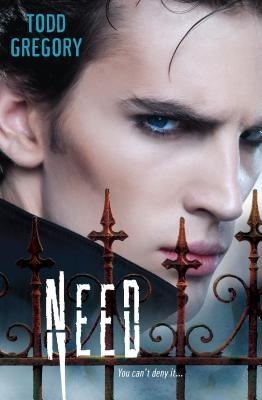
The latest book on my must read list, plus starting back to school this week has left me wanting for sleep.  I started reading Todd Gregory’s Need on Saturday, and it’s been quite hard to put down.  Todd Gregory is better known as Greg Herren, who many of you know is my favorite author.  Todd Gregory is the pseudonym that Herren uses for his more erotic novels.  The main character of Need is Cord Logan, who readers were first introduced to in the short story “Blood on the Moon” in the Midnight Hunger anthology of gay vampire stories, so I read that story again before reading Need.  Need is a stand alone book, but it really helps if you read Cord’s backstory first.
 
At the beginning of Need, Cord Logan has only been a vampire for two years, and is still adapting, trying to figure out who he is and what he wants. Haunted by what happened to him the last few nights he was human, he has turned his back on his fraternity of vampires. Returning to New Orleans, a chance encounter with an old friend from his human life triggers a disturbing chain of events. And now Cord’s erotic journey of self-discovery becomes even more lethal, as an ancient society of supernatural beings must intervene to save the vampire race – and all humanity.
 
Need is erotically charged throughout, and some might complain that it has more sex scenes than substance, but the sex scenes actually do add to the story, which is what a good sex scene should do.  I admit though that some of the scenes seem a little too gratuitous, but they are a hell of a lot of fun to read.
 
Also, like many gay novels, Gregory creates a fascinating, lovable, and snarky female character, much as he does as Greg Herren with the characters Paige Tourneur and Venus Casanova in his Chance McLeod mysteries.  This time the character is Rachel, a female vampire with razor sharp wit, that I couldn’t help but love.
 
The ending appear to me that Need has potential to go into a series. The curse that lead Cord from baby vampire making poor decisions to the very different vampire Cord is at the end of the book opened some interesting possibilities. I would love to read more of Cord if this did turn into a series. The events at the end definitely have my curiosity piqued. 
 
There are parts of the boom also that feels somewhat repetitive and in some parts scenes seem to contradict something we have already learned, but I can forgive that, hopefully you can too. 
 
The major drawback of this book for me, and this is for me personally, is that Herren/Gregory seems to have a deep seeded hatred of the Church of Christ.  Both Chance McLeod and Cord Logan’s characters were raised in harsh, fundamentalist Church of Christ congregations.  I tend to be able to get over it because I just replace Church of Christ with another denomination.  It’s hard for me to read such criticisms of a church I deeply love, but then I was raised in a very loving church.  I have never found out why the Churches of Christ make appearances in Herren/Gregory’s writing.  I can only assume that Herren was raised in a harsh Church of Christ, very unlike the one I was raised in.  One day, I hope to have the chance to ask him that question.  It certainly will never stop me from reading his books.
 
PS If you have emailed me in the last week, I will get back to you this weekend.  With preparations for school starting and school itself, I have been too tired at the end of the day to respond to emails.  I will though.  I also blame Todd Gregory’s Need for my lack of response because I’ve read each night until I have to force myself to go to bed.  So please forgive me.

Greg Herren’s New “Page Turner”

20130725-000028.jpg

20130725-000039.jpgMy favorite author Greg Herren has a new set of mystery novellas that are quick reads and a hell of a lot of fun. I just finished reading the first one last night, and if from reading my reviews of his books, you’ve become a Herren fan as well, then how can you resist this e-book for just 99 cent? It’s worth every penny and then some.

Paige Tourneur (Please! Is that really her name?) is the former Times-Picayune reporter and best friend of Herren’s gay detective Chanse McLeod series. To hear her buddy Chanse tell it, Paige is rotund, cute as a button, a truly bad driver, and the best friend a gay P.I. could possibly have.

Now Paige gets a chance to tell it herself in her own witty and worldly-wise way. Seems like she has quite a past and in Fashion Victim, it’s starting to haunt her. Though it helps to be familiar with Paige from the Chance McLeod series, this novella works well as a stand alone mystery. It just adds a little bit of a thrill for the readers, if you already know Paige.

Since his first novel, I’ve wanted Paige to be a more developed character. She’s still the same hard-drinking, hard-bitten, smart-mouthed red-headed reporter with the heart of gold and the unlikely name. I’ve also always wanted to know more about the his crime fighting NOPD duo Venus and Blaine, but we will have to wait and see if they get books of their own as well. They remain to be the characters that connect his Chanse McLeod and Scotty Bradley mysteries. Of course, the city of New Orleans connects them as well. And it would be a dream if Chance and Scotty would have a crossover mystery.

In her first solo outing, Paige has long since left the Times-Picayune, played out a stint on television, and has now landed a job at Crescent City Magazine, which sends her out to do a personality piece on bitchy fashion designer Marigny Mercereau. Only Marigny ends up dead fifteen minutes before her fifteen minutes of fame.

Twisting through Marigny’s creepy past, Paige is accompanied, as always, by best friend Chanse, her cop buddies Venus Casanova and Blaine Tujague, and (finally!) by the perfect man: her new boy friend, Blaine’s brother Ryan. So what happens when a woman meets the perfect man and her past comes calling?

Fashion Victim is the first in a series of interconnected novellas in the “Paige Tourneur Missing Husband Series.” The second volume, Dead Housewives of New Orleans, is already out and is on my next to read list.