Category Archives: Education

The End of Summer

20130806-232228.jpg

Today is my last day of summer vacation. I go back to school tomorrow. We have teacher workdays Thursday and Friday, then the students come back on Monday. Where has my summer gone? It really feels like the school year just ended last week. I always think of summer as being three months off, but we really only got two months off. I am not ready for school to start back. Smart-mouthed kids, lazy students, and early mornings…YUCK!

I’m going to spend my last day of freedom reading. This hasn’t been the best summer; it’s actually been pretty stressful. However, some of my stresses have recently been relieved, and I was just starting to recover and relax some. Now it all comes to an end.

My hope is that this will be a great school year, and that the students that I am dreading dealing with this year won’t be as bad as I expect.


Gay teachers less likely to challenge homophobia?

20130730-225432.jpg

Despite the ever-present challenges lesbian, gay, bisexual and transgender (LGBT) students face at school, a new study finds that gay teachers are actually less likely to challenge bullying in the classroom than their straight counterparts out of fear for their own jobs.

As TES Magazine reports, the study comprised interviews with more than 350 teachers and school principals over how they deal with anti-gay incidents at school. The bulk of the interviewees who identified as LGBT said that not only did they not feel safe coming out at school, but they had rarely intervened when they witnessed homophobic remarks being made.

Over one-third of the teachers interviewed for the survey said they were worried their jobs would be at risk if they came out to their colleagues, while 62 percent were worried about losing their jobs if they came out to their students, according to the report.

As a gay teacher myself, I understand how other LGBT teachers might feel. Whereas, some teachers might not stand up to homophobic incidents, I do not allow any bullying or any disparaging remarks in my presence. I attempt to teach my students the golden rule. Though I might fear that it might out me to my students or that my students might perceive me as gay because of it, I don’t worry too much. Parents and students alike know that I am the one liberal teacher at the school, and so they think it is just one of my liberal diatribes when I challenge bullying in the classroom. I also tend to give them a mini sermon on the golden rule in the process.

That being said, it does not mean that my job would not be in jeopardy if my sexuality did come out. I have allies on the school board, so I might not lose my job, but it is also quite likely that I would. We can hope that one day, the sexuality of teachers will not be an issue. Currently, it is a very real threat. News of the TES Magazine report follows the case of Carla Hale, a longtime teacher at Ohio’s Bishop Watterson High School who was reportedly fired after her partner’s name, Julie, was listed among the survivors in a public obituary for Hale’s mother. In February, Purcell Marian High School Assistant Principal Mike Moroski was fired by the Archdiocese of Cincinnati after endorsing gay marriage in a personal blog post, while in 2012, music teacher Al Fischer was dismissed from his job at St. Ann Catholic School in north St. Louis County, Mo., after archdiocese officials learned he was planning on marrying his longtime partner.


The ‘That’s So Gay’ Impact

Now, there are times when saying “That’s so gay” is entirely accurate and appropriate, for example when a gay man is describing hand making curtains with silk fabric and trim.  Or, like when I was watching “Warehouse 14” on Syfy Monday night and Agent Jinks, a gay character on the show, does a double take when seeing the ruby slippers from “The Wizard of Oz” in the warehouse. Most of the time, however, this is not the kind of situation that this phrase is most often muttered.

“That’s so gay” has been part of the adolescent lexicon for some time, but a new University of Michigan study has revealed the phrase could have deep consequences for lesbian, gay, bisexual and transgender (LGBT) students.

Published in the current issue of the Journal of American College Health, the study reportedly examined the impact of hearing “that’s so gay” among 114 LGBT students between the ages of 18 and 25, CBS Detroit is reporting.
The resulting data found that LGBT students who heard the phrase frequently were more likely to feel isolated and experience headaches, poor appetite or eating problems than those who didn’t. Still, the study also revealed another troubling statistic: a mere 14 respondents (13 percent) hadn’t heard “that’s so gay” at all throughout the duration of the survey.
“Given the nature of gay-lesbian-bisexual stigma, sexual minority students could already perceive themselves to be excluded on campus and hearing ‘that’s so gay’ may elevate such perceptions,” Michael Woodford, an assistant professor of social work and co-author of the new study, said in a statement. “‘That’s so gay’ conveys that there is something wrong with being gay.”
Woodford went on to suggest, “Policies and educational programs are needed to help students, staff and faculty to understand that such language can be harmful to gay students. Hopefully, these initiatives will help to eliminate the phrase from campuses.”
In 2007, the phrase was at the epicenter of a controversial lawsuit, after a California teen’s parents claimed their daughter’s First Amendment rights had been violated after she was disciplined by her high school for uttering the phrase, which “enjoys widespread currency in youth culture,” to classmates who were allegedly taunting her for her Mormon upbringing, according to court documents cited by the Associated Press.
Still, retired teacher Rick Ayers, who helped compile and publish the “Berkeley High School Slang Dictionary,” told the AP, “I wouldn’t be surprised if this girl didn’t even know the origin of that term. The kids who get caught saying it will claim it’s been decontextualized, but others will say, `No, you know what that means.’ It’s quite talked about.”

Source:  Huffington Post (Gay Voices), “‘That’s So Gay’ Impact,” by Curtis M. Wong 


Top 25 LGBT-Friendly Colleges And Universities


Stanford University, Minnesota’s Carleton College and Georgia’s Emory Universitymay all be vastly different institutions in terms of size of their student body and variety of degree programs offered. Yet all three have been named to Campus Pride’s list of the top 25 most LGBT-friendly colleges and universities in the U.S.
As part of an exclusive partnership with HuffPost Gay Voices, Campus Pride officials have just released the full list, which also includes universities in Pennsylvania, Massachusetts and Michigan. The rankings are based on data from the Campus Pride Index, which rates both colleges and universities on LGBT policy inclusion, student life, academic life as well as other relevant practices using a five (highest) to one (lowest) star rating system. The full index comprises a total of 339 campuses across the country.
Praising the top 25 list was Campus Pride Executive Director Shane Windmeyer. “Every student deserves to feel safe on campus, and all of these colleges are committed to creating a more LGBT-friendly campus,” he said in a statement.
Calling it “the most reliable, trusted source” of its kind, Windmeyer noted that the index differed from others in that its ratings were “done for and by” LGBT people. He also stated that there was still room for improvement across the board, particularly in rural areas and Midwest and Southern regions.
“It is also important to recognize the 300 plus additional colleges that have ‘come out’ as LGBT-friendly on the Campus Pride Index, regardless of their star-rating,” he added.
See the top 25 LGBT-friendly colleges and universities (featured in no specific order) in the slideshow below. For more information on the Campus Pride Index, click here.
How LGBT-friendly is your college or alma mater? Sound off in the comments section below.
Here’s the full rundown of the Top 25. (All 339 school rankings can be found on the Campus Pride Index)

– Carleton College
– Cornell University
– Emory University
– Indiana University
– Ithaca College
– Oberlin College
– Portland State University
– Stanford University
– The Ohio State University
– The Pennsylvania State University
– University of California, Berkeley
– University of California, Los Angeles
– University of California, Riverside
– University of California, Santa Barbara
– University of Chicago
– University of Illinois at Chicago
– University of Maryland, College Park
– University of Massachusetts, Amherst
– University of Michigan
– University of Minnesota-Twin Cities
– University of Oregon
– University of Pennsylvania
– University of Utah
– University of Vermont
– University of Washington

“Every student deserves to feel safe on campus, and all of these colleges are committed to creating a more LGBT-friendly campus,” said Campus Pride Executive Director Shane Windmeyer.


Full story here:


Back to School

Dammit, the summer is over.  I go back to school today to get my room ready for classes to start on Wednesday.  Also, my night class begins tonight.  It’s going to be a busy day.

Queer Conference at the College of Wooster

I would like to draw your attention to a queer conference that will be held at the College of Wooster from October 4-7, 2012.

“Global Queerness: Sexuality, Citizenship, and Human Rights in the 21st Century”

Cherrie Moraga will be giving our keynote address and we will have keynote performances by E. Patrick Johnson and Marga Gomez.Jimmy A. Noriega, Assistant Professor of Theatre and Dance at The College of Wooster, requested that I help circulate the call-for-papers among my faculty and students, as well as anyone else you feel may be interested in attending and/or presenting at our conference. All of the events are free and open to the public and we hope that you will consider joining us for the proceedings. If you need any assistance or would like additional information, do not hesitate to contact Jimmy Noriega at jnoriega@wooster.edu.

The conference website is: http://globalqueerness.voices.wooster.edu/


I am considering presenting a paper myself, and since some of you are in academia as well, I encourage you to submit a paper as well.

Call for Papers

We invite the submission of proposals for a scholarly conference to be held at the College of Wooster (Wooster, Ohio), from October 4-7, 2012. The interdisciplinary nature of this meeting will allow participants to engage with the themes of queer identity, belonging, race, gender, and human rights in an academic and social context. The conference will consist of a keynote address by Cherríe Moraga, keynote performances by E. Patrick Johnson and Marga Gomez, scholarly panels, roundtable discussions, a queer international film screening, a forum with queer athletes, and a celebration to end the gathering. An atmosphere of diversity and equality will engage all involved and promote acceptance and understanding between individuals of all backgrounds. With the growing number of LGBTQ students across U.S. campuses, we hope to use this conference as a way of putting the College of Wooster at the forefront of this important social dialogue.

This is a queer-focused conference designed for scholars, students, creative writers, human rights advocates, and performance artists to present and discuss their work and to exchange and encourage new ways of engaging with LGBTQ issues across disciplines and institutions.

Proposals from all disciplines are welcome. We are soliciting proposals that address topics including, but not limited to:

Queer theory and criticism
Queer images and media
Queer identities in global contexts
Queer theatre and performance
Queer health and wellbeing
Transgender identities and experiences
Queerness and the fine arts
Queerness and faith
Queer history
Queer literature
Queer issues in education
LGBTQ politics, law, and justice

Please send an abstract of no more than 500 words and a CV to aatay@wooster.edu andjnoriega@wooster.edu

Deadline: August 15, 2012.


Why Don’t Students Understand Boundaries Anymore?

San Diego Students Suspended After ‘Gay Test’ Involving Watching Porn Videos On Cell Phones

Nine seventh grade students at a San Diego-based middle school were suspended last month after watching pornographic videos as part of a so-called “gay test,” according to reports.

According to U-T San Diego News, students in all-boys English class at Bell Middle School in Paradise Hills allegedly wore gym shorts as they watched videos on their cell phones. Whoever became sexually aroused while watching the videos was labeled gay, and several adolescents masturbated openly during the class.

In addition, peers complained of inaction by teacher Ed Johnson, who is now reportedly under fire because he did not respond to students who told him about the behavior while it was allegedly happening, according to NBC San Diego.

Among those to condemn the news was Patiti Boman of Parents, Families and Friends of Lesbians and Gays, who called the incident “terrible,” even though Bell Middle School officials have yet to confirm many details.

“I was thinking we were getting better and that’s why we go out and speak in schools. This is news to me and this gives me chills,” Boman, part of the team which helped craft the district’s anti-harassment policy, told U-T San Diego news. “They use that to attack and intimidate.”

Last month, U-T San Diego News reported that school officials and area lawmakers have called the matter a personnel issue and declined additional comment, citing student privacy laws.

“We cannot tell you the reasons for the suspensions, or whether further action is being taken with respect to any particular suspension,” Andra Donovan, deputy general counsel for the district, said in an email as quoted by NBC San Diego. “With respect to Mr. Johnson, all we can tell you is that he is employed by the District and remains assigned to Bell Middle School as of [May 25]. His schedule has not changed.”

Still, Dick Thornburgh, a former U.S. attorney general and author of a 2002 study on how to protect youth from Internet pornography, told the Associated Press that he believes the case illustrates a growing problem.

“The images are perishable, so if a teacher is concerned about someone using a cell phone to look at pornographic images, all you’ve got to do is press a button and it’s gone,” he said. “So it poses all kind of challenges.”

At my school students are supposed to either turn in their cell phones in the morning or leave them in their car.  We should not have to worry about this problem, though students hide their cell phones and sneak them around school regardless of the rules and consequences of being caught.  Besides, even if my students watched porn on their phones in school, I know they do so at home, they would never openly masturbate in class.  They may often be inappropriate, crass, and rude, but at least they do know some boundaries.  The other major difference in my students and these is that my students who watch porn are 10th-12th grade, but my seventh graders would never admit to watching porn.  One of the great things about teaching in a rural school is that the kids keep their innocence longer.


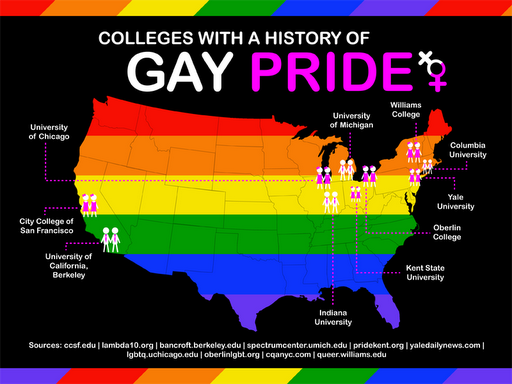
10 Colleges With a History of Gay Pride

Every June, Americans recognize Gay Pride Month via famous parades and other advocacy events promoting marriage equality, adoption, health, teen bullying and suicide prevention, and other social and political issues related to LGBT rights, which directly impact an estimated 10% of the population (and indirectly impact a far higher percentage of loved ones). Because the country is still slowly growing to accept sexual and gender identity minorities, this means many college students head off to their higher education careers isolated, lonely, depressed — or worse. Most campuses these days offer some semblance of a support structure to ensure a safe experience for all LGBT students, and queer studies courses, minors, and majors have started popping up in catalogs across the country. And it’s all thanks to some of the following pioneers, who took a chance on equality when such things still stood as highly taboo.
CITY COLLEGE OF SAN FRANCISCO:  In 1989, City College of San Francisco revolutionized LGBT and queer studies when Jack Collins established America’s very first department promoting the inchoate field. Founded upon Dan Allen’s pioneering 1972 gay literature course taught in the English department, the Lesbian, Gay, Bisexual, Transgender Studies Department really wowed students, teachers, and administrators when it launched, attracting hundreds of enrollees for some of its courses. Because the school sits in one of the world’s most LGBT-friendly cities, the classes beneath the organization’s umbrella often benefit from the surrounding communities’ participation and input.
INDIANA UNIVERSITY:  More famous for Alfred Kinsey’s in-depth studies of American sexual habits at a time when such things popped monocles and inspired pearl-clutchings, Indiana University also happens to exist as a largely LGBT-friendly campus. Activist Shane Windmeyer of Campus Pride fame also established the Lambda 10 project here alongside the school’s Greek leaders in 1995. Today, it exists as the only nonprofit fully dedicated to making fraternity and sorority houses safe spaces for LGBT students. Notable, because neither institution enjoys the healthiest reputation for inclusiveness, tolerance, and equitability.

UNIVERSITY OF CALIFORNIA, BERKELEY:  Spring 1970 saw this historically progressive college offering up the nation’s very first undergraduate course in queer theory. Other schools in Illinois, New York, and even Nebraska quickly followed suit, paving the way for an entire academic field. The Gay Bears Collection pulls from Berkeley’s extensive archives — as well as its own inquiries — to provide students, faculty, staff, and visitors with detailed information about both hidden and not-so-hidden names, dates, and faces involved in the campus’ LGBT history.
UNIVERSITY OF MICHIGAN:  Many — if not most — colleges and universities these days sport some form of official LGBT outreach, usually through an organization or dedicated student services department. University of Michigan launched the very first back in 1971, inspiring more and more to follow suit and provide comfort and safety to an unfairly marginalized segment of the community. Known as the Spectrum Center, it has spent the past four decades ensuring an equal place for LGBT students, faculty, and staff.
KENT STATE UNIVERSITY:  One of the oldest, most inspiring LGBT student organizations in the nation started at Kent State University in 1971, following the precedent set by Berkeley’s groundbreaking undergraduate courses. It started out as the Kent Gay Liberation Front and set about organizing talks, rallies, and even classes on the cause of equality. More than 70 people showed up to the very first meeting scheduled by sociology student Bill Hoover and English professor Dolores Knoll, and the school’s administrators largely supported their banding together and coming out.
YALE UNIVERSITY:  When it comes to the more staunchly traditional Ivy League schools, one probably doesn’t think them bastions of LGBT tolerance and equality, though Yale has historically held a more progressive stance on the matter than its associates. It became the first of its type to organize a Gay Rights Week, rally, and dance celebrating sexual and gender diversity in 1977. Three years later, the school established a Gay and Lesbian Co-Op, which continued promoting LGBT rights, hosting lectures, promoting poetry and film, and other events furthering the cause.
UNIVERSITY OF CHICAGO:  Thanks to LGBT Phoenixes, America’s third-largest city enjoyed its very first gay rights organization, which quickly branched out into groups and events not affiliated with an academic establishment. The University of Chicago Gay Liberation Front banded together in 1969, and OutLaw — dedicated to LGBT law students — followed suit in 1984. By 1992, it was offering the very same domestic partnership benefits to lesbian and gay couples as it did heterosexuals. 
OBERLIN COLLEGE:  Oberlin College frequently lands on lists of the most LGBT-accepting institutes of higher learning in the United States. While its older nature meant at some point it did, in fact, reflect the overarching climate’s prejudices, by the 1960s some semblance of sociopolitical revolution began burbling to the surface at the Conservatory. The 1970s saw more organizations, rallies, dances, and other events bringing the fight to campus, with the Oberlin Gay Liberation Front establishing itself in 1971. More contemporary scholars enjoy the Oberlin College LGBT Community History Project, which offers up first- and second-person accounts of LGBT community history both at the school and the broader social climate.
COLUMBIA UNIVERSITY:  Yale may be one of the most notable Ivy League schools when it comes to sexual and gender identity equality, but it certainly doesn’t fly solo. Since 1967, the Columbia Queer Alliance has served as a safe haven and political rallying point for its LGBT student community — the very first of its kind in the world. Originally known as the Student Homophile League, organizers had to fight, fight, fight, and bite, bite, bite for years before Columbia officials finally green-lighted their group. It stood as one of the cornerstones of the equality movement before the Stonewall Riots two years later inspired others to action.
WILLIAMS COLLEGE:  Thanks to the efforts of Daniel R. Pinello and his 1971 Williams Advocate article “The Homosexual at Williams: Coming Out,” students felt inspired to embrace their sexuality and group together in 1976 as the Williams Gay Support Organization. Reaction to its establishment and subsequent events, which included frank discussions about AIDS, coming out, and even a support hotline, showing love and support to a marginalized minority proved extremely mixed, if not outright hostile. In fact, much of the administration actively shot down attempts to celebrate diversity and promote equality. It wasn’t until 1985, when instances of bullying whipped up a crowd of 300 supporters, that the campus started turning around.


The Harmful Affects of Homophobia

Yesterday, I was perusing through Buddy Bear’s blog, One Step at a Time (which if you’ve never checked it out, you should), and came across his post, “10 Ways Homophobia Hurts Straight People.”. I found this list he posted from the British Columbia Federation of Teachers to be very interesting.  I would love to hear my readers opinions on this list.

      • Ten ways homophobia affects straight people
  1. Homophobia forces all people to act “macho” if male or act “feminine” if female. This limits our individuality and expression.
  2. Homophobia puts pressure on straight people to act aggressively and angrily towards LGBTQ people.
  3. Homophobia makes it hard to be close friends with someone of the same sex.
  4. Homophobia often strains family and community relationships.
  5. Homophobia causes youth to become sexually active before they’re ready in order to prove they are “normal.” This contributes to an increase in unwanted pregnancies and sexually transmitted diseases (STDs).
  6. Homophobia prevents vital information on sex and sexuality to be taught in schools. Without this information youth are putting themselves at greater risk for HIV, and other STDs.
  7. Homophobia can be used to hurt a straight person if they “appear to be gay.”
  8. Homophobia makes it hard for straight people and LGBTQ people to be friends.
  9. Homophobia makes it hard to put an end to AIDS.
  10. Homophobia makes it hard to appreciate true diversity, and the unique traits that are the mainstream population.
So, what do you guys think?

Teacher Writes On Facebook That Being Gay Is ‘The Same As Murder’

Jack Conkling, a Prairie Hills Middle School social studies teacher and Buhler High School assistant women’s basketball coach in Buhler, Kan., is under fire after equating being gay to being a murderer on his Facebook profile, the Hutchinson News reports.

In his post, Conkling comments on gay marriage, writing that homosexuality “ranks in God’s eyes the same as murder, lying, stealing, or cheating.”

According to the paper, several of his students who were also his Facebook friends left comments on the post, something that led the school to eventually take notice.

“I wrote what I wrote for my Facebook friends who understand my heart and my intent,” Conkling told the Hutchinson News. “I understand that there were some folks who didn’t understand my heart, and while that’s sad, it is what it is.”
While the school district has no Facebook policy for its teachers, Craig Williams, the middle school’s principal, said school officials are “looking into it.”

In a news release, Kansas Equality Coalition Executive Director Thomas Witt condemned Conkling’s public sentiments, saying it isolates students.

“What would Mr. Conkling say to a student who is getting bullied for being gay or lesbian,” Witt said in the statement, according to the blog “Gay Star News.”

The full text of Conkling’s Facebook rant, courtesy of The Advocate:

“All this talk in the news about gay marriage recently has finally driven me to write. Gay marriage is wrong because homosexuality is wrong. The Bible clearly states it is sin. Now I do not claim it to be a sin any worse than other sins. It ranks in God’s eyes the same as murder, lying, stealing, or cheating. His standards are perfect and ALL have sinned and fallen short of His glory. Sin is sin and we all deserve hell. Only those who accept Christ as Lord and daily with the help of the Spirit do their best to turn from sin will enter the Kingdom of Heaven. There aren’t multiple ways to get to Heaven. There is one. To many this may seem close minded and antagonistic, but it doesn’t make it any less true. Folks I am willing to admit that my depravity is just as great as anyone else’s, and without Christ I’d be destined for hell, if not for the undeserved grace of God. I’m not condemning gay marriage because I hate gay people. I am doing it because those who embrace it will never enter the Kingdom of Heaven. And I desire that for no one.”

As more are embracing social media as a regular method of communication and information sharing, school districts across the country are grappling with how to keep online interactions among students and teachers constructive.

States from Missouri to New York have adopted social media policies that prohibit or restrict communication between students and teachers on social media sites like Facebook — regulations that have been met with mixed responses.

Greater online exposure has also heightened scrutiny of educators’ personal lives and opinions, which sometimes puts those teachers’ employment security at risk.

Viki Knox, a special education teacher in New Jersey, was investigated last fall for posting anti-gay comments on Facebook. She reportedly wrote on the site that homosexuality is “a perverted spirit that has existed from the beginning of creation,” and a “sin” that “breeds like cancer.”

Last fall, Florida teacher Jerry Buell was reassigned after an anti-gay Facebook post that denounced New York’s decision to allow same-sex marriage. Buell wrote that he “almost threw up” when he heard the news.

“If they want to call it a union, go ahead,” Buell wrote. “But don’t insult a man and woman’s marriage by throwing it in the same cesspool as same-sex whatever! God will not be mocked. When did this sin become acceptable???”

And in March, Christine Rubino, a teacher in New York, found herself under fire after posting to Facebook inflammatory comments about her students. A day after a Harlem girl drowned at a New York area beach, Rubino suggested that her students should take a beach trip. “I hate their guts,” she wrote, according to the New York Post.

It’s so sad to me when people like this are educating America’s children. We need to be teaching love and acceptance, not perpetuating hate. I have a strict policy that I follow when it comes to Facebook, I do not ‘friend’ students, nor do I accept their friend requests. Once the graduate or no longer attend my school, I will reconsider. However, not all of our teachers have this policy. Some use Facebook extensively, mostly to gather gossip. No matter what someone believes, Facebook should not allow people to perpetuate hate. What Jack Conkling did was highly inappropriate; now, we will have to see what the administrators at his school does.