Category Archives: Gay Icon

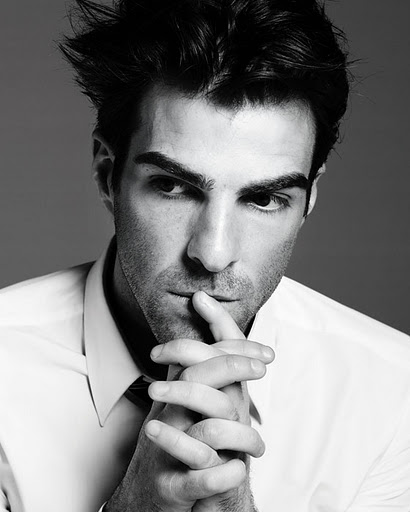
Zachary Quinto Comes Out

Zachary Quinto, inheritor of the iconic Mr. Spock role in JJ Abrams’ “Star Trek” reboot and the star of the upcoming film “Margin Call,” reveals that he is gay in a new profile in New York Magazine. The star, 34, credits his role in the Broadway play “Angels In America,” in which he plays a gay man who leaves his AIDS-afflicted boyfriend, for helping to put him further in touch with the hopes felt and struggles faced by both gay and straight Americans, and discusses his political outlook for the rights movement.

While Quinto’s sexuality hasn’t exactly been a big Hollywood secret, he’s been pretty clear in the past that he’d rather focus on his advocacy for gay rights than his personal life. Last year he told the New York Times,

The fact that these things are such hot-button issues right now, socially and politically, I would much rather talk about that than talk about who I sleep with. I would love to be a voice in this maelstrom of chaos and obsessive celebrity infatuation that says, ‘Let’s talk about something that matters.’

So it was a bit surprising to some people when he seemed to casually refer to himself as a gay man to New York magazine recently. Quinto was talking about his role in the Broadway play “Angels In America,” in which he plays a gay man who leaves his AIDS-afflicted boyfriend. He said,

Doing that play made me realize how fortunate I am to have been born when I was born. And to not have to witness the decimation of an entire generation of amazingly talented and otherwise vital men. And at the same time, as a gay man, it made me feel like I — there’s still so much work to be done. There’s still so many things that need to be looked at and addressed.

In the interview Quinto also mentioned the recent suicide of bullied gay teen Jamey Rodemeyer, saying “as a gay man I look at that and say there’s a hopelessness that surrounds it.”

Last night, Quinto posted a blog entry on his own website that explained some of the thinking that had led him to publicly announcing his orientation:

In light of [Rodemeyer’s] death – it became clear to me in an instant that living a gay life without publicly acknowledging it – is simply not enough to make any significant contribution to the immense work that lies ahead on the road to complete equality. I believe in the power of intention to change the landscape of our society – and it is my intention to live an authentic life of compassion and integrity and action. Jamey Rodemeyer’s life changed mine. And while his death only makes me wish that I had done this sooner – I am eternally grateful to him for being the catalyst for change within me.

To me, the power of what he’s saying goes beyond the issue of sexuality—when I read those words I am touched by the passion in his belief, and the bravery of choosing to come out, and yet not make a huge deal of it. Who among us isn’t striving for a life of authenticity?  A large part of what I discussed in my post about Emerson’s “Self-Reliance” is that we should strive for a life of authenticity. How many of us would be willing to so publicly state our intent to live with compassion, integrity, and action?  I would hope that we all are. I imagine the hard work it took for him to get to this place, and the courage it took to say it.  I am very proud of Zachary Quinto for coming out and for being an inspiration to others.

In an industry that’s so often focused on surface pursuits, I think Zachary Quinto is an absolutely amazing man who should be commended not for disclosing the details of his personal life, but for taking an enormously difficult step to make a difference in the lives of others.

With Quinto’s coming out, we are living in an exciting time.  We actually have celebrities coming out in the prime of their careers as opposed to the end of their careers.  The more celebrities that take this courageous step, the easier it will be for others to accept us as real people, not reject us for our sexuality.
LGBT History Month Icons Oct. 15th – 18th

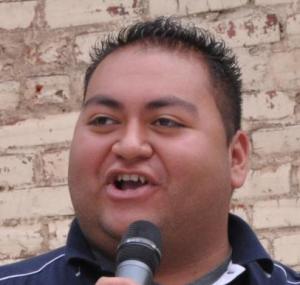
Daniel Hernandez Jr. – Saturday, October 15th
“I don’t think I’m a hero—the heroes are people who spend their entire lives trying to help others.”

University of Arizona student Daniel Hernandez Jr. became a national hero when he saved the life of Congresswoman Gabrielle Giffords. More

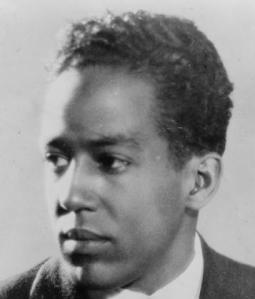
Langston Hughes – Sunday, October 16th
“What happens to a dream deferred? Does it dry up like a raisin in the sun? Or does it fester like a sore—and then run?”

A celebrated poet and novelist, Langston Hughes was a major contributor to American literature. More

Frida Kahlo – Monday, October 17th
“Painting completed my life.”

Frida Kahlo is a renowned Mexican artist. Her paintings have commanded higher prices than any other female artist. More

David Kato – Tuesday, October 18th
“What they’re doing now is to make it more harsh on people, anyone promoting homosexuality is being criminalized.”

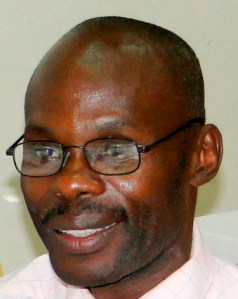
David Kato was the founder of Uganda’s LGBT civil rights movement. His murder brought global attention to the plight of LGBT people in Africa. More


A World Without Homosexuals…

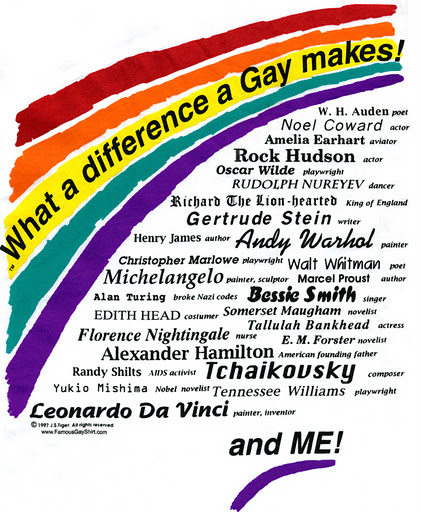
I have been thinking this month especially about all of the contributions of gay, lesbian, bisexual and transgender people.  A thought occurred to me, can I even imagine what the world would be like if there had never been any homosexuals?

Without Alexander the Great, Hellenistic culture would not have been spread from India to Egypt. The Italian Renaissance would have been non-existent without those who created the art and architecture of the Renaissance, the vast majority of whom were gay or bisexual. Leonardo Da Vinci, Michelangelo, Caravaggio, Socrates, Aristotle, and Alexander the Great are also reputed to be gay by some historians. Think what would have been lost in the world of philosophy and art if they hadn’t existed.

The United States, Britain, and the other Allies might have lost World War II because Alan Turing, a gay British mathematician, would never have been born. Turing broke one of the Nazis’ most important codes to help shorten the war. African-Americans might have struggled longer before receiving civil rights because there would have been no Bayard Rustin, the gay man who organized the 1963 March on Washington. This the march where Dr. Martin Luther King, Jr., made his famous “I Have a Dream” speech.

Our musical world would have been impoverished because gay American composer Aaron Copeland would have never been born. Russian composer Peter Ilyich Tchaikovsky would not have existed, neither would have Leonard Bernstein, English composer Benjamin Britten, or singers Bessie Smith, Melissa Etheridge, or Elton John. Katherine Bates would have never written “America the Beautiful.” We would have also missed the folk songs of Stephen Foster or the clever compositions of Cole Porter.

Do you like the plays Our Town, The Glass Menagerie, A Streetcar Named Desire, Cat on a Hot Tin Roof, Who’s Afraid of Virginia Woolf, The Importance of Being Earnest, and Breakfast at Tiffany’s? None of these would have been written. Their authors were all gay.

At times it seems as if some people would prefer a world where no lesbians or gays existed. But what would that world really look like? Above is just a small look at what the world might have been like if it had never included people who were homosexual or had a significant homosexual relationship in life. It would be difficult to envision or recognize a civilized world without the contributions of gays and lesbians.  It would no doubt be a bleak and boring place devoid of much of the art, architecture, philosophy, and much of the wonderful heritage of humanity.  None of the above even begins to include fashion and beauty, what an ugly world we would live in.


LGBT History Month Icons October 12th – 14th

Lady Gaga – Wednesday, October 12th
“I’m just trying to change the world, one sequin at a time.”

Lady Gaga is a chart-topping, world-famous performer and an outspoken advocate for LGBT equality. More

Michael Guest – Thursday, October 13th
“Leaders are judged not only by the challenges they tackle, but by those they fail to address.”

Michael Guest is the first openly gay Senate-confirmed U.S. ambassador. More

Neil Patrick Harris – Friday, October 14th
“I am quite proud to say that I am a very content gay man living my life to the fullest.”

Neil Patrick Harris is an award-winning television, film and Broadway actor and TV host. More


"Gay Is Good"

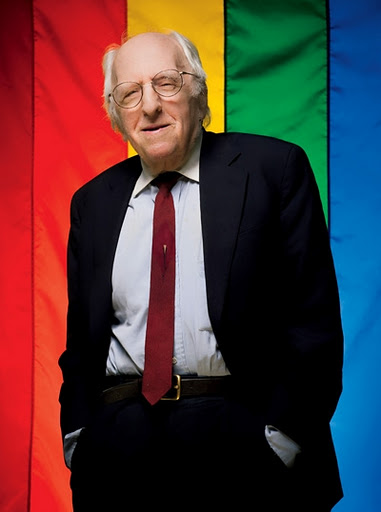
Frank Kameny (center) holding “GAY IS GOOD” sign.

Frank Kameny, the gay rights pioneer who coined the slogan “Gay is Good,” died Tuesday on National Coming Out Day at the age of 86.  Kameney was revered in the gay community for speaking out as an openly gay man when many were too afraid to do so.

“The LGBT civil rights movement stands on the shoulders of Frank Kameny,” stated Malcolm Lazin, Executive Director, Equality Forum and Executive Producer of Gay Pioneers. “Frank Kameny is the father of the LGBT civil rights movement.”

Kameny spearheaded the first organized gay and lesbian demonstrations of activists at Independence Hall and the Liberty Bell each July 4th from 1965 to 1969. The first of the “Annual Reminders” was attended by 40 activists from Washington, New York and Philadelphia. At that time it was the largest gathering for gay rights. It was the first time that demonstrators self-identified as gay and lesbian and openly and proudly demanded equality. The Annual Reminders laid the groundwork for the Stonewall Riots.

Gay Pioneers is a documentary produced by WHYY/PBS and Equality Forum about the Annual Reminders and the start of the LGBT civil rights movement. There is a Historic Marker directly across from Independence Hall and Liberty Bell recognizing the site where the gay and lesbian civil rights movement was launched with Annual Reminders organized by Frank Kameny, Barbara Gittings and other Gay Pioneers.

“When the Annual Reminders took place, gays and lesbians were denied employment by the federal government. Frank Kameny was single-handedly responsible through remarkable intensity and perseverance in having the United States Civil Service Commission end the prohibition of gays and lesbians from government service,” Lazin stated.

“The American Psychiatric Association included homosexuality as a mental disorder. Frank Kameny and Barbara Gittings successfully demonstrated at the 1971 annual meeting of the American Psychiatric Association. At the 1972 annual meeting, Kameny and Gittings presented a program with Dr. No, a gay psychiatrist, who was disguised to avoid recognition. With Dr. No, they explained why pervasive homophobia was the cause of emotional problems, not being gay. A committee was formed to study the issue. On December 15, 1973, homosexuality was removed as a mental illness,” said Lazin.

“I traveled across the nation with Frank Kameny at screenings of Gay Pioneers and at other events,” said Lazin. “Frank had a Ph.D. from Harvard, a computer-like mind and even into his 80’s was a feisty, lovable and committed activist for human rights. American history will remember Frank Kameny as an iconic civil rights leader.”


LGBT History Month Icons Oct. 8th – 11th

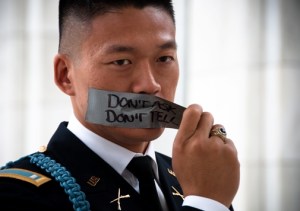
Dan Choi – Saturday, October 8th
“Action and sacrifice speak much more loudly than the best crafted, eloquent speech.”

Dan Choi was the nation’s leading activist for the repeal of “Don’t Ask, Don’t Tell.” More

Aaron Copland – Sunday, October 9th
“To stop the flow of music would be like the stopping of time itself, incredible and inconceivable.

Aaron Copland was a world-renowned composer, teacher, writer, and conductor. More

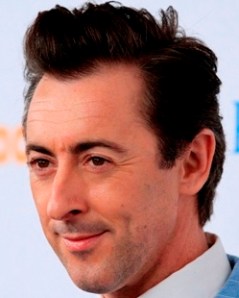
Alan Cumming – Monday, October 10th
“We need to do everything we can to counteract hatred and shame and we need to be strong in this fight.”

Alan Cumming is an award-winning film, television and Broadway actor. More

Rabbi Denise Eger – Tuesday, October 11th
“I believe God made me just as I am. That is all I need to know, that I am exactly who God created me to be!”

Rabbi Denise Eger is one of the first openly gay rabbis. More


LGBT History Month Icons Oct. 5th – 7th

Icons for Wednesday, Oct. 5th – Friday, Oct. 7th

Dustin Lance Black – October 5th
“I heard the story of Harvey Milk and it gave me hope that I could live my life openly as who I am.”

Dustin Lance Black is a screenwriter, director and producer. He received an Academy Award for Best Original Screenplay for “Milk. More

Keith Boykin – October 6th
“I’m not on a show with a pink triangle or rainbow flag, which means that being gay is just a part of who I am.”

Keith Boykin is a political commentator, best-selling author, editor of The Daily Voice, and veteran of two presidential campaigns. More

Rita Mae Brown – October 7th
“Don’t ask to live in tranquil times. Literature doesn’t grow there.”

Rita Mae Brown is a novelist and screenwriter best known for her semi-autobiographical lesbian-themed book “Rubyfruit Jungle.” More


LGBT Icons for Saturday, Oct. 1st – Tuesday, Oct. 4th

Kye Allums – October 1st

“I had to come out because it was too hard not being myself”

Kye Allums is the first openly transgender athlete to play NCAA Division 1 basketball. More

___________________________________

John Ashbery – October 2nd

“My poetry is disjunct, but then so is life.”

John Ashbery is one of the most successful American poets – winning almost every major literary award, including the Pulitzer Prize. More

___________________________________


Alison Bechdel – October 3rd

“The comic strip is about all kinds of things, not just gay and lesbian issues.”

Alison Bechdel is a celebrated cartoonist and author of the long running comic strip Dykes To Watch Out For. More

___________________________________


John Berry – October 4th

“Each time we act against discrimination, we add a ring of life to the American tree of liberty.”

John Berry is the highest-ranking openly gay federal employee in U.S. history. More


Cary Grant

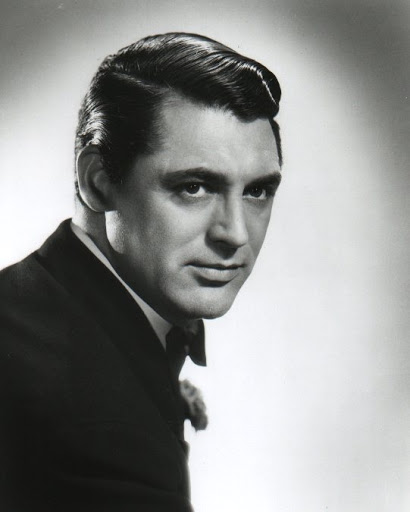
Yesterday on Tuner Classic Movies’s Summer of the Stars, Cary Grant was the feature star.  I love Cary Grant. In my opinion, there has never been, before or since, an actor as handsome and with such charisma as Cary Grant. In honor of Grant, I wanted to write a post about him.

A master of the screwball comedy.

Archibald Alexander Leach, better known by his stage name Cary Grant. With his distinctive mid-Atlantic accent, he was noted as perhaps the foremost exemplar of the debonair leading man, not only handsome, but also witty and charming. He was named the second Greatest Male Star of All Time by the American Film Institute. Grant starred in some of the classic screwball comedies. His popular classic films include The Awful Truth (1937), Bringing Up Baby (1938), Gunga Din (1939), Only Angels Have Wings (1939), His Girl Friday (1940), The Philadelphia Story (1940), Suspicion (1941), Arsenic and Old Lace (1944), Notorious (1946), To Catch A Thief (1955), An Affair to Remember (1957), North by Northwest (1959), and Charade (1963).  From the beginning of his career to the end, I have never seen a bad or even mediocre, Cary Grant movie.  They have all been some of my favorite movies.
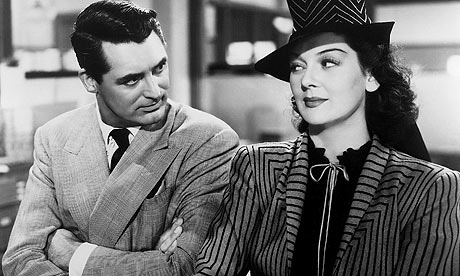
With Rosalind Russell in His Girl Friday

At the 42nd Academy Awards the Academy of Motion Picture Arts and Sciences honored him with an Honorary Award “for his unique mastery of the art of screen acting with the respect and affection of his colleagues”.

Cary Grant embodied the elegance, charm, and sophistication of Hollywood in its golden years. His good looks, charisma, and ambiguous sexuality enchanted women and men alike. As the star-struck comedian Steve Lawrence once said, “When Cary Grant walked into a room, not only did the women primp, the men straightened their ties.”

Grant was married five times. He wed Virginia Cherrill on February 10, 1934. She divorced him on March 26, 1935, following charges that Grant had hit her. In 1942 he married Barbara Hutton, one of the wealthiest women in the world, and became a father figure to her son, Lance Reventlow. The couple was derisively nicknamed “Cash and Cary”, although in an extensive prenuptial agreement Grant refused any financial settlement in the event of a divorce. After divorcing in 1945, they remained lifelong friends. Grant always bristled at the accusation that he married for money: “I may not have married for very sound reasons, but money was never one of them.”

On December 25, 1949, Grant married Betsy Drake. He appeared with her in two films. This would prove to be his longest marriage, ending on August 14, 1962. Drake introduced Grant to LSD, and in the early 1960s he related how treatment with the hallucinogenic drug—legal at the time—at a prestigious California clinic had finally brought him inner peace after yoga, hypnotism, and mysticism had proved ineffective. (In 1932, Grant had also met the Indian spiritual teacher Meher Baba.) Grant and Drake divorced in 1962.

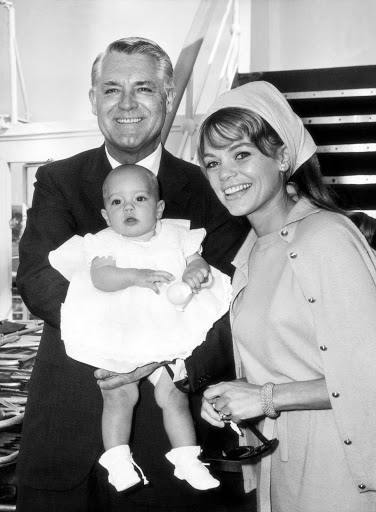
Grant and Cannon

He eloped with Dyan Cannon on July 22, 1965 in Las Vegas. Their daughter, Jennifer Grant, was born prematurely on February 26, 1966. He frequently called her his “best production” and regretted that he had not had children sooner. The marriage was troubled from the beginning and Cannon left him in December 1966, claiming that Grant flew into frequent rages and spanked her when she “disobeyed” him. The divorce, finalized in 1968, was bitter and public, and custody fights over their daughter went on for nearly ten years.

On April 11, 1981, Grant married long-time companion Barbara Harris, a British hotel public relations agent, who was 47 years his junior. They renewed their vows on their fifth wedding anniversary. Fifteen years after Grant’s death, Harris married former Kansas Jayhawks All-American quarterback David Jaynes in 2001.

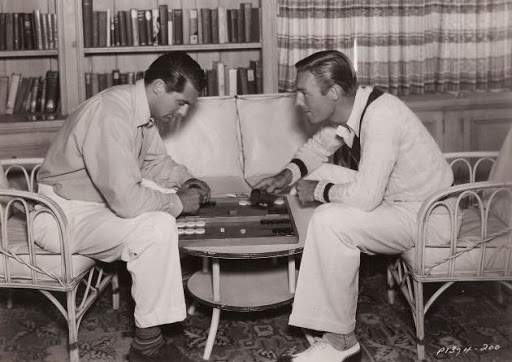
With Randolph Scott

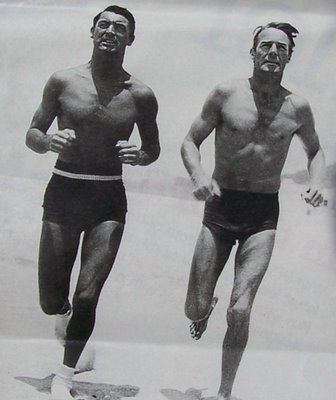
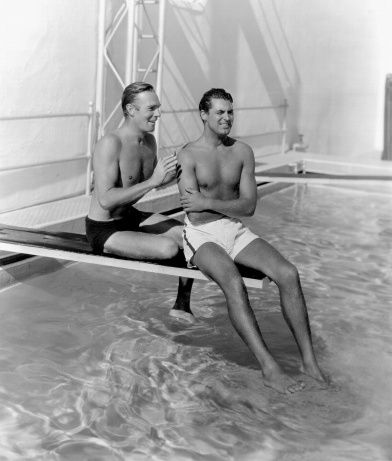
Some, including Hedda Hopper and screenwriter Arthur Laurents have said, that Grant was bisexual, the latter writing that Grant “told me he threw pebbles at my window one night but was luckless”. Grant allegedly was involved with costume designer Orry-Kelly when he first moved to Manhattan, and lived with Randolph Scott off and on for twelve years. Richard Blackwell wrote that Grant and Scott were “deeply, madly in love”, and alleged eyewitness accounts of their physical affection have been published. Alexander D’Arcy, who appeared with Grant in The Awful Truth, said he knew that Grant and Scott “lived together as a gay couple”, adding: “I think Cary knew that people were saying things about him. I don’t think he tried to hide it.” The two men frequently accompanied each other to parties and premieres and were unconcerned when photographs of them cozily preparing dinner together at home were published in fan magazines.

Grant and Scott

Barbara, Grant’s widow, has disputed that there was a relationship with Scott. When Chevy Chase joked about Grant being gay in a television interview Grant sued him for slander; they settled out of court. However, Grant did admit in an interview that his first two wives had accused him of being homosexual. Betsy Drake commented: “Why would I believe that Cary was homosexual when we were busy fucking?”

In 1932 he met fellow actor Randolph Scott on set, and the two shared a rented beach house (known as ‘Bachelor Hall’) on and off for twelve years. Rumours ran rampant at the time that Grant and Scott were lovers. From 1933 onwards, Cary Grant occasionally shared a house with Randolph Scott. There were many rumors about their relationship. Scott often referred to himself, jokingly, as Grant’s wife. Many studio heads threatened not to employ them unless they lived separately.

Grant and Scott

In their biographies of Grant, Marc Eliot, Charles Higham and Roy Moseley contend that Grant was bisexual. Higham and Moseley claim that Grant and Scott were seen kissing in a public car park outside a social function both attended in the 1960s. In his book, Hollywood Gays, Boze Hadleigh cites an interview with homosexual director George Cukor, who commented on the alleged homosexual relationship between Scott and Grant: “Oh, Cary won’t talk about it. At most, he’ll say they did some wonderful pictures together. But Randolph will admit it—to a friend.” (It should be noted that there is substantial disagreement as to the veracity of Hadleigh’s works.) It has even been suggested that Grant and Scott were married in a secret ceremony in Mexico. Randolph Scott’s son Christopher refuted these rumors. Following the death of his father in 1987, Christopher wrote a book, Whatever Happened to Randolph Scott?

Grant and Scott

According to screenwriter Arthur Laurents, Grant was “at best bisexual”. William J. Mann’s book Behind the Screen: How Gays and Lesbians Shaped Hollywood, 1910-1969 recounts how photographer Jerome Zerbe spent “three gay months” (his words) in the movie colony taking many photographs of Grant and Scott, “attesting to their involvement in the gay scene.” Zerbe says that he often stayed with the two actors, “finding them both warm, charming, and happy.” In addition, Darwin Porter’s book, Brando Unzipped (2006) claims that Grant had a homosexual affair with Marlon Brando.
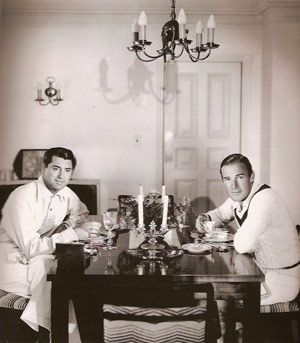
Grant and Scott

Whether Cary Grant was heterosexual, homosexual, or bisexual doesn’t really matter to me, he was a great actor.  His former wife, Dyan Cannon was thrust into the Hollywood celebrity whirlpool in 1965 when, at 28, she married superstar Cary Grant who was 35 years her senior. It was Cannon’s first marriage and Grant’s fourth. She has always been adamant when asked about Grant’s sexuality saying “I can tell you there isn’t an iota of truth to those ugly rumors. They would never have written that drivel when Cary was alive. He’d have sued the pants off those cowards. Cary can’t defend himself from the grave but I will go to mine insisting he was every ounce a straight man.”


William (Billy) Haines

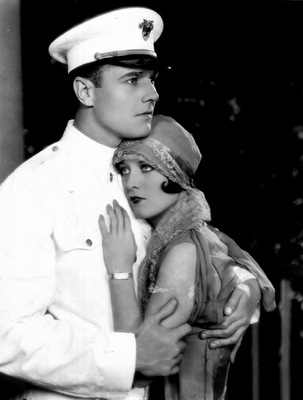
William Haines was born in Virginia in 1900 and in 1914, opened a nightclub in Hopewell, Virginia. Destined for entertainment and high style, he arrives in Hollywood in 1922 after winning a talent contest. He appeared in over twenty films as a leading man to Hollywood’s most famous stars including Joan Crawford, Marion Davies and Constance Bennett. He was a star of the silent era until the 1930s, when Haines’ career was cut short by MGM Studios due to his refusal to deny his homosexuality. Haines never returned to film and instead started a successful interior design business with his life partner and supported by friends in Hollywood.

Haines redefined the way movie stars lived. He lived large and played the role of a successful movie star to the max with the encouragement of his partner, Jimmie Shields. He defined style and his passion for grand automobiles was no exception.

When Haines ran away from home at 14 with his first boyfriend, the fun was only just starting. Next stop: Greenwich Village, New York, where he worked as a model and lived with Cary Grant. A talent scout landed him a contract in Hollywood where he became a top box office draw in silent films. In 1926 he met Jimmie Shields who became his life-long partner.

Then in 1933 he was arrested for being caught with a sailor in the Y.M.C.A.. MGM studio head Louis B. Mayer gave Haines an ultimatum: break up with Jimmie Shields, or get out.

Haines got out. Shields took his lover’s Y.M.C.A. scandal a lot easier than Mayer did. In fact, Haines and Shields had a legendarily open relationship, often sharing tricks and cruising Los Angeles’ Pershing Square together. Joan Crawford described them as “The happiest married couple in Hollywood.”

The young men went on to become some of the most influential designers and antique dealers for the glitterati of Hollywood and Beverly Hills. His BFF was Joan Crawford, and his influence over her look, career, and even her behavior is inestimable— she was one of his greatest creations. His design studio continues to this day and his furniture designs are in constant reissue.

Their lives were disrupted in 1936 when members of the Ku Klux Klan dragged the two men from their home and beat them, because a neighbor had accused the two of propositioning his son. Crawford, along with other stars such as Claudette Colbert, George Burns, Gracie Allen, Kay Francis, and Charles Boyer urged the men to report this to the police. Marion Davies asked her lover William Randolph Hearst to use his influence to ensure the neighbors were prosecuted to the full extent of the law, but ultimately Haines and Shields chose not to report the incident.

The couple finally settled into the Hollywood community in Brentwood, and their business prospered until their retirement in the early 1970s, except for a brief interruption when Haines served in World War II. Their long list of clients included Betsy Bloomingdale, Ronald and Nancy Reagan when Reagan was governor of California, and Walter and Leonore Annenberg with their 240-acre estate “Sunnylands.”

Haines never returned to film. Gloria Swanson, another lifelong friend, extended him a personal invitation to appear with her in the film Sunset Boulevard (1950), but he declined.  Haines and Shields remained together for the rest of their lives. Joan Crawford described them as “the happiest married couple in Hollywood.”

Haines died from lung cancer in Santa Monica, California at the age of 73, a week short of his 74th birthday, which was on the new year of 1974. Soon afterward, Shields, who suffered from what many believe to be Alzheimer’s Disease, put on Haines’ pajamas, took an overdose of pills, and crawled into their bed to die. They were interred side by side in Woodlawn Memorial Cemetery.

William Haines Designs remains in operation, with main offices in West Hollywood and showrooms in New York, Denver and Dallas. Haines’s life story is told in the 1998 biography Wisecracker: The Life and Times of William Haines, Hollywood’s First Openly Gay Star by William J. Mann, and his designs are the subject of Peter Schifando and Haines associate Jean H. Mathison’s 2005 book Class Act: William Haines Legendary Hollywood Decorator. World of Wonder produced Out of the Closet, Off the Screen: The Life of William Haines, which aired on HBO in 2001.


Sources: