Bullfighting seems to be the most masculine of sports. However, it is also highly erotic in a barbaric sort of way. Bullfighters themselves exude sex. A few years ago in 2001, Patricia Nell Warren wrote The Wild Man, a book about a gay bullfighter who was deeply closeted during the reign of Generalissimo Francisco
Franco. I became fascinated with the sensuality and machismo of bullfighters.
Warren, best known for The Front Runner, the ground-breaking novel about a gay athlete, created another gay sports figure in The Wild Man
. With his overweening machismo, the complex hero, a closeted matador at the end of Franco’s rule in Spain, is never entirely sympathetic but always fascinating. He is aware of the political and social changes of the 1960s but must face the conflict between the demands of his aristocratic family and the traditions of his sport, on the one hand, and his growing love for an idealistic young peasant on the other. Warren’s overly romantic style sometimes threatens to turn this into a romance novel. The depiction of gay life under a right-wing dictatorship and the start of the ecological movement in Spain are often more absorbing than the love stories. In spite of stylistic flaws, Warren tells an absorbing story, and his characters transcend stereotypes in a setting that will be exotic to most American readers
Called the corrida de toros in Spanish, the bullfight takes place in a large outdoor arena known as the plaza de toros. The object is for one of the bullfighters (toreros)-the matador-to kill a wild bull, or toro, with a sword.
A modern bullfight consists of three stylized parts (tercios). When the bull enters the ring, toreros wave capes to prod it to charge; then the picadors administer pic (lance) thrusts, which tire the animal and cause him to lower his head; in the second part, the banderilleros
come out and, while on the run, plant banderillas (short barbed sticks) on the withers of the bull; these often spur him into making livelier charges. In the final segment the matador-almost always a man, although some women have entered the sport in recent decades, amid controversy-holds the muleta, a small cloth cape, in one hand, and a sword in the other. Daring passes at the bull work to dominate the animal until it stands with feet square on the ground and head hung low; the matador must then approach the bull from the front and kill him by thrusting his sword between the shoulder blades and into the heart. A matador’s performance requires great skill and courage, and successful matadors reap immense awards in money and adulation. Fighting bulls are bred and selected for spirit and strength.
The Minoans of Bronze Age Crete practiced bull leaping as part of religious ritual, and later Greeks and Romans also had rites that involved the slaughter of bulls. The Moors, who fought bulls from their horses and killed them with javelins, probably introduced the sport to Spain (c.11th cent.). Originally the central figure in the Spanish bullfight was the mounted torero; Francisco Romero is generally credited with being the first (c.1726) to fight on foot. Bullfighting is also popular in the Latin American countries of Mexico, Peru, Colombia, Venezuela, and Ecuador, and in S France. The Portuguese practice a style of fighting from horseback in which the bull is not killed in the ring. Critics contend that bullfighting is an inhumane spectacle of animal torture; aficionados respond that it is a complex ritual central to Spanish culture.
Category Archives: History
Bullfighting
Ancient Sports
Sports seem to have existed from the beginning of time. The original sports were established as a way to train soldiers. Some sports like bull jumping were purely for pleasure and the beauty and sensuality of the sport. Most of them served as entertainment. The winners basked in the glory of their victory. A great athlete was at the height of sexual desire from men and women.
Bull Jumping
Bull-jumping is thought to have been a key ritual in the religion of the Minoan civilization on Bronze Age Crete.
As in the case of other Mediterranean civilizations, the bull was the subject of veneration and worship. Representation of the Bull at the palace of Knossos is a widespread symbol in the art and decoration of this archaeological site.
The assumption, widely debated by scholars, is that the iconography represents a ritual sport and/or performance in which human athletes literally vaulted over bulls as part of a ceremonial rite.
Gladiators![]()
Gladiatorial combats usually took place in amphitheaters. They probably were introduced from Etruria and originally were funeral games. Gladitorial combats, which took place in the Colosseum and in hundreds of other amphitheaters throughout the Roman world, reached their height in the 1st and 2d cent. A.D.
The gladiators were paired off to fight each other, usually to the number of about 100 couples, although in the imperial shows there were sometimes as many as 5,000 pairs. There were various types of gladiators, armed and armored differently. Thus a heavily armored man, a Mirmillo or Samnite, might be opposed to a Retiarius, who fought almost naked, with a net and a trident as his only weapons. He also
might be pitted against a Thracian, who fought with a dagger and a small round shield. Often gladiators were made to fight wild beasts. A defeated gladiator was usually killed by the victor unless the people expressed their desire that he be spared.
At first, gladiators were invariably slaves or prisoners, including Christians. They normally underwent rigid training, and some gained immense popularity. Later, impoverished freedmen also sought a living as gladiators, and finally even members of the ruling classes took part in gladiatorial combats on an amateur basis. Some gladiators, led by Spartacus, took part in the third of the Servile Wars (73 B.C.-71 B.C.). Constantine I forbade gladiatorial games, but they nonetheless continued until A.D. 405.
Olympic Sports![]()
Although records cannot verify games earlier than 776 B.C., the contests in Homer’s Iliad indicate a much earlier competitive tradition. Held in honor of Zeus in the city of Olympia for four days every fourth summer, the Olympic games were the oldest and most prestigious of four great ancient Greek athletic festivals, which also included the Pythian games at Delphi, the Isthmian at Corinth, and the Nemean at Argos (the Panathenaea at Athens was also important).
The Olympics reached their height in the 5th-4th cent. B.C.; thereafter they became more and more professionalized until, in the Roman period, they provoked much censure. They were eventually discontinued by Emperor Theodosius I of Rome, who condemned them as a pagan spectacle, at the end of the 4th cent. A.D.
Among the Greeks, the games were nationalistic in spirit; states were said to
have been prouder of Olympic victories than of battles won. Women, foreigners, slaves, and dishonored persons were forbidden to compete. Contestants were required to train faithfully for 10 months before the games, had to remain 30 days under the eyes of officials in Elis, who had charge of the games, and had to take an oath that they had fulfilled the training requirements before participating. At first, the Olympic games were confined to running, but over tim
e new events were added: the long run (720 B.C.), when the loincloth was abandoned and athletes began competing naked; the pentathlon, which combined running, the long jump, wrestling, and discus and spear throwing (708 B.C.); boxing (688 B.C.); chariot racing (680 B.C.); the pankration (648 B.C.), involving boxing and wrestling contests for boys (632 B.C.); and the foot race with armor (580 B.C.).
Greek women, forbidden not only to participate in but also to watch the Olympic games, held games of their own, called the Heraea. Those were also held every four years but had fewer events than the Olympics.
Known to have been conducted as early as the 6th cent. B.C., the Heraea games were discontinued about the time the Romans conquered Greece. Winning was of prime importance in both male and female festivals. The winners of the Olympics (and of the Heraea) were crowned with chaplets of wild olive, and in their home city-states male champions were also awarded numerous honors, valuable gifts, and privileges.
Each of these sports had an erotic element to them, whether it was the sensuality of the acrobatic movements of the bull-jumpers, the raw sexuality of the brutality and athleticism of the gladiator, or the nudity the ancient Olympians who competed for the glory of victory.
In ancient times, it was believed that athletes literally exuded sexuality.
After sports, athletes would bathe in olive oil and then scrape that oil off their bodies to remove the sweat. As the oil and sweat was being scraped from their bodies, it would be collected in small bottles to be sold as a sexual enhancer. Now for some, this might sound utterly disgusting. I find it highly erotic. Mostly, it was used by women to enhance sexual pleasure, but could you imagine using it as a lube for masturbation. I mean, OMG, the smell of a musty athlete, mixed with the olive oil against your own skin, and then the ultimate smell once you cum and the sweat and oil is mixed with your cum. Now that would be an aphrodisiac.
Naked Warriors in History
No, I am not talking about the movie Avatar. I am speaking of the Celtic warriors of ancient Scotland known as the Picts. From the accounts of Britain made by the classical authors, we know that by the fourth century AD, the predominant people in northern Scotland were referred to as “Picts”. Historians really don’t know what they called themselves, but Picts is the name that came down through history. The Latin word Picti first occurs in a panegyric written by Eumenius in AD 297 and is taken to mean “painted or tattooed people” (Latin pingo “to paint”; pictus, “painted”, cf. Greek “πυκτίς” – puktis, “picture”). Their Old English name gave the modern Scots form Pechts and the Welsh word Fichti.
The Romans were only in Britain for a little over three centuries before their empire collapsed. Romanized Celtic culture survived in many places, particularly Wales, while a more purely Celtic tradition survived in Scotland. The Picts were
gradually absorbed by their Celtic allies. The Romans never tried to conquer Scotland, a poor area which never supported more than 100,000 people during this period. A principal occupation of the “Scots” was raiding the wealthier Roman lands to the south and most Roman military activity in Britain was against the Pict and Celtic tribes in Scotland. The Romanized Celts in Britain sometimes rebelled, or at least a a few of them did. Until the Romans withdrew the last of their legions in the early 5th Century (to deal with the Germans, and civil war), the Romans always had the upper hand. This should come as no surprise. The Romans were supreme organizers and managed to keep up to 60,000 trained soldiers on duty in Britain. No one was able to repeat this feat until near the end of the Medieval period.
Throughout history, these Picts have been shadowy, enigmatic figures. From the outset, they were regarded as savage warriors
and by the time the Norsemen were compiling their sagas, and histories, the memory of the Picts had degenerated into a semi-mythical race of fairies.
Theories abound, although these days it is generally accepted that the Picts were not, as once believed, a new race, but were simply the descendants of the indigenous Iron Age people of northern Scotland.
The cloud of uncertainty that surrounds the Picts is simply because they left no written records. Because of this we have no clear insight into how they lived, their beliefs or society. All we know of them is second-hand anecdotal evidence, lifted from the various historical writers who recorded their own, possibly biased, impressions of the Pictish people.
The earliest surviving mention of the Picts dates from 297AD.
In a poem praising the Roman emperor Constantius Chlorus, the orator Eumenius wrote that the Britons were already accustomed to the semi-naked ‘Picti and Hiberni (Irish) as their enemies’.
From Emenius’ statement we can see that the Picts were already a major thorn in the side of the Roman Empire. And they continued to be a problem for their neighbours – continually harassing their neighbours for centuries after the Roman legions abandoned Britain. But who were they?
The term “Picti” was more than likely a Roman nickname used to describe the people north of Hadrian’s Wall. In much the same way as the term “European” is used today to describe people from a number of countries, Pict was a blanket term applied to an agglomeration of different people in the northern Scotland, probably with different cultures and, if the Life of St Columba is to believed, language.
If you know much about the Roman Empire, you know that its army was very effective and rarely broke ranks. The Roman military was comprised of legions of 5,000 men each. Each
legion consisted of 50 centuries,100 men each, led by a Centurion. Legions were accustomed to 20 mile marches. Courage was rewarded through promotion and honors. Cowardice was punished by stoning or flogging to death. If a century broke ranks, the punishment was decimation—every tenth soldier in the legion was executed. Because of the military structure of the Roman Empire, it was highly unlikely that they would break rank and run the other way. However, that was exactly what happened when they encountered the Picts.
The Picts fought completely naked, with their bodies either painted or tattooed blue (we really don’t know which, the Romans wouldn’t get close enough to find out). When an army of
naked, blue men came running and screaming at the Roman army, the army broke ranks and ran away. They were scared to death of the Picts. What would you do if an army of naked men came running after you? (Well, I know some of you would just turn around and bend over, LOL, but that’s not what the Romans did.) The Romans were well-organized, well-armed, and disciplined; the Picts were not.
Other Celtic tribes the Romans had encountered were more organized (and civilized) than the Picts. The Germans and Gauls of continental Europe had armies that the Romans knew how to deal with. The Picts were not what the Romans expected, and thus, they didn’t know how to deal with them. They became such a problem, that the Romans under Emperor Hadrian decided that the best thing was to build a wall.
Hadrian’s Wall is an ancient Roman wall, 118.3 km (73.5 mi) long, across northern England. Built by the emperor Hadrian c. A.D. 122-126 and extended by Severus a century later, the wall marked the northern defensive boundary of Roman Britain. Fragmentary ruins of the wall remain. The wall was primarily built to keep out the crazy blue men, who the Romans failed to ever conquer.
Later in the Middle Ages, the Vikings had an interesting counterpart to the Picts, called the Berserker. These warriors were the secret weapon of the Vikings. Berserkers (or Berserkers (or Berserks) are Norse warriors who are reported in the Old Norse literature to have fought in a nearly uncontrollable, trance-like fury, a characteristic which later gave rise to the English word berserk.
In old-Norse sagas, they were warriors who dressed themselves in bear skins or were bare-skinned, to make use of the fear
common people had for wild animals. Many of the Vikings were very hairy, and thus even naked would look like bears (the original bear fetish, LOL). They whipped themselves up to a sort of battle frenzy, biting their shields and howling like animals. They were ferocious fighters and seemingly insensitive to pain while this madness lasted; berserks made formidable enemies. In their rage they even attacked the boulders and trees of the forest; it was not uncommon that they killed their own people. The belief in berserks can be compared with the belief in werewolves; both are magical transformations of humans who assume the shape of an kindred animal.
The name berserker arose from their reputed habit of wearing a kind of shirt or coat (Old Norse: serkr) made from the pelt of a
bear (Old Norse: ber-) during battle. In earlier studies, the element ber- was often misinterpreted as berr-, meaning “bare”, understood as indicating that the berserkers fought naked. It is unclear as to whether they dressed like bears or were bare, but either way, they came into battle without armor generally with a battle axe or spear and, in a frenzied drug-induced state, killed anyone and everything that came in their way, friend or foe alike.
A little note about historical interpretation. In a broad look at historians there are four types: traditionalists, revisionists, neo-
traditionalists, and neo-revisionists. The traditionalist often used myths and legends to supplement the telling of history. Revisionists tried to prove traditionalists wrong by saying they found new source material that proves that the traditionalist historians are backwards looking. Neo-traditionalist tend to say, “wait a minute,” there may be flows in the traditionalist view, but there are also some hard facts behind what they wrote. Then you have the neo-revisionists, who say, maybe all three have some validity, but here is what the real history is.
Then the cycle begins again. Case in point, the name berserker: originally it was interpreted as bare-skinned not bear-skinned. But a neo-traditionalist (like myself) would say that “Wait, you miss the point of the traditions of Celtic, German, and Scandinavian warriors were often naked in battle to show they had no fear. You also forget that the Scandinavians were hairier as most northern Europeans were because of the cold climate, and either naked or in bear skins would have looked like huge bears.”
The neo-revisionist would totally contradict me and state (as in the Wikipedia article about Berserkers) “The name berserker arose from their reputed habit of wearing a kind of shirt or coat (Old Norse: serkr) made from the pelt of a bear (Old Norse: ber-) during battle. In earlier studies, the element ber- was often misinterpreted as berr-, meaning “bare”, understood as indicating that the berserkers fought naked. This view has since been abandoned.” They leave no room for other interpretations, but there is always room for interpretation.
So the last bit was my rant about historians, it is up to you how you interpret history. I tend to prefer the more salacious accounts of history, since Judeo-Christian morals have been placed on the writing of history since the Roman Empire converted to Christianity. Therefore, it is my opinion that the more salacious details are probably more accurate than myth. Men have always been horny beasts, and that will never change. If they could get away with it, they did. Plus, they liked to prove their masculinity through nudity. Fraternities didn’t get their pranks and love of nudity out of nowhere, it came down through the history of man.
A History of Gay Sex
What sorts of things did gay men get up to in the past, and how much did these differ from what we get up to today? Does gay sex have a history, or do the forms of pleasure remain the same across centuries? Have some tastes declined, and new tastes arisen?
Some things, like cruising and cottaging, have been popular for centuries. Public latrines and baths or “stews” were good pick-up spots in the late Middle Ages. Dutch gay men in the early 18th century coined the word “kruisen”, and their favourite cruising grounds were the quays along the waterfront. In Amsterdam in the 1760s many sodomites were arrested in the public toilets built next to the city’s numerous bridges; favourite toilets were given nicknames, such as The Old Lady and The Long Lady. In 18th-century London, gay men were regularly arrested in the Lincoln’s Inn bog house, on the east side of New Square, Lincoln’s Inn Fields. The Savoy bog house was used so regularly by gay men that members of the Society for the Reformation of Manners often posted themselves outside and could be sure of making an arrest there. And in the Temple bog house in 1707 a hole had been deliberately cut in the partition wall between two stalls – making it the first recorded glory hole.
In 18th-century England, what gay men called “picking up trade” was common in the covered arcades of the Royal Exchange and Covent Garden, where they competed with Women of Pleasure. In 1718 a watchman caught sight of two people shagging while leaning against the rails of Covent Garden Church, not an unusual sight, but when he realised they were both men he started calling them filthy sodomites. One of these men, whose breeches were down around his ankles, replied “Sirrah! what’s that to you, can’t I make use of my own Body? I have done nothing but what I will do again.”
Public parks and open fields were popular resorts for gay sex. The path that ran across the middle of Moorfields, the large fields just north of the City walls, was called the “Sodomites’ Walk”. The basic pick-up technique was to stand up against a wall and pretend to be making water, and to wait until someone expressed some interest. The best area for male prostitution was Bird Cage Alley in St James’s Park. There, Guardsmen regularly offered themselves for sex and then blackmailed their tricks. A soldier named James Brown and his brother claimed that they had picked up and then blackmailed five hundred gentlemen in Bird Cage Alley in the late 1750s. Another soldier, John Mitchell, who bragged that his penis was nine inches long, said, “When I wanted Money, I took a Walk in the Park, and got 4 or 5 Guineas a-Night of Gentlemen, because they would not be expos’d.”
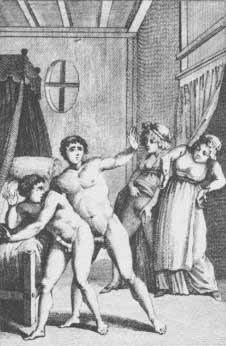
Contrary to the view that gays in the past took strictly “active” or “passive” roles, eighteenth-century trials (our best source for details about sex) show that most gay men took turn and turn about, and enjoyed reciprocal sex. A single sexual encounter often covered a broad range of activity. An illustration of this is the case of two men who were prosecuted in 1772 for buggering one another in the toilet of the Red Lion pub in Moorfields. Robert Crook, a 19-year-old man who was sharing a drink with Charles Gibson, said: “I went into the yard to make water, he came into the yard while I was making water, took hold of my yard, and began to work it with his hand; he said ‘It was a very good one, and he liked it very well’; he then asked me to go down to the vault [i.e. the bog-house] with him, which I did. There he said ‘Did not you know Dick that lived in this house? He had a fine tool, almost as big as my wrist, you are just such a lad as he was, let’s see if your’s is as big as his.’ Then he worked my yard till he made it spend in his hand. Then he pushed me back upon the vault, and worked me in the same manner on the seat of the vault till I did it in his hand; after that he kissed me very heartily; then he unbuttoned his own breeches, put my hand to his private parts, and kept tickling me about ten minutes; he kissed it and rubbed it, then he said ‘Now it will do’; he then turned round, and put his naked breech into my lap, and put his hand behind him, laid hold of my yard, and pushed it into his backside, twice or three times, I am not sure which.” After they were finished, Gibson wanted to change positions and bugger Crook. Crook claimed he was drunk and had been forced to take part in sex. But others had seen them kissing in the pub, and it transpired that this was not the only time both men had been to the vault together.
In this incident Gibson kissed Crook’s “yard”. But there are only half a dozen references to sucking between men in 18th-century English trials. In the Dutch Republic it was also rare, and considered a special treat. In 1730 a wealthy patrician was prosecuted for sucking his servants; one of the things he liked to do was spit their semen into a glass of wine and drink it. In 1765 a pedler was tried in Amsterdam for sucking a friend. He claimed he had learned the practice from a physician, who on one occasion said “Oh boy, I swallowed it.”
Cock-sucking is mentioned, usually as an insult, in Ancient Classical literature, but the practice nearly disappeared between then and modern times. In late medieval Florence, it is mentioned in 12 per cent of the legal records concerning sex between men. In German lands in the 1530s there are cases of men approaching other men in public latrines and offering to “suck out the nature” from them. There are allusions to oral sex in Richard Barnfield’s poem The Affectionate Shepherd, Containing the Complaint of Daphnis for the love of Ganymede, which was published in 1594, e.g.:
If it be sinne to loue a louely Lad:
Oh then sinne I, for whom my soule is sad.
. . . . . .
O would to God (so I might have my fee)
My lips were honey, and thy mouth a Bee.
Then shouldst thou sucke my sweete and my faire flower
That now is ripe, and full of honey-berries.
“Fee” is a common Elizabethan pun for sexual intercourse. Elsewhere in the poem Barnfield hopes his beloved will “suck my Coyne” (“coin” is a common Elizabethan metaphor for semen), and he also uses puns such as “stones” (meaning testicles) and “purses” (meaning scrotum). However, although Barnfield’s homoeroticism is clear, and was recognized by his contemporaries, it has to be acknowledged that any claim that he deals with fellatio depends upon our interpretation of metaphors and puns. Less metaphorical descriptions of oral sex feature in some late 18th-century French erotica, especially by the Marquis de Sade, and there are prints illustrating it. But in real life, hardly anyone in the 17th or 18th centuries, male or female, prostitute or otherwise, gay or straight, ever engaged in oral sex.
Some historians of sexuality argue that oral sex between men and women wasn’t common until the early twentieth century. For example, it wasn’t treated favourably in marriage manuals until the late 1920s. For gay men, the taste for oral sex has grown over the years. In Havelock Ellis’s book Sexual Inversion, published in 1897, nine of the gay men in his case studies preferred anal sex, compared to only three who preferred oral sex. In America, in the late nineteenth century some laws for the first time specifically prohibited oral sex between men, which might indicate that it was a newly popular practice. Herman Melville in his novel Redburn, published in 1849, refers obliquely to oral sex between sailors. It seems possible that oral sex became popular among gay men first in America and was then imported into Europe. Gay Swedish men working on the liners sailing between Gothenburg and New York in the 1930s reported that they got lots of oral sex in New York, while the main sex act in Gothenburg was mutual masturbation. The slang terms “blow” and “blow job” originated in 1930s America. Even in the 1960s and 1970s, it was generally believed that oral sex was more common between American men, while anal sex was more common between British men, and these national preferences are reflected in the pornography of the time.
The changing taste for oral sex is one area where there is a sharp break between the past and the present. Some historians argue that in the past oral sex was disagreeable to people becasue their personal hygiene left something to be desired. That argument isn’t entirely convincing. For one thing, people did in fact wash themselves using a hand basin and water jug even though they didn’t take baths or showers (and they did go to saunas and “stews” or public baths every so often, where lots of non-oral sex was enjoyed). For another, dental hygiene wasn’t too great either — most people had rotten teeth and stinking breath — but that didn’t prevent them from enjoying a good long kiss now and then.
There is probably a strong taboo concerning semen, which gay men overcame earlier than straight men and women. Though semen has no procreative value in sex between men, it nevertheless has a magical value. In some cultures, notably Melanesia, the ingestion of semen features in “coming-of-age” initiation rituals, whereby masculinity is transferred to young men. The two Victorian pioneers of gay liberation, Edward Carpenter and John Addington Symonds, felt that their personal experience confirmed this. Symonds wrote to Carpenter in December 1892: “I have no doubt myself that the absorption of semen implies a real modification of the physique of the person who absorbs it, & that the most beneficent results, as regards health and nervous energy, accrue from the sexual relations between men.”
Volcanic jets of the liquid erupt in gay pornography, as in the Victorian pornographic novel Teleny (1893), which was probably written by a group of men under the direction of Oscar Wilde: “my breath came thickly; I panted, I sighed, I groaned. The thick burning fluid was spouted out slowly and at long intervals. As I rubbed myself against him, he underwent all the sensations I was feeling; for I was hardly drained of the last drop before I was likewise bathed in his own seething sperm.” A lot of “rubbing” takes place in this novel, as well as sodomy. The most common forms of sex between men during Victorian times seem to have been mutual tossing off or between-thigh fucking. Oscar Wilde didn’t much care for anal intercourse, but preferred to have one of his “panthers” or rough trade sit in his lap while he “played” with him. Then Wilde would mount his partner face-to-face to enjoy “spending on his belly”. But sexual tastes vary according to temperament as well as historical period. For example, Oscar Wilde’s lover Lord Alfred Douglas preferred to bugger young schoolboys, while Wilde preferred “rough” older lads. Neither Wilde nor Douglas would seek sex with an obviously effeminate “pouf”.
Times have changed. Some marked changes in gay sexuality have occurred especially since the 1950s and 1960s. Fisting, for example, has no historical precedent — although impalement features in some early gay fantasies. In Teleny, a man who is not satisfied by a dildo bleeds to death after a large glass vase inserted into his anus breaks. Surveys of diaries, news reports, and the gay media have established that fisting was invented in the summer of 1971, in the “backroom” of a gay bar in New York City. The practice quickly spread to the backroom bars of San Francisco, and was exported thence to Japan and Europe. The pent-up libido that was released in the Swinging Sixties has blossomed in a garden of special interests, notably fetishistic sex games ranging from mild bondage and discipline to the extremes of sadomasochism.
To see how things have changed, we can compare the original 1881 edition of The Sins of the Cities of the Plain: Or, The Recollections of a Mary-Anne, with an edition published in 1992 by Badboy Books, New York. This Victorian gay pornography is the genuine (albeit semi-fictionalised) autobiography of a male prostitute, or “Mary-Ann”, named John Saul, aka Dublin Jack, and it probably contain an accurate account of what gay men did in the 1870s. Saul was game for anything, and his memoirs contain plenty of descriptions of between-thigh rubbing, “bottom-fucking” (often by sitting in someone’s lap), rimming preparatory to buggering, fingering ditto, cock-sucking and sixty-nining. But the 1992 “reprint” added several totally new scenes catering for the modern S/M market. In a long episode not in the original, a wicked voluptuary seizes a large candle from a table laid for a banquet and drips molten wax over Jack’s flesh, before stuffing him like a turkey with the said candle. Another important change is that the 1881 original had several heterosexual sex scenes, while the 1992 “reprint” changed the gender pronouns in these scenes, thus making the book exclusively homosexual throughout.
Such alterations suggest that over the course of a century there has been a historical shift in gay self-identity, and a more masculine gay self-image. Alternatively, the changes in the two versions of may simply represent the fact that the modern market for pornography has become much more rigidly segregated between gay and straight than it was a century ago. Nevertheless, in this novel and in other sources we see that the “Mary-Anns” or gay prostitutes in Victorian times often dressed up as women, or at least wore make-up and presented an effeminate appearance. The most famous in real life were Ernest Boulton and Frederick William Park, aka Lady Stella and Miss Fanny. When they were arrested in the Burlington Arcade in 1869 Boulton was wearing a cherry-coloured silk evening dress, trimmed with white lace, and Park was wearing a green satin dress trimmed with black lace. In the 1920s male prostitutes often wore make-up and, like Quentin Crisp, presented an “effeminate” appearance. Today, although male prostitutes often wear distinctive “costumes”, they generally present a macho appearance, echoing the “physique” magazines since the 1950s, when photographers such as Bob Mizer had their models pose as bikers and leathermen, construction workers and sailors of the rougher sort. The “effeminate” model of sexually available young men or “lady-boys” is still common, however, in places such as Thailand and other countries frequented by sexual tourists, and prostitution is the main form of employment of the self-castrated hijras of India. Even in the West, transsexuals form a large percentage of prostitutes, and “chicks with dicks” are an intriguing sub-section on gay porn sites on the web.
However, some things never change. Trial records for all periods turn up cases of men who lived together in “sodomitical sin” that included intimacy and tenderness. Several men investigated by the Paris police in the 1740s claimed that they sought “a relationship which might last”. According to one police report, two men had lived and slept together intimately for two years: “It was even almost always necessary for Duquesnel to have his arm extended along the headboard, under Dumaine’s head. Without that Dumaine could not rest.”
Copyright © 2005, 2006 Rictor Norton.
CITATION: Rictor Norton, “A History of Gay Sex”, Gay History and Literature, 24 November 2006 <http://rictornorton.co.uk/gaysex.htm>

History of Male Contraception
The majority of us as gay men use condoms to protect us against STDs and HIV. So I thought a little history of the condom would be quite interesting. I hope that you find this as interesting as I do.
For men, who were, historically, freer to partake in sexual activity than women, the primary reason for using birth control was to avoid disease and illegitimate children, and, to a lesser extent, to reduced the economic burden of having too many children.
The “Natural” Way
Some social rules regarding birth control relied on the abstinence or control of the male. For instance, some indigenous Australian communities forbade men to have sex with their wives for several months after the birth of a child. In many areas in early Europe, royalty and men of standing (e.g., among 10th-century Ottonian Saxons) would have sex with their wives only for procreation, usually resulting in a rapid succession of births, after which they would spare their wives from having too many children by turning to prostitutes for recreation. Also in early Europe, men often turned to prostitutes to limit the number of children in the family, so as to prevent the family fortune from being split among too many heirs.
Aristotle (384–322 BCE) wrote that homosexual relations in Crete were an officially condoned population control method. The Mohave of New Mexico considered anal intercourse to be a favor to women, since it would not result in pregnancy. In Jewish traditions, the law of niddah separated a husband and wife during menstruation to prevent conception during this time, for hygienic and health reasons.
Hopeful, but unreliable, natural methods of birth control included coitus reservatus (withholding ejaculation) and coitus interruptus (ejaculating outside the vagina). Coitus interruptus was common during the time of Mohammed, and Islam endorsed the practice, unless the woman disagreed. Meanwhile, the Book of Genesis tells of the fate of Onan, who practiced coitus interruptus with his dead brother’s wife to prevent her from becoming pregnant: he was put to death for “spilling his seed on the ground.”
Condoms
Historians believe that ancient Egyptian men wore fabric condoms, mainly for protection from disease, as long ago as 1000 BCE. The Romans used condoms made of animal intestine. In the 1500s, Fallopius, an Italian, invented a linen sheath to be worn to prevent the transmission of syphilis – later in the century the cloth was soaked in a chemical solution that was considered to be a spermicide.
By the 1700s, most condoms were made out of animal intestines – they were expensive, but could be washed and reused. (Often they came with a silk ribbon with which to tie them on.) King Charles II used animal-skin condoms to prevent having illegitimate heirs or contracting diseases. Of course, Charles II is not a testimony to the efficacy of animal-skin condoms: he had at least 13 illegitimate children.
In 1844, vulcanized rubber condoms hit the markets. Men generally wore them to avoid catching diseases such as gonorrhea and syphilis. As a result, for years afterward, condoms became associated with prostitution and disease.
The first condom advertisement appeared in 1861 in The New York Times – the product was “Dr. Power’s French Preventatives.” Laws were passed in the US 12 years later making it illegal to advertise contraceptives and allowing the postal service to confiscate condoms sold through the mail. A similar law was passed in 1882 in Canada, making it illegal to sell or advertise birth control, unless it was “for the public good.”
The first latex condom was invented in the 1880s, but they were not widely used until the 1930s. During World War I, the American troops were not allowed to use condoms, as many Americans believed that “loose” sexual behavior deserved the effects of disease. But by World War II, US troops were encouraged to use condoms. A training film urged, “Don’t forget – put it on before you put it in.”
Timeline for the History of Condoms
1000 BC
The use of condoms has been traced back several thousand years. It is believed that around 1000 BC the ancient Egyptians used a linen sheath for protection against disease.
100 – 200 AD
The earliest evidence of condom use in Europe comes from scenes in cave paintings at Combarelles in France. There is also some evidence that some form of condom was used in imperial Rome.
1500s
The syphilis epidemic that spread across Europe gave rise to the first published account of the condom. Gabrielle Fallopius described a sheath of linen he claimed to have invented to protect men against syphilis.Having been found useful for prevention of infection, it was only later that the usefulness of the condom for the prevention of pregnancy was recognized.
Later in the 1500s, one of the first improvements to the condom was made, when the linen cloth sheaths were sometimes soaked in a chemical solution and then allowed to dry prior to use. These were the first spermicides on condoms.
1700s
The first published use of the world ‘condum’ was in a 1706 poem.It has also been suggested that Condom was a doctor in the time of Charles II. It is believed that he invented the device to help the king to prevent the birth of more illegitimate children.
Even the most famous lover of all, Casanova, was using the condom as a birth control as well as against infection.
Condoms made out of animal intestines began to be available. However, they were quite expensive and the unfortunate result was that they were often reused. This type of condom was described at the time as “an armor against pleasure, and a cobweb against infection”.
In the second half of the 1700’s, a trade in handmade condoms thrived in London and some shops where producing handbills and advertisements of condoms.
1800s
The use of condoms was affected by technological, economic and social development in Europe and the US in the 1800s.
Condom manufacturing was revolutionized by the discovery of rubber vulcanization by Goodyear (founder of the tire company) and Hancock. This meant that is was possible to mass produce rubber goods including condoms quickly and cheaply. Vulcanization is a process, which turns the rubber into a strong elastic material.
In 1861,the first advertisement for condoms was published in an American newspaper when The New York Times printed an ad. for ‘Dr. Power’s French Preventatives.’
In 1873, the Comstock Law was passed. Named after Anthony Comstock, the Comstock Law made illegal the advertising of any sort of birth control, and it also allowed the postal service to confiscate condoms sold through the mail.
1900s
Until the 1920s, most condoms were manufactured by hand-dipping from rubber cement. These kinds of condoms aged quickly and the quality was doubtful.
In 1919, Frederick Killian initiated hand-dipping from natural rubber latex in Ohio. The latex condoms had the advantage of ageing less quickly and being thinner and odorless. These new type of condoms enjoyed a great expansion of sales. By the mid-1930s, the fifteen largest makers in the U.S. were producing 1.5 million condoms a day.
In 1957, the very first lubricated condom was launched in the UK by Durex.
From the early 1960s, the use of condoms as a contraceptive device declined as the pill, the coil and sterilization became more popular.
The use of the condom increased strikingly in many countries following the recognition of HIV and AIDS in the 1980’s. Condoms also became available in pubs, bars, grocery stores and supermarkets.
The female condom has been available in Europe since 1992 and it was approved in 1993 by the US Food and Drug Administration (FDA).
In 1994, the world’s first polyurethane condom for men was launched in the US.
The 1990s also saw the introduction of colored and flavored condoms.
Present day
In more recent years, improved technology has enabled the thickness of the condom to decrease. Also, condom manufacturers have recognized that one size of condom does not fit all. You can now find condoms that are different shapes, widths and lengths.
A Midsummer Night’s Dream
Puck’s soliloquy from the last lines of A Midsummer Night’s Dream, a comedy by William Shakespeare, is one of my favorite lines from any of Shakespeare’s plays.
If we shadows have offended,
Think but this, and all is mended,That you have but slumber’d here
While these visions did appear.
And this weak and idle theme,
No more yielding but a dream,
Gentles, do not reprehend:
if you pardon, we will mend:
And, as I am an honest Puck,
If we have unearned luck
Now to ‘scape the serpent’s tongue,
We will make amends ere long;
Else the Puck a liar call;
So, good night unto you all.
Give me your hands, if we be friends,
And Robin shall restore amends.
In his essay “Preposterous Pleasures, Queer Theories and A Midsummer Night’s Dream“, Douglas E. Green explores possible interpretations of alternative sexuality that he finds within the text of the play, in juxtaposition to the proscribed social mores of the culture at the time the play was written. He writes that his essay “does not (seek to) rewrite A Midsummer Night’s Dream as a gay play but rather explores some of its ‘homoerotic significations’ … moments of ‘queer’ disruption and eruption in this Shakespearean comedy”. Green states that he does not consider Shakspeare to have been a “sexual radical”, but that the play represented a “topsy-turvy world” or “temporary holiday”
that mediates or negotiates the “discontents of civilization”, which while resolved neatly in the story’s conclusion, do not resolve so neatly in real life. Green writes that the “sodomitical elements”, “homoeroticism”, “lesbianism”, and even “compulsory heterosexuality” in the story must be considered in the context of the “culture of early modern England” as a commentary on the “aesthetic rigidities of comic form and political ideologies of the prevailing order”. Aspects of ambiguous sexuality and gender conflict in the story are also addressed in essays by Shirley Garner and William W.E. Slights (see citations below).
Garner, Shirley Nelson. “Jack Shall Have Jill;/ Nought Shall Go Ill“. A Midsummer Night’s Dream Critical Essays. Ed. Dorothea Kehler. New York: Garland Publishing Inc., 1998. 127–144
Slights, William W. E. “The Changeling in A Dream”. Studies in English Literature, 1500–1900. Rice University Press, 1998. 259–272.
If you love a good gay movie, musicals, cute guys, and/or Shakespeare, here is a suggestion for you. Indie movies are definitely not for everyone. In other words, specific movies tend to appeal to specific groups. Were the World Mine will obviously appeal to a gay audience, but also to people who are into Shakespeare, as it is fun and often ridiculous – just like the Bard’s play.
What Is It About?
Were the World Mine was based on a short film entitled Fairies. The movie’s protagonist is Timothy (played by Tanner Cohen), a gay outcast at a prep school in a small town somewhere in America. He loves to daydream, and his daydreams always feature musical sequences and beautiful scenery. The object of his daydreams is Jonathan (played by Nathaniel David Becker), the star jock of the school. It is not long before Timothy gets involved into a school drama project, starts exploring Shakespeare and finds a recipe for the magical love potion in A Midsummer Night’s Dream – which allows him to turn the entire town gay.
Read more at Suite101: Were the World Mine Movie Review: An Indie Retelling of Shakespeare’s A Midsummer Night’s Dream.
Cupid’s Love Spell from A Midsummer Night’s Dream
OBERON
That very time I saw, but thou couldst not,
Flying between the cold moon and the earth,
Cupid all arm’d: a certain aim he took
At a fair vestal throned by the west,
And loosed his love-shaft smartly from his bow,As it should pierce a hundred thousand hearts;
But I might see young Cupid’s fiery shaft
Quench’d in the chaste beams of the watery moon,
And the imperial votaress passed on,
In maiden meditation, fancy-free.
Yet mark’d I where the bolt of Cupid fell:
It fell upon a little western flower,
Before milk-white, now purple with love’s wound,
And maidens call it love-in-idleness.
Fetch me that flower; the herb I shew’d thee once:
The juice of it on sleeping eye-lids laid
Will make or man or woman madly dote
Upon the next live creature that it sees.
Fetch me this herb; and be thou here again
Ere the leviathan can swim a league.
Having once this juice,
I’ll watch Titania when she is asleep,And drop the liquor of it in her eyes.
The next thing then she waking looks upon,
Be it on lion, bear, or wolf, or bull,
On meddling monkey, or on busy ape,
She shall pursue it with the soul of love:
And ere I take this charm from off her sight,
As I can take it with another herb,
I’ll make her render up her page to me.
But who comes here? I am invisible;
And I will overhear their conference.If you could have potion that could turn someone you have a crush on or are in love with gay, would you use it? Seriously, now. I am not talking about just on a whim. You would be changing this person’s life. Would you do it to satisfy your own happiness, even though it might not satisfy their own?
Stefan George
Stefan George (1868-1933)
The German poet Stefan George was born in 1868 in the village of Büdesheim near Bingen, a small but ancient town on the Rhine. In 1873 his family moved to Bingen, where his father, who had first been an inn-keeper, became a successful wine-merchant. From 1882 to 1888 George attended the grammar school in Darmstadt. During the following two years, his first journeys abroad led him to London, Italy and most notably to Paris, were he met the poets of the French symbolism, above all Stéphane Mallarmé, who became the model for the beginning of George’s literary career. The literary situation in Germany at the time was dominated on the one hand by a shallow classicism, on the other hand by a gross naturalism, both of which were equally repelling to George. Mallarmé’s programme of pure poetry’ without any social relevance, his conviction that the Orphic interpretation of the earth is the only task of the poet’ and that everything that is sacred and wants to stay sacred veils itself into mysteries’, was like a revelation and quite appealing to the young George. From 1889 on he was registered for three terms at the University of Berlin, but attended only a few lectures. By the time of the publication of his first volume of poems in 1890 he had already assumed the life style that he was to keep up until his end. Never living in a home of his own – not because he could not have afforded it, as he had inherited a sufficient fortune from his parents, but because of the way he saw himself – he would stay as a guest of his friends and admirers in Berlin, Munich, Heidelberg, Basel, or else traveled abroad, mostly in Italy and in Paris. He avoided all publicity, and his books were only privately published. Moreover, he underlined the esoteric character of his writings by certain orthographic peculiarities and a special ornamental typography.
George’s subsequently famous Kreis (Circle) of like-minded friends was beginning to rally about the same time. Still it consisted mostly of fellows of about his own age treated as equals, as distinguished from the later situation, when George was the august master venerated by much younger disciples.
Though, to all appearances, George was of an almost exclusively homoerotic inclination, there is no indication that he ever went beyond the Platonic concept of spiritual guidance and aesthetic contemplation – to which he adhered doubtless partly out of mere social convention, but also for artistic discipline. Nevertheless, sometimes the strong emotions George displayed in his relationships to young men could be disturbing to them, as it is documented in the case of Hugo von Hofmannsthal. George was himself only 23 when he met the still younger but precocious Austrian poet, who was 17 then. It is not really clear what happened, but evidently their relations were troubled, though they kept up a correspondence for some years. Also another friendship of George that had been initially more successful ended in dissonance, when the
Germanist Friedrich Gundolf whom George had mentored as a teenager, and who had become his most ardent apostle, as a man in his late thirties insisted on marrying despite George’s disapproval.
What proved to be George’s most passionate, most ill-fated and poetically most fruitful love affair began in 1902, when he approached a boy in a street of Munich: Max Kronberger, a 14-year-old grammar-school student, felt flattered when a man he had noted before asked his permission to sketch his ‘interesting’ head. On the next day George succeeded in taking a photograph of the boy, but it seems that thereupon George’s courage failed him, as he did not try to meet the boy again for almost a year. At the time of their next accidental meeting in the street, Kronberger found out that George was a poet and, since his respectable parents agreed, they saw each other regularly from then on, in a relationship not always free from tension. However, Kronberger died of an acute disease on the day after his sixteenth birthday. What followed was a poetical glorification which was sometimes compared to the literary monument erected by Dante for Beatrice, but resembles rather the deification bestowed by Hadrian on Antinous, in a somewhat different way owing to the difference of times and circumstances, of course.
Your eyes were dim with distant dreams, you tended
No more with care the holy fief and knew
in every space the breath of living ended –
Now lift your head for joy has come to you.The cold and dragging year that was your share,
A vernal tide of dawning wonders bore,
With blooming hand, with shimmers in his hair
A god appeared and stepped within your door.Unite in gladness, now no longer darkened
and blushing for an age whose gold is flown:
The calling of a god you too have hearkened,
It was a god whose mouth has kissed your own.You also were elect – no longer mourn
For all your days in unfulfilment sheathed…
Praise to your city where a god was born!
Praise to your age in which a god has breathed!
This forced gesture and overdone interpretation twisted everything George wrote looking back on his love for Maximin. His spontaneous feelings for an adolescent are better expressed in the verses that he, again in love, in 1905 addressed to the 14-year-old Hugo Zernik:
My child came home
The sea-wind tangled in his hair,
His gait still rocks
With conquered fears and young desires for quest.The salty spray
Still tans and burns the bloom upon his cheek:
Fruit swiftly ripe
In savage scent and flame of alien suns.His eyes are grave
With secrets now, that I shall never learn,
And faintly veiled,Since from a spring he came into our frost.So wide the bud
That almost shyly I withdrew my gaze,
And I abstained
From lips that had already chosen lips.My arm enclasps
One who unmoved by me, grew up and bloomed
To other worlds –
My own and yet, how very far from me!
George not only turned Maximin into a myth, but also used him as figurehead for his new aims, as expressed in his most ambitious poetry, contained in the volume Der Siebente Ring, (The Seventh Ring) of 1907. Now George’s programme was no longer art for art’s sake, but a political vision formed in opposition to a time and society he considered vile and decayed, a spiritually void world of mean commercial utilitarianism and brutal power-politics garnished with decorative phrases.
George, who had been opposed to the reality of the Prussian-dominated German Empire, as contrasted with his idea of Germany, was not carried away by the storm of enthusiasm at the outbreak of the First World War in 1914, and felt rather confirmed by the defeat of 1918. In the turmoil of the post-war years, George became the lodestar of the most idealistic part of the young generation, as represented by
Klaus Mann (born in 1906), who remembered later that “my admiration for him was boundless. I saw him as the leader and prophet, the Caesarean priestly figure as he presented himself. Amidst a rotten and barbarous civilization, he embodied human and artistic dignity, uniting discipline and passion, grace and majesty. Each of his gestures was of an exemplary, programmatic character. He stylized his own biography like a myth: his romance, the boy Maximin, was the core of a philosophy that was a revelation to the circle of disciples. — The reunification of morals and beauty seemed to have been realized in the mystery of Maximin. Here I found the reconciliation of Hellenic and Christian ethos. Stefan George’s ordering mind had – or so did I believe – solved the fundamental conflict that Heinrich Heine analyses with intuition and perspicacity, that reigns as tragic leitmotiv over the works of Friedrich Nietzsche. — My youth venerated in Stefan George the Templar whose mission and deed is described in his poem. When the black wave of nihilism was threatening to devour our culture, he arrived, the militant seer and inspired knight.”
At the surface, there were doubtless some similarities between George’s
program of a hierarchic reformation based upon a new aristocracy of mind and spirit, and the ideologies of the fascist movements as they were beginning to flourish in several European countries during the nineteen-twenties. Though to him, for his attitude and sentiments, it was impossible to identify his cause with the Nazism that was to take over Germany, the ambiguity became clear in 1933, when some of his followers embraced the upheaval wholeheartedly, while others, like his oldest companion, the Jewish poet Karl Wolfskehl, were forced to emigrate. George himself, who was already fatally ill, declined all honors by which the new rulers tried to gain his support, and, silent but demonstrative, left Germany to end his life elsewhere. He died on the 4th of December 1933, in Locarno, Ticino, Switzerland.
Editorial Board, World History of Male Love, “Famous Homosexuals”, Stefan George, 2000 <http://www.gay-art-history.org/gay-history/gay-literature/famous-homosexuals/stefan-george-gay/stefan-george-gay.html>