Category Archives: Nudity

Androgyne, Mon Amour

Androgyne, Mon Amour
BY TENNESSEE WILLIAMS


I

Androgyne, mon amour,
brochette de coeur was plat du jour,
(heart lifted on a metal skewer,
encore saignante et palpitante)
where I dined au solitaire,
table intime, one rose vase,
lighted dimly, wildly gay,
as, punctually, across the bay
mist advanced its pompe funèbre,
its coolly silvered drift of gray,
nightly requiem performed for
mourners who have slipped away…

Well, that’s it, the evening scene,
mon amour, Androgyne.

Noontime youths,
thighs and groins tight-jean-displayed,
loiter onto Union Square,
junkies flower-scattered there,
lost in dream, torso-bare,
young as you, old as I, voicing soundlessly
a cry,
oh, yes, among them
revolution bites its tongue beneath its fiery
waiting stare,
indifferent to siren’s wail,
ravishment endured in jail.
Bicentennial salute?
Youth made flesh of crouching brute.

(Dichotomy can I deny of pity in a lustful eye?)

II

Androgyne, mon amour,
shadows of you name a price
exorbitant for short lease.
What would you suggest I do,
wryly smile and turn away,
fox-teeth gnawing chest-bones through?

Even less would that be true
than, carnally, I was to you
many, many lives ago,
requiems of fallen snow.

And, frankly, well, they’d laugh at me,
thick of belly, thin of shank,
spectacle of long neglect,
tragedian of public mirth.

(Chekhov’s Mashas all wore black
for a reason I suspect:
Pertinence? None at all—
yet something made me think of that.)

“Life!” the gob exclaimed to Crane,
“Oh, life’s a geyser!”
Oui, d’accord—
from the rectum of the earth.

Bitter, that. Never mind.
Time’s only challenger is time.

III

Androgyne, mon amour,
cold withdrawal is no cure
for addiction grown so deep.
Now, finally, at cock’s crow,
released in custody of sleep,
dark annealment, time-worn stones
far descending,
no light there, no sound there,
entering depths of thinning breath,
farther down more ancient stones,
halting not, drawn on until

Ever treacherous, ever fair,
at a table small and square,
not first light but last light shows
(meaning of the single rose
where I dined au solitaire
sous l’ombre d’une jeunesse perdue?)

A ghostly little customs-clerk
(“Vos documents, Mesdames, Messieurs?”)
whose somehow tender mockery
contrives to make admittance here
at this mineral frontier
a definition of the pure…

Androgyne, mon amour.

San Francisco, 1976

“Androgyne, Mon Amour” by Tennessee Williams, from THE COLLECTED POEMS OF TENNESSEE WILLIAMS, copyright © 1937, 1956, 1964, 2002 by The University of the South. Used by permission of New Directions Publishing Corp.


Source: THE COLLECTED POEMS OF TENNESSEE WILLIAMS (New Directions Publishing Corporation, 2002)


For more about Tennessee Williams, Click on “Read More” below.

Tennessee Williams

1911–1983

The production of his first two Broadway plays, The Glass Menagerie and A Streetcar Named Desire, secured Tennessee Williams’s place, along with Eugene O’Neill and Arthur Miller, as one of America’s major playwrights of the twentieth century. Critics, playgoers, and fellow dramatists recognized in Williams a poetic innovator who, refusing to be confined in what Stark Young in the New Republic called “the usual sterilities of our playwriting patterns,” pushed drama into new fields, stretched the limits of the individual play and became one of the founders of the so-called “New Drama.” Praising The Glass Menagerie “as a revelation of what superb theater could be,” Brooks Atkinson in Broadway asserted that “Williams’s remembrance of things past gave the theater distinction as a literary medium.” Twenty years later, Joanne Stang wrote in the New York Times that “the American theater, indeed theater everywhere, has never been the same” since the premier of The Glass Menagerie.Four decades after that first play, C. W. E. Bigsby in A Critical Introduction to Twentieth-Century American Drama termed it “one of the best works to have come out of the American theater.” A Streetcar Named Desire became only the second play in history to win both the Pulitzer Prize and the New York Drama Critics Circle Award. Eric Bentley, in What Is Theatre?, called it the “master-drama of the generation.” “The inevitability of a great work of art,” T. E. Kalem stated in Albert J. Devlin’s Conversations with Tennessee Williams, “is that you cannot imagine the time when it didn’t exist. You can’t imagine a time when Streetcar didn’t exist.”

More clearly than with most authors, the facts of Williams’s life reveal the origins of the material he crafted into his best works. The Mississippi in which Thomas Lanier Williams was born March 26, 1911, was in many ways a world that no longer exists, “a dark, wide, open world that you can breathe in,” as Williams nostalgically described it in Harry Rasky’s Tennessee Williams: A Portrait in Laughter and Lamentation. The predominantly rural state was dotted with towns such as Columbus, Canton, and Clarksdale, in which he spent his first seven years with his mother, his sister, Rose, and his maternal grandmother and grandfather, an Episcopal rector. A sickly child, Tom was pampered by doting elders. In 1918, his father, a traveling salesman who had often been absent—perhaps, like his stage counterpart in The Glass Menagerie, “in love with long distances”—moved the family to St. Louis. Something of the trauma they experienced is dramatized in the 1945 play. The contrast between leisurely small-town past and northern big-city present, between protective grandparents and the hard-drinking, gambling father with little patience for the sensitive son he saw as a “sissy,” seriously affected both children. While Rose retreated into her own mind until finally beyond the reach even of her loving brother, Tom made use of that adversity. St. Louis remained for him “a city I loathe,” but the South, despite his portrayal of its grotesque aspects, proved a rich source to which he returned literally and imaginatively for comfort and inspiration. That background, his homosexuality, and his relationships—painful and joyous—with members of his family, were the strongest personal factors shaping Williams’s dramas.

During the St. Louis years, Williams found an imaginative release from unpleasant reality in writing essays, stories, poems, and plays. After attending the University of Missouri, Washington University—from which he earned a B.A. in 1938—and the University of Iowa, he returned to the South, specifically to New Orleans, one of two places where he was for the rest of his life to feel at home. Yet a recurrent motif in his plays involves flight and the fugitive, who, Lord Byron insists in Camino Real: A Play,must keep moving, and the flight from St. Louis initiated a nomadic life of brief stays in a variety of places. Williams fled not only uncongenial atmospheres but a turbulent family situation that had culminated in a decision for Rose to have a prefrontal lobotomy in an effort to alleviate her increasing psychological problems. (Williams’s works often include absentee fathers, enduring—if aggravating—mothers, and dependent relatives; and the memory of Rose appears in some character, situation, symbol or motif in almost every work after 1938.) He fled as well some part of himself, for he had created a new persona—Tennessee Williams the playwright—who shared the same body as the proper young gentleman named Thomas with whom Tennessee would always be to some degree at odds.

In 1940, Williams’s Battle of Angels was staged by the Theatre Guild in an ill-fated production marred as much by faulty smudge pots in the lynching scene as by Boston censorship. Despite the abrupt out-of-town closing of the play, Williams was now known and admired by powerful theater people. During the next two decades, his most productive period, one play succeeded another, each of them permanent entries in the history of modern theater: The Glass Menagerie, A Streetcar Named Desire, Summer and Smoke, The Rose Tattoo, Camino Real, Cat on a Hot Tin Roof, Orpheus Descending, Suddenly Last Summer, Sweet Bird of Youth, and The Night of the Iguana. Despite increasingly adverse criticism, Williams continued his work for the theater for two more decades, during which he wrote more than a dozen additional plays containing evidence of his virtues as a poetic realist. In the course of his long career he also produced three volumes of short stories, many of them as studies for subsequent dramas; two novels, two volumes of poetry; his memoirs; and essays on his life and craft. His dramas made that rare transition from legitimate stage to movies and television, from intellectual acceptance to popular acceptance. Before his death in 1983, he had become the best-known living dramatist; his plays had been translated and performed in many foreign countries, and his name and work had become known even to people who had never seen a production of any of his plays. The persona named Tennessee Williams had achieved the status of a myth.

Williams drew from the experiences of his persona. He saw himself as a shy, sensitive, gifted man trapped in a world where “mendacity” replaced communication, brute violence replaced love, and loneliness was, all too often, the standard human condition. These tensions “at the core of his creation” were identified by Harold Clurman in his introduction to Tennessee Williams: Eight Plays as a terror at what Williams saw in himself and in America, a terror that he must “exorcise” with “his poetic vision.” In an interview collected in Conversations with Tennessee Williams, Williams identified his main theme as a defense of the Old South attitude—”elegance, a love of the beautiful, a romantic attitude toward life”—and “a violent protest against those things that defeat it.” An idealist aware of what he called in a Conversations interview “the merciless harshness of America’s success-oriented society,” he was ironically, naturalistic as well, conscious of the inaccessibility of that for which he yearned. He early developed, according to John Gassner in Theatre at the Crossroads: Plays and Playwrights of the Mid-Century American Stage,“a precise naturalism” and continued to work toward a “fusion of naturalistic detail with symbolism and poetic sensibility rare in American playwriting.” The result was a unique romanticism, as Kenneth Tynan observed in Curtains,“which is not pale or scented but earthy and robust, the product of a mind vitally infected with the rhythms of human speech.”

Williams’s characters endeavor to embrace the ideal, to advance and not “hold back with the brutes,” a struggle no less valiant for being vain. In A Streetcar Named Desire Blanche’s idealization of life at Belle Reve, the DuBois plantation, cannot protect her once, in the words of the brutish Stanley Kowalski, she has come “down off them columns” into the “broken world,” the world of sexual desire. Since every human, as Val Xavier observes in Orpheus Descending, is sentenced “to solitary confinement inside our own lonely skins for as long as we live on earth,” the only hope is to try to communicate, to love, and to live—even beyond despair, as The Night of the Iguanateaches. The attempt to communicate often takes the form of sex (and Williams has been accused of obsession with that aspect of human existence), but at other times it becomes a willingness to show compassion, as when in The Night of the IguanaHannah Jelkes accepts the neuroses of her fellow creatures and when in Cat on a Hot Tin Roof, Big Daddy understands, as his son Brick cannot, the attachment between Brick and Skipper. In his preface to Cat on a Hot Tin Roof Williams might have been describing his characters’ condition when he spoke of “the outcry of prisoner to prisoner from the cell in solitary where each is confined for the duration of his life.” “The marvel is,” as Tynan stated, that Williams’s “abnormal” view of life, “heightened and spotlighted and slashed with bogey shadows,” can be made to touch his audience’s more normal views, thus achieving that “miracle of communication” Williams believed to be almost impossible.

Some of his contemporaries—Arthur Miller notably—responded to the modern condition with social protest, but Williams, after a few early attempts at that genre, chose another approach. Williams insisted in a Conversations interview that he wrote about the South not as a sociologist: “What I am writing about is human nature. . . . Human relations are terrifyingly ambiguous.” Williams chose to present characters full of uncertainties, mysteries, and doubts. Yet Arthur Miller himself wrote in The Theatre Essays of Tennessee Williams that although Williams might not portray social reality, “the intensity with which he feels whatever he does feel is so deep, is so great” that his audiences glimpse another kind of reality, “the reality in the spirit.” Clurman likewise argued that though Williams was no “propagandist,” social commentary is “inherent in his portraiture.” The inner torment and disintegration of a character like Blanche in A Streetcar Named Desire thus symbolize the lost South from which she comes and with which she is inseparably entwined. It was to that lost world and the unpleasant one which succeeded it that Williams turned for the majority of his settings and material.

Like that of most Southern writers, Williams’s work exhibits an abiding concern with time and place and how they affect men and women. “The play is memory,” Tom proclaims in The Glass Menagerie; and Williams’s characters are haunted by a past that they have difficulty accepting or that they valiantly endeavor to transform into myth. Interested in yesterday or tomorrow rather than in today, painfully conscious of the physical and emotional scars the years inflict, they have a static, dreamlike quality, and the result, Tynan observed, is “the drama of mood.” The Mississippi towns of his childhood continued to haunt Williams’s imagination throughout his career, but New Orleans offered him, he told Robert Rice in the 1958 New York Post interviews, a new freedom: “The shock of it against the Puritanism of my nature has given me a subject, a theme, which I have never ceased exploiting.” (That shabby but charming city became the setting for several stories and one-act plays, and A Streetcar Named Desire derives much of its distinction from French Quarter ambience and attitudes; as Stella informs Blanche, “New Orleans isn’t like other cities,” a view reinforced by Williams’s 1977 portrait of the place in Vieux Carre.) Atkinson observed, “Only a writer who had survived in the lower depths of a sultry Southern city could know the characters as intimately as Williams did and be so thoroughly steeped in the aimless sprawl of the neighborhood life.”

Williams’s South provided not only settings but other characteristics of his work—romanticism; a myth of an Arcadian existence now disappeared; a distinctive way of looking at life, including both an inbred Calvinistic belief in the reality of evil eternally at war with good, and what Bentley called a “peculiar combination of the comic and the pathetic.” The South also inspired Williams’s fascination with violence, his drawing upon regional character types, and his skill in recording Southern language—eloquent, flowery, sometimes bombastic. Moreover, Southern history, particularly the lost cause of the U.S. Civil War and the devastating Reconstruction period, imprinted on Williams, as on such major Southern fiction writers as William Faulkner, Flannery O’Connor, and Walker Percy, a profound sense of separation and alienation. Williams, as Thomas E. Porter declared in Myth and Modern American Drama, explored “the mind of the Southerner caught between an idyllic past and an undesirable present,” commemorating the death of a myth even as he continued to examine it. “His broken figures appeal,” Bigsby asserted, “because they are victims of history—the lies of the old South no longer being able to sustain the individual in a world whose pragmatics have no place for the fragile spirit.” In a Conversations interview the playwright commented that “the South once had a way of life that I am just old enough to remember—a culture that had grace, elegance. . . . I write out of regret for that.”

Williams’s plays are peopled with a large cast that J. L. Styan termed, in Modern Drama in Theory and Practice, “Garrulous Grotesques”; these figures include “untouchables whom he touches with frankness and mercy,” according to Tynan. They bear the stamp of their place of origin and speak a “humorous, colorful, graphic” language, which Williams in a Conversations interview called the “mad music of my characters.” “Have you ever known a Southerner who wasn’t long-winded?” he asked; “I mean, a Southerner not afflicted with terminal asthma.” Among that cast are the romantics who, however suspect their own virtues may be, act out of belief in and commitment to what Faulkner called the “old verities and truths of the heart.” They include fallen aristocrats hounded, Gerald Weales observed in American Drama since World War II, “by poverty, by age, by frustration,” or, as Bigsby called them in his 1985 study, “martyrs for a world which has already slipped away unmourned”; fading Southern belles such as Amanda Wingate and Blanche DuBois; slightly deranged women, such as Aunt Rose Comfort in an early one-act play and in the film “Baby Doll”; dictatorial patriarchs such as Big Daddy; and the outcasts (or “fugitive kind,” the playwright’s term later employed as the title of a 1960 motion picture). Many of these characters tend to recreate the scene in which they find themselves—Laura with her glass animals shutting out the alley where cats are brutalized, Blanche trying to subdue the ugliness of the Kowalski apartment with a paper lantern; in their dialogue they frequently poeticize and melodramatize their situations, thereby surrounding themselves with protective illusion, which in later plays becomes “mendacity.” For also inhabiting that dramatic world are more powerful individuals, amoral representatives of the new Southern order, Jabe Torrance in Battle of Angels, Gooper and Mae in Cat on a Hot Tin Roof, Boss Finley in Sweet Bird of Youth, enemies of the romantic impulse and as destructive and virtueless as Faulkner’s Snopes clan. Southern though all these characters are, they are not mere regional portraits, for through Williams’s dramatization of them and their dilemmas and through the audience’s empathy, the characters become everyman and everywoman.

Although traumatic experiences plagued his life, Williams was able to press “the nettle of neurosis” to his heart and produce art, as Gassner observed. Williams’s family problems, his alienation from the social norm resulting from his homosexuality, his sense of being a romantic in an unromantic, postwar world, and his sensitive reaction when a production proved less than successful all contributed significantly to his work. Through the years he suffered from a variety of ailments, some serious, some surely imaginary, and at certain periods he overindulged in alcohol and prescription drugs. Despite these circumstances, he continued to write with a determination that verged at times almost on desperation, even as his new plays elicited progressively more hostile reviews from critics.

An outgrowth of this suffering is the character type “the fugitive kind,” the wanderer who lives outside the pale of society, excluded by his sensitivity, artistic bent, or sexual proclivity from the world of “normal” human beings. Like Faulkner, Williams was troubled by the exclusivity of any society that shuts out certain segments because they are different. First manifested in Val of Battle of Angels (later rewritten as Orpheus Descending) and then in the character of Tom, the struggling poet of The Glass Menagerie and his shy, withdrawn sister, the fugitive kind appears in varying guises in subsequent plays, including Blanche DuBois, Alma Winemiller (Summer and Smoke), Kilroy (Camino Real), and Hannah and Shannon (The Night of the Iguana). Each is unique but they share common characteristics, which Weales summed up as physical or mental illness, a preoccupation with sex, and a “combination of sensitivity and imagination with corruption.” Their abnormality suggests, the critic argued, that the dramatist views the norm of society as being faulty itself. Even characters within the “norm” (Stanley Kowalski, for example) are often identified with strong sexual drives. Like D. H. Lawrence, Williams indulged in a kind of phallic romanticism, attributing sexual potency to members of the unintelligent lower classes and sterility to aristocrats. Despite his romanticism, however, Williams’s view of humanity was too realistic for him to accept such pat categories. “If you write a character that isn’t ambiguous,” Williams said in a Conversations interview, “you are writing a false character, not a true one.” Though he shared Lawrence’s view that one should not suppress sexual impulses, Williams recognized that such impulses are at odds with the romantic desire to transcend and that they often lead to suffering like that endured by Blanche DuBois. Those fugitive characters who are destroyed, Bigsby remarked, often perish “because they offer love in a world characterized by impotence and sterility.” Thus phallic potency may represent a positive force in a character such as Val or a destructive force in one like Stanley Kowalski; but even in A Streetcar Named DesireWilliams acknowledges that the life force, represented by Stella’s baby, is positive. There are, as Weales pointed out, two divisions in the sexual activity Williams dramatizes: “desperation sex,” in which characters such as Val and Blanche “make contact with another only tentatively, momentarily” in order to communicate; and the “consolation and comfort” sex that briefly fulfills Lady in Orpheus Descending and saves Serafina in The Rose Tattoo. There is, surely, a third kind, sex as a weapon, wielded by those like Stanley; this kind of sex is to be feared, for it is often associated with the violence prevalent in Williams’s dramas.

Beginning with Battle of Angels, two opposing camps have existed among Williams’s critics, and his detractors sometimes have objected most strenuously to the innovations his supporters deemed virtues. His strongest advocates among established drama critics, notably Stark Young, Brooks Atkinson, John Gassner, and Walter Kerr, praised him for realistic clarity; compassion and a strong moral sense; unforgettable characters, especially women, based on his keen perception of human nature; dialogue at once credible and poetic; and a pervasive sense of humor that distinguished him from O’Neill and Miller.

Not surprisingly, it was from the conservative establishment that most of the adverse criticism came. Obviously appalled by this “upstart crow,” George Jean Nathan, dean of theater commentators when Williams made his revolutionary entrance onto the scene, sounded notes often to be repeated. In The Theatre Book of the Year, 1947-1948, he faulted Williams’s early triumphs for “mistiness of ideology . . . questionable symbolism . . . debatable character drawing . . . adolescent point of view . . . theatrical fabrication,” obsession with sex, fallen women, and “the deranged Dixie damsel.” Nathan saw Williams as a melodramatist whose attempts at tragedy were as ludicrous as “a threnody on a zither.” Subsequent detractors—notably Richard Gilman, Robert Brustein, Clive Barnes, and John Simon—taxed the playwright for theatricality, repetition, lack of judgment and control, excessive moralizing and philosophizing, and conformity to the demands of the ticket-buying public. His plays, they variously argued, lacked unity of effect, clarity of intention, social content, and variety; these critics saw the plays as burdened with excessive symbolism, violence, sexuality, and attention to the sordid, grotesque elements of life. Additionally, certain commentators charged that Elia Kazan, the director of the early masterpieces, virtually rewrote A Streetcar Named Desire and Cat on a Hot Tin Roof. A particular kind of negative criticism, often intensely emotional, seemed to dominate evaluations of the plays produced in the last twenty years of Williams’s life.

Most critics, even his detractors, have praised the dramatist’s skillful creation of dialogue. Bentley asserted that “no one in the English-speaking theater” created better dialogue, that Williams’s plays were really “written—that is to say, set down in living language.” Ruby Cohn stated in Dialogue in American Drama that Williams gave to American theater “a new vocabulary and rhythm,” and Clurman concluded, “No one in the theater has written more melodiously. Without the least artificial flourish, his writing takes flight from the naturalistic to the poetic.” Even Mary McCarthy, no ardent fan, stated in Theatre Chronicles: 1937-1962 that Williams was the only American realist other than Paddy Chayevsky with an ear for dialogue, knew speech patterns, and really heard his characters. There were, of course, objections to Williams’s lyrical dialogue, different as it is from the dialogue of O’Neill, Miller, or any other major American playwright. Bentley admitted to finding his “fake poeticizing” troublesome at times, while Bigsby insisted that Williams was at his best only when he restrained “over-poetic language” and symbolism with “an imagination which if melodramatic is also capable of fine control.” However, those long poetic speeches or “arias” in plays of the first twenty-five years of his career became a hallmark of the dramatist’s work.

Another major area of contention among commentators has been Williams’s use of symbols, which he called in a Conversations interview “the natural language of drama.” Laura’s glass animals, the paper lantern and cathedral bells in A Streetcar Named Desire, the legless birds of Orpheus Descending, and the iguana in The Night of the Iguana, to name only a few, are integral to the plays in which they appear. Cohn commented on Williams’s extensive use of animal images in Cat on a Hot Tin Roof to symbolize the fact that all the Pollitts, “grasping, screeching, devouring,” are “greedily alive.” In that play, Big Daddy’s malignancy effectively represents the corruption in the family and in the larger society to which the characters belong. However, Weales objected that Williams, like The Glass Menagerie ‘s Tom, had “a poet’s weakness for symbols,” which can get out of hand; he argued that in Suddenly Last Summer, Violet Venable’s garden does not grow out of the situation and enrich the play. Sometimes, Cohn observed, a certain weakness of symbolism “is built into the fabric of the drama.”

Critics favorable to Williams have agreed that one of his virtues lay in his characterization. Those “superbly actable parts,” Atkinson stated, derived from his ability to find “extraordinary spiritual significance in ordinary people.” Cohn admired Williams’s “Southern grotesques” and his knack for giving them “dignity,” although some critics have been put off by the excessive number of such grotesques, which contributed, they argued, to a distorted view of reality. Commentators have generally concurred in their praise of Williams’s talent in creating credible female roles. “No one in American drama has written more intuitively of women,” Clurman asserted; Gassner spoke of Williams’s “uncanny familiarity with the flutterings of the female heart.” Kerr in The Theatre in Spite of Itself expressed wonder at such roles as that of Hannah in The Night of the Iguana, “a portrait which owes nothing to calipers, or to any kind of tooling; it is all surprise and presence, anticipated intimacy. It is found gold, not a borrowing against known reserves.” Surveying the “steamy zoo” of Williams’s characters with their violence, despair, and aberrations, Stang commended the author for the “poetry and compassion that comprise his great gift.” Compassion is the key word in all tributes to Williams’s characterization. It is an acknowledgment of the playwright’s uncanny talent for making audiences and readers empathize with his people, however grotesque, bizarre, or even sordid they may seem on the surface.

Although they have granted him compassion, some of his detractors maintain that Williams does not exhibit a clear philosophy of life, and they have found unacceptable the ambiguity in judging human flaws and frailties that is one of his most distinctive qualities. For them, one difficulty stems from the playwright’s recognition of and insistence on portraying the ambiguity of human activities and relationships. Moral, even puritanical, though he might be, Williams never seems ready to condemn any action other than “deliberate cruelty,” and even that is sometimes portrayed as resulting from extenuating circumstances.

In terms of dramatic technique, those who acknowledge his genius disagree as to where it has been best expressed. For Jerold Phillips, writing in the Dictionary of Literary Biography Documentary Series, Williams’s major contribution lay in turning from the Ibsenesque social problem plays to “Strindberg-like explorations of what goes on underneath the skin,” thereby freeing American theater from “the hold of the so-called well-made play.” For Allan Lewis in American Plays and Playwrights of the Contemporary Theatre, he was a “brilliant inventor of emotionally intense scenes” whose “greatest gift [lay] in suggesting ideas through emotional relations.” His preeminence among dramatists in the United States, Jean Gould wrote in Modern American Playwrights, resulted from a combination of poetic sensitivity, theatricality, and “the dedication of the artist.” If, from the beginning of his career, there were detractors who charged Williams with overuse of melodramatic, grotesque, and violent elements that produced a distorted view of reality, Kerr, in The Theatre in Spite of Itself, termed him “a man unafraid of melodrama, and a man who handles it with extraordinary candor and deftness.”

Other commentators have been offended by what Bentley termed Williams’s “exploitation of the obscene”: his choice of characters—outcasts, alcoholics, the violent and deranged and sexually abnormal—and of subject matter—incest, castration, and cannibalism. Williams justified the “sordid” elements of his work in a Conversationsinterview when he asserted that “we must depict the awfulness of the world we live in, but we must do it with a kind of aesthetic” to avoid producing mere horror.

Another negative aspect of Williams’s art, some critics argued, was his theatricality. Gassner asserted in Directions in Modern Theatre and Drama that Kazan, the director, avoided flashy stage effects called for in Williams’s text of The Glass Menagerie, but that in some plays Kazan collaborated with the playwright to exaggerate these effects, especially in the expressionistic and allegorical drama Camino Real. In a Conversations interview, Williams addressed this charge, particularly as it involved Kazan, by asserting, “My cornpone melodrama is all my own. I want excitement in the theater. . . . I have a tendency toward romanticism and a taste for the theatrical.”

Late in his career, Williams was increasingly subject to charges that he had outlived his talent. Beginning with Period of Adjustment, a comedy generally disliked by critics, there were years of rejection of play after play. By the late 1960s, even the longtime advocate Atkinson observed that in “a melancholy resolution of an illustrious career” the dramatist was producing plays “with a kind of desperation” in which he lost control of content and style. Lewis, accusing Williams of repeating motifs, themes, and characters in play after play, asserted that in failing “to expand and enrich” his theme, he had “dissipated a rare talent.” Gilman, in a particularly vituperative review titled “Mr. Williams, He Dead,” included in his Common and Uncommon Masks: Writings on Theatre, 1961-1970, charged that the “moralist,” subtly present in earlier plays, was “increasingly on stage.” Even if one granted a diminution of creative powers, however, the decline in Williams’s popularity and position as major playwright in the 1960s and 1970s can be attributed in large part to a marked change in the theater itself. Audiences constantly demanded variety, and although the early creations of the playwright remained popular, theatergoers wanted something different, strange, exotic. One problem, Kerr pointed out, was that Williams was so good, people expected him to continue to get better; judging each play against those which had gone before denied a fair hearing to the new creations.

The playwright’s accidental death came when his career, after almost two decades of bad reviews and of dismissals of his “dwindling talents,” was at its lowest ebb since the abortive 1940 production of Battle of Angels. Following Williams’s death, however, the inevitable reevaluation began. Bigsby, for example, found in a reanalysis of the late plays more than mere vestiges of the strengths of earlier years, especially in Out Cry,an experimental drama toward which Williams felt a particular affection. Some of those who had been during his last years his severest critics acknowledged the greatness of his achievement. Even Simon, who had dismissed play after play as valueless repetitions created by an author who had outlived his talent, acknowledged in New York that he had underestimated the playwright’s genius and significance. Williams was, finally, viewed by formerly skeptical observers, as a rebel who broke with the rigid conventions of drama that had preceded him, explored new territory in his quest for a distinctive form and style, created characters as unforgettable as those of Charles Dickens, Nathaniel Hawthorne, or William Faulkner, and lifted the language of the modern stage to a poetic level unmatched in his time.

Posthumous publications of Williams’s writings—correspondence and plays among them—show the many sides of this complex literary legend. Five o’Clock Angel: Letters of Tennessee Williams to Maria St. Just, 1948-1982 takes its title from the name the author gave to Russian-born actress and socialite Maria Britneva, later Maria St. Just, “the confidante Williams wrote to in the evening after his day’s work—his ‘Five o’Clock Angel,’ as he called her in a typically genteel, poetic periphrasis,” noted Edmund White in a piece for the New York Times Book Review. These letters, White added, allow readers “to see the source of everything in his work that was lyrical, innocent, loving, and filled with laughter.” Among the other Williams works published posthumously is Something Cloudy, Something Clear. A play first produced in 1981 and published in 1995, Something Cloudy, Something Clear recounts the author’s homosexual relationship with a doomed dancer in Provincetown. Homosexuality—this time in a violent context—also takes center stage in Not about Nightingales, a tale of terror in a men’s prison. Actress Vanessa Redgrave reportedly played a key role in bringing this early play—written circa 1939—to the London stage in 1998.

Whatever the final judgment of literary historians on the works of Tennessee Williams, certain facts are clear. He was, without question, the most controversial American playwright, a situation unlikely to change as the debate over his significance and the relative merits of individual plays continues. Critics, scholars, and theatergoers do not remain neutral in regard to the man or his work. He is also the most quotable of American playwrights, and even those who disparage the highly poetic dialogue admit the uniqueness of the language he brought to modern theater. In addition, Williams has added to dramatic literature a cast of remarkable, memorable characters and has turned his attention and sympathy toward people and subjects that, before his time, had been considered beneath the concern of serious authors. With “distinctive dramatic feeling,” Gassner said in Theatre at the Crossroads, Williams “made pulsating plays out of his visions of a world of terror, confusion, and perverse beauty.” As a result, Gassner concluded, Williams “makes indifference to the theater virtually impossible.”

CAREER

Playwright, novelist, short story writer, and poet; full-time writer, 1944-83. International Shoe Co., St. Louis, MO, clerical worker and manual laborer, 1934-36; worked various jobs, including waiter and hotel elevator operator, New Orleans, LA, 1939; worked as teletype operator, Jacksonville, FL, 1940; worked various jobs, including waiter and theater usher, New York, NY, 1942; worked as screenwriter for Metro-Goldwyn-Mayer, 1943. Codirector of his play Period of Adjustment, 1959.

A collection of Williams’s manuscripts and letters is located at the Humanities Research Center of the University of Texas at Austin. “Blue Song,” a previously undiscovered 17-line poem written in Williams’s exam book for his Greek final at Washington University in St. Louis, was discovered in 2005 by Washington University professor Henry Schvey in Williams’s papers at the Faulkner House Books in New Orleans.


Autumn Fires

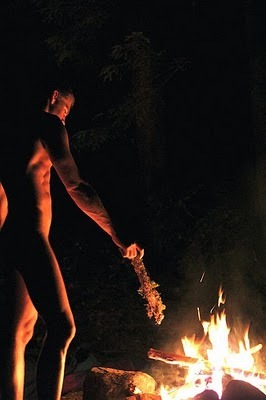
Bonfires always remind me of fall: the big bonfire before the homecoming game, sitting around a bonfire telling stories, ghost stories around the campfire. All these things remind me of autumn.

In some parts of the world, bonfires are identified, not with autumn, but with the summer solstice. In Latvia, Midsummer is called Jāņi . It is a national holiday celebrated on a large scale by almost everyone in Latvia and by people of Latvian origin abroad. Celebrations consist of a lot of traditional elements – eating Jāņu cheese, drinking beer, singing hundreds of Latvian folk songs dedicated to Jāņi, burning bonfire to keep light all through the night and jumping over it, wearing wreaths of flowers (for the women) and leaves (for the men) together with modern commercial products and ideas. Oak wreaths are worn by men named Jānis in honor of their name day. Small oak branches with leaves are attached to cars in Latvia during the festivity.

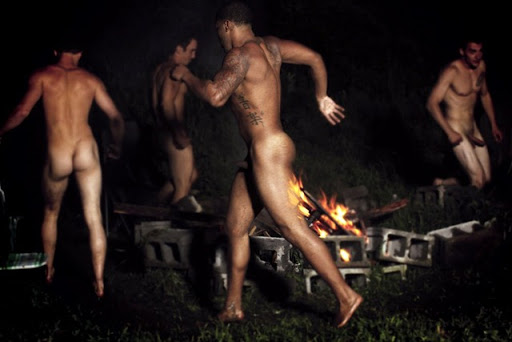
In the western town of Kuldīga, revellers mark the holiday by running naked through the town at three in the morning. The event has taken place for the past seven years. Runners are rewarded with beer, and police are on hand in case any “puritans” attempt to interfere with the naked run.

I just never got the chance to run around them naked, what about you? Do bonfires remind you of autumn? Have you ever run around one naked.

Just as I think of bonfires and autumn together, the following poem by Robert Louis Stevenson is not what I usually associate with Stevenson. I usually associate stories of pirates and life at sea. However, this poem shows that there was much more to Robert Louis Stevenson.

Autumn Fires
Robert Louis Stevenson (1913)

In the other gardens
And all up the vale,
From the autumn bonfires
See the smoke trail!
Pleasant summer over
And all the summer flowers,
The red fire blazes,
The gray smoke towers.
Sing a song of seasons!
Something bright in all!
Flowers in the summer,
Fires in the fall!

More about Robert Louis Stevenson after the jump.

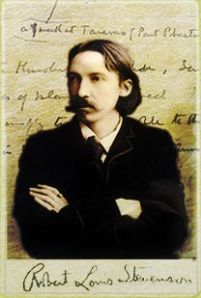
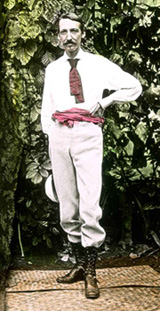
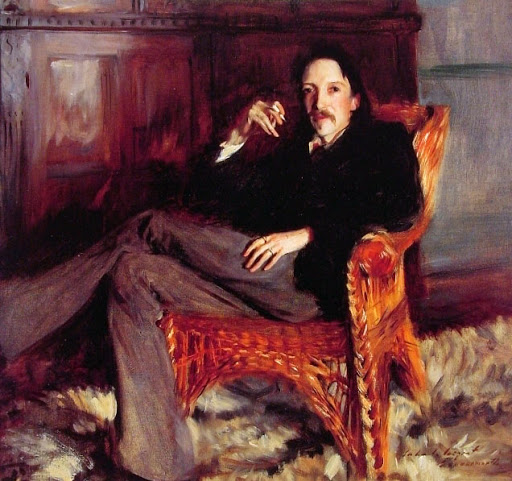
Robert Louis Stevenson
The Scottish novelist, essayist, and poet Robert Louis Stevenson (1850-1894) was one of the most popular and highly regarded British writers of the end of the 19th century. He played a significant part in the revival of the novel of romance.

During Robert Louis Stevenson’s youth the romantic novels of Sir Walter Scott and his followers had been eclipsed by the realism of William Makepeace Thackeray and Anthony Trollope. Writing in conscious opposition to this trend, Stevenson formulated his theoretical position in his essays “A Gossip on Romance” (1882), “A Humble Remonstrance” (1884), and “The Lantern-bearers” (1888). Romance, he wrote, is not concerned with objective truth but rather with things as they appear to the subjective imagination, with the “poetry of circumstance.” Romance, according to Stevenson, avoids complications of character and morality and dwells on action and adventure.

Stevenson was born on Nov. 13, 1850, in Edinburgh, the son of a noted lighthouse builder and harbor engineer. Though robust and healthy at birth, Stevenson soon became a victim of constant respiratory ailments that later developed into tuberculosis and made him skeletally thin and frail most of his life. By the time he entered Edinburgh University at the age of 16, ostensibly to study engineering, Stevenson had fallen under the spell of language and had begun to write. For several years he attended classes irregularly, cultivating a bohemian existence complete with long hair and velvet jackets and acquainting himself with Edinburgh’s lower depths.

Early Works

When he was 21 years old, Stevenson openly declared his intention of becoming a writer against the strong opposition of his father. Agreeing to study law as a compromise, Stevenson was admitted to the Scottish bar in 1875. Having traveled to the Continent several times for health and pleasure, he now swung back and forth between Scotland and a growing circle of artistic and literary friends in London and Paris. Stevenson’s first book, An Inland Voyage (1878), related his adventures during a canoe trip on the canals of Belgium and France.

In 1876 in France, Stevenson had met an American woman named Fanny Osbourne. Separated from her husband, she was 11 years older than Stevenson and had two children. Two years later Stevenson and Osbourne became lovers. In 1878 Osbourne returned to California to arrange a divorce, and a year later Stevenson followed her. After traveling across America in an emigrant train, Stevenson arrived in Monterey in poor health. After his marriage, a stay in an abandoned mining camp, later recounted in The Silverado Squatters (1883), restored his health. A year after setting out for the United States, Stevenson was back in Scotland. But the climate there proved impossible, and for the next 4 years he and his wife lived in Switzerland and in the south of France.

Despite ill health these years were productive. In his collections Virginibus puerisque (1881) and Familiar Studies of Men and Books (1882) Stevenson arrived at maturity as an essayist. Addressing his readers with confidential ease, he reflected on the common beliefs and incidents of life with a mild iconoclasm, a middling disillusionment.

The stories Stevenson collected in The New Arabian Nights (1883) and The Merry Men (1887) range from detective stories to Scottish dialect tales. The evocation of mood and setting that he practiced in his travel essays was used to great effect here. Despite his theory of romance, he was unable entirely to keep away from moral issues in these stories, but he was rarely successful in integrating moral viewpoint with action and scene.

Early Novels

Treasure Island (1881, 1883), first published as a serial in a children’s magazine, ranks as Stevenson’s first popular book, and it established his fame. A perfect romance according to Stevenson’s formula, the novel – riding over all the problems of morality and character that might have arisen – recounts a boy’s involvement with murderous pirates. Kidnapped (1886), set in Scotland shortly after the abortive Jacobite rebellion of 1745, has the same charm. In its sequel, David Balfour (1893), Stevenson could not avoid psychological and moral problems without marked strain. In The Strange Case of Dr. Jekyll and Mr. Hyde (1886) he dealt directly with the nature of evil in man and the hideous effects of a hypocrisy that seeks to deny it. This work pointed the way toward Stevenson’s more serious later novels. During this same period he published a very popular collection of poetry, A Child’s Garden of Verses (1885).

After the death of his father in 1887, Stevenson again traveled to the United States, this time for his health. He lived for a year at Saranac Lake, N.Y., in the Adirondacks. In 1889 Stevenson and his family set out on a cruise of the South Sea Islands. When it became clear that only there could he live in relative good health, he settled on the island of Upolu in Samoa. He bought a plantation (Vailima), built a house, and gained influence with the natives, who called him Tusifala (“teller of tales”). By the time of his death on Dec. 3, 1894, Stevenson had become a significant figure in island affairs. His observations on Samoan life were published in the collection In the South Seas (1896) and in A Footnote to History (1892). Of the stories written in these years, “The Beach of Falesá” in Island Nights’ Entertainments (1893) remains particularly interesting as an exploration of the confrontation between European and native ways of life.

Later Novels

The Master of Ballantrae (1889), set in the same period as Kidnapped, showed a new sophistication in Stevenson’s use of the elements of romance. Its basic theme involved complexities of character that his earlier romances had deliberately avoided. In the more advanced Weir of Hermiston, the legends of the romantic Scottish past saturate the setting and serve as a symbolic background for a tragic conflict between the primitive energies of a father and his sensitive, effete son. Left unfinished at his death, this novel would have ranked as Stevenson’s greatest work. While living in the South Pacific, Stevenson also collaborated on three novels with his stepson Lloyd Osbourne.

Further Reading

The best biographies of Stevenson are David Daiches, Robert Louis Stevenson (1947), and Joseph C. Furnas, Voyage to Windward: The Life of Robert Louis Stevenson (1951). Recommended critical studies include David Daiches, Stevenson and the Art of Fiction (1951); Robert Kiely, Robert Louis Stevenson and the Fiction of Adventure (1964), and Edwin M. Eigner, Robert Louis Stevenson and Romantic Tradition (1966).

Additional Sources

  • Bell, Ian, Dreams of exile: Robert Louis Stevenson, a biography, New York: H. Holt, 1993.
  • Hammond, J. R. (John R.), A Robert Louis Stevenson chronology, New York: St. Martin’s Press, 1996.
  • McLynn, F. J., Robert Louis Stevenson: a biography, New York:Random House, 1994.

Read more: http://www.answers.com/topic/robert-louis-stevenson#ixzz1Z0zi30n4


After Apple-Picking

After Apple-Picking


My long two-pointed ladder’s sticking through a tree
Toward heaven still,
And there’s a barrel that I didn’t fill
Beside it, and there may be two or three
Apples I didn’t pick upon some bough.
But I am done with apple-picking now.
Essence of winter sleep is on the night,
The scent of apples: I am drowsing off.
I cannot rub the strangeness from my sight
I got from looking through a pane of glass
I skimmed this morning from the drinking trough
And held against the world of hoary grass.
It melted, and I let it fall and break.
But I was well
Upon my way to sleep before it fell,
And I could tell
What form my dreaming was about to take.
Magnified apples appear and disappear,
Stem end and blossom end,
And every fleck of russet showing clear.
My instep arch not only keeps the ache,
It keeps the pressure of a ladder-round.
I feel the ladder sway as the boughs bend.

And I keep hearing from the cellar bin
The rumbling sound
Of load on load of apples coming in.
For I have had too much
Of apple-picking: I am overtired
Of the great harvest I myself desired.
There were ten thousand thousand fruit to touch,
Cherish in hand, lift down, and not let fall.
For all
That struck the earth,
No matter if not bruised or spiked with stubble,
Went surely to the cider-apple heap
As of no worth.
One can see what will trouble
This sleep of mine, whatever sleep it is.
Were he not gone,
The woodchuck could say whether it’s like his
Long sleep, as I describe its coming on,
Or just some human sleep.
–Robert Frost (1914)

Born in San Francisco, Frost spent most of his adult life in rural New England and his laconic language and emphasis on individualism in his poetry reflect this region. He attended Dartmouth and Harvard but never earned a degree, and as a young man with growing family he attempted to write poetry while working a farm or teaching school. American editors rejected his submitted poems. With considerable pluck Frost moved his family to England in 1912 and the following year a London publisher brought out his first book. After publishing a second book, Frost returned to America determined to win a reputation in his own country, which he gradually achieved, becoming one of the country’s best-loved poets. Unlike his contemporaries, Frost chose not to experiment with new verse forms but to employ traditional patterns, or as he said, he chose “the old-fashioned way to be new.” Despite the surface cheerfulness and descriptive accuracy of his poems, he often presents a dark, sober vision of life, and there is a decidedly thoughtful quality to his work.
In the poem above we see how, like Wordsworth, Frost takes an ordinary experience and transforms it into a meditative moment, a philosophical musing. Apple-picking slides gradually away from merely harvesting fruit to considering how life has been experienced fully but with some regrets and mistakes. The reference to winter coming on feels like the presence of mortalilty. The question about what kind of sleep to anticipate suggests untroubled oblivion or possibly some kind of new life just as the woodchuck reawakens to fresh life in the spring after his hibernation.


Moment of Zen: Autumn

Autumn is here and you can certainly feel it. The weather is wonderful here. Highs in the upper 70s and low 80s, with Lows in the 60s at night. This is the first comfortable day in nearly six months. It probably won’t last long, but I love fall weather. Hopefully, it will continue to get cooler.

To celebrate the Fall Season, here is William Shakespeare’s “Sonnet 73” to get you in the mood for Fall.

Sonnet 73
by William Shakespeare (1609)
That time of year thou mayst in me behold
When yellow leaves, or none, or few, do hang
Upon those boughs which shake against the cold,
Bare ruined choirs, where late the sweet birds sang.Autumn (2)2
In me thou see’st the twilight of such day
As after sunset fadeth in the west;
Which by and by black night doth take away,
Death’s second self, that seals up all in rest.
In me thou see’st the glowing of such fire,
That on the ashes of his youth doth lie,
As the deathbed whereon it must expire,
Consumed with that which it was nourished by.
This thou perceiv’st, which makes thy love more strong,
To love that well which thou must leave ere long.

History of Gay Pornography, Part II

Sexual Revolution and Gay Pornography
MANual Enterprises Publication

During the 1960s, a series of United States Supreme Court rulings created a more liberalized legal environment that allowed the commercialization of pornography. MANual Enterprises v. Day, 370 U.S. 478 (1962) was the first decision by the United States Supreme Court which held that magazines consisting largely of photographs of nude or near-nude male models are not obscene within the meaning of 18 U.S.C. § 1461. It was the first case in which the Court engaged in plenary review of a Post Office Department order holding obscene matter “nonmailable.” The case is notable for its ruling that photographs of nude men are not obscene, an implication which opened up the U.S. Postal Service to nude male pornographic magazines, especially those catering to gay men.

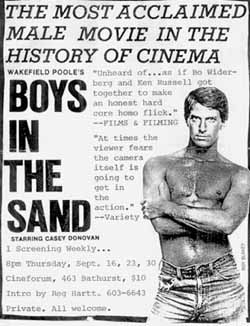
Wakefield Poole’s Boys in the Sand, starring Casey Donovan, can be considered one of the first gay pornography feature films, along with the works of filmmakers such as Pat Rocco and the Park Theatre, Los Angeles, California, circa 1970. Boys in the Sand opened in a theater in New York City in December 1971 and played to a packed house with record breaking box office receipts, preceding Deep Throat, the first commercial straight pornography film in America, which opened in June 1972. This success launched gay pornographic film as a popular phenomenon.

The production of gay pornography films expanded during the 1970s. A few studios released films for the growing number of gay adult movie theatres, where men could also have sexual encounters. Often, the films reflected the sexual liberation that gay men were experiencing at the time, depicting the numerous public spaces where men engaged in sex: bathhouses, sex clubs, beaches, etc.

Peter Berlin’s 1973 film Nights in Black Leather was the first major pornographic film designed to appeal to the gay leather subculture and drew some mainstream gays into this culture.

The 1960s and 1970s also saw the rise of gay publishing with After Dark and Michael’s Thing. During this time many more magazines were founded, including In Touch and Blueboy. Playgirl, ostensibly produced for women, was purchased and enjoyed by gay men and feature full frontal nudity (the posing straps and fig leaves were removed).

The 1980s were a period of transition for gay pornography film. The proliferation of VCRs made pornography videos easily accessible, and, as their prices fell, the market for home videos aimed at adult viewers became more and more lucrative. By the mid-1980s, the standard was to release pornography movies directly on video, which meant the wide disappearance of pornography theaters. Furthermore, video recording being more affordable, a multitude of producers entered the market, making low-budget pornography videos.

This shift from watching pornography as a public activity to doing so in private was also influenced by the discovery of HIV and the subsequent AIDS crisis. Public spaces for sex, such as theatres, became less attended when in the early 1980s it became a much riskier behavior. Masturbatory activities in the privacy of the home became a safe sex practice in the midst of this health crisis.

Gay movies of the 1970s had contained some exploration of novel ways to represent the sexual act. In the 1980s, by contrast, all movies seemed to be made under an unwritten set of rules and conventions. Most scenes would start with a few lines of dialogue, have performers engage in foreplay (fellatio), followed by anal penetration, and ending with a visual climax close-up of ejaculating penises, called a “money shot” or cum shot. Video technology allowed the recording of longer scenes than did the costly film stock. Scenes were often composed of extended footage of the same act filmed from different shots using multiple cameras. The quality of the picture and sound were often very poor.

Major directors such as Matt Sterling, Eric Peterson, John Travis, and William Higgins set the standard for the models of the decade. The performers they cast were especially young, usually appearing to be around the ages of 22 or 23. Their bodies were slender and hairless, of the “swimmer’s build” type, which contrasted with the older, bigger, and hairier man of the 1970s’ gay pornography. Performer roles also evolved into the tight divisions of “tops” and “bottoms”. The “top” in anal sex is the penetrating partner, who would typically have a more muscular body and the larger penis. The “bottom”, or receiver of anal sex, would often be smaller and sometimes more effeminate. The stars of the decade were almost always tops, while the bottoms were interchangeable (with the exception of Joey Stefano, a popular star, who was more of a “bottom”.)

Joey Stefano (bottom left)

This strict division between “tops” and “bottoms” may have reflected a preference by some of the popular directors of the decade to hire heterosexual men for their movies. Heterosexual men who perform gay sex for monetary reasons (commonly labeled “gay-for-pay”) are considered a rare commodity in the gay sex trade, but the biggest producers of the decade could afford them. Many critics attributed the conventionalization of gay pornography of the 80s to this trend.

The gay pornography industry diversified steadily during the 1990s.  In 1989, director Kristen Bjorn started a pornographic business which was considered as setting a standard for gay pornography producers. He was a professional photographer, and the images in his videos were considered to be of high-quality. As a former porn star himself, he directed his models with care, which helped improved the actors’ believability. Other directors had to improve their technical quality to keep up with demands from their audiences.

Another significant change during this decade was the explosion of the niche market.  Many videos began to be produced for viewers with specific tastes (i.e. for amateur pornography, Military (Men in Uniform) pornography, transsexual performers, bondage fetishes, performers belonging to specific ethnic groups, etc.), and this led to a diversification of the people involved in pornography production and consumption.
The gay pornography industry grew substantially in popularity during the 1990s, evolving into a complex and interactive subculture. Professional directors (such as Chi Chi LaRue and John Rutherford), technicians or deck operators during the U-matic phase of video technology, and performers started to engage in pornography as a career, their work sustained by emerging pornographic media and influential critics, such as Mikey Skee.

In the 21st century, gay pornography has become a highly profitable enterprise, ranging from the “straight-guy” pornography of Active Duty and Sean Cody, to the ‘twinks’ of Bel Ami. Many niche genres and online delivery sites cater to various and changing interests. For instance much of Van Darkholme’s work contains bondage and particularly shibari, the Japanese art of bondage and knot-tying, a specialty within BDSM cultures.

On the other hand, Lucas Kazan Productions successfully adapted literary classics: Decameron: Two Naughty Tales is based on two novels by Boccaccio, The Innkeeper on Goldoni’s La Locandiera. Lucas Kazan also found inspiration in 19th and 20th century operas, combining gay porn and melodrama: The School for Lovers, 2007 GayVN Award Winner for Best Foreign Picture, is in fact inspired by Mozart’s Così fan tutte.

Some controversy currently exists regarding studios that produce bareback (sex without condoms) videos. Mainstream companies, such as Falcon Entertainment, Hot House Entertainment, Channel 1 Releasing, Lucas Entertainment, Raging Stallion, Lucas Kazan Productions and Titan Media and LGBT health advocates assert that condomless videos promote unsafe sex and contribute to the HIV/AIDS pandemic, both in the pornography industry and in the gay community as a whole. The controversy dates back to the first few years of the HIV crisis, when nearly all gay pornography production companies voluntarily required their models to wear condoms for anal sex.

Chi Chi LaRue

The premise of industry figures, notably Chi Chi LaRue, is that gay pornography serves as a leading forum for teaching safer sex skills and modeling healthy sexual behaviors. At least one bareback studio agrees that porn should promote healthy sexual behaviors, but disagrees on the definition of “healthy” in this context: speaking about the AIDS crisis, Treasure Island Media owner and founder Paul Morris has expressed his belief that, “To a great extent, the current gay mindset surrounding HIV is a result of a generation of men living with PTSD and not getting the support and help they need now that the war is over.  As a pornographer, all I can do in response is to produce work that features men who are openly positive (or negative) and happily living their lives honestly and fully.”


History of Gay Porn, Part I

Many gay men, and nearly all of the ones that I know personally, love gay porn.  Gay men and their attitudes toward pornography tend not to be as stigmatized as it is with heterosexual men and women, though there are plenty of them who enjoy pornography as well.  Pornography as a whole does not have the stigma that it once did, at least not with the majority of the population; in fact, in some ways, it is becoming somewhat more mainstream.  I’ve noticed even with my students, they are willing to admit that they like porn and are much more likely today to admit that they masturbate than my generation had been.  I think that my generation was the beginning of that change, but as a whole, the attitudes toward sex are becoming more liberal.  I think that part of that is the fact that many people dismiss the AIDS crisis as being something of the past, when it most certainly is not, no matter who well the drug cocktails are working.  All that being said, I thought that I would write a post about the history of gay pornography.

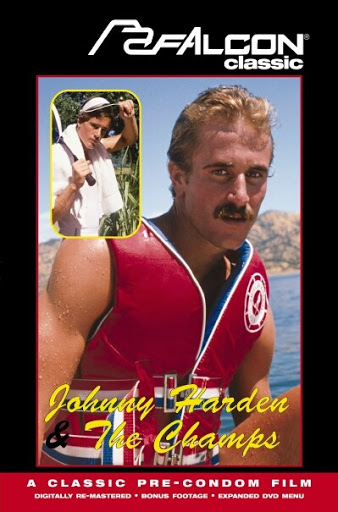
I haven’t done a really salacious post in a while, and 2011 is the 40th anniversary of Falcon Studios. Founded in 1971 by Chuck Holmes, the company is one of the most recognizable brand names in gay pornography. The estate of Chuck Holmes, who died of AIDS complications in September 2000, gave $1 million for the completion of the San Francisco Lesbian Gay Bisexual Transgender Community Center, the largest individual donation ever to any gay community group in San Francisco.

The Swimming Hole (1884–85) by the American artist Thomas Eakins (1844–1916) is regarded as a masterpiece of American painting, and has been called “the most finely designed of all his outdoor pictures”. The painting has been “widely cited as a prime example of homoeroticism in American art”. Eakins himself appears in the water at bottom right – “in signature position, so to speak.” According to Jonathan Weinberg, The Swimming Hole marked the beginning of homoerotic imagery in American art.

Homoeroticism has been present in photography and film since their invention. During much of that time, any kind of sexual depiction had to remain underground because of obscenity laws. In particular, gay material might constitute evidence of an illegal act under sodomy laws in many jurisdictions. This is no longer the case in the United States since such laws were ruled unconstitutional by the Supreme Court in 2003 in Lawrence v. Texas.

However, hardcore pornographic motion pictures (“stag films,” as they were called prior to their legalization in 1970) were produced relatively early in the history of film. The first known pornographic film of any kind appears to have been made in Europe in 1908. The earliest known film to depict hardcore gay (and bisexual) sex was the French film Le Menage Moderne Du Madame Butterfly, produced and released in 1920. Most historians consider the first American stag film to be A Free Ride, produced and released in 1915. But in the United States, hardcore gay sexual intercourse did not make it onto film until 1929’s The Surprise of a Knight.  The Surprise of a Knight‘s plot was relatively simple:

The film opens with an elegantly attired “woman” with short hair as she finishes dressing for a visitor. As the “lady” completes her boudoir, she lifts her skirts to reveal a thick patch of pubic hair. At this point, an intertitle reveals that the screenwriter is “Oscar Wild” (clearly a pseudonym).
The “lady” goes into the drawing room and offers her well-attired gentleman caller (her “knight”) a drink. He refuses it, and she drinks the cocktail. They talk briefly, and then engage in passionate kissing. Whenever the gentleman caller puts his hands on the “lady’s” breasts or genitals, “she” pushes his hand away. Finally, she slaps him coyly. The “lady” then apologizes for her aggressiveness by fellating her partner.

The “lady” then lies face-down on the sofa with her buttocks in the air. It is revealed that she has no underwear on. The gentleman caller then penetrates the “lady” anally (although no penetration is actually shown). After a minute or so, the gentleman withdraws and sits back on the sofa. The “lady” gyrates her buttocks in the air. This induces him to mount her anally again. Both individuals reach orgasm, and the gentleman caller walks off-camera.
The “lady” stands and raises her skirts to reveal that “she” is really a he. The film’s second and final intertitle announces “Surprise.” His penis is exposed. The man in drag then dances about briefly, making sure that his penis bobs up and down in the air. The gentleman caller re-enters the camera’s view, and helps the other man remove his skirt and most of his other clothing. The gentleman caller (now completely clothed again) dances briefly with the nude young man. After a jump cut, the “lady”—now dressed completely in business attire—walks back on screen, winks at the audience, and walks off screen.

The Surprise of a Knight ushered in a brief period of homosexual hardcore pornography in the stag film era. About a year later, in A Stiff Game, an African American male would engage in fellatio on a Caucasian man without the need for drag. The appearance of gay sexual contact on film would soon end, however, and not reappear until the advent of legal gay hardcore pornography after 1970.

It has been noted that the lead character (the “lady”) is in costume, yet costumes are the antithesis of the hardcore pornographic film (in which nudity and the display of genitalia and penetration during intercourse are key). “The costume spectacle either steals the show…” as film historian Thomas Waugh put it, “…or becomes a grotesque distraction…” The revelation of the “lady’s” penis is not real surprise, Waugh concludes, as audiences knew what sort of film they were getting (e.g., homosexual porn).

The use of drag in The Surprise of a Knight also distances the audience from the performers on screen, Waugh argues. The main character of the film is a drag queen, and yet nearly all the audience members could say that they were not drag queens. Waugh see the film not depicting gay men on screen, but reaffirming heteronormativity and negative stereotypes of gay men and gay sex. John Robert Burger writes that it is unclear from the film whether the visitor knows of the drag queen’s gender before the encounter, and that hiding the gender of the drag queen makes it “faux homosexuality”. Burger also writes that The Surprise of a Knight is an exception to the norm of stag films, in which the receptive parter in same-sex anal sex is typically perceived to be victimised or punished.

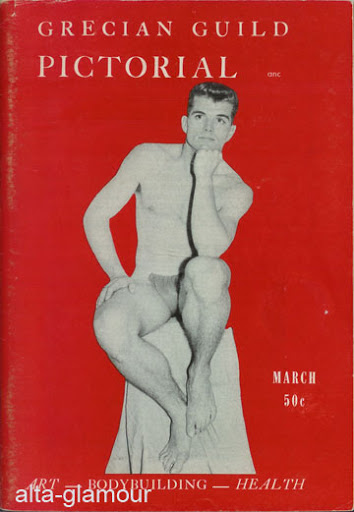
Legal restrictions meant that early hardcore gay pornography was underground and that commercially available gay pornography primarily consisted of pictures of individual men either fully naked or wearing a g-string. Pornography in the 1940s and 1950s focused on athletic men or bodybuilders in statuesque poses. They were generally young, muscular, and with little or no visible body hair. Those pictures were sold in physique magazines, also known as beefcake magazines, allowing the reader to pass as a fitness enthusiast.

The Athletic Model Guild (AMG) founded by photographer Bob Mizer in 1945 in Los Angeles, California, was arguably the first studio to commercially produce material specifically for gay men and published the first magazine known as Physique Pictorial in 1951. Tom of Finland drawings are featured in many issues. Mizer produced about a million images, and thousands of films and videos before he died on May 12, 1992. During the late 1960s and early 1970s, the advent of 16mm film cameras enabled these photographers to produce underground movies of gay sex and/or male masturbation. Sales of these products were either by mail-order or through more discreet channels. Some of the early gay pornographers would travel around the country selling their photographs and films out of their hotel rooms, with advertising only through word of mouth and magazine ads.

The 1960s were also a period where many underground art film makers integrated suggestive or overtly gay content in their work. Kenneth Anger’s Scorpio Rising (1963), Andy Warhol’s Blow Job (1964) and My Hustler (1965), or Paul Morrissey’s Flesh (1968) are examples of experimental films that are known to have influenced further gay pornographic films with their formal qualities and narratives. Tyler Gajewski is a noted actor and model of the period who appeared in Warhol’s and Morrissey’s films, as well as in Mizer’s work at the AMG. Also of note is Joe Dallesandro, who acted in hardcore gay pornographic films in his early 20s, posed nude for Francesco Scavullo, Bruce of L.A. and Bob Mizer, and later acted for Warhol in films such as Flesh. Dallesandro was well-known to the public. In 1969 Time magazine called him one of the most beautiful people of the 1960s, and he graced the cover of Rolling Stone magazine in April 1971. Dallesandro even appeared on the cover of The Smiths’ eponymous debut album, The Smiths.


The Hug by Thom Gunn

The Hug
It was your birthday, we had drunk and dined
Half of the night with our old friend
Who’d showed us in the end
To a bed I reached in one drunk stride.
Already I lay snug,
And drowsy with the wine dozed on one side.

I dozed, I slept. My sleep broke on a hug,
Suddenly, from behind,
In which the full lengths of our bodies pressed:
Your instep to my heel,
My shoulder-blades against your chest.
It was not sex, but I could feel
The whole strength of your body set,
Or braced, to mine,
And locking me to you
As if we were still twenty-two
When our grand passion had not yet
Become familial.
My quick sleep had deleted all
Of intervening time and place.
I only knew
The stay of your secure firm dry embrace.
Thom Gunn

Photo © Ander Gunn 1992

In 1929, Thom Gunn was born in Gravesend, Kent, England, the older son of two journalists. His parents were divorced when the poet was ten years old, and his mother committed suicide while he was a teenager. Before her death, his mother had inspired a deep love of reading in him, including affection for the writings of Marlowe, Keats, Milton, and Tennyson, as well as several prose writers.

Before enrolling in Trinity College, Cambridge, in 1950, he spent two years in the national service and six months in Paris. In 1954, the year after his graduation, Gunn’s first poetry collection, Fighting Terms, was published. The book was instantly embraced by several critics, including John Press, who wrote, “This is one of the few volumes of postwar verse that all serious readers of poetry need to possess and to study.” Gunn relocated to San Francisco and held a one-year fellowship at Stanford University, where he studied with Yvor Winters.

Over the next few decades, he published several collections that were not as warmly received as his earliest work, including The Sense of Movement (1957), My Sad Captains (1961), Touch (1967), Moly (1971), To the Air (1974), Jack Straw’s Castle (1976), Selected Poems 1950-1975 (1979), and The Passages of Joy (1983).

During the 1970s and 80s, Gunn’s poems were marked by the poet’s personal experiences as he wrote more openly about his homosexuality and drug use. Many critics believed he was betraying his talents. But with the publication of The Man with Night Sweats in 1992, a collection memorializing his friends and loved ones who had fallen victim of the AIDS pandemic, critics were reminded of Gunn’s early promise. As Neil Powell wrote of the book, “Gunn restores poetry to a centrality it has often seemed close to losing, by dealing in the context of a specific human catastrophe with the great themes of life and death, coherently, intelligently, memorably. One could hardly ask for more.” Gunn received the Lenore Marshall Poetry Prize for the collection in 1993.

He went on to publish several more books of poetry in the United States and Britain, including Boss Cupid (Farrar, Straus & Giroux, 2000), Frontiers of Gossip (1998), and Collected Poems (1994). He has also written several collections of essays, including The Occasions of Poetry (1982; U.S. edition, 1999).

Gunn’s honors include the Levinson Prize, an Arts Council of Great Britain Award, a Rockefeller Award, the W. H. Smith Award, the PEN (Los Angeles) Prize for Poetry, the Sara Teasdale Prize, a Lila Wallace-Reader’s Digest Award, the Forward Prize, and fellowships from the Guggenheim and MacArthur foundations.

Thom Gunn died on April 25, 2004, in his home in San Francisco.


Fauns and Satyrs

The satyrs were woodland spirits, often depicted in arts with head and upper body of man, horns and pointy ears, and goat legs. They were also depicted with large erect phallus (penis).

They were often seen accompanying Dionysus, the god of wine and ecstasy. They were shown in drunken revelry and orgy, dancing with Dionysus’ female followers, the maenads.
Pan, the god of shepherd was a satyr, so was probably Silenus or Seilenus. Silenus was one of the loyal followers of Dionysus, who brought up the wine god.

Satyrs were usually represented as being very hairy and having the tails and ears of a horse and often the horns and legs of a goat. An important part of Dionysus’ entourage, they were lustful, fertile creatures, always merrily drinking and dancing.

In Greek mythology, satyrs (in Greek, Σάτυροι — Sátyroi) are a troop of male companions of Pan and Dionysus— “satyresses” were a late invention of poets— that roamed the woods and mountains. In mythology they are often associated with male sex drive and vase-painters often portrayed them with uncontrollable erections.

The Fauns and Satyrs were he-creatures, like men, with the hind-legs of goats, short horns on their foreheads, and long pointed ears. But there was a difference between the Fauns and Satyrs. The Fauns were handsome, gentle, innocent, and rather foolish. The Satyrs were hideous, clumsy, hairy monsters, with flat faces, little eyes, and huge mouths, great gluttons, often drunk, and sometimes mischievous: most of them were dull and stupid, but many of them had plenty of sense and knowledge. The Fauns and Satyrs lived among the woods and hills like the Dryads and Oreads.

The king of all these Nymphs, Fauns, and Satyrs was a god named Pan, who was himself a very hideous satyr. He had nothing to do with the gods of Olympus, but lived on the earth, chiefly in a part of Greece called Arcādia. “Pan” is the Greek for “all”—you remember the same word in the name of “Pan-dora.” He was called “Pan” because he was the god of “all” nature—all the hills and mountains, all the woods and forests, all the fields, rivers, and streams.

Anonymous poem: A Faun meets a Taormina shepherd

In the most remote areas of Taormina’s wilderness,
Young shepherds met fauns and satyrs, Pan and Dionysos,
Hidding behind a rock, vanishing in a flash, a flash of light.

Most of the time they were mere illusions, a reflection of the sun,
A mirage in Taormina’s wilderness, at the peak of the hot wave,
Or just a noise of a rock falling down from a cliff… 

But Pasqualino met a faun, a real faun, sitting on a rock,
Far away from the usual paths of Taormina’s young shepherds,
So far that he was in the middle of nowhere… 

“Are you a god or just an illusion ?”, asked Pasqualino.
“Did I love you a long time ago, I am sure I know you”,
Answered the faun with his Dionysiac horns… 

“Cute shepherd of Taormina, please, play a melody for me,
A melody from your reed flute, perhaps I will sing one for you,
A song of love, of the love of gods for Taormina’s shepherds… 

Please, have a seat on this rock, beside me, let us sing and dream,
Hope and remember, love and be loved, let me tell you the legend of fauns,
Please tell me the story of your life, where you are from, what you dream about…” 

And Pasqualino played the most beautiful of the tunes the boys of Taormina know,
A music wide as an horizon, deep as eyes, sensitive as a caressing hand,
A music of longing and sorrow, of dream and hope, of loneliness and communion. 

Wilhelm von Gloeden’s camera obscura was able to catch the magic of this encounter,
The encounter of a Faun and of a young shepherd from Taormina,
At the turn of a century, at the threshold of two worlds, reality and imagination. 

While looking at this photograph, forever I can listen to this forgotten melody,
To the melody of Fauns meeting young shepherds in the most remote wilderness,
Of Fauns falling in love with them, and crossing the invisible border, 

The border between gods and humans, between dream and reality,
Between hope and memory,
So far, so deep, at this crossroads where a lover meet his loved one.

Anonymous poet, around 1907, Von Gloeden Archive, 1907, call number 1907/Anon/12 (Rêves Siciliens)


So Close, and Yet So Far Away

School starts back today (pray for me, LOL), so I didn’t have a lot of time last night to write a post. A friend of mine sent me this article, and I found it an interesting and delightful read.  I hope that you do as well. (Thanks, FOC.)


The contorted history of autofellatio.

By Jesse Bering

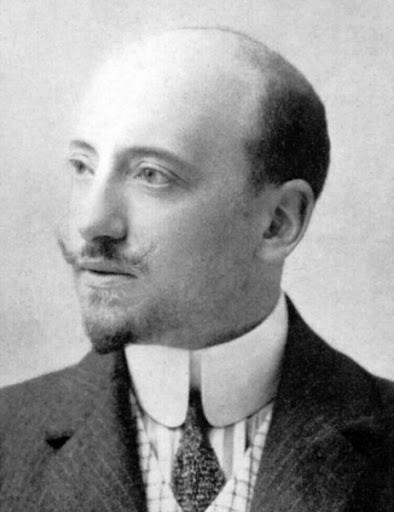
Italian poet Gabriele d’Annunzio

Long before I knew very much about anything regarding sex, I did what many young males do, which of course is to place an empty paper-towel roll over my penis and suck hopefully upon the cardboard end. Okay, perhaps not everyone does this; I was a little confused about the suction principle. And now I’m a bit embarrassed by the story, although it’s been a full year since the event and I’m much better informed on the subject of fellatio today. Oh, settle down, I’m only joking.

Well, kind of. I did actually attempt this feat, but I was 12 or 13 at the time, which, to give you a clearer sense of my unimpressive carnal knowledge at that age, is also around the time that I submitted to my older sister with great confidence that a “blow job” involves using one’s lips to blow a cool breeze upon another’s anus.

So to avoid similar confusion, let us define our terms clearly. Autofellatio, the subject at hand—or rather, not at hand at all—is the act of taking one’s genitals in one’s mouth to derive sexual pleasure. Terminology is important here, because at least one team of psychiatrists writing on this subject distinguishes between autofellatio and “self-irrumatio.” In nonsolo sex, fellatio sees most of the action in the sucking party while irrumatio has more of a thrusting element to it, wherein the other person’s mouth serves as a passive penile receptacle. (Hence the colorful and rather aggressive-sounding slang for irrumatio—”face-f*cking,” “skull-f*cking,” and so on.)

In any event, my paper-towel-roll act was simply a “Plan B” at that puerile age, a futile way to circumvent the obvious anatomical limitations to oral self-gratification. And by all accounts, I wasn’t alone in hatching Plan B. Alfred Kinsey and his colleagues reported in Sexual Behavior in the Human Male, in fact, that, “[a] considerable portion of the population does record attempts at self-fellation, at least in early adolescence.” Sadly, given our species’ pesky ribcage and hesitant spine, Kinsey estimated that only two or three of every 1,000 males are able to achieve this feat. There’s the story of the Italian decadent poet, Gabriele d’Annunzio, who is said to have had a bone removed to facilitate the act, or that old Saturday Night Live skit in which Will Ferrell enrolls in a Yoga class only to become flexible enough to fellate his own organ. But truth is often stranger than fiction. In 1975, the psychiatrist Frances Millican and her colleagues described the real case of a “very disturbed” patient who learned Yoga precisely for this reason.

Now, you may think that being one of the ultrabendable 0.25 percent of the population is all fun and games. (We’ve all heard those quips about never having to leave the house.) But think again. There’s a long and unfortunate history of pathologizing this behavior; psychiatrists have described its practitioners as being sexually maladjusted, stuck in an infantile state of suckling dependency, or even motivated by repressed homosexual desires. Take the case described by psychiatrists Jesse Cavenar, Jean Spalding, and Nancy Butts, who wrote in 1977 of a lonely, 22-year-old serviceman who’d been fellating himself since the age of 12. He was driven mad, “by the fact that he could physically incorporate only the glans, and wanted to be able to incorporate more.” Honestly, it must have been so—oh, what’s the word I’m looking for … it’s right on the tip of my tongue—frustrating, for this poor soldier. This is the ultimate cock tease, its being so close yet so far away.

Since the days of Freud, psychoanalysts have gone to town on the subject of autofellatio. In a 1971 article by psychiatrist Frank Orland, we see the typical jargon-filled language used in dissecting the “symbolic” bases of autofellatio, which is conceptualized as a virtual “ring of narcissism”:

… autofellation represents a recreation of the early infantile state in which the intrapsychic representatives of external objects are separated from the self-object, with a coexisting parasitic symbiosis with the external object. Through the autofellatio phenomenon, the ego re-establishes the necessary mastery over the external object representative as a defence against object loss and to restore the parasitic fusion with the nipple-breast.

That, ladies and gentlemen, is unadulterated psychobabble—and I tell you this as a psychologist. Sometimes, people are motivated to lick their own genitals because it just feels good. Of course, there are always going to be those, such as the dubious Yoga master, who take it a bit too far and for whom autofellatio contributes to mental illness. The foregoing soldier, who couldn’t take it far enough, got so frustrated by his semifulfilled fantasy that, when he masturbated the old-fashioned way, he could achieve climax only by imagining himself fellating himself.

The very first published psychiatric case of autofellatio, appearing in the American Journal of Psychiatry way back in 1938, was also one of the most outrageous and pathological. The patient was a 33-year-old store clerk who, prior to being referred to Yale psychiatrists Eugen Kahn and Ernest Lion, had just completed a 60-day jail sentence for sexual assault. “Among his perverse practices,” explain the authors, “were pedophilia, cunnilinguism, homosexual acts (fellatio, sodomy and mutual masturbation), exhibitionism, transvestism, fetishism, algolagnia, voyeurism and peeping.” But never mind all those vanilla paraphilias. The man’s psychiatrists were especially intrigued by his more unusual habit. He seems a devious wee character, this patient of theirs. The authors describe him as being somewhat effeminate in posture, gait and mannerisms; he stood only 5 feet 2 inches tall—”somewhat thin and with wide hips,” they wrote, with “a female pattern of distribution of his pubic hair” and “his gag reflex is very sluggish.”

The patient was the third-oldest of eight children and grew up in a strict, religious family, which the physicians felt he rebelled against by egregiously breaching their high moral standards. In recounting to the psychiatrists the origins of his interest in autofellatio, the troubled clerk recalled being invited at the age of 14 by a “cripple boy” to engage in oral sex with him. The patient, being shy, had refused this offer, but the thought of it simmered and, lacking the courage to approach anyone else, he took matters upon himself: “He kept trying night after night, managing to bend his back more and more until he finally succeeded in August, 1923.” (The 89th anniversary of this event is coming up, in case you want to mark it on your calendar.) It turns out he liked it—so much, in fact, that even amidst the long litany of perversions he enjoyed, self-irrumatio instantly became his favorite autoerotic act.

In an odd Pavlov’s dog sort of way, the authors even describe how the man’s sexual arousal had since then been accompanied by a “constricting feeling in the throat.” That must be a terribly annoying feeling, I’d imagine, and apparently also one not easily resolved. “He has attempted to secure substitute gratification,” say the authors, “by smoking, or by stimulating his pharynx with a banana, vaginal douche or a broom handle. These have yielded various degrees of satisfaction.” And he did apparently get over his adolescent shyness and lack of confidence, too—he particularly enjoyed fellating himself in front of a shocked audience.

Since this initial case report by Kahn and Lion, a handful of others have trickled in over the years, with subsequent investigators attempting to find a set of common personality denominators in those who prefer autofellatio over other forms of sex. In a 1954 article in Psychoanalytic Review, for instance, William Guy and Michael Finn saw a theme beginning to emerge. “In all of the clinical descriptions,” observe these authors, “one finds repeatedly such phrases as sensitive, shy, timid, effeminate, and passive.” This is code for “queer,” I believe, and in fact other writers have more expressly noted the often-suppressed homosexual desires in these autofellators.

In fact, judging by the scant literature, one of the big psychoanalytic questions yet to be resolved satisfactorily seems to be the extent to which engaging in autofellatio—or perhaps simply the desire to do so—signals a latent erotic attraction to the same sex. I suspect, however, that the overrepresentation of gay men in the antiquated case reports is simply a reflection of the cultural ethos of those times. The most recent psychiatric investigations on autofellatio date to the late 1970s (around the time that Freud’s particular grip on psychiatry lost its tenuous hold), and the earlier ones to the 1930s, so as a rule the men described therein faced baseless moralistic proscriptions against homosexuality. This meant other men’s penises were very hard to come by. So it’s not terribly surprising that those too frightened to perform fellatio on another man would develop severe neuroses after indulging in their own penises.

A 1946 article from the American Journal of Psychiatry exemplifies this phenomenon. The case involves a 36-year-old, highly intelligent, personable, but virginal staff sergeant (not to be confused with the military man we met earlier) with closeted homosexual desires. According to the official record, he’d first performed autofellatio at age 13, but he became so frightened by this “impulse” that he resisted ever doing so again—that is, until a month prior to arriving at the psychiatric ward of the hospital. After giving himself head in private, the sergeant became intensely paranoid that the other soldiers somehow knew of his autofellatio, and that every little snigger, whisper, or averted glance concerned this transgression. He suffered a nervous breakdown on hearing the word “cocksucker” floating about so casually and playfully in the military barracks, convinced it was meant just for him.

It’s a rather sad ending for him, too, because despite his responding well to the doctors’ reassurance that he was being overly paranoid, the sergeant was discharged for being “no longer adaptable within the military service.” The therapists assigned to the case, Major Morris Kessler and Captain George Poucher, reached a rather strange conclusion, one that I have a hunch you might disagree with: “Sexual self-sufficiency,” they write, “either by masturbation or autofellatio, is tantamount to having an affinity for one’s own sex.” In other words, if you were a fan of manual masturbation in 1946, my heterosexual male friends, you’d have been branded a secret homosexual pervert who likes penises so much that he gives himself hand jobs. This would have made autofellatio a devil of a case under the Clinton-era “Don’t Ask, Don’t Tell” ban on gays in the military had it arisen then. And, seriously, good riddance to those ignorant days of yore. To each his own—quite literally in the case of autofellatio.

I know, I know, I didn’t even get a chance to talk about autocunningulism in females. Given the even more serious anatomical hurdles in lacking a protruding reproductive device, such behavior in women may not even be possible. I confess I don’t know; and there’s no mention of it in the scientific literature. The closest female comparison to autofellatio I stumbled upon is the case of women who suckle from their own breasts, for sexual or other purposes. One therapist writes of an especially self-sufficient female patient who had a habit of doing this. When he asked her why, she merely replied, “I’m hungry.” But that’s another article for another day.

Jesse Bering teaches at Wells College and is the author of The Belief Instinct. He is a frequent contributor to Slate and writes the “Bering in Mind” column for scientificamerican.com. His next book will be on the curiously scandalous science of human sexuality. Follow him on Twitter @JesseBering or try adding him on Facebook.

Article URL: http://www.slate.com/id/2300733/


I just can’t…

I really can’t picture anyone at all having a crush on me. I can’t picture anyone daydreaming about me. I can’t picture someone thinking about me when they lay in bed before they fall asleep. I can’t picture anyone telling their friends about me. I can’t picture anyone getting butterflies because I hugged them, or even just because I made eye contact with them. I can’t picture someone smiling because my name lit up their phone. I just can’t.

This is not poetry, but I find it somewhat poetic.  Probably, not everyone has experienced these feelings/insecurities, but many of us have.  How do you feel about the quote above? Have you had these feelings before?  Or, are you just naturally gorgeous and charming with people falling at your feet?  I know that I have felt this way in the past, still do to some extent.