Can a woman forget her nursing child, and not have compassion on the son of her womb? Surely they may forget, yet I will not forget you.”
—Isaiah 49:15
What the Bible is saying in this passage is: that while a mother can forget the love she has for her child, God never will. The design of this passage is apparent. It is to show that the love which God has for his people is stronger than that which is produced by the most tender ties created by any natural relation. The love of a mother for her infant child is one of the strongest attachments in nature. The question here implies that it was unusual for a mother to be unmindful of that tie and to forsake the child that she should nourish and love. With that being said, in the passage above, Isaiah was asking a theoretical question when he said, “Can a woman forget her nursing child?” This passage praises mothers as symbols of amazing compassion, never forgetting their beloved children.
Mothers are not perfect. Mine sure isn’t. Every mother is flawed, just as we are all flawed. However, no matter how flawed we may be, God’s love for us is unchanging and unchangeable. He gives us generous grace and great compassion for all time and throughout eternity. While my mother and I may have our disagreements, we have a strong bond, though not nearly as strong as it once was before I came out, it is still there. She is my comfort, even when she is not comforting. That may sound odd, but when I was young, my mother often sang to us. Sometimes it was silly little songs like “Fishy in a Bowl,” “Do Lord,” or “Yes Sir, That’s My Baby,” though she had her own versions of each one. However, the one I remember most is “You Are My Sunshine.” Even today, when I am sad and lonely or having anxiety or even a full-on panic attack, I can remember my mother singing ‘You Are My Sunshine,” and I am comforted. Part of it has to do with the rhythm of the song helping to slow my rapidly beating heart, but it’s also because I remember the good times when my mother would sing this to me.
I want to leave you with a different verse because while we may see things very differently, my mother does still love me. I firmly believe that she always will. She can’t help but love me. (Who couldn’t? I’m quite lovable. LOL)
Love suffers long and is kind; love does not envy; love does not parade itself, is not puffed up; does not behave rudely, does not seek its own, is not provoked, thinks no evil; does not rejoice in iniquity, but rejoices in the truth; bears all things, believes all things, hopes all things, endures all things.
And now abide faith, hope, charity, these three; but the greatest of these is charity.
—1 Corinthians 13:13
Alabama, especially its Supreme Court, has been trying to impose their twisted version of Christianity on its citizens. Their version of Christianity involves hatred and control as do far too many Christian churches today. Alabama Supreme Court Chief Justice Tom Parker recently appeared on a QAnon podcast to promote so-called Seven Mountains dominionism, which calls for Christians to control every aspect of government, education, media, religion, family, business, and entertainment. I believe if Jesus was to return and see these so called Seven Mountains, he would be appalled. I think the “Seven Mountains” Jesus would have taught are seven virtues that would bring about a better world than Christian control of every aspect of our lives. Jesus would and did teach what Christian theology refers to as the seven heavenly virtues combine the four cardinal virtues of prudence, justice, temperance, and fortitude with the three theological virtues of faith, hope, and charity. Let’s take a look at these seven virtues.
Prudence
Prudence is the ability to govern and discipline oneself by the use of reason. Prudence was considered by the ancient Greeks and later by Christian philosophers, most notably Thomas Aquinas, as the cause, measure, and form of all virtues. It is considered to be the auriga virtutum or the charioteer of the virtues. It is mentioned in the fifth of the Principal Doctrines of Epicurus, and in his Letter to Menoeceus, where he says: “Prudence is the foundation of all these things and is the greatest good. Thus, it is more valuable than philosophy and is the source of every other excellence.” Most examples of prudence in the Bible are in the Book of Proverbs. Proverbs 10:19 says, “Sin is not ended by multiplying words, but the prudent hold their tongues.” When we are tempted to speak many words and give a lot of opinions without talking immediately, we are not prudent. Prudence is being slow to speak and process through before sharing. I can think of a particular bombastic politician who has never practiced this type of prudence. Actually, I can think of several. Proverbs 12:16 says, “Fools show their annoyance at once, but the prudent overlook an insult.” Proverbs 14:15 says, “The simple believe anything, but the prudent give thought to their steps.” In this proverb, prudence means that we do not believe everything that we hear. We are wise and test every spirit and every word.
Justice
Biblical justice is rooted in the very character of God and is characterized by generosity, equality, advocacy, responsibility. Amos 5:24 says, “But let justice run down like water, and righteousness like a mighty stream.” In his speech on the steps of the Lincoln Memorial, Martin Luther King Jr. used this verse to suggest through that unless America makes justice and righteousness a reality it will be destroyed. The former and disgraced president Donald Trump has asked the US Supreme Court to grant him immunity from the crimes he’s committed. If the Court turns its back on justice, the United States will be doomed. Isaiah 1:17 says, “Learn to do good; seek justice, rebuke the oppressor; defend the fatherless, plead for the widow.” Justice is most importantly about equality. If we are not all equal before the law, if we do not help the unfortunate, then there is no justice in this world.
Temperance
Temperance in its modern use is defined as moderation or voluntary self-restraint. It is typically described in terms of what a person voluntarily refrains from doing. This includes restraint from revenge by practicing mercy and forgiveness, restraint from arrogance by practicing humility and modesty, restraint from excesses such as extravagant luxury or splurging, restraint from overindulgence in food and drink, and restraint from rage or craving by practicing calmness and equanimity. Galatians 5:22-23 tells us, “But the fruit of the Spirit is love, joy, peace, longsuffering, kindness, goodness, faithfulness, gentleness, temperance. Against such there is no law.”
Fortitude (Courage)
The classical virtue of fortitude (andreia, fortitudo) is also translated as “courage”, but includes the aspects of perseverance and patience. Fortitude and courage are distinguishable in that fortitude is the mental or emotional strength that enables courage in the face of adversity. Paul would elsewhere write that believers should “stand firm in the faith” (1 Corinthians 16:13) and “be strong in the Lord” so that we “may be able to withstand in the evil day, and having done all, to stand firm” (Ephesians 6:10, 13). Similarly, the writer of Hebrews encourages his readers to “hold fast the confession of our hope without wavering, for he who promised is faithful” (Hebrew 10:23). As believers, we are called to “stand firm,” “be strong,” and “hold fast” because of the hostility of this world, the temptations of the flesh, and the spiritual attacks of Satan. In other words, this requires fortitude.
Faith, Hope, and Charity
Faith, hope, and charity are familiar terms often spoken of together, and nearly always in the same order. Paul indicates that the order has significance, charity being the last and also the greatest of the three. In 1 Corinthians 13:13 Paul writes, “And now abide faith, hope, charity, these three; but the greatest of these is charity.” Some translations of the Bible replace “charity” with “love.” Faith is the total acceptance of an idea. It is fully integrated into the way we think, feel, and live. Getting faith is difficult for many, but once one has it, using it and living with it is easy. It becomes part of what one is, and one would have to make a conscious decision to deviate from it.
In the Bible, “hope” doesn’t have the modern definition of wishing, but it has the sense of reasonable expectation. Hope is the acceptance of an idea accompanied by the realization that it might possibly be wrong. Having hope is easier than faith. It is often based on our own efforts and our confidence in others and the world around us.
Charity or love should be given freely. If we can help one another than it is our responsibility to do so. Love is the most difficult way to think, feel, and behave. It requires definite effort to maintain, especially knowing that most of what we do because of it will be useless. Love is “the greatest,” because it is the most difficult for us to practice, and because its very existence depends upon our already having hope and faith.
“Let not your heart be troubled; you believe in God, believe also in Me. In My Father’s house are many mansions; if it were not so, I would have told you. I go to prepare a place for you. And if I go and prepare a place for you, I will come again and receive you to Myself; that where I am, there you may be also. And where I go you know, and the way you know.”
Thomas said to Him, “Lord, we do not know where You are going, and how can we know the way?”
Jesus said to him, “I am the way, the truth, and the life. No one comes to the Father except through Me.”
—John 14:1-6
“‘Yo soy el camino, la verdad y la vida,’ Juan, catorce seis.” When I took Spanish in high school, we had to memorize a Bible verse in Spanish every week. The first one we learned, and the only one I can still remember, is John 14:6. This verse has always stuck with me, not just because it was the first one I leaned in Spanish class, but also because of the message. Sometimes, in life, it’s no doubt that we get lost. We are not going towards the right path anymore. We even tend to give up in finding the right place. However, Jesus tells us that we shouldn’t let our hearts be troubled and just believe in Jesus who is the way, the truth, and the life. We might not know where we are going but we must keep in mind that there’s Jesus who’s willing to guide us at any time of the day. We should have faith in Him, and we’ve got nothing to worry. He will bring us in the right place. With Him, everything is possible.
John 14:1-6 is meant to give us comfort and hope. This passage is part of a larger story of the Last Supper, and his disciples are greatly distressed that their Savior is going to leave them. They believe they will be lost without him. Jesus responds to the anxiety of his disciples by saying, “Let not your heart be troubled; you believe in God, believe also in Me” (14:1). Jesus calls them back to this fundamental relationship of trust and assures them that he is not abandoning them. Rather, he is returning to his Father, which is good news for them. In speaking of his ascension to the Father, Jesus assures his disciples that this is also their destination. There are many dwellings in his Father’s house, and he goes to prepare a place for them, so that they will be with him and dwell with him in his intimate relationship with the Father (14:2-3).
When Jesus says that they know the way to the place where he is going (14:4), Thomas, like most characters in the Gospel, takes Jesus quite literally. He wants directions, a road map to this place (14:5). Jesus responds by saying that he himself is the way: “I am the way, the truth, and the life. No one comes to the Father except through Me” (14:6).
When we get lost in life, which can be very hectic, stressful, and even disorienting, if we believe in Jesus, follow His teachings, we will never be lost. When we’re lost, Jesus can and will show us the way. He tells us to “believe in God, believe also in Me.” There are times we all feel lost and in despair, know that Jesus is the way through our troubles.
“Enter by the narrow gate; for wide is the gate and broad is the way that leads to destruction, and there are many who go in by it. Because narrow is the gate and difficult is the way which leads to life, and there are few who find it.”
—Matthew 7:13-14
I grew up in rural Alabama, and my house was surrounded by a pasture. There were a lot of pastures around where I lived, and I remember vividly the numerous ways to enter a pasture. If you were on foot, you could climb over or under the fence, but if you were in a vehicle you either had to cross a cattle gap or get out, open the gate, drive through and then get back out of the vehicle and close the gate. I always found it so tedious to have to get in and out of a vehicle to open and close the gates. It was a lot easier if there was a passenger, which I most often was, who could handle the gates when we’d come to them.
When I came across the picture above, it made me consider the symbolism of gates in the Bible. To me, I most often think of Matthew 7:13-14 when I think of gates. In this passage, which is part of Jesus’ Sermon on the Mount, Jesus is speaking to a large crowd about how people are often more interested in appearing outwardly to be religious by practicing rituals that others could see. They were using the wide gate, which signifies a dependence on ourselves and obtaining our own self-righteousness through trying to do things outwardly to impress others, rather than a more personal relationship with God.
The wide gate in many ways represents our culture today, characterized by being self-absorbed and wanting to appear outwardly better than everyone else. Too many people latch onto individual and misinterpreted Bible verses to push forth their own hateful ways while also trying to appear pious. The wider gate is a popularity contest, and it causes people to latch onto politicians and news media that align with their own hateful beliefs and reinforce those beliefs by perverting the Word of God.
The narrow gate that Jesus was referring to is a personal relationship with God, not being outwardly pious by following religious rituals and sacraments to try and earn your way to heaven. It means not wasting time and energy trying to appear outwardly in a way to be accepted by the pious culture of many churches, but rather asking the God to live in you, to change your heart, and transform you into the person He made you to be. God sees the inward appearance of our heart, not our outward appearance to others. Even at the risk of being unpopular, we should follow the teachings of Jesus to live a life of giving help, hope, and happiness to others.
Narrow gates are also easier to defend because they use lesser material and can this concentrate the defense greater than the massive amount of material needed for larger gates. It takes less to defend a narrow gate because it limits the attack of the enemy. The wider gate allows an enemy to attack with a greater force that can weaken the defensive purposes of a gate. Wider gates need greater materials to defend against an enemy. The gates of the ancient cities are not as we imagine today’s gates, but massive gates made of stone, iron, brass, or wood frequently sheeted with metal. They were tall and wide. The gate of Herod’s “which is called Beautiful” (Acts 3:2) was made of brass and required twenty men to close it. These gates were opened during the day to allow the citizens to come and go, but were generally closed and barred at night as a safety measure to keep out enemy attacks. Whoever controlled the gates of the stronghold ruled the city.
Gates can be for good or evil. They can serve as protection or as a prison. Just as Heaven has gates, so does Hell. Therefore, gates can protect us from evil, or they can keep evil contained. We must shut our open gates against the enemy. If even one gate is open and unprotected, we fall prey to our enemies who seek to oppress us and gain a foothold. God warns us not to give the devil a place to spread evil. Gates of pride, rebellion, false beliefs, or wrong motives, allow evil to erect a fortress giving the enemy a place to establish his camp. We must keep watch over our gates. This means searching through our relationship with God and guarding the gates and doors to our soul and body.
When Jesus promised to build His Church, He said Matthew 16:18, “And I also say to you that you are Peter, and on this rock I will build My church, and the gates of Hades shall not prevail against it.” Understanding the biblical implications of “gates” helps us interpret Jesus’ words. Since a gate was a place where rulers met and counsel was given, Jesus was saying that all the evil plans of Satan himself would never defeat the Church. In Matthew 7:15-16, Jesus warns us to “Beware of false prophets, who come to you in sheep’s clothing, but inwardly they are ravenous wolves. You will know them by their fruits.”
Blessed be the God and Father of our Lord Jesus Christ, the Father of mercies and God of all comfort, who comforts us in all our tribulation, that we may be able to comfort those who are in any trouble, with the comfort with which we ourselves are comforted by God.
—2 Corinthians 1:3-4
I had a migraine last night, and it is still with me this morning. As it is Sunday, I was thinking about my weekly devotional. Did I even have the fortitude to write one this week? It made me think about what the Bible says about pain. The Bible speaks a lot about mental and metaphysical such as Revelation 21:4, “And God will wipe away every tear from their eyes; there shall be no more death, nor sorrow, nor crying. There shall be no more pain, for the former things have passed away.” The Bible discusses our grief and suffering many times and how it will one day end “In the Morning of Joy.”
However, other than the miracles Jesus performed healing the sick, not as much is said about physical pain and suffering. As I was searching for verses about physical pain, I came across 2 Corinthians 1:3-4, which says, God “comforts us in all our tribulation, that we may be able to comfort those who are in any trouble, with the comfort with which we ourselves are comforted by God.” While this may not be specifically about physical pain, it did remind me of some of the purposes of this blog. When I first started this blog, it was meant to be “A blog about LGBTQ+ History, Art, Literature, Politics, Culture, and Whatever Else Comes to Mind. The Closet Professor is a fun (sometimes tongue-in-cheek, sometimes very serious) approach to LGBTQ+ Culture” as the tagline says at the top of this blog, but as we do in life, it has taken a journey in a more varied direction.
One of those purposes was to be a place where LGBTQ+ Christians, especially those raised in the Church of Christ, could find a place of understanding and acceptance. Over the years, I have met some wonderful people who came across this blog while searching for what it means to be an LGBTQ+ Christian who wanted to keep their faith in the very conservative Church of Christ, and many of them told me that this blog helped them to understand their faith better and through it found personal acceptance. Some of those individuals became close friends of mine.
Being a welcoming place for LGBTQ+ Christians is something I consider a mission of my Sunday devotionals, but this has not been my sole objective for this blog. I have also chosen to be open and honest about the trials, tribulations, and treatments for my migraines. I am not in the medical profession, but I have experienced nearly every possible medical treatment for migraines, from antidepressants, anti-anxiety medications, beta blockers, calcium blockers, Botox injections, to newer CGRP treatments. I have taken a long list of preventative and abortive treatments for migraines.
In both of these instances, I have tried to give others an honest perspective and to let them know they are not alone. There are people out there who have suffered just like I have. I wanted this blog to be a place where others can hopefully find the same comfort with which I have been comforted by God. I may no longer attend church or formally pray, but I have kept a close relationship with God. I have an internal dialogue with God constantly. Yes, there are certainly times when I offer up a silent prayer for myself and others, because I follow Jesus’s instructions about prayer in Matthew 6:6-7, “But you, when you pray, go into your room, and when you have shut your door, pray to your Father who is in the secret place; and your Father who sees in secret will reward you openly. And when you pray, do not use vain repetitions as the heathen do. For they think that they will be heard for their many words.”
For me, faith is a very personal journey. I will never deny being a devout Christian. I will continue to share my spiritual mission every Sunday, but in my everyday existence, I believe that the best way to show my faith is by living in a way that I hope is an example of a true believer in Christ’s teachings.
So, with this blog, I attempt to provide comfort to others, whether that is through my personal journey as a faithful Christian, a sufferer of chronic migraines, or through stories of my mundane life, my love of poetry, or by giving examples of LGBTQ+ people and our allies throughout history (and, yes, also my appreciation for beautiful men). I’m not sure I’m successful in all those aspects, but I’ll continue to try to be a place of comfort and acceptance.
The sun shall be turned into darkness, and the moon into blood, before the coming of the great and awesome day of the Lord.
— Acts 2:20
A total eclipse of the sun, which will be visible in the skies from Texas to Maine tomorrow afternoon (April 8). Because most of Vermont will be in the “path of totality” (the area where a full eclipse can be viewed), people have been talking about this even for the past several years. Millions of people are expected to travel to see the spectacle, which also will attract scientists from across the country to study its unique effects. On a more spiritual side, many people are preparing to use the eclipse as a time of reflection and prayer, though many also see the celestial events as bad omens. Eclipses have inspired fear and awe among civilizations throughout history, from the Aztecs to the ancient Hindus. They’re also associated with some major religious events, including the darkness that accompanied Jesus’ crucifixion in Christianity and, in Islam, the passing of the Prophet Muhammad’s son, Ibrahim.
Today, I thought I’d reflect on what the Bible says about eclipses. Celestial darkness is mentioned in sections of the Bible depicting the crucifixion of Jesus Christ — Matthew 27, Mark 15 and Luke 23. Mark 15:33 reads: ” Now when the sixth hour had come, there was darkness over the whole land until the ninth hour.” People have used astronomical events such as eclipses to emphasize the power of God over the cosmos. What we today see as an astronomical event, people previously interpreted as having life-and-death significance.
In the Old Testament, prophets often describe eclipses or celestial phenomena as illustrations of a higher power at work when prophesizing. Isaiah 13:10 says, “For the stars of heaven and their constellations will not give their light; the sun will be darkened in its going forth, and the moon will not cause its light to shine.” This verse is part of a prophesy that tells that Babylon will fall to the Medes (ancient Iranians). Ezekiel 32:7 says, “When I put out your light, I will cover the heavens, and make its stars dark; I will cover the sun with a cloud, and the moon shall not give her light.” This verse is a part of Ezekiel’s prophecies against Egypt and include two revelations from God regarding Egypt and its Pharaoh. In the book of Joel, a Jewish prophetic text, Joel 2:10; 2:31states, “The earth quakes before them, the heavens tremble; the sun and moon grow dark, and the stars diminish their brightness…The sun shall be turned into darkness, and the moon into blood, before the coming of the great and awesome day of the Lord.” Also, Joel 3:15 says “The sun and moon will grow dark, and the stars will diminish their brightness.” These verses come from passages about a call to national repentance in the face of God’s judgment and the coming judgment on the Kingdom of Judah’s enemies.
Do you see a theme in these verses that could be interpreted as an eclipse? Each one is spelling doom for one group or another as part of a judgement. They are used to illustrate the power of God. While I do not believe any rational person today would see the eclipse as a judgment from God for our “wicked ways.” Perspectives on eclipses vary widely, but some see celestial happenings as a warning of God’s imminent wrath; some have even claimed they bear political significance. In November 2022, some ultraconservative Christian pastors said the approaching blood moon lunar eclipse portended a surge of Republican midterm wins. That did not go quite as they planned, because I would not call the small Republican gains a “surge.” More recently, Anne Graham Lotz, daughter of iconic evangelist Billy Graham, has seen speculation among some that the combined paths over the United States of this year’s eclipse and the previous two solar eclipses appear to mimic the shapes of the first and last letters of the Hebrew alphabet — in other words, the beginning and the end. These views “eclipse” not only the meaning of God’s Word, but also ignores the scientific phenomenon that causes celestial events such as this.
Some people are equating the New Jersey earthquake on Friday to be related to the eclipse tomorrow. People always seem to try to interpret things as signs, but you probably know me well enough by now to know that I don’t approve of people using the Bible for their own agenda or by reading things into the Bible that are not there. People always look for signs of something, and with the sky going completely dark, that something often spells doom for some people.
I believe that the only “message” the eclipse is giving us is that God created a beautiful, wonderful, and sometimes weird universe. There is a certain “cool factor” about a total solar eclipse, and I am hoping tomorrow will not be a cloudy day but a beautiful clear one in which we can see the Great Eclipse, with our eclipse glasses on, of course. If you are in the path of totality, I hope you will be able to witness this once in a century celestial phenomenon.
Behold, your King is coming to you; He is just and having salvation, lowly and riding on a donkey, a colt, the foal of a donkey.
—Zechariah 9:9
The first recorded Palm Sunday dates back to the 4th century in Jerusalem. The ceremony wasn’t introduced to Western Christianity until about the 9th century. According to the gospels, Jesus rode a donkey into Jerusalem and people welcomed him as their king thinking he’d release them from Roman oppression. Days later, he was crucified. When I think of Palm Sunday, I think of Jesus riding on a donkey and entering Jerusalem. While Jesus is the central character of the Palm Sunday story, the image of the young donkey that carried Jesus into the city makes me think about what the donkey symbolizes in our faith.
Palm Sunday commemorates the story of Jesus’s triumphal entry on the back of a young donkey into Jerusalem shortly before the Jewish holiday of Passover. According to the Gospels, people lined the streets to greet him, waving palm branches and shouting words of praise. Conquering kings typically rode in chariots or on the back of stallions, but Jesus rode into Jerusalem on a donkey going against what people would expect from a king. The people of Judea would have been familiar with another king who rode on a donkey to prove his humility before God. When King David was very old, he wanted to establish his favored son Solomon as his successor. So he arranged for Solomon to ride on David’s own mule, in the company of Zadok the priest and Nathan the prophet. 1 Kings 1:38-39 says, “So Zadok the priest, Nathan the prophet, Benaiah the son of Jehoiada, the Cherethites, and the Pelethites went down and had Solomon ride on King David’s mule, and took him to Gihon. tabernacle and anointed Solomon. And they blew the horn, and all the people said, ‘Long live King Solomon!’”
While in modern American culture, donkeys are often considered to be a stupid animal and are commonly the pun of many jokes. When people are made fun of, they are sometimes compared to a donkey as an insult. For the Jewish and Christian faiths, the donkey is a symbol of humility and peace, but it also represented the fulfillment of a prophecy from Zechariah 9:9. In Judaism, this passage from Zechariah is taken to refer to the Messiah, a spiritual king who would peacefully redeem Israel.
The donkey expresses the idea of peace and ordinariness, as well as God’s omnipotence who, if he wants to, makes something great of the most ordinary thing. In Christianity, the donkey becomes a symbol of Christ himself, given how the animal patiently suffers and bears others’ burdens. Horses, on the other hand, tend to be associated with royalty, power, and war.
The donkey in the stories about Jesus’s triumphal return to Jerusalem was tied up and had to be untied by the disciples. Why does Luke and Mark emphasize the word “untie” several times? There is a lesson we can learn from this. We are often tied, aren’t we? We are tied down by many things — by guilt, anxiety and concern. Some of us are tied down with the need to forgive, but we cannot bring ourselves to do it. Others are tied down to obsessions or addictions. We may be tied down to our smartphones and tablets, unable to put those devices down.
We need to let go and let God untie us from our fears and give us boldness to show love, peace, faith, or joy. We need to be untied from whatever weighs us down. Palm Sunday is not just a celebration of Christ as the King of Kings, but a celebration of Jesus as our liberator from dependencies and afflictions — a celebration of the role Jesus plays in our lives. We need to be free to experience Jesus in our lives. We are meant to ride with Jesus: to follow him on his journey into the very presence of God.
We cannot fully commit to God when we are tied. We must be released by Jesus like the disciples who untied the donkey. We must surrender our burdens and our weights to God, much like the owner who surrendered his donkey to the two disciples. By relinquishing our own burdens, we can help others in their time of need and worship God freely by living a life exemplified by Christ.
The hypocrite with his mouth destroys his neighbor, but through knowledge the righteous will be delivered.
—Proverbs 11:9
I grew up in a very small county church. We only had about a dozen members, though it grew to about two dozen by the time I went to college. I remember that before church started, everyone talked about what had happened during the last week. Sometimes, this was just neighborly news and was good natured, but then there were times when it was just a group of people gossiping about others. Gossip is not something we should spread, though I know that can be very difficult. I admit that I can be a bit of a gossip at times. We probably all can, but I am also sure that we have all been the subject of gossip. Back when I was a teacher at a small private school, there was always gossip about different teachers, students, or their parents, but I was also often the source of gossip because, in a way, my sexuality was an open secret. I never confirmed I was gay except to a select few who I could trust implicitly because if I had been openly gay, I would have lost my job. So, my sexuality was often a source of gossip.
Everyone has experienced the harm of gossip before. Whether the people talking didn’t mean direct harm, the result of gossip is always broken trust and hurt feelings. Gossip can be defined as information about the behavior or personal life of other people, often without the full truth revealed or known. God’s Word warns us to stay away from people who gossip and to guard our words when we speak about others. James 4:11 says, “Do not speak evil of one another, brethren. He who speaks evil of a brother and judges his brother, speaks evil of the law, and judges the law. But if you judge the law, you are not a doer of the law but a judge.” Often, people gossip because they are judging others with statements like “Did you hear about so and so? I can’t believe they would do that.” We often hide behind gossip to make ourselves look better or to deflect from our own issues.
I was reading a book by A.J. Truman called Out of My Mind (It’s part of the Browerton University series of m/m romance novels.) In it, one of the characters is Jewish and worries about the gossip at temple. The following passage jumped out to me:
Whispers was what he called temple gossip. Temples and churches claimed that their main purpose was a place of worship. That was only a front. They served as gossip chambers for communities, places where people went to judge and be judged. He had confirmed it with his non-Jewish friends, too. The news floating in between the pews held more importance to congregants than what was being said on stage. It was like gossiping inside a church or temple allowed people to be instantly absolved of their sins.
Proverbs 16:28 says, “A perverse man sows strife, and a whisperer separates the best of friends.” We sometimes think that gossip is harmless, but if we are gossiping, then we are most likely causing harm, especially when the gossip is either untrue or does not tell the whole story. The Bible talks about slander which means making a false spoken statement damaging to a person’s reputation. Slander can destroy someone’s marriage, job, wealth, and family. The tongue has power, and we must be careful with how we use our words. The Bible tells us what words we should speak and which we should not. Proverbs 10:18 provides the following wisdom, “Whoever hides hatred has lying lips, and whoever spreads slander is a fool.”
More often than not, when someone spreads gossip about someone’s sexuality, they are judging that person and being unkind. Ephesians 4:29 advises us, “Let no corrupt word proceed out of your mouth, but what is good for necessary edification, that it may impart grace to the hearers.” Gossip is usually disguised as a friendly invitation for fellowship but contains a disastrous disease inside. Gossip is like a cancer, spreading like wildfire through gossipers. Have you ever heard a Christian talking bad about someone with the same voice they use to proclaim their Christianity? Their own image becomes tarnished as their gossip poisons the reputation of the one they are gossiping about. This sting of betrayal throws shade on the light of Jesus that is supposed to shine from within us. James 1:26 says, “If anyone among you thinks he is religious and does not bridle his tongue but deceives his own heart, this one’s religion is useless.”
Gossip can have widespread consequences. It’s not just a small group that it can harm, but it can harm thousands at once if it is spread in the social media and 24-hour news stations of our current times. And as long as there have been newspapers, there have been gossip columnists, some who purposely ruined other people’s lives. The political world today is full of gossip and hatred. Groups like QAnon spread harmful rumors and conspiracy theories that have no basis in fact or have been taken out of context. Gossip is often giving information without the correct context. All you have to do is what news media like Fox News for just a few minutes to see how quickly they take words out of context and twist them to their own use for spreading hatred and distrust. Conspiracy theories are the worst form of gossip because they can harm to a much wider group of people. Politicians love to gossip or tell half-truths, and we will hear more and more of the lies that are spread through politics.
While gossip can be entertaining and can seem harmless, it’s not. We may tell one person in confidence, but it will spread from there. Most people can’t help themselves from gossiping, and I know I am one of them. However, I try to do better, and if the people of the world tried to do better, not just with gossiping, but with all aspects of their lives, then we would live in a better and safer world.
“Have I not commanded you? Be strong and of good courage; do not be afraid, nor be dismayed, for the Lord your God is with you wherever you go.”
—Joshua 1:9
Let’s face it, the world can be a scary place. Fear is the main driving force behind many of the world’s problems, and the fear that manifests as hate is the worst kind of fear. In 1 John 4:18, John writes “There is no fear in love; but perfect love casts out fear, because fear involves torment. But he who fears has not been made perfect in love.” The LGBTQ+ community faces hate every day. Homophobia has been defined as contempt, prejudice, aversion, hatred, or antipathy, may be based on irrational fear, and may sometimes be related to religious beliefs. While homophobia has been around since antiquity, the term itself has only been around since the 1960s. Just as with homophobia, racism and other negative attitudes often come from fear and insecurity. What makes homophobia and other forms of hate scary for those on the receiving end is that the fear associated with hatred is often illogical.
People with fear that manifests into hate are, in their minds, like a trapped animal who is absolutely desperate to escape and will be ready to fight viciously. Fear and hated are also derived from ignorance. People do not want to understand those who are different from them. They are insecure in their own self-worth and therefore lash out against others. Fear is a powerful thing, but Christ tells us that fear is devoid of faith. However, faith can be strengthened with courage. Psalm 31:24 says, “Be of good courage, And He shall strengthen your heart, All you who hope in the Lord.”
The fourth chapter of the Gospel of Mark tells the story of Jesus teaching near the sea. It contains the Parable of the Sower in which Jesus talks about how the seeds of truth in the gospels will grow in the right hands, but he says in the wrong hands it can grow into hatred. In the Parable of the Sower, Jesus tells of a farmer who sows seed indiscriminately. Some seed falls on the path (wayside) with no soil, some on rocky ground with little soil, some on soil which contains thorns, and some on good soil. In the first case, the seed is taken away; in the second and third soils, the seed fails to produce a crop; but when it falls on good soil, it grows and yields thirty-, sixty-, or a hundred-fold. In Mark 4:15, Jesus says, “And these are the ones by the wayside where the word is sown. When they hear, Satan comes immediately and takes away the word that was sown in their hearts.” When the teachings of Christ are used to harm others, they spread hatred, which causes people to turn away from God, which is exactly what Satan wants.
Later in day, after Jesus taught these parables by the sea, He and His disciples took a boat to cross the sea, but a great storm arose. Jesus is asleep during the storm and seems unworried. In Mark 4:38, his disciples wake him and ask, “Teacher, do You not care that we are perishing?” The passage continues in Mark 4-39-40 to say that after they had woken Jesus, “Then He arose and rebuked the wind, and said to the sea, ‘Peace, be still!’ And the wind ceased and there was a great calm. But He said to them, ‘Why are you so fearful? How is it that you have no faith?’” Fear is a lack of faith in God. Deuteronomy 31:6 says, “Be strong and of good courage, do not fear nor be afraid of them; for the Lord your God, He is the One who goes with you. He will not leave you nor forsake you.”
The hate manifested by fear uses religion to cause harm and often drives people away from God. However, if instead of being turned away from religion because of hate, courage and faith can motivate us to combat the hatred that is present in all religions. As God says in Joshua 1:9, “Have I not commanded you? Be strong and of good courage; do not be afraid, nor be dismayed, for the Lord your God is with you wherever you go.” God gives us hope that we can one day conquer the hatred in the world. The ancient Persian religion of Zoroastrianism believes that at the end of time, the great battle between good and evil will end with the triumph of good. Christianity believes the same thing, but we believe that good wins the battle against evil every day as our faith and love for God grows within us. Our faith and love in God gives us the courage to love others and to work to make the world a better place.
Love suffers long and is kind; love does not envy; love does not parade itself, is not puffed up; does not behave rudely, does not seek its own, is not provoked, thinks no evil; does not rejoice in iniquity, but rejoices in the truth; bears all things, believes all things, hopes all things, endures all things. Love never fails.
—1 Corinthians 13:4-8
The world does not have as much love as it should. There is far too much hate in this world. Christians make up to 2.38 billion of the worldwide population of about 8 billion people, or about 30 percent of the world’s population. While there are around 10,000 distinct religions in the world, over three-quarters of the global population adheres to one of these four – Christianity (31 percent), Islam (24 percent), Hinduism (15 percent), and Buddhism (7 percent). Love is a universal theme of love found in all religious traditions, Buddhist, Christian, Islam, or others.
Love is not exclusive to any one religion and is a primary underlying principle found in religions worldwide. The concept of altruistic love challenges the spiritual person to “love your enemies” or to “love without thought of return.” First John 3:11 says, “For this is the message that you heard from the beginning, that we should love one another,” It is a love that flows out to others through compassion, kindness, tenderness, and charitable giving. First John 3:18, “My little children, let us not love in word or in tongue, but in deed and in truth.”
Buddhists have a path of compassion, where caring for others becomes the motivating force behind existence. Hindus have a branch of yoga, the heart-centered path, that leads to enlightenment through an overwhelming love for God that takes the form of loving all humanity. Eastern religions, such as Taoism and Confucianism, see transcendent love as essential to true wisdom. Love is a universal theme of love found in all religious traditions. As we realize that all religions have this spiritual principle of love at their core, we can develop a sense of shared humanity. The religious tradition of love should inspire all of us to grow in compassion and love for all people.
When the Pharisees asked Jesus, “Teacher, which is the great commandment in the law?” (Matthew 22:36), Jesus said to them, “‘You shall love the Lord your God with all your heart, with all your soul, and with all your mind.’ This is the first and great commandment. And the second is like it: ‘You shall love your neighbor as yourself.’ On these two commandments hang all the Law and the Prophets.” (Matthew 22:37-40) Yet, not all those who claim to be Christian follow these two laws. They may claim to follow them, but if you do not love your neighbor, then you do not have a love for God.
The hatred we see in the world comes from fear compounded by ignorance. First John 4:18 tells us, “There is no fear in love; but perfect love casts out fear, because fear involves torment. But he who fears has not been made perfect in love.” Fear often comes from misunderstanding and ignorance. It is the unknown that causes many people to be afraid, and fear often manifests itself in hatred. In 2 Timothy 1:7, Paul wrote to his fellow missionary Timothy, “For God has not given us a spirit of fear, but of power and of love and of a sound mind.” Those who hate are afraid of equality and love. Love is one of the primary virtues of Christianity along with faith, hope, and charity.
Love has always been considered central to the Christian faith. It refers both to the nature of God and to the orientation and quality of a Christian. The Bible challenges Jews and Christians with God’s command to love God, other humans, and their own selves. Frist John 4:11-12 says, “Beloved, if God so loved us, we also ought to love one another. No one has seen God at any time. If we love one another, God abides in us, and His love has been perfected in us.” In the three Abrahamic religions (Judaism, Christianity, and Islam), love has always been more than feeling, emotion, and passing sensation. The primary principle of all faiths is to show love and we do this by helping others. James 2:17 says, “Faith by itself isn’t enough. Unless it produces good deeds, it is dead and useless.”
The problem with the phrase “hate the sin, love the sinner” is the interpretation of sin. It is often said to the LGBTQ+ community to justify their claim to love us yet they pass laws and judgement that show their hatred for us. At the heart of sexual orientation is love. Who we love that is the only thing that should distinguish people who are straight, gay, lesbian, bisexual, any other of a myriad of sexualities, and it is loving ourselves that allows a person to accept themselves as transgender or queer. Those who are taught hatred or are the victims of hatred because of a particular faith, especially when done by people who claim to love us, causes many LGBTQ+ individuals to turn away from religion. We are taught to hate ourselves, and that hatred comes from fear. Whether that is fear of losing our family, being ostracized by our community, facing ridicule and shame for who we are, it all stems from people who do not have love in their hearts, and if they do not have love in their hearts, then they do not and cannot love God because it is hatred and fear that separates them from God’s love.
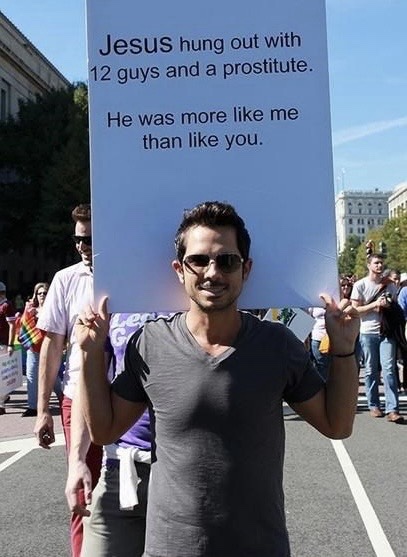
We cannot return that hatred as retribution. In Matthew 5:38-40, Jesus says, “You have heard that it was said, ‘Eye for eye, and tooth for tooth.’But I tell you, do not resist an evil person. If anyone slaps you on the right cheek, turn to them the other cheek also. And if anyone wants to sue you and take your shirt, hand over your coat as well.” Jesus goes on to say in Matthew 5:43-44, “You have heard that it was said, ‘Love your neighbor and hate your enemy.’ But I tell you, love your enemies and pray for those who persecute you.” I remember back in graduate school the hate group that call themselves Westboro Baptist Church came to my campus to protest and shout obscenities to those who they deemed unworthy of God’s love. A lot of people on campus staged a counter protest and engaged with these hateful people. I always felt that there was only one response to hate groups like Westboro Baptist Church, and that is to kneel and pray that God would deliver them from evil and show them the ways of His love. So, as I passed by, I stopped and said a prayer asking God to show them the light of his love. In my opinion, the best way to combat hatred is through love. If we show our love to those who hate us, then we are living by example, and isn’t that what Christianity is about? We are supposed to live by the example that Jesus set forth for us when he walked the earth. I have often seen the picture below of a gay man holding up a sign that says, “Jesus hung out with 12 guys and a prostitutes. He was more like me than you.” I’ve always loved that thought, because Jesus did live the way he wanted us to live.














 Joe
Joe




 The Closet Professor