The truthful lip shall be established forever, but a lying tongue is but for a moment.
—Proverbs 12:19
Over the years, I have had to deal with unscrupulous and disingenuous individuals, deceitful business practices, and those who attempt scam us for their personal gain. Other than losing someone you love, I think it’s one of the hardest things in life. Sometimes, we are able to see through the lies immediately and can do something about it.
Politicians lie to us every day, just look at a certain former president of the United States who lost an election by millions of votes, yet he continues to claim that the more than 7 millions of votes he lost by are fraudulent. Many in his party even support this lie. We all know that politicians are going to lie to get elected. I am skeptical of all politicians, because I don’t think any of them are completely honest all the time. However, we are able to vote against the ones who tell the most grievous and/or dangerous lies.
The internet has become a major source of modern day lies. We all get spammed by emails everyday phishing for our information and attempting to defraud us. Usually, spam emails are easy to spot and be marked as spam, and most email programs will even attempt to filter out spam messages. If you use dating apps, there are so many scammers, and you constantly have to look scrupulously at people on dating apps to see the signs of a scammer. Social media is constantly full of lies and misleading information. We have to be vigilant against such falsehoods and scams, but again, we can usually avoid these lies by paying attention to what we read.
But the lies that harm us on a personal level are the hardest to deal with. I think the most harmful is probably when loved ones lie to you, especially when your partner cheats on you. Luckily, I have never had to deal with that, but I’ve also had few long term relationships in my life. What can also be the most disheartening is when we trust someone in our lives maybe it’s someone you hired to work with you who turns out to not to be the person they led you to believe they were, or it’s someone you conduct business with that you find have lied to you.
John 8:31-32 says, “So Jesus said to the Jews who had believed him, ‘If you abide in my word, you are truly my disciples, and you will know the truth, and the truth will set you free.’” Sadly though, while the “truth will set you free,” it’s not something that comes quickly, and sometimes, it comes at great cost. There is a expression that may originate in a book written by Anthony Weldon in 1651, The Court and Character of King James: “The Italians having a Proverb, ‘He that deceives me once, it’s his fault; but if twice, it’s my fault.’” In other words, we have to learn from our mistakes.
None of us want to go through life constantly worried that someone is deceiving us. I haven’t often been in the position of being in the hiring decision process, though it’s become more frequent in the last several years. The first several times I was part of the hiring process, did not turn out well as I’d hoped. I misjudged the people. With one, the top job candidates was discovered to be a nightmare to work with before they were hired, and another one fooled me completely, and I’ve regretted trusting that the person was being genuine. They turned out to be the opposite of what they seemed. Now, I feel like I’ve lost my confidence in deciding on who is genuinely honest and who is good at playing a part by telling us what we want to hear.
The other lie I’m dealing with at the moment is because I trusted someone in an oral agreement, when I should have had it written on paper to have the proof I needed. I worked for an attorney for years, and I should have known not to take someone’s word for something but to make sure I got it in writing. In my defense, I was in an exceedingly difficult situation, and I felt trusting this person was my only option. Now, I feel like an idiot.
I don’t want to go through life never being able to trust anyone, but I’ve learned too many times, and to my detriment, that just because I’m an honest person, not everyone else is. Thankfully, I do have some very genuine people in my life that I can always count on to be honest and supportive. They are the ones who I believe were heaven sent.
I just pray that the world at large will one day be a more honest place. Sadly, I doubt it ever will be, but we can do something about it. Just as we can live our lives as model Christians, we can also make sure that we are also truth tellers. We may not always receive honesty in return, but if we are truthful, the truth will set us free. That freedom may only come in the next life, but if we live our lives by the Golden Rule, “whatever you want men to do to you, do also to them” (Matthew 7:12), our reward will be greater than anything that we can experience on this earth.
For I am persuaded that neither death nor life, nor angels nor principalities nor powers, nor things present nor things to come, nor height nor depth, nor any other created thing, shall be able to separate us from the love of God which is in Christ Jesus our Lord.
—Romans 8:38-39
Romans 8:38-39 are verses that every true Christian, especially LGBTQ+ Christians, should keep in their hearts. This is especially true of those that f us who were grew up in conservative and unwelcoming churches. When churches are unwelcoming, they drive people away when they should be opening their arms to all people, no matter their sexuality or race or any other defining characteristic that some people who call themselves Christians claim separate us from fellowship with God.
Oh, many of those same Christians will say, “Hate the sin, but love the sinner,” but those words mean nothing. It is still a hateful rejection because they are passing judgment when only God can pass judgment. In Matthew 7:1-2, Jesus says, “Judge not, that you be not judged. For with what judgment you judge, you will be judged; and with the measure you use, it will be measured back to you.” James in James 4:12 says, “There is one Lawgiver, who is able to save and to destroy. Who are you to judge another?”
God clearly tells us that man cannot and should not judge us by their own rules, and likewise, those man-made rules “nor any other created thing, shall be able to separate us from the love of God.” People may try to separate us from God’s love and try to make us believe that we are not worthy of God’s love, but nothing can separate us from God’s love.
Too many LGBTQ+ Christians have been driven from churches, have had hate shouted at them, or laws passed against them by people claiming to be doing God’s work while they are doing the opposite. When hate in any form becomes the defining character of a person or a church, they have not separated us from God, but they’ve have separated themselves from God.
Remember, nothing anyone says or does can separate us from God’s love. His love is as everlasting and unwavering as our love of God should be.
Love bears all things, believes all things, hopes all things, endures all things.
—1 Corinthians 13:7
First Corinthians 13, sometimes called the Love Chapter, has become one of the most famous chapters in the Bible. Since the Bible tells us that God is love (1 John 4:8), it is fitting that this beautiful description of love should be well-known. The apostle Paul used the word love nine times in this short chapter and colorfully and powerfully illustrated what it is and is not.
1 Corinthians 13
If I speak in the tongues of men and of angels, but have not love, I am a noisy gong or a clanging cymbal. And if I have prophetic powers, and understand all mysteries and all knowledge, and if I have all faith, so as to remove mountains, but have not love, I am nothing. If I give away all I have, and if I deliver my body to be burned, but have not love, I gain nothing.
Love is patient and kind; love is not jealous or boastful; it is not arrogant or rude. Love does not insist on its own way; it is not irritable or resentful; it does not rejoice at wrong, but rejoices in the right. Love bears all things, believes all things, hopes all things, endures all things.
Love never ends; as for prophecies, they will pass away; as for tongues, they will cease; as for knowledge, it will pass away. For our knowledge is imperfect and our prophecy is imperfect; but when the perfect comes, the imperfect will pass away. When I was a child, I spoke like a child, I thought like a child, I reasoned like a child; when I became a man, I gave up childish ways. For now we see in a mirror dimly, but then face to face. Now I know in part; then I shall understand fully, even as I have been fully understood. So faith, hope, love abide, these three; but the greatest of these is love.
Paul used the Greek word agape, one of several Greek words that can be translated love. Agape in the New Testament is used to describe the deep, constant, unselfish love that is God’s very nature. Agape is God’s love often described as “unconditional love” by Christians. It is unconditional in the sense that it does not depend on the one being loved, but on the commitment of the one who is loving. Love that is passive is not the most important kind of love, but it is the active love that we give others that is more powerful and true in God’s eyes.
Paul uses fourteen active verbs to describe love. Seven are positive statements about what love does, and the other seven are negative statements about what love does not do. In all cases, true Christian love is about setting one’s self aside for the good of other. Lack of love was at the heart of nearly all the problems Paul had confronted in his letter to the Corinthians.
Love is patient and kind. It actively waits and actively moves for the good of others. On the other hand, love doesn’t envy or boast, not even regarding the spiritual gifts of one’s self or others. Love is not arrogant, convinced of one’s superiority over others. Love is not rude, meaning that it does not act indecently, sinning, and breaking cultural norms to bring attention to one’s self.
Those who love like this have given up on seeking their own status and satisfaction first and foremost. Instead, they genuinely commit themselves to seeking good for others. Because of that, they don’t get irritable or provoked when other people get in their way. The other people are the point, not the obstacle. Love also means truly letting go of past hurts instead of storing them up and keeping a record or wrongs.
Love refuses to take any joy or pleasure from wrongdoing. Instead, it declares that which is true, and is worth celebrating above all. Love loves the truth. Love doesn’t set limits on love. Love does not declare, “This far and no further.” Love bears, or puts up with, all things for the good of other believers. That is true even if that means loving from a greater distance to avoid the active abuse of others. Just because a church may reject LGBTQ+ people does not mean that God does not love us, but that those who call themselves Christian but reject others are not doing God’s will. They are actively working against God, and sometimes we have to find other ways to worship and love God. We do that by actively loving others and not dwelling on rejection, because no true Christian would reject anyone.
Love believes all things, pushing the burden of truthfulness onto others instead of carrying the burden of uncovering falsehood. By rejecting someone and making love conditional, we are not showing love but hatred. Love doesn’t stop hoping for other believers to do good, no matter the evidence of the past. Just because many churches preach hate, does not mean that we can stop loving and worshipping God because others make us feel unwanted, but it means remaining faithful to God’s love against all odds. Love doesn’t quit when the trials of life pile up. Love keeps going.
God is love. God in His love wants us to welcome His love and guidance. Paul begins 1 Corinthians 13 by describing just how useless, even destructive, spiritual gifts are when not applied from the standpoint of love. He tells us that it doesn’t matter how pious we appear or how we display our spiritual gifts are worthless if not used as intended by God, out of a heart of love for Him and others. Even the most extreme selfless acts, such as selling everything to give to the poor and becoming a martyr in the name of God, gains a person nothing if not given in love. We can show all the things we do for others, but if it is not given in unconditional love, then it means nothing.
Paul sums it up: Love never fails. Christians may fail to love, as the Corinthians had demonstrated and many modern Christians do today, but God’s kind of love will always be effective and will last forever.
Historical Note about the Celebration of Love:
Wednesday is Valentine’s Day, and love is in the air. Saint Valentine is the name of one or two legendary Christian martyrs. Valentine was a popular name in ancient Rome, and there are at least 50 stories of different saints by that name. But the earliest surviving accounts of the two February 14 Valentines, written starting in the 500s, have a lot in common. Both were imprisoned for performing secret weddings and said to have healed a child during their captivity which led to the whole household’s conversion to Christianity. Both Saint Valentines were said to be executed on February 14 around the year 270 and buried along the same highway.
However, neither story mentions romance. In fact, Valentine’s Day only became associated with love in the late Middle Ages, thanks to the English poet Geoffrey Chaucer. No record exists of romantic celebrations on Valentine’s Day prior to a poem Chaucer wrote around 1375.
In his work “Parliament of Foules,” he links a tradition of courtly love with the celebration of St. Valentine’s feast day–an association that didn’t exist until after his poem received widespread attention. The poem refers to February 14 as the day birds, as well as humans, come together to find a mate.
If any of you lacks wisdom, let him ask of God, who gives to all liberally and without reproach, and it will be given to him.
—James 1:5
Each time I pray, I have always asked God to guide me because few of us, if any, know our purpose in life. We make decisions every day. It could be to decide a minor thing like whether we should text him back, or as momentous as whether we take a job and move our life to a place where no one knows our name. Do we take that step into the unknown. James 1:5 says, “If any of you lacks wisdom, let him ask of God, who gives to all liberally and without reproach, and it will be given to him.”
Sometimes, the decisions we make in life affect us for the rest of our lives; sometimes, they affect us only in the short term. As an LGBTQ+ person, one of our biggest decisions is when to come out to whom to tell our truth. Often, we do this with fear. Even though we might, we never know how someone will react. Will they love me as they always have? Will they look at me differently, good or bad? Will we see disgust and hatred in their eyes? Will they see compassion for the struggles we have endured to reach the decision to tell them this most significant part of our life?
John 16:33 tells us that “These things I have spoken to you, that in Me you may have peace. In the world you will have tribulation; but be of good cheer, I have overcome the world.” Jesus faced many difficulties on this earth, but he endured them for us. We, too, will face many difficulties, but with God’s guidance we can overcome those difficulties. Matthew 7:13-14 are verses that I think of often when making decisions, ““Enter by the narrow gate; for wide is the gate and broad is the way that leads to destruction, and there are many who go in by it. Because narrow is the gate and difficult is the way which leads to life, and there are few who find it.” It always reminds me to the Robert Frost poem “The Road Not Taken.” The poem is one that is familiar to many of us:
Two roads diverged in a yellow wood, And sorry I could not travel both And be one traveler, long I stood And looked down one as far as I could To where it bent in the undergrowth;
Then took the other, as just as fair, And having perhaps the better claim, Because it was grassy and wanted wear; Though as for that the passing there Had worn them really about the same,
And both that morning equally lay In leaves no step had trodden black. Oh, I kept the first for another day! Yet knowing how way leads on to way, I doubted if I should ever come back.
I shall be telling this with a sigh Somewhere ages and ages hence: Two roads diverged in a wood, and I— I took the one less traveled by, And that has made all the difference.
When we make decisions in life, we have to trust that God will guide us in the right direction. James 4:10 says, “Humble yourselves in the sight of the Lord, and He will lift you up.” There may be times when we will be devastated by our decisions, but even in those times, we learn something about ourselves. We will make mistakes. Romans 3:23 tells us, “for all have sinned and fall short of the glory of God.” But he will lift us back up if we ask and follow his guidance.
Just like when we come out and we are being our true selves, John 4:24 lets us know, “God is Spirit, and those who worship Him must worship in spirit and truth.” We have to live our truth and trust that God will be our guide.
Ask, and it will be given to you; seek, and you will find; knock, and it will be opened to you. For everyone who asks receives, and he who seeks finds, and to him who knocks it will be opened.
—Matthew 7:7-8
Have you ever had a time in your life when money was tight, and you wondered how you were going to make it to your next payday if you even had one on the horizon? Or maybe you or someone you loved had a health scare? At times in our lives, we all ask God for help. Matthew 7:7-8 should give all of us hope. But to be honest, while God has a plan for each of us, sometimes we don’t get what we want. I was always taught that when you ask for things in prayer, sometimes God’s answer is no. I think it’s more about asking for spiritual wealth or spiritual health, although spirituality won’t feed you when you’re hungry. Matthew 7:9-11 says, “Or what man is there among you who, if his son asks for bread, will give him a stone? Or if he asks for a fish, will he give him a serpent?If you then, being evil, know how to give good gifts to your children, how much more will your Father who is in heaven give good things to those who ask Him!” Then, Matthew 7:12 says the most important part of this passage, “Therefore, whatever you want men to do to you, do also to them, for this is the Law and the Prophets.”
In economics, there is a concept of “There is no such thing as a free lunch,” sometimes known by its acronym of TINSTAAFL. When I taught social studies at a high school, I had to teach economics. I hated it and barely understood it myself, but this was one of the concepts I understood. We get what we put into something, and even when something is free, it comes at a cost, but with God, “everyone who asks receives, and he who seeks finds.” We also have to remember to treat other people as we want to be treated. Too often, politicians, especially conservatives, don’t think like this. They want to be treated in a way that is opposite of what they do. Christians are sometimes also this way. They have a big fancy church or an over-paid minister, but if you look at how they treat others, they are doing the opposite of God’s work. They are not providing faith, love, charity, and hope, except for maybe people like them, but not those “others” that don’t fit into their idea of a Christian. The Golden Rule is really about equality. We must treat all people as equals, and you can only achieve this if you treat them as you want to be treated (unless you’re a masochist, then maybe not treat others as you want to be treated).
I am sure that most of those reading this blog worry about finances, because let’s face it, unless you’re a multi-millionaire or billionaire, you worry about financial stability. If you don’t worry about finances, then you probably worry about your health. We all have things we worry about, but God does have an answer for us. Philippians 4:6-7 says, “Be anxious for nothing, but in everything by prayer and supplication, with thanksgiving, let your requests be made known to God; and the peace of God, which surpasses all understanding, will guard your hearts and minds through Christ Jesus.” In Philippians, Paul reinforces the teachings of Christ, especially those laid out in the Sermon on the Mount and Sermon on the Plain, which are the core of Christ’s teachings. Matthew 7:7-12, which is part of the Sermon on the Mount, he tells us to ask God for help when we need it, and we will receive help.
If we continue the passage above from Paul’s letter to the church at Philippi, Philippians 4:8-9 says, “Finally, brethren, whatever things are true, whatever things are noble, whatever things are just, whatever things are pure, whatever things are lovely, whatever things are of good report, if there is any virtue and if there is anything praiseworthy—meditate on these things. The things which you learned and received and heard and saw in me, these do, and the God of peace will be with you.” We can have peace of mind if we follow Christ’s teachings and treat others as we want to be treated.
We have to treat all people the same We can’t help one person and refuse another because we deem them unworthy. All are worthy of equality. Galatians 3:28 says, “There is neither Jew nor Greek, there is neither slave nor free, there is neither male nor female; for you are all one in Christ Jesus.” James 1:22-25 tells us to be doers, not hearers. “But be doers of the word, and not hearers only, deceiving yourselves. For if anyone is a hearer of the word and not a doer, he is like a man observing his natural face in a mirror; for he observes himself, goes away, and immediately forgets what kind of man he was. But he who looks into the perfect law of liberty and continues in it and is not a forgetful hearer but a doer of the work, this one will be blessed in what he does.” So, let us take James’s advice and look into to the mirror. What do you see? Is it the person you want to be, and the person you should be? Are you a doer? Do you live a life that is an example to others? If not, then we need to reevaluate the way we live and not be someone who “forgets what kind” of person we are. We need to uphold the “law of liberty and continues in it.” Because if we do, we can make the world a better place.
I have no doubt that we all have our prejudices. Even within the LGBTQ+ community, prejudices make themselves known. Do you give someone a chance if you don’t find them attractive enough? Do you dismiss a potential partner because they are of a different race? Do you scoff at someone who is less fashionable? Or someone who is older? Or that someone is bisexual? Or overly flamboyant? Every letter of LGBTQ+ has others in the LGBTQ+ community who have prejudices against them. We have too many prejudices, and we must rid ourselves of them. The LGBTQ+ community can be a force of good. We’ve been making the world a better place for millennia. If only because of the art created by LGBTQ+ individuals, we have long contributed to making the world a better place, while we have often been persecuted. We cannot give up on trying to improve humanity and advocate equality. Let us do better as human beings. Let us be the better person and live a loving life that is an inspiration to others.
Trust in the Lord with all your heart and lean not on your own understanding; In all your ways acknowledge Him, And He shall direct your paths.
—Proverbs 3:5-6
Sometimes, I feel anxious and depressed. Even though I take an antidepressant, it doesn’t work all of the time. It seems to happen at this time of year when the days are shorter, and it’s often dark when I leave for work each day and dark when I get home. It’s probably seasonal affective disorder (SAD), a type of depression related to changes in seasons and begins and ends at about the same times every year. Usually it appears for me in January. It is thought that shorter days and less daylight may trigger a chemical change in the brain leading to symptoms of depression. One theory is that if you experience SAD in the winter, this part of your brain isn’t working in the same way. This could mean your body clock is out of sync with daylight, leading to tiredness and depression.
When we’re dealing with depression, it can sometimes be overwhelming or intimidating to seek help. After all, not everyone who has depression has the same symptoms. Feelings of depression can be a heavy burden, and many people make the mistake of thinking it’s a burden they must carry alone. This verse serves as a reminder that Jesus is there to lift your burdens and provide relief. Whether you’re experiencing sadness, a loss of interest in life, or noticing changes in your sleep, appetite, or energy levels, being honest and open about your mental health is often the first step to finding relief. And what’s more: Having depression is nothing to be ashamed of. According to the National Institute of Mental Health, an estimated 6.7 percent of the adult population has likely dealt with depression at some point in their lives. It’s important to know you’re not alone. First Peter 5:6-7 says, “Therefore humble yourselves under the mighty hand of God, that He may exalt you in due time, casting all your care upon Him, for He cares for you.” Depression and anxiety can be isolating experiences. But Jesus is there, and He cares about you. You can turn to Him for help with whatever you may be feeling.
I often look to the Bible when there are difficult times in my life. Matthew 11:28 says, “Come to Me, all you who labor and are heavy laden, and I will give you rest.” I did this when I was trying to figure out my sexuality because I had always been taught that God hates gay people, but Romans 8:38-39 says, “For I am persuaded that neither death nor life, nor angels nor principalities nor powers, nor things present nor things to come, nor height nor depth, nor any other created thing, shall be able to separate us from the love of God which is in Christ Jesus our Lord.” So, I researched what the Bible says about being gay, and found that most of the so-called “clobber passages” condemning homosexuality, were really not about being gay. It was men who had a prejudice against gay people that changed the meaning of words in the Bible to suit their own beliefs, but John 16:33 says, “These things I have spoken to you, that in Me you may have peace. In the world you will have tribulation; but be of good cheer, I have overcome the world.” I came to realize that Jesus knows I have and will in the future experience difficult times. These comforting words are a source of strength as I reflected on His love for all of us. Through faith, we can overcome the obstacles in our lives.
Proverbs 3:5-6 says, “Trust in the Lord with all your heart and lean not on your own understanding; in all your ways acknowledge Him, and He shall direct your paths.” When we are struggling with depression or other issues in your life, it can be difficult to understand why we’re feeling certain emotions and why bad things happen to us. Proverbs 3:5-6 reminds us that the way forward is by trusting the Lord to provide guidance. Things will look up. We must remember that through all the struggles in our lives, God has always been there. Joshua 1:9 says, “Have I not commanded you? Be strong and of good courage; do not be afraid, nor be dismayed, for the Lord your God is with you wherever you go.” Even if we’re struggling with depression and other concerns in our lives, God will continue to be by our side. Remembering this can empower us, and it reminds us that we are not alone. Even though Philippians 4:13 is more complex in context than its words seem to say, it is still something to always keep in mind: “I can do all things through Christ who strengthens me.” Depression can zap your energy and make it feel almost impossible to accomplish even simple tasks. But Philippians 4:13 reminds us that Christ is always there for us. Through him, we can find the will to get through even the darkest times.
In the beginning was the Word, and the Word was with God, and the Word was God.
—John 1:1
Today’s post is going to be a little bit different because I want to recommend a movie to you, the documentary, 1946: The Mistranslation that Shifted Culture. In this documentary, researchers and scholars delve into the 1946 mistranslation of 1 Corinthians 6:9 and explore how it fueled the Christian anti-gay movement that still thrives today. Homophobia did not originate in 1946; the vast majority of religions have been attacking LGBTQ+ people since the beginning of time. In my opinion, religions need numbers to survive and to get those numbers they need more than proselytizing; they need procreation. For the most part, the LGBTQ+ community stands in the way of this. However, homophobia received a huge boost with a mistranslation of the biblical text.
1946: The Mistranslation that Shifted Culture hinges its premise on the fact that the word “homosexual” appeared for the first time in the Bible in 1946, in an apparent mistranslation of the ancient Greek words malakoi – defined as someone effeminate who gives themselves up to a soft, decadent, lazy and indolent way of living – and arsenokoitai – a compound word that roughly translates to “male bed.” While people could take it to mean man bedding man, within the context of the time, scholars believed that arsenokoitai alluded more to abusive, predatory behavior and pederasty than it does homosexuality.
The director and producer Sharon “Rocky” Roggio documents the journey of the Christian author Kathy Baldock and Ed Oxford, an advocate and gay man who grew up Southern Baptist, as they dug through archives at the Yale Sterling Memorial Library. There, they discovered correspondence between the head of the translation committee and a gay seminary student in which the committee head conceded with the student’s point about the mistranslation. In the next translation in 1971, the committee changed the translation from homosexual to “sexual perverts” – but by then the damage was done. Hundreds of millions of Bibles with the wrong translation had been published, and conservative religion and conservative politics soon banded together to push an anti-gay agenda.
The documentary first premiered in 2022 and has won numerous festival awards. It is available to rent online but sadly, only through today (1/14/2024). A dear friend who I’ve talked to many times about being Christian and gay told me about its availability, and I watched it Friday for the first time. As I heard Roggio’s story and Oxford’s story of how he began to research to understand what the Bible was actually saying about Christianity both parallel my own. Roggio melded this research with her own personal story. When she was a teenager, her pastor father discovered that she was a lesbian and responded with a letter full of Bible verses imploring her to repent and forsake her identity. Her story mirrors mine in a way. We are roughly the same age, and her father discovered she was gay and confirmed his suspicions by reading her diary. My mother discovered I was gay and confirmed her suspicions by reading my email. Like my mother, her father won’t listen and continues to cling to a small section of the Bible because it fuels their prejudices. Like me, Oxford delved into research to understand the Bible better, and I still look to the Bible to guide my values of Christ’s love.
With the documentary, Roggio filmed her father attending talks by Baldock and overall standing by his belief that the Bible condemns homosexuality as a sin. “I can’t compromise conviction,” he says in the film. “Prior to even knowing about the 1946 mistranslation, I was led to it because I knew I needed to use scripture to be able to have a conversation with my parents to affirm my reality and my identity,” Roggio said. That didn’t make it easy for her. “I knew what my dad was going to give us,” Roggio said. “I have been around for a while and I’ve been dealing with this for a while and I’ve put up enough armor to be able to go back and have those conversations. And it was extremely painful, just as I’m sure it was painful for my dad.”
The documentary goes beyond this very personal story of Roggio and her father by focusing on academia and research, featuring interviews with language experts and biblical scholars to provide context not just for the mistranslated verse, but also the other “clobber” verses that have been cited by the Christian right as a condemnation of homosexuality. They explore Sodom and Gomorrah, and the historical context behind the Leviticus verse denouncing when “a man lies with a male as with a woman;” scholars believe the verse is not alluding to homosexuality but to ritual pagan prostitution. “What we need to do is see that this is a text that is time-bound, that is determined by the culture in which it was written, and that our sense of God, our sense of the Holy Spirit, isn’t time-bound,” the Rev. Dr. Cheryl Anderson says in the documentary. “We have to ask ourselves again: what’s the word of God for this time and this place? We’re not used to doing that, but that’s the task because that is what the Bible does. It’s reinterpreting itself.”
Between the research, however, Roggio wove in the emotional repercussions for all members of the LGBTQ+ community – showing what it meant to feel as if they had been declared an abomination by sacred text and to grow up hearing that even God doesn’t love you. Oxford has a poignant moment in the film where he admits that even as outspoken as he has been on the topic of religion and sexuality, he has not been able to allow himself to experience intimacy with anyone. “I don’t get depressed about damaging theology anymore,” he says. “I have been damaged and I get depressed over how that affects me today, the here and the now.”
Because for gay Christians like Roggio, this mistranslation means everything. It means that “no one can dictate your relationship with God,” she said. “We’ve been told how we have to live as Christians, by putting away our identity, a part of ourselves. But you can totally be gay and Christian.” But the film’s findings also hold significance beyond Christianity. “Whether you’re Christian or not, or whether you’re religious or not, the Bible impacts you,” said Roggio. “It’s the most published book in the world, translated into multiple languages for millennia.”
Behold, I will bring it health and healing; I will heal them and reveal to them the abundance of peace and truth.
— Jeremiah 33:6
After four years and every Covid vaccine available, it finally caught up to me. I’ve had a cold that started Friday evening. This morning, I was feeling worse, so, I took a home Covid test. It was pretty definitely positive. I scheduled a visit through my insurance company to see a virtual doctor this morning. If she is able to prescribe Paxlovid, I’m not sure that I’ll be able to get to the pharmacy. We are in the middle of a major snowstorm and expected to get 9” of snow throughout the day. The snow isn’t expected to stop until 5 pm which is when the pharmacy closes. I’ll just have to wait and see how the day goes.
When I was a child, I spoke as a child, I understood as a child, I thought as a child; but when I became a man, I put away childish things.
— 1 Corinthians 13:11
As 2023 comes to an end and we look towards 2024, many of us will look back on the last year, some with fond memories, some with hurtful memories, and others with just memories. It’s the time of year when many will make resolutions; things they will do better in the new year. Several years ago, I quit trying to make resolutions. I found they were too hard to keep, and instead of waiting for the old year to end and the new to begin for time to make changes, I decided that change had to come when I was ready. The verse above, 1 Corinthians 13:11, says, “When I was a child, I spoke as a child, I understood as a child, I thought as a child; but when I became a man, I put away childish things.” This is more than just Paul telling us to grow up and be mature, I think of it as a way of saying “out with the old, in with the new.” Ephesians 4: 22-24 tells us to “put off, concerning your former conduct, the old man which grows corrupt according to the deceitful lusts, and be renewed in the spirit of your mind, and that you put on the new man which was created according to God, in true righteousness and holiness.”
I want to put those verses into context. The full passage is sometimes referred to as “The New Man” and is Ephesians 4:17-24 which says:
“This I say, therefore, and testify in the Lord, that you should no longer walk as the rest of the Gentiles walk, in the futility of their mind, having their understanding darkened, being alienated from the life of God, because of the ignorance that is in them, because of the blindness of their heart; who, being past feeling, have given themselves over to lewdness, to work all uncleanness with greediness.
“But you have not so learned Christ, if indeed you have heard Him and have been taught by Him, as the truth is in Jesus: that you put off, concerning your former conduct, the old man which grows corrupt according to the deceitful lusts, and be renewed in the spirit of your mind, and that you put on the new man which was created according to God, in true righteousness and holiness.”
In the last few years, more and more states have attacked the rights of the LGBTQ+ community, especially the trans in our community, with hateful and hurtful laws. We are told that we “should no longer walk as the rest of the Gentiles walk, in the futility of their mind, having their understanding darkened, being alienated from the life of God, because of the ignorance that is in them, because of the blindness of their heart; who, being past feeling, have given themselves over to lewdness, to work all uncleanness with greediness.” Here Paul describes their minds as being futile and darkened, leading them away from God because of their ignorance. In my opinion, ignorance is better described as willful ignorance because people don’t want to know the truth. If you look at the books that are banned, they don’t only want to be ignorant of the real issues, but they also want to make sure others are ignorant of the issues. I know it’s cliché to say, but “knowledge is power” and “the pen is mightier than the sword,” but if knowledge and the written word are banned, then it is not mightier unless we fight censorship.
But it’s not just ignorance that Paul brings to the attention of the Corinthians. He says, that they have “blindness of their heart; who, being past feeling, have given themselves over to lewdness, to work all uncleanness with greediness.” Paul is warning against hardening our hearts and losing our sensitivity or empathy. He warns us not to be “overtaken by lewdness and greed.” Lewdness is subjective for a lot of people and can’t always be defined, but greed is definable. It is not only selfishness, but it is also denying help to others. In 1 Corinthians 13:13, Paul says, “And now abide faith, hope, love, these three; but the greatest of these is love.” The New King James Bible uses the word love, but the King James Bible it is not love but charity: the greatest of these is charity. Does the distinction matter? I don’t think so because, without a charitable heart, there is no love.
So, as the old year ends and the new year begins, instead of resolutions, let us look at ourselves in the mirror and ask, “Do I live my life the way Jesus would want me to live?” I am not talking about manmade morality standards, but those of Jesus. Have we alienated ourselves from God through ignorance? Have we blinded our hearts? Have we given over to lewdness? Have we become unclean because of greed? If you have, then look at that image in the mirror and tell yourself to change. We need to open up our minds and guard against the censorship of others. We need to open up our hearts to charity and love for all mankind, not just those who look or act like us. As for lewdness, I much prefer to not be crass for the sake of being crass, but you can define that how you want. What do you consider lewdness? and how can you guard against it? Are you judging others for lewdness because of manmade standards and prejudices? We need to be more charitable to others. Remember, love and charity are interchangeable in the Bible.
We can be virtuous in the new year. If we believe in God, we have faith. Believing in God and trying to make the world a better place gives us hope. If we do what we can to help others through love and charity, then we have the third virtue. We don’t need our resolutions to be walking so many steps a day or losing weight, giving up cake or something else that we feel bad about consuming, but our resolutions should be broader: what can I do to make myself a better person so that I can make the world a better place.
And it came to pass in those days, that there went out a decree from Caesar Augustus that all the world should be taxed. (And this taxing was first made when Cyrenius was governor of Syria.) And all went to be taxed, everyone into his own city.
And Joseph also went up from Galilee, out of the city of Nazareth, into Judaea, unto the city of David, which is called Bethlehem; (because he was of the house and lineage of David) to be taxed with Mary his espoused wife, being great with child. And so it was, that, while they were there, the days were accomplished that she should be delivered. And she brought forth her firstborn son, and wrapped him in swaddling clothes, and laid him in a manger; because there was no room for them in the inn.
—Luke 2:1-7
The Shepherds and the Angels
And there were in the same country shepherds abiding in the field, keeping watch over their flock by night. And, lo, the angel of the Lord came upon them, and the glory of the Lord shone round about them: and they were sore afraid. And the angel said unto them, “Fear not: for, behold, I bring you good tidings of great joy, which shall be to all people. For unto you is born this day in the city of David a Saviour, which is Christ the Lord. And this shall be a sign unto you; Ye shall find the babe wrapped in swaddling clothes, lying in a manger.”
And suddenly there was with the angel a multitude of the heavenly host praising God, and saying,
“Glory to God in the highest, and on earth peace, good will toward men.”
And it came to pass, as the angels were gone away from them into heaven, the shepherds said one to another, “Let us now go even unto Bethlehem, and see this thing which is come to pass, which the Lord hath made known unto us.”
And they came with haste, and found Mary, and Joseph, and the babe lying in a manger. And when they had seen it, they made known abroad the saying which was told them concerning this child. And all they that heard it wondered at those things which were told them by the shepherds.
But Mary kept all these things and pondered them in her heart. And the shepherds returned, glorifying and praising God for all the things that they had heard and seen, as it was told unto them.
And when eight days were accomplished for the circumcising of the child, his name was called JESUS, which was so named of the angel before he was conceived in the womb.
—Luke 2:8-21
The Three Wise Men
Now when Jesus was born in Bethlehem of Judaea in the days of Herod the king, behold, there came wise men from the east to Jerusalem, saying, “Where is he that is born King of the Jews? for we have seen his star in the east, and are come to worship him.”
When Herod the king had heard these things, he was troubled, and all Jerusalem with him. And when he had gathered all the chief priests and scribes of the people together, he demanded of them where Christ should be born. And they said unto him, “In Bethlehem of Judaea: for thus it is written by the prophet,
“And thou Bethlehem, in the land of Juda, art not the least among the princes of Juda: for out of thee shall come a Governor, that shall rule my people Israel.”
Then Herod, when he had privily called the wise men, enquired of them diligently what time the star appeared. And he sent them to Bethlehem, and said, “Go and search diligently for the young child; and when ye have found him, bring me word again, that I may come and worship him also.”
When they had heard the king, they departed; and, lo, the star, which they saw in the east, went before them, till it came and stood over where the young child was. When they saw the star, they rejoiced with exceeding great joy. And when they were come into the house, they saw the young child with Mary his mother, and fell down, and worshipped him: and when they had opened their treasures, they presented unto him gifts; gold, and frankincense and myrrh. And being warned of God in a dream that they should not return to Herod, they departed into their own country another way.
—Matthew 2:1-12
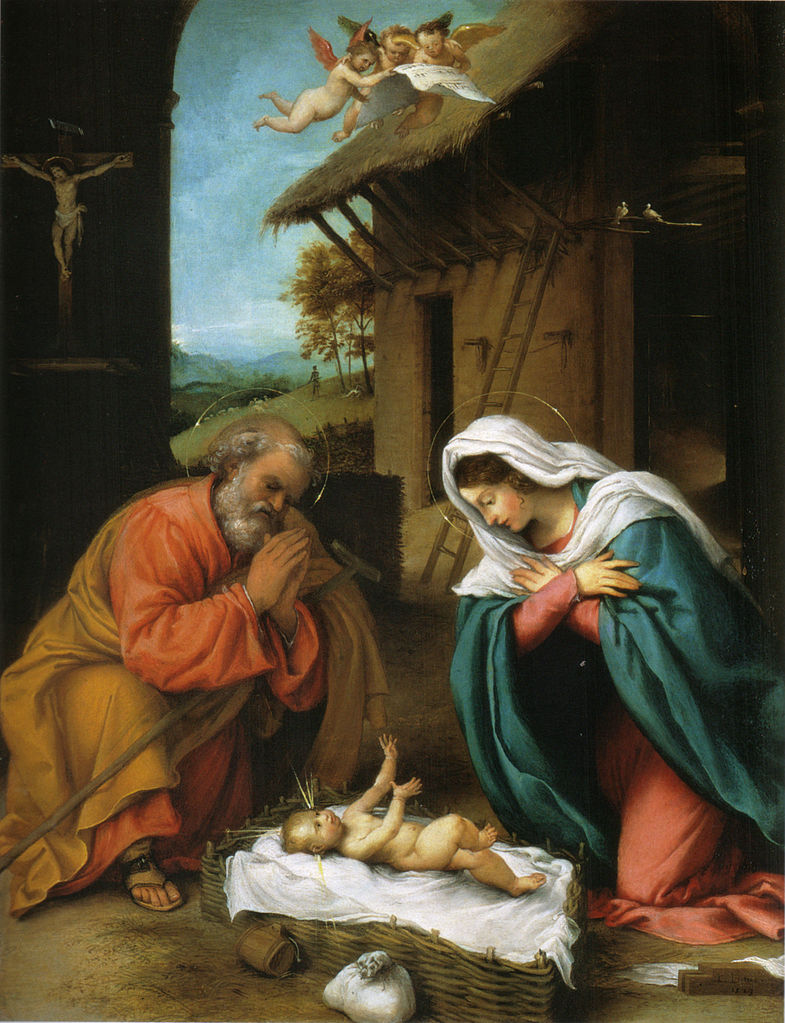
The New Testament contains two Christmas stories, not one. They appear in Matthew 1–2 and Luke 1–2. They have some points in common. However, there are many differences in their characters, plot, messages, and tone. In the verses above, I have chosen only to use the verses directly related to Christ’s birth, the shepherds, and the Magi (the three wise men). In the Christmas story, we all know, that Mary and Joseph travel from Nazareth to Bethlehem to be counted in a census so Rome can levy taxes throughout the empire. Once they get to Bethlehem, they find that there is no room in the inn and the baby Jesus is born in a stable and placed in a manger. His humble birth is celebrated by choirs of angels and shepherds, and he is given precious gifts by the mysterious Magi. This version freely blends material from the two biblical accounts. It has become enshrined in Christmas carols, nativity scenes, and readings during the Christmas season.
Matthew wrote his Gospel in the late first century CE, perhaps in Antioch. He was a Jewish Christian writing primarily for other Jewish Christians. He wanted to show that the legacy of biblical Israel was best fulfilled in the community formed around the memory of Jesus of Nazareth. Now that the Jerusalem temple had been destroyed and Roman control over Jews was even tighter, all Jews had to face the question: how is the heritage of Israel as God’s people to be carried on? Matthew’s answer lay in stressing the Jewishness of Jesus. This setting helps to explain why Matthew told his Christmas story as he did. He begins with a genealogy that relates Jesus to Abraham and David, while including several women of dubious reputation who nonetheless highlight the new thing God was doing in Jesus. Next, he explains how the virginal conception of Jesus through the Holy Spirit fulfilled Isaiah’s prophecy (7:14), and how Jesus the Son of God became the legal Son of David through Joseph. Besides Jesus, Joseph is the main character in Mathew’s Christmas story. Guided by dreams like his biblical namesake, he is the divinely designated protector of Mary and her child Jesus.
The Magi story in Matthew 2 is part of a larger sequence that involves danger for the newborn child and his parents. When King Herod hears about the child “King of the Jews” as a potential rival for his power, he seeks to have Jesus killed. As a result, the family flees to Egypt, while Herod orders the execution of all boys under two years old in the area of Bethlehem. Only after Herod’s death does the family return to the Land of Israel, though to Nazareth rather than Bethlehem. At each point in their itinerary, the family is guided by dreams and texts from the Jewish Scriptures. In his Christmas story, Matthew wants us to learn who Jesus is (Son of Abraham, Son of David, Son of God) and how he got from Bethlehem to Nazareth. Thus, he establishes the Jewish identity of Jesus, while foreshadowing the mystery of the cross and the inclusion of non-Jews in the church. The tone is serious, somber, and foreboding.
Luke wrote his Gospel about the same time as Matthew did (but independently), in the late first century CE. He composed two volumes, one about Jesus’ life and death (the Gospel of Luke), and another about the spread of Christianity from Jerusalem to Rome (Acts of the Apostles). In Luke’s narrative, there are many characters besides Jesus: Zechariah and Elizabeth, John the Baptist, Mary, and Simeon and Anna, as well as various angels and shepherds. These figures represent the best in Jewish piety. Thus, Luke creates an ideal picture of the Israel into which Jesus was born. Furthermore, Luke seems intent on comparing John the Baptist and Jesus. His point is that while John is great, Jesus is even greater. So, the announcement of John’s birth as the forerunner of the Messiah is balanced by the announcement of Jesus’ birth as the Son of the Most High (1:5-25; 1:26-56). And so, the account of John’s birth and naming is balanced by the birth and naming of Jesus as Savior, Messiah, and Lord (1:57-80; 2:1-40).
Luke portrays Jesus and his family as observant with regard to Jewish laws and customs. With his narrative, Luke wants to root Jesus in the best of Israelite piety, while hinting at Jesus’ significance for all the peoples of the world. That is why Luke’s genealogy of Jesus (3:23-38) goes back beyond Abraham all the way to Adam. Luke’s infancy narrative has provided the framework for the traditional “Christian story.” Its tone is upbeat, celebratory, and even romantic.
Since the beginning of Christianity, there has been a debate about when Jesus was born. Why do we celebrate Jesus’s birth on December 25? The simplest answer is that early Christian leaders incorporated known holidays with Christian holidays: the Winter Solstice/Christmas, the Spring Equinox, etc. Not everyone agrees on the date being December 25th. In the third century, the date of birth of Jesus was a subject of great interest, with early Christian writers suggesting various dates. Around AD 200, Clement of Alexandria wrote:
There are those who have determined not only the year of our Lord’s birth, but also the day; and they say that it took place in the 28th year of Augustus, and in the 25th day of [the Egyptian month] Pachon [May 20] […] Further, others say that He was born on the 24th or 25th of Pharmuthi [April 20 or 21].
A late fourth-century sermon by Saint Augustine explains why the winter solstice was a fitting day to celebrate Christ’s birth:
Hence it is that He was born on the day which is the shortest in our earthly reckoning and from which subsequent days begin to increase in length. He, therefore, who bent low and lifted us up chose the shortest day, yet the one whence light begins to increase.











 Joe
Joe





 The Closet Professor