For I know the thoughts that I think toward you, says the Lord, thoughts of peace and not of evil, to give you a future and a hope.
—Jeremiah 29:11
How many of you have made New Year’s resolutions? The real question is:
How many of you have already blown New Year’s resolutions?
I have read that in America, 25 percent of us blow or discard our resolutions by the end of the first day. Change can be so difficult that even people who want to change will most likely fall back into old patterns and not make change permanent. For this reason, I never make New Year’s resolutions. I have goals I want to work towards to better myself, but I do this all year long and don’t need a special day to do so.
Permanent change can be very difficult because we continue to hang around people who knew us before the change—we maintain old patterns in life that don’t want encourage change. Not many people like change. I know I don’t, but sometimes it’s necessary.
We also tend to compartmentalize ourselves. I think, for a lot of LGBTQ+ people we’ve been taught to keep parts of ourselves separated. And it makes sense because it helps us to survive. It helps us to make it through until we’re ready to come out, to deal with unaffirming family, or to keep ourselves safe when we’re out in public.
We get so used to doing this separation that we don’t even notice it anymore. And yet, at some point this compartmentalism stops serving us. It’s not a healthy way to live. You’re constantly trying to remember how to act in different situations when you should just be yourself.
The new year is here. Look at yourself. Are you the person you want to be? Are you being honest about who you are? If you have compartmentalized your life to the extent that it has become unhealthy, admit that it’s time for a change. I’m not going to say to make resolutions, but I do think we should set goals. Start out slow and integrate all parts of your life into one identity. Be intentional about taking steps towards the coming future. No matter what, refuse to let anything pull you back.
And it came to pass in those days that a decree went out from Caesar Augustus that all the world should be registered. This census first took place while Quirinius was governing Syria. So all went to be registered, everyone to his own city.
Joseph also went up from Galilee, out of the city of Nazareth, into Judea, to the city of David, which is called Bethlehem, because he was of the house and lineage of David, to be registered with Mary, his betrothed wife, who was with child. So it was, that while they were there, the days were completed for her to be delivered. And she brought forth her firstborn Son, and wrapped Him in swaddling cloths, and laid Him in a manger, because there was no room for them in the inn.
Now there were in the same country shepherds living out in the fields, keeping watch over their flock by night. And behold, an angel of the Lord stood before them, and the glory of the Lord shone around them, and they were greatly afraid. Then the angel said to them, “Do not be afraid, for behold, I bring you good tidings of great joy which will be to all people. For there is born to you this day in the city of David a Savior, who is Christ the Lord. And this will be the sign to you: You will find a Babe wrapped in swaddling cloths, lying in a manger.”
And suddenly there was with the angel a multitude of the heavenly host praising God and saying:
“Glory to God in the highest, And on earth peace, goodwill toward men!”
So it was, when the angels had gone away from them into heaven, that the shepherds said to one another, “Let us now go to Bethlehem and see this thing that has come to pass, which the Lord has made known to us.” And they came with haste and found Mary and Joseph, and the Babe lying in a manger. Now when they had seen Him, they made widely known the saying which was told them concerning this Child. And all those who heard it marveled at those things which were told them by the shepherds. But Mary kept all these things and pondered them in her heart. Then the shepherds returned, glorifying and praising God for all the things that they had heard and seen, as it was told them.
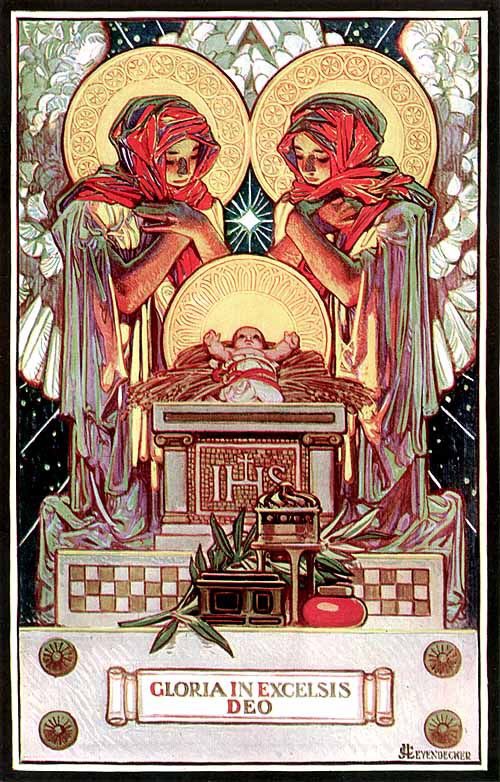
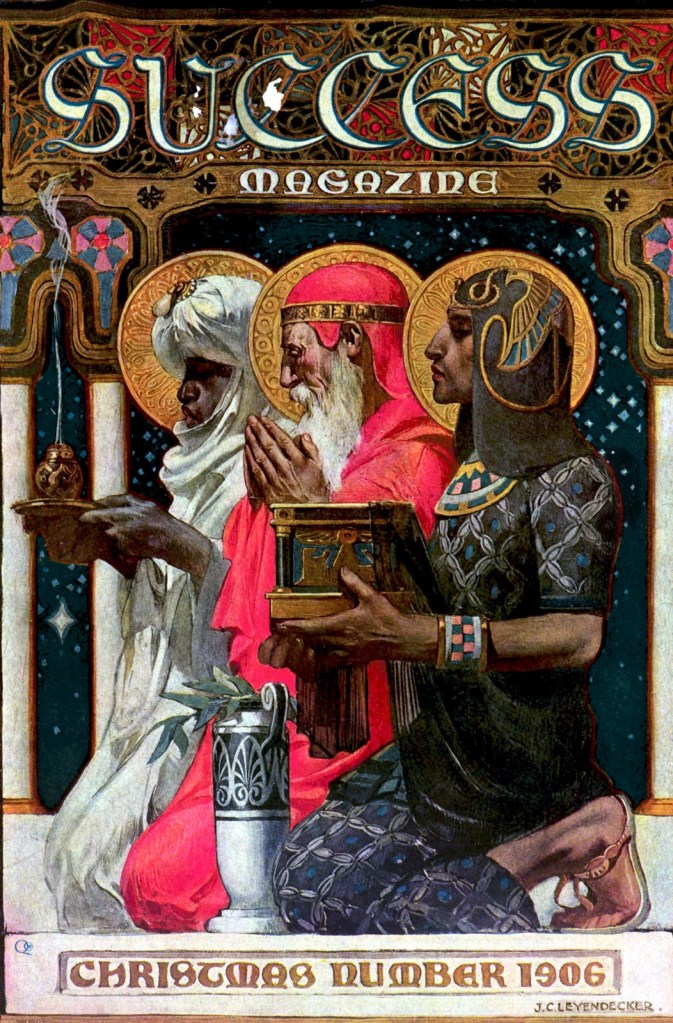
I want to thank Rick for the lovely Christmas image above by the gay artist JC Leyendecker.
On coming to the house, they saw the child with his mother Mary, and they bowed down and worshiped him. Then they opened their treasures and presented him with gifts of gold, frankincense, and myrrh. And having been warned in a dream not to go back to Herod, they returned to their country by another route.
– Matthew 2:11-12
I love getting emails from Queer Theology. They always make me think, and sometimes they become inspiration for my Sunday posts. This week’s devotional is so perfectly worded, that I did not need to adapt it to my experiences. Often, their emails are geared more towards transgender individuals but can be adapted for all of us. Like I stated before, this one needed no adaptation, but there were a few things I wanted to add to it, so you will see that in italics. The rest was written by Brian G. Murphy, the Co-Founder of Queer Theology. As a historian, I find the story of the wise men to be particularly fascinating, mostly because of the inaccuracies most often portrayed in imagery of the wise men. At the end, you will see my own commentary about the wise men.
The nativity story has a message that LGBTQ+ Christians (and our allies) need to hear.
The scene of the “wise men” coming to visit the baby Jesus is imprinted on our collective consciousness—whether from church pageants or Christmas movies or front yard nativity scenes. In most tellings of this tale, the wise men are supporting characters. They are there to reinforce the magnificence of Jesus. They arrive and then they disappear, never to be heard from again. The story of Matthew’s Gospel follows Jesus, not these travelers.
But let’s stick with them for a moment.
These Magi (whom patriarchy reinterprets as men) see a new star in the sky and are moved to find out what it means.
They set out to find the one whose birth the star announces. And they find Jesus.
The author of Matthew’s Gospel is laying out his case that right from the beginning, there was something special about Jesus. Even Magi in a foreign land recognized him as King of the Jews. Jesus, not Caesar, is king, the gospel writer is emphasizing here; a treasonous claim.
The wise travelers could have encountered the baby Jesus and gone back home, from whence they came. That’s what many of us do. For instance, we are stirred to attend a Black Lives Matter march or Pride protest by current events, and then a few months later, our lives slide back to normal.
That’s not what happens here, though. The Magi have an encounter with Jesus that so transforms them that they cannot possibly go home the way they came. They are changed. They “returned by another route.”
Has that happened to you? You encountered something so meaningful that you could not help but be changed by it? Your life could not help but be eternally altered?
Perhaps it was the first time you met a transgender person and you realized “Hot damn! That could be me?!”
Or maybe it was an injustice that cemented your calling as an activist or ally.
Perhaps it was your first queer kiss, when you realized there was no denying it any longer.
We are all shaped by our life experiences. With a little bit of distance, we can sometimes see just how big a difference the smallest moment made. In the hustle and bustle of life, it’s easy to miss them, to let them pass by without a second thought.
What if you took some time to see—truly see—the moments that shaped you? To think about that time on the dance floor or the church retreat or the picket line or summer camp or whatever it might be for you. And to name it holy. To remember that there you encountered the divine and were forever changed. (Want some help seeing how the Gospel is queer? Check this out)
These moments aren’t limited to your past. There are “manger moments” waiting ahead of you, if only you’ll pay attention. If only you’ll see the star in the sky and follow your curiosity and see where it leads and be open to being transformed by what you find there.
Traditional nativity scenes depict three “Wise Men” visiting the infant Jesus on the night of his birth in a manger accompanied by the shepherds and angels, but this should be understood as an artistic convention allowing the two separate scenes of the Adoration of the Shepherds on the birth night and the later Adoration of the Magi to be combined for convenience. The single biblical account in Matthew 2 simply presents an event at an unspecified point after Christ’s birth in which “wise men” visits Him in a house, not a stable. The text also does not specify the length of time between the birth of Christ and the Magi’s visit. Artistic depictions and the closeness of the traditional dates of December 25 and January 6 (Epiphany or Three Kings’ Day) encourage the widespread assumption that the visit took place the same winter as the birth, but later traditions varied, with the visit taken as occurring up to two winters later. This maximum interval explained Herod’s command in Matthew 2:16–18 that the Massacre of the Innocents included boys up to two years old. It’s always been my belief that the Magi visited Jesus sometime before he turned two years old.
Many of the stories we so popularly see about the Magi depicted in paintings and nativities are most likely inaccurate. Even the name “magi” was conceived later. The “wise men” may have been magi, and if they were, they were priests from another monotheistic religion. The term “magi” refers to the Persian priestly caste of Zoroastrianism. These priests paid particular attention to the stars as part of their religion. They gained an international reputation for astrology, which was at that time highly regarded as a science, and the reason why they would have seen the Star of Bethlehem as a sign of a significant birth, that birth being the King of Kings, the Jewish Messiah.
Although the Magi are commonly referred to as “kings,” nothing in the account from the Gospel of Matthew implies that they were rulers of any kind. The identification of the Magi as kings is linked to Old Testament prophecies that describe the Messiah being worshipped by kings in Isaiah 60:3, Psalm 68:29, and Psalm 72:10, which reads, “Yea, all kings shall fall down before him: all nations serve him.” Early readers reinterpreted Matthew in light of these prophecies and elevated the Magi to kings.
The New Testament does not give the names of the Magi nor how many Magi visited Jesus. There is no evidence that there were three wise men. This belief has always been conjectured from the three gifts given to Christ. There had to be at least two because the gospel uses the plural, but the exact number is never specified. However, traditions and legends identify a variety of different names for them. In the Western Christian church, they have all been regarded as saints and are commonly known as Melchior, a Persian scholar; Caspar; and Balthazar, a Babylonian scholar. According to Western church tradition, Balthasar is often represented as a king of Arabia or sometimes Ethiopia, Melchior as a king of Persia, and Gaspar as a king of India.
I could also go into detail about the reasoning behind the three gifts, gold, frankincense, and myrrh; however, I’ve gone on about the Magi for too long already. It does, however, show that what we commonly believe about the birth of Christ has little to do with what is in the Bible. Many Churches of Christ, including the one I grew up in, do not celebrate Christmas (though we did outside of church, just not as part of an official church gathering). The date of Jesus’ birth is not given, and it could just as easily been in the summer as in the winter. The celebration of Christmas started in Rome about 336 CE, but it did not become a major Christian festival until the 9th century. The origins of Christmas stem from both the pagan and Roman cultures. The Romans actually celebrated two holidays in the month of December. The first was Saturnalia, which was a two-week festival honoring their god of agriculture Saturn. On December 25th, they celebrated the birth of Mithra, their sun god. The early Church used the dates of local traditions, holidays, and festivals to set dates for religious holidays as a way to appeal to a wider group of people.
“Moreover, if your brother sins against you, go and tell him his fault between you and him alone. If he hears you, you have gained your brother.”
—Matthew 18:15
I am a people pleaser. It’s ultimately why I am going home this year for Christmas. I am sure that I am not the only one who is enough of a people pleaser who find themselves with a difficult family over the holidays. I am just going to do my best to not let my temper get the better of me. Proverbs 15:1 says, “A soft answer turns away wrath, but a harsh word stirs up anger.” So, I will try to keep my answers soft and avoid stirring up anger. However, I know I can be pushed too far, and no matter how much I try, I won’t be able to keep my mouth shut
Yet, I am a people pleaser at heart. Being a southerner who believes in being a gentleman with good manners, I was doomed to be a people pleaser. Even if I don’t like the person, I hate them being upset with me. Sometimes, this is to my own detriment. I tried my best to please my family for over forty years, but I never have been able to, and I doubt I ever will. I have said this before, but I feel like I wasted much of my life trying to please others. If I am going to please others, I’d rather do it in a more intimate way that I will also enjoy, if you know what I mean. But I am getting off subject.
Whenever conflicts arise, I most often do my best to make it go away. I will take back what I just said, I’ll change the subject, I’ll even apologize, whatever it takes. Which often meant that even in situations where I should be leaning into a conflict; situations where I am standing up for someone or when I should be standing up for myself, I instead try to appease the other person so I can make my own discomfort go away.
I’ve learned to be more assertive and to do what is right for me, not what everyone else thinks is right for me. I am not completely there yet, though I am genuinely trying. Even so, I still feel that sometimes it’s best to just surrender or at least compromise to keep the peace. In the Star Trek: Deep Space Nine episode “The Way of the Warrior,” Worf tells the Chancellor Gowron of the Klingon Empire, “Kahless himself said, ‘Destroying an empire to win a war is no victory…'” The same is true for us in life, destroying ourselves to prove a point or win an argument is no victory. Compromise is sometimes necessary, but sometimes compromise is also not an option. This can be true in politics also, but again that’s a discussion for another time.
Over the years I’ve gotten a lot better about not immediately acquiescing. Now if I get a text, call, or email that sends my heart rate through the roof I wait before replying. If someone says something that hurts my feelings, I am more likely not going to say anything, but my passive aggressive southern nature usually will come out. A pointed stare can say much more than words ever could. I learned that as a teacher. However, I do try to listen more to my feelings, and so, I don’t always shove them aside just to make other people happy.
I am becoming much better about standing up for myself, especially at work. When I feel strongly about being wronged or have a strong opinion that goes against the grain, I craft a thoughtful email response that lays out my thoughts on the matter or decide exactly what I am going to say in person before I say it to my boss. I usually let someone else read over the email before I send it, and I have some people I use as a sounding board for when I know it has to be done verbally. It can be hard, but my boss is also a people pleaser who is also averse to conflict, so he knows that if I buck the system, I have thought long and hard about it and I am very serious. Usually, he seems my side of things.
I think we all have to take up for ourselves. We can’t always be a pushover or try to please everyone. At some point we have to stand up for ourselves and for what is right. It’s always best to be honest. Psalm 34:13 says, “Keep your tongue from evil, and your lips from speaking deceit.”
And not only that, but we also glory in tribulations, knowing that tribulation produces perseverance; and perseverance, character; and character, hope.
—Romans 5:3-4
In 2015, I felt like my world fell apart. While ultimately it didn’t actually fall apart, my life was changed irreparably, some of that has been for the better, you might even say, they were a blessing, just in disguise at the time. Three major events happened in my life that made significant impacts on my life: losing my teaching job, finding a new job 1200 miles away, and suddenly and tragically losing one of the best friends I’ve ever had. The first two turned out to be a blessing. The third sent me into a tailspin that nearly destroyed me.
I have never been one to go to church very often without being forced. However, my faith is strong. When I began to question my sexuality, I did not turn away from God. I turned to God for answers. I prayed and meditated. I questioned my sexuality, but not my faith in God. There have been a number of events in my life that did not go as planned, but I always told myself that I was on the path God had planned for me. I faithfully prayed that God would show me the path that he wanted me to follow. Proverbs 3:5-6 says, “Trust in the Lord with all your heart and lean not on your own understanding; in all your ways acknowledge Him, and He shall direct your paths.” My journey to discover my sexuality has been part of that path. Many things have led me to where I am today: an accepting, gay Christian. I am who God created, and I work hard to be the person God wants me to be.
However, my faith did waiver once in my life. I almost lost all faith in God when my friend died just over seven years ago. I broke down completely. I had moved to Vermont away from my family, who at the time I believed were my support system. I have found that is not really the case. In fact, if it not been for Susan, I doubt I’d have survived this period in my life. See, I hate talking on the phone, but Susan is a willful woman, and I love her for it. She insisted that we talk on the phone. Now, we talk every day. Had she not insisted that we talk, I would have been alone. She carried me through that time in my life, and I will never be able to thank her enough. Many of you know the poem “Footprints”, also known as “Footprints in the Sand.” If you don’t, here is one version of it:
One night I dreamed a dream. As I was walking along the beach with my Lord. Across the dark sky flashed scenes from my life. For each scene, I noticed two sets of footprints in the sand, One belonging to me and one to my Lord.
After the last scene of my life flashed before me, I looked back at the footprints in the sand. I noticed that at many times along the path of my life, especially at the very lowest and saddest times, there was only one set of footprints.
This really troubled me, so I asked the Lord about it. “Lord, you said once I decided to follow you, You’d walk with me all the way. But I noticed that during the saddest and most troublesome times of my life, there was only one set of footprints. I don’t understand why, when I needed You the most, You would leave me.”
He whispered, “My precious child, I love you and will never leave you Never, ever, during your trials and testings. When you saw only one set of footprints, It was then that I carried you.”
God doesn’t literally pick us up and carry us across the sands of time, but occasionally, he sends someone to carry us for him. For me, that someone was Susan. I felt adrift in life during that time.
In December 2015, I tried to write about my wavering faith. In one of my Sunday posts, I wrote:
These last two weeks have been so difficult. Why did God take my friend? Why would he let something so tragic happen to someone with such a beautiful soul? Some terrible things had happened in my friend’s life when he was younger. His parents disowned him for being gay, which had nothing to do with religion but pure homophobia. God brought wonderful people into his life and helped him through those difficulties. My friend had a difficult time understanding how such a great and loving God could allow tragedies to happen. Whether those tragedies were accidents or caused by someone hatred or cause by natural disasters, he wondered how God could let those things happen. I never had a very good answer for him. He had suffered in his life because of his family’s rejection, and I’ve never been able to understand how they could be so cruel.
These past two weeks, I’ve struggled with the same issues. I can’t help but wonder how God could allow him to die in an accident, while his hateful parents continued to live on. I admit that it has made me so angry at God. Being angry at God just compounded my sadness because I felt guilty for being angry at God and questioning the faith I have in Him to protect and provide for us. God took this beautiful man (and I don’t mean in just physical beauty, which he was, but also in his soul.) He was beautiful and so kind. God took him away from not only me, but the rest of the people who’d considered him part of their family: his boyfriend and other friends. For me, he was more than a friend. He was family. He was my confidante, and he was my confessor. He was the younger brother I never had. There are so many wicked and hateful people in this world that God could have taken, but he took someone who had the purest heart I have ever known.
I almost turned my back on God. I could not understand, and honestly, I guess I never will understand why God allows bad things to happen to good and faithful people. There is a song we used to sing in church called “Farther Along.” The first verse and refrain say:
Tempted and tried we’re oft made to wonder, Why it should be thus all the day long; While there are others living about us, Never molested though in the wrong.
Farther along we’ll know all about it, Farther along we’ll understand why; Cheer up, don’t worry, live in the sunshine, We’ll understand it all by and by.
Like in the song, I came to believe that one day I’d understand why. However, for a couple of years after the death of my friend, I was an incredibly sad person. I could not even speak his name or talk about him without getting choked up and having tears in my eyes. I did not want to continue living. As my faith returned, so did my will to live.
There are three verses in the Book of James that used to puzzle me. James 2-4 says, “My brethren, count it all joy when you fall into various trials, knowing that the testing of your faith produces patience. But let patience have its perfect work, that you may be perfect and complete, lacking nothing.” James appears to be saying that when we face trials and tribulations, that we should “count it all joy” these tests of our faith. It’s sad to think that we have to face hardships just to make our faith stronger. Yet, I don’t think that is what James really meant. I think he is telling us that anything that strengthens our faith should be counted as joyful.
It doesn’t have to be tragedy, but any number of events in our lives that might strengthen our faith should be looked at as a blessing. God has his reasons for all things, but I guess I am a bit of a deist when it comes to this. Enlightenment philosophers and deists under the influence of Newtonian science tended to view the universe as a vast machine, created and set in motion by a Creator being that continues to operate according to natural law without any divine intervention. I think the natural world takes over and God does not intervene very much. If God intervened to stop evil and tragedy, we would be living in paradise, but that’s not how God works.
The death of my friend was a catalyst that began my questioning of God, but it also led me to trying to know God better. I had lost the anchor that was the conservative Christian faith I had been raised to believe was the only path to heaven. When I lost that anchor, I wasn’t quite sure how or where I fit. I felt disconnected from my values, disconnected from my faith, disconnected from my family. I had to rethink all that I had been taught to believe. What I learned was that my values were fine, my faith was fine, I was better off being disconnected from my family, and it was my conservative Christian faith that had actually let me astray.
I think any Christian would admit that they have had a crisis of faith at some point in their lives. For some people, that crisis of faith leads to a complete break in their faith; for others, like me, it makes their faith stronger. It is my faith that I think defines who I am. It is where I get my core values. It is why I believe that Christianity is a far gentler faith than most of its practitioners portray these days. Too often do I see people who disparage religion because of religious fanatics. The problem is, the fanatics are merely the loudest, but because they are the loudest and have been at it a while, those who believe in the type of Christianity that puts Christ’s teachings in the equation are a minority.
I may have had my crisis of faith during this time seven years ago, but I think the world is having a crisis of faith because non-Christians have taken over Christianity and have turned good people away from the religion. My hope is that one day Christians take back Christianity, and it becomes the loving and accepting religion that follows the teachings of Jesus Christ. First Timothy 6:12 says, “Fight the good fight of faith, lay hold on eternal life, to which you were also called and have confessed the good confession in the presence of many witnesses.” Maybe that’s what the past seven years have taught me. I fought the good fight, and I hope I am continuing to fight the good fight.
I can’t tell you the point where my faith in God was restored. I’m not sure it was one single thing. I do know that my life in Vermont has changed me for the better. In 2015, I started down the path of a better life and greater faith. I’ve had my ups and downs, but ultimately, I think I am better off where I am now.
So God created man in His own image; in the image of God He created him; male and female He created them.
—Genesis 1:27
Jesus at the Gay Bar By Jay Hulme
He’s here in the midst of it – right at the centre of the dance floor, robes hitched up to His knees to make it easy to spin.
At some point in the evening a boy will touch the hem of His robe and beg to be healed, beg to be anything other than this;
and He will reach His arms out, sweat-damped, and weary from dance. He’ll cup the boy’s face in His hand and say,
my beautiful child there is nothing in this heart of yours that ever needs to be healed.
About the Poem
I saw this posted on Wilson Cruz’s Instagram (@wcruz73), and it just grabbed my heart and nearly brought tears to my eyes. It is such a beautiful poem and a sentiment that we should all remember: “my beautiful child / there is nothing in this heart of yours / that ever needs to be healed.” Genesis 1:27 tells us, “So God created man in His own image; in the image of God He created him; male and female He created them.” It does not say God created man in the image of other men or what other men want you to be. He said we were created in “His own image…male and female He created them.” It’s a beautiful thing to remember. No matter what others tell you that you should be, remember, you are who you are because God created you that way, whether that is gay or straight, cisgender or transgender, male or female, or any of the colors of the rainbow, God created you that way.
About the Poet
Jay Hulme is an award-winning transgender performance poet, speaker, and educator. Alongside his writing and regular performances, he teaches in schools, performs sensitivity reads and consults, and speaks at events and conferences on the importance of diversity in the media, and, more specifically, transgender inclusion and rights. In 2017 he gave a TED talk and was featured in Nationwide Building Society’s “Voices” advertising campaign, with him and his work appearing in both TV and radio adverts.
In recent years Jay has worked alongside and/or consulted with Amnesty International, The Centre for Literacy in Primary Education, Stop Funding Hate, and The Carnegie and Kate Greenaway Awards, among other groups, on inclusion and diversity in literature, especially YA and children’s literature, and has performed confidential inclusion and sensitivity reads for a number of large publishers, improving the quality and accuracy of transgender representation in a number of books.
Jay is currently Poet-in-Residence at ‘The Poet’s Church’, St Giles-in-the-Fields in Central London.
Writer
Jay performs his poetry across the country regularly, as both stand-alone sets, and as part of larger events. He occasionally writes essays as well as poetry, and his work has been published in a number of magazines and journals, as well as anthologies by both independent and well-known publishers, including Bloomsbury and the Ladybird imprint of Penguin Random House.
He has been focusing, most recently, on poetry for children and young adults, and the five-poet collection “Rising Stars”, of which he was a part, was Highly Commended in the 2018 CLiPPA awards – the UK’s biggest award for children’s poetry collections.
His most recent collection, “Clouds Cannot Cover Us” is aimed at teenagers, was published by Troika Books in October 2019, and has been nominated for the 2021 Carnegie Medal – ‘the UK’s oldest and best-loved children’s book award’ (their words).
Speaker
As a speaker, he has given a number of high-profile talks, almost all of which also included the performance of one or more of his poems. Most notably, he’s spoken at 2019’s London Book Fair, the 2018 Children’s Media Conference, and 2017’s TEDx Teen. He has also spoken in Parliament about trans rights, alongside Stonewall and PinkNews, and has worked with large and small companies on LGBT inclusion, as well as working with a number of NHS Hospital Trusts, giving talks and staff training focused on ensuring transgender patients are provided with dignity and adequate medical care.
Educator
As an educator, Jay has taught poetry to adults and children and has worked in libraries and a number of schools, primary and secondary, state and private, working alongside the curriculum to not just expand the pupils’ knowledge of poetry but to generate enthusiasm and excitement for a form that is so often seen as difficult and intimidating. Pupils often express how their perspective on poetry has changed, and their teachers report that their enthusiasm for and engagement with poetry remains long after their visits. Jay also teaches poetry to adults through lectures at universities and through workshops, at venues as varied as libraries and theatres, and at festival sites and pubs. He has also been the coach of the Durham University Slam Poetry Team since its first year. The team has, under his tutelage, won ‘Slam of the North’, and come third in ‘UniSlam’, the UK’s biggest team poetry slam competition.
Jay gained a BA (honours) degree in English Literature and Journalism in 2018, focusing, in his final year, on Victorian Sensation novels, and how they informed and reflected the morality and social mores of mid-19th century British society. He has also taken part in short training courses in order to develop his own practice and educational skills, including a course with the National Literacy Trust focused specifically on working with primary school students, and a course run by Pop-Up Projects and Historic Royal Palaces on the use of heritage sites in literary education and as stimuli for creative writing, something which is very much a passion of his.
For even the Son of Man did not come to be served, but to serve, and to give His life a ransom for many.
— Mark 10:45
I think we all have heard “What would Jesus do?” or WWJD as the bracelets that were popular when I was in high school said. I recently read a quote from the novel Choke by Chuck Palahniuk, in which he writes, “Just keep asking yourself: What would Jesus not do?” Choke itself seems like an odd book (and was made into what sounds like an odd movie), but it is from the same guy who wrote Fight Club, so take that for what it’s worth. However, the quote had me thinking about what it said.
The phrase “What would Jesus do?” comes from Charles Sheldon’s 1896 book In His Steps was subtitled “What Would Jesus Do?” Many years before Sheldon, the Catholic Church emphasized the concept of Imitatio Christi (imitation of Christ), which is summarized well in the English phrase “What Would Jesus Do?” In Sheldon’s popular novel (it had been translated into 21 languages by 1935), Rev. Henry Maxwell encounters a homeless man who challenges him to take seriously the imitation of Christ. The homeless man has difficulty understanding why, in his view, so many Christians ignore the poor:
I heard some people singing at a church prayer meeting the other night,
“All for Jesus, all for Jesus,
All my being’s ransomed powers,
All my thoughts, and all my doings,
All my days, and all my hours.”
and I kept wondering as I sat on the steps outside just what they meant by it. It seems to me there’s an awful lot of trouble in the world that somehow wouldn’t exist if all the people who sing such songs went and lived them out. I suppose I don’t understand. But what would Jesus do? Is that what you mean by following His steps? It seems to me sometimes as if the people in the big churches had good clothes and nice houses to live in, and money to spend for luxuries, and could go away on summer vacations and all that, while the people outside the churches, thousands of them, I mean, die in tenements, and walk the streets for jobs, and never have a piano or a picture in the house, and grow up in misery and drunkenness and sin.”
This leads to many of the novel’s characters asking, “What would Jesus do?” when faced with decisions of some importance. This has the effect of making the characters embrace Christianity more seriously and to focus on what they see as its core — the life of Christ.
It’s one thing to base your decisions on what Jesus would do in the situation, but “What would Jesus not do?” is also an interesting concept. It’s the same phrase just in its prohibitive (negative) form. It’s all well and good to ask yourself what Jesus would do, but have you ever considered what Jesus would not do? Consider this for the moment, Jesus was known to help the poor and downtrodden when no one else would. Growing up in the Church of Christ, we were taught that if it wasn’t in the Bible then we shouldn’t’ do it. A prime example of this is that musical instruments are not mentioned in the New Testament, so we do not use musical instruments in our churches. All singing is done a cappella. So, asking “What would Jesus not do?” would not be part of the Church of Christ theology. However, I stray from that theology sometimes, though at the heart, I follow the basic tenet of having the New Testament as my guide and not adding to what is not there.
If you look at much of Christianity today, it is very easy to ask, “What would Jesus not do?” In too many churches, we see hatred and prejudice. We see theology that has no basis in the teachings of Christ. We see churches picking and choosing what they want to follow and making up the rules as they go along to justify their warped religious and political ideology. So, what would Jesus not do? First of all, he would not turn his back on anyone because of their sexuality or race. He would not sit idly by and allow the hypocrites to dictate His teachings while breaking everything He has taught. He would not allow modern Pharisees to butcher a religion in His name. He would not ignore the poor or downtrodden. He would not seek revenge on those who wronged him. He would not profit from His teachings or use the church to make himself rich. He would not take ideas that are nowhere in the Bible in order to harm or subjugate women, minorities, or the LGBTQ+ community. He would not condemn someone because they had a problem with drugs, alcohol, or gambling. Jesus would not hide the pedophiles and rapists that we hear about all the time in both Protestant and Catholic churches. There is a lot that Jesus would not do.
Think about the churches today. Too many of them are doing things that Jesus would not do. Too many churches are not welcoming or open to those they perceive to be immoral or against their teachings. They fear truth and intelligence. Jesus would never do this. Jesus would want us to be accepting of all people, to work every day for the betterment of humanity and the earth, and to live by His example, not by the example of men who have twisted His words for their own perversion.
To know wisdom and instruction, To perceive the words of understanding, To receive the instruction of wisdom, Justice, judgment, and equity; To give prudence to the simple, To the young man knowledge and discretion— A wise man will hear and increase learning, And a man of understanding will attain wise counsel, To understand a proverb and an enigma, The words of the wise and their riddles.
The fear of the Lord is the beginning of knowledge, But fools despise wisdom and instruction.
—Proverbs 1:2-7
I have been a little under the weather the last few days. I don’t think it’s much more than just fatigue. Last week had a lot going on, and I think I’m just tired. The changes in weather due to the remnants of Hurricane Nicole and a cold front coming through have probably also contributed to the way I’ve been feeling. So, today’s devotional will be a bit short. But I do want to point out something in Proverbs 1:7, “But fools despise wisdom and instruction.” Has this ever been more true? It’s a perfect description of the Republican Party and those who support it. If you look at the “Don’t Say Gay” bills, the banning of books in libraries, etc., there is no question that they “despise wisdom and instruction.” Even God says they are “fools.” But as James 1:5 tells us, “If any of you lacks wisdom, let him ask of God, who gives to all liberally and without reproach, and it will be given to him.” All we have to do is be open to the truth.
I’ll leave you with two quotes I saw this week that I felt had a lot of wisdom.
“To experience genuine human love, to be part of a community of love is to experience the presence of God.”
— John J. McNeill, ‘Taking a Chance on God’
“Success and failure, ultimately, have little to do with living the gospel. Jesus just stood with the outcasts until they were welcomed or until he was crucified- whichever came first.”
I waited patiently for the Lord; And He inclined to me, And heard my cry. He also brought me up out of a horrible pit, Out of the miry clay, And set my feet upon a rock, And established my steps. He has put a new song in my mouth— Praise to our God; Many will see it and fear, And will trust in the Lord.
Blessed is that man who makes the Lord his trust, And does not respect the proud, nor such as turn aside to lies. Many, O Lord my God, are Your wonderful works Which You have done; And Your thoughts toward us Cannot be recounted to You in order; If I would declare and speak of them, They are more than can be numbered.
Sacrifice and offering You did not desire; My ears You have opened. Burnt offering and sin offering You did not require. Then I said, “Behold, I come; In the scroll of the book it is written of me. I delight to do Your will, O my God, And Your law is within my heart.”
I have proclaimed the good news of righteousness In the great assembly; Indeed, I do not restrain my lips, O Lord, You Yourself know. I have not hidden Your righteousness within my heart; I have declared Your faithfulness and Your salvation; I have not concealed Your lovingkindness and Your truth From the great assembly.
Do not withhold Your tender mercies from me, O Lord; Let Your lovingkindness and Your truth continually preserve me. For innumerable evils have surrounded me; My iniquities have overtaken me, so that I am not able to look up; They are more than the hairs of my head; Therefore my heart fails me.
Be pleased, O Lord, to deliver me; O Lord, make haste to help me! Let them be ashamed and brought to mutual confusion Who seek to destroy my life; Let them be driven backward and brought to dishonor Who wish me evil. Let them be confounded because of their shame, Who say to me, “Aha, aha!”
Let all those who seek You rejoice and be glad in You; Let such as love Your salvation say continually, “The Lord be magnified!” But I am poor and needy; Yet the Lord thinks upon me. You are my help and my deliverer; Do not delay, O my God.
—Psalm 40
Psalm 40 begins with a proclamation of faith and trust, “I waited patiently for the Lord; and He inclined to me, and heard my cry.”. How many times have we all wondered if God is really there? If God really hears our cries for help? Psalm 40 reminds us He is there and He does hear. Verse 2 continues, “He also brought me up out of a horrible pit, out of the miry clay, and set my feet upon a rock, and established my steps.”
We are reminded in Psalm 40 that not only does He hear us, He cares for us individually and will act in His time and according to His will. Knowing that the omnipotent, omnipresent, and omniscient God cares for each of us, hears our cries, and pulls us up out of the pit inspires us to sing and praise. We see this response in verse 3, “He has put a new song in my mouth—praise to our God; many will see it and fear, and will trust in the Lord.”
Then your light shall break forth like the morning, Your healing shall spring forth speedily, And your righteousness shall go before you; The glory of the Lord shall be your rear guard.
— Isaiah 58:8
I developed a bad migraine last night before I could get a post written for today. When the really bad ones hit, it’s very difficult to think clearly. So, all I’ll say is that I hope all of you have a wonderful and peaceful Sunday.












 Joe
Joe





 The Closet Professor