Category Archives: Religion

Prayer


And this is the confidence that we have toward him, that if we ask anything according to his will he hears us. And if we know that he hears us in whatever we ask, we know that we have the requests that we have asked of him. – 1 John 5:14-15

You ask and do not receive, because you ask wrongly, to spend it on your passions. – James 4:3

If you abide in me, and my words abide in you, ask whatever you wish, and it will be done for you. – John 15:7

Pray without ceasing. – 1 Thessalonians 5:17

No temptation has overtaken you that is not common to man. God is faithful, and he will not let you be tempted beyond your ability, but with the temptation he will also provide the way of escape, that you may be able to endure it. – 1 Corinthians 10:13

And without faith it is impossible to please him, for whoever would draw near to God must believe that he exists and that he rewards those who seek him. – Hebrews 11:6

If you are a regular reader of this blog, then you know that since the death of my friend, I have suffered from a crisis of faith. It got bad enough that I turned over my Sunday posts to the wisdom of Michael Dodd, because I could not find the faith to write an uplifting and inspirational post. Four things have helped me recover my faith. One, God never abandoned me. We may not have been on speaking terms, but he was still with me and in my heart. Two, John (The Closet Preacher) helped me to see that sometimes tragedies happen, but they aren’t God’s fault. I’d always believed that all things happened for a reason, but John helped me realize that sometimes there is no reason. Three, one friend told me that maybe God had brought my friend into my life to help prepare me for my move to Vermont and that he had served his purpose for God. While I don’t think that I was his only purpose, I do believe that God put him in my life for a certain period of time to help me. I don’t think I was ready to let go of that help, but God had other ideas and my friend is now there with the Heavenly Hosts and is still looking down on me and continues to help, which brings me to my fourth reason. The other day, I was going through some old emails, particularly those sent by my friend. The email below was from him (though I took a few personal paragraphs out). As I read it, I realized that my faith is continuing to grow and that my friend would be saddest by the crisis of faith that I experienced after his death.

So I thought I’d send you a couple of things I heard today at church. Just because they meant something to me and I wanted to share.

First thing he did was ask anyone with an iPhone to raise their hands. Then he asked how many of us use Siri. Then he posed this question. Why is it so easy to turn to Siri or Google for trivial answers, but so hard sometimes to turn to God in prayer to get answer to life’s most important questions or to get his guidance in our lives. Wow.

Then he talked about our approach to prayer. Is it more like picking up the phone, placing a take out order, then hanging up thinking that’s all we need to do or do we take time to meditate and think about the things we want to talk with God about? And he purposely used the word WITH not TO. He said we need to approach prayer as if we are engaging in a conversation, but respectfully because God is our Heavenly Father. He is our father so we can think about him that way and have a conversation WITH him. He also said not to worry if our prayers are clumsy or not perfect. God knows our hearts and will listen.

He then talked about receiving answers to our prayers. He said most prayers aren’t necessarily answered on our knees. Sometimes they are so we need to take time to listen during and after our prayers. But they often come thru other people or other means. And we will know that we received an answer because we will know it in our hearts and God communicates spirit to spirit.

Then he gave us three important things we need in order to receive answers to prayers

  1. Faith that we will receive answers
  2. We need to seek for answers not just ask and sit back waiting. He said we need to do our part. Asking is the first part, acting is the second. We should study scripture or other uplifting words, or meditate and study it out in our minds, and share our questions with others.
  3. Recognize how answers come. Listen to who might be inspired to give us direction. In all cases, we will receive a confirmation in our minds and hearts that we receive the answer if we are truly open to receiving answers regardless of what the answers may be. Sometimes the answer is no or to do things a different way.

Then we ended the meeting by singing “Sweet Hour of Prayer”. I’m guessing you know this hymn and may even sing it in your church. Anyway the song and words are beautiful and really meaningful.

Anyway, I wanted to thank you for your Sunday posts. They always get me thinking. And this time it got me to act. Thanks for your friendship and always being there to help, inspire and humor me. I feel very fortunate to call you my friend and hope that I am able to return that friendship back as much as possible.

And so I will end this post just like that preacher did about eighteen months ago. May God Bless you all.

Sweet Hour of Prayer
By William W. Walford

Sweet hour of prayer! sweet hour of prayer!
That calls me from a world of care,
And bids me at my Father’s throne
Make all my wants and wishes known.
In seasons of distress and grief,
My soul has often found relief,
And oft escaped the tempter’s snare,
By thy return, sweet hour of prayer!
Sweet hour of prayer! sweet hour of prayer!

The joys I feel, the bliss I share,
Of those whose anxious spirits burn
With strong desires for thy return!
With such I hasten to the place
Where God my Savior shows His face,
And gladly take my station there,
And wait for thee, sweet hour of prayer!
Sweet hour of prayer! sweet hour of prayer!

Thy wings shall my petition bear
To Him whose truth and faithfulness
Engage the waiting soul to bless.
And since He bids me seek His face,
Believe His Word and trust His grace,
I’ll cast on Him my every care,
And wait for thee, sweet hour of prayer!
Sweet hour of prayer! sweet hour of prayer!

May I thy consolation share,
Till, from Mount Pisgah’s lofty height,
I view my home and take my flight.
This robe of flesh I’ll drop, and rise
To seize the everlasting prize,
And shout, while passing through the air,
“Farewell, farewell, sweet hour of prayer!”



A Beautiful Life

image

But a Samaritan while traveling came near him; and when he saw him, he was moved with pity. He went to him and bandaged his wounds, having poured oil and wine on them. Then he put him on his own animal, brought him to an inn, and took care of him. Luke 10:33-34

A Beautiful Life
By William M. Golden, 1918

Each day I’ll do a golden deed,
By helping those who are in need;
My life on earth is but a span,
And so I’ll do the best I can.

Refrain:
Life’s evening sun is sinking low,
A few more days, and I must go
To meet the deeds that I have done,
Where there will be no setting sun.

To be a child of God each day,
My light must shine along the way;
I’ll sing His praise while ages roll,
And strive to help some troubled soul.

The only life that will endure,
Is one that’s kind and good and pure;
And so for God I’ll take my stand,
Each day I’ll lend a helping hand.

I’ll help someone in time of need,
And journey on with rapid speed;
I’ll help the sick and poor and weak,
And words of kindness to them speak.

While going down life’s weary road,
I’ll try to lift some trav’ler’s load;
I’ll try to turn the night to day,
Make flowers bloom along the way.

This song reminds me of my friend who passed away. I think everyone who knew him thought he’d be gone far too soon. He was too good for us to keep forever. He struggled with issues that few people understand. One of the reasons we both seemed to click so well is because we both suffered from depression and anxiety. I still do, but he’s now in a place where there is no setting sun. He had a beautiful smile and it was infectious. He was a beautiful life.

He strove each day to do a golden deed. His golden deed might be telling someone good morning and have a great day, or it might be picking out a greeting card that he thought was perfect for someone he cared about, not for a special occasion but because he wanted to “give you a little happy” as he’d call it. He gave so much to so many. Those of us who knew him felt the love radiate from him.

He wanted to be a child of God. He succeeded because his light shone far and wide. He brought joy to so many and while he himself was a troubled soul, he worked to lift the weary load of other troubled souls. I can remember many times this past summer when I was searching for a job, when he would tell me that God had a plan. When I’d get a rejection letter, he’d say it was because God knew it wasn’t the right job for me. He always had an encouraging word.

While my friend may no longer have an earthly presence, he lived a life that will endure, because he was “kind and good and pure.” Each day he did lend me a helping hand, and I’m sure he lent a helping hand to many others. He was a genuinely good person.

When I needed someone most, he was always there. The only times that I didn’t receive a rapid response to a call for help was when he couldn’t give one. The last time I reached out to him and begged him to respond and let me know that he was okay, he couldn’t answer because he’d already left us. He always helped when I was sick, and he’d help the poor often by giving anonymously. He never wanted credit for his good deeds.

He journeyed down life’s weary road and took on the burdens of others. He believed his own load of worries was too much for anyone to bear, but he’d add on more worries from those who needed help the most. He always could turn my night to day. When I was in my darkest moods, he knew exactly how to cheer me up, and I’m sure he did that with many other people as well.

This song is based on the Parable of the Good Samaritan. You may know that the Samaritans were despised by the Jews, and vice versa. My friend tried to find a church where he lived. He’d wanted to worship God and be in his light, but at several churches he attended, he was told, sometimes in words, sometimes in deeds, that he was not welcomed because he was gay.

One of the lessons of the Parable of the Good Samaritan is that we should see each other equally and help out those in need, no matter who they are, what flaws we may perceive they have. The Samaritan didn’t see the Jew as a Jew, but as a man in need. Remember that a priest and a Levite, both holy men, had passed by the injured man, but it was the Samaritan, the outcast who’d helped.

We cannot turn our heads and ignore those in need, and we should strive to help others. We may not be able to financially, but there are always ways to lend love and support. Love and support are often worth far more than gold and silver. Imagine how wonderful this world would be if it were made up of people like my friend, people who followed the true ideals of Jesus.

My friend was not only a Good Samaritan but he also was a beautiful life.


Hope

When the righteous cry for help, the LORD hears and delivers them out of all their troubles. The LORD is near to the brokenhearted and saves the crushed in spirit. Many are the afflictions of the righteous, but the LORD delivers him out of them all. – Psalm 34:17-19

The other day, I received the most beautiful card from a dear friend of mine. She knows how much I have struggled with my friend’s death and how it nearly shattered my faith when it shattered my world. I can’t say that I will ever get over this hurt and anguish that I feel each day as I miss him, but I am learning to live on and it has been friendships and messages like the one below that has helped to bring me out of the deepest of disparity that I felt. The message in the card was titled “I Prayed for You Today” and was written by Donna Fargo. The words inside the card read:

I prayed for you today, give thanks for your life, wished you the best, as the heavens to bless you with good health and happiness…

I prayed for you today. I sent you good thoughts, surrounded you with hope and faith and love. I ask your guardian angels to protect you and keep you safe from any harm and to blanket you with joy and contentment in peace and prosperity. I asked that you be guided with the wisdom to make choices to enhance your life in the awareness to make changes that are in your best interest. I wishes for you a storehouse of opportunities, the ability to meet your goals, and the joy of your own approval and acceptance. I wished for you your hearts desire, every need met, every prayer answered, and every dream come true.

I prayed for you today. I asked that you be prepared for whatever life hands you whatever you’re going through. I asked that your spirit be strong and lead you and guide you each step of the way down every path you take. I asked the universe to confirm for you that you’re someone very special. I asked the earth to be good to you, and I ask God to show you His perfect way. I prayed for you today.

As I was looking for more about Donna Fargo and her writings, I also came across this piece of writing which I hope will help someone else who is also grieving. This one is titled “You Will Get Your Smile Back.”

When you’re feeling off-balanced or puzzled by the detours life puts in your way, trust that things will eventually get easier. Your hurts will melt into lessons learned. There will be peace and possibilities, and you will feel better again.

The twinkle will come back to your eyes. There will be a skip in your step and a big sun in your sky. The melody will play again to the song in your heart. Eventually hope will replace discouragement. There will be answers to your questions and resolutions to your conflicts.

Your smile will come back and things will get better. Just remember…those who care for you are standing with you, praying for you, and believing that there will be a favorable outcome for all you’re going through.

There is always hope still in our hearts and no tragedy can ever take away that hope because one day we will be reunited with our loved ones. As for our sorrow, we can always remember the chorus of the hymn “No Night There,” which says, “God shall wipe away all tears; there’s no death, no pain, nor fears; and thy count not time by years for there is no night there.” The words of this chorus come from Revelation 21:4 “He will wipe away every tear from their eyes, and death shall be no more, neither shall there be mourning, nor crying, nor pain anymore, for the former things have passed away.”


WWJD?


Once again this week, I turn to the generosity of Michael Dodd to provide the weekly devotional. I have been talking to and counseled by a very dear friend of mine, who is a preacher in Alabama, and he has helped me in getting my faith back. I’m still not ready to write a devotional yet, but soon I think I will be.

Some years ago when I was visiting my parents, my young niece was there wearing a woven anklet with the initials WWJD on it. I asked her if she knew what they stood for.

“What would Jesus do?” she replied promptly, smiling up into my face. Then she looked down at the anklet for a moment and turned a puzzled look on me. “What does that mean?” she asked.

Obviously the anklet was more a fashion statement than a religious statement for her at that age. The question she asked, however, was a profound one: What does it mean to ask what Jesus would do?

I suspect some of the people behind the marketing of WWJD jewelry and accessories may have only been asking how much they could make financially, but behind it no doubt lay a sincere wish to find a simple way of calling people – young people, in particular – to reflect on their behavior in the light of the behavior of Jesus.

In this, they were continuing the tradition found all the way back in Paul’s first letter to the Corinthians: “Imitate me, as I imitate Christ.” (I Corinthians 11:1) In other places, the context makes clear that imitation of Christ is also meant: “Become imitators of us and of the Lord.” (I Thessalonians 1:6); “Therefore be imitators of God.” (Ephesians 5:1) And, of course, one of history’s most popular books of Christian devotion bears the very title The Imitation of Christ.

John of the Cross in his Ascent of Mount Carmel, offers this advice to the person seeking union with God:

First, have habitual desire to imitate Christ in all your deeds by bringing your life into conformity with his. You must then study his life in order to know how to imitate him and behave in all events as he would.

Ascent of Mount Carmel I,13, 3

 I would like to point out something that may be easy for believers to overlook in this advice. John says we “must study his life in order to know how to imitate him and behave in all events as he would.” That seems straightforward and points us toward the Gospels, the word of God. And clearly we must turn to the Gospels as our primary source for understanding the life of Jesus.

 Yet there is a danger that we need to beware. Sometimes we unconsciously fall into the error of thinking that the Word did not become flesh so much as that the Word became text. We do not turn our gaze upon the living person of Jesus but upon the text of scripture. And we easily think that the particular translation that we have before us or that we prefer is the fullness of the word of God.

It is not so simple. There is an Eastern story about the spiritual master warning his disciples not to mistake the finger pointing at the moon for the moon itself. Even the inspired text points beyond itself.

John of the Cross talks about focusing on the life of Jesus. To me, this means that we gaze upon the living Jesus, not the words about Jesus. God’s Word became flesh, not text. When we focus only on the words about Jesus we can let ourselves be led astray. If you think I exaggerate, reflect on the tragic divisions within the Christian community that are due to different interpretations of biblical texts. We need to contemplate what Jesus did and learn the lessons contained in his example.

So What Would Jesus DO?

Michael Dodd

Michael Dodd has written and lectured about Carmelite spirituality and history for over twenty years. His work has appeared in publications in the United States, Europe and Africa. He is the author of The Dark Night Murders: A Fray John of the Cross Mystery and Jerome Gratian: Treatise on Melancholy. The above devotional is from his book Elijah and the Ravens of Carith: A Twenty-First Century Reflection in a Medieval Carmelite Mode, which can be purchased on Amazon.com in paperback for $9.95. 


God’s Eye View


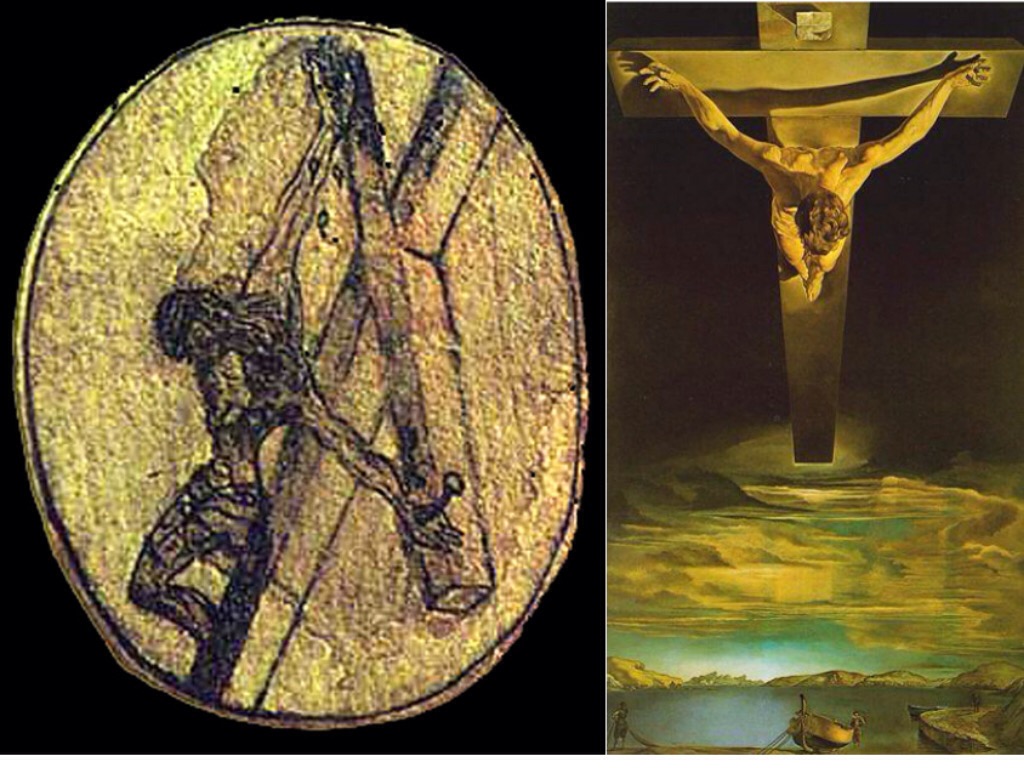
 Michael Dodd was kind enough to provide the following devotional today. I was so glad that Michael agreed to send a devotional which comes from a book of devotionals that he wrote. Michael always provides the perfect words for encouragement, and I always value his advice tremendously. When Michael sent this devotional, he wrote “Attached is an excerpt from my book for your consideration. This passage refers to a drawing of Christ crucified done by St. John of the Cross [left], later made much more famous by the Salvador Dali painting it inspired [right].” When he sent this, he also said that he “realize[d] that this passage may hit very close to the bone for you at the moment and might not be one you want to use.” Here is what Michael sent me:

In his profound teaching on the experience that has come to be called the dark night of the soul, John of the Cross helps the person experiencing spiritual dryness see the experience from a different perspective. He helps me see that God has not abandoned me, despite my feelings or my confusion, but that God is perhaps being present to me in a new way. This may be unfamiliar to me and seem to be regression, whereas, properly understood, it is in fact a sign of spiritual progress. It is a matter of changing my perspective so that I begin to see things from God’s point of view.

A wonderful example of this can be seen in a famous painting of Salvador Dali, based on a drawing of the crucified Christ by John of the Cross. The original drawing, preserved in the museum at the Monastery of the Incarnation in Avila, intrigues the viewer because of the angle from which it is drawn. Most familiar views of the crucifixion are head-on or perhaps looking up at the figure of Jesus on the cross. John’s drawing looks at the body from the side and a bit from above. It is such an unusual angle that the viewer’s first impulse is to shift position or even to reach out and turn the drawing, trying to make it fit into the expected perspective. Dali’s beautiful painting emphasizes this view from above, so that one is looking down, as it were, from heaven on the scene of Christ’s death. At first, it may look like a bird’s-eye view, but then the thought come: It is perhaps a God’s-eye view.

If you read the accounts of the Passion in the four gospels, you cannot help being struck by the way the perspective in John differs from the perspective in the first three gospels. The story is the same, and we tend to merge details from each version into one continuous storyline in our imagination. Yet the Jesus in John seems to be moving in a different atmosphere than the same Jesus in Matthew, Mark and Luke. I would contend that it is not the story that is different, but the perspective. Matthew, Mark and Luke tell the story very much from the human point of view; John gives us a mystical glimpse into the same events with the eyes of God.

In the Dali painting, the bloody brutality that marks our ordinary perception of Calvary is missing, and instead there is an air of timelessness and even serenity. Instead of the walls of Jerusalem in the background, we see a boat beside a body of water, and nearby stands a figure in the uniform of the papal Swiss Guard. The mind is directed not to the past but to the future, to the action of God that will flow from this supreme act of love on the part of Jesus: the establishment of the church as the sacrament of his body and the instrument of the invitation to universal salvation.

When you and I stand on different sides of an image and look at it, we see the same object, but what we see is not the same. My view – and yours – is always partial. That is why we move around from side to side, walk around behind a statue or peer at a painting from different angles. Our view remains partial, but we seek to see more so that we may see more fully. We sometimes mistakenly think we have seen all there is to see. Dali’s painting, like the original drawing of John of the Cross, is a reminder that there is more.

Dryness, therefore, can call us to change our way of seeing things, our way of seeing the world and ourselves so as to open out hearts and minds up to what Jesus calls “God’s work.” Dryness, tragedy and sorrow can be seen as an opportunity for grace more than as a sign of divine anger.

I’m not sure Michael expected my response. I had been talking earlier with my friend John, who will most likely also be providing some devotionals until I can get back on a firmer spiritual footing. After reading the above devotional, a few things kind of clicked and I wrote Michael back saying: “It did hit close to home, but not in a bad way. John and I had a long discussion this afternoon about our relationship with God. He said that God is always with us, but sometimes he is silent and allows us to work through things on our own, especially when it is a time of great pain. We also discussed heaven. I was always taught that you did not enter heaven until the Day of Judgement, but he said that he’s always believed we go straight to heaven. He allowed me to realize…that for God, time is meaningless. So even if we do go to heaven on the Day of Judgement, time is meaningless once we are there, so those who have gone on before are able to enjoy the greatness of heaven and look down upon us even now before the Judgement because for them it has already happened. Maybe I’m making a stretch here, but when we look at things from God’s perspective as it is done in the two paintings and in the Gospel of John, then we can take greater comfort in the passing of loved ones. They are already in a better place.”

Michael Dodd

Michael Dodd has written and lectured about Carmelite spirituality and history for over twenty years. His work has appeared in publications in the United States, Europe and Africa. He is the author of The Dark Night Murders: A Fray John of the Cross Mystery and Jerome Gratian: Treatise on Melancholy. The above devotional is from his book Elijah and the Ravens of Carith: A Twenty-First Century Reflection in a Medieval Carmelite Mode, which can be purchased on Amazon.com in paperback for $9.95. 

By the way, Michael did not ask that I mention his books, but I think anyone who reads this blog and also reads the comments know that Michael is a very special person, wise beyond words, and we all love him.


Merry Christmas

  
The Birth of Jesus

Chapter 2 

1 And it came to pass in those days, that there went out a decree from Caesar Augustus that all the world should be taxed.

2 (And this taxing was first made when Cyrenius was governor of Syria.)

3 And all went to be taxed, every one into his own city.

4 And Joseph also went up from Galilee, out of the city of Nazareth, into Judaea, unto the city of David, which is called Bethlehem; (because he was of the house and lineage of David:)

5 To be taxed with Mary his espoused wife, being great with child.

6 And so it was, that, while they were there, the days were accomplished that she should be delivered.

7 And she brought forth her firstborn son, and wrapped him in swaddling clothes, and laid him in a manger; because there was no room for them in the inn.

8 And there were in the same country shepherds abiding in the field, keeping watch over their flock by night.

9 And, lo, the angel of the Lord came upon them, and the glory of the Lord shone round about them: and they were sore afraid.

10 And the angel said unto them, Fear not: for, behold, I bring you good tidings of great joy, which shall be to all people.

11 For unto you is born this day in the city of David a Saviour, which is Christ the Lord.

12 And this shall be a sign unto you; Ye shall find the babe wrapped in swaddling clothes, lying in a manger.

13 And suddenly there was with the angel a multitude of the heavenly host praising God, and saying,

14 Glory to God in the highest, and on earth peace, good will toward men.

15 And it came to pass, as the angels were gone away from them into heaven, the shepherds said one to another, Let us now go even unto Bethlehem, and see this thing which is come to pass, which the Lord hath made known unto us.

16 And they came with haste, and found Mary, and Joseph, and the babe lying in a manger.

17 And when they had seen it, they made known abroad the saying which was told them concerning this child.

18 And all they that heard it wondered at those things which were told them by the shepherds.

19 But Mary kept all these things, and pondered them in her heart.

20 And the shepherds returned, glorifying and praising God for all the things that they had heard and seen, as it was told unto them.

Luke 2:1-20 (KJV)

When I was young, my mother had a Book of Christmas, I think that was the name, and it had all kinds of Christmas stories and legends. There were three things she read to my sister and me each year at Christmastime: “A Visit from St Nicholas” aka “‘Twas the Night before Christmas,” the editorial from the September 21, 1897, edition of The (New York) Sun commonly known as “Yes, Virginia, there is a Santa Clause,” and she would read us Luke Chapter 2:1-20. While the first two, I will always remember in her voice, it seems like I can only ever hear Luke 2:1-20 in the voice of Linus from the Peanuts’ classic ” A Charlie Brown Christmas.” The thing is, I hear the whole twenty verses in Linus’s voice; however, in the Peanuts’ special, Linus only recited Verses 8-14.

Merry Christmas, everyone, and I hope all of you have a wonderful day.


Abandoned

  
When I wrote this post, I was in an extremely dark mood. I want to emphasize that I do not feel abandoned by family and friends, but the abandoned feelings are only directed at God. In a way, I guess I understand the Deists of the Enlightenment. They believe that God was the creator, and then left us alone. The problem that I have with that is that Christ came and died for our salvation. Even Jesus had doubts of abandonment. In the cross (Matthew 27:6), Jesus said ” Eli, Eli, lama sabachthani?” which translates to “My God, my God, why have you forsaken me?” Maybe Christinity is only a salvation religion. Maybe we are to live a good life in hopes of being welcomed home to God in heaven, and God doesn’t protect us here on earth. Maybe there is no power to prayer, except when we ask forgiveness. This post was what I was feeling last night when I wrote this, but I think it’s important to put those thoughts into words. Maybe someone can help me through this grief. I’m not sure that God is there to do so.

Honestly, I have no inspiration for a Sunday post. I feel abandoned. I have friends who check on me, and they try to comfort me. I’ve been told that my strong faith will bring me through this period of sorrow, but at the moment I feel like God has abandoned me. It seemed like he made my life as bleak as possible when I lost my job, all the money worries I’ve had, the chronic headaches, and a myriad of other problems. Through all those my friend that I lost had been like the voice of God. He’d always encouraged me. He allowed me to fully be my true self. He knew me better than anyone on this earth ever has. With him and God, I felt like things would turn around and things would be better. I had hope and I thought I’d been rewarded for my faith when I did find what was the perfect job for me.

Suddenly it seemed like I had been rewarded for my faith. My headaches were gone. I was happier than I have ever been in life. I had a job that was an absolute dream. I had friends who loved me, one in particular who I loved back so very much. I looked forward to waking up each morning. Then on my thirty-eighth birthday my world came crashing down. I found out that my friend had died in an automobile accident. I’ve tried to come to terms with the loss. Friends have done their best to comfort me. I have tried to appear happy again, but I can’t. I can’t because my faith can’t bring him back to me. God ripped him away. My headaches have returned. My depression is worse than it has ever been. I am constantly on the verge of tears. I feel as if the happiness I’d experienced when I moved was mere false hope. I honestly feel abandoned by God. The hope and happiness that had filled my heart are gone. I hate feeling this way, but no matter how hard I try, no matter what inspirational words I read, no matter how much I study the Bible for answers, and no matter how much I beg God for some relief, the sorrow won’t lessen. I don’t doubt that God exists, I know he does, but it’s my faith in Him being a part of my life that is what’s in doubt.

When I moved to Vermont, one of the things that I’d feared, really my only fear, had been how I’d be able to handle driving in winter conditions. I thought it was inevitable that eventually I’d have a wreck. If I did and didn’t survive it, then the world would continue. It wouldn’t be a great loss. My mother could stop fearing that someone would find out that she had a gay son. My father would have the one child left that he’d always loved the most anyway. I’ve always been a disappointment in his eyes. My friends had their boyfriends, husbands, and wives to love them. They would survive. I have no one who is that close,,and I fear that I never will again. Yes, I have friends, and they would mourn, but they have someone to comfort them. The one person who I had, the one person who loved me unconditionally, the one person who accepted me just they way I am, had a boyfriend that he loved and could comfort him. Yet, when my best friend died, I am alone and a long way from home.

Yesterday, I was awoken by the pain of one of my cluster headaches. This is something that hasn’t happened in nearly a year. I’ve had headaches, but none have caused me to wake up from the pain. I got up, took some medicine and was able to fall back to sleep. I woke up a few hours later and felt much better, so I decided to go do the shopping that I desperately needed to do. For the most part, my shopping day was successful (I found some great winter boots), even if I never did find the 6 inch springform pan that I was looking for. As I was driving home, it was snowing, not bad and not enough to really make conditions terrible for driving, but it made me think about what I’d originally thought about being in a car accident. This might not make sense, but I always figured if anybody in my life would die in a car accident it would be me. Never did I imagine that it would be my best friend who would die. Nor did I ever imagine that he would end up back in the hands of the parents he was abandoned by. I couldn’t believe it when I found out that his parents refused to let any of the people who’d become his family, when they declared that he was no longer a part of theirs, to attend a funeral for him.

By the time I got back home, not only was my headache back with a vengeance, but I was intensely depressed. As my head pounded and I dreaded the idea of a new cycle of cluster headaches beginning as they have for the past several weeks, I thought about how I felt abandoned by God. Last Sunday’s I talked about my anger and doubt. I am still angry. I am so angry that God would let such awful things happen in this world. The ironic thing is, my friend used to say he didn’t quite understand God, and that if he really existed, how could he let the terrible things that happen in this world happen? My friend had many awful things happen to him personally, and he couldn’t understand why God had allowed it to happen and why God did not protect him. I’d always consoled him and said that God loved him and some things weren’t God’s fault because humans are given free will. Humans are to blame for these tragedies. To be honest I’d never known how to answe those questions. It bothered me that I couldn’t, and I couldn’t find the answers. Now I find myself with the same doubt.

I spoke with his boyfriend after my friend’s death. He talked about how I’d helped my friend with his faith. He had struggled with it a lot, but ultimately he said that God must love him because God had brought me into his life. My friend had never told me that. I always felt a connection to my friend that we were destined to know one another, and apparently he thought I was a gift to him from God. Now I wonder, if he was a gift in my life as I’d believed he was (and apparently he felt I was God’s gift to him), then why did God take back his gift. Why had He only allowed me to have him for a short time? Why didn’t God let me say goodbye? I just don’t understand why, and I don’t understand how God has seemingly left me. I want to understand. I’ve searched for answers but they all ring hollow to me. I feel like I’ve been abandoned.

For the friends who are still in my life who are reading this, please don’t think this lessens my love for you or that I don’t greatly value your friendship and all the love and support you have given me. The thing is that the relationship that I had with my late friend transcended mere friendship and love. It was a connection that went to my very soul. All I can say is that as much as I love and appreciate my friends, I feel like I lost part of my soul. How do you get back your soul? He and his boyfriend had been perfect together. There love was so strong from the very beginning, but he was my soul mate. It was a love that transcended romance. He was more like a brother to me (and even that doesn’t describe the connection well enough), and I always felt that our souls were connected. I’m certain, I know the moment he died, because that night when he would have still been on his way home, I became violently ill and began vomiting. My head began to hurt worse than anything I’d experienced in a long time, and I had a sudden feeling of dread. That dread built throughout the following twenty-four hours or so before I got the news of his death. I have not felt whole since, and I haven’t felt the presence of God since that moment either. I’ve only felt abandonment.


Anger and Doubt

image

All of you know that I am a man who has great faith in God, at least I hope you think that. These last two weeks have been so difficult. Why did God take my friend? Why would he let something so tragic happen to someone with such a beautiful soul? Some terrible things had happened in my friend’s life when he was younger. His parents disowned him for being gay, which had nothing to do with religion but pure homophobia. God brought wonderful people into his life and helped him through those difficulties. My friend had a difficult time understanding how such a great and loving God could allow tragedies to happen. Whether those tragedies were accidents or caused by someone hatred or cause by natural disasters, he wondered how God could let those things happen. I never had a very good answer for him. He had suffered in his life because of his family’s rejection, and I’ve never been able to understand how they could be so cruel.

These past two weeks, I’ve struggled with the same issues. I can’t help but wonder how God could allow him to die in an accident, while his hateful parents continued to live on. I admit that it has made me so angry at God. Being angry at God just compounded my sadness because I felt guilty for being angry at God and questioning the faith I have in Him to protect and provide for us. God took this beautiful man (and I don’t mean in just physical beauty, which he was, but also in his soul.) He was beautiful and so kind. God took him away from not only me, but the rest of the people who’d considered him part of their family: his boyfriend and other friends. For me, he was more than a friend. He was family. He was my confidante, and he was my confessor. He was the younger brother I never had. There are so many wicked and hateful people in this world that God could have taken, but he took someone who had the purest heart I have ever known.

One friend told me that I had to think of this as purely an accident, because horrible tragedies like this are not the hand of God. While I wish I could think that way, I was always told that God guides all things. God performs miracles every day, why couldn’t He have saved my friend? I’ve always believed that everything happens for a reason. If so, what could possibly be the reason behind this? Being angry or disappointed with God is a troubling subject for me. If God is such a loving God, how can He allow such pain? It reminds me of a scene from Steel Magnolias. I produced the play a couple of years ago as part of the drama club I was in charge of. It’s the most difficult scene in the whole play and one that I never did get through without tears in my eyes:

M’Lynn: [crying] I’m fine, I’m fine, I’m fine.
[screaming]
M’Lynn: I’m fine! I can jog all the way to Texas and back, but my daughter can’t! She never could! Oh God! I am so mad I don’t know what to do! I wanna know why! I wanna know *why* Shelby’s life is over! I wanna know how that baby will *ever* know how wonderful his mother was! Will he *ever* know what she went through for him! Oh *God* I wanna know *why*? *Why*? Lord, I wish I could understand!
[in a firm tone]
M’Lynn: No! No! No! It’s not supposed to happen this way! I’m supposed to go first. I’ve always been ready to go first! I-I don’t think I can take this! I-I don’t think I can take this! I-I just wanna *hit* somebody ’til they feel as bad as I do! I just wanna hit something! I wanna hit it hard!

The scene of course is followed immediately by a humorous scene that breaks the tension. While I’ve always found this an emotional scene, it’s a very close description to how I feel.
I’ve read that being angry with God is something that both believers and unbelievers wrestle with. When some extreme difficulty or tragedy happens in our lives, we naturally ask God the question — “Why?” I’ve asked that question a lot in the last two weeks. I was researching ways to deal with my doubts and anger and came across the following passage written by Dr. D. W. Ekstrand:

This response indicates two flaws in our thinking — first, even as believers, we all have the tendency to operate under the impression that life should be easy and pleasant (especially if GOD is our God), and that God should prevent tragedy, difficulty and pain from happening to us (Jn 11:37); so when He does not, we get angry or disappointed with Him (Jn 11:32). Second, when we do not seem to be able to reconcile the extent of God’s sovereignty, we lose confidence in His ability to control all of the circumstances we go through in life. When we lose faith in God’s sovereignty, it is actually because our frail human flesh is grappling with our own frustration and our own lack of control over events. All of us tend to live life in such a way that we can positively affect the outcome of situations… that everything will work out as we have planned; as such, we believe that we are the ones who ultimately determine our fate — when good things happen, we generally attribute it to our own efforts; so when things go bad we are quick to blame God, and get angry with Him for not preventing it. Deep down we believe we should be immune to unpleasant circumstances (flaw number one as noted above), especially if God loves us.

While I think this is a good answer to what I’ve been dealing with tragedy, he’s flawed when he says “when good things happen, we generally attribute it to our own efforts.” I don’t. I attribute it to God’s guiding hand. So if we give God the credit for what good happens in our life, why shouldn’t He also take blame for the tragedies. Why does God continue to have us go through pain and loss? When will good Christians and faithful believers be rewarded? Is it only in death? If feel like in the past seven or eight years I have been constantly beat down. Finally something good had happened in my life and career, and I was thankful for God’s guiding hand. Then suddenly, all of that joy and happiness was ripped away by the loss of my friend. While I am still thankful for my job, I have to wonder: is this God’s way of reminding me that I will never be fully happy? It seems like in my life for every ten failures, I have one success. Is it my destiny to be knocked down each time God helps me up?

Dr. Ekstrand went on to say:

Tragedies and suffering bring home the sobering truth that we are not in charge… that God is the One who ultimately determines what happens in our lives… that everything is either caused or allowed by God. Remember, He is God. We can complain, get angry, and blame God for what is happening, yet if we will trust Him and yield our bitterness and pain to Him, acknowledging the prideful sin of trying to force our own will over His, He can and will grant us His peace and strength to get us through any difficult situation (1 Cor 10:13). We can be angry with God for many reasons, so we all have to accept at some point that there are things we cannot control or even understand with our finite minds.

This has not been the most upbeat of my post on religion. Maybe it doesn’t even belong here, but this is where I think through my relationship with God and try to understand it. Right now, I’m having trouble understanding it and maybe some of you have better answer than I do. Quite frankly, I have no answers right now.


Sacrilegious 

  
Queerty published an article the other day titled, “Jesus Had Two Dads: Guys Share What It’s Like To Be Gay And Religious.” I clicked on the article because I thought it would be be interesting. Instead I was disgusted and outraged. While the pictures like the one above with the text were posted on Whisper and many made excellent points in my opinion, the Queerty article chose to deride and belittle people because they held religious beliefs. To make the article even more detestable, the commenters were so bitchy and chose to make fun of gay people who had religious convictions. While a few tried to comment in the defense of religious gays, they were completely attached by other commenters. It’s one thing to not believe, but it’s another to call someone a fool because they do. I think everyone has their right to believe or not, but no one on either side has the right to belittle me because of what I choose to believe or not believe. I tried very hard when I was a teacher and teaching about other religions to get my students to not think of other religious beliefs as crazy, but to try to understand other religions and cultures. As gay men and women, we don’t like people judging us for our sexuality, so why should we allow for discrimination against those who are religious or have a different skin tone. People need to quit being so judgmental. If they would do that we would have a much better and far more happy world.


The Morning of Joy

image

Listen, I will tell you a mystery! We will not all die, but we will all be changed, in a moment, in the twinkling of an eye, at the last trumpet. For the trumpet will sound, and the dead will be raised imperishable, and we will be changed. For this perishable body must put on imperishability, and this mortal body must put on immortality. When this perishable body puts on imperishability, and this mortal body puts on immortality, then the saying that is written will be fulfilled:

‘Death has been swallowed up in victory.’


‘Where, O death, is your victory?


Where, O death, is your sting?’


The sting of death is sin, and the power of sin is the law. But thanks be to God, who gives us the victory through our Lord Jesus Christ.


Therefore, my beloved, be steadfast, immovable, always excelling in the work of the Lord, because you know that in the Lord your labour is not in vain.


1 Corinthians 15:51-58

In The Morning of Joy

When the trumpet shall sound,
And the dead shall arise,
And the splendors immortal
Shall envelop the skies;
When the Angel of Death
Shall no longer destroy,
And the dead shall awaken
In the morning of joy:

In the morning of joy,
We’ll be gathered to glory,
In the morning of joy;
In the morning of joy,
We’ll be gathered to glory,
In the morning of joy.

When the King shall appear
In His beauty on high,
And shall summon His children
To the courts of the sky;
Shall the cause of the Lord
Have been all your employ,
That your soul may be spotless
In the morning of joy?

In the morning of joy,
We’ll be gathered to glory,
In the morning of joy;
In the morning of joy,
We’ll be gathered to glory,
In the morning of joy.

O the bliss of that morn,
When our loved ones we meet!
With the songs of the ransomed
We each other shall greet,
Singing praise to the Lamb,
Thro’ eternity’s years,
With the past all forgotten
With its sorrows and tears

In the morning of joy,
We’ll be gathered to glory,
In the morning of joy;
In the morning of joy,
We’ll be gathered to glory,
In the morning of joy.


I woke up Friday morning with this song in my head. As I sang it to myself, tears rolled down my face. This song was sang at my grandmama’s funeral, and I often sang it when I was the song leader of my church. It brings me comfort, since I know that in that morning of joy, I will be reunited with my friend.
The above sculpture is called “Angel of Grief” and is an 1894 sculpture by William Wetmore Story which serves as the grave stone of the artist and his wife at the Protestant Cemetery, Rome.