Category Archives: Religion

Hope

image

Faith, hope, and love abide. – 1 Corinthians 13:13

Therefore, brothers, since we have confidence to enter the holy places by the blood of Jesus, by the new and living way that he opened for us through the curtain, that is, through his flesh, and since we have a great priest over the house of God, let us draw near with a true heart in full assurance of faith, with our hearts sprinkled clean from an evil conscience and our bodies washed with pure water. – Hebrews 10:19-22

Most people understand hope as wishful thinking, as in “I hope something will happen.” This is not what the Bible means by hope. The biblical definition of hope is “confident expectation.” Hope is a firm assurance regarding things that are unclear and unknown. Hope is a fundamental component of the life of the righteous. Without hope, life loses its meaning and in death there is no hope. The righteous who trust or put their hope in God will be helped, and they will not be confounded, put to shame, or disappointed. The righteous, who have this trustful hope in God, have a general confidence in God’s protection and help and are free from fear and anxiety.

The New Testament idea of hope is the recognition that in Christ is found the fulfillment of the Old Testament promises. Christian hope is rooted in faith in the divine salvation in Christ. Hope of Christians is brought into being through the presence of the promised Holy Spirit. It is the future hope of the resurrection of the dead, the promises given to Israel, the redemption of the body and of the whole creation, eternal glory, eternal life and the inheritance of the saints, the return of Christ, transformation into the likeness of Christ, the salvation of God, or simply Christ Himself.

The certainty of this blessed future is guaranteed through the indwelling of the Spirit, Christ in us, and the resurrection of Christ. Hope is produced by endurance through suffering and is the inspiration behind endurance. Trustworthy promises from God give us hope, and we may boast in this hope and exhibit great boldness in our faith. By contrast, those who do not place their trust in God are said to be without hope.

Along with faith and love, hope is an enduring virtue of the Christian life, and love springs from hope. Hope produces joy and peace in believers through the power of the Spirit. Paul attributes his apostolic calling to the hope of eternal glory. Hope in the return of Christ is the basis for believers to purify themselves in this life.

Straight or gay, hope is one of the essential things we all need to hold on to. In classical Greek mythology, Pandora was the first woman on Earth. Zeus ordered Hephaestus to create her. So he did, using water and earth. The gods endowed her with many gifts: Athena clothed her, Aphrodite gave her beauty, Apollo gave her musical ability, and Hermes gave her speech. One day, Pandora opened a jar (usually referred to as a box) containing death and all the evils of the world which were then released into the world. She hastened to close the container, but the whole contents had escaped except for one thing that lay at the bottom – hope. Hope springs eternal, and it should always be kept in reserve because we need to have hope.

This last week has been a difficult week for me spiritually. My spirit has been sad and distraught. Last Sunday, I talked about having faith in God, and while that has not wavered, I have learned that I can lose faith in people. When you have a great respect for and trust in someone and they betray your respect and trust and prove unworthy of your faith, it made my ideal of faith waiver. But, I refuse to let it cause my faith in God to waiver. It is as strong as ever, and my faith in God grows stronger with His gift of hope.

I have hope that Christians who teach with ignorance and misunderstanding, while spreading hate, will finally be awakened by God’s light of love. It have hope that religious extremist will see that LGBT Christians often have the greatest faith in God. When evangelicals tell us that God has turned his back on us, hope allows us to have faith that God would never turn His back on us. Hope allows us to believe that there will be a better day coming for all of us, especially in the LGBT community. Not all Christians will accept us as an essential and integral part of Christianity, but there will always be false teachers and those who claim that they a carrying out the will of God under mistaken beliefs and are actually carrying out the wishes of Evil. Hope allows us to look forward to our rightful place in heaven with out King. So I call on all LGBT Christians to not lose their faith and to keep hope alive.

Hope springs eternal in the human breast;
Man never is, but always to be blessed:
The soul, uneasy and confined from home,
Rests and expatiates in a life to come.
Alexander Pope, An Essay on Man


Contextual Errors

image

My preacher began is sermon with a verse from the last book of the Old Testament to begin the points he was going to make. It was the first of many mistakes he made in his sermon.

For I am the LORD, I change not; therefore ye sons of Jacob are not consumed. Malachi 3:6

The first part of this verse “For I am the LORD, I change not;” is what my preacher used to show that God never changes; however, this is taking the verse out of its context. Malachi writes this to show that God performs his promises, and effectually disposes of the allegation in Malachi 2:17:

Ye have wearied the LORD with your words. Yet ye say, Wherein have we wearied him? When ye say, Every one that doeth evil is good in the sight of the LORD, and he delighteth in them; or, Where is the God of judgment?

Which says that God put no difference between the evil and the good. The great principles of right and wrong never alter; they are as everlasting as he who gave them. God here speaks of himself by his covenant name, which expresses his eternal independent being, “the Father of lights, with whom is no variableness, neither shadow of turning” (James 1:17). Whereas, my minister claimed that this meant that God’s commandments never change, it is not what the verse itself means. It is also wholly incorrect to say that the commandments of God have never changed. While I find many things abhorrent from his sermon, as a member of the Churches of Christ, I cannot agree with the concept of a never changing God. For the Churches of Christ believe that the New Testament, or New Covenant brought by Jesus, replaced the church of the Jews in the Old Testament. There are numerous examples of this, and I will use a few glaring examples. First is the Sabbath, the seventh day of the Hebrew calendar week. According to Exodus 20:8 it is commanded by God to be kept as a holy day of rest, as God rested from creation: “Remember the sabbath day, to keep it holy.” However, as most Christians observe, we keep the first day of the week as holy as opposed to the seventh. In Acts 20:7 we read: “And upon the first day of the week, when the disciples came together to break bread, Paul preached unto them, ready to depart on the morrow; and continued his speech until midnight.” What was notable about the first day of the week? It was the day when the disciples came together to partake of the Lord’s Supper. The first day of the week was also the day when contributions were collected. “Upon the first day of the week let every one of you lay by him in store, as God hath prospered him, that there be no gatherings when I come.” (I Corinthians 16:2).

To make his main point, my preacher then turned to one of the most overused texts against homosexuality, Leviticus 18:22 which states: “Thou shalt not lie with mankind, as with womankind: it is abomination.” Considering that this one verse is in a long list of sexual prohibitions of heterosexual sex, it remind me of the Lynn Lavner quote: “The Bible contains 6 admonishments to homosexuals, and 362 to heterosexuals. That doesn’t mean that God doesn’t love straight people, just that they need more supervision.” But to be more serious, not many Christians could, would, or do live by the laws of Leviticus, nor ahold we. In Galatians 5:1 Paul states, “Stand fast therefore in the liberty wherewith Christ hath made us free, and be not entangled again with the yoke of bondage.” Most, if not all, scholars would agree that this relates to the Jewish laws in Leviticus. Leviticus is often used by Christians to attack the LGBT community. Along with Deuteronomy and swathes of Exodus and Numbers, it lays out the Law for the Israelites, and though many do not follow all the laws of the Old Testament. Many are still willing to cite Leviticus for things that they think are sinful, while ignoring it for things they don’t. Yet, and I’m going to apply this particularly to Southerners of the United States who are often the most fervent in their condemnation, many southerners spent the Fourth of July holiday eating barbecue, usually pork, an unclean animal prohibited in the Old Testament. Southerners often use bacon of pork to season our vegetables, find a good soul,food restaurant that doesn’t. You won’t be able to find one. Furthermore, Leviticus forbids eating water dwelling creatures without scales, that would obviously include all shellfish, but it would a,so include catfish (catfish do not have scales), a southern staple. Those are just some of the food related prohibitions found in the Old Testament, there are many others that we would find absolutely abhorrent, yet many Christians still pick a verse here and there to make points that conform to their archaic and erroneous beliefs.

Jesus also spoke out against the use of the laws of the Old Testament. In John 8:3-7:

And the scribes and Pharisees brought unto him a woman taken in adultery; and when they had set her in the midst, They say unto him, Master, this woman was taken in adultery, in the very act. Now Moses in the law commanded us, that such should be stoned: but what sayest thou? This they said, tempting him, that they might have to accuse him. But Jesus stooped down, and with his finger wrote on the ground, as though he heard them not. So when they continued asking him, he lifted up himself, and said unto them, He that is without sin among you, let him first cast a stone at her.

And while Jesus doesn’t say what the woman did was not wrong, He did say that those who have sinned (For all have sinned, and come short of the glory of God [Romans 3:23]) cannot judge those who have.

And just in case, he didn’t think he’d made his point, he brought out two sets of verses from the New Testament, which he completely took out of context. He first quoted Romans 1: 26-27:

For this reason God gave them up to dishonorable passions. For their women exchanged natural relations for those that are contrary to nature;and the men likewise gave up natural relations with women and were consumed with passion for one another, men committing shameless acts with men and receiving in themselves the due penalty for their error.

Modern scholars who have studied the contest of this passage view it as an attack on heterosexual persons who were formerly Christians, who reverted to Paganism, and who engaged in ritual sexual behavior as a part of their newly adopted Pagan services. During these rituals, the Pagans were whipped into such a state of sexual frenzy that they went against their basic heterosexual nature and started engaging in sexual behavior with members of the same sex. Paul condemns such behavior. He concludes that Pagan worship will inevitably leads to other negative behavior. Therefore, the passage is not discussing homosexuality, but ritual pagan sexual practices. It is inappropriate to use this verse to condemn homosexuality as it is deceitful and shows ignorance of Paul’s message.

The second set of verses he quoted, was 1 Corinthians 6: 9-10, which states:

Or do you not know that the unrighteous will not inherit the kingdom of God? Do not be deceived: neither the sexually immoral, nor idolaters, nor adulterers, nor men who practice homosexuality, nor thieves, nor the greedy, nor drunkards, nor revilers, nor swindlers will inherit the kingdom of God.

I found the use of this passage particularly disturbing because of two reasons. The first is that in the original Greek, homosexuality as translated here is wholly inaccurate. Homosexuality could not have been the word meant by Paul because it was neither a concept or a word in Paul’s time as it is used in modern times. The word was never even used until the nineteenth century. Furthermore in this set of verses, Paul is most likely discussing the Greek practice of pederasty. Pederasty, which is the practice of older men mentoring and loving younger men (often that meant sex to the Romans), continued in Greek areas of the Roman Empire even though it was frowned upon the Romans. Remember that Corinth is a Greek city and pederasty would have been still practiced in this city and as a Greek himself, Paul would be familiar with he practice.

The second thing about my minister’s use of this passage is the way he used it. I’m not sure you noticed or not, but until these last two passages, I followed my preacher’s use of the King James Version of the Bible; however, like him, I switched to a modern translation for these two verses. In my case I used the English Standard Version. This is particularly deceitful when using the verses from 1 Corinthians. The King James Version states:

Know ye not that the unrighteous shall not inherit the kingdom of God? Be not deceived: neither fornicators, nor idolaters, nor adulterers, nor effeminate, nor abusers of themselves with mankind, Nor thieves, nor covetous, nor drunkards, nor revilers, nor extortioners, shall inherit the kingdom of God.

You see out of ignorance and the long standing hatred of homosexuals by church leaders who fear for their own loss of power and to continue their own prejudices, modern translators have oversimplified the King James translation of “nor effeminate (malakos), nor abusers of themselves with mankind (arsenokoites)” to simply “nor men who practice homosexuality (malakos).” It is deceitful and an oversimplification. Furthermore, the English standard version omits any translation of arsenokoites. They do not want to admit the actual context, meaning, and complexity of the original words used by Paul, when he wrote his letter in his native Greek. Though I could write a whole post on “malakos” and “arsenokoites,” and whole books have been written, I hope you will take my word here and understand that neither of these words translates to homosexuality. If you do want a more in depth look at the words, check my early posts on the churches of Christ.

The last thing he covered in his sermon was the concept of Hell, that is not the kingdom of God, where unrepentant sinners will go. I’m only going to dwell on this briefly because it hardens back to my first point about God changing his laws. A simple history lesson on the Hebrews would teach you the error in this. In the history of the Hebrew, i.e. Jews, there is no mention nor does there seem to be a concept of Hell in Jewish theology before the Babylonian Exile, when they came into contact with a new religion called Zoroastrianism. This religion is the first that historians know of that introduced a place of punishment in the afterlife.m after the exiled Hebrews were returned to Judah, they incorporated this concept of Hell into the Jewish religion. It was later a major concept of Christianity. This is not said to diminish the concept of Hell but to point out that God’ definition of Hell changed.

I have often gone home after church and studied further the words of my preacher. Occasionally, I have used them and adapted those very sermons for my Sunday posts. I have never found such glaring errors in his sermons before, and so I hope by writing this, you come to understand my profound disappointment in my preacher. He disagreed with a decision of the United States Supreme Court, which is at its heart political even if we agree with its outcome, and brought it to the pulpit because he disagreed with the ruling. Furthermore, contrary to his usual sermons, which are often really Bible studies, he took an anti-intellectual, blasphemous, and ungodly view of the topic and ,are a sermon of it. I had thought better of him than to use word trickery and oversimplification, something that I have never known him to do in the past, and I am extremely disappointed.


Poems of Lies and Deception

image

Against Lying
By Isaac Watts

O ’tis a lovely thing for youth
To early walk in wisdom’s way;
To fear a lie, to speak the truth,
That we may trust to all they say!

But liars we can never trust,
Even when they say what is true.

And he who does one fault at first
And lies to hide it, makes it two.
Have we not known, nor heard, nor read
How God does hate deceit and wrong?
How Ananias was struck dead,
Caught with a lie upon his tongue?

So did his wife Sapphira die,
When she came in, and grew so bold
As to confirm that wicked lie,
Which just before her husband told.
The Lord delights in them that speak
The words of truth; but every liar
Must have his portion in the lake
That burns with brimstone and with fire.

Sowing Seeds of Deception
By Raymond A. Foss

Into the soil of our doubts
sowing seeds of deception
in patterns of behavior
in the shifting sands of numbers
moving beneath our feet

Changing the truths, facts
something which should be immutable
new information coming
beyond the last hour

Interpretations written, conveyed
seeking different understanding
nothings known generally
the public unawares

Raising concerns within us
a history of doubt growing
whether there is thought in these
or if innocence prevails
some frustrations almost palpable

When I was looking for a poem for today, I could not choose between the head two. They both fit what I was feeling since church on Sunday. Before I discuss these two poems, I want to say that although I strongly disapprove and disagree with what my preacher said on Sunday about homosexuality, I believe that he is a product of the ignorance that exist in so many Christians. I do not believe that the Bible can be taken completely literally, nor do I believe that you should only believe what others tell you to believe. I think that we must read and study the words and context of the Bible. When taken out of context, the Bible is largely meaningless because you are able to twist the words to what you want them to say. This is one of the cores of historical research: you cannot go into a topic with rigid preconceived beliefs, you must be able to adapt to the direction your research takes you and you must remain objective.

Isaac Watts (1674-1748) was an English pastor, preacher, poet, and hymn writer. Wrote about 600 hymns including his most famous, Joy to the World. Considered the founder of English hymnody, the singing and composition of hymns. “Against Lying” speaks of the innocence of children but that with one lie or deceit, then it is hard to ever trust again. He alludes to the story of Ananias and his wife Sapphira. It is just a small story, tucked away in the Book of Acts, familiar to many Christians. The couple sold a piece of property and agreed together to keep some of the money for themselves while giving the rest to the Church. Although the passage in Acts 5:1-11 does not explicitly say so, Ananias apparently pretended to be giving it all. For as soon as he laid the money at the apostles’ feet, Peter reproached him for lying to the Holy Spirit and keeping back some of the money, and Ananias fell down dead. Sapphira, arriving later, was questioned by Peter as to the amount of the sale. She, too, apparently lied, for Peter reproached her for agreeing to “put the Spirit of the Lord to the test,” and she fell down dead as well. Then the story concludes with the statement, “Great fear came upon the whole church, and upon all who heard of these things.” The poem then ends with God delighting in those who speak the truth but casting those who lie will be cast into the lake of fire and brimstone, i.e. Hell.

Raymond A. Foss was born in 1960 in Westfield, Massachusetts, and the oldest of five children. After moving to Claremont, NH at 16, he attended the University of New Hampshire, earning a Bachelor of Arts in Political Science in 1982 and a Master of Public Administration in 1984. He graduated from Franklin Pierce Law Center in 2004. He started writing poetry while serving on the Barrington, NH School Board in 2000. In “Sowing Seeds of Deception,” Foss speaks of the characteristics of deception. He says that changing the truth, changing facts “which should be immutable,” using interpretations that are false, and by not trying to correct mistakes, then you are deceitful and cannot be trusted. When there is an “innocence” in the deception, meaning that the person did not know better, but have not tried to gain the knowledge to know better, then it cause frustrations. Ignorance may make it a bit more palatable, but I do not feel that it is an excuse, especially when you profess to be an expert on the subject.

I guess that what I’m trying to say is that even though I do not agree with my preacher’s perspective, he is a product of evangelical Christianity. They are hard to change and they like hardline interpretations of the Bible, because it makes it easier to understand. However, most evangelical Christians consider themselves Protestant, which means that they rejected being told what to think and believe by the Catholic Church. There was only one interpretation and all others were destroyed through various crusades, so it is the nature of Protestants to question the hardline beliefs of the Bible. Mainline Protestants have done this but evangelical Protestants have forgotten this. It’s difficult to put the Churches of Christ into these two categories though they are usually considered evangelicals because of their rigid stances on biblical issues, but whereas most other Christians would classify them as Protestant, the Churches of Christ declare that they are restorationist not Protestants, (six of one, half dozen of another if you ask me).

I am going to leave you guys with a quote from a recent op-ed piece in the Jackson, Mississippi’s Clarion-Ledger written by Rob Hill, a former Methodist minister and current director of HRC Mississippi (if you are interested in the whole op-ed use this link: http://www.clarionledger.com/story/opinion/columnists/2015/05/30/hill-methodist-church-law-ends-ministry/28227759/). I believe this fits perfectly into the message that I am trying to get across today:

This isn’t an attack on the church I love, but a response to the erroneous and dangerous biblical interpretation that has met almost every positive social change in American history. It was the Bible many used to justify slavery, to deny women the right to vote, to prop up segregation and deny the most basic of civil rights to African Americans and other racial minorities. And it’s the Bible that many church leaders and many politicians continue to reference in an attempt to perpetuate discrimination against LGBT people in this country and around the world.

Tomorrow’s post will be about what my preacher said Sunday and why I believe it is wrong. I know I usually keep religious posts to Sundays, but this is an important issue that I am trying to work through in my own head and writing about it helps. Also, I love reading your comments and advice.


Faith

image

Faith, hope, and love abide. – 1 Corinthians 13:13

Now faith is the assurance of things hoped for, the conviction of things not seen. For by it the people of old received their commendation. By faith we understand that the universe was created by the word of God, so that what is seen was not made out of things that are visible.
And without faith it is impossible to please him, for whoever would draw near to God must believe that he exists and that he rewards those who seek him.
– Hebrews 11:1-3, 6

Hebrews 11:1 tells us that faith is “the assurance of things hoped for, the conviction of things not seen.” There is only one component of the Christian life that is more important than faith, and that component is love, because without love, we cannot have faith. The dictionary defines faith as “belief in, devotion to, or trust in somebody or something, especially without logical proof.” It also defines faith as “belief in and devotion to God.” The Bible has much more to say about faith and how important it is. In fact, it is so important that, without faith, we have no place with God, and it is impossible to please Him: “And without faith it is impossible to please him, for whoever would draw near to God must believe that he exists and that he rewards those who seek him.” (Hebrews 11:6). According to the Bible, faith is belief in the one, true God without actually seeing Him.

Faith is not something we conjure up on our own, nor is it something we are born with, nor is faith a result of diligence in study or pursuit of the spiritual. Ephesians 2:8-9 says “For by grace you have been saved through faith. And this is not your own doing; it is the gift of God, not a result of works, so that no one may boast.” This passage makes it clear that faith is a gift from God, not because we deserve it, have earned it, or are worthy to have it. It is not from ourselves; it is from God. It is not obtained by our power or our free will. Faith is simply given to us by God, along with His grace and mercy, according to His plan and purpose, and because of that, He gets all the glory.

God designed a way to distinguish between those who belong to Him and those who don’t, and it is called faith. Very simply, we need faith to please God. God tells us that it pleases Him that we believe in Him even though we cannot see Him. A key part of Hebrews 11:6 tells us that “he rewards those who seek him.” This is not to say that we have faith in God just to get something from Him. However, God blesses those who are obedient and faithful. We see a perfect example of this in Luke 7:50. Jesus is engaged in dialog with a sinful woman when He gives us a glimpse of why faith is so rewarding. “Your faith has saved you; go in peace.” The woman believed in Jesus Christ by faith, and He rewarded her for it. Finally, faith is what sustains us to the end, knowing that by faith we will be in heaven with God for all eternity. First Peter 1:8-9 tells us “Though you have not seen him, you love him. Though you do not now see him, you believe in him and rejoice with joy that is inexpressible and filled with glory, obtaining the outcome of your faith, the salvation of your souls.”

As LGBT Christians, we know that faith can be very difficult. All people question God’s plans at various times. Why did He allow that tornado to hit? Why would He allow some one to walk into a Church and kill nine people? At every tragedy, we ask why, but we must believe in God’s plan. Look at the aftermath of the Charleston shooting, we are openly discussing racism in this country and symbols of that racism, like the Confederate flag, that many people claim is their heritage. Yes, it is part of their heritage and that heritage is a heritage of hate and disloyalty to their country. However, that discussion is now being had all across America.

To bring this back to LGBT Christians, we wonder why God would allow parents to reject us. Why do so many LGBT youth become homeless? Why is the suicide rate for LGBT higher than any other group in society? Why does God not strike down those who preach hate in His name in the pulpits of churches across the world? But if we believe, if we have faith, then we know that God has a greater purpose. What is that purpose, because it is hard to see at times? I do not know, only God knows, but we should have faith in him.

When we question our faith, we should remember the story of David and Goliath, which is just one of many stories of faith in the Bible, but I use David because of his great love of Jonathan:

“Then David said to the Philistine, ‘You come to me with a sword and with a spear and with a javelin, but I come to you in the name of the Lord of hosts, the God of the armies of Israel, whom you have defied. This day the Lord will deliver you into my hand, and I will strike you down. . .that all this assembly may know that the Lord saves not with sword and spear. For the battle is the Lord’s, and he will give you into our hand.’”

By faith, we can do incredible things that will ultimately bring glory to God. David was a small boy and Goliath was a giant, but David had faith in God and with that faith he defeated Goliath. When the odds are against is, powers that be they their best to take away our rights, and preachers fill their congregations with hatred for us, we must remember to have faith in God. He will ultimately protect us and keep us safe, but we must have faith. No matter how limited you feel about your abilities to make the world a better place, we can do amazing things through faith and for the glory of God.

I want to leave you today with what Paul wrote to Timothy:

I have fought the good fight, I have finished the race, I have kept the faith. Henceforth there is laid up for me the crown of righteousness, which the Lord, the righteous judge, will award to me on that Day, and not only to me but also to all who have loved his appearing. – 2 Timothy 4:7-8


Hypocrisy and the Nones


If anyone thinks he is religious and does not bridle his tongue but deceives his heart, this person’s religion is worthless. Religion that is pure and undefiled before God, the Father, is this: to visit orphans and widows in their affliction, and to keep oneself unstained from the world.

James 1:26-27

By this it is evident who are the children of God, and who are the children of the devil: whoever does not practice righteousness is not of God, nor is the one who does not love his brother.

1 John 3:10

“But woe to you, scribes and Pharisees, hypocrites! For you shut the kingdom of heaven in people’s faces. For you neither enter yourselves nor allow those who would enter to go in.

Matthew 23:13

Take no part in the unfruitful works of darkness, but instead expose them.

Ephesians 5:11

And as they continued to ask him, he stood up and said to them, “Let him who is without sin among you be the first to throw a stone at her.”

John 8:7

There is a crisis of faith in the world today. It’s not because of liberals, the LGBT, sexual promiscuity, science, drug use, or any of the myriad of things that religious conservatives claim is at the heart of every problem in the world. The greatest problem religious leaders face is their own hatefulness,a me what often turns out to be hypocrisy. I think this tactic of evangelicals is one that is fueled with hatred and fear, two things that I do not believe Jesus would have ever approved of using, but that of something Satan would wholeheartedly approve.
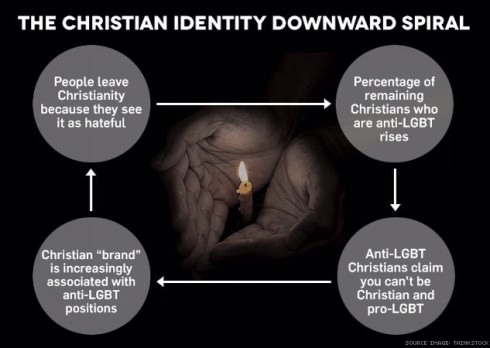
 Before I go any further, I want to briefly discuss the concept of hypocrisy. Hypocrisy is the claim or pretense of holding beliefs, feelings, standards, qualities, opinions, behaviors, virtues, motivations, or other characteristics that one does not actually hold. Hypocrisy is not simply failing to practice those virtues that one preaches. The modern notion is that a hypocrite is someone who says one thing but does another, a person who is two-faced, who is inconsistent or phony. Jesus’ teaching on Hypocrisy does not exclude this notion but is far richer. The Biblical understanding enunciated by Jesus is rooted in the original meaning of the Greek word ὑποκριταί (hypokritai) which means “stage actors.” At one level it is easy to see how this word has come to mean some one who is phony. For what they claim to be, they really are not, they are just acting a role. But when no one is looking (i.e. the audience is gone) they revert to their true self, which is some one quite different. But Jesus in his teaching here develops the understanding far more richly that shows how sad and poignant hypocrisy is, what its origin is and how it can be overcome.

In effect Jesus describes hypocrisy as the sad state of a person who reduces himself to being an actor on a stage, because he does not know God the Father. There are many people who live their life in a desperate search for human approval and applause. They discern their dignity and worth, not from God, (who is in effect a stranger to them), but from what other human beings think of them. They are willing to adapt themselves often in dramatic ways to win approval. They are willing to play many roles and wear many masks to give the audience what they want. They are like actors on a stage, who seek applause or perhaps laughter and approval. Most politicians fall into this category. Notice the way Jesus describes the heart of hypocrisy:

Jesus said to his disciples: “Beware of practicing your righteousness before other people in order to be seen by them, for then you will have no reward from your Father who is in heaven.” ( Matthew 6:1) Jesus goes on to say that they blow a trumpet so that others will see them giving alms, they pray ostentatiously so that others may see they are praying, and they alter their appearance so that others may see they are fasting.

There are many examples of people Jesus would call a hypocrite. I doubt mp that very many of us could pass His test, but there are those who are in the limelight who are outward examples of hypocrisy. The Duggars are the latest example, but far from being the only example, of people who have held themselves up as a model of Christianity: wearing their religion on their sleeves, being politically active, and professing deeply conservative, anti-LGBT, patriarchal, and anti-science views. Some members of the family have adopted a particularly evangelical bent to their faith, telling other Christians: if you aren’t as conservative as us, you’re not real Christians. 

“Real Christians” like the Duggars would like to think they’re doing God’s work. But if they’re judged by the fruits of their tree, as the Bible teaches, they’ve actually driven Americans away from churches. And new research indicates that their entrenched, anti-LGBT positions are part of why Americans are abandoning the faith in record numbers — and not coming back, but it’s not just their anti-LGBT positions, it’s their intolerance of anyone who disagrees with their brand of hatred. However, this is not something new, and numbers have been declining since the 1950s.

When the Pew Research Center released its latest religion in America survey results, it highlighted a trend that has been ongoing for years: people are leaving organized religion in droves. In response, churches have been attempting to combat this declining attendance, with attempts to “jazz up” services that range from engaging youth pastors, rebranding efforts, building activity centers (I know of one church that put in a bowling alley, while several others have put in coffee bars), and anything else they can think of to get Millennials back — apparently to no avail. The number of people who identify with any religious denomination keeps shrinking.

There are now approximately 56 million religiously unaffiliated adults (those identifying as agnostic, atheist, or “nothing in particular”) in the U.S., according to Pew. In light of this group’s “none of the above” attitude toward existing organized religion, the group is sometimes referred to as the “Nones.”

The Nones are more numerous than either Catholics or mainline Protestants, according to Pew’s latest survey. Indeed, the unaffiliated are now second in size only to evangelical Protestants among major religious groups in the U.S., and growing faster than any other group. The Nones are more likely to be young, white, and educated, although growth is occurring across almost every demographic.

But the Nones also tend to be one of the most solidly Democratic and pro-LGBT demographics as well. This isn’t coincidental; prior studies from the Public Religion Research Institute have shown that up to a third of Millennial Nones left traditional faith communities because of religious intolerance, especially toward LGBT people.

You would think that because Mainline (Non-Evangelical) Protestants tend to be more accepting of LGBT Christians, that their numbers would be growing, however membership in these churches have fallen faster than for any other group in the Pew survey, by virtually any measure. Some, particularly those in evangelical denominations, blame the declining attendance on the liberalization of these churches, saying they have watered down Christianity into moral relativism, with no clear delineation of right and wrong. Some sociologists hold that demographics, such as differences in birth rates, are the real reason why the ranks of mainline Protestants are declining faster than evangelicals.

Others point to a groundbreaking 2010 study by Putnam and Campbell, which argues there is a strong link between Millennial disenchantment with Christianity and the rise of evangelical conservatism in the 1980s and ‘90s. That study hypothesizes that Millennials have come of age in an environment where being Christian means being conservative (and Republican). More socially progressive Millennials — which is most of them — view the choice before them as an ultimatum of sorts: identifying with one’s political identity, or their religious identity. When it comes down to brass tacks, Millennials are apt to change the latter, given how little effort it takes to drop out of organized religion. In short, when there is a conflict between religious and political identity, the path of least resistance involves giving up the religious one. I tend to think that with twenty-four hour news channels comes more sensationalism that points to the hypocrisy of those who profess their beliefs in Christianity but yet have secret lives that are in direct violation of what they profess as right and wrong. The hypocrisy turns people away from Christianity.

The solution, from Putnam and Cambell’s perspective, would be to sever the link between religion and politics. But recent polling indicates that 57 percent of Republicans want to see Christianity as the official religion of the United States. Additionally, greater religious involvement in government is a core tenet for many evangelicals. But given the shrinking number of mainline Protestants compared to the sizable and growing membership of the evangelical community, the researchers’ solution seems a slim chance of becoming reality.

Sadly, the LGBT community is less likely to be religious than the American population as a whole, according to a recent Gallup poll. Given the scarcity of LGBT-affirming faiths, how often LGBT people have been mistreated by the faith communities they were born in to, and the link between anti-LGBT religions and politics, this reality is unsurprising. But that hasn’t stopped national organizations like The National LGBTQ Task Force and the Human Rights Campaign from having dedicated religious outreach campaigns. These organizations see such efforts as essential to their missions. Chad Griffin, HRC’s president, describes religious outreach as one of the group’s top priorities in fighting for LGBT equality:

“There’s sort of two pieces of this work. Number one, and first and foremost, is changing hearts and minds. You change hearts and minds by building bridges and by having a conversation with business leaders, with faith and religious leaders, with community leaders, and also with elected officials at the community level and at the state level.”

These religious outreach efforts have several purposes. According to a National LGBTQ Task Force Report on inclusive religious organizing, “Pro-LGBTQQIA faith-based leaders and leadership structures bring significant resources to the fight — the ability to speak with moral authority to large numbers and through a variety of communication vehicles.”

The ability to have religious leaders testify in favor of pro-LGBT legislation significantly alters the perception that LGBT issues are purely religious or moral, according to the report. It also allows for greater reach into communities where people of color suffer the most from the confluence of multiple forms of discrimination and oppression.

Unfortunately, the influence of LGBT-affirming churches is waning as their membership declines. Relatedly, research shows that increased Internet access — especially when used to access progressive media sources like Right Wing Watch and ThinkProgress — helps tighten the spiral of religious de-identification by consistently pointing out the link between conservative religions and politics.

“For people living in homogeneous communities, the Internet provides opportunities to find information about people of other religions (and none), and to interact with them personally,” wrote Allen Downey, a computer science professor at Franklin W. Olin College of Engineering who studied the impact of web access on religious identification. The Internet also provides LGBT Christians, like myself who find that in rural America LGBT inclusive churches are basically nonexistent, with a place to interact with other LGBT Christians. It’s one of the reasons for my blog, to reach out to other like-minded individuals.

No matter how the demographics are sliced, the decline in denominational identification is accelerating. So is the decline in church attendance. It seems likely that this trend will continue for years, if not decades. While the end result is uncertain, current shifts in religious messaging imply that a segment of conservative religions will hold on to a core constituency for a long time to come, even without moving toward greater acceptance. A contrarian social outlook (no matter how unpopular) will always have adherents: just look at interracial marriage, which has been legal across the U.S. for more than 50 years. But approximately one in six Americans is still opposed to interracial marriage, according to the Pew survey.

Right-wing pundits who support the church maintaining its anti-LGBT stance have seized onto the fact that evangelical groups are holding on to members better than denominations that affirm LGBT people, yet they don’t seem to realize that their own intolerance is what is driving people away from all churches.

In an August op-ed for the Federalist, Daily Caller reporter Alex Griswold sardonically concluded that the fastest way to “Shrink Your Church in One Easy Step” is to become LGBT-affirming. “A number of Christian denominations have already taken significant steps towards liberalizing their stances on homosexuality and marriage, and the evidence so far seems to indicate that affirming homosexuality is hardly a cure for membership woes,” wrote Griswold. “On the contrary, every major American church that has taken steps towards liberalization of sexual issues has seen a steep decline in membership.”

This observation is factually correct, but it misses the bigger picture. Conservative faiths are holding steady while moderate progressive ones are shrinking, but Pew’s research indicates that it’s actually conservative faiths that are making all of Christianity toxic to moderate and progressive Millennials.

LGBT rights aren’t the only social issue where conservative theology drives younger moderates and progressives away. As prominent atheist blogger Hemant Mehta noted at CNN, those conservative faiths are “antigay, anti-women, anti-science, anti-sex-education and anti-doubt, to name a few of the most common criticisms.”

Churches that dig in their heels on anti-LGBT positions might hear more about how that issue is driving away new members, but that’s because public opinion on LGBT people has shifted faster than any of the other issues the church is refusing to evolve upon.

As proof, look no further than a 2007 study by the Barna Group, which found that the most common word used by Millennials to describe Christianity was “antihomosexual.” For a staggering 91 percent of non-Christians, this was the first word that came to their mind when asked about key Christian qualities. The same was true for 80 percent of young churchgoers. The next most common negative descriptors were “judgmental,” “hypocritical,” and “too involved in politics,” according to David Kinnaman and Gabe Lyons’ book UnChristian: What a New Generation Really Thinks About Christianity… And Why It Matters.

Whether the rise of the Nones — and the concurrent decline of moderate religions — ultimately speeds up or slows down efforts to secure legal protections for LGBT people as a whole remains to be seen. What we do know is that is that the rise of the Nones and the increasing acceptance of LGBT people are strongly linked.

And neither is likely to be undone.

A friend of mine who read an early draft of this post, brought up an important point and one that I find the saddest of all about the Nones. While the LGBT and the Nones may be turned away from religion by anti-gay religious organizations and the conservative right wing, each individual has his own choice/free will to choose his faith, religion, and God. All of the blame cannot be put onto these hypocrites – but each individual who turns away from God is ultimately the one who holds the blame and will be accountable for his or her own decisions. God will not give those individuals who turned away from Him a free pass because they were driven away by fanaticism and hypocrisy. The reality of this breaks my heart, which is why I am a primitive restorationist (the core idea of the churches of Christ that we should return to the original church Christ established), who believes we should return to what Christ taught about love and faith in God’s grace.

In the wake of the Surpeme Court’s decision in Obergefell v. Hodges, we have seen many evangelicals speak out against marriage equality now that it has become the law of the land.  I think more clergy should follow what Episcopal Bishop Robert Wright said in a statement on the Supreme Court decision:

“Today the nation’s highest court has concluded that the Constitution guarantees a nationwide right to same-sex marriage.

In the days ahead, whatever your position, I ask you to keep close to your heart and lips the words of scripture, that “God is love.” Christ’s church is trans-political, above all earthly partisanship.

Therefore, if love has won even a small victory today, then let us rejoice.”

Source: This post is largely adapted from an article from The Advocate, “How The Nonreligious ‘Nones’ Are Driving LGBT Equality in the U.S.” http://www.advocate.com/politics/religion/2015/06/08/how-nonreligious-nones-are-driving-lgbt-equality-us


Bringing in the Sheaves


Those who sow in tears
     shall reap with shouts of joy!
He who goes out weeping,
     bearing the seed for sowing,
shall come home with shouts of joy,
     bringing his sheaves with him.

                            – Psalm 126:5-6

Bringing in the Sheaves

By Knowles Shaw

Sowing in the morning, sowing seeds of kindness,
Sowing in the noontide and the dewy eve;
Waiting for the harvest, and the time of reaping,
We shall come rejoicing, bringing in the sheaves.

     Bringing in the sheaves, bringing in the sheaves,
     We shall come rejoicing, bringing in the sheaves;
     Bringing in the sheaves, bringing in the sheaves,
     We shall come rejoicing, bringing in the sheaves.

Sowing in the sunshine, sowing in the shadows,
Fearing neither clouds nor winter’s chilling breeze;
By and by the harvest, and the labor ended,
We shall come rejoicing, bringing in the sheaves.

     Bringing in the sheaves, bringing in the sheaves,
     We shall come rejoicing, bringing in the sheaves;
     Bringing in the sheaves, bringing in the sheaves,
     We shall come rejoicing, bringing in the sheaves.

Going forth with weeping, sowing for the Master,
Though the loss sustained our spirit often grieves;
When our weeping’s over, He will bid us welcome,
We shall come rejoicing, bringing in the sheaves.

     Bringing in the sheaves, bringing in the sheaves, 
     We shall come rejoicing, bringing in the sheaves;
     Bringing in the sheaves, bringing in the sheaves,
     We shall come rejoicing, bringing in the sheaves.

Knowles Shaw (1834-1878) was a preacher, singer, and songwriter (of both words and music). In his day he was one of the best known figures in the American Restoration Movement. He was a member of the churches of Christ, which many of you know is a non-instrumental church. Perhaps Shaw’s best known work is the popular gospel song “Bringing in the Sheaves.”  Shaw was an exceptional singer by all accounts, and integrated hymns into his sermons as a natural extension of his message.

“Bringing in the Sheaves” was written in 1874, and was dedicated to the memory of Augustus Damon Fillmore (1823-1870), a fellow preacher and songwriter. For some reason this hymn has taken hold of the popular imagination as the go-to cultural reference for American “old-time religion.” It has appeared in a lengthy list of movies and television episodes. It is often associated with the Salvation Army because it is played by the Salvation Army band in the musical Guys and Dolls.

Ancient Israel was an agrarian society, and Jesus himself grew up in the farming country of Galilee, so the Bible naturally is full of references to the commonplace sights of planting and harvesting. It was difficult work to get a crop out of the dry, drought-prone land of Palestine, and then as now the farmers relied on their store of practical knowledge to get the most from their land. Jesus referred to this common knowledge in John 4:35, “Do you not say, ‘There are yet four months, then comes the harvest’?”

The harvest was a joyous time, especially if there was an assurance of a good yield after the uncertainties of the planting and growing season. Reapers would cut off the stalks close to the ground with a scythe, tying up convenient arm-loads and stacking them in groups for loading onto carts. The book of Ruth gives a detailed description of the ancient harvest practices, including the harvest feast when the crops were taken in and the work was over.

The Bible makes at least two spiritual applications of this earthly process. On a personal level, our actions and course of life, good or bad, are often compared to planting seed that grows to a harvest–good or bad, which I wrote about last week in the “Parable of the Soils.” And in a more outward-looking sense, our efforts toward spreading the gospel and leading others to Christ are frequently compared to sowing seed that will bring about a harvest in the lives of others.

Also, in the parable of the tares (or “weeds”) in Matthew 13:24-30, Jesus taught:

“The kingdom of heaven may be compared to a man who sowed good seed in his field, but while his men were sleeping, his enemy came and sowed weeds among the wheat and went away. So when the plants came up and bore grain, then the weeds appeared also. And the servants of the master of the house came and said to him, ‘Master, did you not sow good seed in your field? How then does it have weeds?’ He said to them, ‘An enemy has done this.’ So the servants said to him, ‘Then do you want us to go and gather them?’ But he said, ‘No, lest in gathering the weeds you root up the wheat along with them. Let both grow together until the harvest, and at harvest time I will tell the reapers, Gather the weeds first and bind them in bundles to be burned, but gather the wheat into my barn.'”

Jesus concludes with the warning, that although the wheat and the tares were growing side by side, and impossible to separate, the final reckoning would sort each out. God will not be mocked; His just judgment will return a harvest fitting to the seed that is sown.

The Old Testament spoke this truth in proverb and prophecy, and often with great poetic beauty. Proverbs 22:8 says, “Whoever sows injustice will reap calamity,” returning on himself the misfortunes he causes to others. Hosea 8:7 goes a step further, famously warning, “For they sow the wind, and they shall reap the whirlwind.” The result of continued sowing of wicked deeds is presented in terrifying language in Joel 3:13–“Put in the sickle, for the harvest is ripe. Go in, tread, for the winepress is full. The vats overflow, for their evil is great.” When God “tramples out the vintage” of His “grapes of wrath,” it is not a sight any wise person wants to witness. But even in the absence of great wickedness, the lack of good deeds has its consequences: “The harvest is past, the summer is ended, and we are not saved.”(Jeremiah 8:20)

On the positive side, the Bible also presents the harvest as a long-awaited recompense for the righteous person’s struggles. Hosea, though so much of his prophecy was of punishment, also exhorted the people with this beautiful picture of a better harvest to come: “Sow for yourselves righteousness; reap steadfast love; break up your fallow ground, for it is the time to seek the Lord, that He may come and rain righteousness upon you.”(Hosea 10:12) James seems almost to echo these words in this passage: “But the wisdom from above is first pure, then peaceable, gentle, open to reason, full of mercy and good fruits, impartial and sincere. And a harvest of righteousness is sown in peace by those who make peace.”(James 3:17-18)

In this sense we are all farmers, planting seed every day in the words we say and the things we do, for either good or bad; our harvest is being determined now, both in quality and proportion. “Whoever sows sparingly will also reap sparingly, and whoever sows bountifully will also reap bountifully.”(2 Corinthians 9:6)

As I said last week, we all will reap what we sow. God tells us that in numerous passages of the Bible. Many who call themselves Christians will tell us that as LGBT individuals, that we will reap Hell because we have sown a life of sin with our homosexuality. Even if I didn’t think they were wrong about this, their hatred is sowing not seeds of kindness but seeds of hatred and ungodly behavior. However, we cannot allow people like that to sow seeds of discord, nor can we allow them to push us away from God. Instead, we must continue to sow seeds of kindness so that we can nourish and grow in great faith within the Christian community.

We are already sowing the seeds of this with the faith initiatives of the Human Rights Campaign and within congregations who are LGBT friendly, such as the United Church of Christ and the Metropolitan Community Church. Some congregations are merely non-discriminatory and LGBT-affirming while others are specifically oriented toward gay, lesbian, bisexual, and transgender persons. Some local congregations, especially those designated as “Welcoming churches” in the Disciples of Christ, Baptist, Lutheran, Presbyterian, United Church of Christ, Methodist, Episcopal, and Brethren/Mennonite denominations, may consist of a majority of gay, lesbian, bisexual, and transgender members.

We cannot let the weeds of discord choke our growing faith communities and we should continue to celebrate the harvest of churches who are welcoming to all. The welcoming churches show the true spirit of the message of Jesus, and I believe as the LGBT community continues to gain acceptance and equal rights, we will see more churches opening their doors to the LGBT community.


The Parable of the Soils


That same day Jesus went out of the house and sat beside the sea. And great crowds gathered about him, so that he got into a boat and sat down. And the whole crowd stood on the beach.
And he told them many things in parables, saying: “A sower went out to sow. And as he sowed, some seeds fell along the path, and the birds came and devoured them. Other seeds fell on rocky ground, where they did not have much soil, and immediately they sprang up, since they had no depth of soil, but when the sun rose they were scorched. And since they had no root, they withered away. Other seeds fell among thorns, and the thorns grew up and choked them. Other seeds fell on good soil and produced grain, some a hundredfold, some sixty, some thirty. He who has ears, let him hear.”

          – Matthew 13:1-9

In this short parable, there are four lessons that we can learn from studying the story of the farmer planting seed, known as the Parable of the Soils or the Parable of the Sower. With the first seeds, they are lost to the wayside, or the path. When anyone hears news of the kingdom and doesn’t take it in, it just remains on the surface, and so just as the birds ate the seeds, so does the devil influence our understanding. He comes along and plucks it right out of that person’s heart. This is the seed the farmer scatters on the road. If you walk through a field, you know where the path is, nothing grows. It is the same as when you walk through a pasture and there is a well worn path where the cows have walked. In those paths, the dirt is packed and the seeds cannot get into the soil and therefore are subject to being eaten and/or are unable to take root. The soil must be prepared and tilled in order to be loosened and be fertile. The same is true of our hearts; we must soften our hearts and minds in order to allow the Truth into our lives.

The seed that was cast in the rocky ground did not have enough soil for the seeds to take root. It grew quickly but was killed by the scorching sun because it did not have the security that the tilled soil gives a seed. In this instance, Jesus is speaking of the person who hears and instantly responds with enthusiasm. But there is no soil of character, and so when the emotions wear off and some difficulty arrives, there is nothing to show for it. Without deep roots and a good foundation, we cannot survive the scorching sun, which symbolizes the trials of life. With deep roots, we can persevere with God through a devastating trial, and we can prosper from the lessons of that trial. However, shallow roots will continue to be devastated because there is nothing that grounds us, causing our faith to wither and die. Hebrew 6:1, says “Let us leave the elementary doctrine of Christ and go on to maturity.” If we only have the basics and have not become spiritually mature, then we will be like the seeds on the rocky soil and will not be able to weather the rough times ahead.

The seed cast in the weeds is the person who hears the kingdom news, but weeds of worry and illusions about getting more and wanting everything under the sun strangle what was heard, and nothing comes of it. In the thorns and weeds, we get bogged down in the cares of the world and it chokes us. In the Beatitudes, Jesus tells us, “”Blessed are those who hunger and thirst for righteousness, for they shall be satisfied.” (Matthew 5:6) God’s will within our heart is not mere observance of the law (Matthew 5:20), but rather an expression of brotherly love (I John 3:10). A continuous desire for justice and perfection will lead us to a fulfillment of that desire, but if we are strangled by the cares of the world then we will be pulled further away from righteousness and from God.

The seed cast on good earth is the person who hears and takes in the Word of God, and then produces a harvest beyond his wildest dreams. Galatians 6:6-10 says:

Let the one who is taught the word share all good things with the one who teaches. Do not be deceived: God is not mocked, for whatever one sows, that will he also reap. For the one who sows to his own flesh will from the flesh reap corruption, but the one who sows to the Spirit will from the Spirit reap eternal life. And let us not grow weary of doing good, for in due season we will reap, if we do not give up. So then, as we have opportunity, let us do good to everyone, and especially to those who are of the household of faith.

The Parable of the Soils can be applied to LGBT Christians. I think LGBT Christians can be put into four categories: the hardened hearts, those of little faith, the worldly, and the faithful. Those with the hardened hearts have had their hearts trampled on by others who call themselves Christians and more importantly are the seeds left in that trampled path and have been plucked out of Christianity by those hateful and intolerant people who call themselves Christians but instead are like the birds (or Satan) who have hardened their hearts to LGBT Christians and turned them away from Christianity and destroying their faith.

Those of little faith may have been drawn to Christianity but never had a strong foundation and thus with all the hatemongering that the religious right heaps on the LGBT community, there seems to be no room for spiritual growth. The scorched earth policy of the religious right toward LGBT issues and rights turns many in the LGBT community away from Christianity, especially those who never had a strong foundation in faith. The soil was rocky and therefore it cannot take root and can easily become discouraged.

Others in the LGBT community are too bogged down in other worries to nurture their faith. Often this is not their fault. Issues with family or depression or health or life issues causes people to question the idea of faith. We get bogged down in worldly issues that have no bearing on our eternal lives. When we let these worldly problems strangle us, it is because we do not have full faith in God. These last few weeks since I lost my job have been very difficult, but it is only one of many struggles in my life. My own struggle with the acceptance of my sexuality was a weed choking my life. My family’s rejection of my sexuality has been an issue that has tried to draw me away from my faith. Even my depression and issues with headaches have tried to strangle me. At one time, I let these problems bring me down, and I largely turned away from my faith, but several years ago, through much prayer and meditation, I decided to put my faith in God and let him lead me on the path he has chosen for me.

It was at that point when I put my full faith in God, and I have never been happier. Yes, there have been ups and downs, but I have found that as long as I remain faithful to God, He will help me through any situation. That does not mean that I can sit back and wait for life to happen, but I must be proactive. Just as the soil needs to be prepared and the seed nurtured, so does our soul. We must prepare our hearts to receive God, and we must nurture God’s plan, but we also cannot do it alone. We need to ask for His help, and we will reap what we sow.


The Ethiopian Eunuch


Now an angel of the Lord said to Philip, “Rise and go toward the south to the road that goes down from Jerusalem to Gaza.” This is a desert place. And he rose and went. And there was an Ethiopian, a eunuch, a court official of Candace, queen of the Ethiopians, who was in charge of all her treasure. He had come to Jerusalem to worship and was returning, seated in his chariot, and he was reading the prophet Isaiah. And the Spirit said to Philip, “Go over and join this chariot.” So Philip ran to him and heard him reading Isaiah the prophet and asked, “Do you understand what you are reading?” And he said, “How can I, unless someone guides me?” And he invited Philip to come up and sit with him. Now the passage of the Scripture that he was reading was this:
     “Like a sheep he was led to the slaughter
          and like a lamb before its shearer is silent,
          so he opens not his mouth.
     In his humiliation justice was denied him.
          Who can describe his generation?
          For his life is taken away from the earth.”  

And the eunuch said to Philip, “About whom, I ask you, does the prophet say this, about himself or about someone else?” Then Philip opened his mouth, and beginning with this Scripture he told him the good news about Jesus. And as they were going along the road they came to some water, and the eunuch said, “See, here is water! What prevents me from being baptized?” And he commanded the chariot to stop, and they both went down into the water, Philip and the eunuch, and he baptized him. And when they came up out of the water, the Spirit of the Lord carried Philip away, and the eunuch saw him no more, and went on his way rejoicing.

Acts 8:26-39

The story of the Ethiopian eunuch in Acts 8 is a marvelous depiction of God’s role in evangelism. There are many elements of God’s providence and intervention in the story of the Ethiopian eunuch. The account reveals the importance of these three things: the Word of God, the Holy Spirit’s leading, and a human evangelist. In order for a person to accept the truth, he must first hear the truth preached (Romans 10:14). It is God’s desire that the truth be preached everywhere (Acts 1:8). The Spirit of the Lord had been preparing the eunuch’s heart to receive the gospel. As the eunuch read Isaiah, he began to ask questions, and at just the right moment the Lord brought Philip across his path. The field was “ripe for harvest” (John 4:35), and Philip was God’s laborer in the field. This was no coincidence. It was God’s plan from the very beginning, and Philip was obedient to that plan.

The Ethiopian eunuch’s conversion illustrates Jesus’ promise to take the initiative to draw all kinds of people to himself (Jn.12:32). We might expect that Philip, who was a working-class Jew from a family with a biblical heritage, would become a follower of Jesus. But a black, sexually-altered treasury secretary for the royal family of a distant and totally pagan country? Yet the story emphasizes the lengths to which Jesus will go to draw people to himself. The passage narrates the culmination of Jesus’ drawing—but it also provides hints at how Jesus had been drawing him long before this time.

The story of the Ethiopian eunuch is a wonderful conversion story, but it takes on a much more significant story for LGBT Christians. The term eunuch in the ancient world was often synonymous with what we call today homosexuality, but was understood differently in ancient society. In Matthew 19:12, Jesus says “For there are eunuchs who have been so from birth, and there are eunuchs who have been made eunuchs by men, and there are eunuchs who have made themselves eunuchs for the sake of the kingdom of heaven. Let the one who is able to receive this receive it.”. Though, in this is trance, Jesus is teaching about divorce, but he clearly acknowledges that some men are born in a way that does not allow them to have children. These men that Jesus speaks of are men who did not marry in order to devote their lives to God, but also could, and I think it does, mean that some men are not mean to be with women, some of those men are asexual, others are homosexual.

Commentators generally suggest that the combination of “eunuch” together with the title “court official” indicates a literal eunuch, who would have been excluded from the Temple by the restriction in Deuteronomy 23:1. Some scholars point out that eunuchs were excluded from Jewish worship and extend the New Testament’s inclusion of these men to other sexual minorities. John J. McNeill, ordained as a Jesuit priest and a major figure in Queer Theology, cites the non-literal uses of “eunuch” in other New Testament passages such as Matthew 19:12, suggesting that this eunuch was “the first baptized gay Christian,” while Jack Rogers, a Presbyterian minister and author, writes that “the fact that the first Gentile convert to Christianity is from a sexual minority and a different race, ethnicity and nationality together” calls Christians to be radically inclusive and welcoming.

When evangelicals and fundamentalists share the gospel with gay men and lesbians, it is standard practice to tell the new believer he or she must stop being gay, but they forget that Jesus does not discriminate. He welcomed all people, even the Ethiopian eunuch, a high court official, who was probably perceived as a homosexual. Yet, Philip did not shun the man for his sexuality, whatever it may have been, but embraced him, taught him the gospel, baptized him, and sent him back to Ethiopia to spread the Good News. Whenever churches exclude LGBT Christians, they are not following the teachings of God, but the prejudices of man. We must remind them that turning someone away from God, as they often do, that it is the practice of Satan, because God welcomes all.


Plenty of Hard Times


 After they had proclaimed the good news to that city and had made many disciples, they returned to Lystra, then on to Iconium and Antioch. There they strengthened the souls of the disciples and encouraged them to continue in the faith, saying, ‘It is through many persecutions that we must enter the kingdom of God.’ And after they had appointed elders for them in each church, with prayer and fasting they entrusted them to the Lord in whom they had come to believe.
 Then they passed through Pisidia and came to Pamphylia. When they had spoken the word in Perga, they went down to Attalia. From there they sailed back to Antioch, where they had been commended to the grace of God for the work that they had completed. When they arrived, they called the church together and related all that God had done with them, and how he had opened a door of faith for the Gentiles. And they stayed there with the disciples for some time.


Acts 14:21-28 (NRSV) 

When I read today’s passage, I was powerfully drawn to the last sentence in verse 22, where Paul says, “It is through many persecutions that we must enter the kingdom of God.” I found myself captured by this thought and needing to understand it better. I think each of us has been through numerous trials and tribulations, whether it is because of our sexuality or other issues in our life, such as my current job search.

The fact that Paul uses the word “must” really grabbed my attention. Paul doesn’t say that we “might” have to go through persecutions to enter the kingdom. He doesn’t even say “probably.” He says that it is a “must.” There is no way to enter into heaven, Paul says, unless we are willing to go through persecutions and be able to keep our faith while doing so.

What does “persecutions” mean? Paul and many apostles faced persecution, torture, and death for their belief. Most early Christians didn’t face that level of persecution, but all of them faced hardship in life — as do we. How we react to those hard times will determine whether we make it into the kingdom of God.

James tells us the same thing in James chapter 1:

 …whenever you face trials of any kind, consider it nothing but joy, because you know that the testing of your faith produces endurance; and let endurance have its full effect, so that you may be mature and complete, lacking in nothing.
 If any of you is lacking in wisdom, ask God, who gives to all generously and ungrudgingly, and it will be given you. But ask in faith, never doubting, for the one who doubts is like a wave of the sea, driven and tossed by the wind; for the doubter, being double-minded and unstable in every way, must not expect to receive anything from the Lord.
(James 1:2-8 [NRSV])

James tells us that we must look at the hardships of our life and “consider it nothing but joy.” I know that sounds odd to most of us, but as I said last week, when God closes one door, i.e. we face a hardship, He is opening a new door for us. There are better things to come. And as James says, we must endure and we will be “lacking in nothing.”

With the loss of my job, the frustration of the job search, or the everyday problems of being a gay man in the Deep South, I could get angry with God, grow cynical, and walk away from my faith, and many people do, especially with the reaction they receive from many people who call themselves Christians but then condemn others for what they perceive as wrong. Instead, I do my best to respond by drawing closer to God, knowing that through God I will find the strength not just to endure, but to prevail in the midst of hardship. If we lose faith and question the intent of God, then God knows that and He will not reward our lack of faith. Therefore, my faith gives me great comfort in times of stress and difficulty for I know that my faith will bring me closer to God.

One person’s hardship may not be ours, but we all have our own hardships. How we react will make all the difference. “It is through many persecutions that we must enter the kingdom of God.” Instead of becoming discouraged, don’t view hardships as a sign that life has gone awry. Embrace them as learning opportunities for the soul and rejoice.


God’s Doors


And they went through the region of Phrygia and Galatia, having been forbidden by the Holy Spirit to speak the word in Asia. And when they had come up to Mysia, they attempted to go into Bithynia, but the Spirit of Jesus did not allow them. So, passing by Mysia, they went down to Troas. And a vision appeared to Paul in the night: a man of Macedonia was standing there, urging him and saying, “Come over to Macedonia and help us.” And when Paul had seen the vision, immediately we sought to go on into Macedonia, concluding that God had called us to preach the gospel to them.Acts 16:6-10

The world is not always a kind place. It is filled with bitterness, hatred, and betrayal. Life is just not fair at times. At times like the last few days, it seems like there’s no way out of the situation I’m in. I pray and pray (day and night) asking God to open up the windows of opportunity for me, but what can I do when all the doors seems to be closed. I looked to God and the Bible for an answer. I found e beautiful passage above.

In the sixteenth chapter of Acts, Paul was on what many refer to as his second missionary journey. He and his companion Silas had traveled to Derbe and Lystra, where they were joined by Timothy. They then departed through Phrygia and Galatia. Luke says that while they were passing through this area they were forbidden by the Holy Spirit to preach the word. When they came to Mysia, they wanted to turn to the northeast and take the gospel into Bithynia, but the Spirit did not allow them to go there either. While in the Mysian city of Troas, in a vision at night, Paul received the Macedonian Call.

“So, passing by Mysia, they went down to Troas. And a vision appeared to Paul in the night: a man of Macedonia was standing there, urging him and saying, “Come over to Macedonia and help us.” And when Paul had seen the vision, immediately we sought to go on into Macedonia, concluding that God had called us to preach the gospel to them.” (Acts 16:8-10).

Determining that they had been called by God, they went to preach to the Macedonians. Paul was very successful on this journey. Several important and noteworthy churches were established; including churches in Philippi, Thessalonica, Corinth, and Ephesus.

There are times when we pray and ask God for things. “God bless me with a job; give me that promotion at work; help me to pay my bills and etc”. We ask God for a lot of things. Most often, I ask God to guide me on the path that he has chosen for me. However, we never ask God to open doors He wants to be open and shut doors He wants to be closed.

Today, I’m looking for a job, which I’ve been doing for the past seven years. My last teaching job was never, in my mind, meant to be permanent. Other jobs I’ve applied for, I have been turned down for time and time again. With this latest setback, the loss my very flimsy safety net, I realized that God has something better in store for me. My plans are not always His plans.

Sometimes the things we pray for aren’t the things God has in store for us. Oftentimes, we pray for little things when God wants to bless us with bigger things. Sometimes we pray for God to bless us with the wrong things. I had to encourage myself and tell myself: when one door closes, another one opens, just as many of you and many others have told me in the past few days.

You may be going through a situation right now feeling as though nothing is working out for your good. You might want to give up and throw the towel in. I know in the past two days, I have certainly felt that way at times. I am hopeful one minute, hopeless the next. My emotions have been a roller coaster. I want to encourage you today, as I have done my best to encourage myself, so not to give up.

When God closes one door He opens up another. It could be that God wants me to have or be somewhere else in life. Or that God simply has another route for me to go down. Sometimes we have to hear no in order to get to where God wants us to be. Sometimes door closes not because God is against us, but simply because it’s used as a tool to guide us where God wants us to be.

When you feel as though you want to lose hope; don’t! You want to give up; don’t do it. Know that God is with you. This has done more for me these past few days than you could imagine. God is guiding and ordering our footsteps. He has a specific path just for us to travel down but sometimes as children wondering we lose track and go down the wrong path. I’m not for sure that this job I lost was not the wrong track for the past five years, but it has gained me the experience I needed in education. Because of this, God put road blocks in the wrong paths to get us going down the right path.

I am encouraged and know that God has the key to open every door; change every situation and open new windows of opportunities. Sometimes, road blocks are there to lead us to the path Jesus would have us go.  It may feel like your naked in a hallway of closed doors, but eventually, we will all come to an open one.

I am encouraged and know that God does everything for a reason; not for our downfall, but for our good and to His glory. The road blocks we face is simply God guiding us. Be encouraged in Jesus name knowing that when one door closes, another one opens. I want to leave you with the words to a song we will be singing in church tomorrow (I know this because I will be the song leader tomorrow, a job I do when our regular song leader is not there):

Farther Along

Tempted and tried, we’re oft made to wonder
Why it should be thus all the day long;
While there are others living about us,
Never molested, though in the wrong.

Refrain:
Farther along we’ll know more about it,
Farther along we’ll understand why;
Cheer up, my brother, live in the sunshine,
We’ll understand it all by and by.

Sometimes I wonder why I must suffer,
Go in the rain, the cold, and the snow,
When there are many living in comfort,
Giving no heed to all I can do.

Refrain

Tempted and tried, how often we question
Why we must suffer year after year,
Being accused by those of our loved ones,
E’en though we’ve walked in God’s holy fear.

Refrain