Category Archives: Religion

The Key to Patience


But the fruit of the Spirit is love, joy, peace, patience, kindness, goodness, faithfulness, gentleness, self-control; against such things there is no law. And those who belong to Christ Jesus have crucified the flesh with its passions and desires. – Galatians 5:22-24

“Patience is a virtue.” We’re all familiar with that cliché, and many of us know that patience is listed by Paul in Galatians 5:22-23 as among the fruit of the Spirit. So there’s no disputing that the Christian ought to be patient. But as with most of the virtues, the biblical writers assume that we know what patience is and don’t give an explicit definition. But do we?

Why patience is a virtue? If we define it as “waiting without complaint,” patience might seem to be a morally insignificant trait. If no discomfort is involved, then are we really patient? Therefore to improve on that initial definition above, we might say that to be patient is to endure discomfort without complaint. This calls into play some other virtues, specifically, self-control, humility, and generosity. That is, patience is not a fundamental virtue so much as a complex of other virtues.

What are the different contexts in which patience is demonstrated? One way to distinguish types of patience is based upon the nature of the discomfort involved. The following threefold distinction can be made.

The first type is the patience needed when facing a nuisance of some kind. A person or a set of circumstances really irritates you, and you’d love to complain about it, but you hold your tongue, knowing that such a grievance would be petty or simply compound the problem.

A second type of patience is called for when facing boredom. Those who fall into a rut at work or at home often experience discomfort over the uneventful routine. To those who don’t struggle with boredom, it might seem absurd to suggest it can be a serious trial. But those who endure the plague of drab routine without complaint exhibit the virtue of patience.

A third type of patience is the most serious and significant. It is the patience required when one suffers in some way, either physically or psychologically. If you’re struggling with some disease or mental illness, then patience is required of you. Another example is when you find yourself out of a job. You put faith in God that he will provide, as He says he will. Philippians 4:19 says, “And my God will supply every need of yours according to his riches in glory in Christ Jesus.” However, as time stretches on, you begin to wonder will God provide, if we have faith, He will, and that faith calls for patience. When we see the light at the end of the tunnel, and a job is almost in our grasp, we must be patient and know that God will provide. We must have faith and patience.

Does faith and patience mean that we must endure our trials without complaint? Jesus complained when his disciples lacked faith. And on the cross, Mark 15:33-34 tells us, “And when the sixth hour had come, there was darkness over the whole land until the ninth hour. And at the ninth hour Jesus cried with a loud voice, ‘Eloi, Eloi, lema sabachthani?’ which means, ‘My God, my God, why have you forsaken me?” 

Complaint to God is inappropriate only when its cause is insignificant. Major physical and psychological afflictions are significant, so patiently enduring them may actually involve complaint. Thus, complaining to God in prayer in such cases is not vicious but virtuous. It is a useful complaint to someone who is sovereign and therefore in control of whatever concerns us. The Psalms feature several examples of godly complaints, such as the following:

Why, O lord, do you stand far off?

Why do you hide yourself in times of trouble?

Psalm 10:1

Why do you hide your face

and forget our misery and oppression?

Psalm 44:24

I pour out my complaint before him;

before him I tell my trouble.

Psalm 142:2

And in one of the darkest of biblical passages, the psalmist declares,

From my youth I have been afflicted and close to death;

I have suffered your terrors and am in despair. 

Your wrath has swept over me;

your terrors have destroyed me. …

You have taken my companions and loved ones from me;

the darkness is my closest friend.

Psalm 88:15-18

This is, indeed, a complaint, but the severity of the suffering calls for it. Most importantly, God is the recipient of the complaint. So this is actually an act of faith on the part of the psalmist, affirming divine sovereignty even over his terrible pain.

This point suggests yet another way to categorize patience, one premised upon the biblical idea that God continually sustains the whole universe. God governs every occurrence in nature, so even “natural” events, as it turns out, have a personal explanation—namely God himself. This means that all patience or impatience is ultimately patience or impatience with someone.

The most challenging times of patience is the patience that is God-directed. In every Christian’s life there comes a time when one must wait upon God. Sometimes we must wait for a need to be met, such as finding a job. Other times we must wait for the satisfaction of a significant desire, like finding a job. At other times we wait for God to fulfill a promise, to comfort during a trial, or to give us assurance of our forgiveness for some sin. In these cases, we must be patient with God.

Why is patience toward God so difficult? The explanation boils down to, again, our tendency to see things only from our own point of view. Further reasons compound the difficulty of waiting upon God. For one thing, patience with God involves faith, and to exercise faith is to surrender final control of one’s life. To lack faith is to give in to one’s desire for control. So our patience with God will only be as strong as our ability to overcome this desire and surrender every aspect of our lives.

Most difficult of all, there’s no guarantee that God will, indeed, act to satisfy our desires. God always answers us when we pray, but sometimes the answer is no. Most situations that demand patience aren’t in regard to specific promises of God. Although he has told us he will meet all our needs, he hasn’t guaranteed that all of our desires, even significant ones, will be satisfied. Here, someone might note the biblical promise that if you “delight yourself in the Lord … he will give you the desires of your heart” (Ps. 37:4). This, however, is not a promise that all of our present desires will be fulfilled the way we want them to be. Sometimes they are, but often God keeps this promise by adjusting our desires to bring them into line with his will. If this is disappointing, keep in mind that even if God does change our desires, they are still our sincere desires.

So patience is a virtue, a difficult but important one for the Christian. While every day our patience is tested and, we can hope, increased, we must be mindful of our faith and how God is at work in our difficulties, even in tiny annoyances, to make us more like Jesus. But as Peter says, we must “prepare [our] minds for action” (1 Peter 1:13). We must be intentional about increasing our patience, perhaps even by using mental exercises, but definitely by practicing the spiritual disciplines. Let us focus ever more clearly on the example of Christ in order to imitate him in all things, large and small. 


Deo Volente

image


Do not boast about tomorrow, for you do not know what a day may bring.
—Proverbs 27:1

Deo volente was often used in conjunction with a signature at the end of letters and was used in order to signify that “God willing” this letter will get to you safely and/or “God willing” the contents of this letter come true. As an abbreviation (simply “D.V.”) it is often found in personal letters (in English) of the early 1900s, employed to generally and piously qualify a given statement about a future planned action, that it will be carried out, so long as God wills. It was used because James 4:13-15 seems to suggest this way of speaking:

Come now, you who say, “Today or tomorrow we will go to such and such a town and spend a year there, doing business and making money.” Yet you do not even know what tomorrow will bring. What is your life? For you are a mist that appears for a little while and then vanishes. Instead you ought to say, “If the Lord wishes, we will live and do this or that.” —James 4:13-15

There is so much depth to James 4:13-17 to remind us of just what God wills. In the big picture, do we include God in all of our plans? Do we include Him in our career or educational plans? Do we pray about the path He wants us to take? When we make plans and exclude God, no matter what the plans are, it is as if we are boasting in our own abilities.

James chapter 4, verses 13 and 14 refer to making future plans for prosperity without consulting God. Even if the plans are honorable and righteous, God may have other ideas. Our lives are but a blink of God’s eye, “a mist that appears for a little time and then vanishes.” God wants us to consult with Him for all plans.

I plan ahead. If I do not have the next step or two thought out before I get to them, I feel behind and unorganized. However, God does not work this way. Ever since I gave Him full rights to my life, I cannot seem to plan anything too far in advance. He is the ultimate schedule shifter. James notes, “you do not know what tomorrow will bring.” I have to remind myself of this. Life throws sudden changes at you. Yes, I still plan ahead to the best of my ability, but I now make flexible plans instead of rigid ones. This is one way I submit my life to God, by giving Him free reign to jumble my schedule. In the end, I trust God has a better idea of what I should do with my life than I do since He sees the entire picture.

I remind myself that God has a plan for me in my prayers. I begin by asking God to forgive me of my sins, then I ask Him to guide me down the path He has chosen for me before asking Him to bless my family and friends. I pray for guidance down the path God has chosen for me, because I know it is not an easy path. In Matthew 7:13-14, Jesus says, “Enter by the narrow gate. For the gate is wide and the way is easy that leads to destruction, and those who enter by it are many. For the gate is narrow and the way is hard that leads to life, and those who find it are few.”

I’ve learned to use verse 15 in all planning. “If the Lord wills, we will live and do this or that.” There is so much each of us wants to do with what time we have left in our lives, right? Personally, I want to get a good job, travel to Europe again, write a book, get in better shape, and be healthier. With each thing I want do to, I pray about it and say, “Lord, if it is Your will that I do this, then I will do it.”

Psalm 37:4 states: “Delight yourself in the LORD, and he will give you the desires of your heart.” This is a Scripture of hope. We think, “I love the Lord and so He will give me whatever my heart desires.” That sounds great and all, but what about this: if we love the Lord and become very close and intimate with Him, very soon His desires become the desire of our hearts. Ask the Lord if your desire is His will and you may find that His will truly becomes your desire.

Tomorrow, I am supposed to travel for a job interview. “If the Lord wishes” has been something that has run through my mind a lot the last few weeks. Whether I get this job or not, I know that it is God’s will. Sometimes our ambitions can rob us. We can become so enmeshed with what tomorrow can bring that we don’t fully engage with what is in front of us today. But the Bible tells us that our current actions are important to God. The things that you pay attention to now will have great impact upon your tomorrow, so don’t daydream about what could happen—be fully present with what you are doing today. I have been trying to do that as I prepare for this interview and trip. I know that I just do my part, but the outcome will be the Will of God.


Our Cups of Joy and Sorrow 


“Rejoice in the Lord always, And again I say, Rejoice!” – Philippians 4:4

That text is often quoted, but I notice that in many cases it is much misunderstood. The text is sometimes used to make people feel guilty who are downhearted, sorrowful, grieving, depressed —as if they need that burden of guilt on top of their other unhappiness! This passage certainly does say we should rejoice always. However it does not say we should rejoice only. This verse does not forbid sorrow. If it did, then it would condemn Jesus, because he was “a man of sorrows and acquainted with grief” (Isaiah 53:3).

While God gives us many reasons for joy, he does not yet wipe away every tear or take away every pain. That will not happen until we reach heaven “and God shall wipe away every tear from their eyes, and there shall no longer be any death, or mourning, or crying, or pain…” (Revelation 21:4).

The knowledge expressed in that verse (Revelation 21:4) gives us very mixed feelings when we have sorrows. Those confusing mixed feelings are perfectly proper and normal. Otherwise why would Peter speak of joy “inexpressible”, and Paul of groanings “too deep for words”? (1 Peter 1:8, Romans 8:26).

There is an idea that joy and sorrow are mutually exclusive and that if you are feeling sorrow there is something wrong with your joy and it is less than full. On the other hand if your sorrow is somewhat mitigated by your joy, and you “do not grieve like those who have no hope” (1 Thessalonians 4:13), people think that there is something wrong with you psychologically or that you are not a genuine person. The reason for such misunderstandings is that people think you only have one cup, and if that cup is full of joy then there is no room for sorrowing, or if that cup is full of sorrow then there is no room for joy. But really you have two cups. One is a cup of joy, and that cup should always be full and overflowing in Christ. The other is a cup of sorrow, and from time to time in this life it can be anywhere from empty to overflowing. We all hold these two cups while we are in this world.

No matter what sorrows we suffer, our cup of joy can still be always full. One of the passages we mentioned before says, “Though you have not seen Jesus Christ, you love him, and though you do not see him now, but believe in him, you greatly rejoice with joy inexpressible and full of glory” (1 Peter 1:8). Now this is true for the firm believer no matter what sorrow or misery might come the believer’s way.

This week, we lost our friend Jay, and we have every reason to be sorrowful. Yet we can’t stop believing in Jesus or loving him, nor can we do so any less for our sorrow. Therefore, while we have great sorrow, we also retain all our joy in Jesus, and that faith, love, and joy, helps us immensely to cope with our great sorrow.

This week has been a very emotional week. Usually when someone says that, they mean that it has been a bad week. They usually only mean that it has been a week of sorrowful emotions. In my case, I mean that there were many different emotions. The week began with intense emotions of worry. I had already heard from Jay that he was contemplating ending his life. I worried for my friend. I was also anxious to hear the results of my phone interview from the week before. Anxiety brings forth the emotions of fear and doubt. Occasionally, I could overcome it by telling myself that the interview went well and I had to be patient. Then the news came that we had lost Jay, and I was filled with intense sorrow. When I received the call from the interview asking me to come up for an onsite visit, I was ecstatic. I was so happy and so thrilled. I’d made it past another hurdle. Once the initial excitement and joy subsided a bit, I was getting mixed emotions from all of my friends and family. Some were just so very happy that I had this opportunity, some had mixed emotions about the possibility of me moving. Needless to say, it has been an emotion filled week.

There is both sorrow and joy in this world, and both cups together can be full to overflowing. However, if we are in Christ, the joy will be everlasting whilst the sorrow will be only temporary. So our cup of joy in Jesus Christ will one day break our cup of sorrows in this world. Just as the joy of Jesus overcame his sorrows and suffering (Acts 2:24-28), so will it overcome ours and “the sufferings of this present time are not worthy to be compared with the glory that is to be revealed to us” (Romans 8:18).

Therefore we endure trials, and we overcome (1Pet 4:12-16, Romans 8:35-39). We just have to believe that God will bring us through those times of grief and will lead us to times of joy. Remember what Jesus told his disciples before the crucifixion, “You will weep and lament… but your grief will be turned into joy” (John 16:20-22).


Power of Prayer

image

“Whatever you ask for in prayer with faith, you will receive.” – Matthew 21:22

I’ve been asking do your prayers this week, and hopefully, by the middle or at least the end of this week, if all goes well, I will have great news to tell you. We can never underestimate the power of prayer. When we are praying according to God’s will, our prayers are unstoppable.

Jesus made this promise: “If you abide in Me, and My words abide in you, ask for whatever you wish, and it will be done for you.” (John 15:7).

First John 5:14–15 says, “And this is the boldness we have in him, that if we ask anything according to his will, he hears us. And if we know that he hears us in whatever we ask, we know that we have obtained the requests made of him.”

Therefore, we should never give up or back down. We need to keep praying. That is why Jesus said, ” Ask, and it will be given you; search, and you will find; knock, and the door will be opened for you. For everyone who asks receives, and everyone who searches finds, and for everyone who knocks, the door will be opened.” (Matthew 7:7-8).

Jesus is very clear that prayer is very powerful, but it’s not for just when we want something for ourselves. It can also be for guidance or wanting something for others. Often we pray because something bad has happened. Hardships and tragedies are a constant reminder to keep connected to God through prayer, reading, and reflection. It’s important to keep our hearts open so we may reach out to others who may be in that same kind of situation we found ourselves. In helping them, we provide someone in need with the remedy that will soothe their broken spirit.

To maintain God’s peace, we must give up the need to be right, along with the need to control. We must humble ourselves and give it all to God, trusting that we will be shown the way to whatever it is we need to know, as well as Who is in control. God always answers our prayers, but it might just be “no” on occasion. The most important thing though is that it is always God’s will.


Why Do I Let Myself Worry?

image

This is a post that I needed to write and contemplate. It’s one I need to believe, even though it’s very hard to do so right now. I feel like a complete loser as I write this, because I just received my seventh rejection letter in one week. Seven “we were very impressed with your qualifications, but we selected another candidate for this position” letters, I must be a real winner. (Sarcasm, if you couldn’t guess.) I am trying to keep my faith and believe that God really will direct me, and He will provide for me. It gets tougher every day to keep believing that something good will come out of all of this.

I’ve spent an awful lot of time in my life worrying. I’ve worried about grades in school, job interviews or lack thereof, approaching deadlines, and many, many other things. I’ve worried about bills and expenses, rising gas prices, insurance costs, and what I did to end up in this situation. Lately, I have worried most about what I will do next, where will I go from here, and whether or not anyone will ever want to hire me.

Over the span of my lifetime, worrying accounts for hours and hours of invaluable time that I’ll never get back. I’ve decided I need to quit worrying and look to the future but it’s very hard when the future looks so bleak and uncertain. I’m not convinced that I can give up my worrying, it’s a part of who I am, because if I’m not worrying about myself, I’m worrying about others. I found these four biblical reasons not to worry, and I’m hoping they will help me deal with my current situation better and maybe encourage someone who’s in a similar position

1. Jesus explicitly tells us in the Sermon on the Mount that worrying accomplishes absolutely nothing. Consider Matthew 6:25-34:

“Therefore I tell you, do not be anxious about your life, what you will eat or what you will drink, nor about your body, what you will put on. Is not life more than food, and the body more than clothing? Look at the birds of the air: they neither sow nor reap nor gather into barns, and yet your heavenly Father feeds them. Are you not of more value than they? And which of you by being anxious can add a single hour to his span of life? And why are you anxious about clothing? Consider the lilies of the field, how they grow: they neither toil nor spin, yet I tell you, even Solomon in all his glory was not arrayed like one of these. But if God so clothes the grass of the field, which today is alive and tomorrow is thrown into the oven, will he not much more clothe you, O you of little faith? Therefore do not be anxious, saying, ‘What shall we eat?’ or ‘What shall we drink?’ or ‘What shall we wear?’ For the Gentiles seek after all these things, and your heavenly Father knows that you need them all. But seek first the kingdom of God and his righteousness, and all these things will be added to you.
“Therefore do not be anxious about tomorrow, for tomorrow will be anxious for itself. Sufficient for the day is its own trouble.”

I know Jesus is telling us what is best, and I also realize that worrying is a waste of time. But, how do you actually stop worrying? I don’t have an answer. I can’t bring myself to act happy all the time without a care in the world, because I do worry. I know it is a waste of energy, but I cannot seem to stop worrying. If I am not worried about my own life and future, I am worried about my friends and family.

2. Solomon tells us in Proverbs that worrying is not good for us.Worrying is destructive to us in many ways. It becomes a mental burden that can even cause us to grow physically sick. Consider Proverbs 12:25:

Anxiety in a man’s heart weighs him down, but a good word makes him glad.

I know the medical implications of worry and stress. It is a major cause of my headaches. One of the things that my medicine for my headache does is that it allows me to sleep and to take my mind off my worries. I also know that it causes weight gain. I know that I’m a stress eater. I know that I want to sit down and drink a whole bottle of wine in hopes of forgetting my troubles for just a little while. (I don’t because even one glass of wine can trigger one of my headaches.) I know that I am not the only person who turns to destructive behavior when I am stressed, but that’s just it, it’s destructive behavior, and we have to save ourselves from it.

3. Paul told the Philippians that worrying is the opposite of trusting God. The energy that we spend worrying can be put to much better use in prayer. Here’s a little formula that I’ve been told to remember: Worry replaced by Prayer equals Trust. Consider Philippians 4:4-7:

Rejoice in the Lord always; again I will say, rejoice. Let your reasonableness be known to everyone. The Lord is at hand; do not be anxious about anything, but in everything by prayer and supplication with thanksgiving let your requests be made known to God. And the peace of God, which surpasses all understanding, will guard your hearts and your minds in Christ Jesus.

I have certainly prayed plenty, and many people have been praying for me, but maybe I am not praying enough. In times past, when I didn’t understand something, I prayed and meditated on the answer. I did this when I didn’t understand my sexuality. I’d always been taught that being gay was evil, but I was not attracted to women. I was attracted to guys. I knew I wouldn’t be happy alone, and I knew I’d make a woman miserable. So I prayed, and I meditated. And God delivered his answer. I am gay, and God still loves me and wants me to be happy. I just need to do that again, and realize that God does love me, He will take care of me, the right opportunity will come along, and He wants me to be happy. I just need faith.

4. Peter wrote that worrying puts our focus in the wrong direction. We are told that when we keep our eyes focused on God, we remember his love for us and we realize we truly have nothing to worry about. Consider 1 Peter 5:6-7:

Humble yourselves, therefore, under the mighty hand of God so that at the proper time He may exalt you, casting all your anxieties on Him, because He cares for you.

I know that God has a wonderful plan for our lives, and part of that plan includes taking care of us. Even in the difficult times, when it seems like God doesn’t care, we can put our trust in the Lord and focus on his love for us, because that never wavers. God will take care of our every need, but when I read these passages, I feel guilty. I know I should put more of my faith in God. I honestly don’t doubt God, and I trust Him completely, but each time I get a rejection about a job offer, especially one that I know I was well-qualified for and would have done an excellent job for the organization, I begin to doubt myself.

I don’t know if I’ve said this on this blog before, but my current boss at the job where I volunteer, told me that when she was looking for a job that she prayed to God, “LORD, please let me get offered the job that is right for me. I need to trust in You, and Your guidance, because You know I get confused when there are choices.” So I’m putting my faith in the idea that God wants me to have patience and wait for the right one. I hope He just doesn’t want me to get confused. Besides, He is providing. I finally started getting unemployment benefits, and it was a much easier process this time around. I have the love and support of my friends and family and that means the world to me, and I know I have the love and support of God. In the song “Crazy,” Patsy Cline sang, “Worry, why do I let myself worry? Wondering what in the world did I do?” And she’s right (or Willie Nelson was right since he wrote the song), if I keep worrying and not putting my faith in God, then it will drive me crazy.


Being and Doing


“Enter by the narrow gate. For the gate is wide and the way is easy that leads to destruction, and those who enter by it are many. For the gate is narrow and the way is hard that leads to life, and those who find it are few.” – Matthew 7:13-14

I’ve always loved this passage of the Bible from the Sermon on the Mount. Just before it, we have the Golden Rule, “”So whatever you wish that others would do to you, do also to them, for this is the Law and the Prophets.” (Matthew 7:12). I’ve always believed that the Golden Rule is the basic belief of Christianity summed up in one verse, but the verses that follow it explains what it’s like to be a Christian. We have two paths we can follow in life, the popular path, which is through the wide gate, or the less popular path, which is through the narrow gate.

Anyone who has ever been a social outcast, those of us who walk to the beat of our own drum, we are going through the narrow gate. Gay Christians always choose the narrow gate. We are usually not only unpopular with other Christians but also unpopular in the LGBT community. For many people who claim to be Christians, they take the easier path and condemn homosexuality but ignore many of the passages surrounding the clobber passages they throw at us. Also, many in the LGBT community turn away from God. They see God as allowing their persecution by people who claim to follow Him. Neither is anymore right or wrong than the other, but both are equally wrong. It puts gay Christians in a very unpopular position, and one that causes many struggles.

While we may not be accepted easily by either group, we must continue our faith. Jesus tells us that as Christians we cannot look for shortcuts to God. He tells us that the market is flooded with surefire, easygoing formulas for a successful life that can be practiced in your spare time, but we can’t fall for the the easy way out, even though crowds of people do. We cannot change our sexual orientation as Christians claim we can, nor can we turn away from God as many in the LGBT community do. The way to a fulfilled life and to God is vigorous and requires total attention.

So many people fall under the spell of religious leaders who preach hate, but we must be wary of these false preachers who smile a lot, dripping with practiced sincerity. Chances are they are out to rip you off some way or other. Don’t be impressed with charisma; look for character. Who preachers are is the main thing, not what they say. A genuine leader will never exploit your emotions or your pocketbook. They will promise salvation of you follow their teachings but it is their teachings, not those of God.

To give an example of this, the increasingly predictable Pat Robertson recently said that he has no time for Christians who are accepting of the LGBT community. The right-wing televangelist, who has been outspoken in regard to his deep opposition to LGBT rights, warned a “700 Club” viewer to “stay far away” from a church with an openly gay pastor. He followed this with his version of quotes from the Bible. Earlier this year, he told a concerned mother to “pray that God will straighten out” her teenage lesbian daughter, who had recently come out of the closet. Instead of preaching love and inclusiveness, Robertson takes the path of the wide gate and preaches fear and hatred.

We can’t just say “Lord, Lord” and expect that we can look pious and then it will be seen as thus, but we must practice the life Jesus spelled out for us. What is required is serious obedience to God. In Matthew 7:21-23 Jesus says:

“Not everyone who says to me, ‘Lord, Lord,’ will enter the kingdom of heaven, but the one who does the will of my Father who is in heaven. On that day many will say to me, ‘Lord, Lord, did we not prophesy in your name, and cast out demons in your name, and do many mighty works in your name?’ And then will I declare to them, ‘I never knew you; depart from me, you workers of lawlessness.’” 

Just because someone speaks the Word of God does not mean he follows the Word of God. What you speak must be on a good foundation, something preachers like Robertson lack. The Words of God are foundational words, words to build our life on. If we work these words into our life, then we build upon a firm foundation and it will withstand the pressures from the outside world. But for those who just use His words in Bible studies and don’t work them into their life, you are like the man who built his house on the sandy beach, then when a storm rolled in and the waves came up, it collapsed like a house of cards. Robertson and those like him build their ministries on the poor foundation of fear and hatred.

I have always followed my own path, and I have usually been excluded from the popular crowd. Instead of partying in high school and college, I studied and made good grades. It allowed me to get a fantastic education. Grant it, I’m currently without a job, but that is a temporary setback. When we are on the narrow path, sometimes it takes us a while to get through the more narrow gates, but we will and we will be better for it in the end. Good things will happen in my life if I just persevere, and as a Christian, good thing will happen in the next life because I kept the faith, followed God’s Word, and didn’t take the wide and popular path.


Let Justice Roll Down As Waters

image

But let justice roll down as waters, and righteousness as a mighty stream.
Amos 5:24 (ASV)

Last Thursday was the 50th anniversary of the signing of the 1965 Voting Rights Act. After I finished volunteering, I decided I would take a little walk in Montgomery. Downtown Montgomery is such a historic place. In March, there was a commemoration of the 50th anniversary of the Selma to Montgomery March that lead to the passage of the Voting Rights Act.  Dexter Avenue, the main street leading to the Alabama State Capitol, is within walking distance of only a few blocks either way from other historic sites, including the Dexter Avenue King Memorial Baptist Church, the Civil Rights Memorial Center (pictured above), the Alabama Department of Archives and History, the Rosa Parks Library and Museum, and the Court Square Fountain. Downtown Montgomery is where the history of the Civil War and Civil Rights merge into one place, side by side.

One of the most moving tributes is the the Civil Rights Memorial dedicated to forty-one people who died in the struggle for the equal treatment of all people, regardless of race, during the Civil Rights Movement between 1955 (Emmett Till) and 1968 (Martin Luther King, Jr.). The LGBT Rights Movement has had its own martyrs. The Civil Rights Memorial Center lists Billy Jack Gaither, a 39-year-old gay man, was brutally beaten to death in Rockford, Alabama, simply because he was gay. But there are many others: the thirty-two people who died when an arsonist burned the Upstairs Lounge in New Orleans, Harvey Milk, Brandon Teena, Matthew Shepard, Barry Winchell, and so many others who were killed because they were gay, lesbian, bisexual, or transgender. The list is further expanded when you add in the number of LGBT suicides, especially of teenagers, because of bigotry and hatred often fueled by religious fanaticism.

The Civil Rights Memorial may only list the names of those who died because they believed in equality for African Americans but it also stands as a testament to all those who have died because of differences perceived by others. It is to remind us of the fight for equality. The concept of Maya Lin’s design of the Civil Rights Memorial (Maya Lin’s most famous design is the Vietnam Memorial) is based on the soothing and healing effect of water. It was inspired by Martin Luther King, Jr.’s paraphrase “… we will not be satisfied until justice rolls down like waters and righteousness like a mighty stream. …”, from the “I Have a Dream” speech, delivered at the Lincoln Memorial, Washington D.C. on August 28, 1963:

There are those who are asking the devotees of civil rights, “When will you be satisfied?” We can never be satisfied as long as the Negro is the victim of the unspeakable horrors of police brutality. We can never be satisfied as long as our bodies, heavy with the fatigue of travel, cannot gain lodging in the motels of the highways and the hotels of the cities. *We cannot be satisfied as long as the negro’s basic mobility is from a smaller ghetto to a larger one. We can never be satisfied as long as our children are stripped of their self-hood and robbed of their dignity by signs stating: “For Whites Only.”* We cannot be satisfied as long as a Negro in Mississippi cannot vote and a Negro in New York believes he has nothing for which to vote. No, no, we are not satisfied, and we will not be satisfied until “justice rolls down like waters, and righteousness like a mighty stream.”

No matter who is fighting for rights and equal treatment, the message is basically the same. The Supreme Court gave us marriage equality, but we cannot be satisfied with that. We need to end discrimination of any kind and for those who claim that they can discriminate because it is their religious right and they are only fighting for their religious freedom are in reality fitting for their own bigotry, no different then the white supremacist of the 1950s and 60s. Amos is a very appropriate prophet to look at when discussing equality. Throughout the Book of Amos, Amos voices prophetic rage against the injustices of the day. The entire book is given to denouncing the excesses of eighth-century B.C.E. Israelite life and reminding people of their true covenantal obligations. Those who are “at ease in Zion” and “feel secure on Mount Samaria,” who “lie on beds of ivory” and “eat lambs from the flock,” will “be the first to go into exile” (Amos 6:1-7) because they have forgotten the plight of the poor and mistaken religious observance and piety for moral responsibility.

If Amos were alive today, what might he say? Perhaps the most famous line from the book is the one King paraphrased from Amos 5:24: “But let justice roll down as waters, and righteousness as a mighty stream.” The context of this powerful statement is a prophetic denunciation of the “sacrifices and meal offerings” of a people who have failed to keep the covenant, which is constituted by justice and fairness. Throughout Amos 5-6, the prophet lashes out against those who have become rich at the expense of the poor and against public—but hollow—displays of piety. According to Amos, God says, “I hate, I despise your festivals, and I take no delight in your solemn assemblies” (Amos 5:21). Religious devotion is meaningless if it is accompanied by unfair taxes on the poor, backdoor bribes, and working against those in need (Amos 5:11-12).

Because of these sentiments, this passage has become an important source for some observers of contemporary American religious and political culture. I think Amos would disapprove of the concentration of wealth and the corresponding increase in poverty, and he would rage against the displays of self-importance and exceptionalism in some quarters of American life.

According to Amos, a nation is exceptional by the measure of how it cares for the lowest members of society; and a nation of religious hypocrisy and injustice is one that will perish. John Winthrop expressed the message of Amos in his famous work “A Modell of Christian Charity” (1630); he knew that for the Puritan legacy to be a “light unto the nations” and a “city upon a hill,” the community would have to be based upon principles of justice, fairness, and regard for others, “that every man afford his help to another in every want or distress.”

No matter what religious fanatics and bigots say, God is on our side, and one day, truth, justice, and equality will prevail throughout the United States, and instead of the death and destruction that the bigots proclaim will happen, God and His peace and love will be there instead.


In Celebration of Friendship Day

image
This is a expanded repost of a post I’ve done before about friendship. True friendship are one of our most treasured gifts, and I am truly blessed to count my readers as friends. Happy Friendship Day!

As soon as he had finished speaking to Saul, the soul of Jonathan was knit to the soul of David, and Jonathan loved him as his own soul. And Saul took him that day and would not let him return to his father’s house. Then Jonathan made a covenant with David, because he loved him as his own soul. And Jonathan stripped himself of the robe that was on him and gave it to David, and his armor, and even his sword and his bow and his belt.
1 Samuel 18:1-4

Two boys collected a bucket of nuts underneath a great tree inside a cemetery on the outskirts of town. When the bucket was full, they sat down out of sight to divide the spoils.

“One for you, one for me. One for you, one for me,” said one boy, as the other watched intently. Their bucket was so full that some of the nuts had spilled out and rolled toward the fence.

It was dusk, and another boy came riding along the road on his bicycle. As he passed, he thought he heard voices from inside the cemetery. He slowed down to investigate. Sure enough, he heard, “One for you, one for me. One for you, one for me.”

The boy with the bike knew just what was happening, and his face went ghostly white. “Oh my,” he shuddered. “It’s Satan and the Lord dividing souls at the cemetery!”

He jumped back on his bike and rode off, desperately looking for a friend. Just around the bend he met an old, scowling man who hobbled along with a cane.

“Come with me, quick!” said the boy. “You won’t believe what I heard! Satan and the Lord are down at the cemetery dividing up the souls!”

The man said, “Beat it, kid, can’t you see it’s hard for me to walk?” When the boy insisted, though, the man hobbled to the cemetery. When they arrived at the fence, they heard, “One for you, one for me. One for you, one for me.”

Ready to have a little fun, the old man whispered, “Boy, you’ve been tellin’ the truth. Let’s go inside, and see if we can see the Devil himself!”

The child was horrified, but the old man was already taking his first step toward the gate. Then they heard, “Okay, that’s the last of them. That’s all. Now let’s go get those two nuts by the fence, and we’ll be done.” They say the old guy made it back to town five minutes ahead of the boy! More than likely, he was looking for a friend.

Most people are constantly looking for friends. Some people are desperately looking for friendship. At times we all stand frozen with fear by the cemetery fence, so to speak, when life shakes us to the core. At times the legs don’t support, and a healthy heart nearly breaks. At times we can barely muster a prayer, and when it comes out, it’s a plea for a friend.

Friends can be a wonderful blessing. A source of comfort in times good and bad and a source of good counsel when we need advice or a sympathetic ear. It is not always easy to know who our true friends are. The greatest true friend we will always have is Jesus, and if you are lucky (and I count myself as very lucky), I have a number of true friends who love and care for me. We’ve all heard that old saying, “You can choose your friends but not your family…” Maybe that’s why some friendships feel so natural; we choose each other.

It seems pretty important to God that we have good friendships. The Bible is full of examples of this. Think about the amazing friendship of Jonathan and David. Jonathan warned David that his life was in danger at the hands of Jonathan’s own father, King Saul. This warning allowed David to take action and avoid harm, and ultimately this act of true friendship allowed David to take the throne, which was God’s plan.

The Bible describes true friendship as when one will be honest even when it hurts. Proverbs 27:6 says, “Wounds from a friend can be trusted, but an enemy multiplies kisses.” This means that a true friend of yours will tell you what you need to hear, even if it hurts, instead of flattering you all of the time. I’ve definitely felt wounded by a friend, but it’s usually because I needed to be set straight about something I had done or planned on doing. Our friends care for us, and while we all want to make good decisions, sometimes we don’t. Perhaps that’s why intelligent people in powerful positions tend to surround themselves with trusted friends who can advise them.

Good friends will have a positive influence on you. Ecclesiastes 4:9-12 says that “two are better than one,” and goes on to tell how life is much better when you have a friend. I can’t even count the times over the years that I have sought to be a better person thanks to the example of trusted friends. In turn, bad friends will have a negative influence on you. The Bible says in 1 Corinthians 15:33 that “bad company will corrupt someone with good character.” Many people make the mistake of associating with the wrong crowd, and it is one of the warnings parents try and give their children all through their developing years and even into adulthood. There’s a Spanish proverb that he would use to teach this lesson, “Dime con quién andas, y te dire quién eres. / Tell me with whom you walk, and I will tell you who you are.”

I can’t help but think how Jesus, who could have chosen to complete His earthly ministry all by himself, instead chose to surround himself with a group of friends. For three years, they lived together, ate together, celebrated together, and mourned together. I also really like the fact that when you look at these twelve men Jesus hand-picked to follow Him, they were just real guys. Jesus could have chosen men of influence, who came with tons of money and education. Instead he chose fishermen and a tax collector! Again, Jesus–even in a subtle way–gives us the perfect example of how important it is to choose friendships wisely.

Of course the ultimate example of friendship is that Jesus chose to sacrifice Himself for us. John 15:12-14 says, “My command is this: Love each other as I have loved you. Greater love has no one than this, that he lay down his life for his friends. You are my friends if you do what I command.” As I sit and enjoy my coffee this morning, I am prayerfully thankful that God has blessed me, over the years, with such good friendships. Some of these friends are local and some are distant…but I love them and they love me no matter where we are in the world.


Christian Persecution

image


Yet if anyone suffers as a Christian, let him not be ashamed, but let him glorify God in that name.1 Peter 4:16

Lately in the news, we’ve heard a lot about religious freedoms laws, because people are afraid they will be persecuted for being Christians. The idea that in America that people would be persecuted for being a true Christian who follows a loving God, is preposterous. Sadly, however, Christian persecution in the United States is real. It’s just not what you think.

Christian persecution isn’t about having to offer birth control to women. It’s not about having to serve wedding cakes to gay and lesbian couples. Christian persecution isn’t even having people call you out when you spout homophobic, sexist, or racist opinions, veiled blasphemously as biblical.

Real Christian persecution is having your church burned to the ground because black people worship there.

Real Christian persecution is sitting in a church as a minister misinterprets the Bible to fit his own narrow minded views.

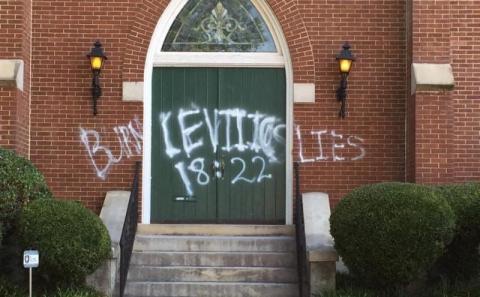
Real Christian persecution is having your church graffitied hatefully because gay and lesbian people can worship there. Real Christian persecution in the United States terrorizes people — often Christians themselves, and more often then not, it is done by people professing to be Christian but persecuting LGBT Christians and LGBT-affirming Christians.

This type of Christian persecution uses hate and violence, because hate always leads to violence, done in the name of God and continuing in the name of God. And Christianity— particularly as it has been historically practiced by white, heterosexual people in the United States—has a very deep, very long history of perpetrating this kind of violence.

The latest victim of such persecution is the Church of Our Redeemer, a Metropolitan Community Church in Augusta, Georgia (MCCOR). It’s an open and affirming church in the midst of a deeply homophobic culture that birthed the Southern Baptist Convention.

The church is a beacon for LGBTQ equality, a home and safe haven for many in the town.

But a neighbor Tuesday morning called the church’s senior pastor, the Rev. Rick Sosbe, after noticing a vandal had sought to extinguish the church’s light for equality. Someone had spray-painted “Leviticus 18:22” on doors of the church along with the words “burn” and “lie.” And just an hour away, the KKK, a self-professed Christian organization, is protesting the Confederate battle flag being removed from the South Carolina capitol in the most vile and hateful of ways. Certainly, these two shouldn’t be simply equated with each other, but at their core, both are motivated by hate and by violence toward difference.

Hate, it seems, has become a “Christian” value for some. These Christians use biblical verses out of context to spew their hate and to justify their violence. They may not be as well-organized or as violent as ISIS, but they are no better. Many would love nothing more than to have a Christian version of ISIS in America, yet in the same hate speech they will denounce ISIS without seeing the correlation between the he two.

How in God’s name has Jesus been fashioned into an idol for bigotry? Need we be reminded that almost half of the gay, lesbian, and bisexual community are professing Christians? Need we be reminded that the vast majority of Black Americans are Christians? Need we be reminded—yet again—that in the United States, it has almost always been Christians terrorizing Christians?

White Christians have been terrorizing Black Christians for centuries since whites forced African slaves into conversion to Christianity. Heterosexual Christians terrorizing gay, lesbian, bisexual, and transgender Christians for decades and longer. Those categories aren’t mutually exclusive mind you, but it bears remembering that hate crimes in this country have tended to be committed overwhelmingly by Christians, frequently against Christians.

It’s terribly ironic. Christians like Franklin Graham fret and worry about attacks on the Christian faith from Muslims or other vague bogeymen who aren’t white, who aren’t Christians, or who aren’t heterosexual. But the real attack on Christianity is coming from Christians.

As tempting as it is to focus just on this evil and hateful crime in Augusta that’s not the whole story. The MCCOR community is continuing to shine its light in Augusta . Church and community members—even a few passersby—have rallied together to repair the damage, to clean and re-paint. There has been shared joy in the joining together to literally erase the hate, according to folks there.

As always, the whole story can be so much bigger and more generous than an act of hate, and we can be a small part of that. In many ways, MCCOR is a beacon—and a fairly isolated one at that—in Augusta for ministry to and among LGBTQ people. My sister used to live in Augusta, so I know how it is not one of the most welcoming of cities. She and her husband only stayed a couple of years.

May God bless LGBT Christians everywhere and especially MCCOR.

Sources: This is an edited version of a Believe Out Loud post by David Henson who received his Master of Arts from Graduate Theological Union in Berkeley, California, after receiving a Lilly Grant for religious education for journalists. He is ordained in the Episcopal Church as a priest. He lives in North Carolina, is a father of two boys, and the husband of a medical resident.

http://www.believeoutloud.com/latest/real-christian-persecution-augusta-church-hit-anti-lgbt-hate-crime


Love

image

So now faith, hope, and love abide, these three; but the greatest of these is love. – 1 Corinthians 13:13

Love is patient and kind; love does not envy or boast; it is not arrogant or rude. It does not insist on its own way; it is not irritable or resentful; it does not rejoice at wrongdoing, but rejoices with the truth. Love bears all things, believes all things, hopes all things, endures all things. Love never ends. – 1 Corinthians 13:4-8a

God does not ask us to choose between compassion and faith in the Bible.

Mainline Christians are increasingly divided over the issue of the acceptance and inclusion of gay persons into the church. The debate itself is usually framed as essentially pitting the Bible, on one hand, against compassion and social justice on the other. Our Christian hearts, runs the (usually impassioned) argument, compel us to grant full moral and legal equality to gay and lesbian people; our Christian faith, comes the (usually impassioned) rebuttal, compels us to cleave, above all, to the word of God.

Compassion for others is the fundamental cornerstone of Christian ethics; the Bible is the bedrock of the Christian faith. What Christian can possibly choose between the two?

The answer is that no Christian is called upon to make that choice. The text of the Bible on one hand, and full equality for gay and lesbian people on the other, is a false dichotomy. God would not ask or expect Christians to ever choose between their compassion and their faith.

Reconciling the Bible with unqualified acceptance and equality for LGBT people does not necessitate discounting, recasting, or deconstructing the Bible. All it takes is reading those passages of the Bible wherein homosexuality is mentioned with the same care that we would any other passage of the book.

We can trust God; we can trust that God is loving.

And we can trust that we can—and that we certainly should—take God, in this matter, as in all things, at his word.

If there is no clearly stated directive in the Bible to marginalize and ostracize gay people, then it is morally indefensible for Christians to continue to do so.

What cannot be denied is that Christians have caused a great deal of pain and suffering to gay persons, by:

  • Banning their participation in the church, thus depriving them of the comforts and spiritual fruits of the church.
  • Banning their participation in the sacrament of marriage, thus depriving them of the comforts and spiritual fruits of marriage.
  • Damaging the bonds between gays and their straight family members, thus weakening the comforts and spiritual fruits of family life for both gays and their families.
  • Using their position within society as spokespersons for God to proclaim that all homosexual relations are disdained by God, thus knowingly contributing to the cruel persecution of a minority population.

Christians do not deny that they have done these things. However, they contend that they have no choice but to do these things, based on what they say is a clear directive about homosexuals delivered to them by God through the Holy Bible. They assert that the Bible defines all homosexual acts as sinful, instructs them to exclude from full participation in the church all non-repentant sinners (including gay people), and morally calls upon them to publicly (or at least resolutely) denounce homosexual acts.

Without an explicit directive from God to exclude and condemn homosexuals, the Christian community’s treatment of gay persons is in clear violation of what Jesus and the New Testament writers pointedly identified as one-half of God’s most important commandment: to love one’s neighbor as one’s self.

The gay community has cried out for justice from Christians, who have a biblically mandated obligation to be just. Because the suffering imposed on gay persons by Christians is so severe, the directive from God to marginalize and ostracize gay people would have to be clear and explicit in the Bible. If there is no such clearly stated directive, then the continued Christian mistreatment of gay and lesbian people is morally indefensible, and must cease.

Heterosexual Christians are being unbiblical by using the clobber passages as justification for applying absolute standards of morality to homosexual “sins” that they themselves are not tempted to commit, while at the same time accepting for themselves a standard of relative morality for those sins listed in the clobber passages that they do routinely commit.

Homosexuality is briefly mentioned in only six or seven of the Bible’s 31,173 verses. (The verses wherein homosexuality is mentioned are commonly known as the “clobber passages,” since they are typically used by Christians to “clobber” LGBT people.) The fact that homosexuality is so rarely mentioned in the Bible should be an indication to us of the lack of importance ascribed it by the authors of the Bible.

While the Bible is nearly silent on homosexuality, a great deal of its content is devoted to how a Christian should behave. Throughout, the New Testament insists upon fairness, equity, love, and the rejection of legalism over compassion. If heterosexual Christians are obligated to look to the Bible to determine the sinfulness of homosexual acts, how much greater is their obligation to look to the Bible to determine the sinfulness of their behavior toward gay persons, especially in light of the gay community’s call to them for justice?

Some Bible passages pertinent to this concern are:

Let any one of you who is without sin be the first to throw a stone at her. — John 8: 7

Let no debt remain outstanding, except the continuing debt to love one another, for whoever loves others has fulfilled the law. The commandments, “You shall not commit adultery,” “You shall not murder,” “You shall not steal,” “You shall not covet,” and whatever other command there may be, are summed up in this one command: “Love your neighbor as yourself.” Love does no harm to a neighbor. Therefore love is the fulfillment of the law — Romans 13:8-10

Here there is no Gentile or Jew, circumcised or uncircumcised, barbarian, Scythian, slave or free, but Christ is all, and is in all. Therefore, as God’s chosen people, holy and dearly loved, clothe yourselves with compassion, kindness, humility, gentleness and patience. Bear with each other and forgive one another if any of you has a grievance against someone. Forgive as the Lord forgave you — Colossians 3:11-13

Woe to you, teachers of the law and Pharisees, you hypocrites! You give a tenth of your spices—mint, dill and cumin. But you have neglected the more important matters of the law—justice, mercy and faithfulness. You should have practiced the latter, without neglecting the former. You blind guides! You strain out a gnat but swallow a camel. — Matthew 23: 23-24

A fundamental tenet of Christianity is that we are all born sinners, that we have no choice but to exist in relationship to our sinful natures. And so Christians accept as inevitable that any given Christian will, for instance, on occasion drink too much, lust, or tell a lie.

As we’ll see below, in the clobber passages Paul also condemns, along with homosexuality, those three specific sins. But Christians don’t think that they are expected to never commit any degree of those sins. They understand that circumstances and normal human weaknesses must be taken into account before condemning any transgression. We all readily understand and accept the moral distinction between drinking socially and being a drunk, between a lustful thought and committing adultery, between telling a flattering white lie and chronically lying.

Even a sin as heinous as murder we do not judge without first taking into account the context in which it occurred. Self-defense, protection of the innocent, during a war—we recognize that there are times when taking the life of another is not only not a sin, but a morally justified and even heroic act.

Christians evaluate the degree of sin, or even whether or not a real sin has occurred, by looking at both the harm caused by the sin, and the intent of the sin’s perpetrator.

They do, that is, for all sins except homosexuality.

Virtually any degree of homosexual “transgression” gets treated by some Christians as an absolute sin deserving absolute punishment. Such Christians draw no moral distinction between the homosexual gang rape in the story of Sodom and Gomorrah, the orgies to which Paul refers in his letter to the Romans, the wild sexual abandon Paul addresses in 1 Corinthians, and consensual homosexual sex between loving and committed homosexual partners.

Heterosexual Christians are being unfair and hypocritical by using the clobber passages as justification for applying absolute standards of morality (and an absolute penalty) to homosexual “sins” that they themselves are never tempted to commit, while at the same time accepting for themselves a standard of relative morality (and applying no real penalty) for those sins listed in the clobber passages that they do routinely commit.

As there is no demonstrable harm arising from sex within a committed homosexual relationship, and there is significant demonstrable harm arising from the discrimination against and condemnation of gay persons, what possible biblical basis can there be for not recognizing the vast moral differences between sex acts done within the context of a loving committed relationship, and sex acts of any other sort?

Here are a couple of Bible passages that any Christian should bear in mind whenever he or she is called upon (or at least emotionally compelled) to render a moral judgment:

Do not judge, or you too will be judged. For in the same way you judge others, you will be judged, and with the measure you use, it will be measured to you. — Matthew 7:1-2

Why do you look at the speck of sawdust in your brother’s eye and pay no attention to the plank in your own eye? How can you say to your brother, ‘Brother, let me take the speck out of your eye,’ when you yourself fail to see the plank in your own eye? You hypocrite, first take the plank out of your eye, and then you will see clearly to remove the speck from your brother’s eye. — Luke 6:41-42

The Bible isn’t a rulebook, and Christians cannot lift out of its context any passage from it, and still hope to gain a clear understanding of that passage.

It is important to understand that even the most fundamentalist Christian sects do not take the Bible wholly literally. The New Testament is two thousand years old, the old Testament much older. The Bible’s cultural contexts, along with the translation at hand, is always taken into consideration by any Christian serious about understanding this vast and complex work.

To excerpt any isolated short passage from the Bible, and then claim for that passage absolute authority, is to fail to take the Bible on its own terms. If we wish to follow the word of God, then we must take the entirety of God’s words into account. For example, when the Bible itself identifies some of its words as proverbs, it is bestowing upon those words less moral weight than other words that it identifies as commandments. The Bible itself tells us that some of its contents are songs, some visions, some histories, some dreams, some parables, and some commandments. The Bible itself also instructs Christians that New Testament moral directives supersede Old Testament moral directives. The Bible itself tells us that its moral principles supersede any of its moral “rules.”

The context of any Bible passage is as integral to its meaning as the passage itself. It may be appropriate to give equal weight to each clause within a business contract, each step within a set of mechanical instructions, or each rule within a game rulebook. But the Bible itself tells us that the Bible is not a uniform document, with each passage spelling out something clear and specific, and all passages having equal value. The Bible is not a rulebook for being Christian. We would be foolish to fail to understand that not everything in the Bible is a commandment, and that Christians cannot take a small section of the Bible out of its larger context, and still hope to gain a clear understanding of that section. Isolating a clobber passage from its context, and then claiming a sort of moral helplessness because “it’s in the Bible,” is failing to take the Bible either literally or seriously.

Using the four Old Testament passages to condemn all homosexual acts is not in keeping with any Christian directive from God, nor with the practices of contemporary Christians.

The Bible’s first four references to homosexuality occur in the Old Testament.

While continuing to be spiritually inspired and influenced by the Old Testament, Christians were specifically instructed by Paul not to follow the law of the Old Testament, in such passages as:

The former regulation is set aside because it was weak and useless (for the law made nothing perfect), and a better hope is introduced, by which we draw near to God. —Hebrews 7:18-19

Before the coming of this faith, we were held in custody under the law, locked up until the faith that was to come would be revealed. So the law was our guardian until Christ came that we might be justified by faith. Now that this faith has come, we are no longer under a guardian. — Galatians 3:23-25

So, my brothers and sisters, you also died to the law through the body of Christ, that you might belong to another … — Romans 7:4

For sin shall no longer be your master, because you are not under the law, but under grace. — Romans 6:14

In practice, Christians do not follow the dictates of the Old Testament. If they did, polygamy would be legal, and things like tattoos, wearing mixed fabrics, eating pork, and seeding lawns with a variety of grasses would be forbidden. If Christians followed the dictates of the Old Testament, then today if the parents of a new bride could not, upon her husband’s request, prove that she was a virgin, that bride would have to be stoned to death. Christians would also have to stone to death any Christian guilty of adultery. And the Christian day of worship would be Saturday, not Sunday.

Clearly, Christians no longer cleave to the rules of the Old Testament.

Therefore, the use of the four Old Testament passages to condemn all homosexual acts is not in keeping with any Christian directive from God, nor with the practices of contemporary Christians.

In the clobber passages Paul condemns the coercive, excessive, and predatory same-sex sexual activity practiced by the Romans—and would have condemned the same acts had they been heterosexual in nature.

Because Christians’ understanding and practice of New Testament prescriptions naturally and inevitably evolve along with the society and culture of which they are a part, at any given time in history Christians have always selectively followed the dictates of the New Testament. Whenever a specific biblical injunction is found to be incongruous with contemporary mores, a reshaping of the conception of that injunction is not only widely accepted by Christians, it’s encouraged, as long as the new thinking is understood to be in keeping with overriding timeless biblical moral principles. This is why Christian women no longer feel morally constrained to follow Paul’s directives to leave their hair uncut, to keep their heads covered in church, or to always remain quiet in church. It’s also why the Bible is no longer used to justify the cruel institution of slavery, or to deny women the right to vote.

Just as those thoughts and understandings of the New Testament changed and grew, so today is it becoming increasingly clear to Christians that the three New Testament clobber passages (each of which was written by Paul in letters to or about nascent distant churches), when understood in their historical context, do not constitute a directive from God against LGBT people today.

Here are the three references to homosexuality in the New Testament:

Or do you not know that wrongdoers will not inherit the kingdom of God? Do not be deceived: Neither the sexually immoral nor idolaters nor adulterers nor men who have sex with men nor thieves nor the greedy nor drunkards nor slanderers nor swindlers will inherit the kingdom of God. — 1 Corinthians 6:9-10

We also know that the law is made not for the righteous but for lawbreakers and rebels, the ungodly and sinful, the unholy and irreligious, for those who kill their fathers or mothers, for murderers, for the sexually immoral, for those practicing homosexuality, for slave traders and liars and perjurers—and for whatever else is contrary to the sound doctrine. —1 Timothy 1:9-10

Because of this, God gave them over to shameful lusts. Even their women exchanged natural sexual relations for unnatural ones. In the same way the men also abandoned natural relations with women and were inflamed with lust for one another. Men committed shameful acts with other men, and received in themselves the due penalty for their error. —Romans 1:26-27

During the time in which the New Testament was written, the Roman conquerors of the region frequently and openly engaged in homosexual acts between themselves and boys. Such acts were also common between Roman men and their male slaves. These acts of non-consensual sex were considered normal and socially acceptable. They were, however, morally repulsive to Paul, as today they would be to everyone, gay and straight.

The universally acknowledged authoritative reference on matters of antiquity is the Oxford Classical Dictionary. Here is what the OCD (third edition revised, 2003) says in its section about homosexuality as practiced in the time of Paul:

“… the sexual penetration of male prostitutes or slaves by conventionally masculine elite men, who might purchase slaves expressly for that purpose, was not considered morally problematic.”

This is the societal context in which Paul wrote of homosexual acts, and it is this context that Christians must acknowledge when seeking to understand and interpret the three New Testament clobber passages. Yes, Paul condemned the same-sex sexual activity he saw around him—because it was coercive, without constraint, and between older men and boys. As a moral man, Paul was revolted by these acts, as, certainly, he would have been by the same acts had they been heterosexual in nature.

The Bible’s clobber passages were written about same-sex acts between heterosexual persons, and do not address the subject of homosexual acts between a committed gay couple, because the concept of a person being homosexual did not exist at the time the Bible was written.

It is critical to our reading of the New Testament’s three clobber passages to understand that while Paul would have known about sex acts that took place between persons of the same gender, he would have had no concept whatsoever of homosexual persons. Virtually no one in Paul’s time was “out”; no one lived, or in any way publicly self-identified, as a homosexual. Paul had no reference point for an entire group of people who, as a fundamental, unalterable condition of their existence, were sexually attracted to persons of the same gender, and not sexually attracted to persons of the opposite gender.

Here is the opening of the OCD’s article on homosexuality:

“No Greek or Latin word corresponds to the modern term ‘homosexuality,’ and ancient Mediterranean society did not in practice treat homosexuality as a socially operating category of personal or public life. Sexual relations between persons of the same sex certainly did occur (they are widely attested in ancient sources), but they were not systematically distinguished or conceptualized as such, much less were they thought to represent a single, homogeneous phenomenon in contradistinction to sexual relations between persons of different sexes. … The application of ‘homosexuality’ (and ‘heterosexuality’) in a substantive or normative sense to sexual expression in classical antiquity is not advised.”

We can be confident that Paul was not writing to, or about, gay people, because he simply could not have been, any more than he could have written about smartphones, iPads, or televisions. We do not know what Paul might write or say today about gay people. All we know is that in the New Testament he wrote about promiscuous, predatory, non-consensual same-sex acts between people whom he understood to be heterosexual.

The Bible does condemn homosexual (and heterosexual) sex that is excessive, exploitive, and outside of marriage. It does not, however, address the state of homosexuality itself, much less the subject of homosexual acts between a married gay couple. Christians, therefore, have no Bible-based moral justification to condemn such acts.

Because there was no concept of gay marriage when the Bible was written, the Bible does not, and could not, address the sinfulness of homosexual acts within the context of gay marriage.

The Bible routinely, clearly, and strongly classifies all sex acts outside of the bonds of marriage as sinful. But, because when the Bible was written there was no concept of gay people—let alone, then, of gay marriage—the Bible does not, and could not, address the sinfulness of homosexual acts within the context of marriage.

By denying marriage equality to gay people, Christians are compelling gay couples to sin, because their intimacy must happen outside of marriage, and is therefore, by biblical definition, sinful. Christians, in other words, cause gay people to sin, and then blame the gay people for that sin. By any decent standard of morality that is manifestly and egregiously unfair.

Being personally repelled by homosexual sex doesn’t make homosexual sex a sin.

In addition to the Bible, many Christians cite as evidence of the inherent sinfulness of homosexual acts their own emotional response to such acts. It is understandable that many straight people find homosexual sex repugnant (just as many gay people find heterosexual sex repugnant). It is normal for any one of us to be viscerally repelled by the idea of sex between, or with, people for whom we personally have no sexual attraction. Young people, for example, are often disgusted by the thought of senior citizens having sex. And who isn’t repulsed by the idea of their own parents having sex? (When, rationally speaking, we should rejoice in the fact that they did—at least once!) But it is much too easy for any person to mistake their instinctive reaction against something as a moral reaction to that thing. Outrage isn’t always moral outrage, though the two usually feel the same.

It may feel to a straight Christian that their instinctive negative reaction to homosexual sex arises from the Bible. But all of us necessarily view the Bible through the lens of our own experiences and prejudices, and we must be very careful to ensure that lens does not distort our reading of God’s sacrosanct word.

“The greatest of these is love”

The overriding message of Jesus was love. Jesus modeled love, Jesus preached love, Jesus was love. Christians desiring to do and live the will of Jesus are morally obligated to always err on the side of love. Taken all together, the evidence—the social context in which the Bible was written, the lack of the very concept of gay people in Paul’s time, the inability of gay people to marry, the inequity between how the clobber passages are applied between a majority and a minority population, the injustice of exclusion from God’s church on earth and from human love as the punishment for a state of being over which one has no choice—conclusively shows that choosing to condemn and exclude gay people based on the Bible is the morally incorrect choice. That evidence should instead lead Christians to the most obvious, and most Christian of all positions, stated so beautifully by Paul himself in 1 Corinthians 13:8-13:

Love never fails. But where there are prophecies, they will cease; where there are tongues, they will be stilled; where there is knowledge, it will pass away. For we know in part and we prophesy in part, but when completeness comes, what is in part disappears. When I was a child, I talked like a child, I thought like a child, I reasoned like a child. When I became a man, I put the ways of childhood behind me. For now we see only a reflection as in a mirror; then we shall see face to face. Now I know in part; then I shall know fully, even as I am fully known.

And now these three remain: faith, hope and love. But the greatest of these is love.

(The text for this lesson is an excerpt from John Shores’ book, UNFAIR: Christians and the LGBT Question.)