Category Archives: Television

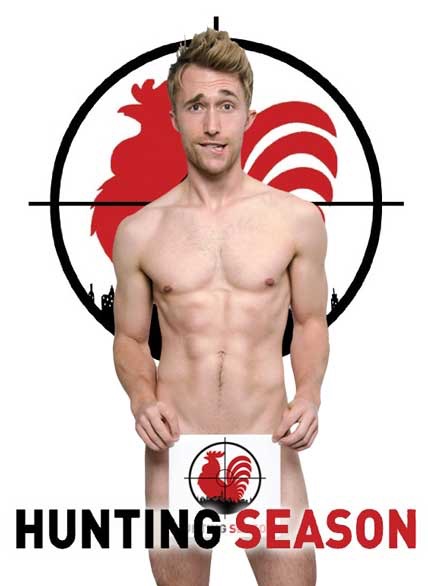
Corey Kent White: Too Cute and Talented Not to Win


Corey Kent White is many things. He’s an artist. He’s a songwriter, and he’s a hard worker. So far, he’s also, hands down, my pick to win The Voice this season.  White has put in thousands of hours as a writer and performer. In fact, White’s performances and original songs have already captivated audiences of all sizes throughout the United States.

As part of Team Blake, White and Jacob Rummell  competed in the final night of The Voice battle rounds Tuesday, and White walked away with the win.  In what coach Blake Shelton declared a “dead even” battle, it was White who Shelton chose to advance to the knockout rounds, though I think White was clearly the best choice.  Rummell was stolen by Pharrell, so he remains on the show as well.

The knockout rounds are set to air March 23, 24 and 30 on NBC.  In the knockouts, the singers are again pitted against a fellow team member, but they choose which song they will perform individually while the other watches.

Over ten years ago, White started his music career on a lonely stage at the State Fair in Tulsa, OK. Although it was just him and his guitar, Corey’s talent and professionalism shone through and impressed the manager of a Western Swing band called Oklahoma Stomp. White’s first appearance quickly turned into a five-year gig touring with this group that opened for well-known acts like the Oak Ridge Boys and played famous stages like the Kennedy Center in Washington, DC.

One thing about the success that White has experienced is clear—it was earned not given. He has worked extraordinarily hard to achieve these extraordinary results.  What’s more, all of this clears up one thing about his future…He won’t stop working until he is at the top, and I hope he’s the top choice for America this season on The Voice.  I can’t help but be excited over White.  I usually choose a country singer to root for, because they are usually some of the best talent on the show, but White has a breathy, sexy voice, not to mention that he’s just adorable.

Jack Falahee: Inquiring Minds Want to Know

2015/02/img_0509.jpg

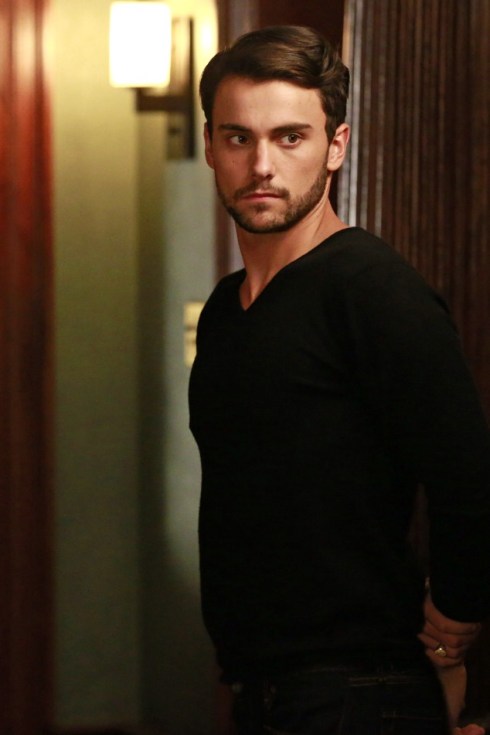
The two hour season finale of “How to Get Away with Murder” aired last night. There were many OMG, OMFG, WOW, and WTF moments in last night’s episode. We got to see a little bit more about Connor and Oliver’s relationship, but sadly we haven’t gotten any steamy sex scenes since the first half of the season.

“How to Get Away with Murder” star Jack Falahee, who’s been steaming up TV screens with his gay sex scenes as Connor Walsh, expounded further on why he’s not announcing his sexual orientation any time soon. His approach to this question is quite interesting, and to a certain degree, I understand it. Even though, my curiosity is up too. Jack is incredibly sexy.

In a recent interview in Out that received lots of social media attention, he’d said it “seems reductive” to note his sexual orientation publicly, explaining that he doesn’t think it ”accomplishes anything other than quenching the thirst of curiosity,” and opined that, ”no matter how I answer, someone will say, ‘No, that’s not true.’”

Speaking with me on SiriusXM Progress, Falahee, who replied “Yeah, sure,” when asked if it’s important for young LGBT people to see out actors and celebrities, further explained his thinking on why, in his case, he’s not discussing whether he’s straight, gay or bisexual.

“I was basically trying to say [in that interview], for me it’s like asking an actor who plays an alcoholic what their relationship is with alcohol,” he explained. “It’s not necessarily — I think we’re projecting onto actors in a way. I think we’re expecting them to be their characters when, at the end of the day, this is my job and I’m an actor portraying a role on a fictitious television show.”

But an actor who plays an alcoholic might be asked what he brings to the role and if he’s had that experience in his life. If people ask what an actor like Falahee, whose character, Connor Walsh, had lots of hook-up sex with various men last season, what he brings to the role of a gay man, isn’t the interviewer simply asking what he brings to the experience?

“Right, but that wasn’t the question,” Falahee replied. “The question was, ‘How do I define my sexuality?’ And that’s a very different question than asking — actually we were in Atlanta, for the ATL TV Fest, and a young woman, she actually had a really great question. She said, ‘What personal experience do you bring to portray — what did she say? — a ‘manwhore’ homosexual on television?’”

“And you know, I was like, that is a great question,” he continued. “That is a different question than how do I define my sexuality. And to answer that question, I would say, well, you know, I went to NYU, and the Tisch School of Drama, and there we studied Stanislavski-based acting techniques. And while I have dabbled in the Lee Strasberg method of sense-memory and using your own experience to portray a character, I found that that was a fast track, maybe, to therapy. And so, I fell more into the Stella Adler method of acting camp, and create fictitious circumstances….I’m creating circumstances in which Conor exists to accurately portray him..I just think it’s interesting because I have a body of work before Conor Walsh that is primarily heterosexual and yet people want to ask — you know, no on asks any other man, or woman, on my show, about their sexuality, and that’s what fascinates me.”

He then added, “We don’t ask the actor playing James Bond what his sexual preference is. So I don’t know what it is, really, with trying to out actors who portray gay characters on television. But it is some sort of fascination in society.”

Homophobic?

IMG_0066.PNG

On Sunday, while promoting his new FX show “The Comedians” at a Television Critics Association Winter Press Tour panel, Billy Crystal was asked about playing a gay role on the ABC show “Soap” in the late ’70s and how television has changed since that time.

In his response, the comedian talked about being uncomfortable with how sexualized some shows have become and, in doing so, employed a few phrases like “a little too far for my tastes” and “shove it in our face” that always trip my homophobia sensors and make me want to protest by grabbing every man in sight by whatever appendage is handiest and dragging them into a studio to stage a gay sex telethon that will be broadcast into the living rooms of every family in the world.

This led some gay Americans to ask questions about Crystal’s statements. Was some kind of further context missing? Did you have to be in the room to see his body language or hear the tone of his voice? Was he really separating his displeasure with viewing gay sex scenes from his displeasure with viewing straight sex scenes?

However, in a follow up interview with Xfinity’s tv blog, the actor addressed his earlier comments, saying in part:

First of all, I don’t understand why there would be anything offensive that I said. When it gets too far either visually…now, that world exists because it does for the hetero world, it exists, and I don’t want to see that either. But when I feel it’s a cause, when I feel it’s “You’re going to like my lifestyle,” no matter what it is, I’m going to have a problem and there were a couple of shows I went ‘I couldn’t watch that with somebody else.” That’s fine. If whoever writes it or produces it…totally get it. It’s all about personal taste.

When I read some of the criticism of Crystal’s statement, I had to wonder: is what he saying really homophobic as many pundits are claiming? I’m not sure that I agree that it is. He clearly states that sex scenes on television go too far whether they are heterosexual or homosexual. Furthermore, shows like “Scandal” and “How to Get Away with Murder” produced by Shonda Rhimes, both of which I really enjoy (and the gay sex scenes are a major plus), unabashedly show gay sex in the same context that straight sex is often portrayed on television. Furthermore, Rhimes has explicitly admitted that she is pushing an agenda to see more equality in sex scenes on television. Crystal merely said what Rhimes herself has said, but he also said that it was too much for him. Sometimes the explicit way that straight sex is portrayed on television is too much for me, does that make me heterophobic. I don’t think it does, any more than saying the same makes Crystal homophobic.

We live in a very scary time in many ways. You can’t say this, you can’t say that, you can’t offend this group, that group. As someone who has lived in the Deep South my entire life, I’ve seen plenty of homophobia and racism. All across America, and especially in the South, what people say about race is often taken as being racist. So much of the country believes that if you are white and you have an opinion on race, then that opinion is racist. People claim that there is no such thing as “reverse” racism, but when you are the minority in your area, whether you are white or black, if the majority discriminates because of your race, it is racism. People get too easily offended and they take political correctness to the extreme. That’s offensive to me.

The thing is, we should all treat everyone as we wish to be treated. So if Billy Crystal says that sex on television, and gay sex on television in particular is not something he wants to watch, well that’s his right to have that opinion. If Billy Crystal has a sex scene on television or a movie, I don’t want to see him naked either. My opinion is that we have the right to watch what we want to watch. If that includes gay sex, or straight sex, or whatever kind of sex, then we had that right, but we also have the right to say, “Look, that’s just too much for me. I don’t think I want to watch that,” well that’s our prerogative. And if I don’t want to watch something because it has an agenda, then I don’t have to watch it.

Case in point, I will not go to the movie theater to see “Selma.” It’s not because of racial tensions or that I’m racist, but because the movie is politically bent to put forth an agenda and skew the history of that event. The makers of the movie have admitted to that and have admitted to changing certain facts because it fit their artistic vision (i.e. political agenda). As a historian, I constantly having to fight against how history is portrayed in movies because people take it as fact, when it is fiction. So for a movie about an event as important as the Selma to Montgomery March to purposefully skew those facts is abhorrent in my opinion.

So I won’t be going to see “Selma.” Does that make me a racist? No, it doesn’t, and neither does Billy Crystal saying that he thinks sex on television goes to far when asked about his previous role playing a gay man on television nearly forty years ago and how it compares to gay roles today. We have our opinions and we have the right to voice those opinions. We also have a right to call bullshit when someone takes our words out of context because something we said hurt their over sensitive ideas of the need to be political correct 100 percent of the time.


MCM: Jonathan Groff

IMG_9988.JPG

Last weekend, we received a free preview weekend of HBO and Starz. Usually during the free preview weekends, they never show anything really great, but the second season of the HBO show ‘Looking’ premiered last Sunday, so I had the good fortune of getting to see a marathon of the first season of ‘Looking.’ If you’re not familiar with the show, ‘Looking’ offers up the unfiltered experiences of three close friends living — and loving — in modern-day San Francisco. Friendship may bind them, but each is at a markedly different point in his journey: Patrick (Jonathan Groff) is the 29-year-old video game designer getting back into the dating world in the wake of his ex’s engagement; aspiring artist Agustín (Frankie J. Alvarez), 31, is questioning the idea of monogamy amid a move to domesticate with his boyfriend; and the group’s oldest member — longtime waiter Dom (Murray Bartlett), 39 — is facing middle age with romantic and professional dreams still unfulfilled.

The trio’s stories intertwine and unspool dramatically as they search for happiness and intimacy in an age of unparalleled choices — and rights — for gay men. Also important to the ‘Looking’ mix is the progressive, unpredictable, sexually open culture of the Bay Area, with real San Francisco locations serving as a backdrop for the group’s lives. Rounding out the ‘Looking’ world are a bevy of dynamic gay men including Kevin (Russell Tovey), Lynn (Scott Bakula), and Richie (Raul Castillo), as well as a wide-range of supporting characters like Dom’s roommate Doris (Lauren Weedman), Agustín’s boyfriend Frank (O.T. Fagbenle), and Patrick’s co-worker Owen (Andrew Law).

Jonathan Groff who portrays Patrick is so incredibly hot, sexy, and talented. I really love his character, and if it wasn’t for Groff, I’m not for sure I’d even really like the show that much. I did like Murray Bartlett’s character Dom, but Frankie J. Alvarez’s character Agustín just left me cold. Overall, I enjoyed the show, and I hope I will get to see the second season.


Game of Thrones

IMG_9738.JPG

I am sure I am far behind on becoming a fan of the HBO series Game of Thrones, but I just got the first two seasons on DVD for Christmas. I spent much of the weekend watching the twenty episodes of the first season. If I subscribed to HBO, I’d probably have already seen the series before, but I don’t so I had to wait to get it on DVD. As soon as I watched the first episode, I knew I was hooked. Now I need the third season and can anxiously await the fourth season on DVD in February.

If you are not familiar with the HBO series, it is an adaptation of A Song of Ice and Fire, George R. R. Martin’s series of fantasy novels, the first of which is titled A Game of Thrones. I’ve never read the novels, but hope to one day. The novels and their adaptation derive aspects of their settings, characters and plot from various events of European history. A principal inspiration for the novels is the English Wars of the Roses (1455–85) between the houses of Lancaster and York, reflected in Martin’s houses of Lannister and Stark. Most of Westeros, with its castles and knightly tournaments, is reminiscent of High Medieval Western Europe. I am not an expert on Medieval Europe, but I have been fascinated by Medieval England since I took a class on it from a woman who I consider to have been one of the greatest history professors to ever live. She was also my mentor until her death, and she encouraged me to continue my study of history.

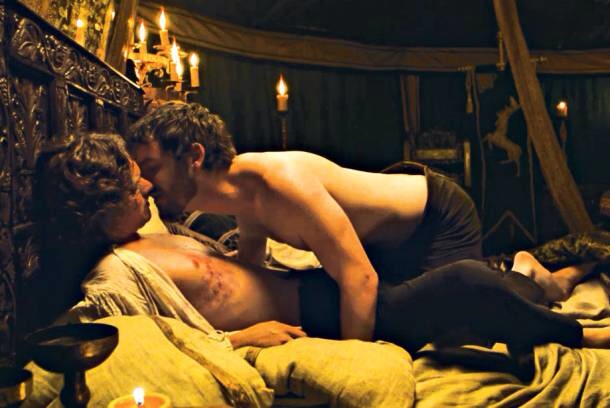
That being said, Game of Thrones has many redeeming qualities. There are a massive number of characters to keep up with, but the male eye candy is tremendous. With gay knights and nobles, there is a bit of gay sex thrown into the mix. The male nudity is not nearly as numerous as the female nudity, but each time it appears on the screen, it is well worth it. Amazingly, or maybe not so amazing, the most well-endowed actors tend to show frontal nudity, but there are plenty of male backsides to enjoy as well.

IMG_9737.JPG

Game of Thrones star Finn Jones stated the obvious in one interview: There’s “not enough hot gay sex” on the show. Jones plays Loras Tyrell (pictured on his back in the above screenshot), a rather unique character for American television. He is unreservedly gay, but fierce as any other Westeros warrior.

Actor Kristian Nairn is best known as the dim-but-loyal Hodor on Game of Thrones. His character carries a crippled child around and only utters the word Hodor. Hodor is said to have giant’s blood in him and by the looks of his nude scene in season one, he’s a giant in more ways than one. But more interesting than his prodigious member is that he is openly gay. In an interview he said of being a gay man, “I had an upbringing to respect other people’s privacy, and their right to be and choose what they want, and I expect—no, demand—no less for myself. It’s a very small part of who I am on the whole, but nonetheless, in this day and age, it’s important to stand up and be counted. I have and always will stand my ground. So, yeah, people have been great, on the show, but I don’t see why it would be an issue.”

If you enjoy semi-historical television with a mix of fantasy, Game of Thrones is well worth watching.


Grant Gustin As The Flash

IMG_9282.PNG

The CW has a new superhero drama, The Flash. There are two superheroes that have always fascinated me: Superman and The Flash. More recently, I have a thing for Captain America, but that mainly has to do with Chris Evans, so it’s not a long time obsession. I’m pretty sure that I’ve talked about my superman obsession, though I don’t think it’s really a full on obsession, but I’m sure I’ve never discussed The Flash before. The blog QueerClick (NSFW, it’s mostly porn but with a few interesting non-porn articles here and there) posted one of their QC Open Forums the other day which was provocatively titled “Is The Flash Too Gay For His Own Good?” The main text of the post (which was mostly pictures, like the one above which I swear has a nice outline of Grant Gustin’s privates in it) stated:

If you have seen The Flash you have probably noticed how Grant Gustin’s gay comes shining through. We’re not saying he is gay (we totally are) but there are moments where The Flash just comes off as very gay, loud and proud. Don’t you find odd the lack of chemistry with his leading lady on the show? That’s like awfully suspicious. And there are times when the inflections of his voice or the way he acts sets our gaydar off like a klaxon. Is that because he has trouble with the character or because the melodrama is over the top? Or is it a vestigial trait from when he was on Glee?

There’s no denying that Grant is super charming and his portrayal of Barry Allen as a good-hearted superhero in the learning stages of his career is not grim or tortured, nowadays that is totally refreshing in the genre. One thing that could disprove our theory is that if he were gay, he wouldn’t have choose such awful variation of the suit.

But we can’t help going back and forth with the primary question, is The Flash too gay for his own good?

I left a comment on this (the featured comment for the post “woot woot”) that said, “Grant Gustin makes the perfect Flash. I seriously see no flaw in his portrayal. He’s sweet, kind, dorky, and so damn cute. I think I’m in love.” Honestly, I really do enjoy the show, and I enjoyed The Flash when it was on in the 1990s with John Wesley Shipp, who by the way plays Barry Allen’s father in this incarnation of The Flash.

While some of the other comments tended to be along the lines of mine and a few were just horny male comments like you’d expect on a gay porn blog, many of the comments were angry at QC for publishing such a post that asked of the character “is too gay.” A comment by Tyrone said:

This kind of commentary actually sets our community back. Neil Patrick Harris, Jim Parsons, Matt Bomer, and T.R. Knight are examples of queer performers who have successfully played straight roles (and the list is endless). Actors, by definition, are portraying something or someone they are not. Their sexuality shouldn’t be a factor, and when you are saying it is, you’re effectively saying a gay performer can’t be taken seriously as a leading man or as a main character in a mainstream movie. That’s a problem.

Now here’s my thought on this: if it were a more serious news blog or a non-gay blog doing a post like this, then I’d say he had a right for his indignation, but QC is a gay porn blog. Even when they try to do something serious, it’s always tongue-in-cheek. Rarely do they every have a serious post. The most ridiculous comment in the whole thread was by “batGRRRl4ever” who wrote “I thought better of this site to even ask a question like this.” Really, she thought better of a gay porn blog that is often satirical was better than to “even ask a question like this.”

In my opinion, Gustin plays Barry Allen perfectly. I don’t think it’s “too gay,” and though I thoroughly wish Grant Gustin was gay and they would have some gay characters on the show (Wentworth Miller plays one of the [maybe recurring] villains and there is rumors of an actual gay character), it doesn’t matter one way or the other because I enjoy the show. Furthermore, just because someone acts dorky and awkward doesn’t mean they are gay. Sure in the case of me it does, but it’s also the reason I was unmercifully picked on as a child and still face some discrimination based on how I am perceived without someone knowing the truth. I give QC a pass for asking the question because I know I’ve been having a similar train of thought, but I give them a pass because of the type of blog they are and that’s a blog that actually publishes the dirty thoughts that gay men often have and do so unabashedly.

I only have one real bone to pick with the QC post. I like The Flash’s costume. I love the dark red leather look much more than I ever like the bright red spandex that The Flash has always been seen wearing. I think it’s a good look, and it looks great on a Grant Gustin, and I sure it would look even better crumpled on the floor while he was naked next to me in bed.

IMG_9289.JPG


May “The Professor” Rest in Peace

20140116-221002.jpg

Two characters of movie and television inspired me to become a teacher. Those two characters were the Professor from Gilligan’s Island and Indiana Jones. I think there are few historians or archaeologists of my generation who were not inspired by Indiana Jones, and the Professor was just so incredibly smart. On January 16, 2014, Russell Johnson passed away from natural causes. He was best known for playing the handsome Professor Roy Hinkley (usually referred to as “The Professor”), the very knowledgeable polymath who could build all sorts of inventions out of the most rudimentary materials available on the island, but, as Johnson himself pointed out, could not fix the hole in the boat.

Gilligan’s Island was one of my favorite shows as a young kid (ranking with I Dream of Jeanie, Bewitched, and Scarecrow and Mrs. King). On Gilligan’s Island, the Professor was always my hero. The Professor was a good-looking but nerdy academic, an exaggerated stereotype of the man of capacious intelligence with little or no social awareness. Occasionally approached romantically by Ginger (and guest stars, including Zsa Zsa Gabor), he remained chaste and unaffected. Since I was a kid, who didn’t understand why I was not all crazy about girls and had more of a fascination for boys, it seemed like remaining “chaste and unaffected” was the way to go. It would largely remain my philosophy until I was in my twenties. The Professor was my role model in many ways.

Before becoming an actor, Russell Johnson served in the U.S. Army Air Forces during World War II. He was on a B-24 Liberator when it was shot down during a bombing raid over the Philippines in 1945, according to his official biography, and used his G.I. Bill benefits to pay for acting school after the war.

Johnson married Kay Levey on July 23, 1949. Their son, David, ran the AIDS program for Los Angeles, California, until David’s own death from complications of AIDS in 1994. Johnson was a full-time volunteer for AIDS research fundraising since his son was diagnosed. He also had a daughter with Levey, Kim. Kay Levey died on January 20, 1980 in Century City, California. In 1982, Johnson married Constance Dane. Johnson is survived by his wife, Constance Dane, and daughter, Kim Johnson, from an earlier marriage.


Sleepy Hollow

20130922-191808.jpg

Most of us are familiar with “The Legend of Sleepy Hollow,” a short story by American author Washington Irving, contained in his collection of 34 essays and short stories entitled The Sketch Book of Geoffrey Crayon, Gent. Irving is one of my favorite early American authors, and my English students and I just read “The Legend of Sleepy Hollow.” I even showed them the old Disney cartoon, which surprisingly follows the story very closely. It was written while Irving was living abroad in Birmingham, England, and was first published in 1820. Along with Irving’s companion piece “Rip Van Winkle,” “The Legend of Sleepy Hollow” is among the earliest examples of American fiction with enduring popularity.

It’s popularity has led to Fox creating a modern retelling in its new series “Sleepy Hollow.” I watched it for the first time last night. I had DVRed it last Monday and just got the chance to watch it. I really enjoyed it.

In the Fox show, Ichabod Crane “dies” during a mission for General George Washington in 1781. He awakens in 2013 Sleepy Hollow, New York, but so does the Headless Horseman, whose head Ichabod chopped off before his perceived death. The horseman begins his nightly killing spree, and Ichabod must partner with Lt. Abbie Mills.

Abbie investigates the horseman after he kills the sheriff (Clancy Brown). While hunting the horseman, Abbie looks into the old case files her late partner (the former sheriff) was investigating and learns of two types of occult groups—one for good, the other evil—which may have summoned the horseman again. If the horseman is not stopped, dark supernatural forces will affect the Earth. This becomes more difficult as the Horseman discovers modern weaponry, which he assimilates into his ritualistic hunt. Ichabod must also adjust to the societal and technological differences of the 21st century.

The headless horseman is revealed to be Death, one of the Four Horsemen of the Apocalypse described in the Book of Revelation.

As Abbie is a black woman, Crane’s worldview from 18th century Colonial America causes some friction with her, and also the people he must now work with. Given the fact that he is, and states he is from, the time of the American Revolution, local law enforcement see him as a madman but useful in hunting the horseman.

20130922-191959.jpg

On the second episode (it nabbed 10 million viewers with its Sept. 16 premiere), Captain Frank Irving (Orlando Jones) and Lieutenant Abbie Mills are trying to make sense of the new mystery man about town, Ichabod Crane (Tom Mison). Meanwhile, Ichabod is trying to wrap his brain around such modern marvels as hair dryer, coffee maker, and indoor plumbing. The TV gives him a good jolt too. Check it out in the following clip from “Blood Moon,” which airs tonight at 9 p.m. I recommend watching it, and if you haven’t seen The first episode, you should try to catch it online before the second one airs.

When Ichabod finally does getting around to putting on his shirt in the episode (Tom Mison is good looking enough by himself for me to watch the show), he and Abbie go on the hunt for a centuries-old vengeful witch who “has been awoken by unknown evils and is on a path of destruction.”

Sounds scary. My only criticism is that I would have preferred that the Headless Horseman continue to use his ax, instead of using modern weapons such as machine guns. However,Tom Mison is worth watching as Ichabod Crane. He may not be the frightened Ichabod of Irving’s original story, but the show takes an interesting twist on the legend.


Schrödinger’s Cat

Big Bang Theory is by far my favorite show on TV right now.  It is smart and funny without being mean-spirited or too bawdy.  On one of the earlier episodes, Leonard has asked Penny out on a date.  Neither knows whether or not they should go through with it, and both end up asking the socially inept Sheldon for advice. Sheldon’s answer to their queries is the story of Schrödinger’s Cat.  If you would like to see the clip in which Sheldon explains Schrödinger’s Cat, click this link here.  After seeing the episode several times, I decided that I would do a little research into Schrödinger’s Cat and I came across the following explanatory poem from The Straight Dope.  I hope that you enjoy it as much as I did.

A STRAIGHT DOPE CLASSIC FROM CECIL’S STOREHOUSE OF HUMAN KNOWLEDGE
The story of Schroedinger’s cat (an epic poem)

May 7, 1982
Dear Cecil:

Cecil, you’re my final hope
Of finding out the true Straight Dope
For I have been reading of Schroedinger’s cat
But none of my cats are at all like that.
This unusual animal (so it is said)
Is simultaneously live and dead!
What I don’t understand is just why he
Can’t be one or other, unquestionably.
My future now hangs in between eigenstates.
In one I’m enlightened, the other I ain’t.
If you understand, Cecil, then show me the way
And rescue my psyche from quantum decay.
But if this queer thing has perplexed even you,
Then I will and won’t see you in Schroedinger’s zoo.

— Randy F., Chicago

Cecil replies:

Schroedinger, Erwin! Professor of physics!
Wrote daring equations! Confounded his critics!
(Not bad, eh? Don’t worry. This part of the verse
Starts off pretty good, but it gets a lot worse.)
Win saw that the theory that Newton’d invented
By Einstein’s discov’ries had been badly dented.
What now? wailed his colleagues. Said Erwin, “Don’t panic,
No grease monkey I, but a quantum mechanic.
Consider electrons. Now, these teeny articles
Are sometimes like waves, and then sometimes like particles.
If that’s not confusing, the nuclear dance
Of electrons and suchlike is governed by chance!
No sweat, though — my theory permits us to judge
Where some of ’em is and the rest of ’em was.”
Not everyone bought this. It threatened to wreck
The comforting linkage of cause and effect.
E’en Einstein had doubts, and so Schroedinger tried
To tell him what quantum mechanics implied.
Said Win to Al, “Brother, suppose we’ve a cat,
And inside a tube we have put that cat at —
Along with a solitaire deck and some Fritos,
A bottle of Night Train, a couple mosquitoes
(Or something else rhyming) and, oh, if you got ’em,
One vial prussic acid, one decaying ottom
Or atom — whatever — but when it emits,
A trigger device blasts the vial into bits
Which snuffs our poor kitty. The odds of this crime
Are 50 to 50 per hour each time.
The cylinder’s sealed. The hour’s passed away. Is
Our pussy still purring — or pushing up daisies?
Now, you’d say the cat either lives or it don’t
But quantum mechanics is stubborn and won’t.
Statistically speaking, the cat (goes the joke),
Is half a cat breathing and half a cat croaked.
To some this may seem a ridiculous split,
But quantum mechanics must answer, “Tough shit.
We may not know much, but one thing’s fo’ sho’:
There’s things in the cosmos that we cannot know.
Shine light on electrons — you’ll cause them to swerve.
The act of observing disturbs the observed —
Which ruins your test. But then if there’s no testing
To see if a particle’s moving or resting
Why try to conjecture? Pure useless endeavor!
We know probability — certainty, never.’
The effect of this notion? I very much fear
‘Twill make doubtful all things that were formerly clear.
Till soon the cat doctors will say in reports,
“We’ve just flipped a coin and we’ve learned he’s a corpse.”‘
So saith Herr Erwin. Quoth Albert, “You’re nuts.
God doesn’t play dice with the universe, putz.
I’ll prove it!” he said, and the Lord knows he tried —
In vain — until fin’ly he more or less died.
Win spoke at the funeral: “Listen, dear friends,
Sweet Al was my buddy. I must make amends.
Though he doubted my theory, I’ll say of this saint:
Ten-to-one he’s in heaven — but five bucks says he ain’t.”

— Cecil Adams


Blue? Or Maybe, Gay?

The above title is a play on words: blue/sad and gay/happy, but it also has a different meaning. As some of you may know, the Smurfs movie opens in theaters today. I remember watching the Smurfs on Saturday morning as a kid, it ran on NBC from 1980-1989, my prime years of watching cartoons. But to be honest, I didn’t remember much about them except that they were blue, they substituted the word smurf and various versions of it for other words, and that their nemesis was Gargamel and his cat Azreal. So, being the curious person I am, I looked up the Smurfs on Wikipedia. The article was quite enlightening. From Wikipedia:

The Smurfs (French: Les – Schtroumpfs) is a comic and television franchise centered on a group of small blue fictional creatures called Smurfs, created and first introduced as a series of comic strips by the Belgian cartoonist Peyo (pen name of Pierre Culliford) on October 23, 1958. The original term and the accompanying language came during a meal Peyo was having with his colleague and friend André Franquin in which, having momentarily forgotten the word “salt”, Peyo asked him (in French) to pass the schtroumpf. Franquin replied: “Here’s the Schtroumpf — when you are done schtroumpfing, schtroumpf it back” and the two spent the rest of that weekend speaking in schtroumpf language. The name was later translated into Dutch as Smurf, which was adopted in English.

Papa Smurf

I had no idea that the Smurfs had been around since 1958. Moreover, I didn’t realize some of the odd criticisms that the Smurfs has received. Not only were there allegations of the Smurfs representing a communist utopia, with Papa Smurf (the only one to wear red) as a representation of Karl Marx and Brainy Smurf as representing Leon Trostky. Regarding these accusations, Thierry Culliford, son of Peyo and current head of Studio Peyo, said the accusations were, “between the grotesque and the not serious.”

Brainy Smurf

There were other allegations that the Smurfs were homosexual society. Now if you remember the Smurfs, you may ask yourself, what about Smurfette. In the original Belgian versions of The Smurfs, Smurfette did not exist. Hal Erickson said in Television Cartoon Shows: An Illustrated Encyclopedia 1949-1993 that the inclusion of Smurfette was “bowing to merchandising dictates” in order to “appeal to little girl toy consumers.” Jeffrey P. Dennis, author of the journal article “The Same Thing We Do Every Night: Signifying Same-Sex Desire in Television Cartoons,” said that the inclusion of Smurfette in the cartoon version of The Smurfs was likely to serve as an object of heterosexual desire for the other Smurfs and to end speculation arguing that the Smurfs were homosexual. In a response to Dennis’s statements, Martin Goodman of Animation World Network, said that Dennis had not taken into account Erickson’s comments about merchandising. Goodman further argued that capturing the young female audience would increase ratings, so the networks were more likely trying to pander to young girls than trying to defuse accusations of homosexuality; Smurfette was the most frequently merchandised of the Smurfs.

Smurfette

After reading about Jeffrey P. Dennis’s work, I decided to look into him a little more. Jeffery P. Dennis received his Ph.D. from SUNY Stony Brook in 2001 and is currently an Associate Professor of Sociology, SUNY, College at Oneonta. He is interested in the intersection of deviance and criminology with issues of gender, masculinity, and sexuality, especially the historical representation of deviant youth and bullying, harassment, and delinquency among LGBT youth today. Dr. Dennis is the author of Queering Teen Culture (2006), We Boys Together: Teenagers in Love before Girl-Craziness (2007), and many chapters, articles, and research presentations. However, I wanted to look more closely at his article “The Same Thing We Do Every Night: Signifying Same-Sex Desire in Television Cartoons.” Journal of Popular Film & Television. Fall 2003. Volume 31, Issue 3. 132-140.

Though I could not get a look at this article, I did find in Soundscapes—Journal on Media Culture, the article “Queertoons: The Dynamics of Same-Sex Desire in the Animated Cartoon” by Jeffrey P. Dennis, which seems to be remarkably similar, if not the same article under a different name and publication In this article he discusses same-sex relationships in cartoons, though the article is in need of being updated in regards to present-day Fox Network adult-oriented cartoons, such as The Simpsons, American Dad, and Family Guy. The article was quite interesting, but I think he is extrapolating ideas that aren’t intentional by the cartoonists. I want to end by quoting what he has to say about the Smurfs:

Vanity Smurf

[J. Marc] Schmidt finds a “homotopia” in The Smurfs (1969-1986), a group of small blue humanoids named after their primary personality characteristics (“Hefty”, “Brainy”, “Clumsy”), because all but one was male, and because the Smurf named Vanity was a self-absorbed dandy who might be read as a homophobic stereotype. However, male Smurfs never developed exclusive or even close relationships with each other, whereas they often developed goofy crushes on Smurfette. The back story reveals that an evil wizard created Smurfette to introduce discord into the all-male village; more likely the character was introduced specifically to provide an object for the Smurfs’ heterosexual desire and defuse conjectures that they might be “really” gay.

Some of these arguments, I find to be quite humorous. People will read so much in a simple cartoon. I remember with G.I. Joe, and a few other cartoons of the same time, having a moral at the end of the show. “Now you know, and knowing is half the battle.” I just thought that this was interesting and wanted to share. So what do you think? Were the Smurfs a homosexual/communist utopia? Was Smurfette merely a cover-up, i.e. the smurf’s beard?