Tag Archives: United States

The End of Summer

20130806-232228.jpg

Today is my last day of summer vacation. I go back to school tomorrow. We have teacher workdays Thursday and Friday, then the students come back on Monday. Where has my summer gone? It really feels like the school year just ended last week. I always think of summer as being three months off, but we really only got two months off. I am not ready for school to start back. Smart-mouthed kids, lazy students, and early mornings…YUCK!

I’m going to spend my last day of freedom reading. This hasn’t been the best summer; it’s actually been pretty stressful. However, some of my stresses have recently been relieved, and I was just starting to recover and relax some. Now it all comes to an end.

My hope is that this will be a great school year, and that the students that I am dreading dealing with this year won’t be as bad as I expect.


What’s the railroad to me?

20130729-232826.jpg

What’s the railroad to me?
by Henry David Thoreau
What’s the railroad to me?
I never go to see
Where it ends.
It fills a few hollows,
And makes banks for the swallows,
It sets the sand a-blowing,
And the blackberries a-growing.
  • About This Poem
    Henry David Thoreau was cautious about the effect of technological progress on mankind, feeling that it often could be a distraction from the inner life. In his book Walden he famously writes, “We do not ride on the railroad; it rides upon us.”
  • About This Poet
    Henry David Thoreau was born in Concord, Massachusetts, on July 12, 1817. He is perhaps best known for his works Walden, which touches upon the virtues of nature and simple living, and Civil Disobedience, which promotes peaceful resistance to acts by an unjust government. Thoreau died in 1862.

    Remembering Rock

    20130725-223520.jpg

    On July 25, 1985, HIV/AIDS was given a global spotlight when it was announced that screen icon Rock Hudson was suffering from the disease.
    Looking gaunt and almost unrecognizable, rumors began to circulate about his health earlier in the summer when the actor had made a public appearance to promote a new cable series of his friend and former co-star Doris Day.
    After collapsing in Paris in July 1985, he was diagnosed with AIDS and given treatment with the drug HPA-23, which at the time was unavailable in the United States. It was while he was in the hospital that it was announced to the public that Hudson had AIDS:

    “According to publicist Yanou Collart, who acted as his spokeswoman in Paris, the decision was Hudson’s. ‘The hardest thing I ever had to do in my life was to walk into his room and read him the press release,’ says Collart. “I’ll never forget the look on his face. How can I explain it? Very few people knew he was gay. In his eyes was the realization that he was destroying his own image. After I read it, he said simply, ‘That’s it, it has to be done.’ “

    Hudson passed away at the age of 59, on October 2, 1985, less than three months after the announcement, in his Beverly Hills home. In his last weeks he was visited by many famous friends such as Carol Burnett, Roddy McDowell and Elizabeth Taylor, who upon his death was reported as saying “Please God, he did not die in vain.”
    Hudson’s AIDS diagnosis put the disease into the headlines and changed the way the public thought of AIDS patients, as well as gay stereotypes. Before his death he created the Rock Hudson AIDS Foundation, donating the $250,000 he received from an advance of a biography to the foundation.
    Hudson’s death is also credited with jumpstarting Elizabeth Taylor’s fundraising crusade to fight AIDS and Chairman of California’s AIDS Advisory Board Committee Bruce Decker said upon Hudson’s death: “His illness and death have moved the fight against AIDS ahead more in three months than anything in the past three years.”
    Tales of the City author Armistead Maupin was quoted as saying: “I’m sure Rock’s coming out will stand as a landmark in the gay community.”

    Greg Herren’s New “Page Turner”

    20130725-000028.jpg

    20130725-000039.jpgMy favorite author Greg Herren has a new set of mystery novellas that are quick reads and a hell of a lot of fun. I just finished reading the first one last night, and if from reading my reviews of his books, you’ve become a Herren fan as well, then how can you resist this e-book for just 99 cent? It’s worth every penny and then some.

    Paige Tourneur (Please! Is that really her name?) is the former Times-Picayune reporter and best friend of Herren’s gay detective Chanse McLeod series. To hear her buddy Chanse tell it, Paige is rotund, cute as a button, a truly bad driver, and the best friend a gay P.I. could possibly have.

    Now Paige gets a chance to tell it herself in her own witty and worldly-wise way. Seems like she has quite a past and in Fashion Victim, it’s starting to haunt her. Though it helps to be familiar with Paige from the Chance McLeod series, this novella works well as a stand alone mystery. It just adds a little bit of a thrill for the readers, if you already know Paige.

    Since his first novel, I’ve wanted Paige to be a more developed character. She’s still the same hard-drinking, hard-bitten, smart-mouthed red-headed reporter with the heart of gold and the unlikely name. I’ve also always wanted to know more about the his crime fighting NOPD duo Venus and Blaine, but we will have to wait and see if they get books of their own as well. They remain to be the characters that connect his Chanse McLeod and Scotty Bradley mysteries. Of course, the city of New Orleans connects them as well. And it would be a dream if Chance and Scotty would have a crossover mystery.

    In her first solo outing, Paige has long since left the Times-Picayune, played out a stint on television, and has now landed a job at Crescent City Magazine, which sends her out to do a personality piece on bitchy fashion designer Marigny Mercereau. Only Marigny ends up dead fifteen minutes before her fifteen minutes of fame.

    Twisting through Marigny’s creepy past, Paige is accompanied, as always, by best friend Chanse, her cop buddies Venus Casanova and Blaine Tujague, and (finally!) by the perfect man: her new boy friend, Blaine’s brother Ryan. So what happens when a woman meets the perfect man and her past comes calling?

    Fashion Victim is the first in a series of interconnected novellas in the “Paige Tourneur Missing Husband Series.” The second volume, Dead Housewives of New Orleans, is already out and is on my next to read list.


    Excelsior

    NYC Construction Workers

    Excelsior
    by Walt Whitman

    Who has gone farthest? for I would go farther,
    And who has been just? for I would be the most just person of the
    earth,
    And who most cautious? for I would be more cautious,
    And who has been happiest? O I think it is I–I think no one was ever
    happier than I,
    And who has lavish’d all? for I lavish constantly the best I have,
    And who proudest? for I think I have reason to be the proudest son
    alive–for I am the son of the brawny and tall-topt city,
    And who has been bold and true? for I would be the boldest and truest
    being of the universe,
    And who benevolent? for I would show more benevolence than all the
    rest,
    And who has receiv’d the love of the most friends? for I know what it
    is to receive the passionate love of many friends,
    And who possesses a perfect and enamour’d body? for I do not believe
    any one possesses a more perfect or enamour’d body than mine,
    And who thinks the amplest thoughts? for I would surround those
    thoughts,
    And who has made hymns fit for the earth? for I am mad with

    About This Poem

    Excelsior is a Latin term meaning “ever upward”; it is the official motto of the State of New York. A slightly different version of this poem first appeared as “Poem of the Heart of the Son of Manhattan Island” in the second edition of Leaves of Grass.

    Walt Whitman was born in Huntington, New York, on May 31, 1819. He is best known for Leaves of Grass, a prodigious collection of poetry that he continually revised for most of his life. Whitman died in 1892. He is one of America’s most celebrated gay poets.


    Bigotry, Biscuits and Gravy: Being Queer Below The Mason-Dixon Line

    Interesting post about LGBT identities in the South


    Country Music

    Country music has been the buzz on many gay sites and blogs because of the hot little number by Steve Grand, which I posted about on Friday.  As I mentioned on Friday, I went to an Alabama concert on Friday night.  Alabama has been around for forty years, and my aunt, who I went with has been seeing them in concert, every time they come around, for thirty of those years.  To say she’s a fan might be an understatement.  I have one more concert to go to with my aunt on Thursday, more on that in a moment.  My aunt s a huge country music fan, and I have, since I was a kid, went along to concerts with her so she didn’t go alone.  My aunt is a wonderful woman, who always took my sister and I on different vacations each summer.  She is keeping pretty busy this month, and it often means me going along.  There is a reason for this.  You see tomorrow will be a year since her mother and my Grandmama died.  Her father and my Granddaddy died at the end of July twelve years ago.  For these reasons, July is a difficult month for my family, and especially for my aunt, who took care of my grandparents in their waning years.  When I started writing this post, I had not meant for it to be such a downer, so I am going to make a radical shift back to the topic of country music.

    The Alabama concert was a wonderful and surprising event.  I was surprised by the number of young people at the concert.  Alabama hasn’t toured in years, and it has been quite a while since they put out an album, but the teenagers and twenty-somethings seem to love them.  Three cute teenage boys were sitting behind us.  One of them knew the words and sang along to every song that Alabama sang.  I was impressed.  (If I were one to have a foot fetish, his bare feet propped next to me for a good part of the night probably would have caused a spontaneous orgasm, lol.)  One other surprise that I noticed in the crowd was a hot guy in cut-off jean shorts (Daisy Duke short), button down shirt with the sleeves ripped off, boots and a cowboy hat.  He was smokin’ hot in a slutty gay boy kind of way.  Whether he was gay, lost a bet, or just has a quirky sense of fashion, this hot little number was quite the looker.  I’d loved to have snuck off with him and had my way with him, but alas, I only got to admire him from afar.

    The opening act was another surprise.  Aaron Parker, who incidentally I had never heard of, was the hot little cowboy who opened up for Alabama.   His picture is above.  Be forewarned, my description of him might be a little raunchy.  First of all, Mr. Parker is packing some major meat.  His bulge was big enough to be noticeable from where I was sitting on the second level, maybe two hundred yards away. He also had a tight little butt that was drool worthy.  It was definitely fun to watch him continuously bump and grind one of his band mates, see picture above.  His music was okay, and with Alabama’s help, he might have a good career ahead of him.  Being the opening act for a band like Alabama has to be difficult considering how great of a band they are and that people were there to see them and not him, but he was fun to watch.  Most likely, he was chosen because of his song, “Anything Alabama.”

    Alabama came on afterward and were fantastic.  They sang “Love in the First Degree,” “The Closer You Get,” “High Cotton,” “Feels So Right,” “Roll On (Eighteen Wheeler),” “Song of the South,” “The Fans,” “Tennessee River,” “Dancin’, Shaggin’ on the Boulevard,” and of course, no night would be complete without “Mountain Music” and “My Home’s in Alabama.”  Their song list was no surprise, but it was what everyone came to see.  The biggest surprise of the night was yet to come.  Randy Owens, the lead singer of Alabama, announced that they would have a new album coming out soon.  It will be the first studio album since 2001.  Yet that was really not what caused to crowd to go wild.  That was when Owens announced that he was bringing out someone who he had been told several years ago would be a star.  He then welcomed to the stage Luke Bryan, the CMA Entertainer of the Year.  I happen to be a big fan of Luke Bryan.  I think that he is incredibly sexy.  I stood and cheered like everyone else, and “Little Joe” stood up at attention as well, if you know what I mean, lol.
    The concert I will be going to Thursday night is a Luke Bryan concert in Birmingham.  I can’t wait to see this sexy man in action again.  I fell in love with Luke Bryan the first time I saw his video for “All My Friends Say.”  I’ve been a fan ever since and have wanted to see him in concert.  He came to Montgomery a few years ago, but because of the circumstances at the time, I was not able to go.  Now I am finally able to go, and I can’t wait.  Georgia-Florida Line and Thompson Square will be the opening acts on Thursday night.

    National Gay Blood Drive

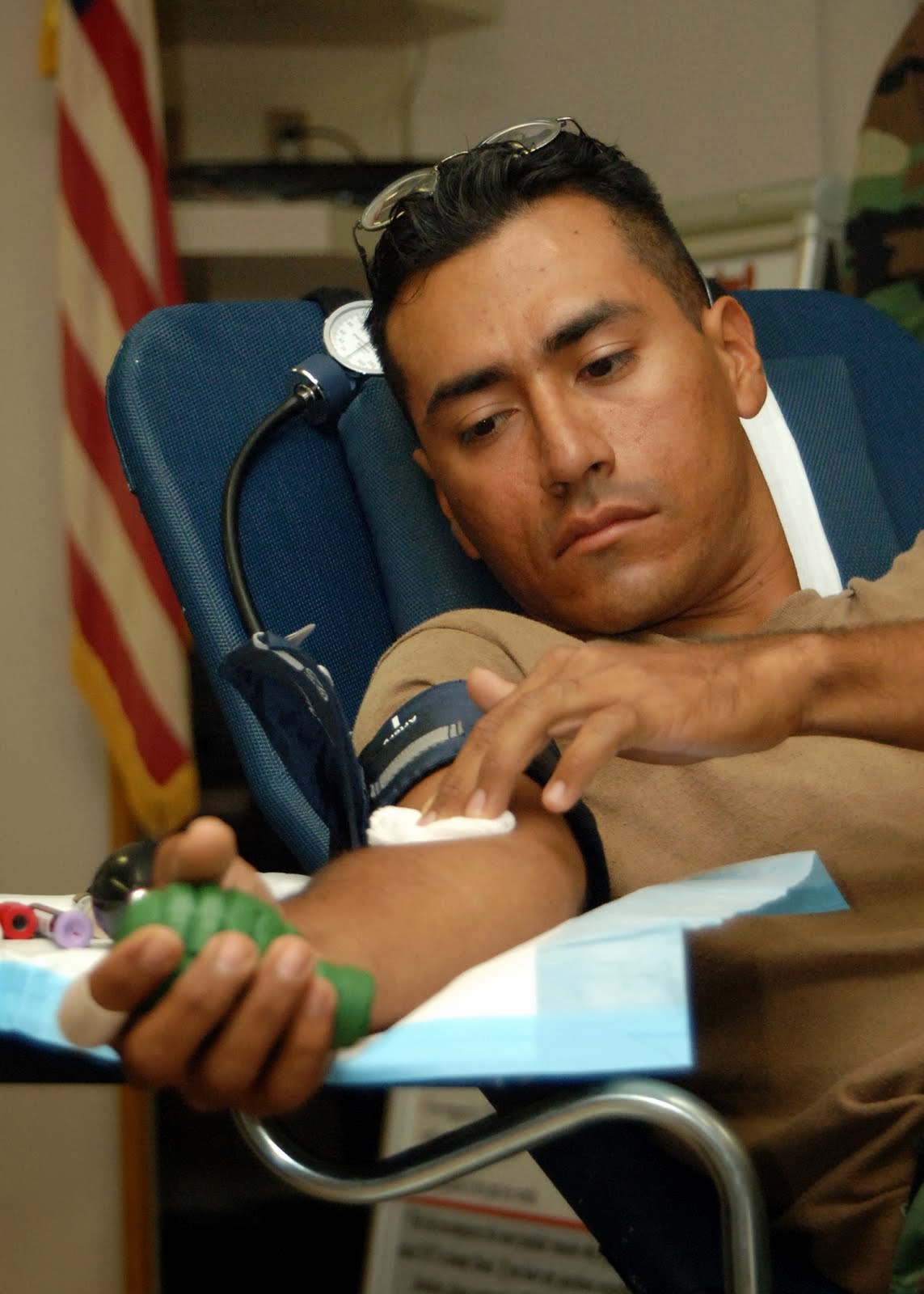
    In 1985 the US Food and Drug Administration (FDA) began enforcing a ban on blood donations from men who have had sex with other men anytime after 1977 for fear of drawing HIV-contaminated blood. Though much has happened in the last 30 years, and even with today’s advanced HIV screenings, they refuse to change their stance on the ban.
     
    This can be a particularly difficult thing for men in the closet, as I am at work.  My school has an annual blood drive, and as a teacher, I am always asked to give blood.  I always say that I can’t, my usual excuse is that it is because of medicine I take for my blood pressure.  Of course, there is nothing with my blood pressure medicine that prevents me from giving blood; however, the ban on gay and bisexual men giving blood is the real reason.  I just don’t want to answer the questions that will be asked and have someone possibly overhear.  I have always been honest when the American Red Cross asked me if I have ever had sex with another man; I just don’t like lying, even though I keep closeted to my students.  The fact is though I am disease free and have not had sex in a while, so I think I should be able to give blood.  Which is why I find the idea of a National Gay Blood Drive on July 12 to be intriguing because it will hopefully bring awareness and maybe change to the issue of gay and bisexual men donating blood in the United States.
     
    Ryan James Yezak, the director of the upcoming documentary “Second Class Citizens,” hopes to  bring awareness and hopefully change this ban with the first ever National Gay Blood Drive on July 12.  All across the country on July 12 from 9am to 5pm PST, gay and bisexual men, (also known as “MSM donors”) can show up to a designated blood donation center where a mobile HIV testing center will be waiting. The men will be tested, and once the test is negative, they can attempt to donate blood. When the men are rejected from giving blood, their HIV test results will be compiled and delivered to the FDA, to show the administration why they should lift their ban.
     
    In a press release about the Blood Drive, Yezak says:

    “The ban is outdated, and as a result, countless otherwise eligible gay and bisexual men are unable to contribute to the nation’s blood supply and help save lives.  Especially a time when blood shortages are increasingly common. Not only that, but the ban perpetuates negative stereotypes and stigma. Whether intentional or not, it is discrimination based on sexual orientation.”

    The American Medical Association (AMA) also recently came out against the gay blood ban, saying the ban is “discriminatory” and “not based on sound science.”  Canada will be listing their ban on gay men giving blood by the end of this summer.  Canadian Blood Services will impose a five-year deferral period.  Thus, gay men can donate blood so long as they haven’t had sex with another man within the last five years.  Multiple countries already permit gay men to donate blood, and some even have a shorter deferral period than Canada. In Britain and Australia the deferral period is one year, while in South Africa it is six months.

    Paul Revere’s Ride

    image

     
    Paul Revere’s Ride
    Henry Wadsworth Longfellow
    Listen, my children, and you shall hear
    Of the midnight ride of Paul Revere,
    On the eighteenth of April, in Seventy-Five:
    Hardly a man is now alive
    Who remembers that famous day and year.
    He said to his friend, “If the British march
    By land or sea from the town to-night,
    Hang a lantern aloft in the belfry-arch
    Of the North-Church-tower, as a signal-light,–
    One if by land, and two if by sea;
    And I on the opposite shore will be,
    Ready to ride and spread the alarm
    Through every Middlesex village and farm,
    For the country-folk to be up and to arm.”
    Then he said “Good night!” and with muffled oar
    Silently rowed to the Charlestown shore,
    Just as the moon rose over the bay,
    Where swinging wide at her moorings lay
    The Somerset, British man-of-war:
    A phantom ship, with each mast and spar
    Across the moon, like a prison-bar,
    And a huge black hulk, that was magnified
    By its own reflection in the tide.
    Meanwhile, his friend, through alley and street
    Wanders and watches with eager ears,
    Till in the silence around him he hears
    The muster of men at the barrack door,
    The sound of arms, and the tramp of feet,
    And the measured tread of the grenadiers
    Marching down to their boats on the shore.
    Then he climbed to the tower of the church,
    Up the wooden stairs, with stealthy tread,
    To the belfry-chamber overhead,
    And startled the pigeons from their perch
    On the sombre rafters, that round him made
    Masses and moving shapes of shade,–
    By the trembling ladder, steep and tall,
    To the highest window in the wall,
    Where he paused to listen and look down
    A moment on the roofs of the town,
    And the moonlight flowing over all.
    Beneath, in the churchyard, lay the dead,
    In their night-encampment on the hill,
    Wrapped in silence so deep and still
    That he could hear, like a sentinel’s tread,
    The watchful night-wind, as it went
    Creeping along from tent to tent,
    And seeming to whisper, “All is well!”
    A moment only he feels the spell
    Of the place and the hour, and the secret dread
    Of the lonely belfry and the dead;
    For suddenly all his thoughts are bent
    On a shadowy something far away,
    Where the river widens to meet the bay, —
    A line of black, that bends and floats
    On the rising tide, like a bridge of boats.
    Meanwhile, impatient to mount and ride,
    Booted and spurred, with a heavy stride,
    On the opposite shore walked Paul Revere.
    Now he patted his horse’s side,
    Now gazed on the landscape far and near,
    Then impetuous stamped the earth,
    And turned and tightened his saddle-girth;
    But mostly he watched with eager search
    The belfry-tower of the old North Church,
    As it rose above the graves on the hill,
    Lonely and spectral and sombre and still.
    And lo! as he looks, on the belfry’s height,
    A glimmer, and then a gleam of light!
    He springs to the saddle, the bridle he turns,
    But lingers and gazes, till full on his sight
    A second lamp in the belfry burns!
    A hurry of hoofs in a village-street,
    A shape in the moonlight, a bulk in the dark,
    And beneath from the pebbles, in passing, a spark
    Struck out by a steed that flies fearless and fleet:
    That was all! And yet, through the gloom and the light,
    The fate of a nation was riding that night;
    And the spark struck out by that steed, in his flight,
    Kindled the land into flame with its heat.
    He has left the village and mounted the steep,
    And beneath him, tranquil and broad and deep,
    Is the Mystic, meeting the ocean tides;
    And under the alders, that skirt its edge,
    Now soft on the sand, now loud on the ledge,
    Is heard the tramp of his steed as he rides.
    It was twelve by the village clock
    When he crossed the bridge into Medford town.
    He heard the crowing of the cock,
    And the barking of the farmer’s dog,
    And felt the damp of the river-fog,
    That rises when the sun goes down.
    It was one by the village clock,
    When he galloped into Lexington.
    He saw the gilded weathercock
    Swim in the moonlight as he passed,
    And the meeting-house windows, blank and bare,
    Gaze at him with a spectral glare,
    As if they already stood aghast
    At the bloody work they would look upon.
    It was two by the village clock,
    When be came to the bridge in Concord town.
    He heard the bleating of the flock,
    And the twitter of birds among the trees,
    And felt the breath of the morning breeze
    Blowing over the meadows brown.
    And one was safe and asleep in his bed
    Who at the bridge would be first to fall,
    Who that day would be lying dead,
    Pierced by a British musket-ball.
    You know the rest. In the books you have read,
    How the British Regulars fired and fled,–
    How the farmers gave them ball for ball,
    From behind each fence and farmyard-wall,
    Chasing the red-coats down the lane,
    Then crossing the fields to emerge again
    Under the trees at the turn of the road,
    And only pausing to fire and load.
    So through the night rode Paul Revere;
    And so through the night went his cry of alarm
    To every Middlesex village and farm,–
    A cry of defiance, and not of fear,
    A voice in the darkness, a knock at the door,
    And a word that shall echo forevermore!
    For, borne on the night-wind of the Past,
    Through all our history, to the last,
    In the hour of darkness and peril and need,
    The people will waken and listen to hear
    The hurrying hoof-beats of that steed,
    And the midnight message of Paul Revere.
    image
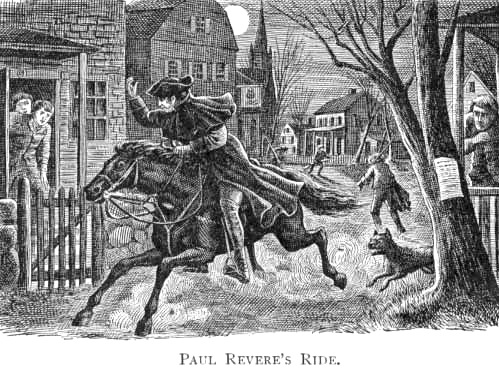
    Thursday is Independence Day, so I thought I would post a patriotic poem.  Though the events of this poem occurred on April 18-19, 1775, over a year before the signing of the Declaration of Independence, it is one of the most famous events of the American Revolution.  In 1774 and the Spring of 1775 Paul Revere was employed by the Boston Committee of Correspondence and the Massachusetts Committee of Safety as an express rider to carry news, messages, and copies of resolutions as far away as New York and Philadelphia.
     
    On the evening of April 18, 1775, Paul Revere was sent for by Dr. Joseph Warren and instructed to ride to Lexington, Massachusetts, to warn Samuel Adams and John Hancock that British troops were marching to arrest them. After being rowed across the Charles River to Charlestown by two associates, Paul Revere borrowed a horse from his friend Deacon John Larkin. While in Charlestown, he verified that the local “Sons of Liberty” committee had seen his pre-arranged signals. (Two lanterns had been hung briefly in the bell-tower of Christ Church in Boston, indicating that troops would row “by sea” across the Charles River to Cambridge, rather than marching “by land” out Boston Neck. Revere had arranged for these signals the previous weekend, as he was afraid that he might be prevented from leaving Boston).
     
    On the way to Lexington, Revere “alarmed” the country-side, stopping at each house, and arrived in Lexington about midnight. As he approached the house where Adams and Hancock were staying, a sentry asked that he not make so much noise. “Noise!” cried Revere, “You’ll have noise enough before long. The regulars are coming out!” After delivering his message, Revere was joined by a second rider, William Dawes, who had been sent on the same errand by a different route. Deciding on their own to continue on to Concord, Massachusetts, where weapons and supplies were hidden, Revere and Dawes were joined by a third rider, Dr. Samuel Prescott. Soon after, all three were arrested by a British patrol. Prescott escaped almost immediately, and Dawes soon after. Revere was held for some time and then released. Left without a horse, Revere returned to Lexington in time to witness part of the battle on the Lexington Green.
     
    The events of that night were immortalized by Henry Wadsworth Longfellow to commemorates Revere’s actions. Longfellow’s poem is not historically accurate but his “mistakes” were deliberate. He had researched the historical event, using works like George Bancroft’s History of the United States, but he manipulated the facts for poetic effect.  He was purposely trying to create American legends, much as he did with works like The Song of Hiawatha (1855) and The Courtship of Miles Standish (1858).  Longfellow was inspired to write the poem after visiting the Old North Church and climbing its tower on April 5, 1860. He began writing the poem the next day. It was first published in the January 1861 issue of The Atlantic Monthly. It was later re-published in Longfellow’s Tales of a Wayside Inn as “The Landlord’s Tale” in 1863. The poem served as the first in a series of 22 narratives bundled as a collection, similar to Geoffrey Chaucer’s The Canterbury Tales, and was published in three installments over 10 years.
     
    The poem is spoken by the landlord of the Wayside Inn and tells a partly fictionalized story of Paul Revere. In the poem, Revere tells a friend to prepare signal lanterns in the Old North Church to inform him if the British will attack by land or sea. He would await the signal across the river in Charlestown and be ready to spread the alarm throughout Middlesex County, Massachusetts. The unnamed friend climbs up the steeple and soon sets up two signal lanterns, informing Revere that the British are coming by sea. Revere rides his horse through Medford, Lexington, and Concord to warn the patriots.