Monthly Archives: September 2013

Sad, But True

image

Kids like this really get on my last nerve. I asked on a test the other day “Who wrote the Federalist Papers and how did they sign their name?” The answer is easy: John Jay, James Madison, and Alexander Hamilton wrote the Federalist Papers, each signing with the pseudonym “Publius.” Yet, the answer I received: “Men with ink.” I was furious. I hate smartass answers.

However, since the above is not one of my students, I do find the answers a tad bit humorous.

On a completely different note, HRH turns 15 years old today.


Apathy

20130918-224553.jpg

I’m still aggravated with my students, but mainly because of their apathy. I just don’t understand it. Why wouldn’t someone want to learn? There is so much on this world to know, and ignorance is just not an excuse for me. I have always loved learning new things. I’ve always been one of those people (before the Internet age) who would look something up in the encyclopedia, find something else interesting along the way, read both, and then end up finding something else. I could spend hours perusing the encyclopedia. (Maybe I had a bit of ADD, LOL.) I’m the same way with Wikipedia and other information sources on the Internet. The difference now is that I can open a new tab instead of having three or four fingers holding my place for the next thing I wanted to read about.

I realize that this makes me a complete nerd. Then again it also makes me a great partner for Trivial Pursuit. I’m full of useless knowledge; some not so useless. Sometimes it just comes spilling out, and I have the fear that I’m a complete bore. I try to guard against that. A bore, a nerd, or whatever you would want to call me, I’ve always loved adding to my knowledge and reading new things. My love of learning is why student apathy frustrates me so much. I think it is something all teachers have to deal with at some point. It’s one of the reasons I loved teaching at the college where I was an adjunct. A lot of my students were older and had tried college once before but left because of apathy, then they realized what they were missing and were back to really learn this time around. Middle and high school students just don’t have that life experience yet to realize what they are missing. And it’s not just with my teaching because that would sound incredibly arrogant of me, but it is with nearly all teachers (many coaches are the exception). We have so much to give, and it gets frustrating when students don’t care.


Aggravation

20130917-222242.jpg

Between students lying, coaches thinking winning is more important than a test, and my dogs getting out and running around the neighborhood, I had a very aggravating day yesterday.

First of all, a student told his parents that I am never in my classroom during class. That just pisses me off, since I am probably one of only teachers who never leaves their students in the classroom by themselves. If I have to go to the restroom, I wait until we are between classes. Once I get into my room in the morning, I rarely leave it except for break and lunch. The only time that I am not in my room is during my planning period because I am usually running off tests or other such errands.

The next thing was that one of our coaches took nearly half of my class to “practice” before they left for their game. Who has practice before leaving for an away game? I wouldn’t have minded as much, if I was not giving a major test. Was I asked if I had something important going on? No! Did I complain to our principal? Yes! Did anything get done about it? No! All of the students in the class got a reprieve and the test will be today because I did not want the students who did take the test to be able to tell those not there what was on it. They think they got an advantage, but they’re not smarter than me, no matter what they think. Since most of them weren’t listening when I was lecturing, an extra day will not do them any good. There is no way to pass this test if you had not listened in class.

The last thing was the dogs. I have a large fenced in backyard. For some reason the dogs decided to break through the fence. I spent nearly three hours fixing fences and corralling dogs back through the gate. Four times they got out, four times they found a new way out. Finally, I fixed all of the escape routes (fingers crossed, anyway). I was ready to kill them before it was over. Poor dogs, they had no idea how aggravated I already was today.

Sorry, but sometimes I just feel the need to bitch and gripe. I hope you guys don’t mind too much.


Why Poetry Can Be Hard For Most People

20130916-001124.jpg

Why Poetry Can Be Hard For Most People
by Dorothea Lasky

Because speaking to the dead is not something you want to do
When you have other things to do in your day
Like take out the trash or use the vacuum
In the edge between the stove and cupboard
Because the rat is everywhere
Crawling around
Or more so walking
And it is doesn’t even notice you
It has its own intentions
And is searching for that perfect bag of potato chips like you once were
Because life is no more important than eating
Or fucking
Or talking someone into fucking
Or talking someone into something
Or sleeping calmly and soundly
And all you can hope for are the people who put that calm in you
Or let you go into it with dignity
Because poetry reminds you
That there is no dignity
In living
You just muddle through and for what
Jack Jack you wrote to him
You wrote to all of us
I wasn’t even born
You wrote to me
A ball of red and green shifting sparks
In my parents’ eye
You wrote to me and I just listened
I listened I listened I tell you
And I came back
No
Poetry is hard for most people
Because of sound


About This Poem
“I wrote ‘Why Poetry Can Be Hard For Most People’ after reading and teaching some of Jack Spicer’s letters to Lorca. I became bewitched by the idea that we are always speaking to the dead when we write poems, especially Spicer’s line, ‘You are dead and the dead are very patient.’ I think the communication between the dead and undead is so full of real emotion because of its patience. Poetry is patient, too.”–Dorothea Lasky

About Dorothea Lasky
Born on March 27, 1978, in St. Louis, Missouri, Dorothea Lasky received her B.A. from Washington University. She continued her studies at the University of Massachusetts, Amherst, where she received her M.F.A. She has also earned a masters degree in arts and education from Harvard University and a PhD in creativity and education from the University of Pennsylvania. Lasky is the author of two books of poetry, AWE (Wave Books, 2007), and Black Life (Wave Books, 2010). She has also authored numerous chapbooks and pamphlets, most recently Poetry is Not a Project (Ugly Duckling Presse, 2010). She lives in New York.


Love in War

20130915-193823.jpg
 
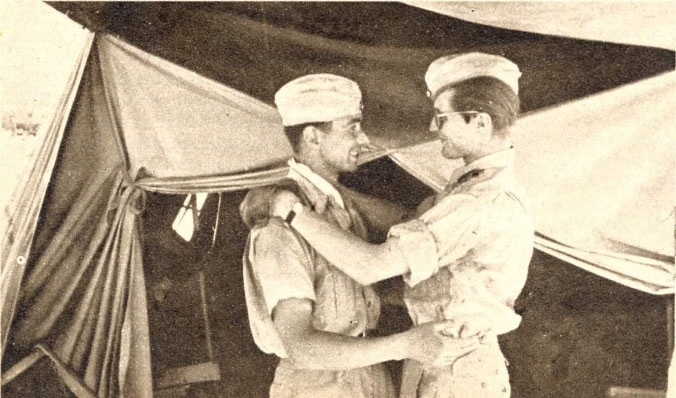
The Second World War was a huge disruption of American life. People from farms, small towns, and cities, from all regions and classes now found themselves suddenly uprooted and thrown together. People who had never traveled more than 5 miles from home now found themselves in the South Pacific or flying over Central Europe. This was true, not just for soldiers, but for civilians on the home front. The war created desperate labor shortages in factories contracted for war production. Those jobs were filled by women, African Americans, and other minorities. Like the soldiers, many of these workers left home and found themselves living together, sometimes in close quarters in alien environments. Time honored customs and beliefs about class, gender, region, and race came under unprecedented strain. While this created incredible stress for many, for others, this created unexpected opportunities and raised expectations.
 
Gays and lesbians were an invisible minority; not only invisible to society at large, but to each other. Most of the American population at the start of the war still lived in small towns and on farms. A lot of gay men and lesbians from those backgrounds who previously felt very isolated now found each other in the military or in wartime production. Within the ranks of the military, a huge underground gay culture began to flourish. Gay soldiers in the South Pacific would create “gay beaches” for gathering sometimes within days of capturing an island from the Japanese.
 
A gay soldier from rural America recalled visiting Paris within days of liberation in 1944. He sought out a once famous Parisian gay night spot thinking it may still be closed for the duration. When he arrived, the place was wide open and packed with soldiers from a dozen different countries. He described American and Free French soldiers dancing together with Polish and Italian partisans and British troops. Not only did this soldier no longer feel isolated, he also began to see a certain potential. Gay men may have been a minority, but they were not a small minority. Formerly isolated gay men and lesbians discovered that there were lots and lots and lots of people like them. This caused a lot of people to rethink some things and to get some ideas.
 
Regulations and anti-sodomy laws had limited gay service since the Revolutionary War, leading to dishonorable discharge, courts-martial, or imprisonment for men found having sex with other men. The massive manpower needs during World War II and the growing influence of psychiatry in America led the military to classify some homosexual troops as psychologically unfit for service. Still, among the sixteen million Americans who served in the Armed Forces during World War II were hundreds of thousands of gay and lesbian military personnel who proudly served. Only about 5000 of the eighteen million men called before draft boards and medical inspectors during World War II were screened out initially because of homosexuality.  As Charles Rowland, a gay draftee from Arizona explained, “We were not about to be deprived the privilege of serving our country in a time of great national emergency by virtue of some stupid regulation about being gay.”
 
The military’s policies toward gays and lesbians became increasingly aggressive and more punitive as the war drew to a close.  The American military only used the ban against LGBT service members when it was convenient; times of war, WWII, Korea, and Vietnam, were not convenient times for the American military.  They often overlooked homosexuality because they needed the manpower.   However, just as African- American servicemen saw freedom abroad, so did LGBT service members.  The Stonewall Riots of 1969 are often credited with being a watershed moment that fundamentally altered the course of gay history. This, of course, is true. But it was not the watershed moment. Long before gay bar patrons rioted against the NYPD and gave momentum to the largest political mobilization of gays and lesbians in history, World War II was setting the stage for Stonewall.  This emerging gay culture continued to flourish, and it survived the war’s end. Large American port cities like New York, Boston, Chicago, and San Francisco found themselves with huge populations of gays and lesbians at the end of the war; people who couldn’t or wouldn’t go home again. Friendships and communities formed during the war would quickly become useful for resisting and pushing back as an increasingly paranoid Post War America tried hard to put the genie of expectations for women, African Americans, and LGBTs back into the bottle.
 
A particular letter of love and loss between two World War II soldiers is making its rounds on the Internet, and the heartbreakingly beautiful story it paints for the reader will have you reaching for the tissues.
 
Long before the days of “Don’t Ask Don’t Tell” and its subsequent repeal, the two men appear to have met and fallen for one another while on duty in Africa. However, their idealistic romance seems to have been cut short.
 
An excerpt reads,
 

This is in memory of an anniversary — the anniversary of October 27th, 1943, when I first heard you singing in North Africa. That song brings memories of the happiest times I have ever known. Memories of a GI show troop — curtains made from barrage balloons — spotlights made from cocoa cans — rehearsals that ran late into the evenings — and a handsome boy with a wonderful tenor voice … The happiness when told we were going home — and the misery when we learned that we would not be going together. Fond goodbyes on a secluded beach beneath the star-studded velvet of an African night, and the tears that would not be stopped as I stood atop the sea-wall and watched your convoy disappear over the horizon…

 
The heart-rending love letter was written by American World War II veteran Brian Keith to Dave, a fellow soldier he met and fell in love with in 1943 while stationed in North Africa. It was penned on the occasion of their anniversary and reprinted in September of 1961 by ONE Magazine, a groundbreaking pro-gay magazine first published in 1953.  The original is supposedly preserved in the Library of Congress. Read the rest of the letter below, and have a somber glimpse inside the mid-century romance of Dave and Brian.
 

20130915-193759.jpg

Here is the full transcript:
Dear Dave,
 
This is in memory of an anniversary — the anniversary of October 27th, 1943, when I first heard you singing in North Africa. That song brings memories of the happiest times I’ve ever known. Memories of a GI show troop — curtains made from barrage balloons — spotlights made from cocoa cans — rehearsals that ran late into the evenings — and a handsome boy with a wonderful tenor voice. Opening night at a theatre in Canastel — perhaps a bit too much muscatel, and someone who understood. Exciting days playing in the beautiful and stately Municipal Opera House in Oran — a misunderstanding — an understanding in the wings just before opening chorus.
 
Drinks at “Coq d’or” — dinner at the “Auberge” — a ring and promise given. The show 1st Armoured — muscatel, scotch, wine — someone who had to be carried from the truck and put to bed in his tent. A night of pouring rain and two very soaked GIs beneath a solitary tree on an African plain. A borrowed French convertible — a warm sulphur spring, the cool Mediterranean, and a picnic of “rations” and hot cokes. Two lieutenants who were smart enough to know the score, but not smart enough to realize that we wanted to be alone. A screwball piano player — competition — miserable days and lonely nights. The cold, windy night we crawled through the window of a GI theatre and fell asleep on a cot backstage, locked in each other’s arms — the shock when we awoke and realized that miraculously we hadn’t been discovered. A fast drive to a cliff above the sea — pictures taken, and a stop amid the purple grapes and cool leaves of a vineyard.
 
The happiness when told we were going home — and the misery when we learned that we would not be going together. Fond goodbyes on a secluded beach beneath the star-studded velvet of an African night, and the tears that would not be stopped as I stood atop the sea-wall and watched your convoy disappear over the horizon.
 
We vowed we’d be together again “back home,” but fate knew better — you never got there. And so, Dave, I hope that where ever you are these memories are as precious to you as they are to me.
 
Goodnight, sleep well my love.
 
Brian Keith
 
I recommend Alan Berube’s book Coming Out Under Fire: The History of Gay Men and Women in World War II. Bérubé argues in Coming Out Under Fire, “the massive mobilization for World War II relaxed the social constraints of peacetime that kept many gay men and women unaware of themselves and each other.”  

The Faith of a Centurion

20130914-214945.jpg

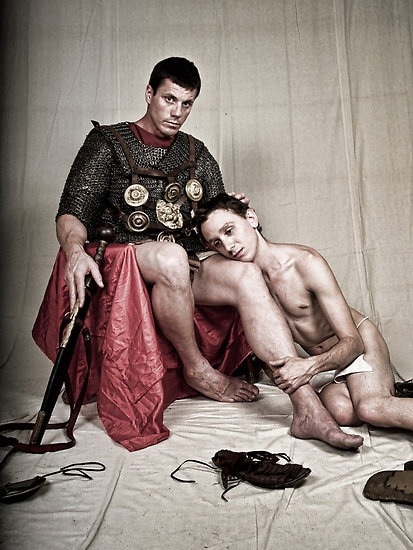
When he had entered Capernaum, a centurion came forward to him, appealing to him, “Lord, my servant is lying paralyzed at home, suffering terribly.” And he said to him, “I will come and heal him.” But the centurion replied, “Lord, I am not worthy to have you come under my roof, but only say the word, and my servant will be healed. For I too am a man under authority, with soldiers under me. And I say to one, ‘Go,’ and he goes, and to another, ‘Come,’ and he comes, and to my servant, ‘Do this,’ and he does it.” When Jesus heard this, he marveled and said to those who followed him, “Truly, I tell you, with no one in Israel have I found such faith. I tell you, many will come from east and west and recline at table with Abraham, Isaac, and Jacob in the kingdom of heaven, while the sons of the kingdom will be thrown into the outer darkness. In that place there will be weeping and gnashing of teeth.” And to the centurion Jesus said, “Go; let it be done for you as you have believed.” And the servant was healed at that very moment.

Matthew 8:5-13

After he had finished all his sayings in the hearing of the people, he entered Capernaum. Now a centurion had a servant who was sick and at the point of death, who was highly valued by him. When the centurion heard about Jesus, he sent to him elders of the Jews, asking him to come and heal his servant. And when they came to Jesus, they pleaded with him earnestly, saying, “He is worthy to have you do this for him, for he loves our nation, and he is the one who built us our synagogue.” And Jesus went with them. When he was not far from the house, the centurion sent friends, saying to him, “Lord, do not trouble yourself, for I am not worthy to have you come under my roof. Therefore I did not presume to come to you. But say the word, and let my servant be healed. For I too am a man set under authority, with soldiers under me: and I say to one, ‘Go,’ and he goes; and to another, ‘Come,’ and he comes; and to my servant, ‘Do this,’ and he does it.” When Jesus heard these things, he marveled at him, and turning to the crowd that followed him, said, “I tell you, not even in Israel have I found such faith.” And when those who had been sent returned to the house, they found the servant well.

Luke 7:1-10

In the original language, the importance of this story for LGBT Christians is much clearer. The Greek word used in Matthew’s account to refer to the servant of the centurion is pais. In the language of the time, pais had three possible meanings depending upon the context in which it was used. It could mean “son or boy;” it could mean “servant,” or it could mean a particular type of servant — one who was “his master’s male lover.” Often these lovers were younger than their masters, even teenagers.

To our modern minds, the idea of buying a teen lover seems repugnant. But we have to place this in the context of ancient cultural norms. In ancient times, commercial transactions were the predominant means of forming relationships. Under the law, the wife was viewed as the property of the husband, with a status just above that of slave. Moreover, in Jesus’ day, a boy or girl was considered of marriageable age upon reaching his or her early teens. It was not uncommon for boys and girls to marry at age 14 or 15. Nor was it uncommon for an older man to marry a young girl. Fortunately civilization has advanced, but these were the norms in the culture of Jesus’ day.

In that culture, if you were a gay man who wanted a male “spouse,” you achieved this, like your heterosexual counterparts, through a commercial transaction — purchasing someone to serve that purpose. A servant purchased to serve this purpose was often called a pais.

The word boy in English offers a rough comparison. Like pais, the word boy can be used to refer to a male child. But in the slave South in the nineteenth century, boy was also often used to refer to male slaves. The term boy can also be used as a term of endearment. The term boy can be used in the same way, as in “my boy” or “my beau.” In ancient Greek, pais had a similar range of meanings.

Thus, when this term was used, the listener had to consider the context of the statement to determine which meaning was intended. Some modern Christians may be tempted to simply declare by fiat that the Gospels could not possibly have used the term pais in the sense of male lover, end of discussion. But that would be yielding to prejudice. We must let the word of God speak for itself, even if it leads us to an uncomfortable destination. And to be honest with you, the Greek noun pais is used in the New Testament 24 times and has a range of meanings that include “adolescent,” “child” and “servant.” In the Greek translation of the Old Testament, it appears numerous times and it always refers to a “servant.” There are no occurrences of the term anywhere in the Bible that can be interpreted a referring to the junior partner in a homosexual relationship. However, that does not mean that it is not used to refer to a homosexual relationship in the context of the centurion.

The Bible provides three key pieces of textual and circumstantial evidence. First, in the Luke passage, several additional Greek words are used to describe the one who is sick. Luke says this pais was the centurion’s entimos doulos. The word doulos is a generic term for slave, and was never used in ancient Greek to describe a son/boy. Thus, Luke’s account rules out the possibility the sick person was the centurion’s son; his use of doulos makes clear this was a slave. However, Luke also takes care to indicate this was no ordinary slave. The word entimos means “honored.” This was an “honored slave” (entimos doulos) who was his master’s pais. Taken together, the three Greek words preclude the possibility the sick person was either the centurion’s son or an ordinary slave, leaving only one viable option — he was his master’s male lover.

A second piece of evidence is found in verse 9 of Matthew’s account. In the course of expressing his faith in Jesus’ power to heal by simply speaking, the centurion says, “When I tell my slave to do something, he does it.” By extension, the centurion concludes that Jesus is also able to issue a remote verbal command that must be carried out. When speaking here of his slaves, the centurion uses the word doulos. But when speaking of the one he is asking Jesus to heal, he uses only pais. In other words, when he is quoted in Matthew, the centurion uses pais only when referring to the sick person. He uses a different word, doulos, when speaking of his other slaves, as if to draw a distinction. (In Luke, it is others, not the centurion, who call the sick one an entimos doulos.) Again, the clear implication is that the sick man was no ordinary slave. And when pais was used to describe a servant who was not an ordinary slave, it meant only one thing — a slave who was the master’s male lover.

The third piece of evidence is circumstantial. In the Gospels, we have many examples of people seeking healing for themselves or for family members. But this story is the only example of someone seeking healing for a slave. The actions described are made even more remarkable by the fact that this was a proud Roman centurion (the conqueror/oppressor) who was humbling himself and pleading with a Jewish rabbi (the conquered/oppressed) to heal his slave. The extraordinary lengths to which this man went to seek healing for his slave is much more understandable, from a psychological perspective, if the slave was his beloved companion.

Thus, all the textual and circumstantial evidence in the Gospels points in one direction. For objective observers, the conclusion is inescapable: In this story Jesus healed a man’s male lover. When understood this way, the story takes on a whole new dimension.

Imagine how it may have happened. While stationed in Palestine, the centurion’s pais becomes ill — experiencing some type of life-threatening paralysis. The centurion will stop at nothing to save him. Perhaps a friend tells him of rumors of Jesus’ healing powers. Perhaps this friend also tells him Jesus is unusually open to foreigners, teaching his followers that they should love their enemies, even Roman soldiers. So the centurion decides to take a chance. Jesus was his only hope.

As he made his way to Jesus, he probably worried about the possibility that Jesus, like other Jewish rabbis, would take a dim view of his homosexual relationship. Perhaps he even considered lying. He could simply use the word duolos. That would have been accurate, as far as it went. But the centurion probably figured if Jesus was powerful enough to heal his lover, he was also powerful enough to see through any half-truths.

So the centurion approaches Jesus and bows before him. “Rabbi, my . . . ,” the word gets caught in his throat. This is it — the moment of truth. Either Jesus will turn away in disgust, or something wonderful will happen. So, the centurion clears his throat and speaks again. “Rabbi, my pais — yes, my pais lies at home sick unto death.” Then he pauses and waits for a second that must have seemed like an eternity. The crowd of good, God-fearing people surrounding Jesus probably became tense. This was like a gay man asking a televangelist to heal his lover. What would Jesus do?

Without hesitation, Jesus says, “Then I will come and heal him.”

At this point, the centurion says there is no need for Jesus to travel to his home. He has faith that Jesus’ word is sufficient. Jesus then turns to the good people standing around him — those who were already dumbfounded that he was willing to heal this man’s male lover. To them, Jesus says in verse 10 of Matthew’s account, “I have not found faith this great anywhere in Israel.” In other words, Jesus holds up this gay centurion as an example of the type of faith others should aspire to.

Jesus didn’t just tolerate this gay centurion. He said he was an example of faith — someone we all should strive to be like.

Then, just so the good, God-fearing people wouldn’t miss his point, Jesus speaks again in verse 11: “I tell you, many will come from the east and the west [i.e., beyond the borders of Israel] to find a seat in the kingdom of heaven, while the heirs [i.e., those considered likely to inherit heaven] will be thrown into outer darkness.” By this statement Jesus affirmed that many others like this gay centurion — those who come from beyond the assumed boundaries of God’s grace — are going to be admitted to the kingdom of heaven. And he also warned that many who think themselves the most likely to be admitted will be left out.

For most Christians, the debate over the sexuality of the centurion would be a non sequitur, but for LGBT Christians, it is quite significant. First of all, Jesus did not care what the relationship was between the soldier and his servant. Jesus saw someone in need, and he answered that need. Second, Jesus did not condemn the soldier, nor did Matthew or Luke when writing about the soldier and his, quite possible, homosexual relationship with his servant. They had the chance to condemn the obviously loving relationship, but they did not. Jesus healed the servant, without comment on the relationship. If he felt it necessary to comment on the relationship, then why did he not do so? I do not think that if early Christians condemned homosexuality, as so many claim, that Jesus, Matthew, or Luke would not have passed on the opportunity to comment on this.

The most important lesson is not to get stuck on the superficial issues, such as sexual orientation. I spent the majority of this post looking at the relationship to seek a connection with LGBT Christians, but it is really not the most important part of these passages. The essential part is that the centurion relied on the most important issue that faces us and that is faith in Jesus Christ. The centurion believed that Jesus could heal his beloved, with just His word, the command that he be healed. That is tremendous faith. Jesus even said, “I tell you, not even in Israel have I found such faith.” The Bible is very clear about faith. Ephesians 2:8 says, “For by grace you have been saved through faith. And this is not your own doing; it is the gift of God.”



Moment of Zen: Bubble Butts

20130913-233228.jpg


Relief

image

Yesterday did provide some relief, but all of the dread I was feeling gave me a terrible migraine. I’m sure all of you have heard of functioning alcoholics; well, I’m a functioning migraine sufferer. Some people who have migraines have to go to bed in a dark place. It’s what I always want to do when I have a migraine, but I rarely have that luxury. I did not have at luxury yesterday. I had to keep going and do what I needed to do. Since I had the day off, I went ahead and ran some errands after my “ordeal.”

When I got home, I cooked supper. I had promised my aunt that I would fry some okra for her. She told me that since I had a migraine, I shouldn’t have tried to cook, but I did anyway. I braised a London broil that was on sale at the grocery store, cooked some collard greens and fried some cornbread. It was quite delicious, but I didn’t have much of an appetite because migraines tend to make me slightly nauseous. After supper, I went to bed. Luckily, I can always count on HRH to bring me some comfort. She curled up on top of me after I laid down, and we called it an early night.

By the way, with my triskaidekaphobia* I’m dreading today, just a little bit. However, since it’s my mothers birthday, I probably shouldn’t see it as bad luck.

*Triskaidekaphobia (from Greek tris meaning “3”, kai meaning “and”, deka meaning “10” and phobos meaning “fear” or “morbid fear”) is fear of the number 13 and avoidance to use it; it is a superstition and related to a specific fear of Friday the 13th, called paraskevidekatriaphobia (from Παρασκευή Paraskevi, Greek for Friday) or friggatriskaidekaphobia (after Frigg, the Norse goddess Friday is named after in English).


Blue Days

imageI think we all have those days when we just feel a bit blue, down in the dumps, or just plain melancholy. Yesterday was one of those days, and I suspect today will be as well. Many times, there is just no good reason for these moods, and on other days, there is a very good reason. Yesterday was one of those days with a reason. The thing is, I’m off work today; something that should make me happy. However, I’m off work today because I have something I have to do today that I don’t want to do. I really don’t want to go into an explanation of what I have to do today, but it’s going to be uncomfortable. I know that when it is over, a great weight will be lifted off my shoulders. It’s still something I wish I didn’t have to do, but I really don’t have a choice.

I know I’m being cryptic about what this is all about, but I can’t help it. I promise you guys that it is nothing really bad, but this is just something I have to face the facts about. I felt the need to write about my feelings in hopes that it will bring me some comfort. Sometimes it helps to just let the stream of consciousness flow, and after writing this, maybe I do feel a little better. I’d still much rather just stay in bed today and hide.


Bad Teacher

20130910-211024.jpg

The 2011 movie Bad Teacher was about an immoral, gold digging Chicago-area middle school teacher at the fictional John Adams Middle School who curses at her students, drinks heavily, smokes marijuana, and only shows movies while she sleeps through class. However, all of that does not compare to the story I read the other day about a South Carolina teacher.

The teacher is alleged to have bullied the student starting in early April. The student’s mother alleges that the teacher repeatedly belittled her son in front of his peers, calling him “gay,” “gay boy,” and other names. The teacher repeatedly told the student’s classmates that the student was in a homosexual relationship with another classmate, the suit states.

The mother alleges that the teacher encouraged and asked other students to pick on her son during class. She alleges that her son was made to feel that he could not report the bullying to school administration. The student was also made to feel he could not appeal to any of his classmates because of the resulting alienation and isolation that the situation created.

The student’s mother filed a lawsuit on her son’s behalf against the Charleston County School District alleging that a high school teacher bullied a male student by repeatedly telling the class that the student was gay. The unidentified student, referred to in documents as John Doe, was a student at West Ashley High School, according to the complaint.

On the West Ashley High School web site, the teacher identified in the suit is listed as a member of the math faculty. The suit against the school district says that the emotional stress created by the teacher’s conduct caused the student to become physically ill. The student attempted to commit suicide by hanging himself as a result of the bullying, according to the complaint. The student has allegedly suffered severe emotional and psychological damages and has been forced to withdraw from school. He is being home-schooled. He is also receiving mental health counseling, according to the suit.

A spokesman for the school district said he could not comment on pending litigation. The suit alleges that the school district failed to properly hire, train and/or supervise the teacher. According to the complaint, the school district’s negligence entitles the defendant to an award of past, present and future damages sufficient to properly compensate him for the pain and suffering, the mental anguish, the permanency of his injury, the loss of enjoyment of life, the alienation of his lifestyle and his past and future medical bills.

If the allegations are true, they are beyond disturbing. I’ve known of parents to complain that a teacher was “picking” on their child and treating them unfairly, and it is usually groundless because the student either perceived he was being singled out or because the student was covering for his own misdeeds. I’ve had allegations of singling out a student before, but the complaint is generally because I told the child to behave and the students reaction was, “But everyone else was doing it.” However, the allegations against this teacher goes far beyond anything I have seen before.

As a teacher (and if you’ve been reading my blog for a while) you know, that I have no tolerance for bullying of any kind. My former headmaster actually encouraged bullying saying that “it helped students conform.” Our current headmaster has a zero tolerance for bullying, which is a relief. His policy is immediate expulsion, as it should be. This South Carolina case seems even worse to me because it is the teacher, and it seems to have been taking to extremes because, most likely, the student did not “conform.” A student with bad behavior is one thing, but one who may be socially awkward or “non-conforming” in some way should never be singled out. We are all unique, and it’s one of the great characteristics of humanity. We should not be punished for our uniqueness.

Experts have linked school bullying to an increased risk for mental health problems, substance abuse and suicide. Students who are victims of bullying are also at risk for poor academic achievement on standardized tests. They are more likely to feel isolated, to participate less in school activities and to miss, skip or drop out of school, according to stopbullying.gov, a website that provides information on the issue from various government agencies. Lesbian, gay, bisexual, or transgender (LGBT) youth and those perceived as LGBT are at an increased risk of being bullied, the website says.

If the bullying by the teacher has reached such a level that the student was withdrawn from the school, had to seek counseling, and for a lawsuit to be filed, then I suspect there is a great deal of evidence to supports the student’s and his mother’s claims. I. This case, I feel, that the appropriate response from the school district should be suspension of the teacher until an internal investigation is concluded. If the allegations are true, and for some reason (i.e. personal intuition) I suspect they are true, then the teacher should be fired and his teaching credentials revoked.

I hope and pray that the allegations are false, because it is inconceivable to me that a teacher would do this to a student. Teachers are protectors of our students. Teachers are there to provide an education. Teachers are their to encourage students. What this teacher is alleged to have done is none of these. I may not like some of my students, but it is because of their apathy and misbehavior, nothing else.