Monthly Archives: September 2013

In a Station of the Metro

20130909-231800.jpg

In a Station of the Metro
by Ezra Pound

The apparition of these faces in the crowd;
Petals on a wet, black bough.

About this Poem
Though a very short poem, only fourteen words, this is the only Ezra Pound poem that many people will read in their lives. Why? Because it’s two lines long. “In the Station of the Metro” is an exercise in brevity. It is an Imagist poem, from a movement in early 20th-century Anglo-American poetry that favored precision of imagery and clear, sharp language. Pound wrote it after having a spiritual experience in a Paris metro (subway) station in 1912.

In 1916, Pound wrote about the process of writing the poem (Pound, Gaudier-Brzeska, 1916). Apparently, he originally thought he could best capture his vision in a painting. Unfortunately, he wasn’t a painter, which was a problem. So he wrote a 30-line poem, which he didn’t like. He pitched the long version in the waste bin. Six months later, he wrote a shorter poem, but didn’t like that one either and threw it away. Finally, a full year after the experience, he had been reading short Japanese poems called haikus, and he figured he would try to adapt this form to his vision in the metro. The result, which was published in 1913, is one the most famous, influential, and haunting works in modern poetry.

Pound packs a lot of meaning into these two lines and fourteen words. By linking human faces, an allusion for people themselves, with petals on a damp bough, the poet calls attention to both the elegance and beauty of human life, as well as its transience. A dark, wet bough implies that it has just rained, and the petals stuck to the bough were shortly before attached to flowers from the tree. They may still be living, but they will not be for long. In this way, Pound calls attention to human mortality as a whole – we are all dying. This is the essence of the poem.


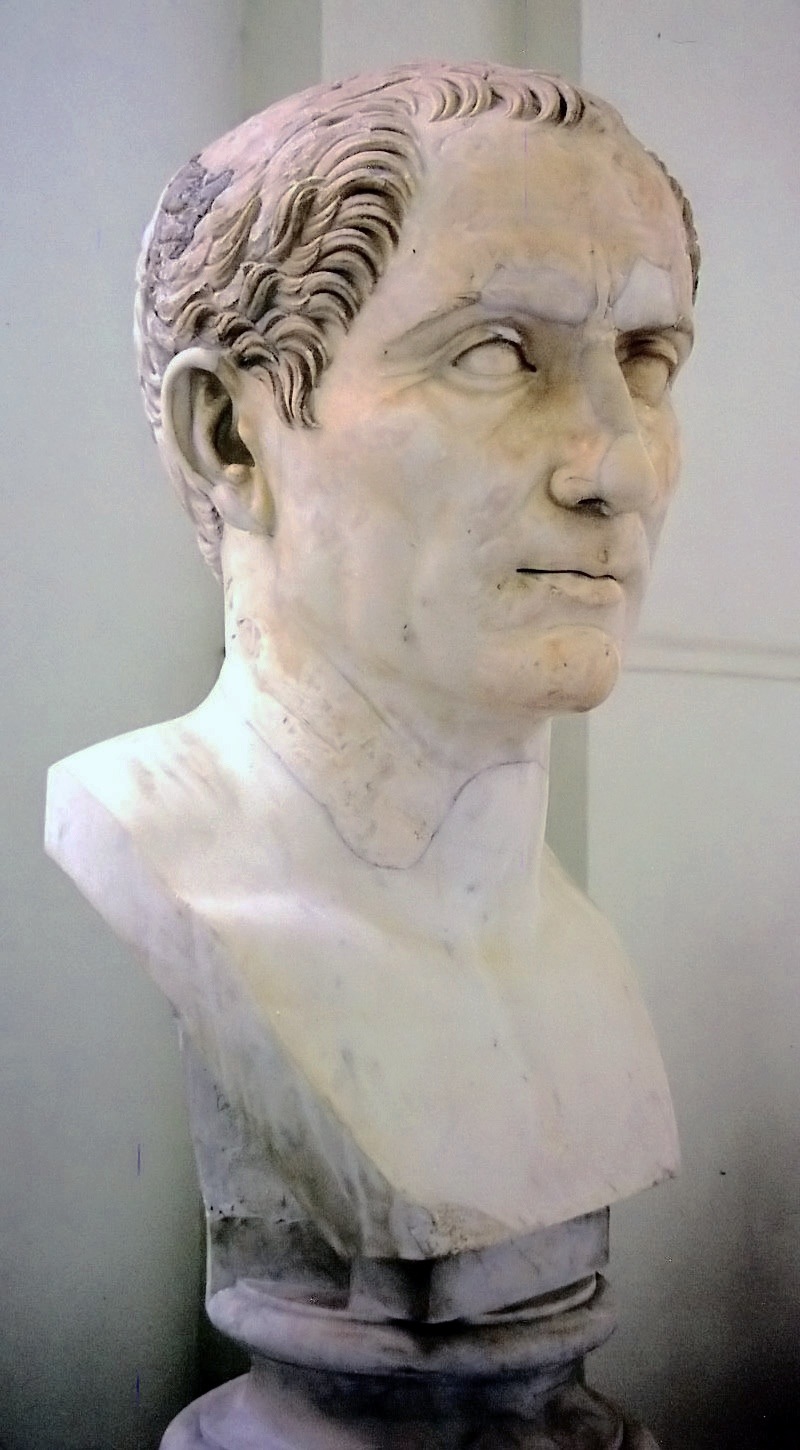
“He is every woman’s man and every man’s woman.”

20130908-222141.jpg

In 80 BCE, young Julius Caesar was an ambassador to Nicomedes’ court. He served his first campaign in Asia on the personal staff of Marcus Thermus, governor of the province. Being sent by Thermus to Bithynia, to fetch a fleet, because he had stayed there for so long, a rumor developed that he was suspected of improper relations with the king [The Latin is stronger – “non sine rumore prostratae regi pudicitiae”], leading to the disparaging title, “the Queen of Bithynia”, an allegation that was much brought up by Caesar’s political enemies later on in his life. A political opponent once said that “He is every woman’s man and every man’s woman.” He lent further suspicion to this scandal by going back to Bithynia a few days after his return for the alleged purpose of collecting a debt for a freedman, one of his dependents. During the rest of the campaign he enjoyed a better reputation, and at the storming of Mytilene Thermus awarded him the civic crown.

Julius Caesar is said to have been tall of stature, with a fair complexion, shapely limbs, a somewhat full face, and keen black eyes; sound of health, except that towards the end he was subject to sudden fainting fits and to nightmare as well. He was twice attacked by the falling sickness [what most historians believe to be epilepsy] during his campaigns. He was somewhat overnice in the care of his person, being not only carefully trimmed and shaved, but even having superfluous hair plucked out, as some have charged; while his baldness was a disfigurement which troubled him greatly, since he found that it was often the subject of the gibes of his detractors. Because of it he used to comb forward his scanty locks from the crown of his head, and of all the honors voted him by the senate and people there was none which he received or made use of more gladly than the privilege of wearing a laurel wreath at all times. They say, too, that he was fantastic in his dress; that he wore a senator’s tunic with fringed sleeves reaching to the wrist [i.e. Latus clavis – the braod purple strip, or a tunic with the broad stripe. All senators had the right to wear this; the peculiarity in Caesar’s case consisted in the long fringed sleeves.] , and always had a girdle over it, though rather a loose one. While a girdle was commonly worn with the ordinary tunic, it was not usual to wear one with the latus clavis. The looseness of the girdle was an additional peculiarity. This, they say, was the occasion of Sulla’s mot, when he often warned the nobles to keep an eye on the ill-girt boy.

There was no stain on his reputation for chastity except his intimacy with King Nicomedes, but that was a deep and lasting reproach, which laid him open to insults from every quarter. I say nothing of the notorious lines of Licinius Calvus:

Whate’er Bithynia had, and Caesar’s paramour.
Bithynia quicquid/ et pedicator Caesaris umquam habuit

I pass over, too, the invectives of Dolabella and the elder Curio, in which Dolabella calls him “the queen’s rival, the inner partner of the royal couch,” and Curio, “the brothel of Nicomedes and the stew of Bithynia” I take no account of the edicts of Bibulus, in which he posted his colleague as “the queen of Bithyllia,” saying that ” of yore he was enamoured of a king, but now of a king’s estate.” At this same time, so Marcus Brutus declares, one Octavius, a man whose disordered mind made him sornewhat free with his tongue, after saluting Pompey as ” king ” in a crowded assembly, greeted Caesar as ”Queen.” But Gaius Memmius makes the direct charge that he acted as cup-bearer to Nicomedes with the rest of his wantons at a large dinner-party, and that among the guests were some merchants from Rome, whose names Memmius gives. Cicero, indeed, is not content with having written in sundry letters that Caesar was led by the king’s attendants to the royal apartments, that he lay on a golden couch arrayed in purple, and that the virginity of this son of Venus was lost in Bithynia; but when Caesar was once addressing the senate in defence of Nysa, daughter of Nicomedes, and was enumerating his obligations to the king, Cicero cried: ” No more of that, pray, for it is well known what he gave you, and what you gave him in turn.” Finally, in his Gallic triumph his soldiers, among the bantering songs which are usually sung by those who follow the chariot, shouted these lines, which became a byword

All the Gauls did Caesar vanquish, Nicomedes vanquished him;
Lo ! now Caesar rides in triumph, victor over all the Gauls,
Nicomedes does not triumph, who subdued the conqueror.

As one of his last acts as king of Bithynia, in 74 BCE, Nicomedes bequeathed the entire kingdom of Bithynia to Rome. The Roman Senate quickly voted it as a new province.

That he was unbridled and extravagant in his intrigues is the general opinion, and that he seduced many illustrious women, among them Postumia, wife of Servius Sulpicius, Lollia, wife of Aulus Gabinius, Tertulla, wife of Marcus Crassus, and even Gnaeus Pompey’s wife Mucia. At all events there is no doubt that Pompey was taken to task by the elder and the younger Curio, as well as by many others, because through a desire for power he had afterwards married the daughter of a man on whose account he divorced a wife who had borne him three children, and whom he had often referred to with a groan as an Aegisthus. But beyond all others Caesar loved Servilia, the mother of Marcus Brutus, for whom in his first consulship he bought a pearl costing six million sesterces. During the civil war, too, besides other presents, he knocked down some fine estates to her in a public auction at a nominal price and when some expressed their surprise at the low figure, Cicero wittily remarked: “It’s a better bargain than you think, for there is a third off.” And in fact it was thought that Servilia was prostituting her own daughter Tertia to Caesar.

That he did not refrain from intrigues in the provinces is shown in particular by this couplet, which was also shouted by the soldiers in his Gallic triumph:

Men of Rome, keep close your consorts, here’s a bald adulterer.
Gold in Gaul you spent in dalliance, which you borrowed here in Rome.

He had love affairs with queens too, including Eunoe the Moor, wife of Bogudes, on whom, as well as on her husband, he bestowed many splendid presents, as Naso writes: but above all with Cleopatra, with whom he often feasted until daybreak, and he would have gone through Egypt with her in her state-barge almost to Aethiopia, had not his soldiers refused to follow him. Finally he called her to Rome and did not let her leave until he had ladened her with high honors and rich gifts, and he allowed her to give his name to the child which she bore. In fact, according to certain Greek writers, this child was very like Caesar in looks and carriage. Mark Antony declared to the senate that Caesar had really acknowledged the boy, and that Gaius Matius, Gaius Oppius, and other friends of Caesar knew this. Of these Gaius Oppius, as if admitting that the situation required apology and defense, published a book, to prove that the child whom Cleopatra fathered on Caesar was not his. Helvius Cinna, tribune of the commons, admitted to several that he had a bill drawn up in due form, which Caesar had ordered him to propose to the people in his absence, making it lawful for Caesar to marry what wives he wished, and as many as he wished, “for the purpose of begetting children.” But to remove all doubt that he had an evil reputation both for shameless vice and for adultery (impudicitae et adulteriorum), I have only to add that the elder Curio in one of his speeches calls him “every woman’s man and every man’s woman”

*****

The above history of Julius Caesar is adapted from translations of Suetonius’s The Life of Julius Caesar. Suetonius is my favorite ancient historian. He had a dirty mind and, most likely, a wild imagination, making him a lot of fun to read. He used rumors to write his histories, though there is evidence that he performed a great deal of research. I am currently reading George Gardiner’s The Hadrian Enigma about the death of the Roman Emperor Hadrian’s young Bithynian lover Antinous’s suspicious death on the Nile. Suetonius is he narrator and a prominent character of the book. Since this book is nearly 500 pages long, it might take me a while to read it, since I don’t get a lot of pleasure reading time during the school year.


How Is God With Us

20130907-212844.jpg

He has just been elected the president of a great nation. Many thought him unfit to be the president. He didn’t have the education of many of those who had gone before him. Many considered him a stumbling buffoon, unfit for such an office. The country was divided on so many issues. Was war justified? How could he unify a country which seem to have been further divided by the recent presidential election? Where would he find the other leaders he needed to be his cabinet?

Who was this man? No, it isn’t George W. Bush. It is Abraham Lincoln. He had just been elected president of the United States- a man without a formal education like all those others who had preceded him in the office. He came from a state, Illinois that didn’t seem to have the prestige, of the eastern states. The country was terribly divide on the issue of slavery and seemed to be headed for war. How must Lincoln have felt amidst the criticism of his detractors who thought him to be ill prepared, ill-equipped, and ignorant? How could he lead in the midst of such divisiveness, such conflict, such doubts? Surely he must have felt alone.

When Abraham Lincoln departed from Springfield, Illinois, he bid his friends farewell with these words: “I now leave, not knowing when, or whether ever, I may return, with a task before me greater than that which rested upon Washington. Without the assistance of that Divine Being, who ever attended him, I cannot succeed. With that assistance I cannot fail. Trusting in Him, who can go with me, and remain with you and be everywhere for good, let us confidently hope that all will yet be well. To His care commending you, as I hope in your prayers you will commend me, I bid you an affectionate farewell.”

In this dark hour of the nation, with war impending, anger welling up around him, Lincoln had a profound sense of “God with us.” He didn’t count on his own abilities, on the abilities of the other leaders he was yet to choose for his cabinet. He knew that his abilities were not sufficient; others who would help to lead were no better. He put his faith in God with him and the nation.

It is God who so loved the world, God who so loves you and me that God came to share our life on earth. God’s ultimate purpose is to establish the realm of God on earth so that the whole creation will be bound together in one community of justice and love.

Truly God is with us. No matter the circumstances of the world- war, starvation, violence on the streets, anger and hurt in homes, betrayal among friends, greed among nations, injustice everywhere. God is with us. What does God want from us? God wants us to open our eyes, to see the wonders of the world around us and to believe in His love.

God cannot be confined to the church, to a sanctuary. God will be found on the battle lines of war. God is found in a nursing home where some of the residents have nobody to come to visit. God is found at the bedside of the dying. God is with us when the unthinkable happens. God is found in every place that seems godforsaken. Our God lives where our God lives, in the world. Destruction has no ultimate power and even death cannot stop the living. Truly God is with us.


Moment of Zen: A Handsome Man

20130907-003100.jpg

There are some times, when no matter how crappy you feel, that you can gaze upon a handsome man, and it makes you feel just a little better for getting a glimpse of his beauty. At least, that’s how I feel. Then again, maybe I’m just shallow.


Early Morning

20130905-220712.jpg

I had to get up about an hour early this morning to be at school extra early. I am not a morning person, which is the reason I usually write my posts the night before and schedule them for the next day. However, since I have to get up early and I’ve been busy making out a test for most of the evening, this is going to be a short post.

You probably know by now that this blog is a bit eclectic, so you never know what you will get. Silvereagle called my blog “a very varied site” yesterday, and that’s true, especially since I’m trying to open up more about myself and be a bit more personal, like the last two posts. The only problem is that sometimes, actually most of the time, my life is pretty boring. The more personal posts seem to resonate with my wonderful readers more, so I’m trying. So just a quick survey and you can post your answers to this question in the comments section below: what type of post do you most prefer from me? Or, do you just like to be surprised?


True Confession

20130904-225329.jpg

At school, we have this one particular coach that is very hot and has an amazing butt. Since most of the day he teaches P.E., he is almost always wearing athletic shorts, which shows off his butt incredibly. As one of my coworkers likes to say, “I hate to see him go, but I sure do love to watch him walk away.” Honestly, it’s mesmerizing, and it never fails to make me incredibly horny. He has one of those amazingly shaped men’s asses in which the cheeks move up and down separately as he walks….I have to just turn away and think of dead puppies or something to keep from getting incredibly turned on. It also doesn’t hurt that he is incredibly nice, and he makes his athletes behave. Not enough coaches these days take their job as role model serious enough; they only care about winning, not understanding that if your players respect you, then they will try even harder. His athletes, though, know their punishment will be hell if they cause a teacher trouble. Oh, and have I failed to mention that he has the most gorgeous blue eyes?

I’m not the only one who notices either. All of the girls at school think he is “just so hot.” The female teachers feel the same way. It was really tough last year during spring sports when he had a coaching intern/assistant coach that was just as hot, if not a little more so (but he was a bit young for my taste). They made nice eye candy at lunch.

While I’m confessing, I probably should admit that as I was writing this post last night, I was incredibly horny, which is probably the reason that this was on my mind enough to,actually write this post.


Traffic Court

20130903-221625.jpg

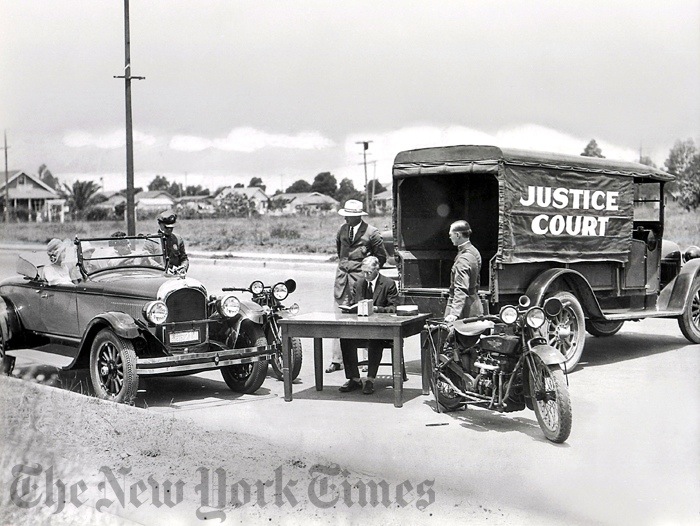
Yesterday, I had a court appearance for my speeding ticket. As I said yesterday, I wasn’t speeding, so I’m fighting it. Let me just say this, the Alabama judicial system is f*cked. I knew it would be when the dishonorable Judge Roy Moore became the head of the Alabama judicial system again. (He had bankrupted the courts once before before getting booted from office for violating a federal court order, then in the infinite wisdom of Alabama voters, he was elected to the same position again.) Any person entering the court can see that the courts are in trouble right away, when they take one look around at the results of the massive budget cuts. The first thing you notice is how hot it is on the courtroom (can’t afford good AC). The next thing is when the judge walks in and he’s having to share a clerk with another courtroom plus the judge is having to do the clerk’s job himself while at the same time conducting court. By the way, in Alabama, the district courts handle traffic court unless you get a ticket by a city police officer and then you go to municipal court. My ticket was by a state trooper, so I had to go to district court.

My day in court seemed to be going smoothly when I got there. I was third in line to sign in (all the other men had to go tuck in their shirts). Since it is first come first serve, my case was called second, at which time I was asked how I plead. When I said not guilty, I was told to go see the district attorney to schedule a court date. Now back when I used to work for an attorney, the clerks office, not the D.A., set trial dates, but maybe I’m wrong. The D.A. told me that they could set the trial at 1:00 that afternoon, if they could get the officer there. This was fine by me, though I still think that if the chief witness for the state was not there then my case should have been dismissed; however, with the Alabama court system it seems that the world revolves around Alabama State Troopers. The D.A. told me that he would call me if the officer could not appear.

After doing some shopping, while waiting around for one o’clock, the D.A. called (just before noon) and told me that they would have to reschedule because the officer was out of town. So as soon as a new date is scheduled, I will receive a letter in the mail with my trial date. Since I am a teacher and can’t just schedule my life around a state trooper’s schedule, I will most likely have to reschedule the trial date. Also, my witness, who was in the car with me the day of the ticket, will not be able to get another day off until November, which is what I will tell the court when I call to reschedule.

When I do go to trial, assuming the court can schedule around the officer’s schedule, then I will be representing myself. That is, unless any of you know of a lawyer who would represent me for free and is in the Montgomery, Alabama, area. I would get the lawyer I used to work for, but she has retired from practicing law and has no interest in reentering the profession. The judge, which will be the trial judge as well, was very helpful in telling us what we need to know, and he assured us that in trial, it is winnable if we can show reasonable doubt. With a witness and my testimony, plus the fact that there is no way this officer is perfect and incapable of making a mistake as he claimed when he gave me a ticket, I do have some hope that I can show reasonable doubt.

I do wish Alabama was like so many other places and if the officer failed to appear, then the case would be dismissed, but no such luck. However, I have a right to a trial, and I refuse to plead guilty and pay the fine when I am not guilty.


Same Love

20130902-205752.jpg

I have to admit that I am behind the times on this. I had heard about this song (which will be the poem for today), but I had not heard it. I could have easily listened to it on YouTube, but I hadn’t taken the time. On my way home Friday night, I felt like my local Top 40 station was having a gay night. It started with this song, several commercials for the local gay club (or alternative nightspot, as they called it), and then numerous songs about being yourself. It was actually a lot of great music. It was also a bit surreal considering that they kept updating the Friday night football scores as well. Though I am not a fan of rap music in the least, I have to admit that the words to Macklemore’s “Same Love” are quite poetic and meaningful. Besides isn’t tap supposed to be urban poetry?

“Same Love” is the fourth single released by Seattle-based rapper Macklemore and producer Ryan Lewis from their 2012 debut studio album, The Heist. The track, featuring vocals by Mary Lambert, talks about legalizing same-sex marriage and was recorded during the campaign for Washington Referendum 74, which, upon approval in 2012, legalized same-sex marriages in Washington state. The song has so far reached number 11 on the Billboard Hot 100 in the United States and reached number 1 in both New Zealand and Australia.

The cover artwork for the single shows a photograph of Macklemore’s uncle, John Haggerty, and his partner, Sean.

The song was featured as a part of YouTube’s Pride Week (http://youtu.be/OQngzapK5dM).

“Same Love”
Macklemore with Ryan Lewis featuring Mary Lambert
By Ben Haggerty (Macklemore), Ryan Lewis, Mary Lambert, Curtis Mayfield

When I was in the third grade I thought that I was gay,
‘Cause I could draw, my uncle was, and I kept my room straight.
I told my mom, tears rushing down my face
She’s like “Ben you’ve loved girls since before pre-k, trippin’ ”
Yeah, I guess she had a point, didn’t she?
Bunch of stereotypes all in my head.
I remember doing the math like, “Yeah, I’m good at little league”
A preconceived idea of what it all meant
For those that liked the same sex
Had the characteristics
The right wing conservatives think it’s a decision
And you can be cured with some treatment and religion
Man-made rewiring of a predisposition
Playing God, aw nah here we go
America the brave still fears what we don’t know
And God loves all his children, is somehow forgotten
But we paraphrase a book written thirty-five-hundred years ago
I don’t know

And I can’t change
Even if I tried
Even if I wanted to
And I can’t change
Even if I tried
Even if I wanted to
My love
My love
My love
She keeps me warm
She keeps me warm
She keeps me warm
She keeps me warm

If I was gay, I would think hip-hop hates me
Have you read the YouTube comments lately?
“Man, that’s gay” gets dropped on the daily
We become so numb to what we’re saying
A culture founded from oppression
Yet we don’t have acceptance for ’em
Call each other faggots behind the keys of a message board
A word rooted in hate, yet our genre still ignores it
Gay is synonymous with the lesser
It’s the same hate that’s caused wars from religion
Gender to skin color, the complexion of your pigment
The same fight that led people to walk outs and sit ins
It’s human rights for everybody, there is no difference!
Live on and be yourself
When I was at church they taught me something else
If you preach hate at the service those words aren’t anointed
That holy water that you soak in has been poisoned
When everyone else is more comfortable remaining voiceless
Rather than fighting for humans that have had their rights stolen
I might not be the same, but that’s not important
No freedom till we’re equal, damn right I support it

(I don’t know)

And I can’t change
Even if I tried
Even if I wanted to
My love
My love
My love
She keeps me warm
She keeps me warm
She keeps me warm
She keeps me warm

We press play, don’t press pause
Progress, march on
With the veil over our eyes
We turn our back on the cause
Till the day that my uncles can be united by law
When kids are walking ’round the hallway plagued by pain in their heart
A world so hateful some would rather die than be who they are
And a certificate on paper isn’t gonna solve it all
But it’s a damn good place to start
No law is gonna change us
We have to change us
Whatever God you believe in
We come from the same one
Strip away the fear
Underneath it’s all the same love
About time that we raised up… sex

And I can’t change
Even if I tried
Even if I wanted to
And I can’t change
Even if I tried
Even if I wanted to
My love
My love
My love
She keeps me warm
She keeps me warm
She keeps me warm
She keeps me warm

Love is patient
Love is kind
Love is patient
Love is kind
(not crying on Sundays)
Love is patient
(not crying on Sundays)
Love is kind
(I’m not crying on Sundays)
Love is patient
(not crying on Sundays)
Love is kind
(I’m not crying on Sundays)
Love is patient
(not crying on Sundays)
Love is kind
(I’m not crying on Sundays)
Love is patient
Love is kind

PS I hope you will all wish me luck today as I go to court to fight a speeding ticket. My cruise control was set at 65 mph, but the state trooper said he clocked me going 85 mph. Cars were passing me left and right, including a similar model to my car that was the same color. If I had been speeding, I’d just pay it, but I wasn’t, so I’m going to court.


Southern Decadence

20130901-223810.jpg

Since it was founded in 1781, New Orleans has marched to the beat of its own drum.  For two centuries, those in control of the Louisiana state government have tried in vain to impose their prejudices on a city that is French, Spanish, Creole, African, Catholic, pagan and very gay (in both senses of the word).  If nothing else, New Orleans knows how to throw a party, from the world-famous Mardi Gras to other, more specialized celebrations.

One of these celebrations began quite inauspiciously in August of 1972, by a group of friends living in a ramshackle cottage house at 2110 Barracks Street in the Treme section of New Orleans, just outside of the French Quarter. It was in desperate need of repair, and the rent was $100 per month.  At any given time the residents numbered anywhere from six to ten, and it was still sometimes difficult to come up with the rent.

The large bathroom became a natural gathering place in the house.  It had no shower, only a clawfoot tub, but it also had a sofa.  With from six to ten residents, and one bathtub, everyone became close friends.  While one soaked in the tub, another would recline on the couch and read A Streetcar Named Desire aloud. The Tennessee Williams play inspired the residents to fondly name the house “Belle Reve” in honor of Blanche DuBois’ Mississippi plantation.

And so it was, on a sultry August afternoon in 1972, that this band of friends decided to plan an amusement.  According to author James T. Spears, writing in Rebels, Rubyfruit and Rhinestones: Queering Space in the Stonewall South, this “motley crew of outcasts” began Southern Decadence as a going away party for a friend named Michael Evers, and to shut up a new “Belle Reve” tenant (from New York) who kept complaining about the New Orleans heat.  As a riff on the “Belle Reve” theme, the group named the event a “Southern Decadence Party: Come As Your Favorite Southern Decadent,” requiring all participants to dress in costume as their favorite “decadent Southern” character.    According to Spears, “The party began late that Sunday afternoon, with the expectation that the next day (Labor Day) would allow for recovery. Forty or fifty people drank, smoked, and carried on near the big fig tree … even though Maureen (the New Yorker) still complained about the heat.”

The following year the group decided to throw another Southern Decadence Party.  They met at Matassa’s bar in the French Quarter to show off their costumes, then they walked back to “Belle Reve.”  This first “parade” included only about 15 people impersonating such “decadent Southern” icons as Belle Watling, Mary Ann Mobley, Tallulah Bankhead, Helen Keller, and New Orleans’ own Ruthie the Duck Lady.  This impromptu parade through the French Quarter and along Esplanade Avenue laid the groundwork for future events, and  the group decided to repeat the party again the following year.

In 1974, the Southern Decadence visionaries named Frederick Wright as the first Grand Marshal, hoping to provide at least a modicum of order.  For the next six years, the format of the celebration changed little.  The founding group continued to appoint each year’s Grand Marshal by consensus.  Some were gay, some were not. But all were members of the founding group.

By 1981, most of the original organizers had moved on with their lives.  Many felt that the event had become so big that it was no longer the intimate party they had started nine years earlier.  Of the original group, only Grand Marshal V Robert King was actively participating.  He, along with some of his friends that hung out at the Golden Lantern bar, thought it was worth continuing and they took over the festivities.  It was at this point that Southern Decadence became primarily a gay event.  Other protocol changes made in 1981 included moving the starting point of the annual parade from Matassa’s to the Golden Lantern bar, and allowing Grand Marshals to personally name their own successors.  Both of these traditions continue today. And in 1987, the Grand Marshal began to make a proclamation of the official theme, color and song.

Because the 2005 celebration was cancelled due to Hurricane Katrina, Southern Decadence 2005 Grand Marshals Lisa Beaumann and Regina Adams reigned for both 2005 and 2006, making the very first time in Southern Decadence history that grand marshals ruled for two years.  And keeping with the unpredictability of Decadence, the Grand Marshals from 2008 reigned once again in 2009.

The rest, as they say, is history.  What began as a little costume party is now a world-famous gay celebration.  In the 39th year, it has mushroomed from a small gathering of friends to a Labor Day weekend tradition, attracting over 100,000 participants, predominantly gay and lesbian, and generating almost $100 million in tourist revenue.  This annual economic impact ranks it among the city’s top five most significant tourist events.  The mayor has even welcomed the event with an Official Proclamation.

Described by one reporter as “a happening of haberdashery fit for an LSD Alice in Wonderland,” Southern Decadence 2010 will be as outrageous as ever and live up to its reputation as New Orleans’ largest gay street fair.  It all begins in earnest six weeks before Labor Day.  However, the real party starts on the Wednesday before Labor Day, and the events are non-stop. It picks up steam daily as it nears Sunday’s big street parade, which rivals New Orleans’ gay Mardi Gras in scope, with the party lasting well into the day on Monday.

If you’ve never been to Southern Decadence, and sadly I haven’t, here are some tips to know before you go. What follows are some thoughts gathered from locals that will help you get the most out of your experience.

Pass by the NO/AIDS Task Force’s information tables located on the St. Ann Street sidewalk in front of Hit Parade Gift and Clothing, at the corner of Bourbon and St. Ann Streets.  You’ll find lots of community information and details of the weekend’s events.  The literature racks inside of Hit Parade are another great source for all of the Southern Decadence information that you will need.

During Southern Decadence, some streets of the French Quarter do not allow parking – look for, and heed, no parking signs. Plan on doing a lot of walking. Comfortable shoes are a must. Always walk where it is well lit and there are a lot of people. New Orleans is a city of neighborhoods. Like all large cities, the Big Easy does have some trouble spots. Always walk with others, never alone if possible. Don’t wander about the city. In New Orleans the neighborhoods can change, literally, when you cross a street. Always carry a map. If you’re drinking, don’t go stumbling about the French Quarter. Locals know that the people who encounter trouble are usually the ones who have been drinking.

And a bit of urban common sense is in order. When you walk the streets, don’t bring your wallet. Take the cash you need and possibly a credit card, along with some sort of identification, and put them in a pocket that no one can slip their hand into. Don’t wear expensive jewelry. Basically, don’t take anything with you that you would have a hard time replacing if it were lost.

If your car is impounded, it will cost you over $100 plus whatever else the city decides to tack on. Your car can be retrieved from the City Auto Pound, located in a dangerous area of the city, 400 N. Claiborne Ave., (504.565.7236). This will spoil a good time. Cabs are not difficult to get during Southern Decadence. If you are going to take a cab, try UNITED CABS: 504.522.9771 or 504.524.9606. Write these numbers down and put them in your wallet. This cab company can be trusted. United Cabs has a sound reputation with the New Orleans gay community.

People are allowed to drink on the streets in New Orleans —  that large 24-oz Southern Decadence cup that you’ll see people walking with and drinking from likely contains several shots of alcohol!  However, if your drink isn’t already in a plastic cup, please ask for one before leaving your favorite watering hole. Glass and cans are not allowed on the streets for safety reasons.

Most bars in New Orleans are open twenty-four hours a day. Pace yourself. Most important, it’s easy to get caught up in all the excitement and forget to eat. If you want to make it through the weekend, solid food is a necessity. Of course, New Orleans is world famous for its food and indulging is part of a complete New Orleans experience.

Clean bathrooms can be difficult to find during Southern Decadence. Most businesses close their facilities to everyone but paying customers. If your hotel is far from the action, take care of the more important business before you hit the streets. If you need to, plan on buying lunch or dinner and using the restaurant’s bathroom before you pay the check!

The French Quarter is an historic neighborhood. Please respect it. No matter how “bad” you have to go, do not urinate in the streets or on door steps or through iron gates. This is a good way to end up in central lock-up, and people who are arrested sit in jail until the courts re-open after Labor Day. It will cost you about $200. And it’s not polite. Listen to your body. Get in line before you really have to go. By the time you’re crossing your legs, you might be at the front of the line.

During Southern Decadence weekend, you’re guaranteed to get an eyeful of great costumes and fabulous bodies. Officially, public nudity is not allowed and there are obscenity laws on the books. Better judgment should be the rule of the day.

Southern Decadence is a BIG non-stop party. People drink and are having a good time. It’s easy to forget that there is a real world out there. Free condoms are available from the NO/AIDS Task Force station located near the Bourbon Pub / Parade. Don’t allow the party to overwhelm your better judgment. We want you to come again. Have fun and play safe!

20130901-223842.jpg


Photos from vjbrendan.com.


Laboring in God’s Word

20130831-150346.jpg

“Let not your hearts be troubled. Believe in God; believe also in me. In my Father’s house are many rooms. If it were not so, would I have told you that I go to prepare a place for you? And if I go and prepare a place for you, I will come again and will take you to myself, that where I am you may be also. And you know the way to where I am going.” Thomas said to him, “Lord, we do not know where you are going. How can we know the way?” Jesus said to him, “I am the way, and the truth, and the life. No one comes to the Father except through me. If you had known me, you would have known my Father also. From now on you do know him and have seen him.”

Philip said to him, “Lord, show us the Father, and it is enough for us.” Jesus said to him, “Have I been with you so long, and you still do not know me, Philip? Whoever has seen me has seen the Father. How can you say, ‘Show us the Father’? Do you not believe that I am in the Father and the Father is in me? The words that I say to you I do not speak on my own authority, but the Father who dwells in me does his works. Believe me that I am in the Father and the Father is in me, or else believe on account of the works themselves.

“Truly, truly, I say to you, whoever believes in me will also do the works that I do; and greater works than these will he do, because I am going to the Father. Whatever you ask in my name, this I will do, that the Father may be glorified in the Son. If you ask me anything in my name, I will do it.
John 14:1-14

When you read what Philip said in verse 8 of John 14 does it seem like an unreasonable request? To the contrary, one might conclude that it was commendable. After all, what could be wrong with expressing a desire to see the Father whom Jesus often spoke about? Furthermore, Jesus had just mentioned that He would soon depart to go to the Father’s house and would come back for the disciples to take them there (John 14:1-3). No doubt this peaked the natural curiosity of Philip. What is the Father like? Yet, when we look at the reply of the Lord to Philip it is troubling. Philip was not commended, he was rebuked for his ignorance.

The end of the Lord’s public ministry was near and he did not fully grasp the most vital truth concerning Jesus – the manifestation of His Divine nature, “Whoever has seen me has seen the Father. How can you say, ‘Show us the Father’?” Jesus had given proof of His Divine power throughout His ministry. Was it not Philip who said, “we have found him, of whom Moses in the law, and the prophets, did write” (John 1:45). This led me to question how well the disciples of Jesus in our day know him? Do they understand all of the necessary truths that reveal the person and work of Christ revealed in God’s Word.

The early church father Jerome said, “to be ignorant of the Scripture is to be ignorant of Christ”. What I learn from the inquiry of Philip and Thomas (John 14:5) is that the duration of our exposure to truth does not guarantee that we are mature in the faith.

Last Sunday I mentioned that we must be hearers and doers of the Word. In Jesus we have the opportunity to overcome the nature of man. We can have the victory over the flesh by learning and applying the words of the truth. The path we are to follow is not the traditions of man, but the truth of the gospel of Christ. Seek His ways and you will find a path where there is no defilement. We must give ourselves to the “Do your best to present yourself to God as one approved, a worker who has no need to be ashamed, rightly handling the word of truth.” (2 Timothy 2:15)

As far as I can tell the problem of Biblical ignorance is not due to a lack of resources. We have Bible dictionaries, systematic theology books, commentaries, lexicons, study Bibles, Christian internet web sites, books and more books from gifted authors. There is no end to the study aids at our disposal. However, all of these are of no use if we do not utilize them. They are tools to Bible understanding, but tools perform no work unless they are in the hands of the workman.

To study means to labor to discover the correct interpretation of a text. The problem is not ignorance, the problem is laziness and misplaced priorities. Some are like little babes who cannot feed themselves. This crowd is dependent on the spiritual food that comes only from the study others have done. The voice of their favorite Bible teacher has replaced the voice of the Holy Spirit who bears witness to the truth of His inspired Word through diligent personal study. Others are like Martha who was “troubled with many things (Luke 10:41).”

The maddening pace of the modern age is taking a toll on our lives, not only physically, but spiritually. We must learn from the great example set by Mary who “sat at Jesus feet and heard His word” (Luke 10:39). Take time today to sit alone at Jesus feet with your Bible and learn from Him. Consider this thought from the pen of William Whitaker, “God willed to have His truth, so sublime, so heavenly, sought and found with so much labor, the more esteemed by us on that account. For we generally despise and scorn whatever is easily acquired, near at hand, and costs small or no labor. But these things which we find with great toil and much exertion, those, when once we have found them out, we esteem highly and consider their value proportionally greater” – Disputations on Holy Scripture by William Whitaker 1588.