Category Archives: History

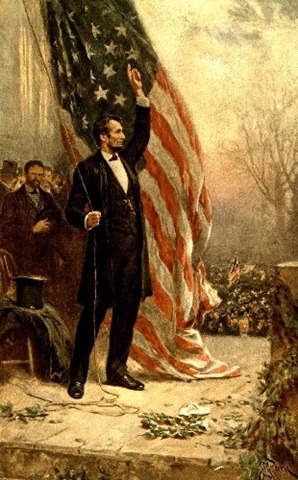
Abraham Lincoln, Gay?

If you want just my opinion on this controversial issue, this would be a very short post, because I don’t think he was gay.  However, there is a lot of controversy over this issue, and I thought I would give a closer look for you guys.

The sexuality of Abraham Lincoln is a subject that is laced with many discrepancies and historical flaws.  GayLincoln The notion that Lincoln was a homosexual also portrays nearly perfectly two of my major pet peeves with historians.  First, much of the argument is taken out of its historical context, and second, the authors who expound on this notion have no historical objectivity.  I will explain these two pet peeves of mine as I relate the supposed homosexuality of Abraham Lincoln.  Mostly, I will explain what is wrong with the theories of Lincoln’s homosexuality.  If you are not familiar with the arguments concerning Lincoln’s homosexuality, please read the suggested readings below.   

6a00d8341c730253ef00e54f3297c08833-640wi In The Intimate World of Abraham Lincoln, C. A. Tripp contends that Lincoln had erotic attractions and attachments to men throughout his life, from his youth to his presidency. He further argues that Lincoln’s relationships with women were either invented by biographers (his love of Ann Rutledge) or were desolate botches (his courtship of Mary Owens and his marriage to Mary Todd). Tripp is not the first to argue that Lincoln was homosexual — earlier writers have parsed his friendship with Joshua Speed, the young store owner he lived with after moving to Springfield, Ill. — but he assembles a mass of evidence and tries to make sense of it.

imageTripp died in May 2003, after finishing the manuscript of this book, which means he never had a chance to fix its flaws. Tripp alternates shrewd guesses and modest judgments with bluster and fantasy. He drags in references to Alfred Kinsey (with whom he once worked) to give his arguments a (spurious) scientific sheen. And he has an ax to grind. Not only did he work with Kinsey, but Tripp was a well-known gay activist and psychologist.  By the way, psychologists who write psycho-history are often the worst type of historians.  They have very little understanding of the craft and they use their knowledge of psychology to interpret historical data.  The same goes for most journalists, who do not have the same standards as historians when it comes to citing their sources. Psychologists who write history too often apply Freudian and Jungian psychology to people who had never had any knowledge of this type of psychoanalyzing. 

In the after math of the Franco-Prussian War in Europe (1870-71), Carl von Clauswitz wrote the military strategy book On War.  Military historians after the publication of On War are able to compare Clauswitz theories to modern warfare because it influenced modern generals and military strategists.  Likewise, the psychological theories of Freud and Jung and the perverted misunderstanding of Einstein’s Theory of Relativity (“everything is relative,” not just E = mc2, as Einstein meant it) greatly influenced 20th century writers, who used this knowledge to form their characters and plot devises. I mention these two instances of influencing theories because Tripp uses modern homosexual behavior to explain Lincoln relationships with men.  He takes the notion out of its historical context. 

imageIntimacy between men was much more common and less sexually laced in the 19th century than it was in the later part of the 20th century.  In 19th century America, men commonly slept with other men. For example, when lawyers and judges traveled “the circuit” with Lincoln, the lawyers often slept “two in a bed and eight in a room.”  William H. Herndon recalled, “I have slept with 20 men in the same room.”  A tabulation of historical sources shows that Lincoln slept with at least 11 boys and men during his youth and adulthood. There are no known instances in which Lincoln tried to suppress knowledge or discussion of such arrangements, and in some conversations, raised the subject himself. Tripp, who was not aware of this large number of Lincoln’s male co-sleepers, discusses only three of them at length: Joshua Speed, William Greene, and Charles Derickson.

image
Joshua Speed

Tripp and other gay activists have an agenda to prove Lincoln’s homosexuality.  He is seen as the father of the Republican Party, an American political party known for its many anti-gay members and platforms.  Their objectivity is shot to hell because they are not attempting to give their readers an intimate look at the private life of Abraham Lincoln, but to discredit the Republican Party.  For me, this takes away much of the credibility of advocates of Lincoln’s homosexuality.  I am no fan of the Republican Party.  I largely find the modern Republican Party to be defined by what it hates and not what it is for; however, the same could be said for the Democratic Party.  American politics is a divisive politics of hate.  If someone writing history is blinded by that hate, they cannot see the error of their historical argument.  They apply modern interpretations to situations that do not warrant modernity.  Yes, the Civil War in America, the mid-19th century was a turning point in the history of America.  It is a period of transitioning from the early republic to the modern era.  Yet, this transition was not even complete by 1877 when Reconstruction ended.  Therefore, modern interpretations of events are null and void.

Suggested Readings:

Reverend Wigglesworth

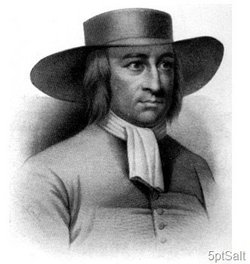
Michael Wigglesworth

When I was doing research at the Massachusetts Historical Society a few years ago for my dissertation, I did some research into the Wigglesworth Family Papers.  My primary concern at the time were the diaries of Anna and George Wigglesworth and their travels to Europe in the mid 19th century.  However, as I was looking through the OutHistory.org internet archives, that I blogged about yesterday, I came across the Reverent Michael Wigglesworth (1631–1705) who was a Puritan minister and poet. His most famous poem The Day of Doom was a bestseller in early New England. Wigglesworth is included in OutHistory.org’s section called “Age of Sodomitical Sin: 1607-1776” because of his extraordinary diary. I wanted to share this article with you because I found it so fascinating.

“Too much doting affection”

The extraordinary diary of the Reverend Wigglesworth documents the inner life of this Puritan divine, famous as the author of the poem “Day of Doom,” a popular classic in the New England hellfire and brimstone tradition. [1]His diary reveals that while Wigglesworth was a tutor at Harvard he was tormented by sexual feelings for his male students — feelings experienced as deeply sinful.
Historian Edmund Morgan’s introduction to the published edition of Wigglesworth’s diary admits that “We should scarcely exaggerate … if we described Michael Wigglesworth as a morbid, humorless, selfish busybody,” an “ugly,” “absurd,” “pathetic” cartoon caricature of a Puritan.[2]

As a striking example of the strict Puritan of popular imagination, Wigglesworth is a problem for those historians who, led by Edmund Morgan, have criticized the popular view of the early Puritans as “grossly overdrawn.” The Puritans, Morgan stressed, did not exclude “enjoyment”; they “read books, wrote verse,” “had their pictures painted,” were “unashamedly fond” of beer, wine, and harder liquors, liked to eat well, “made no pretensions to asceticism:’ were “not prudish,” and made “no attempt to stiffle natural passions in celibacy.”
Morgan then admitted that “the mark of the Puritan” was “his zeal, his suspicion of pleasure, his sense of guilt.” Those characteristics in Wigglesworth are not evidence of any purely individual eccentricity, but were “simply the qualities demanded of a good Puritan.” Many of Wigglesworth’s contemporaries were probably not quite so distressed by their inability to live up to the demands of a religious ideal. Philip Greven’s differentiation of colonial Protestants as strict “Evangelical,” “Moderate,” and “Genteel” usefully suggests a wider, and probably more realistic range of colonial personalities. Greven does view Wigglesworth’s extreme sense of sin as typical of the evangelical personality, however. And it was this strict Puritanism that was institutionalized in early statutes and in many prosecutions. Wigglesworth’s writing for New England “the most popular book of his time,” his teaching at Harvard, and his ministerial service to a Puritan congregation all suggest that his views were not unique, and appealed to a common chord in the early colonists.
Of special interest here are Wigglesworth’s intimate, problematic relationships with males, worldly and otherworldly, in particular with his father, his Harvard students, with God his “father,” and with Christ. Wigglesworth’s loving these, and being loved by them, either not enough or (in some cases) too much, was a central and continuing preoccupation. His feeling that his earthly loves detracted from his love for God indicates a concept of love as a scarce and limited good. Wigglesworth’s thinking of himself as a Bride of Christ (as did other evangelicals, male and female) sometimes led him to speak of kissing and embracing his “husband,” a metaphor with distinctly erotic overtones. Such ideas, together with his entries on marriage, make Wigglesworth’s diary quite a complete and amazing account of early Puritan sexual and affectional life.
Throughout his diary, Wigglesworth often referred to an earthly “creature” who kept stealing his affection away from God. That “creature” was usually earthly comfort in general. But in the early entries especially, that seductive “creature” often turns out to be Wigglesworth’s male students. It seems that one of the sins that made the Day of Judgment a “Day of Doom” for Wigglesworth was his “too much doting affection” for young Harvard males.
The most explicit sexual passages in the diary were written in a special shorthand code (decoded and printed in italics as in Morgan’s edition). While Wigglesworth reported his sins quite frankly to God, his code suggests he wanted to keep them hidden from his fellow humans.
In the first entry, dating to February 1653, Wigglesworth asked:

If the unloving carriages of my pupils can go so to my heart as they do; how then do my vain thoughts, my detestable pride, my unnaturalfilthy lust that are so oJt and even this day in some measure stirring in me . . . ?[3]

On February 7, Wigglesworth feared

there is much sensuality and doting upon the creature in my pursuit of the good of others… [4]

On February 15, Wigglesworth declared:

Lord I am vile, I desire to abhor my self (0 that I could!)…. I find such unresistable torments of carnal lusts or provocation unto the ejection of seed that I find my self unable to read anything to inform me about my distemper because oj the prevailing or rising of my lusts. . . . [5]

On February 17, 1653, Wigglesworth wrote:

The last night a filthy dream and so pollution escaped me in my sleep for which I desire to hang down my head with shame and beseech the Lord not to make me possess the sin of my youth and give me into the hands of my abomination. [6]

On February 26, he noted: “Some filthiness escaped me in a filthy dream. The Lord notwithstanding.” He fretted that when his affections were taken up with doing good, “it is very hard for me to set my heart upon God himself and not to rest in the creature. “[7]
On March 5, 1653, Wigglesworth recorded: much distracted thoughts I find arising from too much doting affection to some of my pupils one of whom went to Boston with me today. He felt no power to love God, he said, “my spirit is so leavened with love to the creature. This frame I am afraid of.”[8]
On April 1, Wigglesworth asked the Lord, his “father,” to “witness my daily sensual glutting my heart with creature comforts.”[9]
And, on April 5, Wigglesworth found

vain distracting thoughts molested me in holy duties. I find my spirit so exceedingly carried with love to my pupils that I can’t tell how to take up my rest in God. Lord for this cause I am afraid of my wicked heart. Fear takes hold of me. [10]

One morning in April, Wigglesworth wondered “will the Lord now again return and embrace me in the arms of his dearest love? Will he fall upon my neck and kiss me?” He then lamented that his love for God had grown cold; he was also “afraid” of his “want of natural affection” for his parents.[11]
At the end of April, Wigglesworth begged God to “give me some sweet soul ravishing communion with thy self. “[12] He also recorded “whorish desertions of my heart from God to the creature.” Wigglesworth noted his “cooling affections” for God, and his “whorish outgoings of heart after other things. I fear my pupils formerly, and now my ease and sloth and pleasure are getting oft between christ and me.” Despite such “backslidings” Wigglesworth thought that God did not “upbraid me of my other lovers.” As a Bride of Christ he begged the Lord to restore “the love of my espousals thine to me and mine to thee.”[13]
On April 27, Wigglesworth told the Lord: “I seek at the hands of a father pardon and power over my still prevailing lusts, principally pride and sensuality, want of love to thee and fervent desires after communion with thee.”[14] Unable to savor communion with God “above communion with men,” Wigglesworth felt unworthy.[15]
Click on more for the rest of this passage.


On June 24, Wigglesworth warned a rebellious Harvard student of “the dangers of pleasure”; the minister was later distraught to find that same student “at play” and making music “with ill company.”[16]

On July 4 and 5, Wigglesworth reported:

such filthy lust also flowing from myfond affection tomypupils whiles in their presence … that I confess myself an object of God’s loathing. . . . [17]

On July 7, Wigglesworth complained that he was so involved in his own business, and in “my pupils’ good,” that he had lost his love for God, and feared his “own spirit of whoredoms.” He prayed: “O give me a new heart a circumcized heart,” so he could again love “harking to God’s covenant.”[18]
On October 14, Wigglesworth thought of “my want of love and dutifulness to my parents,” and “the very next morning news is brought me of my father’s death.”
On October 18, he prayed for grace, wondering whether “I might not be secretly glad that my father was gone.” He added:

The last night some filthiness in a vile dream escaped me for which I loath myself and desire to abase myself before my God. [19]

On November 9, Wigglesworth told the Lord:

when thou showest me my face r abhor myself. Who can bring a clean thing out of filthiness. I was conceived bred brought up in sin.

He reported “too much savoring of the creature.”[20]
On November 30, Wigglesworth told the Lord that he knew he deserved “to be kicked out of this world because I have not had natural affections to my natural father,” because he had thought evil of all his “governors,” and because he had “rebell’d against … my heavenly father.” He asked the Lord not to punish and destroy others for his sins, mentioning one of his pupils who had been “taken away for my sin in too eager seeking their good.”[21]
On December 4, Wigglesworth wondered if he should get married, and hoped the Lord would guide him “in the weighty business that troubles me.”[22]
On February 15, 1655, Wigglesworth referred to “my weakness,” an “affiiction” which exposed him to “sin and temptations by day,” and caused him “dreams and self pollution by night.” Wigglesworth’s “weakness” (which he distinguished from “wantonness”) was apparently gonorrhea — with which he imagined himself to be diseased, and which he apparently thought of as provoking his sexual sins.[23] He also mused that

To continue in a single estate, Is both uncomfortable many ways, and dangerous (as I conceive) to my life, and exposeth to sin, and contrary to engagement of affections, and Friends’ expectations, and liable to the harsh censure of the world that expecteth the quite contrary.

Yet he also believed that to get married and

change my condition endangers to bring me into a pining and loathsome disease, to a wretched life and miserable death and consequently 1 fear it would be injurious to another besides my self…[24]

Wigglesworth seems to have thought that the availability of marital intercourse would increase both his lust and his bodily infirmity. He admitted that no one knew of his infirmities, that he had not talked to anybody about them, and had “even been afraid to pray for myself,” since he feared to think much of his “sad condition.” But with “spring approaching” he had written for advice to John Winthrop, Jr., son of the governor, to John Alcock, a doctor, and to John Rogers, a minister. He had also written and proposed to his cousin, Mary Reyner, “dealing plainly with her in the business, what danger I apprehended,” so that she would “know with whom she matches.”
On February 18, he reported preaching in public on the “sins of these times and places. “[25]
On February 22, Wigglesworth declared himself

much overborn with carnal concupiscence nature being suppressed for I had not had my afflux [emission] in 12 nights. Friday night it came again without any dream that I know of Yet after it I am still inclined to lust. The Lord help’me against it and against discouragement by it and against temptations of another nature and disquietments.[26]

On March 7, Wigglesworth wrote:

I begin to think marriage will be necessary for me'(as an ordinance of God appointed to maintain purity…).[27]

On March 12 and 13, Wigglesworth reported that “fleshly lusts” were “sometimes too strong in me.” He was ashamed

that I wrong and grieve [Christ] my head and husband so by not loving and delighting in his presence; by my liking other loves more than him. Ah Lord! I pull down evils upon others as well as myself. Sickness, death of godly ones, wants, divisions, have not my sins a hand in these miseries?[28]

On March 18, Wigglesworth remarked that “sabbaths are blessed seasons wherein poor wandering harlots, may return to their husband again.” (The harlot of the metaphor was Wigglesworth himself, the husband, Christ.)[29]
At the beginning of April, Wigglesworth, despite a fever, hastened to Massachusetts Bay “To redeem the spring time for marrying or taking physic, or both.” There, Dr. Alcock advised him “to proceed with the business of marriage.” The Reverend Rogers, however, advised “physick” first, marriage later. But after “a little reasoning,” and a “fuller declaration of my illness,” The Reverend Rogers also advised the “consumation” of Wigglesworth’s planned marriage.[30]
Wigglesworth was ready to be “contracted” in marriage when the return of his “weakness” made him consult Dr. Alcock again. The doctor thought it would be a longer, more tedious, difficult cure by “physick” than “he hoped it would be by marriage.” Alcock told Wigglesworth that many other men had taken the marriage cure “with good success.” The doctor also told Wigglesworth “that mine was not vera Gon” (gonorrhea), but a condition caused by “a little acrimony” gathering in the mouth, which caused “humours to flow.” Marriage “would take away the cause of that distemper.”
Because of the inconvenience of “physick,” the “great charge and expense,” and Wigglesworth’s inability to live “with comfort and honesty” as long as he was single, he decided that “god calleth to a speedy change of my condition, which I therefore desire to attend as a duty.” Resolving further doubts about “the lawfulness of marrying with a Kinswoman,” Wigglesworth was “contracted” with his cousin.[31]
“At the time appointed,” he reported, “with fear and trembling I came to Rowley to be married.” Because of “Physicians’ counsel,” and because “the institution of marriage” had been created by God “for the preservation of purity and chastity,” Wigglesworth “went about the business which god call’d me to attend. And consumated it … by the will of god May 18, 1655.”[32] The day following he noted:

I feel stirrings and strongly of my former distemper even after the use of marriage the next day which makes me exceeding afraid.[33]

On July 28, he thanked the Lord for “so much comfort in a married estate contrary to my fears.”[34]
On September 10, he recorded, of himself and his wife,

we can’t lay severally [apart]without obloquy and reproach neither can we lay together without exposing me to the return of grievous disease.[35]

On September 16, Wigglesworth reported:

some night pollution escaped me notwithstanding my earnest prayer to the contrary which brought to mind my old sins now too much forgotten . . . together with my later sins. [36]

In 1657 Wigglesworth still found his heart “as carnal as some years since,” and begged: “mortify Lord these earthly members.” He prayed: “let curiousness die this day for the Lord sake. I feel and I fear it.”[37]
In an undated section in the back of his diary Wigglesworth wrote a list of “Considerations against Pride.” This sin, he noted, “was the ringleader of Sodom’s sins, and pull’d down streams of fire and brimstone upon their heads.” Wigglesworth thought he retained “a Sodom [of pride] within the temple of the holy-ghost [his body].” He reiterated: “Sodom’s ringleading sin” was that its citizens “were proud and haughty and they must fry in the flame of fire for it.”[38]
References
  1.  Jonathan Ned Katz, Gay/Lesbian Almanac (NY: Harper & Row, 1983), p. 94-100 citing Michael Wigglesworth, The Diary of … 1653-1657′; The Conscience of a Puritan, edited with an introduction by Edmund S. Morgan (New York: Harper & Row, 1965). Also see Philip Greven’s comments on Wigglesworth in The Protestant Temperament.
  2.  Wigglesworth, Diary, viii.
  3.  Wigglesworth, Diary, p. 3.
  4.  Wigglesworth, Diary, p. 3.
  5.  Wigglesworth, Diary, p. 4.
  6.  Wigglesworth, Diary, p. 5.
  7.  Wigglesworth, Diary, p. 6.
  8.  Wigglesworth, Diary, p. 9.
  9.  Wigglesworth, Diary, p. 10.
  10.  Wigglesworth, Diary, p. 11.
  11.  Wigglesworth, Diary, p. 13.
  12.  Wigglesworth, Diary, p. 15.
  13.  Wigglesworth, Diary, p. 17.
  14.  Wigglesworth, Diary, p. 19.
  15.  Wigglesworth, Diary, p. 20.
  16.  Wigglesworth, Diary, p. 27.
  17.  Wigglesworth, Diary, p. 30-32.
  18.  Wigglesworth, Diary, p. 31.
  19.  Wigglesworth, Diary, p. 50.
  20.  Wigglesworth, Diary, p. 53.
  21.  Wigglesworth, Diary, p. 57.
  22.  Wigglesworth, Diary, p. 78.
  23.  Wigglesworth, Diary, p. 86 n. 42.
  24.  Wigglesworth, Diary, p. 79.
  25.  Wigglesworth, Diary, p. 80.
  26.  Wigglesworth, Diary, p. 80-81.
  27.  Wigglesworth, Diary, p. 81.
  28.  Wigglesworth, Diary, p. 82.
  29.  Wigglesworth, Diary, p. 82.
  30.  Wigglesworth, Diary, p. 85-86.
  31.  Wigglesworth, Diary, p. 86-87.
  32.  Wigglesworth, Diary, p. 87.
  33.  Wigglesworth, Diary, p. 87-88.
  34.  Wigglesworth, Diary, p. 88-89.
  35.  Wigglesworth, Diary, p. 92.
  36.  Wigglesworth, Diary, p. 87-93.
  37.  Wigglesworth, Diary, p. 98.
  38.  Wigglesworth, Diary, p. 104.

OutHistory.org

This is a wonderful source for LGBTQ history that I recently found.  I found it when I was searching for information about gay men in colonial America, and I came across this web page, which had a wealth of primary source information.  I kind of got lost in reading it for a little while.  I hope you will check it out and help support OutHistory.org.


Liberating the LGBTQ Past to Understand the Present and Inspire the Future

OutHistory.org is a website in development about gender and sexual history, a site that, at its best, should encourage us to think deeply and critically about historical evidence and what it means to understand LGBT and heterosexual life in the perspective of society and time. OutHistory should help us ask and begin to answer questions about the gendered and sexual actions and feelings of people within social structures over time. OutHistory includes elements of an almanac, archive, article, bibliography, book, encyclopedia, library, and museum, but it is not identical to any one of these. It’s a history website — on it, time is of the essence. What this history website is, and what it does, will become clearer as it develops its own historical life and identity over time.

OutHistory.org is produced by The Center for Lesbian and Gay Studies (CLAGS), located at the City University of New York Graduate Center. The site is directed by Jonathan Ned Katz and the OutHistory Project Director for CLAGS is Lauren Gutterman. The content of OutHistory.org is provided by volunteers. The official launch of OutHistory.org took place October 21, 2008. From September 2011 on OutHistory is being directed by historians John D’Emilio and Jennifer Brier at the University of Illinois, Chicago, in consultation with Jonathan Ned Katz, and in cooperation with the Center for Lesbian and Gay Studies at the City University of New York Graduate Center, and other interested advisors.

OutHistory.org is a freely accessible, community created, educational, non-profit website on lesbian, gay, bisexual, transgender, queer and, yes, heterosexual history.

OutHistory was awarded the 2010 Allan Berube Prize in Public History by the Committee on LGBT History of the American Historical Association.


A Model of Christian Charity

This semester, I am teaching the first part of the US History Survey for the first time.  It has been a wonderful experience so far, and I have enjoyed going back and reading some of the early American documents to refresh myself on them for my lectures.  One of my favorites is John Winthrop’s “A Model of Christian Charity.”  This is Winthrop’s most famous thesis, written on board the Arbella in 1630. We love to imagine the occasion when he personally spoke this oration to some large portion of the Winthrop fleet passengers during or just before their passage.

In an age not long past, when the Puritan founders were still respected by the educational establishment, this was required reading in many courses of American history and literature. However, it was often abridged to just the first and last few paragraphs. This left the overture of the piece sounding unkind and fatalistic, and the finale rather sternly zealous. A common misrepresentation of the Puritan character.

Winthrop’s genius was logical reasoning combined with a sympathetic nature. To remove this work’s central arguments about love and relationships is to completely lose the sense of the whole.  You may read the full text by clicking on the link above.  However, below, I have done what so many in American history and literature have done and just given you the last few paragraphs.

Now the only way to avoid this shipwreck, and to provide for our posterity, is to follow the counsel of Micah, to do justly, to love mercy, to walk humbly with our God. For this end, we must be knit together, in this work, as one man. We must entertain each other in brotherly affection. We must be willing to abridge ourselves of our superfluities, for the supply of others’ necessities. We must uphold a familiar commerce together in all meekness, gentleness, patience and liberality. We must delight in each other; make others’ conditions our own; rejoice together, mourn together, labor and suffer together, always having before our eyes our commission and community in the work, as members of the same body. So shall we keep the unity of the spirit in the bond of peace. The Lord will be our God, and delight to dwell among us, as His own people, and will command a blessing upon us in all our ways, so that we shall see much more of His wisdom, power, goodness and truth, than formerly we have been acquainted with. We shall find that the God of Israel is among us, when ten of us shall be able to resist a thousand of our enemies; when He shall make us a praise and glory that men shall say of succeeding plantations, “may the Lord make it like that of New England.” For we must consider that we shall be as a city upon a hill. The eyes of all people are upon us. So that if we shall deal falsely with our God in this work we have undertaken, and so cause Him to withdraw His present help from us, we shall be made a story and a by-word through the world. We shall open the mouths of enemies to speak evil of the ways of God, and all professors for God’s sake. We shall shame the faces of many of God’s worthy servants, and cause their prayers to be turned into curses upon us till we be consumed out of the good land whither we are going.

And to shut this discourse with that exhortation of Moses, that faithful servant of the Lord, in his last farewell to Israel, Deut. 30. “Beloved, there is now set before us life and death, good and evil,” in that we are commanded this day to love the Lord our God, and to love one another, to walk in his ways and to keep his Commandments and his ordinance and his laws, and the articles of our Covenant with Him, that we may live and be multiplied, and that the Lord our God may bless us in the land whither we go to possess it. But if our hearts shall turn away, so that we will not obey, but shall be seduced, and worship other Gods, our pleasure and profits, and serve them; it is propounded unto us this day, we shall surely perish out of the good land whither we pass over this vast sea to possess it.

Therefore let us choose life,
that we and our seed may live,
by obeying His voice and cleaving to Him,
for He is our life and our prosperity.

A City upon a Hill is a phrase from the parable of Salt and Light in Jesus’ Sermon on the Mount. In Matthew 5:14, he tells his listeners, “You are the light of the world. A city that is set on a hill cannot be hidden.” The phrase entered the American lexicon early in its history, in the Puritan John Winthrop’s 1630 sermon “A Model of Christian Charity”. Still aboard the ship Arbella, Winthrop admonished the future Massachusetts Bay colonists that their new community would be a “city upon a hill”, watched by the world—which became the ideal the New England colonists placed upon their hilly capital city, Boston. Winthrop’s sermon gave rise to the widespread belief in American folklore that the United States of America is God’s country because metaphorically it is a Shining City upon a Hill, an early example of American exceptionalism.

American exceptionalism refers to the theory that the United States is qualitatively different from other countries. In this view, America’s exceptionalism stems from its emergence from a revolution, becoming “the first new nation,” and developing a uniquely American ideology, based on liberty, egalitarianism, individualism, populism and laissez-faire. This observation can be traced to Alexis de Tocqueville, the first writer to describe the United States as “exceptional” in 1831 and 1840. Historian Gordon Wood has argued, “Our beliefs in liberty, equality, constitutionalism, and the well-being of ordinary people came out of the Revolutionary era. So too did our idea that we Americans are a special people with a special destiny to lead the world toward liberty and democracy.”

I think that we still have that call of duty to be the “city upon a hill,” though I see it a little differently.  American exceptionalism is alive and well, but in truth what are we exceptional at? Do we continue to uphold a uniquely American ideology, based on liberty, egalitarianism, individualism, populism and laissez-faire.  I don’t think that most of us do.  Too many are out for what is best for us, not best for our country or the world.  I think that we should believe in what Jefferson wrote in the Declaration of Independence “We hold these truths to be self-evident, that all men [and women] are created equal, that they are endowed by their Creator with certain unalienable Rights, that among these are Life, Liberty and the pursuit of Happiness.”  Why then do politicians and Americans fight against equal rights for the GLBT community?  Why are we so often excluded from these ideals?  God, and, yes, our Founding Fathers advocated love and equality.  Why then are we held back from having equality?  Why do some of us have to hide who we are behind a closet door?  Why can’t we be accepted for who we are without fear of rejection?

I know there are no easy answer to these questions, but when I look at these early documents and the ideology that the United States was founded on, then it makes me question what kind of government Americans expect us to have and what kind of God they are claiming to follow.  In my humble opinion, it is not the government of our Founding Fathers (though most, if not all of the Founding Fathers, would not have wanted equality for what they would have termed sodomites) nor is it the religion of the one true God.


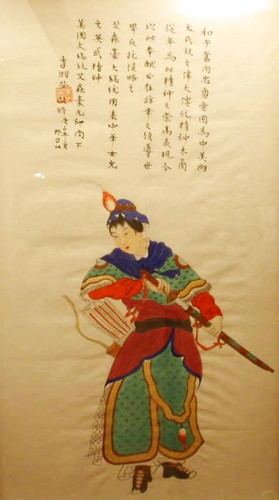
The Ballad of Hua Mulan

This poem was composed in the fifth or sixth century CE. At the time, China was divided between north and south. The rulers of the northern dynasties were from non-Han ethnic groups, most of them from Turkic peoples such as the Toba (Tuoba, also known as Xianbei), whose Northern Wei dynasty ruled most of northern China from 386–534. This background explains why the character Mulan refers to the Son of Heaven as “Khan” — the title given to rulers among the pastoral nomadic people of the north, including the Xianbei — one of the many reasons why the images conveyed in the movie “Mulan” of a stereotypically Confucian Chinese civilization fighting against the barbaric “Huns” to the north are inaccurate.

Tsiek tsiek and again tsiek tsiek,
Mulan weaves, facing the door.
You don’t hear the shuttle’s sound,
You only hear Daughter’s sighs.
They ask Daughter who’s in her heart,
They ask Daughter who’s on her mind.
“No one is on Daughter’s heart,
No one is on Daughter’s mind.
Last night I saw the draft posters,
The Khan is calling many troops,
The army list is in twelve scrolls,
On every scroll there’s Father’s name.
Father has no grown-up son,
Mulan has no elder brother.
I want to buy a saddle and horse,
And serve in the army in Father’s place.

In the East Market she buys a spirited horse,
In the West Market she buys a saddle,
In the South Market she buys a bridle,
In the North Market she buys a long whip.
At dawn she takes leave of Father and Mother,
In the evening camps on the Yellow River’s bank.
She doesn’t hear the sound of Father and Mother calling,
She only hears the Yellow River’s flowing water cry tsien tsien.

At dawn she takes leave of the Yellow River,
In the evening she arrives at Black Mountain.
She doesn’t hear the sound of Father and Mother calling,
She only hears Mount Yen’s nomad horses cry tsiu tsiu.
She goes ten thousand miles on the business of war,
She crosses passes and mountains like flying.
Northern gusts carry the rattle of army pots,
Chilly light shines on iron armor.
Generals die in a hundred battles,
Stout soldiers return after ten years.

On her return she sees the Son of Heaven,
The Son of Heaven sits in the Splendid Hall.
He gives out promotions in twelve ranks
And prizes of a hundred thousand and more.
The Khan asks her what she desires.
“Mulan has no use for a minister’s post.
I wish to ride a swift mount
To take me back to my home.”

When Father and Mother hear Daughter is coming
They go outside the wall to meet her, leaning on each other.
When Elder Sister hears Younger Sister is coming
She fixes her rouge, facing the door.
When Little Brother hears Elder Sister is coming
He whets the knife, quick quick, for pig and sheep.
“I open the door to my east chamber,
I sit on my couch in the west room,
I take off my wartime gown
And put on my old-time clothes.”
Facing the window she fixes her cloudlike hair,
Hanging up a mirror she dabs on yellow flower powder
She goes out the door and sees her comrades.
Her comrades are all amazed and perplexed.
Traveling together for twelve years
They didn’t know Mulan was a girl.
“The he-hare’s feet go hop and skip,
The she-hare’s eyes are muddled and fuddled.
Two hares running side by side close to the ground,
How can they tell if I am he or she?”


The Legend of Hua Mulan

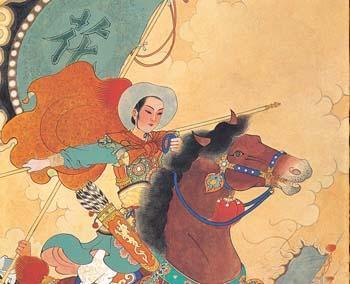
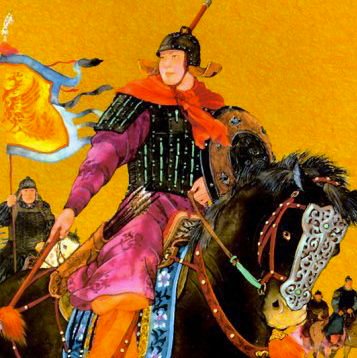
The name Hua Mulan has been synonymous with the word “heroine” for hundreds of years in Chinese society and culture. Disney’s 1998 animated film, “Mulan,” brought her name to a wider audience.

A historical figure famous for disguising herself as a man is Hua Mulan. Her name has long been synonymous with the word “heroine”, yet opinions differ as to whether this is her real name. According to Annals of the Ming, her surname is Zhu, while the Annals of the Qing say it is Wei. Xu Wei offers yet another alternative when, in his play, Mulan Joins the Army for Her Father, he gives her the surname Hua. Others using The Ballad of Mulan as their guide have attributed her surname to be Mu.

There is also some confusion concerning her place of origin and the era in which she lived. She is said by some to have come from the Wan County in Hebei, others believed she came from the Shangqiu province in Henan and a third opinion is that she was native of the Liang prefecture in Gansu. One thing seems certain though. Hua Mulan was from the region known as the Central Plains.

Cheng Dachang of the Song Dynasty recorded that Hua Mulan lived during the Sui and the Tang Dynasties. Song Xiangfeng of the Qing Dynasty asserted that she was of Sui origins (AD 581-618) while Yao Ying, also of the Qing Dynasty, believed she was from the time of the Six Dynasties. No record of her achievements appears in official history books prior to the Song times. Stories circulated in China’s Central Plains indicate that she must have lived before the Tang Dynasty.

Both history books and legends do at least agree on one thing – her accomplishments. It is said that Hua Mulan’s father received an order to serve in the army. He had fought before but, by this time, was old and infirm. Hua Mulan knew it was out of the question for her father to go and her only brother was much too young. She decided to disguise herself as a man and take her father’s place.

China’s most famous woman warrior lived and fought in the fifth century AD. Her father was conscripted to go to war, but he was too sick to fight, so Hua Mu-Lan offered to go in his place. Her father rejected the offer, but she insisted. She suggested they have a sword fight and if she won, she’d go. Mu-Lan won the fight.

She cut her hair, put on her father’s armor and joined the emperor’s troops using her father’s name. For over ten years, she fought as a man without her true identity being discovered.  The troops fought in many bloody campaigns before they obtained permission to return home. Her bravery at the front lines and extraordinary fighting skill so impressed her general that he offered this soldier his daughter’s hand in marriage. Somehow, the marriage never took place and Mu-Lan returned home and became herself again. Hua Mulan was summoned to the court by the emperor, who wished to appoint her to high office as a reward for her outstanding service. Hua Mulan declined his offer and accepted a fine horse instead.

Only later, when her former comrades in arms went to visit her, did they learn that she was a woman.  The story of Hua Mulan is well known and has provided much inspiration for poetry, essays, operas and paintings.

A play written in her honor, the Mu-Lan Play ends with the following lines:

She had much fighting ability, and could act the leader. Her body passed through one hundred battles, always at the front, and compared to the fiercest soldiers, she was still better.


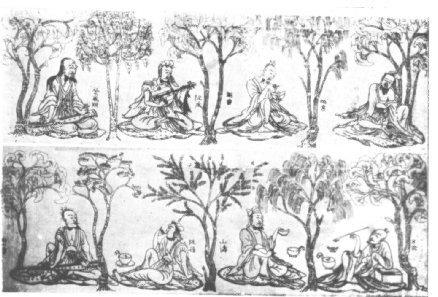
The Seven Sages of the Bamboo Grove

The Seven Sages of the Bamboo Grove

As is traditionally depicted, a certain group of seven scholar/musician/poets wishing to escape the intrigues, corruption and stifling atmosphere of court life during the politically fraught Three Kingdoms period of Chinese history habitually gathered in the obscurity of a bamboo grove near the house of Xi Kang in Shanyang (now in Henan province). Here they enjoyed practicing their works, and enjoying the simple, rustic life, always with too much Chinese alcoholic beverage (sometimes referred to as “wine”). This was contrasted with the theoretically and Confucian certified honorable and joyful duty of serving ones country; but, which at this time would have actually meant living (at least briefly) a life of attempting to perform governmental service amid the deadly dangerous political quagmires of the seats of power and changes of government. Rather than attempt to stay loyal to Wei through the rise of Jin by their active, personal involvement, the Seven Sages of the Bamboo Grove instead stressed the enjoyment of ale, personal freedom, spontaneity and a celebration of nature — together with political avoidance.

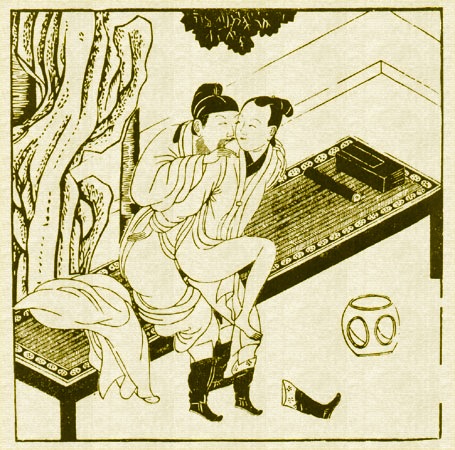
The complexity of homosexual relationships inevitably led to the creation of poetic works immortalizing conflicting sentiments. Ruan Ji is usually mentioned first among the Seven Sages of the Bamboo Grove. The other sages were Xi Kang his lover, Shan Tao, Liu Ling, Ruan Xian, Xiang Xiu, Wang Rong. They created an image of wise men enjoying life rather uninhibitedly, realizing the old dream of a Daoist concord of free men who are gifted with hidden wisdom “to be together, not being together” and “act jointly, not acting jointly”. The wine goblet, which became a symbol of being accustomed to “contemplating many wonders” pertaining to Daoism, united them even more than any principles. Ruan Ji talked in his works about “remote” things but about the “Bamboo Groove” he remained silent, although the group became the main focus of his searches for free and frank friendship.  Ruan Ji was one of the most famous poets to apply his brush to a homosexual theme. This work, one of several dealing with homosexuality from the “Jade Terrace,” a collection of love poetry, beautifully illustrates the stock imagery on which men of his time could draw in conceptualizing and describing love for another man.

In days of old there were many blossom boys —
An Ling and Long Yang.
Young peach and plum blossoms,
Dazzling with glorious brightness.
Joyful as nine springtimes;
Pliant as if bowed by autumn frost.
Roving glances gave rise to beautiful seductions;
Speech and laughter expelled fragrance.
Hand in hand they shared love’s rapture,
Sharing coverlcts and bedclothes.

Couples of birds in flight,
Paired wings soaring.
Cinnabar and green pigments record a vow:
“I’ll never forget you for all eternity. “


Westerners and Homosexuality in Asian

Recently, I was discussing with a close friend of mine, who happens to be of Chinese descent, about homosexuality in China. He told me that one of the interesting cultural views about homosexuality in Asia is that some non-western cultures, such as China, sometimes demonize homosexuality as an import of the West, and thus attack it from a nationalistic view. It happens in Asia and Africa -has mental contortionist’s outlook that seems bizarre by our standards — but basically, it’s if you like to be the receptive partner, then you are gay; but if you are a guy who is the active partner, then you are not considered gay.

What I found most interesting about this exchange is that in most non-western cultures, homosexuality is seen as an import from the West. The truth is that it is not the homosexuality that is an import from the West, but the homophobia that is the imported idea.

Early western observers, such as the Jesuit Matthew Ricci long noted the acceptance of homosexuality in China, but could do little to change it. In modern China, however, homosexuality is looked down on. Part of the reason for this was the huge impact made by the West from the 19th century on. After the impact of Buddhism, Western Science is the outside cultural force with the most impact on Chinese culture. Until recent years the full weight of this science depicted homosexuality as abnormal and evil.

Here is one British official’s view from 1806 [from John Barrow, Travels in China, (London: 1806)]:

The commission of this detestable and unnatural act is attended with so little sense of shame, or feelings of delicacy that many of the first officers of the state seemed to make no hesitation in publicly avowing it. Each of these officers is constantly attended by his pipe-bearer, who is generally a handsome boy, from fourteen to eighteen yaers of age, and is always well dressed.

Europeans, and the British especially (during the 19th century, the British were a major influence in China), brought the unnatural idea that homosexuality is wrong.  The eurocentric view of the world saw their way as the only legitimate way.  Countries which have been greatly influenced or ruled by the the British Empire currently have some of the harshest anti-sodomy laws.

An interesting caveat to this discussion is that in Vietnam, which had been a French colony, homosexual men are seen as good luck charms.  I found this out from a friend of mine who is from Vietnam and used to each year invite all of her friends over for a traditional Tet (Vietnamese Chinese New Year) dinner.  She was always particular fond of me because she knew I was gay and believed that by being there, I would bring good luck and great fortune to her family.  I think it worked.  Her husband who I went to graduate school with now has a prestigious job at a well-respected university’s Vietnam studies center.


Homosexuality in the Zhou Period

Discussion of homosexual behavior in Chinese literature referred back to three classic tales of love from the Zhou period, the Story of Mizi Xia, the Story of Pan Zhang, and the Story of Lord Long Yang.

The Story of Mizi Xia

As recorded in the Legalist philosophical work, Han Fei Tzu: Basic Writings, (New York: Columbia University Press, 1964), 78-79).

In ancient times Mizi Xia won favor [chang] with the ruler of Wei. According to the laws of the state of Wei, anyone who secretly made use of the ruler’s carriage was punished by having his feet amputated. When Mizi Xia’s mother fell ill, someone slipped into the palace at night to report this to Mizi Xia. Mizi Xia forged an order from the ruler, got into the ruler’s carriage, and went to see her, but when the ruler heard of it, he only praised him, saying, “How filial! For the sake of his mother he forgot all about the danger of having his feet cut off!” Another day Mizi Xia was strolling with the ruler in an orchard and, biting into a peach and finding it sweet, he stopped eating and gave the remaining half to the ruler to enjoy. “How sincere is your love for me!” exclaimed the ruler. “You forgot your own appetite and think only of giving me good things to eat!” Later, however, when Mizi Xia’s looks had faded and the ruler’s passion for him had cooled, he was accused at committing some crime against his lord. “After all,” said the ruler, “he once stole my carriage, and another time he gave me a half-eaten peach to eat!” Mizi Xia was acting no diffrently from the way he always had; the fact that he was praised in the early days and accused of crime later on, was because the ruler’s love had turned hate.

If you gain the ruler’s love, your wisdom will be appreciated; you will enjoy his favor as well; but if he hates you, not only will your wisdom be rejected, but you will be regarded as a criminal and thrust aside…. The beast called the dragon can be tamed and trained to the point where you may ride on its back. But on the underside of its throat it has scales a foot in diameter that curl back from the body, and anyone who chances to brush against them is sure to die. The ruler of men too has his bristling scales.”

The Story of Pan Zhang

When Pan Zhang was young he had a beautiful [mei] appearance and bearing, and so people of that time were exceedingly fond of him. Wang Zhongxian of the state of Chu heard of his reputation and came to request his writings. Thereafter Wang Zhongxian wanted to study together with him. They fell in love at first sight and were as affectionate as husband and wife, sharing the same coverlet and pillow with unbounded intimacy for one another.

Afterwards they died together and everyone mourned them. When they were buried together at Lofu Mountain, on the peak a tree with long branches and leafy twigs suddenly grew. All of these embraced one another! At the time people considered this a miracle. It was called the “Shared Pillow Tree.”‘

The Story of Lord Long Yang

The King of Wei and Lord Long Yang shared a boat while fishing. Lord Long Yang began to cry, so the King asked why he wept. “Because I caught a fish.”

“But why does that make you cry?” the king asked.

Lord Long Yang replied, “When I caught the fish, at first I was extremely pleased. But afterward I sought a larger fish, so I wanted to throw back the first fish I had caught. Because of this eveil act I will be expelled from your bed!”

“There are innumerable beauties in the world. Upon hearing of my receiving your favor, surely they will lift up the hems of their robes so that they can hasten to you. I am a previously caught fish! I will also be thrown back! How can I keep from crying?”

Because of this incident the King of Wei announced to the world “Anyone who dares speak of other beauties will be executed along with his whole family”.


The Gay Love Letters of Bo Juyi to Yuan Zhen and others

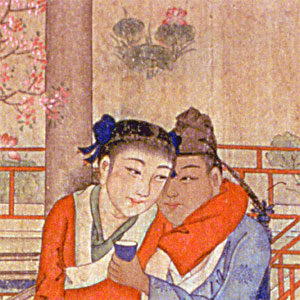
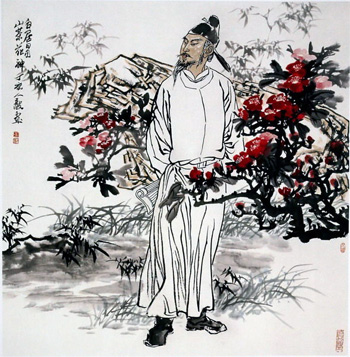
There is a very ancient and honorable homosexual literary tradition in China, and gay love poems are contained in the country’s earliest surviving anthology. Most gay men fulfilled their kinship interests (still the major factor in Chinese life today) by getting married, but they also maintained romantic homosexual affairs. The two major tropes for homosexual love – “sharing peaches”, and “the passion of the cut sleeve” – come from the story of Mizi Xia who gave a half-eaten peach to his lover Duke Ling of Wei (534–493 BC), and the story of how the Emperor Ai (reigned 6 BC to 1 AD) cut off his sleeve rather than wake his sleeping favorite Dong Xian. These ancient images demonstrate that male-to-male love rather than just sex was important for establishing a specifically gay identity, and how imaginative metaphors are at least as important as pejortive labels. For two hundred years the Han Dynasty was ruled by ten openly bisexual emperors, and detailed biographies were written about their favorites. During the Tang Dynasty, more records survive describing gay life and romantic friendship outside of imperial circles. The Chinese poet Bo Juyi (772–846) was one of the scholar-officials who served in the vast Chinese civil service, and became Governor of Suchow in 825. His fellow bureaucrats often were sent to provincial towns in the widespread empire, and he exchanged with them poems or verse-letters which are full of the expressions of romantic love. To his friend Qian Hui he sent a poetic souvenir of one winter night they spent together. His friend Yu Shunzhi sent him a bolt of patterned purple silk as a token of remembrance, and Bo Juyi replied how he would make this gift a symbol of their friendship. His greatest love was his fellow student Yuan Zhen (779–831). They were both Collators of Texts in the Palace Library at the northern imperial city of Ch’ang-an, and they exchanged intimate poetry for several decades when different careers separated them and Yuan Zhen was sent to the eastern city of Lo-yang. Bo Juyi wrote to his beloved,

Who knows my heart as I think of you?
It’s a captive falcon and a caged crane.

Even after a long separation – they both became commissioners in different provinces, and it could take almost a year for their letters to reach one another – Bo Juyi would sometimes dream that they were still together:

Awakening, I suspected you were at my side,
reached for you but there was nothingness.

Both poets got married; Yuan Zhen loved his wife but she died after only a few years; Bo Juyi’s wife “read no books” and he seems to have had no special intimacy with her; he built a cottage near a monastery where he would go to be alone. In his poem “Night Rain” (812) Bo Juyi speaks of his longing for Yuan Zhen:

There is one that I love in a far, far land;
There is something that harrows me, tied in the depths of my heart.
So Far is the land that I cannot visit him;
I can only gaze in longing, day on day.
So deep the sorrow that it cannot be torn away;
Never a night but I brood on it, hour, by hour.

In 814 Bo Juyi sent Yuan Zhan a sum of money equivalent to half a year’s salary,

Not that I thought you were bent on food and clothes,
But only because I felt tenderly towards you.

They were reunited briefly in 819, when both carved a poem on the rock outside a cave; they met again in 821–2 and in 829. The two men had made a pact to live together as Taoist recluses in their retirement, but Yuan Zhen died after a sudden illness before this plan could be put into effect. Bo Juyi wrote two formal dirges to recite at his beloved’s funeral and three songs for the pall-bearers to sing.

BO JUYI TO QIAN HUI     [early ninth century]

Night deep – the memorial draft finished;
mist and moon intense piercing cold.
About to lie down, I warm the last remnant of the wine;
we face before the lamp and drink.
Drawing up the green silk coverlets,
placing our pillows side by side;
like spending more than a hundred nights,
to sleep together with you here.

BO JUYI TO YU SHUNZHI

Thousand leagues, friend’s heart cordial;
one strand, fragrant silk purple resplendent.
Breaking the seal, it glistens
with a rose hue of the sun at eve –
The pattern fills in the width
of a breeze arising on autumnal waters.
About to cut it to make a mattress,
pitying the breaking of the leaves;
about to cut it to make a bag,
pitying the dividing of the flowers.
It is bettter to sew it,
making a coverlet of joined delight;
I think of you as if I’m with you,
day or night.

BO JUYI TO YUAN ZHEN     [805]

Since I left home to seek official state
Seven years I have lived in Ch’ang-an.
What have I gained? Only you, Yuan;
So hard it is to bind friendship fast. . . .
We did not go up together for Examination;
We were not serving in the same Department of State.
The bond that joined us lay deeper than outward things;
The rivers of our souls spring from the same well!

YUAN ZHEN TO BO JUYI     [816]

Other people too have friends that they love;
But ours was a love such as few friends have known.
You were all my sustenance; it mattered more
To see you daily than to get my morning food.
And if there was a single day when we did not meet
I would sit listless, my mind in a tangle of gloom.
To think we are now thousands of miles apart,
Lost like clouds, each drifting on his far way!
Those clouds on high, where many winds blow,
What is their chance of ever meeting again?
And if in open heaven the beings of the air
Are driven and thwarted, what of Man below?

BO JUYI TO YUAN ZHEN

Last night the clouds scattered everywhere,
for a thousand leagues the same moon color.
At dawn’s coming I saw you in dreams;
it must be you were thinking of me.
In my dream I grasped your hand,
asked you what your thoughts were.
You said you thought of me with pain,
had no one to send a letter through.

When I awoke, I still had not spoken in reply.
a knock-on-the-door sound, rap rap!
Saying, “A messenger from Shangzhou,”
he delivered a letter of yours.
From the pillow I rose sudden and startled,
putting on my clothes topsy-turvy.
I opened the seal, saw the hand-letter,
one sheet, thirteen lines.

SOURCE: Trans. Howard S. Levy, Translations from Po Chü-i’s Collected Works, 4 vols. (repr. New York, 1971); and Arthur Walley, The Life and Times of Po Chü-i (London: George Allen & Unwin, 1949).