Category Archives: Nudity

The Lover’s Story

A few weeks ago, I received an email from the poet Christopher Hennessy saying how much he appreciated my poetry posts.  Christopher asked if he could send me a copy of his first book of poetry Love-In-Idleness.  I was absolutely delighted and waited with eager anticipation to read his poetry.  I was not disappointed and found Christopher’s poetry to be quite moving.  The poem “The Lover’s Story” is one of my favorites.

The Lover’s Story
by Christopher Hennessy

Emperor Ai of the Han Dynasty, rather than wake his lover, asleep on his royal gown, cut the sleeve as proof of his devotion.

To trace my name onto his back
was enough to make him want me.
I needed only a push to the ground,
the choke of his panicked kiss.

Sleepily, I circled him, entranced,
then a languorous fall
to his feet to trail my tongue
ankle to waste,

the seduction concealed
under the robes. Blindness,
the perfect muscle of faith.
Imagining ourselves strangers.

After sex, I only pretended to sleep,
nesting in the folds of his robe.
Hidden in the sleeve—a purple sail.
I chewed my lip to keep awake,

fearing I might admit to a trust
in his love or a promise of mine.
Had I heard the rip as his teeth cut
into the robe’s silk, I’d have shouted:

Old Fool, you ruin your gown
for a delicate coward, for the hush
of your mouth on mine.
Or, had we not been so in love,

I could have whispered:
My emperor, make soft noises
as you leave, quick gasps of grief,
so I can hold myself to the dark.


Christopher Hennessy is the author of Outside the Lines: Talking with Contemporary Gay Poets(University of Michigan Press). He earned an MFA from Emerson College and currently is a Ph.D. candidate in English Literature at the University of Massachusetts-Amherst. He was included in Ploughshares’ special “Emerging Writers” edition, and his poetry, interviews, and book reviews have appeared in American Poetry ReviewVerseCimarron ReviewThe Writer’s Chronicle, The Bloomsbury ReviewCourt Green, OCHOCrab Orchard Review, Natural BridgeWisconsin Review, Brooklyn ReviewMemorious, and elsewhere. Hennessy is a longtime associate editor for The Gay & Lesbian Review-Worldwide.

Thank you, Christopher.


Moment of Zen: Cooking

I love to cook, not generally in the nude, but I love this picture nonetheless.  You can get lost in cooking and your worries go away.  Generally when I cook, especially things like the cookies I made the other night, I am cooking for other people, so I enjoy the joy they get out of eating what I made.  So that is my moment of Zen for today, because with the holidays, there will be lots of cooking going on around here.

Tait requested that I share the recipe for my pistachio/cherry cookies.  I first saw this recipe on a Food Network holiday cookie special, but have since made it enough times to make some adjustments of my own to them.  People always seem to love them.

Sugar Cookies with Pistachio and Dried Cherries
Prep Time:15 min
Inactive Prep Time:30 min
Cook Time:11 min

Ingredients
1 (8-ounce) roll refrigerated sugar cookie dough
1/2 cup pistachios, chopped
1/2 cup dried cherries, chopped
1 (11-ounce) bag white chocolate chips

Directions
Preheat the oven to 350 degrees F.

Open sugar cookie log and press into a rectangle on cutting board. Add pistachios and cherries, kneading/mixing into the dough, and refrigerate overnight. Using a cookie scoop or spoon, scoop out cookies and make a one inch ball of dough. Slightly press the ball to flatten the cookies a little. Transfer cookies to a baking sheet.

Bake 10 to 15 minutes, until golden around the edges. Transfer to wire racks to cool completely.

While cookies are cooling, melt white chocolate chips in a bowl over simmering water. (Microwaving for 1 min. 30 sec. on medium power gets this process working quicker. Then place bowl over simmering water to finish the melting process.)

When cookies are cool, dip bottom half of cookies into melted white chocolate and place on waxed or parchment paper to cool.

The green of the pistachios and the red of the dried cherries makes a wonderful Christmas themed cookie. To add a little more festivity to them, I often sprinkle some red and green nonpareil holiday sprinkles on the white chocolate before it hardens.

A nice variation to these is to use dried peaches and pecans instead of dried cherries and pistachios.  It gives them a totally different but very “Southern” flavor to them.


Now Winter Nights Enlarge

Now Winter Nights Enlarge
by Thomas Campion

Now winter nights enlarge
     This number of their hours;
And clouds their storms discharge
     Upon the airy towers.
Let now the chimneys blaze
     And cups o’erflow with wine,
Let well-tuned words amaze
     With harmony divine.
Now yellow waxen lights
     Shall wait on honey love
While youthful revels, masques, and courtly sights
     Sleep’s leaden spells remove.

This time doth well dispense
     With lovers’ long discourse;
Much speech hath some defense,
     Though beauty no remorse.
All do not all things well:
     Some measures comely tread,
Some knotted riddles tell,
     Some poems smoothly read.
The summer hath his joys,
     And winter his delights;
Though love and all his pleasures are but toys
     They shorten tedious nights.

Thomas Campion

Born in London on February 12, 1567, to John and Lucy Campion, Thomas Campion was a physician, a composer, and a poet. His parents died while he was a child, and at the age of fourteen he and a stepbrother were sent away to Cambridge. Campion did not earn a degree at Cambridge, but he came into contact with writers such as Thomas Nashe and Gabriel Harvey. In 1586, he enrolled at Gray’s Inn, a law school, where he performed in plays and masques. The facts of his life from this time until 1602 remain vague; in 1602 Campion entered the University of Caen and shortly thereafter, at the age of forty, took up a medical practice in London.
His first published works were five songs, which appeared in 1591. Campion’s first collection of poems, Thomae Campiani Poemata, was published in Latin in 1595. The book included over 129 epigrams as well as a number of elegies and an incomplete epic poem. The epigrams show Campion’s ability to draw a portrait in a few precise lines, and he would later publish 453 epigrams in Epigrammatum Libri II (1619). By 1597, Campion had focused his attention almost completely on writing the words and music for songs. In 1601, he contributed twenty-one songs, and a brief treatise on song, to the Philip Rosseter’s Book of Ayeres. Rosseter was the King James’ lutenist. Campion would publish four more books of ayeres, or solo songs, including Light Conceits of Lovers (1613), and The Third and Fourth Booke of Ayres (circa 1617). The lyrics in these books are distinguished by their fine musical quality; as Campion noted in the preface to one of his books, “I have chiefly aimed to couple my words and notes lovingly together.”
Campion’s book of prosody, Observations in the Art of English Posie, was published in 1602. In it, he explored the relationship of music and poetry, and warned against “the childish titillation of rhyming.” Campion also wrote a number of libretti for masques performed in King James’ court, including Lord Hay’s Masque (1607) and The Squire’s Masque (1614). These works, commissioned by King James, allowed Campion to associate with many of England’s artistic and aristocratic elite. Campion died on March 1, 1620, in London, probably of the plague, and was buried at St. Dunstan’s-in-the-West, Fleet Street. He never married and died with only twenty-three pounds to his name, which he left to his friend and collaborator, Philip Rosseter.

Exhausted

It’s been a good, but ultimately tiring week.  This is what I would rather be doing today than going to school, but at least there are only two more weeks before Christmas break.  I do want to thank all of you for your birthday wishes from Wednesday.  They really made my birthday special.  I always love hearing from you, so I will apologize for the short post today, there are more things in the works.


The Pumpkin by John Greenleaf Whittier

The Pumpkin
by John Greenleaf Whittier

Oh, greenly and fair in the lands of the sun,
The vines of the gourd and the rich melon run,
And the rock and the tree and the cottage enfold,
With broad leaves all greenness and blossoms all gold,
Like that which o’er Nineveh’s prophet once grew,
While he waited to know that his warning was true,
And longed for the storm-cloud, and listened in vain
For the rush of the whirlwind and red fire-rain.

On the banks of the Xenil the dark Spanish maiden
Comes up with the fruit of the tangled vine laden;
And the Creole of Cuba laughs out to behold
Through orange-leaves shining the broad spheres of gold;
Yet with dearer delight from his home in the North,
On the fields of his harvest the Yankee looks forth,
Where crook-necks are coiling and yellow fruit shines,
And the sun of September melts down on his vines.

Ah! on Thanksgiving day, when from East and from West,
From North and from South comes the pilgrim and guest;
When the gray-haired New Englander sees round his board
The old broken links of affection restored,
When the care-wearied man seeks his mother once more,
And the worn matron smiles where the girl smiled before,
What moistens the lip and what brightens the eye?
What calls back the past, like the rich Pumpkin pie?

Oh, fruit loved of boyhood! the old days recalling,
When wood-grapes were purpling and brown nuts were falling!
When wild, ugly faces we carved in its skin,
Glaring out through the dark with a candle within!
When we laughed round the corn-heap, with hearts all in tune,
Our chair a broad pumpkin,—our lantern the moon,
Telling tales of the fairy who travelled like steam
In a pumpkin-shell coach, with two rats for her team!

Then thanks for thy present! none sweeter or better
E’er smoked from an oven or circled a platter!
Fairer hands never wrought at a pastry more fine,
Brighter eyes never watched o’er its baking, than thine!
And the prayer, which my mouth is too full to express,
Swells my heart that thy shadow may never be less,
That the days of thy lot may be lengthened below,
And the fame of thy worth like a pumpkin-vine grow,
And thy life be as sweet, and its last sunset sky
Golden-tinted and fair as thy own Pumpkin pie!

In the poem “The Pumpkin” by 19th century poet John Greenleaf Whittier, the tradition of Thanksgiving is described as a time of remembrance and return, a celebration of abundance, both of sustenance and of love, at a family gathering. The poet depicts the scene sensually, packing each line with the fruits of a healthy harvest and the warmth of a kitchen sweet from baking. By the end of the poem, the words achieve an almost too-full splendor:

And the prayer, which my mouth is too full to express,
Swells my heart that thy shadow may never be less,
That the days of thy lot may be lengthened below,
And the fame of thy worth like a pumpkin-vine grow…

Having lived on a farm his entire life, Whittier offers his reader the plentiful harvest as a symbol of a productive year, evoking the historical origin of Thanksgiving as the meal held in 1621 by the Wampanoag together with the Pilgrims who settled in Plymouth, Massachusetts; the harvest festival was a shared tradition of both cultures, and the account of a peaceful celebration between the two groups is still the basis for the holiday today. While some of the elements of the story are myths that were consciously exaggerated in the 1890s and early 1900s in the hopes of forging a national identity in the aftermath of the Civil War, the core message of acceptance and commonality still remains for many celebrants.

SOURCES:


Moment of Zen: Reflection

A healthy social life is found only, when in the mirror of each soul the whole community finds its reflection, and when in the whole community the virtue of each one is living.

A little reflection will show us that every belief, even the simplest and most fundamental, goes beyond experience when regarded as a guide to our actions.

By three methods we may learn wisdom: First, by reflection, which is noblest; Second, by imitation, which is easiest; and third by experience, which is the bitterest.


A Day Off…


Thanatopsis

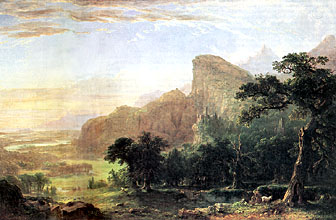
To commemorate All Saints Day and Día de los Muertos, I give you Thanatopsis by William Cullen Bryant.

THANATOPSIS
by: William Cullen Bryant (1794-1878)
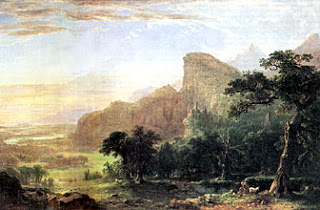
Asher Durand: “Scene from Thanatopsis” (1850)

O him who in the love of Nature holds
Communion with her visible forms, she speaks
A various language; for his gayer hours
She has a voice of gladness, and a smile
And eloquence of beauty, and she glides
Into his darker musings, with a mild
And healing sympathy, that steals away
Their sharpness, ere he is aware. When thoughts
Of the last bitter hour come like a blight
Over thy spirit, and sad images
Of the stern agony, and shroud, and pall,
And breathless darkness, and the narrow house,
Make thee to shudder and grow sick at heart;–
Go forth, under the open sky, and list
To Nature’s teachings, while from all around–
Earth and her waters, and the depths of air–
Comes a still voice–Yet a few days, and thee
The all-beholding sun shall see no more
In all his course; nor yet in the cold ground,
Where thy pale form was laid with many tears,
Nor in the embrace of ocean, shall exist
Thy image. Earth, that nourish’d thee, shall claim
Thy growth, to be resolved to earth again,
And, lost each human trace, surrendering up
Thine individual being, shalt thou go
To mix for ever with the elements,
To be a brother to the insensible rock,
And to the sluggish clod, which the rude swain
Turns with his share, and treads upon. The oak
Shall send his roots abroad, and pierce thy mould.

Yet not to thine eternal resting-place
Shalt thou retire alone, nor couldst thou wish
Couch more magnificent. Thou shalt lie down
With patriarchs of the infant world–with kings,
The powerful of the earth–the wise, the good,
Fair forms, and hoary seers of ages past,
All in one mighty sepulchre. The hills
Rock-ribb’d and ancient as the sun,–the vales
Stretching in pensive quietness between;
The venerable woods; rivers that move
In majesty, and the complaining brooks
That make the meadows green; and, pour’d round all,
Old Ocean’s grey and melancholy waste,–
Are but the solemn decorations all
Of the great tomb of man. The golden sun,
The planets, all the infinite host of heaven,
Are shining on the sad abodes of death,
Through the still lapse of ages. All that tread
The globe are but a handful to the tribes
That slumber in its bosom.–Take the wings
Of morning, pierce the Barcan wilderness,
Or lose thyself in the continuous woods
Where rolls the Oregon and hears no sound
Save his own dashings–yet the dead are there:
And millions in those solitudes, since first
The flight of years began, have laid them down
In their last sleep–the dead reign there alone.
So shalt thou rest: and what if thou withdraw
In silence from the living, and no friend
Take note of thy departure? All that breathe
Will share thy destiny. The gay will laugh
When thou art gone, the solemn brood of care
Plod on, and each one as before will chase
His favourite phantom; yet all these shall leave
Their mirth and their employments, and shall come
And make their bed with thee. As the long train
Of ages glides away, the sons of men,
The youth in life’s green spring, and he who goes
In the full strength of years, matron and maid,
The speechless babe, and the gray-headed man–
Shall one by one be gathered to thy side
By those who in their turn shall follow them.

So live, that when thy summons comes to join
The innumerable caravan which moves
To that mysterious realm where each shall take
His chamber in the silent halls of death,
Thou go not, like the quarry-slave at night,
Scourged by his dungeon; but, sustain’d and soothed
By an unfaltering trust, approach thy grave,
Like one who wraps the drapery of his couch
About him, and lies down to pleasant dreams.

William Cullen Bryant

(born Nov. 3, 1794, Cummington, Mass., U.S. — died June 12, 1878, New York, N.Y.) U.S. poet. At age 17 Bryant wrote “Thanatopsis,” a meditation on nature and death that remains his best-known poem; influenced by deism, it in turn influenced Ralph Waldo Emerson and Henry David Thoreau. Admitted to the bar at age 21, he spent nearly 10 years as an attorney, a profession he hated. His Poems (1821), including “To a Waterfowl,” secured his reputation. In 1825 he moved to New York City, where for almost 50 years (1829 – 78) he was editor in chief of the Evening Post, which he transformed into an organ of progressive thought.



Moment of Zen: Flaunt

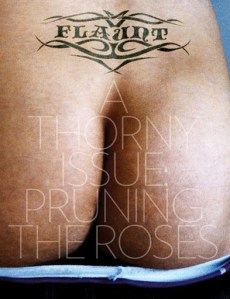
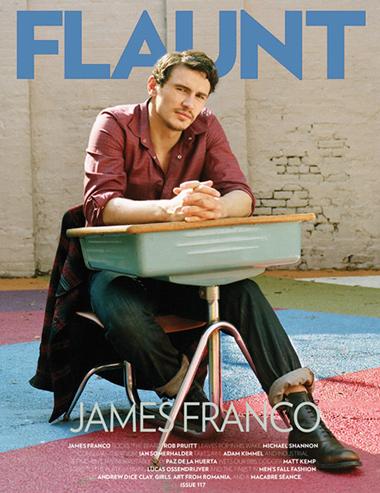
James Franco continues to be one of the most unusual, unpredictable and random A-list actors in Hollywood. From producing gay-themed art films and starring in a music video with Kalup Linzy to enrolling in something like 100 college graduate courses, the guy is not only a creative energizer bunny, but an odd one at that.

Franco’s latest uncharted turn is both shocking and not-so-shocking, considering the era we live in. The shocking part is that a recent Oscar-nominee would agree to have a close up photo of his naked bum grace the cover of Flaunt, the Los Angeles-based fashion magazine. That’s right kids; you can go out and purchase a close to life-size photo of Franco’s sweet cheeks, ready for framing or sleeping with under your pillow. The not-so-shocking part is that we live in a world where we’ve seen paparazzi photos of Britney and Lindsay’s naughty bits and sex tapes of Kim Kardarshian, Paris Hilton, Eric Dane and more. At this point in time, a 2-D picture of an actor’s butt seems almost…well, family friendly.

GAY.NET: JAMES FRANCO’S NAKED BUTT SCORES A MAGAZINE COVER BY: MICHAEL MATSON 10.27.2011


Moment of Zen: Contemplation