Category Archives: Poetry

To Jake

To Jake
by Eunice Tietjens

You are turned wraith. Your supple, flitting hands,
As formless as the night wind’s moan,
Beckon across the years, and your heart’s pain
Fades surely as a stainèd stone.

And yet you will not let me rest, crying
And calling down the night to me
A thing that when your body moved and glowed,
Living, you could not make me see.

Lean down your homely, mist-encircled head
Close, close above my human ear,
And tell me what of pain among the dead—
Tell me, and I will try to hear.


Gulls

Gulls
by Leonora Speyer

Fearless riders of the gale,
In your bleak eyes is the memory
Of sinking ships:
Desire, unsatisfied,
Droops from your wings.

You lie at dusk
In the sea’s ebbing cradles,
Unresponsive to its mood;
Or hover and swoop,
Snatching your food and rising again,
Greedy,
Unthinking.

You veer and steer your callous course,
Unloved of other birds;
And in your soulless cry
Is the mocking echo
Of woman’s weeping in the night.


Pic of the Day

Pic of the Day


Too Darn Hot

Too Darn Hot

It’s too darn hot

It’s too darn hot

I’d like to sup with my baby tonight

Refill the cup with my baby tonight

I’d like to sup with my baby tonight

Refill the cup with my baby tonight

But I ain’t up to my baby tonight

‘Cause it’s too darn hot

It’s too darn hot

It’s too darn hot

I’d like to coo with my baby tonight

And pitch the woo with my baby tonight

I’d like to coo with my baby tonight

And pitch the woo with my baby tonight

But brother, you fight my baby tonight

‘Cause it’s too darn hot

According to the Kinsey Report, ev’ry average man you know

Much prefers his lovey-dovey to court

When the temperature is low

But when the thermometer goes ‘way up

And the weather is sizzling hot

Mister, pants for romance is not

‘Cause it’s too, too, too darn hot

It’s too darn hot

It’s too, too darn hot

I’d like to coo with my baby tonight

And pitch the woo with my baby tonight

I’d like to coo with my baby tonight

And pitch the woo with my baby tonight

But brother, you fight my baby tonight

‘Cause it’s too darn hot

According to the Kinsey Report, ev’ry average man you know

Much prefers his lovey-dovey to court

When the temperature is low

But when the thermometer goes ‘way up

And the weather is sizzling hot

Mr. Gob for his squab

A marine for his queen

A G.I. for his cutie-pie is not

‘Cause it’s too, too, too darn hot

It’s too darn hot

It’s too darn hot

It’s too darn hot

It’s too darn hot

It’s too darn hot

Songwriter: Cole Porter


Coastal Plain

Coastal Plain
by Kathryn Stripling Byer

The only clouds
forming are crow clouds,

the only shade, oaks
bound together in a tangle of oak

limbs that signal the wind
coming, if there is any wind

stroking the flat
fields, the flat

swatch of corn.
Far as anyone’s eye can see, corn’s

dying under the sky
that repeats itself either as sky

or as water
that won’t remain water

for long on the highway: its shimmer
is merely the shimmer

of one more illusion that yields
to our crossing as we ourselves yield

to our lives, to the roots
of our landscape. Pull up the roots

and what do we see but the night
soil of dream, the night

soil of what we call
home. Home that calls

and calls
and calls.


Humdrum

Humdrum
by Carl Sandburg

If I had a million lives to live
and a million deaths to die
in a million humdrum worlds,

I’d like to change my name
and have a new house number to go by
each and every time I died
and started life all over again.

I wouldn’t want the same name every time
and the same old house number always,
dying a million deaths,
dying one by one a million times:
—would you?
or you?
or you?


The Robin

The Robin
by Witter Bynner

Except within poetic pale
I have not found a nightingale,
Nor hearkened in a dusky vale
To song and silence blending;
No stock-dove have I ever heard,
Nor listened to a cuckoo-bird,
Nor seen a lark ascending.
But I have felt a pulse-beat start
Because a robin, spending
The utmost of his simple art
Some of his pleasure to impart
While twilight came descending,
Has found an answer in my heart,
A sudden comprehending.


Ozymandias

Ozymandias
Percy Bysshe Shelley, 1792 – 1822

I met a traveller from an antique land
Who said: “Two vast and trunkless legs of stone
Stand in the desert . . . Near them, on the sand,
Half sunk, a shattered visage lies, whose frown,
And wrinkled lip, and sneer of cold command,
Tell that its sculptor well those passions read
Which yet survive, stamped on these lifeless things,
The hand that mocked them, and the heart that fed:
And on the pedestal these words appear:
‘My name is Ozymandias, king of kings:
Look on my works, ye Mighty, and despair!’
Nothing beside remains. Round the decay
Of that colossal wreck, boundless and bare
The lone and level sands stretch far away.”

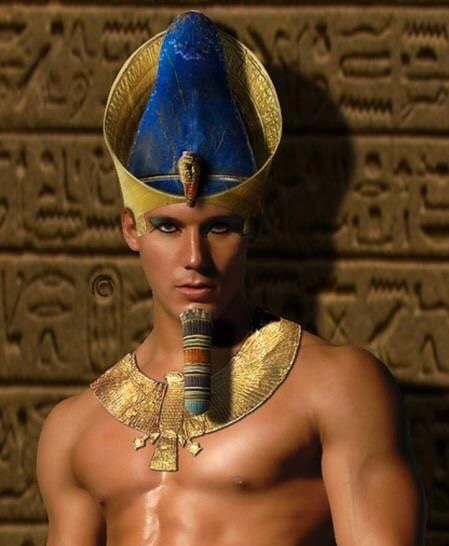
In antiquity, Ozymandias (Ὀσυμανδύας) was a Greek name for the Egyptian pharaoh Ramesses II. Shelley began writing his poem in 1817, soon after the announcement of the British Museum’s acquisition of a large fragment of a statue of Ramesses II from the thirteenth century BC, leading some scholars to believe that Shelley was inspired by this. The 7.25-ton fragment of the statue’s head and torso had been removed in 1816 from the mortuary temple of Ramesses at Thebes by Italian adventurer Giovanni Battista Belzoni. It was expected to arrive in London in 1818, but did not arrive until 1821. Shelley wrote the poem in friendly competition with his friend and fellow poet Horace Smith (1779–1849), who also wrote a sonnet on the same topic with the same title. Smith’s poem was published in The Examiner a few weeks after Shelley’s sonnet. Both poems explore the fate of history and the ravages of time: even the greatest men and the empires they forge are impermanent, their legacies fated to decay into oblivion.

Ozymandias
Horace Smith, 1779-1849

In Egypt’s sandy silence, all alone,
Stands a gigantic Leg, which far off throws
The only shadow that the Desart knows:-
‘I am great OZYMANDIAS,’ saith the stone,
‘The King of Kings; this mighty City shows
‘The wonders of my hand.’- The City’s gone,-
Nought but the Leg remaining to disclose
The site of this forgotten Babylon.

We wonder,-and some Hunter may express
Wonder like ours, when thro’ the wilderness
Where London stood, holding the Wolf in chace,
He meets some fragment huge, and stops to guess
What powerful but unrecorded race
Once dwelt in that annihilated place.

A central theme of “Ozymandias” is the inevitable decline of leaders of empires and their pretensions to greatness. The name “Ozymandias” represents a rendering in Greek of a part of Ramesses’ throne name, User-maat-re Setep-en-re. The sonnet paraphrases the inscription on the base of the statue, given by Diodorus Siculus in his Bibliotheca historica as “King of Kings am I, Ozymandias. If anyone would know how great I am and where I lie, let him surpass one of my works.”


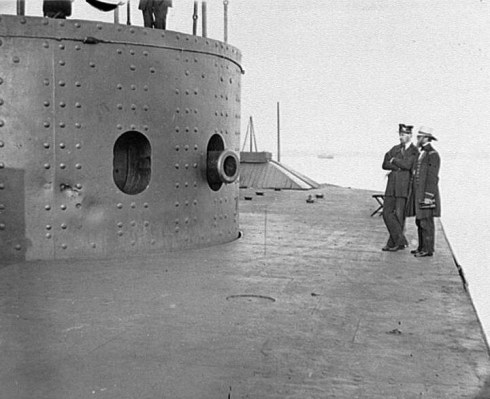
A Utilitarian View of the Monitors Fight

A Utilitarian View of the Monitors Fight.
by Herman Mellville

Plain be the phrase, yet apt the verse,
More ponderous than nimble;
For since grimed War here laid aside
His Orient pomp, ‘twould ill befit
Overmuch to ply
The Rhyme’s barbaric cymbal.

Hail to victory without the gaud
Of glory; zeal that needs no fans
Of banners; plain mechanic power
Plied cogently in War now placed —
Where War belongs —
Among the trades and artisans.

Yet this was battle, and intense —
Beyond the strife of fleets heroic;
Deadlier, closer, calm ‘mid storm;
No passion; all went on by crank,
Pivot, and screw,
And calculations of caloric.

Needless to dwell; the story’s known.
the ringing of those plates on plates
Still ringeth round the world —
The clangor of that blacksmith’s fray.
The anvil-din
Resounds this message from the Fates:

War shall yet be, and to the end;
But war-paint shows the streaks of weather;
War yet shall be, but warriors
Are now but operatives; War’s made
Less grand than Peace,
And a singe runs through lace and feather.


A Tempest in a Teacup

A Tempest in a Teacup
by A. Van Jordan

Prospero

Assume, just for a moment,
I am denied a job
in the factory of my dreams
under the fluorescent lights
of a porcelain white foreman.

It’s orderly and neat.
I feed my family.
No one questions my face.
I raised my son in my likeness,
so he would never go unseen,

bobbing on a wave of expectation,
I set in motion with my back
put into my work, praying
for my country, blessed
with more of me, never worrying

about those who might die,
or those who did, trying
to stir a storm, trying
to stand where I’m standing.

About This Poem

“This poem is part of a series of poems in which characters from The Tempest become composite characters who wrestle with the tensions around how we talk about race today, particularly when that talk is gendered. Prospero represents the older, straight white male who fears the cultural shift in America, without seeing the benefits of that shift both for America and even for himself.”
—A. Van Jordan

A. Van Jordan is the author of four poetry collections, including The Cineaste (W. W. Norton, 2013). A professor of English and literature at the University of Mich