Category Archives: Religion

We Are All Children of God

It’s so easy to get wrapped up in all the details of being a Christian.  There are theological issues to resolve, questions we don’t have answers to, and disagreements that have existed since the beginning.  Sometimes, it’s easy to miss the forest for the trees.

So this week, let’s step back and get back to the basics.

If you’re frustrated in your life, confused by issues, or way too busy for your own good, take a moment to relax.  Take a deep breath.  Ask God for a refreshing spiritual breeze in your life.

Then read the following two passages for a reminder of why we’re Christians.

1 John 4:7-19
Beloved, jet us love one another, for love is from God, and whoever loves has been born of God and knows God. Anyone who does not love does not know God, because God is love. In this the love of God was made manifest among us, that God sent his only Son into the world, so that we might live through him. In this is love, not that we have loved God but that he loved us and sent his Son to be the propitiation for our sins. Beloved, if God so loved us, we also ought to love one another. No one has ever seen God; if we love one another, God abides in us and his love is perfected in us.
By this we know that we abide in him and he in us, because he has given us of his Spirit. And we have seen and testify that the Father has sent his Son to be the Savior of the world. Whoever confesses that Jesus is the Son of God, God abides in him, and he in God. So we have come to know and to believe the love that God has for us. God is love, and whoever abides in love abides in God, and God abides in him. By this is love perfected with us, so that we may have confidence for the day of judgment, because as he is so also are we in this world. There is no fear in love, but perfect love casts out fear. For fear has to do with punishment, and whoever fears has not been perfected in love. We love because he first loved us.

1 John 3:1-3 
See what kind of love the Father has given to us, that we should be called children of God; and so we are. The reason why the world does not know us is that it did not know him. Beloved, we are God’s children now, and what we will be has not yet appeared; but we know that when he appears we shall be like him, because we shall see him as he is. And everyone who thus hopes in him purifies himself as he is pure.
You are a child of God.

May that be the single thing that sticks in your mind as you tackle whatever life throws at you this week.

God loves you, exactly as you are.  So take that love and share it!


Forgiveness and Homosexuality

Matthew 6:14-15 (ESV)

For if you forgive others their trespasses, your heavenly Father will also forgive you, but if you do not forgive others their trespasses, neither will your Father forgive your trespasses.

Gay people do not need to be forgiven for just being gay any more than straight people need to be forgiven for just being straight. Homosexuality is not in opposition to Christian values. Homophobia and the systemic abuse and oppression of gay, lesbian, bisexual, and trans-identified people is opposed to basic Christian values. 

When it comes to sexual orientation, forgiveness is important to the both the gay and straight communities. The level of anger around topics related to homosexuality is harming both straight and gay people. A load of anger can make people bitter and can harm people’s health. Through forgiveness people can find true peace and healthy spirituality.

Forgiveness is not amnesia. When we forgive somebody, we do not forget the past. In fact, forgetting the past can be the wrong thing to do. We can learn important life lessons from the times we’ve been hurt. The gay community should not forget terrible acts that governments, legislators, courts, police, churches and individuals have committed. Forgetting the past could place one at risk of not learning history’s lessons. To forgive somebody is to decide not to hurt a person back after the individual hurt you. Forgiveness is not something one only needs to do once. You need to forgive every single time the desire to hurt back returns.

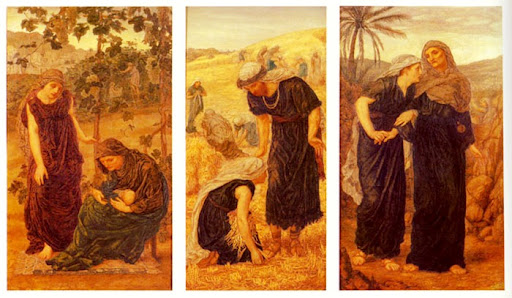
Ruth’s Loyalty

Ruth 1:16-17 (KJV)

16 And Ruth said, Intreat me not to leave thee, or to return from following after thee: for whither thou goest, I will go; and where thou lodgest, I will lodge: thy people shall be my people, and thy God my God:
17 Where thou diest, will I die, and there will I be buried: theLord do so to me, and more also, if ought but death part thee and me.
The Book of Ruth is one of the Bible’s shortest books, telling its story in only 4 chapters. Its main character is a Moabite woman named Ruth, the daughter-in-law of a Jewish widow named Naomi. It’s an intimate family tale of misfortune, crafty use of kinship ties, and ultimately, loyalty.

Not only is the Book of Ruth short, it’s in an odd place, since it interrupts the grand sweep of history found in the books around it. These “history” books include Joshua, Judges, Ruth, 1-2 Samuel1-2 Kings, 1-2 Chronicles, Ezra, and Nehemiah. They’re called the Deuteronomistic History because they all share theological principles expressed in the Book of Deuteronomy. Specifically, they’re based on the idea that God had direct, intimate relationships with the descendants of Abraham, the Jews, and was involved directly in shaping Israel’s history.

So what about Ruth?

So how does the protagonist of the Book of Ruth become an important ancestor of David and Jesus? In brief, her story goes like this:
During a famine, a man named Elimelech took his wife Naomi and their two sons, Mahlon and Chilion, east from their home in Bethlehem in Judea to a country called Moab. After their father’s death, the sons married Moabite women named Orpah and Ruth. They lived together for about 10 years until both Mahlon and Chilion died, leaving their mother Naomi to live with her daughters-in-law.
Hearing that the famine was over in Judah, Naomi decided to return to her home, and she urged her daughters-in-law to return to their own mothers in Moab. After much dispute, Orpah acceded to her mother-in-law’s wishes and left her, weeping. But the Bible says Ruth “clung to” Naomi and uttered now-famous words: “Where you go I will go; where you lodge, I will lodge; your people shall be my people, and your God my God” (Ruth 1:16).
Once they reach Bethlehem, Naomi and Ruth seek food by gleaning grain from the field of a kinsman of Naomi’s named Boaz. As they do so, Boaz sees Ruth gleaning, so he introduces himself and tells her that his workers will protect her and share their provisions with her. Ruth thanks Boaz, but then she questions why she, a foreigner, should receive such kindness. Boaz replies that he has learned of Ruth’s faithfulness to her mother-in-law, and then he prays the God of Israel to bless Ruth for her loyalty.
Hearing of Boaz’s interest in Ruth, Naomi then contrives to get Ruth married to Boaz by invoking her kinship with him. She sends Ruth to Boaz at night to offer herself to him, but Boaz, being an upright man, refuses to take advantage of her. Instead he helps Naomi and Ruth negotiate some rituals of inheritance, after which Boaz marries Ruth. Soon they have a son, Obed, who fathered a son named Jesse, who was the father of David, who became king of a unified Israel.

The Reasons Behind the Story

Ultimately, the reasons behind the story of Ruth are twofold. First, unlike the books of Ezra and Nehemiah that demanded Jews divorce foreign wives, Ruth shows that outsiders who profess faith in Israel’s God can be fully assimilated into Jewish society. The Book of Ruth’s original placement next to Ezra and Nehemiah would have served to emphasize how petty and short-sighted a policy of racial purity would have been for the Jews.
Second, and more important, Ruth becomes the great-grandmother of Israel’s heroic king, David. This means that not only could a foreigner be completely assimilated, but he or she might be God’s instrument for some higher good. Thus the Book of Ruth becomes one of the first calls for universality rather than tribalism in Judaism.
The latter concept also lies behind connecting the ancestry of Jesus to the House of David. David was Israel’s greatest hero, a messiah (god-sent leader) in his own right. Jesus’ lineage from David’s family in both blood through his mother Mary and legal kinship through his foster father Joseph gave him royal credence among his followers as the messiah who would liberate the Jews. Thus for Christians, the Book of Ruth represents an early sign that the Messiah would liberate all of humankind, not solely the Jews.
Her story is one that continues to inspire Jewish and Christian believers today. It has always been an inspiration to me. As LGBT Christians, we are often seen as outsiders, just as Ruth was because she was a Moabite; however, our loyalty to God and our faith is what liberates us.

Sources
The New Oxford Annotated Bible with Apocrypha, New Revised Standard Version (Oxford University Press, 1994).
The Jewish Study Bible, TANAKH Translation (Oxford University Press, 2004).
Isaac Asimov’s Guide to the Bible, The Old and New Testaments (Avenel Books, 1981).

Bullying Hurts…

We are having a problem at the school where I teach with bullying. As someone who,was unmercifully bullied in school, I believe in a zero tolerance policy. However, with the current situation it’s becoming clear that though one of the bullies has been suspended and the decision about expulsion is pending, students are beginning to stand up for the bully and ostracize the bullied, which I believe is further bullying. I just don’t know what the solution is.  Whereas, I think the policy should be zero tolerance, i.e. bullies should be expelled, those who are being bullied are still facing more problems with other forms of bullying. How do I protect these kids? I’m not the only one fighting this fight, but we have to reach these kids somehow so that we can stop this hatred and bullying.
I keep thinking of the Bible for solutions.  We are a Christian school and most of the students would profess to being good Christians, but I think they are lost lambs.  So I have been mulling over the following verses from the Bible. All of the following verses are from the King James Version of the Bible.

Matthew 22:36-40 Master, which is the great commandment in the law? Jesus said unto him, Thou shalt love the Lord thy God with all thy heart, and with all thy soul, and with all thy mind. This is the first and great commandment. And the second is like unto it, Thou shalt love thy neighbour as thyself. On these two commandments hang all the law and the prophets. 

Matthew 7:12 Therefore all things whatsoever ye would that men should do to you, do ye even so to them: for this is the law and the prophets. 

Luke 6:31 And as ye would that men should do to you, do ye also to them likewise. 

Galatians 5:14 For all the law is fulfilled in one word, even in this; Thou shalt love thy neighbour as thyself.

I am attending a conference tomorrow on the subject of bullying (it came at an appropriate and opportune time).  Maybe it will provide some answers.  Any advice?

Positive Gay Christianity

Joshua 1:9 (KJV) 
Have not I commanded thee? Be strong and of a good courage; be not afraid, neither be thou dismayed: for the Lord thy God is with thee whithersoever thou goest.
Strength and courage aren’t always that easy to find. Sometimes we’d rather crawl in a hole than deal with the things going on in our lives. Yet, God tells us that He will provide us with the strength to deal with anything. He commands that we face the difficult things in our lives, and He encourages us to rely on His strength to get us through.

There are so many things we face each day that bring about fear in varying levels. One of the things that we fear the most is change. Some of you may have just come out and are struggling with your faith, and it can be very daunting. Will you be able to handle the contradictions you’ve been taught? Will you allow yourself to realize that God’s love for you is what really matters, not the misguided interpretations of God’s word by so many mainstream churches?  Will other gay people accept you? Will you proudly stand and say, “I am Christian, and I am gay?” God tells us that He will be with us through it all. Sometimes we face these fears because God has more for us to do and learn. When we lean on His strength, He only makes us stronger through the sometimes difficult process. Remember Phillippians 4:13, “I can do all things through Christ which strengtheneth me.” Through Christ we can be positive gay Christians.


What are Positive Gay Christians?  We are:


  • are are comfortable with being gay, lesbian, bisexual, or trans-identified
  • are comfortable with being Christian
  • see no contradiction between being queer and Christian
  • are not consumed with defending their identity
  • are future focused
  • know God loves them
  • love themselves
  • are living for God
  • believe they are worthwhile and worthy of being loved
  • see themselves as having control over their lives

  • Are you a positive gay Christian?

    Jesus’ personality test: What kind of seed are you?

    Mark 4:1-20 (NASB)

    Parable of the Sower and Soils

    He began to teach again by the sea. And such a very large crowd gathered to Him that He got into a boat in the sea and sat down; and the whole crowd was by the sea on the land.And He was teaching them many things in parables, and was saying to them in His teaching, “Listen to this! Behold, the sower went out to sow; as he was sowing, some seedfell beside the road, and the birds came and ate it up. Otherseed fell on the rocky ground where it did not have much soil; and immediately it sprang up because it had no depth of soil. And after the sun had risen, it was scorched; and because it had no root, it withered away. Other seed fell among the thorns, and the thorns came up and choked it, and it yielded no crop. Other seeds fell into the good soil, and as they grew up and increased, they yielded a crop and produced thirty, sixty, and a hundredfold.” And He was saying, He who has ears to hear, let him hear.”

    10 As soon as He was alone, His followers, along with the twelve, began asking Him about the parables. 11 And He was saying to them, “To you has been given the mystery of the kingdom of God, but those who are outside get everything in parables, 12 so that while seeing, they may see and not perceive, and while hearing, they may hear and not understand, otherwise they might return and be forgiven.”

    Explanation

    13 And He said to them, “Do you not understand this parable? How will you understand all the parables? 14 The sower sows the word. 15 These are the ones who are beside the road where the word is sown; and when they hear, immediately Satan comes and takes away the word which has been sown in them. 16 In a similar way these are the ones on whom seed was sown on the rocky places, who, when they hear the word, immediately receive it with joy;17 and they have no firm root in themselves, but are onlytemporary; then, when affliction or persecution arises because of the word, immediately they fall away. 18 And others are the ones on whom seed was sown among the thorns; these are the ones who have heard the word, 19 but the worries of the world, and the deceitfulness of riches, and the desires for other things enter in and choke the word, and it becomes unfruitful. 20 And those are the ones on whom seed was sown on the good soil; and they hear the word and accept it and bear fruit, thirty, sixty, and a hundredfold.”

    Do you ever take those online personality tests, the ones where you answer a few questions and find out which TV character you are, or which color represents you?  If so, here’s your chance to categorize yourself once more!  Anytime Jesus divides humanity up into categories, the first thing we ought to wonder is, “which one am I?”
    So take a moment to think about your life and see which one of these descriptions fits you best.  Which seed are you?
    The Path Seed – Although you may have grown up in a Christian environment, God’s word never really took root in your life.  “Christian” has always been more of a social label than a spiritual one, if you even consider yourself Christian at all.  And while you might go to church and visit Christian websites (like this one), you don’t really feel very connected to God.  In fact, if you’re honest with yourself, you’re life’s not that different from how it would be if you weren’t a Christian.  Whatever that passion is that some people have about Christ, that’s not something you’ve experienced firsthand.
    The Rocky Seed – You wanna talk about passion?  You’ve got it, baby!  At least sometimes.  You really love God, and you’re totally on fire for Christ… as long as you’re around other Christians.  The trouble is, when it comes to taking difficult stands, you’ve never been very good at that.  You cave into pressure.  A lot.  You’re not the kind of person to talk about Jesus around your non-Christian friends, and you’re ashamed to admit that you don’t really act like a Christian when you’re around them either.  You want to do better, and you know that you should, but it’s just so hard.
    The Thorny Seed – No doubt about it, you’re a Christian.  And all in all, you’re a pretty decent human being.  You’re not perfect, but who is?  To be honest, you know you ought to spend more time with God, having quiet times and Bible studies, and you really do plan to do that sometime.  If only you weren’t so busy.  You’ve got a lot of stuff going on right now, and a lot of things on your mind.  You do pray, but mostly quick prayers at certain times of the day or as needs arise.  And your Bible has a bit of a tendency to gather dust in between readings.  But it’s not like you’re not a committed Christian, because you really are.  You just get, well, a little distracted.  There’s school and work and money issues and relationships and health and recreation and before you know it, the day’s over and you never got around to those things you meant to do for God.  One of these days, though…
    The Fruitful Seed – A relationship with God isn’t just something you talk about; it’s something you experience.  Every day.  And it’s amazing.  You make time for God every day, often having long, intimate conversations that leave you feeling refreshed.  You study the Bible regularly, and you’re always learning new things during that time.  More importantly, you put what you learn into practice.  God’s love and truth shine through you in a way that even your enemies can’t deny.  And you’re making a difference for the kingdom of God, something that could accurately be called even a hundred times greater than the seed that was sown in you.
     So, which one is you?  Be honest with yourself. To be honest with you, I am more of a thorny seed trying to be a fruitful seed.

    Are there things God wants you to change in your life to make it more fruitful?  If so, what steps do you need to take to make those changes?
    Will you make them?


    Jesus Was a Capricorn

    Jesus was a Capricorn
    He ate organic food
    He believed in love and peace
    and never wore no shoes.
    Long hair, beard and sandals
    And a funky bunch of friends
    Reckon we’d just nail him up
    If he came down again

    Kris Kristofferson

    I have to admit that I agree with many of Kris Kristofferson’s sentiments on the subject of Jesus and honestly, I started thinking about what would Jesus be like if he came back to earth today. A few years ago, one of the big things was WWJD? bracelets. Christians were challenged to ask themselves “What would Jesus do?” and sadly for too many of them, it was not unconditional love and acceptance.  Would Jesus discriminate as so many Christians do today, especially against those who are different (that is , unless you are a Christian Republican and now have decided for the first time in your religious history to believe that Mormons are Christians just like you)?  Instinctively, we all sense that the answer must be a resounding No!  Yet we live in a time when many churches are leading the effort to deny gay and transgender people equal protection under the law.  Since so many churches are invoking the name of Jesus to justify their assault on the rights of gay and transgender people, I invite thoughtful people everywhere to ask this simple question:

    What would Jesus do?

    The answer is not hard to find.  One of the themes of Jesus’ ministry was a recurring conflict with the Pharisees, a powerful group of legalistic religious leaders.  The Pharisees were waiting for the Messiah to come, and they believed that would happen only when their entire nation became righteous.  So, in their minds, anyone who failed to follow their particular set of rules was bringing down a curse on their nation and worthy of contempt.

    Sound familiar?  I see the same type of attitude and arguments from the Christian conservatives, who increasingly are becoming the voice of the Republican Party.

    The list of people despised by the Pharisees was long:

    • The Samaritans were considered religious heretics and ethnically impure. 
    • Sick people were believed to be sinners whom God was punishing. 
    • Women were deemed unworthy of discipleship. 
    • Tax collectors and Roman soldiers were regarded as the enemy. 
    • The poor, who had neither the time nor resources to maintain rigorous rites of religious purity, were thought to be beyond God’s grace. 

    The list of people despised by Republicans is even longer.

    Jesus emphatically rejected each one of these prejudices as I believe he would the prejudices in the world of today.  You can read the stories yourself in your own Bible.  E.g., John 4:1-42; Luke 10:29-37; John 9:1-34; Luke 8:1-3; Matthew 11:16-19; Matthew 5:38-48; and Matthew 9:18-26. 

    A classic example is provided in Matthew 8.   There, a Roman soldier asked Jesus to heal his “pais.”  This is a Greek term often used in ancient times to refer to a servant who was his master’s same-sex partner.  [K.J. Cover, Greek Homosexuality (Harvard University Press, Cambridge, 1978), p. 16].  When the soldier said, “Lord, my ‘partner’ is lying at home paralyzed, in terrible distress,” Jesus was immediately compassionate and spoke no words of exclusion or condemnation.  He simply said, “I will come and heal him.”

    In the dialogue that followed, Jesus commended this Roman solider for having more faith than anyone he had ever met and assured him that he would sit down in the Kingdom of Heaven with Abraham, Isaac, and Jacob.  By this miracle of healing, Jesus preserved this loving same-sex relationship.

    The Gospels are clear. Jesus refused to be bound by cultural prejudice.  Repeatedly, he took up the cause of the oppressed and defended them against narrow-minded religious leaders.

    A Call To Action

    I call upon Christians of goodwill to have the courage to follow the example of Jesus. Specifically, I call upon Christians everywhere to take four key steps to end the Church’s history of persecuting gay and transgender people:

    1. We must renew our commitment to honesty.“Thou shalt not bear false witness.”  Exodus 20:16. This is one of God’s most basic commands.  Too many Christians today are playing fast and loose with the truth, making sweeping statements about gay and transgender people without ever taking the time to investigate.  For example, some confidently assert that “gay people choose to be that way” and “gay people can change their orientation if they want to” and “the gay and trans lifestyle is inherently unhealthy.”  None of these statements have any basis in science or reality.  As Christians, God expects us to love the truth, seek the truth, and tell the truth – even when it’s not popular. 
    2. We must educate ourselves by daring, like Jesus before us, to become genuine friends of all people who face persecution.Jesus set the example. He was a genuine friend to all kinds of people, including those that his contemporaries derisively referred to as “sinners.”  Anyone who really wants to know the truth about gay and transgender people needs to take the time to get to know us, have a meal with us, engage in a real conversation with us.   
    3. We must carefully reexamine what the Bible teaches about same-sex relationships.On many occasions in the past, “accepted Christian wisdom” has been wrong.  For centuries, many in the Church vigorously opposed the right of women to vote, condemned interracial marriage, and supported slavery – always insisting that the Bible supported their point of view.  Now we know better.
    4. We must stop the use of the law to hurt gay and transgender people. Regardless what anyone believes about gay and transgender people, there is no excuse for doing us harm. Enacting laws that keep a dying gay person in an emergency room from seeing his life partner in his final moments of life is not Christian – it’s plain cruel.  Enacting laws that refuse to recognize the shared property of same-sex partners, thereby forcing one partner to sell their home when the other dies, is not Christian – it’s just meanspirited.

      The effort of some modern Christians to deprive gay families of basic civil rights is shameful and must stop.  Jesus would expect no less.

    I stand with Jesus in defense of those who are being unfairly targeted and invite you to join me in doing what Jesus would really do!

    I have to apologize for something in this post: the politics of it.  I do not like to overtly mix politics with religion.  Quite honestly, I think they should be kept separate. in America, though, that seems almost impossible. However, in the current highly political climate of election season, I just couldn’t keep my mouth shut. So I hope you will excuse me for mentioning politics in this week’s Bible study.


    You Are Never Alone

    Joshua 1:9 (NASB)

    Have I not commanded you? Be strong and courageous! Do not tremble or be dismayed, for the Lord your God is with you wherever you go.”
    I know there are times in our lives when we feel alone, but we are never alone.  God is with us.  Even if you do not believe in God, know that there is someone out there who loves you.  Even if you don’t know them, they are there.  I love each and every one of my readers, even though I don’t know all of you.  My late Grandmama always taught me that it was a sin to hate, that God loves us all and therefore we should likewise love all.  We may not like everyone or everything, but we should hate no one and no thing. Grandmama was a wise woman.

    I may not be able to do much, but I at least attempt to bring some hope to those who read my blog.  In one way or another, we are all in the same boat, and we must love and encourage one another so that this often cruel world we live in will be a little bit better of a place to live.


    We Are God’s Children

    It’s so easy to get wrapped up in all the details of being a Christian.  There are theological issues to resolve, questions we don’t have answers to, and disagreements that have existed since the beginning.  Sometimes, it’s easy to miss the forest for the trees.

    So this week, let’s step back and get back to the basics.

    If you’re frustrated in your life, confused by issues, or way too busy for your own good, take a moment to relax.  Take a deep breath.  Ask God for a refreshing spiritual breeze in your life.
    Then read the following two passages for a reminder of why we’re Christians.

    1 John 4:7-19

    King James Version (KJV)
    Beloved, let us love one another: for love is of God; and every one that loveth is born of God, and knoweth God.
    He that loveth not knoweth not God; for God is love.
    In this was manifested the love of God toward us, because that God sent his only begotten Son into the world, that we might live through him.
    10 Herein is love, not that we loved God, but that he loved us, and sent his Son to be the propitiation for our sins.
    11 Beloved, if God so loved us, we ought also to love one another.
    12 No man hath seen God at any time. If we love one another, God dwelleth in us, and his love is perfected in us.
    13 Hereby know we that we dwell in him, and he in us, because he hath given us of his Spirit.
    14 And we have seen and do testify that the Father sent the Son to be the Saviour of the world.
    15 Whosoever shall confess that Jesus is the Son of God, God dwelleth in him, and he in God.
    16 And we have known and believed the love that God hath to us. God is love; and he that dwelleth in love dwelleth in God, and God in him.
    17 Herein is our love made perfect, that we may have boldness in the day of judgment: because as he is, so are we in this world.
    18 There is no fear in love; but perfect love casteth out fear: because fear hath torment. He that feareth is not made perfect in love.
    19 We love him, because he first loved us.

    1 John 3:1-3

    King James Version (KJV)
    Behold, what manner of love the Father hath bestowed upon us, that we should be called the sons of God: therefore the world knoweth us not, because it knew him not.

    Beloved, now are we the sons of God, and it doth not yet appear what we shall be: but we know that, when he shall appear, we shall be like him; for we shall see him as he is.
    And every man that hath this hope in him purifieth himself, even as he is pure.


    You are a child of God.

    May that be the single thing that sticks in your mind as you tackle whatever life throws at you this week.

    God loves you, exactly as you are.  So take that love and share it!

    Talents

    Matthew 25:14-30

    New American Standard Bible (NASB)

    Parable of the Talents

    14 ” For it is just like a man about to go on a journey, who called his own slaves and entrusted his possessions to them.15 To one he gave five talents, to another, two, and to another, one, each according to his own ability; and he went on his journey. 16 Immediately the one who had received the five talents went and traded with them, and gained five more talents. 17 In the same manner the one who had received the two talents gained two more. 18 But he who received the onetalent went away, and dug a hole in the ground and hid his master’s money.19 “Now after a long time the master of those slaves *came and * settled accounts with them. 20 The one who had received the five talents came up and brought five more talents, saying, ‘Master, you entrusted five talents to me. See, I have gained five more talents.’ 21 His master said to him, ‘Well done, good and faithful slave. You were faithful with a few things, I will put you in charge of many things; enter into the joy of your master.’22 “Also the one who had received the two talents came up and said, ‘Master, you entrusted two talents to me. See, I have gained two more talents.’ 23 His master said to him, ‘Well done, good and faithful slave. You were faithful with a few things, I will put you in charge of many things; enter into the joy of your master.’24 “And the one also who had received the one talent came up and said, ‘Master, I knew you to be a hard man, reaping where you did not sow and gathering where you scattered noseed. 25 And I was afraid, and went away and hid your talent in the ground. See, you have what is yours.’26 “But his master answered and said to him, ‘You wicked, lazy slave, you knew that I reap where I did not sow and gather where I scattered no seed. 27 Then you ought to have put my money in the bank, and on my arrival I would have received my money back with interest. 28 Therefore take away the talent from him, and give it to the one who has the ten talents.’29 ” For to everyone who has, more shall be given, and he will have an abundance; but from the one who does not have, even what he does have shall be taken away. 30 Throw out the worthless slave into the outer darkness; in that place there will be weeping and gnashing of teeth.

    In Jesus’ day, a “talent” was a fairly large amount of money.  Of course, like all of Jesus’ parables, this one is symbolic, and it doesn’t take much imagination to guess that the “talents” in the story represent the resources God has given us – not only our talents, but our time, spiritual gifts, material possessions, and all the resources we have at our disposal.  You might say that the moral of the story is “use it or lose it.”  We’re supposed to use our gifts for the sake of the Kingdom of God.

    So, for starters, you might ask yourself, “Am I using my gifts for God?”

    And immediately, some of us come back with the response, “What gifts?”

    Maybe you’re one of those who feel like you have nothing substantial to offer – few if any material possessions, no real talents to speak of, nothing unique to contribute.  Interestingly, this passage doesn’t try to claim that all of us are equal in that regard.  Some people do have more “talents” to offer than others.  But that’s not really the point, is it?  Even the servant with only one talent is held accountable for his actions.  His master doesn’t expect him to earn the same amount as the guy with five talents, but he does expect something.  Maybe you don’t have the resources that the person sitting next to you has, but you do have something, and that’s what you have to use – whatever you’ve got.

    Now here’s where the passage gets a bit tricky.  Because I’ve heard some people say that this parable is teaching us to be “good stewards” of what we have; in other words, don’t waste what God has given you.

    But if Jesus had wanted to make this parable about not wasting your resources, it would have been very easy to do so.  The guy with the one talent could have wasted it, squandering the wealth like the prodigal son.  But he didn’t.  Notice, even the “wicked, lazy servant” didn’t waste his talent; he saved it, protecting his master’s money by burying it in the ground until his return.  And yet the master was angry with him, because he wanted his servant to do something with the talent and earn more.

    The point isn’t just “don’t waste your talents.”  If you’re living your life just trying to avoid sin, you’ve only gotten half of the message.  Are you expecting a reward just because you didn’t spend your talent on something for yourself?  Don’t count on it.  God demands more!  God wants you to use what He’s given you and invest it in the Kingdom.

    In a sense, when you invest your talents in this world, you’re burying them in the ground.  From an eternal perspective, that kind of investment counts for nothing, and earns no spiritual wealth.  There’s nothing wrong with using your talent of persuasion, for instance, to make a living in advertising, but if that’s all you’ve done with it, you’re burying it.  That same talent could be used to help share the gospel or make a difference in the church.  Do you have financial gifts?  You could spend them to buy a more impressive car and a bigger DVD collection, or you could put them to use in your church or find other ways to make them work for the Kingdom.

    The band Sixpence None the Richer took their name from a quote by C.S. Lewis:

    Every faculty you have, your power of thinking or of moving your limbs from moment to moment, is given to you by God. If you devoted every moment of your whole life exclusively to His service you could not give Him anything that was not in a sense His own already. So that when we talk of a man doing anything for God or giving anything to God, I will tell you what it is really like. It is like a small child going to his father and saying, ‘Daddy, give me sixpence to buy you a birthday present.’ Of course, the father does, and he is pleased with the child’s present. It is all very nice and proper, but only an idiot would think that the father is sixpence to the good on the transaction.

    Jesus’ parable makes the same point.  The talents in the question do not belong to the servants; they are the master’s, given to them for their use for a short while.

    Our talents and resources are God’s.  But unlike the child in Lewis’ story, we take our sixpence and divide it up – spending some of it on ourselves, wasting some of it on sin, leaving some of it lying around unused.  After we’ve almost used it up, we find some little bit left over and we use that to buy God’s birthday present, proudly presenting Him with five minutes out of our day or a few dollars in the collection plate.  The rest of it is wasted, or at best, buried in the ground somewhere.  Even then, I think, God blesses our efforts, but that says a lot more about God’s grace than it does about our own goodness.

    So what are you doing with what God has given you?  Even if it’s only sixpence, God has given you something to invest, and He’s expecting a return on that investment.  How are you using your time, your money, and your gifts?  Are you wasting them?  Are you investing them in this world?  Or are you putting them to work for the Kingdom, gaining more for God so that upon His return, you’ll hear, “Well done, good and faithful servant!”?