Category Archives: Religion

Fishers of Men

Then He said to them, “Follow Me, and I will make you fishers of men.”

—Matthew 4:19

The phrase “fishers of men” was spoken by Jesus when He was calling His first two disciples, Simon Peter and Andrew, to follow Him. The idea behind fishing is to know the fish you are looking for and attract it so you can make the catch. To catch a fish we must know what equipment to use, the habitat and depth of the water we are fishing in, as well as the kind of bait the fish will go after. Growing up, I used to love to go fishing. I never really had the patience to fish for catfish or other fish who are slow to bite a hook, but I loved fishing for bream. If you found the right spot, all you had to do was bate the hook, drop it in the water and they would bite. You did not need a fancy rod or reel; all it took was some bate and a cane pole. Being a fisher of men is more difficult, and I am not talking about looking for Mr. Right or Mr. Right Now.

Jesus wants us to be fishers of men. To be a fisher of men in the simplest terms means to win people to Christ. This means to share the gospel and to ask them if they want to receive it. I know that is very basic and there are different methods you can use to try to win people to Christ. I have always believed that the best way to attract others to the love of Christ is to live by his example. The Apostle Paul lived by Christ’s example. In Philippians 3:17, he told the people of the Christian church in Philippi, “Brethren, join in following my example, and note those who so walk, as you have us for a pattern.” 

Too often when it comes to sharing the gospel, Christians want to play the short game. They will proselytize about Christianity by quoting what the Bible says, but not only do they often pick and choose what they want to preach about, but they also often don’t live by the same standards they hold others to. When I enjoyed fishing, I would simply bait the hook, and throw it into the water, and if the fish didn’t bite right away, I’d move on hoping to find a better spot. The problem with fishing for bream is that they aren’t the best fish to eat. You probably aren’t going to get boneless fillets, because bream are small and are usually fried whole, which means there are lots of little bones to pick through. So, fishing for bream was rewarding in the short term, but not really in the long term, if your long-term goal is to eat the fish that you catch. My point is that if you want to leave a lasting impression on why to follow Christ’s teachings, you can’t just go for the easy catch, you will not only have to tell them but live it in front of them. This is the long game.

Living a life of faith feels like fishing. You cast the line, and throw out the nets, but you can’t control what you catch. It is wearisome when our best efforts do not lead to the outcome we are hoping for. My other favorite way to fish was to cast a net. Not many things I did truly made my father proud because I wasn’t good in the things he thought I should be. However, there was one exception, I could throw a fishing net better than anyone else. I know last week, I spoke about being humble, but I have a point in bragging about being able to cast a net. You cast a net not trying to catch fish to eat, but usually to use as bait because you are hoping to catch a lot of small fish, not just one at a time. John 21:1–4 tells the story of a group of disciples led by Peter who got out on a boat at night to fish while Jesus stayed on the shore. That night, they caught nothing. John 21:5-6 tells us what happened next, “Then Jesus said to them, ‘Children, have you any food?’ They answered Him, ‘No.’ And He said to them, ‘Cast the net on the right side of the boat, and you will find some.’ So they cast, and now they were not able to draw it in because of the multitude of fish.”

I know what it feels like to be one of the disciples on the boat. We often come across similar instances in our own lives, such as when we are searching for a job. Out on the water, trying time and time again, but all efforts come back void. Like the disciples, we put in application after application, but it results in nothing. Sometimes, you might get an initial interview but then be passed over for the job. It’s frustrating and tiring. It is at this point where we often begin doubting ourselves, doubting God, doubting just about everything.

When the school where I taught hired a new coach, I suddenly found myself out of a job because this new coach could “teach” my classes. Over that summer, I applied to dozens of jobs, and had a few telephone interviews, but didn’t receive an offer. I became frustrated and hopeless. Finally, I came across a job announcement that not only fit my qualifications, but I even fit their preferred qualifications. I applied and got a telephone interview. The next thing I knew, I was on a plane to Vermont to have an in-person interview. Obviously, I got the job. The job had its ups and downs, and I eventually found out that the job was only a three-year position, something I had not been told when I accepted the job. So I went back on the job hunt. Again, I applied for jobs, and to my surprise, I was interviewed for nearly every job I applied for. The problem was, that either I did not fit all their preferred qualifications and someone else did, or they decided they could not pay me enough to make it worth offering me the job. There was a restructuring at the museum where I worked, and they basically created a job for me. It has turned out to be a job that I absolutely love.

When I was on those job searches, I prayed that God would not only direct me to the right job but that He would help me make the right choice if an offer was made. Just as the disciples trusted Jesus when He told them to “Cast the net on the right side of the boat,” I followed my own faith. Faith to me is all about listening to God, obeying, taking action, and then trusting God with the results. As I said before, you can cast your line, and throw out your net, but you can’t control what you catch. When we fish, we have to believe that we will catch what we are hoping for. Likewise, we have to have faith that if we live life that follows Christ’s example we will bring others to follow Christ. 


Humility

For I say, through the grace given to me, to everyone who is among you, not to think of himself more highly than he ought to think, but to think soberly, as God has dealt to each one a measure of faith. 

—Romans 12:3

Humility is not always an easy virtue to exercise, it takes courage, discipline, and faith to put humility into daily practice. But humility is an important characteristic to develop as a follower of Christ. The Bible gives us guidance and words that inspire us to keep practicing humility. C.S. Lewis said, “Humility isn’t thinking less of yourself, it’s thinking of yourself less.” Humility calls us to first serve God and our neighbors before serving ourselves.

Humility is mentioned in Proverbs 22:4. This Bible verse tells us the definition of humility distinctly and definitively:

By humility and the fear of the Lord are riches and honor and life.

Fear of the Lord isn’t referring to being scared of the Lord, but rather remembering that God alone is all-powerful. It’s acknowledging that only God deserves all glory and honor. Fear of the Lord reminds us that we should not hold ourselves in the same light or position that God righteously deserves. Therefore, being humble means that we acknowledge that we are wholly dependent on God and that without Him, we wouldn’t be who we are, and we wouldn’t have what we have or lead the life we live. Practicing humility shows that we put ourselves in a position that points all glory and all things back to God.

Sometimes, we see humility as meaning that we are not allowed to think highly of ourselves. Humility merely means that we know we are God’s children, and we should love ourselves as He loves us, but that we do not become self-seeking, greedy, or arrogant in spirit or in material things. Humility can be practiced regardless of job title, wealth, or economic status.

As we mentioned earlier, the opposite of humility is arrogance. Humility in the Bible is presented as the practice of meekness, obedience to God, respect for self and others, submissiveness, and modesty. Colossians 3:12-13 tells us, “Therefore, as the elect of God, holy and beloved, put on tender mercies, kindness, humility, meekness, longsuffering; bearing with one another, and forgiving one another, if anyone has a complaint against another; even as Christ forgave you, so you also must do.” People with humility put others’ needs before their own, sacrificing for the love of others. Luke 14:11 says, “For whoever exalts himself will be humbled, and he who humbles himself will be exalted.”


Hiding

“Can anyone hide himself in secret places, So I shall not see him?” says the Lord; “Do I not fill heaven and earth?” says the Lord.

—Jeremiah 23:24

There are many LGBTQ+ people who never come out of the closet for any number of reasons. Often that reason is religious. LGBTQ+ Christians often are made to feel great shame over their sexuality, and they fear losing their family, friends, and sometimes even their jobs. Others who live countries where being LGBTQ+ is a crime remain in the closet because they fear for their lives because the punishment for being LGBTQ+ is either imprisonment or death. There are other reasons as well, most arguments against the LGBTQ+ community is or originally was based on religious beliefs. It is so sad that we live in a world that does not fully accept all people regardless of their sexuality, race, gender, religion, ancestry, etc. For others, they do not even come out to themselves let alone others. Jeremiah 23:24 that God proclaims, “Can anyone hide himself in secret places, So I shall not see him?” In other words, we do not have to come out to God, who is omnipotent, omniscient omnipresent, and omnibenevolent.

I have always believed that God created me as gay. Many people argue that it is a choice, I do not believe that it is. We are born this way. We are created by God, who does not make mistakes. Jeremiah 29:11-12 says, “For I know the plans I have for you, says the Lord, plans for welfare and not for evil, to give you a future and a hope. Then you will call upon me and come and pray to me, and I will hear you.” If I ever got a tattoo of a Bible verse, this would be it. It is my core philosophy that God has a plan for me, and I pray that He will guide me on the path to fulfill his plan. When God created us, our sexuality was part of that creation, and we should be proud to be part of God’s plan. Whether someone comes out or not, God created us in a way for a purpose and we should not hide form ourselves because we cannot hide from God. Proverbs 16:3 says, “Commit your works to the Lord, and your thoughts will be established.”

God knows that many struggle with their sexuality. We may recognize an attraction to men early in our lives. We may find we are attracted to both men and women. We may realize that we are born with the wrong gender. We may not even know what these feelings means, but God does. Whether we feel supported or not by the outside world, what we can be sure of is that we are accepted by God for how he created us. God will give us the strength we need to carry out His plan for us. Philippians 4:13 says, “I can do all things through Christ who strengthens me.” The closet can be a lonely place, and coming out can help end that loneliness, but we are never truly alone. God is omnipotent and all-powerful. God is omniscient and all-knowing. God is omnipresent and is always with us. God is omnibenevolent and will always love us. He is the personification of goodness, so we should not fear coming out to God because he already knows and already loves us.

In the “Parable of the Talents,” (Matthew 25:14–30), Jesus tells of a master who was leaving his house to travel, and, before leaving, entrusted his property to his servants. According to the abilities of each man, one servant received five talents, the second had received two, and the third received only one. The property entrusted to the three servants was worth eight talents. Upon returning home, after a long absence, the master asks his three servants for an account of the talents he entrusted to them. The first and the second servants explain that they each put their talents to work and have doubled the value of the property with which they were entrusted. The third servant, however, had merely hidden his talent, burying it in the ground. The third servant is punished and banished from the master. Thought his story is about a sum of money, there is a double meaning here. The use of the word “talent” to mean “gift or skill” in English and other languages originated from an interpretation of this parable sometime late in the 13th century. God gives us many talents, one of those is that He created all of being, including our sexuality.

Whether you remain in the closet only long enough to realize that you are in the closet, or you never emerge from the closet, you are still the person God created and the person God wants you to be. We have to be ourselves. We literally can’t be anyone else. If we hide who we are, we are hiding a gift given by God. It may not be safe for you to come out, but know that God sees you, He knows you, and He loves you. So, the least you can do is know yourself and love yourself. The Bible tells us to embrace Jesus and His sacrifice and live our lives based on that model. Part of being a healthy individual is figuring out who God wants us to be and learning to grow into and love­ that person. Paul tells us in Romans 12:2, “And do not be conformed to this world, but be transformed by the renewing of your mind, that you may prove what is that good and acceptable and perfect will of God.” First John 4:19 tells us, “We love Him because He first loved us.” I will end with this verse from Ephesians 2:10, “For we are His workmanship, created in Christ Jesus for good works, which God prepared beforehand that we should walk in them.”

A note on the context of Jeremiah 23:24:

Jeremiah 23:24 is a short passage from a series of prophesies in which the Jeremiah is supposedly in conflict with other prophets in his society. Jeremiah, one of the major prophets in the Bible, lived during the late 7th and early 6th centuries BC. He prophesied that Jerusalem would be handed over to the Babylonian army, which it did in 587 BC. Biblical scholars have argued that this verse and the one before it first had an independent existence before it became part of the collection of prophesies in Jeremiah 23:9-40. I usually do not take verses out of context, but this is one time that I will, especially since some scholars believe that it was part of an independent prophesy. As a stand-alone verse, Jeremiah proclaims that his God is not just a localized god like many of the gods of the polytheistic people around Judah, but an omnipresent God from whom no person can hide. When read as part of Jeremiah 23:9-40, it should be regarded as a passionate argument against a view held by some prophets that God’s nearness guarantees peace and security.


A Beautiful Life

But a certain Samaritan, as he journeyed, came where he was. And when he saw him, he had compassion. So he went to him and bandaged his wounds, pouring on oil and wine; and he set him on his own animal, brought him to an inn, and took care of him.

—Luke 10:33-34

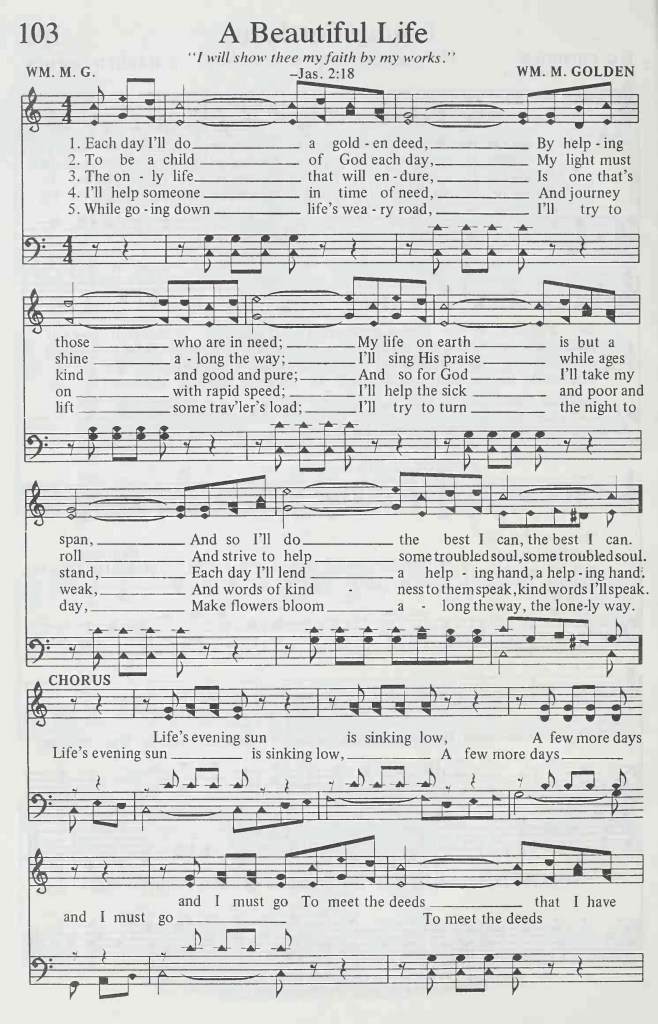
A Beautiful Life
By William M. Golden (1918)

1
Each day I’ll do a golden deed,
By helping those who are in need;
My life on earth is but a span,
And so I’ll do the best I can, (the best I can).

Life’s evening sun is sinking low,
A few more days and I must go,
To meet the deeds that I have done,
Where there will be no setting sun. (no setting sun.)

2
To be a child of God each day,
My light must shine along the way;
I’ll sing His praise while ages roll
And strive to help some troubled soul, (some troubled soul).

Life’s evening sun is sinking low,
A few more days and I must go,
To meet the deeds that I have done,
Where there will be no setting sun. (no setting sun.)

3
The only life that will endure,
Is one that’s kind and good and pure;
And so for God I’ll take my stand,
Each day I’ll lend a helping hand, (a helping hand).

Life’s evening sun is sinking low,
A few more days and I must go,
To meet the deeds that I have done,
Where there will be no setting sun. (no setting sun.)

4
I’ll help someone in time of need,
And journey on with rapid speed;
I’ll help the sick and poor and weak,
And words of kindness to them speak, (kind words I’ll speak).

Life’s evening sun is sinking low,
A few more days and I must go,
To meet the deeds that I have done,
Where there will be no setting sun. (no setting sun.)

5
While going down life’s weary road,
I’ll try to lift some trav’ler’s load;
I’ll try to turn the night today,
Make flowers bloom along the way, (the lonely way).

Life’s evening sun is sinking low,
A few more days and I must go,
To meet the deeds that I have done,
Where there will be no setting sun. (no setting sun.)

Back when I was a teenager, I was the song leader at my church, even though I am a terrible singer. I could usually at least get a song going before someone else will pick it up and actually lead the song for the congregation. I only had a small repertoire of songs that I knew well enough to sing, but not all of them could be sang by our small congregation. This was one of the songs that was quite difficult to lead because the song’s refrain needs a group to sing tenor and a group to sing base. It’s difficult for a small congregation and most likely easier for a choir to sing. It is also one that works better with musical instruments than a capella which is what we sing in the Church of Christ (we have no musical accompaniment).

Even though “A Beautiful Life” was not a song I ever lead, my mother used to play it on the piano, and I have always loved it. The song encourages us to do good deeds for others in an effort to influence righteousness in this world. We are to lead by example. In Matthew 25:34-40, Jesus says that on the Day of Judgement, the Lord will say:

“Come, you blessed of My Father, inherit the kingdom prepared for you from the foundation of the world: for I was hungry and you gave Me food; I was thirsty and you gave Me drink; I was a stranger and you took Me in; I was naked and you clothed Me; I was sick and you visited Me; I was in prison and you came to Me.

“Then the righteous will answer Him, saying, ‘Lord, when did we see You hungry and feed You, or thirsty and give You drink? When did we see You a stranger and take You in, or naked and clothe You? Or when did we see You sick, or in prison, and come to You?’ And the King will answer and say to them, ‘Assuredly, I say to you, inasmuch as you did it to one of the least of these My brethren, you did it to Me.’”

Jesus is telling us that if we help others, then God will favor us. It doesn’t matter how much faith you proclaim to have, if you are not following that faith with good deeds, then your faith is not real. It is merely a proclamation. For if you truly believe, then you will try to live a life that imitates that of Christ. We are commanded to feed, clothes, shelter, nurse and lift up those who are downtrodden and in need. If we refuse these things to our fellow man, then we are refusing them to God as well. Of course, we have to do what we reasonably can. We may make sacrifices to help others, but we can only do so much. What we can’t do is place conditions on the goods deeds that we do.

“A Beautiful Life” suggests several things that we can do to be a good influence on others. Christianity is a religion that must be practiced daily and affect our daily lives, and therefore, every day we should be concerned about those who are in need. God wants us to be His spiritual children; however, as His children, He wants us to let our lights so shine that men may see our good works and glorify Him. One way to do this is to sing His praise that we might be an example to others. Our lives are more than just our physical existence, and to have an enduring quality they must be influenced by Christ. A life that is truly influenced by Christ will be characterized by kindness, and such a life will also not be ashamed to take a stand for God so that it can be a help to others.

We should be willing to help those who are in need because we love our neighbor as ourselves. Again, we need to show this love while we have the time because we are journeying on with rapid speed. Showing our love means helping the sick and poor and weak. We can lift the traveler’s load by showing our faith in giving him what he needs. We can help turn the night to day by showing our love in assisting others in need. We can make flowers bloom along the way by being an influence for righteousness.

The chorus of “A Beautiful Life” re-emphasizes the need to be doing these things because of the brevity of life. God has eternal life planned for His people in heaven. However, to be made fit for such a wonderful dwelling place, we must strive while we journey here on this earth to have “A Beautiful Life.”


Happy Father’s Day

Children, obey your parents in the Lord, for this is right. “Honor your father and mother” (this is the first commandment with a promise), “that it may go well with you and that you may live long in the land.” Fathers, do not provoke your children to anger, but bring them up in the discipline and instruction of The Lord. 

Ephesians 6:1-4

Listen to your father who gave you life, and do not despise your mother when she is old. Buy truth, and do not sell it; buy wisdom, instruction, and understanding. The father of the righteous will greatly rejoice; he who fathers a wise son will be glad in him. Let your father and mother be glad; let her who bore you rejoice.  

Proverbs 23: 22-25

I know there are at least a few dads out there who read my blog, maybe even two gay dads out there raising sons and/or daughters, and I want to wish you a very Happy Father’s Day.  Just like mothers, fathers can drive us crazy.  Most of us may not have been as close to our fathers as maybe we should have been or should be, but all of us have a father somewhere.  Besides wishing you fathers out there a Happy Father’s Day, I also wanted to tell you about my father.


We are very different in so many ways.  He is very outdoorsy: he hunts, fishes, and constantly works outdoors.  I was always a bookworm who liked books better than sports.  I’ve learned to like the outdoors:  I walk nature trails, I like to hike, and I even like to fish occasionally.  Whereas my father worked outside all his life, I prefer to work inside, research, writing, teaching, etc.  There are a lot of other differences as well.  We can generally have a conversation for about 15-20 minutes before we get into some type of argument.  My father has never felt I was right about anything.  I can be agreeing with him, and he will fuss at me for agreeing with him.  No matter what I say, he will say the opposite.  One example is that I once made a remark about a house being painted white (it used to be gray). He argued with me that the house was painted gray, just a lighter shade.  Everyone else I know says the house is white, but he still says that it is gray.  Often he tells me that I am not a very pleasant person to be around.  It’s odd because, as far as I know, he’s just about the only person I know who feels that way.   It’s that sort of thing that drives me crazy.  Needless to say, we barely get along.  I love him, but I don’t like him.  He can be very cruel and frustrating.

To switch gears a little bit, I want to tell you also how great my father can be without me ever knowing it.  This is part of the reason that I forgive so much of the misery he causes me.  When my parents found out I was gay, it was a very traumatic experience for all concerned.  My mother had suspected for quite a while and was very nosy.  She checked my email.  She didn’t like some of the emails that she saw.  Most of them, if not all, were fairly innocent, but there were some, like an ad from Showtime about “Queer as Folk” and maybe another one from gay.com. I was over at my grandmother’s checking on her when my mother called me and confronted me about it.  I was tired of denying it.  All of my friends knew, so why shouldn’t she.  I knew she wouldn’t like it.  She had confronted me several years before about it, and I denied it then.  I wasn’t ready, and to make sure that I never was, my mother told me, “If you would rather have a dick up your ass, than be part of this family, then leave.  We will have nothing more to do with you.”  When this time came around, we got into a huge argument.  I yelled, she yelled, and I left.  I was still dependent on them for some things, but I could live without them.  My mother went to bed and cried for the next two weeks.  By the way, this all happened two days before Christmas while I was home on Christmas break.  My mother did get up and do the family things the holiday required but was very cold toward me the whole time. When my father got home, he talked to my mother about what was wrong.  She told him.  She tells him everything. This was one of the times when he sided with me.

He told my mother that I was their child.  She could not stop loving me just because she did not agree with my “lifestyle.” He would continue to love me, and she would have to do the same.  No matter what his children did, they would still love them (it may have helped that my sister married a complete and total jackass, who doesn’t physically abuse her, but abuses her mentally). Then he came and talked with me.  He told me that he didn’t care what I told my mother, but to tell her something or she would die in that bed in there (you don’t know my mother, but she would have).  Then he told me what surprised me the most, “I should have taught you how to fight the urges.  I am sorry that I failed you.”  It is the only time my father ever apologized to me for anything.  I never asked about the “urges,” but I am pretty sure I know what he was talking about.  I think he knew exactly how I felt, and it may be why he is such a miserable person.  Maybe, he had been there himself, but he had chosen a different path.  This may be why they still believe it is a choice.  But I see the misery in him almost every day.  I went to my parents and told them both that I was celibate and would remain that way, that I had never acted on my sexuality (yes, it was a lie, but it was one I think was and still is for the better, even though I hate lying more than anything).  They made me promise that I would not tell anyone else in the family, and I have agreed to that. Eventually, I told my niece, who came out as transgender. Our family has become a “Don’t ask, don’t tell, don’t discuss” zone.  It is not my preference, but it is what I must deal with for the time being.  If I ever find a man to live my life with, I will deal with the other consequences then.  I don’t think I could hide from my family the love of my life (if he ever comes along).  My mother continues to be the queen of denial and believes I will find the right girl and get married someday.

They still consider my being gay a lifestyle choice. I never will.  I don’t believe I would have chosen to be gay.  I would have chosen to live a more open life, but that is mostly not possible where I lived back then. I have a different job now and live 1200 miles away. I am far happier being open and honest about my sexuality. I know what makes me happy, and after a lot of prayer and meditation, God told me that love is what matters most in this world.  I came to understand that if I lived a lie and married a woman, I would make her and my life miserable (somewhat like my father has).  If I was going to be alone, then I would be alone. At least I wouldn’t be hurting someone else.  I realize that some people had more pressures to get married and have a family and come out later in life.  I do not fault them for that. It was a different time and/or different circumstances.  But in this day and age, I felt I could not lie to myself or anyone else and spend a large portion of my life as a lie.


Behave Like a Christian

Therefore comfort each other and edify one another, just as you also are doing.

— 1 Thessalonians 5:11

When I was in high school, I worked at a Subway restaurant with this girl who was a year below me in school. She no longer went to my school, but she had a few years before. There was always talk that she slept around a lot, and they were most likely true. However, we became friends while working together. So that year when it came to our annual homecoming dance, I asked her to be my date. It was not a romantic thing, but just two friends. At one point, she went to talk to some friends who had been in her class when she attended my school. I remember how they asked her, “Why are you with him? He’s a fag!” or something along those lines. She said, “He’s a very nice guy, and he’s been kind to me, which I can’t say about everyone.” (Again, or something similar.) I had always been nice to her, and though I had not been fond of the girls she had been friends with, I never judged her for that.

At that same homecoming dance, my best friend at the time went with her boyfriend, who was one of, if not the, most beautiful man I have ever known. He was older than she was, by a few years. He had been in the military and had even moonlighted as a stripper. The man was gorgeous. (He also had a brother who was a police officer in town who was almost as good looking.) I was not the only person who noticed how strikingly handsome he was, so did my date. He and my best friend didn’t date much longer after that, but eventually he began to date the girl who was my date. He got her pregnant, and her father, who was not a kind man, forced them to get married. As I understand it, it was a literal shotgun wedding. They were not married but a few years, but in those years, she gave birth to two beautiful sons. One was as strikingly handsome as his father, and the younger one looked more like his mother, but was still quite handsome.

After a few years, she got a divorce and raised those boys on her own. Her now ex-husband went to work for his father’s logging company, where he suffered an accident that paralyzed him. He had been so handsome and vibrant, and now, he had very limited mobility and was unable to do much of anything. It was obviously devastating for him, and sometime after that, he ended his own life. Those boys were raised by their single mother who I have no doubt was struggling to make ends meet, and now, they had lost their father completely. I don’t know what all went on in their lives because I did not keep in touch with their mother. Several years ago, she got her realtor’s license, fell in love with a fellow (and wealthy) realtor, and got married for a second time. Even though I was living in Vermont, she added me as a friend on Facebook just in case I was ever in the market for a house. Her life seemed to be going well. She was happy. She had a man she loved and who adored her. She lived very comfortably and eventually made enough money in real estate to buy a house on the beach and move to the Alabama Gulf Coast. She also had two very beautiful boys who she loved dearly.

However, not all was well with her boys. The oldest had apparently became a drug addict. Three years ago, my sister called* to say the kid, who was in his by then in his 20s, had either overdosed or took a drug laced with fentanyl (or both). His mother and brother were absolutely devastated over his death. A few days ago, my sister called to tell me that the younger son had committed suicide. According to his mother’s post on Facebook, it was just days before the three-year anniversary of his brother’s death. She said that he had demons in his head and had never gotten over his brother’s death. Though she did not mention it, I would venture to guess that he was also still grieving the loss of his father. I cannot imagine the pain and grief she must be feeling.

The truth is, we don’t know what demons people are struggling with. I have known several people who lived with nightmares and night terrors because of things that happened in their past. They can be happy people on most days, but their nights are filled with a terror we may not know about. We just don’t know what someone is going through. As Christians, we can offer comfort to those we know are suffering, but what can we do for those who hide their pain? The Bible gives us the best answer for this: Behave Like a Christian. Roman 12:9-21 tells us how to do this.

Let love be without hypocrisy. Abhor what is evil. Cling to what is good. 10 Be kindly affectionate to one another with brotherly love, in honor giving preference to one another; 11 not lagging in diligence, fervent in spirit, serving the Lord; 12 rejoicing in hope, patient in tribulation, continuing steadfastly in prayer; 13 distributing to the needs of the saints, given to hospitality.

14 Bless those who persecute you; bless and do not curse. 15 Rejoice with those who rejoice, and weep with those who weep. 16 Be of the same mind toward one another. Do not set your mind on high things, but associate with the humble. Do not be wise in your own opinion.

17 Repay no one evil for evil. Have regard for good things in the sight of all men. 18 If it is possible, as much as depends on you, live peaceably with all men. 19  Beloved, do not avenge yourselves, but rather give place to wrath; for it is written, “Vengeance is Mine, I will repay,” says the Lord. 20 Therefore

    “If your enemy is hungry, feed him;
    If he is thirsty, give him a drink;
    For in so doing you will heap coals of fire on his head.”

21 Do not be overcome by evil but overcome evil with good.

If you are suffering from pain reach out to someone you trust. If you are considering suicide, in the US, you can call Suicide and Crisis Lifeline at 988, National Suicide Prevention Lifeline at 1-800-273-TALK (8255), or the National Hopeline Network, Suicide & Crisis Hotline 1-800-442-HOPE (4673). You are not alone. Others are suffering to but there is help. Please seek that help. If you are from another country, would you please leave the number of your suicide prevention lifeline in the comments below?

If you know of someone who is suffering, be there for them. We cannot always know the struggles that people are dealing with, so if we treat everyone with kindness and Christian love, then maybe we will influence their day in a way that helps them out or just to know that kindness exists. Sometimes, all a person might need is a kind word or a smile to brighten their day.


Pride

Pride goeth before destruction, and an haughty spirit before a fall. Better it is to be of an humble spirit with the lowly, than to divide the spoil with the proud.

—Proverbs 16:18-19 (KJV)

Should we celebrate LGBTQ+ Pride when it is considered one of the Seven Deadly Sins? The answer is yes because LGBTQ+ Pride is not a sinful pride as described in scripture. It is a celebration of who we are, and the person God created us to be. Pride in the Bible is the antonym of humility. The Britannica Dictionary offers four definitions for Pride:

  1. a feeling that you respect yourself and deserve to be respected by other people, i.e., self-respect
  2. a feeling that you are more important or better than other people
  3. a feeling of happiness that you get when you or someone you know does something good, difficult, etc.
  4. a person or thing that makes you feel proud

It is the second definition that the Bible says God abhors and is a sin. LGBTQ+ Pride is an example of the first and third definitions. LGBTQ+ Pride is about self-respect, not superiority. The Bible offers two basic types of pride: legitimate pride and sinful pride.

The word “pride” is mentioned in the Bible multiple times, but the exact count varies depending on the translation. The New King James Version mentions the word “pride” 51 times, but there are many more instances of pride that do not use the word itself. None of those instances encourage pride. Pride, in a biblical context, refers to an excessive sense of self-worth, arrogance, and superiority often leading to rebellion against God. In the Bible, pride is frequently associated with disobedience, rebellion, and an elevation of self above God and others. It is regarded as a sin that hinders humility and disrupts one’s relationship with God.

To give a biblical example, in Revelation 18, an angel announces the judgment of Babylon and describes what provokes God’s wrath on the world. Revelation 18:7 says: “In the measure that she glorified herself and lived luxuriously, in the same measure give her torment and sorrow; for she says in her heart, ‘I sit as queen, and am no widow, and will not see sorrow.’” Here we see pride is what Revelation describes as the antichrist. (The Epistle of James speaks of many antichrists, not just one as some Christians believe. An antichrist is someone who is the opposite of Christ though they will often claim to be Christ-like.) Pride is an attitude that we can trust in wealth and independence and have no need for God in our lives. As Believers, we are called to rely on the Lord for all that we need. 

Matthew Poole, an English Puritan who lived from 1624–1679, summarized in his commentaries the situation this way, “Pride goeth before destruction; it is commonly a forerunner and cause of men’s ruin because it highly provokes both God and men.” There is a tension between the will of man and the will of God. For things to go well for us, we must be willing to surrender our lives to God and follow the example set forth by Christ. We are called to trust God with our hearts and believe God when He promises that He will take care of us. Proverbs 3:5-6 tells us, “Trust in the Lord with all your heart, and lean not on your own understanding; in all your ways acknowledge Him, and He shall direct your paths.”

In contrast to sinful pride, LGBTQ+ pride is not meant to celebrate arrogance or superiority. LGBTQ+ pride is the promotion of the self-affirmation, dignity, equality, and increased visibility of lesbian, gay, bisexual, transgender, and queer people as a social group. Pride, as opposed to shame and social stigma, is the predominant outlook that bolsters most LGBTQ+ rights movements. Pride is a celebration of who we are and the rights we have fought to be acknowledged and protected. It is about equality, not superiority. We have parades, parties, and rainbows everywhere to celebrate Pride, and it may look like a sinful pride from the outside looking in, but it is actually a humble pride. We do not seek superiority over others; we seek equality and recognition.

In his annual proclamation for Pride month, President Biden wrote, “To the entire LGBTQI+ community — and especially transgender children — please know that your President and my entire Administration have your back. We see you for who you are: made in the image of God and deserving of dignity, respect, and support.” I can’t reiterate enough that we are made in the image of God and deserving of dignity, respect, and support. This is what Pride should be for LGBTQ+ Christians.

P.S. I could have done a whole post about Donald Trump and the sins of pride. He is one of the most sinful examples of pride in the public eye today, but with his conviction on Thursday and his and other Republicans subsequent reactions, I can only be reminded of Proverbs 16:18, “Pride goeth before destruction, and an haughty spirit before a fall.


Live by Example

So then, my beloved brethren, let every man be swift to hear, slow to speak, slow to wrath; for the wrath of man does not produce the righteousness of God.

—James 1:19-20

Growing up, anyone outside of my family would have said I was a very polite and quiet kid. However, when it came to my parents, especially my dad, I had a bad habit of talking back. We both wanted the last word, and I often didn’t know when to shut up. My grandmama gave me the best advice on how to deal with my father. She said, “Your daddy is just like his daddy. You just have to keep your mouth shut, and eventually, he will shut up. Then you can go about your day.” To this day, my father and I barely get along. I’ve never been the son he wanted, and he says I “annoy him.” Last time I was home at Christmas, he actually said, “I was dreading you coming home because you usually annoy me, but I haven’t been annoyed this time until now.” It was all because I said I would not watch Fox News. He took this as me saying he could not watch Fox News. I did not; I just meant I’d go elsewhere. However, when it comes to me, my father is a man who is slow to hear (if he does at all), swift to speak, and swift to wrath.

I know that I get my temper from my dad. It’s one of the reasons I never wanted children. I did not want to be the kind of father my father and grandfather were, and I knew I had their temper at times. Over the years, I have learned to control my temper, but most people who know me know that I can be pushed just so far before that temper comes out. I wish I could suppress my temper at all times, so I try to “be swift to hear, slow to speak, slow to wrath.” Do I always succeed? No, but I do try my best.

Following the verse above, James goes on to say in James 1:21-27:

Therefore lay aside all filthiness and overflow of wickedness, and receive with meekness the implanted word, which is able to save your souls.

But be doers of the word, and not hearers only, deceiving yourselves. For if anyone is a hearer of the word and not a doer, he is like a man observing his natural face in a mirror; or he observes himself, goes away, and immediately forgets what kind of man he was. But he who looks into the perfect law of liberty and continues in it and is not a forgetful hearer but a doer of the work, this one will be blessed in what he does.

If anyone among you thinks he is religious and does not bridle his tongue but deceives his own heart, this one’s religion is useless. Pure and undefiled religion before God and the Father is this: to visit orphans and widows in their trouble, and to keep oneself unspotted from the world.

Too many Christians today are not “doers of the word.” Sadly, they hear what they want to hear and ignore the parts of the Bible they disagree with. They rely on bad translations and put forward a belief that is an anathema to Christ’s teachings. I have always believed that we should live by example, meaning to guide others through your behavior instead of your words. Your intention is to inspire others to copy your behavior. Luke 6:31 says, “And just as you want men to do to you, you also do to them likewise.” The opposite of leading by example is to say one thing and do another, i.e., being a hypocrite. My father always lived by the saying “do as I say, not as I do,” but this is not how we are supposed to live.

We can study the Bible all we want, but if we fail to apply the lessons that God teaches us through His word, then we are only hearers and not doers. First Timothy 4:12 tells us, “Let no one despise your youth, but be an example to the believers in word, in conduct, in love, in spirit, in faith, in purity.” Could you, in good conscience, encourage someone to be to follow Christ’s teachings if you yourself are not? We must live in such a way that we are beyond reproach. Titus 2:6–8 says, “Likewise, exhort [encourage’ the young men to be sober-minded, in all things showing yourself to be a pattern of good works; in doctrine showing integrity, reverence, incorruptibility, sound speech that cannot be condemned, that one who is an opponent may be ashamed, having nothing evil to say of you.” Live by example, then those who are not following the Word of God cannot fault you. They may try, but you have to remember what is important. It is how God will judge you, not how man will judge you.

In Matthew 7:1-5, Jesus says, “7 “Judge not, that you be not judged. For with what judgment you judge, you will be judged; and with the measure you use, it will be measured back to you. And why do you look at the speck in your brother’s eye, but do not consider the plank in your own eye? Or how can you say to your brother, ‘Let me remove the speck from your eye;’ and look, a plank is in your own eye? Hypocrite! First remove the plank from your own eye, and then you will see clearly to remove the speck from your brother’s eye.” Jesus is telling us that we cannot criticize or judge others for things we ourselves do not follow. 

When it comes to living by example, there’s no one who’s ever done it better than Jesus Himself. He is the ultimate example, because He built His entire ministry around living by example. At the end of the day, if we have not modelled our behavior to other people on that of Christ, then we are failing to follow Christ’s example. To do that, we need to practice humility and selflessness above all. Hebrews 10:24 says, “And let us consider one another in order to stir up love and good works.” Living by example isn’t always easy. If it were, then we wouldn’t need to rely on God’s strength to do it. Isaiah 41:10 says, “Fear not, for I am with you; be not dismayed, for I am your God. I will strengthen you, yes, I will help you, I will uphold you with My righteous right hand.” If you’re at that point in your life where you’re discouraged and unsure if you can press on and continue living by example, remember that God will strengthen us, help us, and support us.


Kindness

And be kind to one another, tenderhearted, forgiving one another, even as God in Christ forgave you.

—Ephesians 4:32

To be kind, according to the Merriam-Webster dictionary, means to have a sympathetic or helpful nature. It also indicates gentleness, compassion and affection. Kindness is different than niceness. It goes deeper – it’s a genuine reflection of the heart. Niceness can be helpful, but kindness is a result of a heart in the right place. Mark Twain was once said, “Kindness is a language which the deaf can hear and the blind can see.”

We are surrounded by God’s kindness every day. Evidence of his kindness shows in our lives, in the Bible and in his character. Jesus set the ultimate example of kindness with his life. Following his example can be difficult, but God calls and equips believers to be kind. With this understanding of how important kindness is to God and in how we interact with the world,

The kindness of God is our starting place for a holistic view of kindness. He made us for community with himself and other people. For any community to thrive, there must be kindness. From God’s loving kindness, we start to understand how securely loved we are by God, and in that security, we can reach out to those we come across who need a reminder of kindness in their lives.

We know God calls Christians to be kind, but sometimes we struggle with knowing what that kindness looks like in everyday life. Where are we supposed to direct our kindness? And to whom? The short answer is to be kind to everyone. Galatians 6:10 says, “Therefore, as we have opportunity, let us do good to all.”

If we all did a small act of kindness each day, the world would be a better place. It doesn’t take much to be kind. It can be as simple as holding open a door for someone or picking up something they’ve dropped. Maybe the person behind you in line at the grocery store as significantly fewer groceries than you, and you let them ahead of you in line. The simplest form of kindness is to smile at someone.

Love and encourage people. And always be open to listen. You never know what people are going through and sometimes the people with the biggest smiles are struggling the most, so be kind. That’s why it’s so important to lead with kindness as often as we can. You may never know how much a small act of kindness will affect someone.

P.S. Steve Davis, one of my frequent reader and commenters, reminded me that today is Pentecost,* and I wanted to add a few words about how kindness is an appropriate virtue to celebrate the holiday. Pentecost is described in the second chapter of the Acts of the Apostles. Acts 2:4 says, “And they were all filled with the Holy Spirit and began to speak with other tongues, as the Spirit gave them utterance.” I’ve never fully understood “speaking in tongues” in the modern sense in Holiness and Pentecostal Christianity. What is often described as speaking in tongues never seemed to be a universal language that everyone could understand as described in Acts 2:4. However, I believe what Mark Twain said, “Kindness is a language which the deaf can hear and the blind can see.” Kindness is a universal language that everyone can speak and understand, and maybe that is what the Holy Spirit filled the Apostles with on Pentecost.

* Pentecost was never a holiday we observed in the Church of Christ when I was growing up so it did not occur to me to write a post about Pentecost.


Mother’s Day

Can a woman forget her nursing child, and not have compassion on the son of her womb? Surely they may forget, yet I will not forget you.”

—Isaiah 49:15

What the Bible is saying in this passage is: that while a mother can forget the love she has for her child, God never will. The design of this passage is apparent. It is to show that the love which God has for his people is stronger than that which is produced by the most tender ties created by any natural relation. The love of a mother for her infant child is one of the strongest attachments in nature. The question here implies that it was unusual for a mother to be unmindful of that tie and to forsake the child that she should nourish and love. With that being said, in the passage above, Isaiah was asking a theoretical question when he said, “Can a woman forget her nursing child?” This passage praises mothers as symbols of amazing compassion, never forgetting their beloved children.

Mothers are not perfect. Mine sure isn’t. Every mother is flawed, just as we are all flawed. However, no matter how flawed we may be, God’s love for us is unchanging and unchangeable. He gives us generous grace and great compassion for all time and throughout eternity. While my mother and I may have our disagreements, we have a strong bond, though not nearly as strong as it once was before I came out, it is still there. She is my comfort, even when she is not comforting. That may sound odd, but when I was young, my mother often sang to us. Sometimes it was silly little songs like “Fishy in a Bowl,” “Do Lord,” or “Yes Sir, That’s My Baby,” though she had her own versions of each one. However, the one I remember most is “You Are My Sunshine.” Even today, when I am sad and lonely or having anxiety or even a full-on panic attack, I can remember my mother singing ‘You Are My Sunshine,” and I am comforted. Part of it has to do with the rhythm of the song helping to slow my rapidly beating heart, but it’s also because I remember the good times when my mother would sing this to me.

I want to leave you with a different verse because while we may see things very differently, my mother does still love me. I firmly believe that she always will. She can’t help but love me. (Who couldn’t? I’m quite lovable. LOL)

Love suffers long and is kind; love does not envy; love does not parade itself, is not puffed up; does not behave rudely, does not seek its own, is not provoked, thinks no evil; does not rejoice in iniquity, but rejoices in the truth; bears all things, believes all things, hopes all things, endures all things.

—1 Corinthians 13:4-7