Monthly Archives: July 2013

Do You Need A Rounder Bum?

A few weeks ago, I received an email from a representative of Rounderbum Underwear.  The rep asked if she could send me a pair of Rounderbum underwear to try out and write a review of them.  First of all, I have to admit that I almost have a fetish for underwear.  Whether anyone else thinks a pair of underwear looks good on me, it is definitely an ego boost when I put on a sexy pair of underwear.  They just make me feel better. Also, i have always wanted to try a pair of butt enhancing underwear to see if it would actually work and make my rather flat behind look rounder.  So, when I was contacted by Rounderbum, I said that I would love to test out their underwear and write a review.


First, a little bit about Rounderbum.  With a growing trend of men who take care of their appearance, Rounderbum created a men’s line specially for those who want to look more attractive, athletic and are in need of body enhancing underwear. 

Rounderbum uses hidden padding made of flexible polyurethane that conforms to every body shape in some styles. Other styles utilize hidden bands of technology that lifts with a more subtle and discreet effect. Whether padding or hidden bands are used, Rounderbum’s cutting edge design is carefully made by a patented manufacturing technology that blends discretely with the body. 
I chose the ROUNDERBUM BASIC PADDED TRUNK to give a try.  They have a modern and low cut design that gives more volume and a rounder shape to the glutes. Since I have always had a small butt and was looking for something natural-looking, this product seemed to suit the purpose I was looking for. This product is pretty amazing! You can wear anything and nobody would ever know that you have pads, even if they were to grab you! LOL! I was pleased with the results.  They did provide me with a beefier behind and were extremely comfortable.  It was definitely worth the experience.

Everyone’s a Biblical Literalist Until You Bring Up Gluttony

image
 

I came across a link to this on Dan in OKC and decide it was probably worth reading. After reading the blog post from Rachel Held Evans, I wanted to share it with my readers as well. Tell me what you think.

…Or divorce, or gossip, or slavery, or head coverings, or Jesus’ teachings on nonviolence, or the “abomination” of eating shellfish and the hell-worthy sin of calling other people idiots.

Then we need a little context.

Then we need a little grace.

Then we need a little room to disagree.

I got to thinking about this after I was criticized last week for my post about loving gay kids unconditionally. Some folks were very upset that I had the audacity write an entire blog post about putting a stop to LGBT bullying without including a Bible-based condemnation of LGBT people, or at least a theological discussion around the issue of homosexuality and Scripture.

Bible verses were quoted.  Open letters were written. End Times predictions were made.  Pillows in my home were thrown record distances.

It’s funny. Yesterday, in Sunday Superlatives, I included a quote from Mark Twain in which he referred to a snake oil salesman as an “idiot,” but no one left an angry comment warning me of hell based on Jesus’ teaching in Matthew 5:22 that “if you call someone an idiot, you are in danger of being brought before the court; and if you curse someone, you are in danger of the fires of hell.”

Nor did anyone raise any biblical objections regarding gluttony a few weeks ago when I casually mentioned overdosing on Sweet Frog frozen yogurt (strawberry, with a pile of chocolate chips, Oreo crumbs, and chocolate animal crackers on top, if you must know), or about materialism when I shared pictures of our new car. (Hey, for some people, a brand new Honda Civic is pretty flashy.)

And in spite of the flood of emails I get each week condemning my support of women in ministry, I’ve never received so much as an open letter criticizing my refusal to wear a head covering, even though my Web site is full of photographic evidence of what the apostle Paul calls a “disgrace” in 1 Corinthians 11:6.

We may laugh at these examples or dismiss them silly, but the biblical language employed in these contexts is actually pretty strong: eating shellfish is an abomination, a bare head is a disgrace, gossips will not inherit the kingdom of God, careless words are punishable by hell, guys who leer at women should gouge out their eyes.

Heck, you could make a pretty good biblical case for gluttony being a “lifestyle sin” that has been normalized by our culture of “Supersized” portions and overflowing buffet lines, starting with passages like Philippians 3:19 (“their god is their belly”), Psalm 78: 18 (“they tested God in their heart by demanding the food they craved”), Proverbs 23:20 (“be not among drunkards or among gluttonous eaters of meat”), Proverbs 23:2 (“put a knife to your throat if you are given to appetite”), or better yet, Ezekiel 16:49 (“Now this was the sin of your sister Sodom: She and her daughters were arrogant, overfed and unconcerned; they did not help the poor and needy.”)

Yet you don’t see weigh-ins preceding baptisms or people holding “God Hates Gluttons” signs outside the den of iniquity that is Ryan’s Steakhouse.

And we haven’t even touched on materialism, or the fact that on the day I stuffed my face with froyo, 30,000 kids died from preventable diseases and many more went hungry. 

It seems the more ubiquitous the biblical violation, the more invisible it becomes.

So why do so many Christians focus on the so-called “clobber verses” related to homosexuality while ignoring “clobber verses” related to gluttony or greed, head coverings or divorce?  Why is homosexuality the great biblical debate of this decade and not slavery, (as it once was) or the increasing problem of materialism and inequity? Why do so many advocate making gay marriage illegal but not divorce, when Jesus never referenced the former but spoke quite negatively about the latter?

While there are certainly important hermeneutical and cultural issues at play, I can’t help but wonder if something more nefarious is also at work.  I can’t help but wonder if biblical condemnation is often a numbers game.

Though it affects more of us than we tend to realize, statistically, homosexuality affects far fewer of us than gluttony, materialism, or divorce. And as Jesus pointed out so often in his ministry, we like to focus on the biblical violations (real or perceived) of the minority rather than our own.  

In short, we like to gang up.  We like to fashion weapons out of the verses that affect us the least and then “clobber” the minority with them. Or better yet, conjure up some saccharine language about speaking the truth in love before breaking out our spec-removing tweezers to help get our minds off of these uncomfortable logs in our own eyes.

We see this in the story of the religious leaders who ganged up on the woman caught in adultery. She was such an easy target: a woman, probably poor, disempowered, and charged with the go-to favorite of the self-righteous—sexual sin.   When they brought her to Jesus, they were using her as an example to test him, to see how “biblical” his response to her would be. (See Deuteronomy 22:23-14.)  Jesus knelt down and scribbled in the sand before saying, “He who is without sin can cast the first stone.” They dropped their stones.

While self-righteousness avoidance certainly affects our selective literalism , we also have good reasons for not condemning one another for the more ubiquitous biblical violations (again, real or perceived) in our culture.

It’s hard for me to flatly condemn divorce, for example, when I know of several women whose lives, and the lives of their children, may have been saved by it, or when I hear from people who tell me they would have rather come from a broken home than grown up in one. We have a natural revulsion to the idea of checking people’s BMI before accepting them into the Church, especially when obesity is not necessarily reflective of gluttony (often, in this country, it is a result of poverty), and when we know from our own experiences or the experiences of those we love that an unhealthy weight can result from a variety of factors—from genetics to psychological components—and when some of our favorite people in the world (or when we ourselves) wrestle with a complicated relationship with food, whether it’s through overeating or under-eating.  

Again, it’s a numbers game. It’s hard to “other” the people we know and love the most. It’s become a cliché, but everything changes when it’s your brother or sister who gets divorced, when it’s your son or daughter who is gay, when it’s your best friend who struggles with addiction, when it’s your husband or wife asking some good questions about Christianity you never thought about before.  Our relationships have a tendency to destroy our categories, to melt black and white into gray, and I don’t think God is disappointed or threatened by this. I think God expects it. It happened to Peter when he encountered Corneilus and Philip when he encountered the Ehtiopian eunuch. Suddenly it became a lot harder to label your friends “unclean” or “unworthy.” 

 After all, when God became flesh and lived among us, the religious accused him of hanging out with “sinners” (even gluttons!) never realizing that this was the whole point, that there were only “sinners” to hang out with.

Of course, all of this raises questions about when it’s right or wrong to “call out” sin, and I confess I’m no good at sorting that out. I’m as hypocritical as the next person, judgmental of those I deem judgmental, self-righteous, indulgent, a gossip, too careless with my words, too quick to get angry at certain people with certain theological views, too easily seduced by money and notoriety and…my favorite things in the whole entire world…AWARDSI LISTS! ACCOLADES!

I too need reminding that, for all my big talk about a “Christocentric hermeneutic,” more often than not, I’m following a “Rachelcentric hermeneutic” when I read the Bible, complete with my own biases, preferences, insecurities, and opinions guiding how I “pick and choose.” (Oh I can wield every Bible verse that challenges Calvinism like a knife, but I’d rather not talk about how I’m actually applying the Sermon on the Mount to my life or what I really think about enemy-love.) 

Should we stop discussing which biblical instructions apply today and how we ought to apply them? Certainly not. Should we remain silent when the vulnerable are oppressed and exploited or when injustice and immorality pervades our culture? No. Do we abandon our convictions about what the Bible says is sin? No, not even when we disagree on that. Are rhetorical questions overused in blog posts? Yes.

But it’s good to remind ourselves now and then that just as Southern slaveholders had a vested interest in interpreting Colossians 3:22 literally, so we tend to “pick and choose” to our own advantage. 

And when we make separate categories for the “real sinners,” when we reduce our fellow human beings to theological issues up for constant debate who cannot even be told they are loved without qualifiers, when our hermeneutic conveniently renders others the problem and us the heroes, maybe it’s time to sit across a table and get to know one another a little better, to break up some categories and make some new friends. Maybe it’s time to drop our stones for a while and pass the bread.

…healthy, whole grain, organic bread, of course.


In Memoriam

20130708-232611.jpg

In Memoriam, [To Sleep I give my powers away]
Lord Alfred Tennyson
To Sleep I give my powers away;
    My will is bondsman to the dark;
    I sit within a helmless bark,
And with my heart I muse and say:
O heart, how fares it with thee now,
    That thou should fail from thy desire,
    Who scarcely darest to inquire,
“What is it makes me beat so low?”
Something it is which thou hast lost,
    Some pleasure from thine early years.
    Break thou deep vase of chilling tears,
That grief hath shaken into frost!
Such clouds of nameless trouble cross
    All night below the darkened eyes;
    With morning wakes the will, and cries,
“Thou shalt not be the fool of loss.”
“In Memoriam” consists of 131 smallerpoems of varying length, of which the above poem is an excerpt. Tennyson wrote “In Memoriam” after he learned that his beloved friend Arthur Henry Hallam had died suddenly and unexpectedly of a fever at the age of 22. Hallam was not only the poet’s closest friend and confidante, but also the fiancé of his sister. After learning of Hallam’s death, Tennyson was overwhelmed with doubts about the meaning of life and the significance of man’s existence. He composed the short poems that comprise “In Memoriam” over the course of seventeen years (1833-1849) with no intention of weaving them together, though he ultimately published them as a single lengthy poem in 1850.
 
A year ago today, my beloved Grandmama passed away.  I wanted to post a poem that would be in memory of her.  The above poem is not perfect for this purpose, but it works to an extent.  I mourn Grandmama’s life each day.  Last night I read the post I did last year right after she died.  I sat and cried.  I couldn’t help myself.  Then I read the loving comments of my readers, and my spirits were lifted a little.  Though she is now gone, she will forever live in my heart. 

Country Music

Country music has been the buzz on many gay sites and blogs because of the hot little number by Steve Grand, which I posted about on Friday.  As I mentioned on Friday, I went to an Alabama concert on Friday night.  Alabama has been around for forty years, and my aunt, who I went with has been seeing them in concert, every time they come around, for thirty of those years.  To say she’s a fan might be an understatement.  I have one more concert to go to with my aunt on Thursday, more on that in a moment.  My aunt s a huge country music fan, and I have, since I was a kid, went along to concerts with her so she didn’t go alone.  My aunt is a wonderful woman, who always took my sister and I on different vacations each summer.  She is keeping pretty busy this month, and it often means me going along.  There is a reason for this.  You see tomorrow will be a year since her mother and my Grandmama died.  Her father and my Granddaddy died at the end of July twelve years ago.  For these reasons, July is a difficult month for my family, and especially for my aunt, who took care of my grandparents in their waning years.  When I started writing this post, I had not meant for it to be such a downer, so I am going to make a radical shift back to the topic of country music.

The Alabama concert was a wonderful and surprising event.  I was surprised by the number of young people at the concert.  Alabama hasn’t toured in years, and it has been quite a while since they put out an album, but the teenagers and twenty-somethings seem to love them.  Three cute teenage boys were sitting behind us.  One of them knew the words and sang along to every song that Alabama sang.  I was impressed.  (If I were one to have a foot fetish, his bare feet propped next to me for a good part of the night probably would have caused a spontaneous orgasm, lol.)  One other surprise that I noticed in the crowd was a hot guy in cut-off jean shorts (Daisy Duke short), button down shirt with the sleeves ripped off, boots and a cowboy hat.  He was smokin’ hot in a slutty gay boy kind of way.  Whether he was gay, lost a bet, or just has a quirky sense of fashion, this hot little number was quite the looker.  I’d loved to have snuck off with him and had my way with him, but alas, I only got to admire him from afar.

The opening act was another surprise.  Aaron Parker, who incidentally I had never heard of, was the hot little cowboy who opened up for Alabama.   His picture is above.  Be forewarned, my description of him might be a little raunchy.  First of all, Mr. Parker is packing some major meat.  His bulge was big enough to be noticeable from where I was sitting on the second level, maybe two hundred yards away. He also had a tight little butt that was drool worthy.  It was definitely fun to watch him continuously bump and grind one of his band mates, see picture above.  His music was okay, and with Alabama’s help, he might have a good career ahead of him.  Being the opening act for a band like Alabama has to be difficult considering how great of a band they are and that people were there to see them and not him, but he was fun to watch.  Most likely, he was chosen because of his song, “Anything Alabama.”

Alabama came on afterward and were fantastic.  They sang “Love in the First Degree,” “The Closer You Get,” “High Cotton,” “Feels So Right,” “Roll On (Eighteen Wheeler),” “Song of the South,” “The Fans,” “Tennessee River,” “Dancin’, Shaggin’ on the Boulevard,” and of course, no night would be complete without “Mountain Music” and “My Home’s in Alabama.”  Their song list was no surprise, but it was what everyone came to see.  The biggest surprise of the night was yet to come.  Randy Owens, the lead singer of Alabama, announced that they would have a new album coming out soon.  It will be the first studio album since 2001.  Yet that was really not what caused to crowd to go wild.  That was when Owens announced that he was bringing out someone who he had been told several years ago would be a star.  He then welcomed to the stage Luke Bryan, the CMA Entertainer of the Year.  I happen to be a big fan of Luke Bryan.  I think that he is incredibly sexy.  I stood and cheered like everyone else, and “Little Joe” stood up at attention as well, if you know what I mean, lol.
The concert I will be going to Thursday night is a Luke Bryan concert in Birmingham.  I can’t wait to see this sexy man in action again.  I fell in love with Luke Bryan the first time I saw his video for “All My Friends Say.”  I’ve been a fan ever since and have wanted to see him in concert.  He came to Montgomery a few years ago, but because of the circumstances at the time, I was not able to go.  Now I am finally able to go, and I can’t wait.  Georgia-Florida Line and Thompson Square will be the opening acts on Thursday night.

Warning Against Worldliness

20130706-212001.jpg

What causes quarrels and what causes fights among you? Is it not this, that your passions are at war within you? You desire and do not have, so you murder. You covet and cannot obtain, so you fight and quarrel. You do not have, because you do not ask. You ask and do not receive, because you ask wrongly, to spend it on your passions. You adulterous people! Do you not know that friendship with the world is enmity with God? Therefore whoever wishes to be a friend of the world makes himself an enemy of God. Or do you suppose it is to no purpose that the Scripture says, “He yearns jealously over the spirit that he has made to dwell in us”? But he gives more grace. Therefore it says, “God opposes the proud, but gives grace to the humble.” Submit yourselves therefore to God. Resist the devil, and he will flee from you. Draw near to God, and he will draw near to you. Cleanse your hands, you sinners, and purify your hearts, you double-minded. Be wretched and mourn and weep. Let your laughter be turned to mourning and your joy to gloom. Humble yourselves before the Lord, and he will exalt you.
 
Do not speak evil against one another, brothers. The one who speaks against a brother or judges his brother, speaks evil against the law and judges the law. But if you judge the law, you are not a doer of the law but a judge. There is only one lawgiver and judge, he who is able to save and to destroy. But who are you to judge your neighbor?
 
James 4:1-12
 
When was the last time you heard a sermon warning against worldliness? I suspect for most believers it would have been a very long time indeed. There are several reasons for this. Likely it is because we are in fact very worldly, and we don’t like to speak to our particular sins, so we just drift along. Also, you are particularly unlikely to hear a sermon, or in this case read a Bible study, about worldliness and gay Christians.  First of all, most of us would start squirming in our chairs.  My first thought would be, “This can’t be good.”  The reason for this is that as gay Christians most of our naysayers consider homosexuality to be a sin of worldliness.  That as gay Christians, we want to sin, be a part of this hedonistic culture, and call ourselves Christians.  But I hope that if you are one of those who regularly follow my Sunday posts, then you will know that is not the message I will deliver here.  I write these posts as both Bible studies and as a way to deliver the truth.  Therefore, I want to study this passage in a way that brings to light the kind of worldliness that applies to LGBT Christians.
 
There is also another reason Christians don’t tend to dwell on worldliness. We have tended to misunderstand what the warnings against worldliness actually mean, and/or have quite distorted the actual biblical teaching on this. That is, we have often thought that worldliness means having nothing to do with this material world altogether.  Or, as LGBT Christians we have been branded as worldly people because too many people believe that homosexuality is a choice.  The truth is, as I believe it (and I do believe that God helped me understand this after much prayer and meditation), God created us to be gay.  He had a purpose for us.  Whatever, that purpose is, we cannot deny God for creating us or leading us down this path.  We are all God’s children and have his undying and eternal love.
 
James is not the only one to warn about worldliness.
John: 1 John 2:15-17 – Do not love the world nor the things in the world. If anyone loves the world, the love of the Father is not in him. For all that is in the world, the lust of the flesh and the lust of the eyes and the boastful pride of life, is not from the Father, but is from the world. The world is passing away, and also its lusts; but the one who does the will of God lives forever.
 
Paul: Ephesians 2:1-3 – And you were dead in your trespasses and sins, in which you formerly walked according to the course of this world, according to the prince of the power of the air, of the spirit that is now working in the sons of disobedience. Among them we too all formerly lived in the lusts of our flesh, indulging the desires of the flesh and of the mind, and were by nature children of wrath, even as the rest.
In the text from James above, these verses make me think of the person who tries to live in both the world and in the kingdom. It can’t be done. Living in the kingdom means the Spirit dwells within us, and God reigns over us. It must be all or nothing. In Matthew 6:24, Jesus says, “No one can serve two masters, for either he will hate the one and love the other, or he will be devoted to the one and despise the other.”  Therefor, ask yourself to describe you in one word.  What would you say?  If you are worldly, then your answer might be your profession or an adjective describing how you feel or act, but truthfully, the answer should be very simple: Christian.  Whatever else you are, however else you might describe yourself, it is being a Christian that should come first.
 
James finishes this section of scripture we are examining with a warning about verbally attacking or slandering our brother. When we do this, we are not only attacking, but judging his character. In doing so, we are speaking out against and judging the law. Think about it. We are to love our Lord God with all of our heart, soul, strength and might; and to love our neighbor as ourselves. When we speak against our brother, we are not loving our neighbor as ourselves, and might as well throw the whole commandment out the window.

…do not be conformed to this world, but be transformed by the renewing of your mind, that you may prove what is that good and acceptable and perfect will of God…. Abhor what is evil. Cling to what is good.” Romans 12:2, 9

As believers, we are not of the world. Worldliness is not a kingdom attribute.
 
If you’re wondering if a behavior or activity is worldly, ask yourself these questions:
  • Does this activity, thing, pursuit take my heart away from God?
  • Does it sabotage my communion with God and my walk in the Spirit?
  • Does it undermine or seek to displace my relationship to Christ as the power of my life?
  • Does it attempt (is it designed) to do so?
  • Does it feed the self-centered, appetite-driven, God-hating part of me called the flesh?
  • Does it inflame my desire to disobey God’s commands?
  • Does it produce pride, contention, immorality, or any other behavior contrary to the love of God and the love of others?
  • Does it lure me into obsession with what is earthbound and temporal versus what is heavenly and eternal?
In John 18, Jesus answers Pilate by repeating this phrase twice:  My kingdom is not of this world.
 
If you follow Jesus, then your kingdom is the Kingdom of Heaven, and it is not of this world.


Moment of Zen: Old Pictures

20130704-231639.jpg

Oh, the history contained in old pictures!


All-American Boy

20130705-001354.jpg

A friend of mine sent me a link to the video below, and I think it’s pretty fantastic.  I was raised on country music, in fact I’m going to a concert tonight (the group Alabama).  I wouldn’t say I’m a huge country music fan, because I tend to like older country music.  Most of the time when I listen to the radio in the car, I am listening to NPR, not music.  I tend to like funky alternative rock more, but I do like some country music.  When my friend sent me this video, he said, “Since you like country music you are going to enjoy this video.  It’s got a surprise twist.  And the singer is so damn gorgeous and so aptly named.  It is making its rounds on gay sites so you might have seen it already.”  I had not seen it, but I couldn’t pass up an introduction like that.  You guys may have already seen it, if not I hope you will watch it.  Let me know what you think.
Steve Grand  is out to be a country music star, and an out one at that. He’s got the whole package – great voice, musically talented, incredibly hot, and fearless, as you can see in his video for “All American Boy” which he created out of pocket, as he doesn’t have a label yet. The hopelessly romantic singer falls for a guy in a heterosexual relationship in the video. The two spend time together leading to skinny-dipping in a river and a kiss. Unfortunately, the attraction is only held by one of the characters. His lyrics are quite dreamy for his crush “He smiles, his arms around her but his eyes are holding me, just a captive to his wonder, ohh I say we go this road tonight.” Steve produced all his own music, as he does not have a manager or label. He raised funds to pay for everything on his own by playing piano at a local joint and at a church. 
 
He’s ready to be upfront and honest from the start of his career, “time to be brave. the world does not see change until it sees honesty. I am taking a risk here in many ways, but really there is no choice but to be brave. To not tell this story is to let my soul die. It is all I believe in. It is all I hold dear. We have all longed for someone we can never have… we all have felt that ache for our ‎#allamericanboy.”


Gay country music artists do not have a good track record.  Josey Greenwell ended up recording a pop song, and k.d. lang left country music, at least for the most part.  I love to hear all of them sing, but I love k.d. more as a jazz artist.  She has a beautiful voice.  I hope Josey goes back to his country music roots and finds success, just as I hope Steve Grand has success.


Thank you, Steve Grand, for having the courage to make the music you want and to be a voice for thousands, in a music genre that may not support you. 

Independence

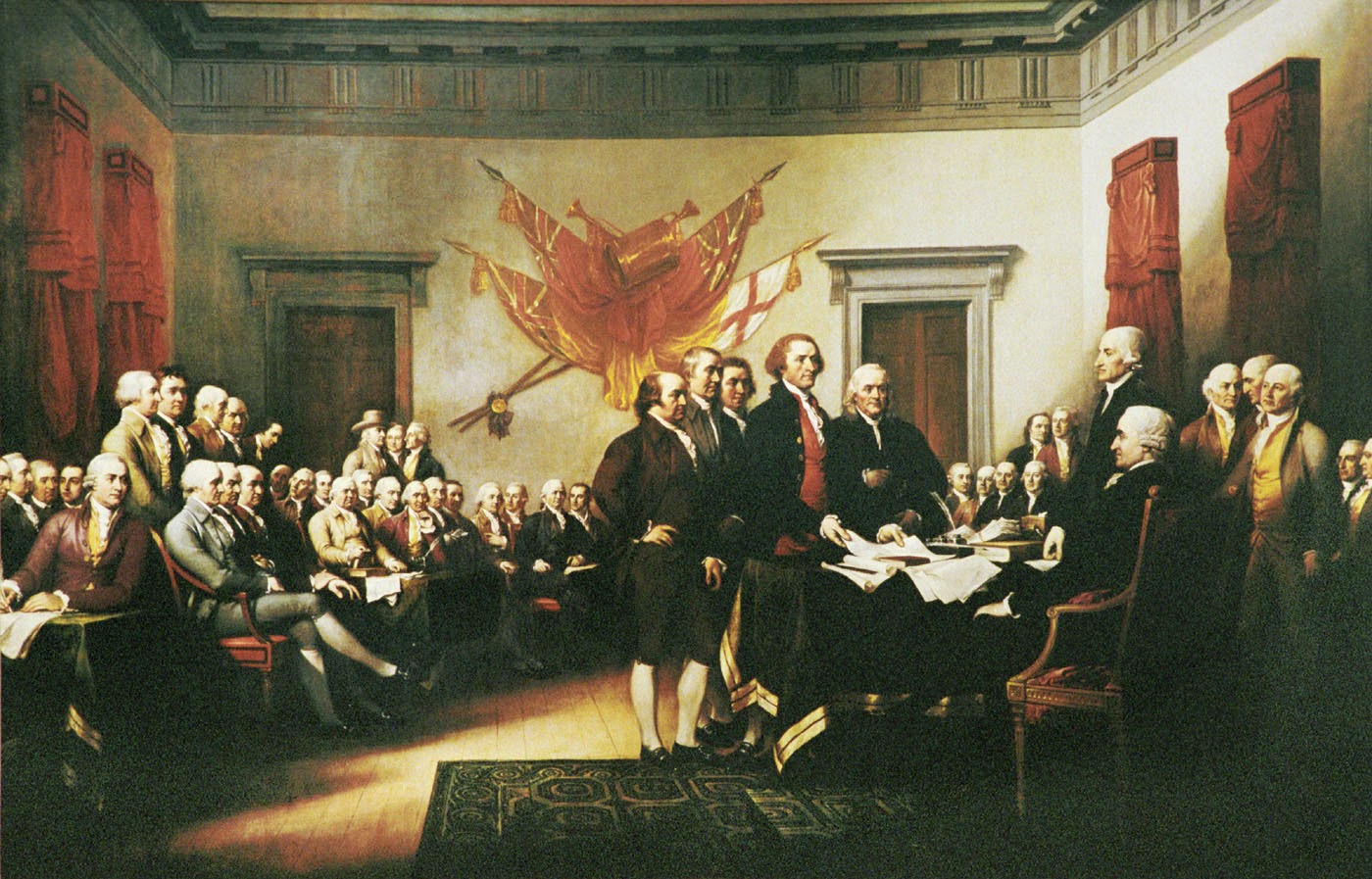
John Trumbull’s Declaration of Independence
When in the Course of human events, it becomes necessary for one people to dissolve the political bands which have connected them with another, and to assume among the powers of the earth, the separate and equal station to which the Laws of Nature and of Nature’s God entitle them, a decent respect to the opinions of mankind requires that they should declare the causes which impel them to the separation.
We hold these truths to be self-evident, that all men are created equal, that they are endowed by their Creator with certain unalienable Rights, that among these are Life, Liberty and the pursuit of Happiness.–That to secure these rights, Governments are instituted among Men, deriving their just powers from the consent of the governed, –That whenever any Form of Government becomes destructive of these ends, it is the Right of the People to alter or to abolish it, and to institute new Government, laying its foundation on such principles and organizing its powers in such form, as to them shall seem most likely to effect their Safety and Happiness. Prudence, indeed, will dictate that Governments long established should not be changed for light and transient causes; and accordingly all experience hath shewn, that mankind are more disposed to suffer, while evils are sufferable, than to right themselves by abolishing the forms to which they are accustomed. But when a long train of abuses and usurpations, pursuing invariably the same Object evinces a design to reduce them under absolute Despotism, it is their right, it is their duty, to throw off such Government, and to provide new Guards for their future security.–Such has been the patient sufferance of these Colonies; and such is now the necessity which constrains them to alter their former Systems of Government. The history of the present King of Great Britain is a history of repeated injuries and usurpations, all having in direct object the establishment of an absolute Tyranny over these States. To prove this, let Facts be submitted to a candid world.
The Declaration of Independence is arguably one of the most influential documents in American History. Other countries and organizations have adopted its tone and manner in their own documents and declarations. For example, France wrote its ‘Declaration of the Rights of Man’ and the Women’s Rights movement wrote its ‘Declaration of Sentiments’. However, the Declaration of Independence was actually not technically necessary in proclaiming independence from Great Britain.
A resolution of independence passed the Philadelphia Convention on July 2. This was all that was needed to break away from Britain. The colonists had been fighting Great Britain for 14 months while proclaiming their allegiance to the crown. Now they were breaking away. Obviously, they wanted to make clear exactly why they decided to take this action. Hence, they presented the world with the ‘Declaration of Independence’ drafted by thirty-three year old Thomas Jefferson.

The text of the Declaration has been compared to a ‘Lawyer’s Brief’. It presents a long list of grievances against King George III including such items as taxation without representation, maintaining a standing army in peacetime, dissolving houses of representatives, and hiring “large armies of foreign mercenaries.” The analogy is that Jefferson is an attorney presenting his case before the world court. Not everything that Jefferson wrote was exactly correct. However, it is important to remember that he was writing a persuasive essay, not a historical text. The formal break from Great Britain was complete with the adoption of this document on July 4, 1776.

Jefferson wrote the Declaration in a way that was meant to be read aloud.  The first two paragraphs are some of the most powerful words ever written.  Each year when I teach about the Declaration in my Civics, Government, and history classes, I make sure that it is read aloud so that the students get the full effect.  The most popular way to do this is to play the following video:  http://youtu.be/jYyttEu_NLU.  My students tend to pay more attention to the famous actors who read the Declaration of Independence.
HAPPY INDEPENDENCE DAY, MY FELLOW AMERICANS!

National Gay Blood Drive

In 1985 the US Food and Drug Administration (FDA) began enforcing a ban on blood donations from men who have had sex with other men anytime after 1977 for fear of drawing HIV-contaminated blood. Though much has happened in the last 30 years, and even with today’s advanced HIV screenings, they refuse to change their stance on the ban.
 
This can be a particularly difficult thing for men in the closet, as I am at work.  My school has an annual blood drive, and as a teacher, I am always asked to give blood.  I always say that I can’t, my usual excuse is that it is because of medicine I take for my blood pressure.  Of course, there is nothing with my blood pressure medicine that prevents me from giving blood; however, the ban on gay and bisexual men giving blood is the real reason.  I just don’t want to answer the questions that will be asked and have someone possibly overhear.  I have always been honest when the American Red Cross asked me if I have ever had sex with another man; I just don’t like lying, even though I keep closeted to my students.  The fact is though I am disease free and have not had sex in a while, so I think I should be able to give blood.  Which is why I find the idea of a National Gay Blood Drive on July 12 to be intriguing because it will hopefully bring awareness and maybe change to the issue of gay and bisexual men donating blood in the United States.
 
Ryan James Yezak, the director of the upcoming documentary “Second Class Citizens,” hopes to  bring awareness and hopefully change this ban with the first ever National Gay Blood Drive on July 12.  All across the country on July 12 from 9am to 5pm PST, gay and bisexual men, (also known as “MSM donors”) can show up to a designated blood donation center where a mobile HIV testing center will be waiting. The men will be tested, and once the test is negative, they can attempt to donate blood. When the men are rejected from giving blood, their HIV test results will be compiled and delivered to the FDA, to show the administration why they should lift their ban.
 
In a press release about the Blood Drive, Yezak says:

“The ban is outdated, and as a result, countless otherwise eligible gay and bisexual men are unable to contribute to the nation’s blood supply and help save lives.  Especially a time when blood shortages are increasingly common. Not only that, but the ban perpetuates negative stereotypes and stigma. Whether intentional or not, it is discrimination based on sexual orientation.”

The American Medical Association (AMA) also recently came out against the gay blood ban, saying the ban is “discriminatory” and “not based on sound science.”  Canada will be listing their ban on gay men giving blood by the end of this summer.  Canadian Blood Services will impose a five-year deferral period.  Thus, gay men can donate blood so long as they haven’t had sex with another man within the last five years.  Multiple countries already permit gay men to donate blood, and some even have a shorter deferral period than Canada. In Britain and Australia the deferral period is one year, while in South Africa it is six months.

Paul Revere’s Ride

image

 
Paul Revere’s Ride
Henry Wadsworth Longfellow
Listen, my children, and you shall hear
Of the midnight ride of Paul Revere,
On the eighteenth of April, in Seventy-Five:
Hardly a man is now alive
Who remembers that famous day and year.
He said to his friend, “If the British march
By land or sea from the town to-night,
Hang a lantern aloft in the belfry-arch
Of the North-Church-tower, as a signal-light,–
One if by land, and two if by sea;
And I on the opposite shore will be,
Ready to ride and spread the alarm
Through every Middlesex village and farm,
For the country-folk to be up and to arm.”
Then he said “Good night!” and with muffled oar
Silently rowed to the Charlestown shore,
Just as the moon rose over the bay,
Where swinging wide at her moorings lay
The Somerset, British man-of-war:
A phantom ship, with each mast and spar
Across the moon, like a prison-bar,
And a huge black hulk, that was magnified
By its own reflection in the tide.
Meanwhile, his friend, through alley and street
Wanders and watches with eager ears,
Till in the silence around him he hears
The muster of men at the barrack door,
The sound of arms, and the tramp of feet,
And the measured tread of the grenadiers
Marching down to their boats on the shore.
Then he climbed to the tower of the church,
Up the wooden stairs, with stealthy tread,
To the belfry-chamber overhead,
And startled the pigeons from their perch
On the sombre rafters, that round him made
Masses and moving shapes of shade,–
By the trembling ladder, steep and tall,
To the highest window in the wall,
Where he paused to listen and look down
A moment on the roofs of the town,
And the moonlight flowing over all.
Beneath, in the churchyard, lay the dead,
In their night-encampment on the hill,
Wrapped in silence so deep and still
That he could hear, like a sentinel’s tread,
The watchful night-wind, as it went
Creeping along from tent to tent,
And seeming to whisper, “All is well!”
A moment only he feels the spell
Of the place and the hour, and the secret dread
Of the lonely belfry and the dead;
For suddenly all his thoughts are bent
On a shadowy something far away,
Where the river widens to meet the bay, —
A line of black, that bends and floats
On the rising tide, like a bridge of boats.
Meanwhile, impatient to mount and ride,
Booted and spurred, with a heavy stride,
On the opposite shore walked Paul Revere.
Now he patted his horse’s side,
Now gazed on the landscape far and near,
Then impetuous stamped the earth,
And turned and tightened his saddle-girth;
But mostly he watched with eager search
The belfry-tower of the old North Church,
As it rose above the graves on the hill,
Lonely and spectral and sombre and still.
And lo! as he looks, on the belfry’s height,
A glimmer, and then a gleam of light!
He springs to the saddle, the bridle he turns,
But lingers and gazes, till full on his sight
A second lamp in the belfry burns!
A hurry of hoofs in a village-street,
A shape in the moonlight, a bulk in the dark,
And beneath from the pebbles, in passing, a spark
Struck out by a steed that flies fearless and fleet:
That was all! And yet, through the gloom and the light,
The fate of a nation was riding that night;
And the spark struck out by that steed, in his flight,
Kindled the land into flame with its heat.
He has left the village and mounted the steep,
And beneath him, tranquil and broad and deep,
Is the Mystic, meeting the ocean tides;
And under the alders, that skirt its edge,
Now soft on the sand, now loud on the ledge,
Is heard the tramp of his steed as he rides.
It was twelve by the village clock
When he crossed the bridge into Medford town.
He heard the crowing of the cock,
And the barking of the farmer’s dog,
And felt the damp of the river-fog,
That rises when the sun goes down.
It was one by the village clock,
When he galloped into Lexington.
He saw the gilded weathercock
Swim in the moonlight as he passed,
And the meeting-house windows, blank and bare,
Gaze at him with a spectral glare,
As if they already stood aghast
At the bloody work they would look upon.
It was two by the village clock,
When be came to the bridge in Concord town.
He heard the bleating of the flock,
And the twitter of birds among the trees,
And felt the breath of the morning breeze
Blowing over the meadows brown.
And one was safe and asleep in his bed
Who at the bridge would be first to fall,
Who that day would be lying dead,
Pierced by a British musket-ball.
You know the rest. In the books you have read,
How the British Regulars fired and fled,–
How the farmers gave them ball for ball,
From behind each fence and farmyard-wall,
Chasing the red-coats down the lane,
Then crossing the fields to emerge again
Under the trees at the turn of the road,
And only pausing to fire and load.
So through the night rode Paul Revere;
And so through the night went his cry of alarm
To every Middlesex village and farm,–
A cry of defiance, and not of fear,
A voice in the darkness, a knock at the door,
And a word that shall echo forevermore!
For, borne on the night-wind of the Past,
Through all our history, to the last,
In the hour of darkness and peril and need,
The people will waken and listen to hear
The hurrying hoof-beats of that steed,
And the midnight message of Paul Revere.
image
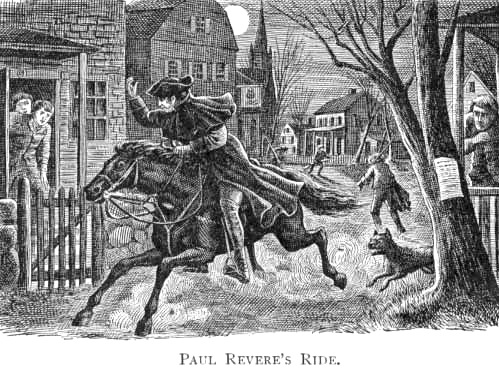
Thursday is Independence Day, so I thought I would post a patriotic poem.  Though the events of this poem occurred on April 18-19, 1775, over a year before the signing of the Declaration of Independence, it is one of the most famous events of the American Revolution.  In 1774 and the Spring of 1775 Paul Revere was employed by the Boston Committee of Correspondence and the Massachusetts Committee of Safety as an express rider to carry news, messages, and copies of resolutions as far away as New York and Philadelphia.
 
On the evening of April 18, 1775, Paul Revere was sent for by Dr. Joseph Warren and instructed to ride to Lexington, Massachusetts, to warn Samuel Adams and John Hancock that British troops were marching to arrest them. After being rowed across the Charles River to Charlestown by two associates, Paul Revere borrowed a horse from his friend Deacon John Larkin. While in Charlestown, he verified that the local “Sons of Liberty” committee had seen his pre-arranged signals. (Two lanterns had been hung briefly in the bell-tower of Christ Church in Boston, indicating that troops would row “by sea” across the Charles River to Cambridge, rather than marching “by land” out Boston Neck. Revere had arranged for these signals the previous weekend, as he was afraid that he might be prevented from leaving Boston).
 
On the way to Lexington, Revere “alarmed” the country-side, stopping at each house, and arrived in Lexington about midnight. As he approached the house where Adams and Hancock were staying, a sentry asked that he not make so much noise. “Noise!” cried Revere, “You’ll have noise enough before long. The regulars are coming out!” After delivering his message, Revere was joined by a second rider, William Dawes, who had been sent on the same errand by a different route. Deciding on their own to continue on to Concord, Massachusetts, where weapons and supplies were hidden, Revere and Dawes were joined by a third rider, Dr. Samuel Prescott. Soon after, all three were arrested by a British patrol. Prescott escaped almost immediately, and Dawes soon after. Revere was held for some time and then released. Left without a horse, Revere returned to Lexington in time to witness part of the battle on the Lexington Green.
 
The events of that night were immortalized by Henry Wadsworth Longfellow to commemorates Revere’s actions. Longfellow’s poem is not historically accurate but his “mistakes” were deliberate. He had researched the historical event, using works like George Bancroft’s History of the United States, but he manipulated the facts for poetic effect.  He was purposely trying to create American legends, much as he did with works like The Song of Hiawatha (1855) and The Courtship of Miles Standish (1858).  Longfellow was inspired to write the poem after visiting the Old North Church and climbing its tower on April 5, 1860. He began writing the poem the next day. It was first published in the January 1861 issue of The Atlantic Monthly. It was later re-published in Longfellow’s Tales of a Wayside Inn as “The Landlord’s Tale” in 1863. The poem served as the first in a series of 22 narratives bundled as a collection, similar to Geoffrey Chaucer’s The Canterbury Tales, and was published in three installments over 10 years.
 
The poem is spoken by the landlord of the Wayside Inn and tells a partly fictionalized story of Paul Revere. In the poem, Revere tells a friend to prepare signal lanterns in the Old North Church to inform him if the British will attack by land or sea. He would await the signal across the river in Charlestown and be ready to spread the alarm throughout Middlesex County, Massachusetts. The unnamed friend climbs up the steeple and soon sets up two signal lanterns, informing Revere that the British are coming by sea. Revere rides his horse through Medford, Lexington, and Concord to warn the patriots.