Category Archives: History

Stonewall

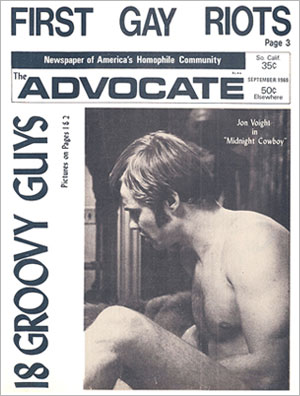
Something unremarkable happened on June 27, 1969 in New York’s Greenwich Village, an event which had occurred a thousand times before across the U.S. over the decades. The police raided a gay bar. The events that followed marked the beginnings of the Gay Rights Movement.  

The Stonewall riots were a series of spontaneous, violent demonstrations against a police raid that took place in the early morning hours of June 28, 1969, at the Stonewall Inn, in the Greenwich Village neighborhood of New York City. They are frequently cited as the first instance in American history when people in the homosexual community fought back against a government-sponsored system that persecuted sexual minorities, and they have become the defining event that marked the start of the gay rights movement in the United States and around the world.

For more information about the beginnings of the Gay Rights Movement in the United States and the Stonewall Riots, please check out my series of post on Stonewall.

HAPPY GAY PRIDE!!!

Keep It Real

Last night I watched “Is Genesis History?” which my boss recommended. The program tries to prove that Genesis is literal history. It attempts to convince the viewer to believe that yom (י֔וֹם) means a literal day not a period of time. Yom can mean either. It also tries to say that the Grand Canyon was created by the Great Flood of Noah. I just don’t buy it. If Genesis is literal than mankind is only 6,000 years old, but we know from science that mankind has been around for much longer. I believe that Genesis is allegorical. All I have to say to the filmmakers is the same thing on the guy’s shirt above–keep it real.


Whitman Sampler

Walt Whitman would have turned 198 years old last month had he not succumbed to bronchial pneumonia way back in 1892.

To mark the occasion, Whitman superfan Hugh Ryan at Broadly has been poring over what appears to be a series of seven nude black and white photographs of a man who bears a striking resemblance to the great American poet.

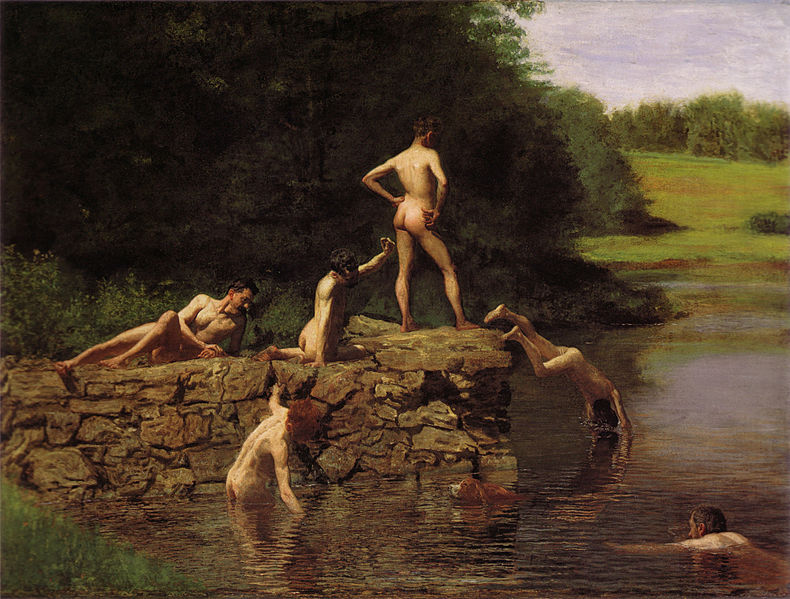
The photos, labeled simply “Old Man,” were taken 141 years ago by famed artist and photographer Thomas Eakins (July 25, 1844 – June 25, 1916). They depict a slender man (with just a slight ponch) with a long white beard fully naked from several different angles: full-on, in profile, and from behind.

Ryan sent the photos to several different Walt Whitman experts to get their opinions.

Karen Karbiener, a Whitman scholar and professor at NYU, replied to Ryan’s inquiry by saying:

The size fits. He was six feet tall, never had a gut, was always in reasonably good shape even when he was older… I haven’t seen a lot of 80-year-old men naked, but presumably this is good shape for an 80-year-old man!
Not just that, Karbiener said, but Whitman was one of the most photographed men of the 19th century, and he also wasn’t shy about things like sex and nudity, as anyone whose read Leaves of Grass knows.

“I don’t think Walt would have any shame about posing for these,” she hypothesized. “Especially for Eakins. There was a mutual affection and respect there.”

Eakins and Whitman met around 1887 and bonded, no doubt, over their mutual affection for younger gentlemen.
Ryan also approached Ed Folsom, a Whitman scholar and co-director of the Walt Whitman Archive online, about the photos.

Folsom wasn’t sure if the man in the photo was Whitman, so he submitted them to a neurologist. His hope was that the neurologist would find physical evidence of the strokes and other health problems Whitman suffered in the years when this photo was taken. (Whitman had his first of several strokes in 1873.)

The results? Inconclusive.

In his investigation, Ryan concludes:

Whitman would have been 198 years old today; were he still alive, perhaps that photo would grace his Grindr profile. Some might consider it indecorous to commemorate one of America’s literary treasures with an investigation into his penis, but it’s oddly fitting for Whitman. This was a man who loved puzzles, new technology, and—yes—penises. He reveled in the body, and in thumbing his nose at Victorian morality. Sharing this photo, whether or not it is actually of Whitman himself, is perhaps the most Whitman-ic way we could celebrate his birthday.


LGBTQ History Matters 

LGBTQ people have always existed, but our history has either not been recorded or has actively been erased. Berlin in the 1920s and early 1930s was the gayest city on the planet, easily the San Francisco of its day. Yet the Nazis erased everything, putting gay men in concentration camps, where they were either worked to death or forced to have lobotomies performed. Unlike gay men, lesbians were not generally regarded as a social or political threat. Anthropologists are revealing the existence of LGBTQ people in cultures across the globe.

LGBTQ history is important not only for our community but for everyone. Part of the richness of LGBTQ culture and history is that it poses alternative social structures to the patriarchal and hierarchical model that saturates modern society. Because of the ubiquity of LGBTQ people, our continuing liberation movement is part of and a collaborator with other liberation struggles.

The recent presidential election in the U.S. heightens the importance of all of us resisting together. Saturday, June 10, Vermont will hold an LGBTQ Solidarity March on Montpelier. The March is an act of solidarity with the LGBTQIA National Unity March on Washington. LGBTQ people from across Vermont and other states will march on the Vermont capital of Montpelier.


Memorial Day

tumblr_llvcgiip061qfjriho1_1280

Memorial Day is a United States federal holiday observed on the last Monday of May. Formerly known as Decoration Day, it commemorates men and women who died while in military service to the United States. First enacted to honor Union and Confederate soldiers following the American Civil War, it was extended after World War I to honor Americans who have died in all wars.

Memorial Day often marks the start of the summer vacation season, and Labor Day its end.

Begun as a ritual of remembrance and reconciliation after the civil war, by the early 20th century, Memorial Day was an occasion for more general expressions of memory, as ordinary people visited the graves of their deceased relatives, whether they had served in the military or not.

History

Graves_at_Arlington_on_Memorial_DayBy 1865 the practice of decorating soldiers’ graves had become widespread in the North. The first known observance was in Boalsburg, Pa on October, 1864, and each year thereafter. The friendship between General John Murray, a distinguished citizen of Waterloo, and General John A. Logan, who helped bring attention to the event nationwide, was likely a factor in the holiday’s growth. On May 5, 1868, in his capacity as commander-in-chief of the Grand Army of the Republic – the organization for Northern Civil War veterans – Logan issued a proclamation that “Decoration Day” should be observed nationwide. It was observed for the first time on May 30 of the same year; the date was chosen because it was not the anniversary of a battle.

There were events in 183 cemeteries in 27 states in 1868, and 336 in 1869. The northern states quickly adopted the holiday; Michigan made “Decoration Day” an official state holiday in 1871 and by 1890 every northern state followed suit. The ceremonies were sponsored by the Women’s Relief Corps, which had 100,000 members. By 1870, the remains of nearly 300,000 Union dead had been buried in 73 national cemeteries, located mostly in the South, near the battlefields. The most famous are Gettysburg National Cemetery in Pennsylvania and Arlington National Cemetery, near Washington.

The Memorial Day speech became an occasion for veterans, politicians and ministers to commemorate the war – and at first to recall the atrocities of the enemy. They mixed religion and celebratory nationalism and provided a means for the people to make sense of their history in terms of sacrifice for a better nation, one closer to their God. People of all religious beliefs joined together, and the point was often made that the German and Irish soldiers had become true Americans in the “baptism of blood” on the battlefield. By the end of the 1870s the rancor was gone and the speeches praised the soldiers of both the Union and Confederacy. By the 1950s, the theme was American exceptionalism and duty to uphold freedom in the world. In 1882, the name of Decoration Day was formally changed to Memorial Day in “memory” and ‘honor” of those who gave their lives fighting for a common cause, America.


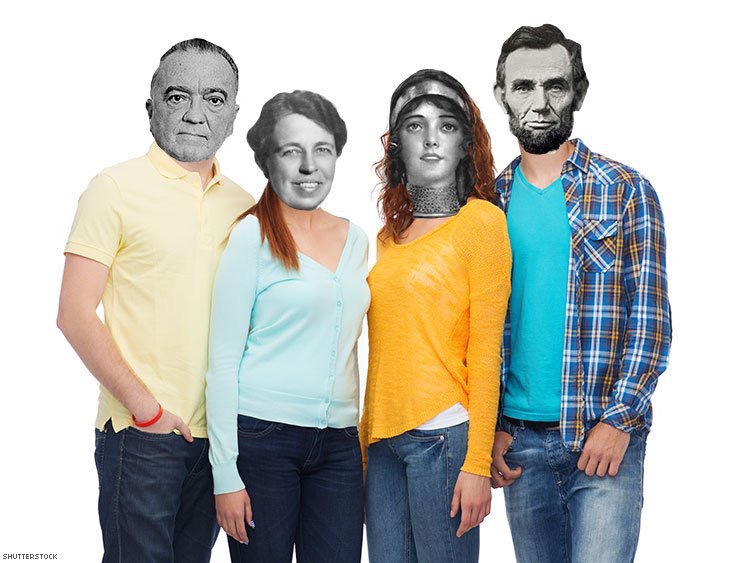
The Habit of Making Historicsl Figures Gay or Trans Is Problematic

With Transgender Day of Visibility and the GLAAD Media Awards occurring during the same week and with Pride Month just a few months away, it made me reflect on LGBT history and historiography. If you don’t know what historiography is, it can be defined as “the writing, methods of scholarship, and selection of materials to create a narrative of history that will stand the test of critical review.” It’s the work that historians engage in to help us understand our past. There are numerous approaches to it that have risen and fallen in popularity over time from Great Man, Annales School, and Marxist to Consensus and New Left, each with its own merits and followings. However, the challenge they all share is how to reconcile their views with the complexity of human existence and its past. As part of that, LGBT history faces the same dilemmas and the same issues with reconciling the past without falling subject to fallacies commonly found in historical thought.

It’s only been in the last few decades that being LGBT has moved beyond being seen as merely a sexuality or way of expressing yourself but a genuine group identity. As with any emerging group, there is a drive to create a historical narrative of where we came from, to create a mythology that includes virtuous heroes, and to place us within the greater society. This is nothing new or special, as every group in history has done it — nations, ethnicities, genders, religions, and even various professions. To want to find a place in the historical narrative of humanity is simply an act of being human, yet as such can be entirely flawed and problematic. This is not to say that what LGBT people are doing is wrong — far from it — it’s just that we need to be aware of these problems and work to correct them, as the process can ultimately work against our goals of acceptance.

The major problem where this occurs is the same problem that has plagued other groups, which is forming a selective narrative and projecting our current worldviews into the past. The first part is forming a selective narrative that tends to emphasize the good and play down or ignore the bad. A good example for Americans would be the issue of race. For example, while much focus is placed upon the South’s Jim Crow laws and slavery in our collective history, we tend to overlook that American finance and industry were funded and supported by the slave trade. Additionally, we have yet to fully resolve the contradictions of our hero Founding Fathers with their claim “All men are created equal,” while many still fought to own slaves themselves. In this regard, the LGBT community is quick to proclaim virtuous obvious heroes such as Harvey Milk, Alan Turing, and Bayard Rustin, but tends to play down those that are far less virtuous such as Roy Cohn, a man who helped persecute LGBT people and helped Donald Trump escape greater punishment for his racist housing practices. Another great example of this is J. Edgar Hoover, who helps highlight the second great problem in developing an LGBT history.

J. Edgar Hoover was never proven to be gay, though rumors circulated his entire life. Allegations about his relationship with his assistant Clyde Tolson, whom he was extremely close to, were around for years, along with Hoover’s suspiciously coincidental associations with other closeted gay men like Roy Cohn. Now, while Hoover’s sexuality will likely never be proven to a general satisfaction and many people will debate it for years, it raises a particular issue for LGBT people — that of appropriating historical figures. While there certainly are historical figures we can cite as being part of the LGBT population, such as the Emperor Hadrian, Gustave Flaubert, or Oscar Wilde, it’s when we start to take on those who have more ambiguous histories that we run into issues that may actually end up working against us. For example, it’s often said that Abraham Lincoln was gay and Joan of Arc was transgender because of the behaviors they exhibited that we see now as fitting those identities. Historians have a word for it: “presentism.”

With LGBT people, the issue is that in trying to paint many historical figures who behave in ways that seem to be “gay” that are familiar to us — or err on the side of favorable historical rumors — we run contrary to the contemporary arguments about gender and sexuality that we use to foster our own acceptance. We regularly argue that gender roles and behaviors are a social construct and therefore are constantly evolving. For example, we point out that at one point in Western history it was acceptable to be bisexual or to exhibit same-sex attraction, yet we fail to note that people of the time viewed sexual behaviors in a vastly different than we do, and the period often included complex social values and norms. We also seem to sometimes place modern views on same-sex nonsexual relationships to these figures in that “no true straight person” could have such feelings for a person without it being sexual. We cite letters and poems that express a fondness we consider romantic or sexual, when we know well that in those times and in different cultures expressions of closeness were different. Even in today’s world, while Americans might find men kissing or holding hands an overtly homosexual act, in many parts of the world, it’s simply a sign of affection and closeness, just as men sharing a bed for long periods of time in the past was completely common but seen as “queer” today. The same goes for expressions of gender behavior that we have deemed masculine or effeminate, like dress and occupation, including those that served a specific purpose. When we place a pattern of gendered behaviors from our contemporary culture onto the past, we contradict our own arguments against gender expectations.

LGBT people are not special nor really stand out in misinterpreting, appropriating, or revising history to suit their purposes over any other groups. Reconciling the good and bad LGBT figures from history will come with time and from a more reflective position when values have changed. People project their own values and views so regularly onto the past, it’s practically expected. A huge portion of the work historians do is to counter that. However, there is a unique interest in LGBT history to avoid viewing the past through our current frameworks. If we are to advocate for diversity of expression, to work against toxic views of gender and sexuality, and to show that society is better for embracing such beliefs, we cannot rewrite or whitewash history along those lines, as we end up working against our self-interest. 
AMANDA KERRI is a writer and comedian based in Oklahoma City. Follow her on Twitter @EternalKerri.
Source: http://www.advocate.com/commentary/2017/4/05/habit-making-historical-figures-gay-or-trans-problematic


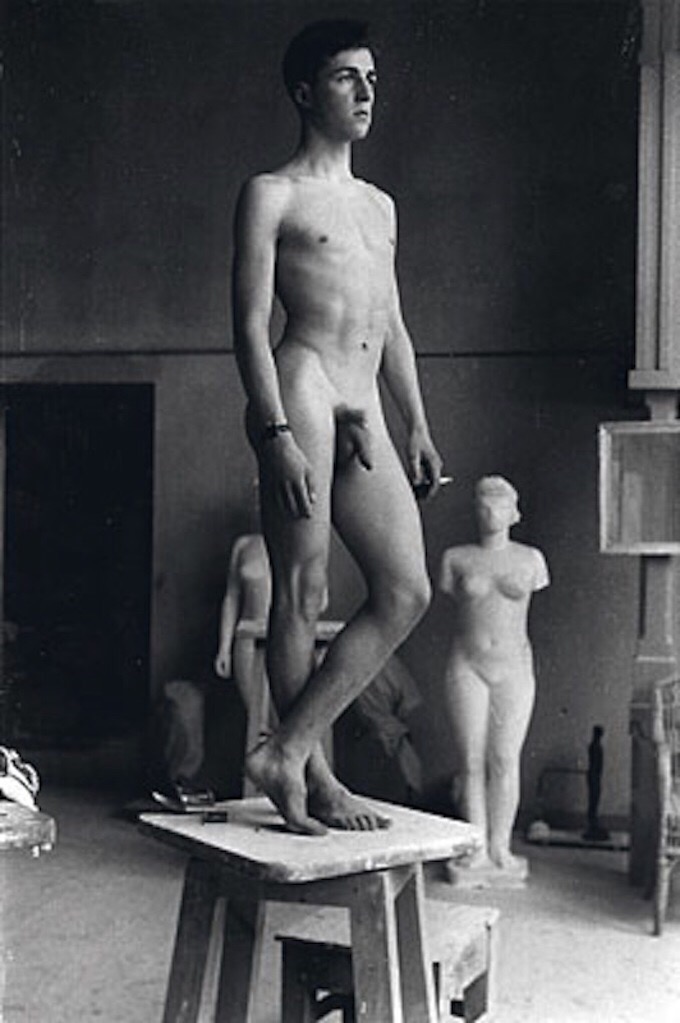
Fritz Morgenthaler

Fritz Morgenthaler modeling for Sculptor Karl Geiser (1930s)

Fritz Morgenthaler (Swiss 1919-1984) was later the first psychoanalyst who said that homosexuality is not an illness or a psychological defect.

Fritz Morgenthaler, a Swiss physician specializing in neurology and a member of the Swiss Psychoanalytic Society, was born at Oberhofen on July 19, 1919 and died on October 26, 1984, while visiting Addis Ababa.

The son of a famous painter (Ernst Morgenthaler) and doll designer Sacha Morgenthaler-von Sinner, he was also a painter and a professional juggler. He was educated in Zurich and Paris, studied medicine in Zurich and then worked as a physician in war-torn Bosnia for one year. This was the beginning of his friendship, then scientific collaboration and, beginning in 1952, joint practice with Paul Parin and Goldy Parin-Matthèy. In 1947 he commenced his analysis with Rudolf Brun. Between 1954 and 1971, Morgenthaler accompanied the Parins on six voyages of ethno-psychoanalytic research in West Africa (Parin, et al., 1963, 1971).

Most of Morgenthaler’s remarkable influence was due to his charm and the intellectual sparkle of his personality as a lecturer, seminar director, and supervisor. Starting from a case history or a dream, he had an exceptional gift for communicating the psychic functioning of the patient, the unconscious emotional relations between the analyst and the analysand, and for discovering new and unexpected aspects therein. His original approach to Freud’s dream in 1986: Ein Traum als Beweismittel (An evidential dream) is a good example of this: although he may not have opened up new theoretical pathways, he used Freudian concepts pertinently and effectively.

His often playfully dialectic mode of thinking earned him divided opinions with regard to the scientific value of his work. When his admirers praised him for making great progress and outstripping Freud in therapeutic technique (1978), in the theory of sexuality (1984), and in analyzing dreams (1988), more detached observers ranked him in classic psychoanalytic thinking somewhere between Freud and Kohut. In his later work he did, however, try to work politico-social (Marxist-inspired) concepts into the theory of psychic functioning, but without much success: the “sexual” as an indeterminate motion, without orientation of the primary process (1988, p. 106-107), is considered as an “emotionality” (p. 107) that alone enables us to “appear alive,” (p. 107) and this “sexual” runs up against the “dictatorship of sexuality” (1988, p. 110), which is “established by the instinctual and ego developments by means of the events in the secondary process in order to absorb the motion of the primary process, guide it into certain controllable channels, and restrict it by means of conditions” (p. 110).
“Morgenthaler, Fritz (1919-1984).” International Dictionary of Psychoanalysis. . Encyclopedia.com. (March 26, 2017). http://www.encyclopedia.com/psychology/dictionaries-thesauruses-pictures-and-press-releases/morgenthaler-fritz-1919-1984


Remember Pearl Harbor 

It began as an ordinary December day. People were gathered around the radio listening to a football game or planning holiday parties, not girding for battle. But on Dec. 7, 1941, when the first Associated Press report came over the radio at 2:22 p.m. Eastern Standard Time of a “bombing in Hawaii,” the news was electrifying. Seventy-five years later, every American living now who heard it then can still tell you exactly what he was doing when he learned of the Japanese attack on Pearl Harbor.

My grandmother would never forget that day seventy-five years ago. Her first child died of pneumonia on that day. She came home from the hospital to turn on the radio just as they were announcing the bombing of Pearl Harbor. Not only had she just lost her baby, but also, she realized that she would soon lose her husband to the war as well. My grandfather fought in WWII and luckily he safely returned, and they had two more children, my father and my aunt.

Pearl Harbor marked a watershed in the nation’s history and we knew it. What came after would be very different from what came before. It was the war that changed the world. “The Day of Infamy” thrust us into a conflict more than four years long that altered nearly every aspect of American life, large and small – from rationing gas and sugar to the harnessing of atomic power to the new role of women in the workplace. We united to defend our democracy. For more than 400,000, it would be the ultimate sacrifice.

That is why it is so important to remember the 75th anniversary of Pearl Harbor and all the 70th anniversaries of World War II events that follow. I will be commemorating the day by presenting a talk on the voices (oral histories) of Pearl Harbor. I hope my presentation goes well today.


Those Kinky Romans

When we think of Ancient Rome, we immediately think of excess. The kind of excess that means balls to the wall, non-stop drinking and orgy-fueled ridiculousness, leading to their eventual fall from grace. And in this excess was a shameless, extravagant community of homosexuals. Though there was no Latin word for ‘gay’ per se, men were getting down with each other in Ancient Rome like it was their damn job, often in ways that, by today’s standards, are highly disturbing. Here are a few of the more bizarre activities and habits that the boys got up to in their spare time:

1. Bestiality Role Play

Emperor Nero, who reigned from 54 to 68 AD, was a frisky guy. And by frisky, we mean psychotic pervert. The infamous fire of Rome that took place during his reign is often thought to be intentionally sparked to make way for his Golden Pleasure Palace, paid for with the taxes of Roman citizens. One of the gayest activities that took place in said palace was what he called ‘The Animal Game’. It began by tying and binding naked men to various posts set up around the room. Nero would then don himself in animal skins and be put in a cage. When released from the cage, he would wildly begin to ravage each of his victims however he chose. Whatever you say of the man, you can’t deny that he was imaginative.

2. Freaky Gay Marriages

Considering the great lengths to which the modern world has fought for gay marriage, it seems odd that it would have been a perfectly legal practice in the ancient world. But the practice of gay marriage was a bit more fetishized and falsified than the union we know today. Everyone’s favorite emperor Nero was a frequenter of this practice, as was the emperor Elagabalus. These two would proudly display their male lover du jour in a full, official ceremony, complete with bridal veil and a dowry. Nero even bent genders, participating in two ceremonies where he ‘played bride’. But this is all fine compared to the men he castrated to be his true ‘bride’.  

3. Tiberius’ ‘Tiddlers’ also known as ‘Minnows’

Swimming pools are a perfectly understandable breeding ground for the erotic. You’re having a good time, you’re half or completely naked, and usually with one or more persons feeling your carefree vibe. So who could blame Emperor Tiberius for being a prolific swimmer, especially when his empire had such decadent bathhouses and pools so readily available? However, Tiberius’ underwater excursions were accompanied by a league of helpers he referred to as his ‘tiddlers’. These tiddlers were young men (and often even younger boys) who were trained to swim beneath him and provide pleasure through light nibbling and coddling. In other words, actual humans were trained to act as sexual minnows in the emperor’s private pond. No word on how long these tiddlers had to hold their breath, but assume it was on the longer side.

4. Road-Side Sex Stops

Everybody has those urges that seem so desperate, they must be filled immediately – it’s a normal part of being a horny human. But for those in Ancient Rome with money and power to spare, these urges could be fed however they pleased. The most creative outlet was surely the road-side sex stops, set up along whichever street or riverbank the lucky member of aristocracy happened to pass through. These were quite literally tents that would be prepared ahead of the wealthy man’s journey where a male prostitute would lay in waiting to be ravaged before their lord would continue about his stroll. Think of it like a McDonald’s stop, but even more satisfying.

5. Learning by Pictures

Another innovation made handy by the randy Emperor Tiberius, entire rooms in his palaces were devoted to paintings depicting every sex act imaginable in vivid detail. These were not just for decor; Tiberius had these works created for learning purposes. He would reportedly bring in scores of his new male prostitutes to these chambers to learn the finite details of how to please an emperor; that way there could be no question about one’s duty in the bedroom. It was a practice rarely seen before in ancient times, yet oddly one that mirrors the way young gays today learn from their elders via pornography on screen. Guess Tiberius’ gross libido did some good. Many bathhouses had these depictions as well. Pompeii is known to have had many such depictions of sexual acts in their bathhouses.
From: https://dandydicks.com/blog-entry/a-brief-history-of-all-the-gay-shit-that-went-down-in-ancient-rome


Baron Friedrich Wilhelm von Steuben

Meet the gay man who actually won America her independence
By Mark Segal

To appreciate the contributions Baron Friedrich Wilhelm von Steuben (1730-94) made to the American Revolution, consider this: Before his arrival in Valley Forge in 1778, the colonies were on the path to defeat. Without his leadership, our modern America might still be the British Colonies.

The Sodomite Soldier

Before von Steuben arrived at Valley Forge, the Revolutionary Army was a loosely organized, rag-tag band of men with little military training or discipline. The military fumbled through the beginning of the war for independence lacking training and organization. Gen. George Washington and the Continental Congress knew that, without help from additional seasoned military experts, the colonies would clearly lose.

Since Washington himself was the best the colonies had, they looked to Europe for someone who could train the troops. To that end, Washington wrote the colonies’ representatives in Paris, among them Benjamin Franklin, to see what he could come up with. Franklin, a renowned inventor, was treated as a celebrity in the French court. This would be pivotal in achieving his two major objectives in France: winning financial support for the American Revolution and finding military leaders who could bring a semblance of order to the Revolutionary Army.

Franklin learned of a “brilliant Prussian” military genius, Lt. Gen. Baron Friedrich Wilhelm von Steuben, who had a string of successes across Germanic Europe. But there was one problem. He’d been asked to depart many of those states and countries because of his “affections for members of his own sex,” according to biographer Paul Lockhart’s The Drillmaster of Valley Forge.

This became urgent in 1777 when von Steuben literally escaped imprisonment in what is now Germany and traveled to Paris. There, Franklin was interviewing candidates to assist Washington back in the colonies when his fellow Colonial representative Silas Deane brought von Steuben to his residence for an interview in June.

During the process, Franklin discovered von Steuben’s reputation for having “affections” with males and the issue became pressing, as members of the French clergy demanded the French court, as in other countries, take action against this sodomite, whom they considered a pedophile. They had decided to make their effort a crusade and run him out of France.

Lockhart’s biography tells of von Steuben’s being summoned from Paris for Karlsruhe, at the court of the Margrave of Baden, for a military vacancy. But, Lockhart notes, “what he found waiting for him at Karlsruhe was not an officer’s commissioner but a rumor, a horrible, vicious rumor” that the Baron had “taken familiarities with young boys.”

Those allegations were fueled by von Steuben’s close ties to Prince Henry and Frederick the Great, also “widely rumored to be homosexual.”

Benjamin Franklin: Smuggler & Scandal Fixer

Von Steuben returned to Paris, and Franklin had a choice here — and he decided von Steuben’s expertise was more important to the colonies than his sexuality. While it can be debated how much a part Franklin played in the recruitment of von Steuben, one cannot doubt that one of the most informed people at the French court would know of the allegations against the baron. With that knowledge, and with von Steuben about to be jailed, Franklin, along with Deane, wrote what must be the nation’s first example of “Don’t Ask, Don’t Tell” as they mutually signed a recommendation letter to Gen. Washington that embellished von Steuben’s military expertise and titles and suggested he had been recommended by various princes and “other great personages.” Most surprisingly, it remarked that “his distinguished character and known abilities were attested to by two judges of military merit in this country.”

The judges of character that Franklin referred to were two of the four involved in the plot to bring von Steuben to America, along with Franklin and Deane, and personal friends of the baron: Pierre Beaumarchais, author of the “Figaro” plays and an arms dealer who supplied arms for the ship von Steuben eventually sailed on, and Claude Louis, Comte de Saint-Germain, the minister of war under Louis XVI.

What the letter didn’t mention was that he was about to be arrested and appear before judges in France.

Franklin, working with Deane, decided von Steuben’s “affections” were less important than what he, Washington and the colonies needed to win the war with England. Deane learned of von Steuben’s indiscretions — and that the French clergy was investigating — from a letter to the Prince of Hechingen, which read in part:

“It has come to me from different sources that M. de Steuben is accused of having taken familiarities with young boys, which the laws forbid and punish severely. I have even been informed that that is the reason why M. de Steuben was obliged to leave Hechingen and that the clergy of your country intend to prosecute him by law as soon as he may establish himself anywhere.”

The proof of Franklin and Deane’s knowledge lies in the letter to Washington recommending von Steuben and their quick action to secure the baron from France. So in September 1777, von Steuben boarded a 24-gun ship named Heureux — but, for this voyage, the ship’s name was changed to Le Flamand, and the baron’s name was entered onto the captain’s log as “Frank.” And he was on his way to the colonies.

Baron von Steuben Whips the Men Into Shape

Washington and Franklin’s trust in von Steuben was rewarded. He whipped the rag-tag army of the colonies into a professional fighting force, able to take on the most powerful superpower of the time, England. Some of his accomplishments include instituting a “model company” for training, establishing sanitary standards and organization for the camp and training soldiers in drills and tactics such as bayonet fighting and musket loading. According to the New York Public Library, (“The Papers of Von Steuben”) these were his achievements:

  • February 1778: Arrives at Valley Forge to serve under Washington, having informed Congress of his desire for paid service after an initial volunteer trial period, with which request Washington concurs.
  • March 1778: Begins tenure as inspector general, drilling troops according to established European military precepts.
  • 1778-79: Writes “Regulations for the Order and Discipline of the Troops of the United States,” which becomes a fundamental guide for the Continental Army and remains in active use through the War of 1812, was published in over 70 editions.
  • 1780-81: Senior military officer in charge of troop and supply mobilization in Virginia.
  • 1781: Replaced by Marquis de Lafayette as commander in Virginia.
  • 1781-83: Continues to serve as Washington’s inspector general, and is active in improving discipline and streamlining administration in the Army.
  • Spring 1783: Assists in formulating plans for the post-war American military.

Washington rewarded von Steuben with a house at Valley Forge, which he shared with his aide-de-camps Capt. William North and Gen. Benjamin Walker. Walker lived with him through the remainder of his life, and von Steuben, who neither married nor denied any of the allegations of homosexuality, left his estate to North and Walker. There wasn’t much else to claim, as the baron was in debt at the time of his death, according to both Kapp and Lockhart. His last will and testament has been described as a love letter to Walker and has been purported to describe their “extraordinarily intense emotional relationship,” yet that line was not in the Kapp biography of 1859.
Both North and Walker are featured in the statue of von Steuben in Lafayette Park across from the White House.

John Adams’ Son’s ‘Unsavory’ Relationship with the Baron

Von Steuben and with whom he slept was long a matter of discussion — from Prussia to France to the United States. Yet he never publicly denied it. The closest he came was to ask Washington to speak on behalf of his morals in a letter to Congress so he could get his pension. And why did he ask Washington?

Since his arrival in Philadelphia to assist the Revolution, von Steuben had financial issues caused by a Continental Congress that often didn’t keep its funding promises, a challenge compounded by his own personality: Von Steuben at times could be cold and aloof, which was problematic when diplomacy was needed with an important member of Congress. He also had a tendency to live and spend extravagantly, especially on his uniforms, which were often emblazoned with epaulettes and medals of his own design.

Adding to that were the constant rumors about his sexuality, which by 1790, reached one of the revolution’s first families, the Adamses of Massachusetts.

Charles, the son of John and Abigail Adams — the second president and first lady of the new union — was what today would be called the black sheep of the family. Early on, Abigail considered him “not at peace within himself.” His biggest problem was alcoholism but, as revealed in letters among the various members of the family, the Adamses had other concerns.

As John Ferling wrote in the biography John Adams: A Life, “There are references to [Charles’] alleged proclivity for consorting with men whom his parents regarded as unsavory.” One of these men was von Steuben, who, as Ferling writes, many at the time considered homosexual.

Charles had become infatuated with and adored Von Steuben. It is clear from the family letters that the Adamses were concerned about a relationship between Charles and the baron. Von Steuben’s sexuality was an open secret, one that he himself never challenged, other than to ask Washington to defend his moral character.

The Nation’s First Underwear Party

The baron is a puzzle. At first, I really didn’t like him: The man himself was pompous, cold and theatrical, and his uniforms and title were stage props for an officer who didn’t even speak English when he got to Valley Forge. But I respected him for what he did to help Washington’s rag-tag army to defeat the British, eventually leading to the creation of our country. His knowledge created the first sense of military discipline in the colonies. My appreciation for him came from his most recent biographer, Lockhart, whose book The Drillmaster of Valley Forge offers a complete look at von Steuben’s work.

There is one story in the book that could be considered rather scandalous in today’s terms: Von Steuben most likely threw the first underwear party in the United States military, at his house in Valley Forge.

As Lockhart writes, “The Baron hosted a party exclusively for their lower-ranking friends. He insisted, though, that ‘none should be admitted that had on a whole pair of breeches,’ making light of the shortages that affected the junior officers as they did the enlisted men.”

Apart from this humorous anecdote, it’s hard to question von Steuben’s importance — especially as Washington’s last official act as commander-in-chief of the Continental Army was to write a letter to the baron.

George Washington Says Goodbye

Sent from Annapolis and dated Dec. 23, 1783, Washington wrote:

My dear Baron: Altho’ I have taken frequent opportunities, both in public and private, of acknowledging your great zeal, attention and abilities in performing the duties of your office; yet I wish to make use of this last moment of my public life, to signifie [sic] in the strongest terms my entire approbation of your conduct, and to express my sense of the obligations the public is under to you, for your faithful and meritorious services.

“I beg you will be convinced, my dear sir, that I should rejoice if it could ever be in my power to serve you more essentially than by expressions of regard and affection; but in the meantime, I am persuaded you will not be displeased with this farewell token of my sincere friendship and esteem for you.

“This is the last letter I shall ever write while I continue in the service of my country; the hour of my resignation is fixed at 12 this day, after which I shall become a private citizen on the banks of the Potomack, where I shall be glad to embrace you, and to testify the great esteem and consideration with which I am, etc.”

The nation that von Steuben helped found has memorialized him with numerous statues, including those at Lafayette Square near the White House and at Valley Forge and Utica, N.Y. (where he is buried) and German Americans celebrate his birthday each year on Sept. 17, hosting parades in New York City, Philadelphia and Chicago.

It was von Steuben, a gay man, who played a giant role in not only the creation of our military, but the idea of military academies, a standing Army and even veterans organizations.

If George Washington was the father of the nation, then von Steuben, a gay man, was the father of the United States military.

This article was originally published on Bilerico in 2013. This version has been abridged.